Co-normal Points and Normals to an Ellipse
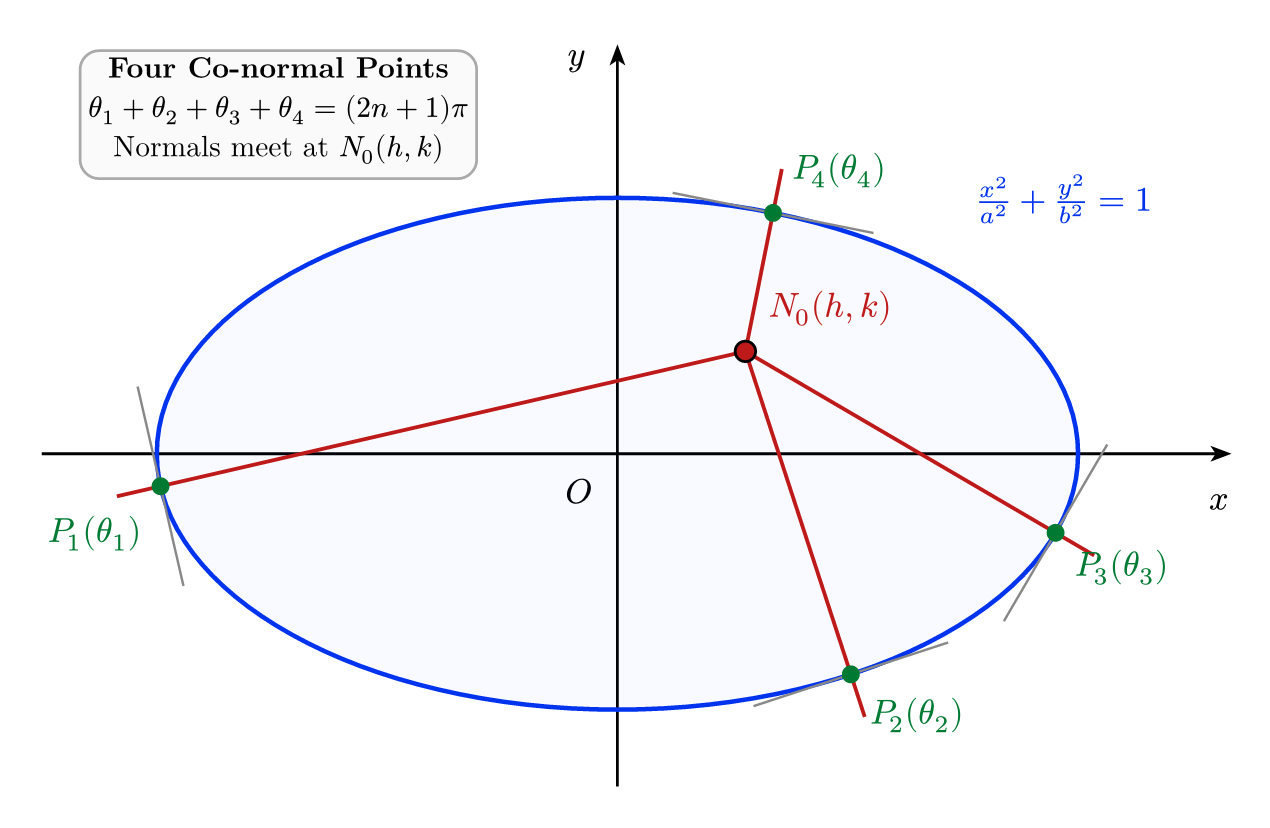
When a normal line is drawn to an ellipse from a point on the curve, the construction is unique. However, if an external point is chosen in the plane, multiple normal lines can often be drawn from that single point to the ellipse.
The points on the ellipse where these normals touch the curve are called co-normal points.
Normals Drawn from an External Point
Consider the standard ellipse:
Let \(P(a\cos\theta, b\sin\theta)\) be any point on the ellipse with eccentric angle \(\theta\). The equation of the normal line at \(P\) is:
Let \(c^2 = a^2 - b^2\). If this normal passes through a given point \(N_0(h, k)\) in the plane, the coordinates \((h, k)\) must satisfy the equation:
Clearing the denominators by multiplying both sides by \(\sin\theta \cos\theta\):
To determine how many values of \(\theta\) satisfy this equation, we express \(\cos\theta\) and \(\sin\theta\) in terms of the half-angle parameter \(t = \tan\frac{\theta}{2}\):
Substituting these relations into \(ah\sin\theta - bk\cos\theta = c^2 \sin\theta \cos\theta\):
Multiplying the entire equation by \((1 + t^2)^2\):
Expanding each term:
Rearranging all terms into descending powers of \(t\):
This is a polynomial equation of degree 4 in \(t = \tan\frac{\theta}{2}\).
By the Fundamental Theorem of Algebra, a degree 4 polynomial has at most 4 roots. Therefore:
At most four normals can be drawn from any given point \((h, k)\) to an ellipse. The feet of these four normals on the ellipse are called co-normal points.
Properties of Co-normal Points
Let \(t_1, t_2, t_3, t_4\) be the four roots of the quartic equation:
Applying Vieta's formulas, the elementary symmetric sums of the roots are:
These relations lead to several fundamental geometric properties.
Sum of the Eccentric Angles
Let the eccentric angles of the four co-normal points be \(\theta_1, \theta_2, \theta_3, \theta_4\), where \(t_i = \tan\frac{\theta_i}{2}\).
The tangent of half the sum of the four angles is given by the multi-angle tangent addition formula:
Substituting \(S_2 = 0\) and \(S_4 = -1\) into the denominator:
Since the denominator vanishes while the numerator \(S_1 - S_3 = -\frac{4c^2}{bk} \neq 0\) (for \(k \neq 0\)):
Therefore, half the sum of the eccentric angles must be an odd multiple of \(\frac{\pi}{2}\):
Multiplying by 2:
Fundamental Theorem: The sum of the eccentric angles of four co-normal points on an ellipse is always an odd multiple of \(\pi\).
Sum of Trigonometric Coordinates
Using the roots of the quartic equation, the sum of the coordinates of the four co-normal points can be evaluated directly:
Since the coordinates of each co-normal point are \(x_i = a\cos\theta_i\) and \(y_i = b\sin\theta_i\), the sums of the coordinates are:
The centroid \(G(\bar{x}, \bar{y})\) of the four co-normal points is:
Comparison: Co-normal Points vs Concyclic Points
A classic result in coordinate geometry connects co-normal points with points lying on a circle (concyclic points).
Condition for Concyclic Points on an Ellipse
Let a general circle be:
Substitute the parametric coordinates \(x = a\cos\theta, y = b\sin\theta\):
Expressing \(\cos\theta\) and \(\sin\theta\) in terms of \(t = \tan\frac{\theta}{2}\), this equation becomes a quartic in \(t\):
Notice that the coefficient of \(t^3\) equals the coefficient of \(t\):
Therefore:
This implies:
Concyclic Condition: The sum of the eccentric angles of four concyclic points on an ellipse is always an even multiple of \(\pi\).
The Circle Through Three Co-normal Points
Suppose \(P_1(\theta_1), P_2(\theta_2), P_3(\theta_3), P_4(\theta_4)\) are four co-normal points from \(N_0(h, k)\).
By the co-normal property:
Now construct the unique circle passing through the three points \(P_1, P_2, P_3\). Let this circle intersect the ellipse at a fourth point \(P_4'(\theta_4')\).
Since \(P_1, P_2, P_3, P_4'\) are concyclic on the ellipse:
Subtracting the co-normal relation from the concyclic relation:
This difference is an odd multiple of \(\pi\). Therefore:
Evaluating the coordinates of \(P_4'\):
The point \(P_4'(-x_4, -y_4)\) is the diametrically opposite point (the antipode) of \(P_4(x_4, y_4)\) with respect to the center of the ellipse.
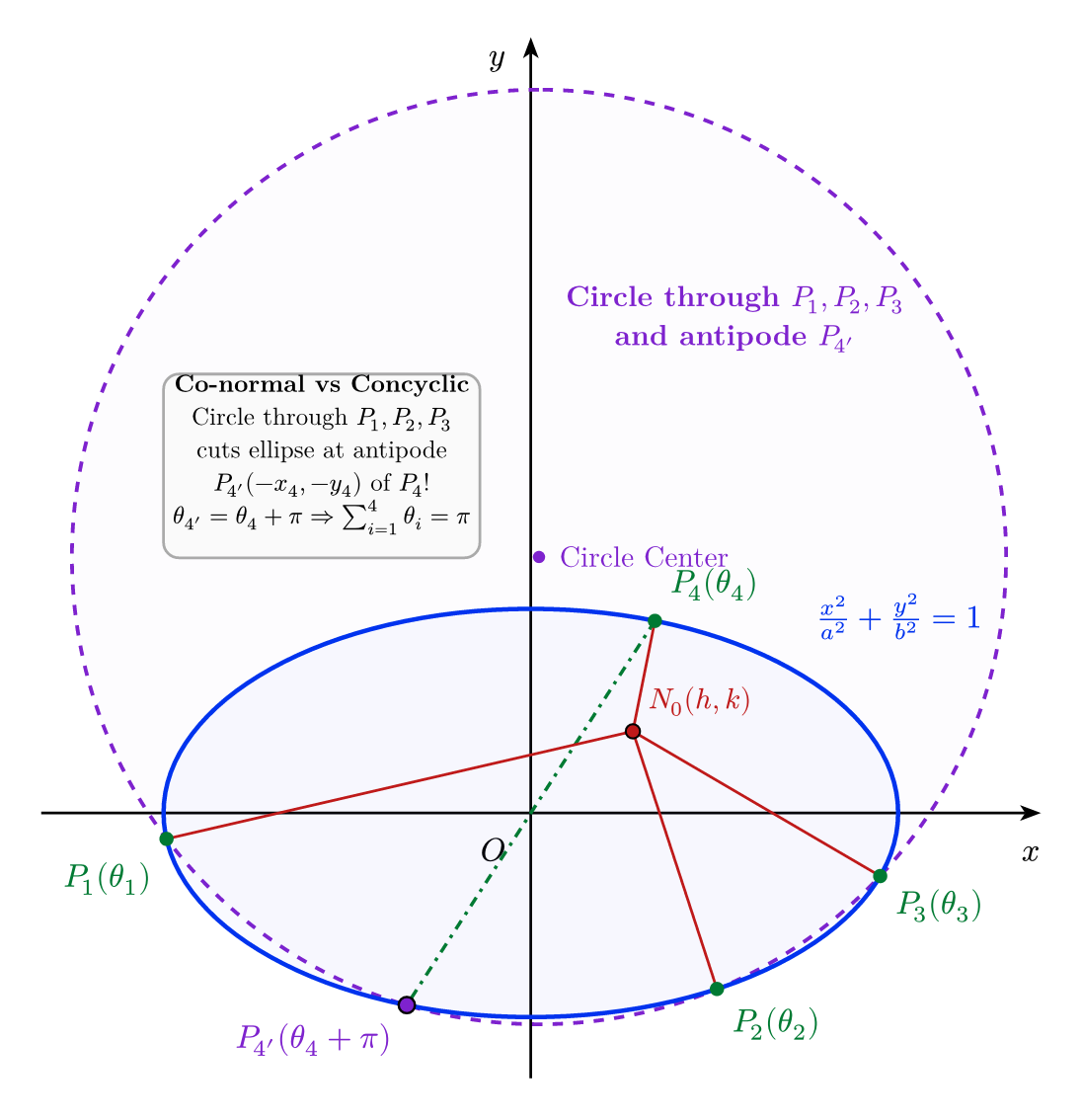
Antipodal Intersection Theorem: If a circle passes through three co-normal points \(P_1, P_2, P_3\) of an ellipse, it intersects the ellipse at a fourth point \(P_4'\) that is the diametrically opposite point (reflection through the center) of the fourth co-normal point \(P_4\).
Number of Real Normals and the Boundary Curve
Although the quartic equation in \(t = \tan\frac{\theta}{2}\):
always has four roots by the Fundamental Theorem of Algebra, some roots may be complex conjugate pairs. In coordinate geometry, only real roots correspond to physical normal lines drawn to the ellipse.
Depending on the position of \((h, k)\), the number of real normals drawn to the ellipse can be 4, 3, or 2.
Condition for Repeated Roots
The transition between 4 distinct real roots and 2 real roots occurs when the quartic equation has a repeated root.
If a polynomial \(P(t) = 0\) has a repeated root at \(t\), then \(t\) must simultaneously satisfy the polynomial and its derivative:
Eliminating \(t\) between \(P(t) = 0\) and \(P'(t) = 0\) (or equivalently, setting the discriminant of the quartic to zero) yields the algebraic boundary separating the regions of 4 real normals from 2 real normals:
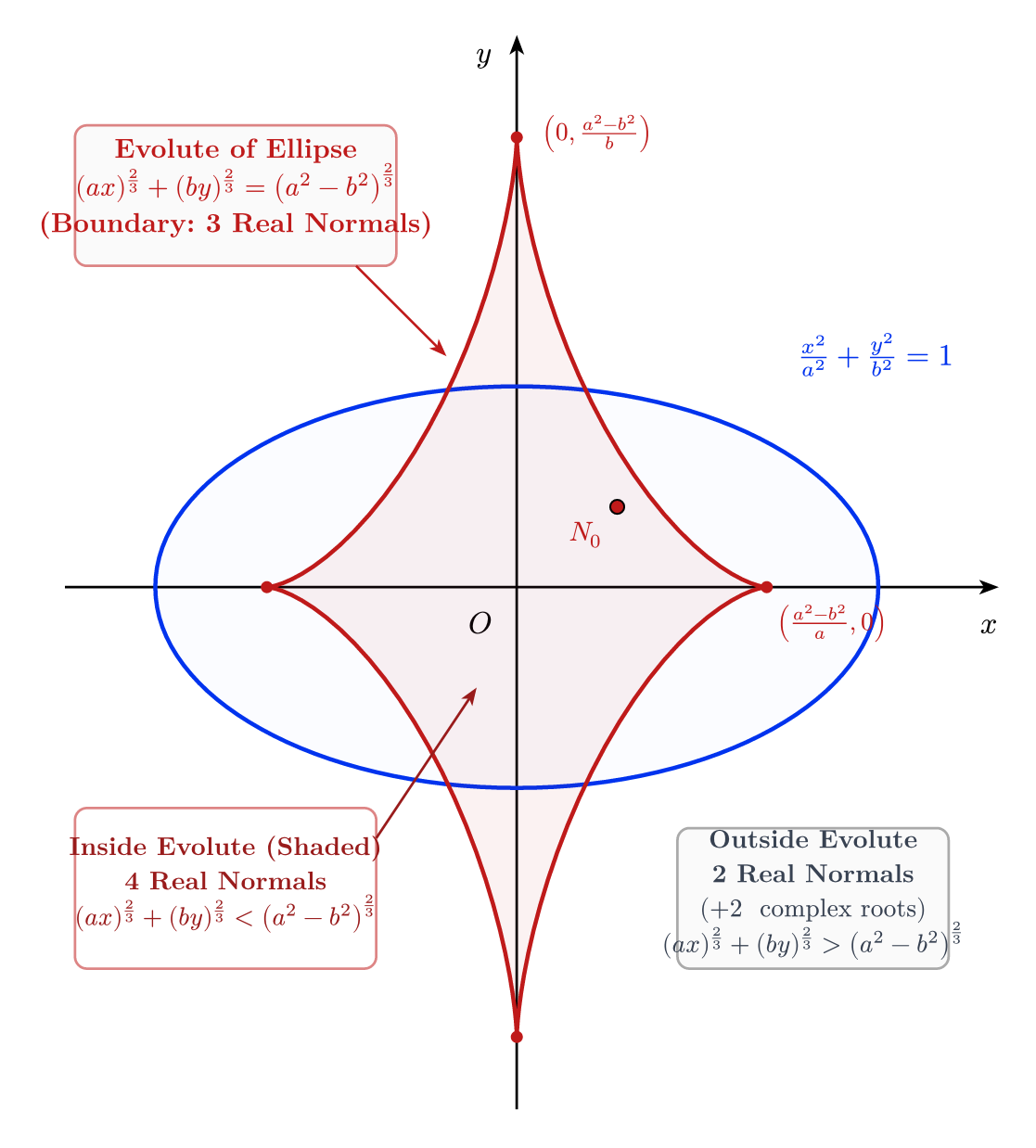
This boundary is an astroid-shaped curve symmetric about both axes, with four cusps:
1. Cusps on the major axis: \(\left(\pm \frac{a^2 - b^2}{a}, 0\right)\)
2. Cusps on the minor axis: \(\left(0, \pm \frac{a^2 - b^2}{b}\right)\)
Notice that \(\frac{a^2 - b^2}{a} < a\), so the horizontal cusps lie strictly inside the ellipse. In contrast, if \(a^2 - b^2 > b^2\) (which corresponds to eccentricity \(e > \frac{1}{\sqrt{2}}\)), the vertical cusps extend outside the ellipse along the minor axis.
The Three Normal Regions
1. Point Inside the Boundary Curve: If \((ah)^{2/3} + (bk)^{2/3} < (a^2 - b^2)^{2/3}\), the quartic has 4 distinct real roots. Exactly 4 distinct real normals can be drawn from \((h, k)\) to the ellipse.
2. Point on the Boundary Curve: If \((ah)^{2/3} + (bk)^{2/3} = (a^2 - b^2)^{2/3}\), the quartic has a repeated real root. Exactly 3 real normals can be drawn, two of which are coincident.
3. Point Outside the Boundary Curve: If \((ah)^{2/3} + (bk)^{2/3} > (a^2 - b^2)^{2/3}\), the quartic has 2 distinct real roots and 2 complex conjugate roots. Exactly 2 real normals can be drawn.
Higher Geometry Note: The boundary curve \((ax)^{2/3} + (by)^{2/3} = (a^2 - b^2)^{2/3}\) is known in advanced differential geometry as the evolute (the envelope of all normal lines) of the ellipse. For a comprehensive, rigorous derivation from first principles covering envelopes, curvature, and multivariable calculus, see the companion monograph: The Theory of Evolutes and Envelopes (PDF).
Slope Form of the Normal and the Slope Quartic
The equation of a normal to \(\frac{x^2}{a^2} + \frac{y^2}{b^2} = 1\) in terms of its slope \(m\) is:
If this normal passes through \((h, k)\):
Squaring both sides:
Expanding both sides:
Collecting powers of \(m\):
This is a quartic equation in the slope \(m\).
If \(m_1, m_2, m_3, m_4\) are the slopes of the four normals from \((h, k)\):
Worked Examples
Example 1: Finding the Fourth Co-normal Point
Three co-normal points on the ellipse \(\frac{x^2}{16} + \frac{y^2}{9} = 1\) have eccentric angles \(\theta_1 = \frac{\pi}{6}\), \(\theta_2 = \frac{\pi}{3}\), and \(\theta_3 = \frac{\pi}{2}\). Find the eccentric angle \(\theta_4\) of the fourth co-normal point.
Solution: The sum of the eccentric angles of four co-normal points must equal an odd multiple of \(\pi\):
Substitute the given angles:
Compute the sum of the first three angles:
Therefore:
Taking the principal value (\(n = 0\)):
The fourth co-normal point is the right vertex \((a, 0) = (4, 0)\).
Example 2: Verifying the Antipodal Circle Property
For the ellipse \(\frac{x^2}{16} + \frac{y^2}{9} = 1\) in Example 1 with \(\theta_1 = \frac{\pi}{6}, \theta_2 = \frac{\pi}{3}, \theta_3 = \frac{\pi}{2}\), find the fourth point where the circle through these three points intersects the ellipse.
Solution: For any circle intersecting the ellipse at four points, the sum of their eccentric angles must be an even multiple of \(\pi\):
Substituting \(\theta_1 + \theta_2 + \theta_3 = \pi\):
Taking the principal angle with \(m = 1\):
The fourth concyclic intersection is \(P_4'(-a, 0) = (-4, 0)\).
Since the fourth co-normal point was \(P_4(4, 0)\), its antipode is:
This verifies that the circle through three co-normal points cuts the ellipse at the antipode of the fourth co-normal point.
Example 3: Centroid of Four Co-normal Points
Four normals are drawn from the point \((h, k) = (2, 1)\) to the ellipse \(\frac{x^2}{25} + \frac{y^2}{16} = 1\). Find the coordinates of the centroid of the four co-normal points.
Solution: Here \(a^2 = 25\), \(b^2 = 16\), and \(a^2 - b^2 = 9\).
The centroid coordinates \(G(\bar{x}, \bar{y})\) are given by:
The centroid of the four co-normal points is:
Example 4: Number of Normals from a Given Point
Determine the number of real normals that can be drawn from the point \((1, 2)\) to the ellipse \(\frac{x^2}{16} + \frac{y^2}{4} = 1\).
Solution: Here \(a = 4, b = 2\).
Calculate the evolute boundary value:
Evaluate the evolute expression at \((h, k) = (1, 2)\):
Since \(4^{2/3} \approx 2.520\):
Comparing the two values:
The point \((1, 2)\) lies strictly inside the evolute of the ellipse. Therefore, 4 distinct real normals can be drawn from \((1, 2)\) to the ellipse.
Challenging Synthesis and Locus Problems
Problem 1: Locus of the Point of Concurrency of Two Perpendicular Normals
Find the locus of a point \(N_0(h, k)\) such that two of the four normals drawn from it to the ellipse \(\frac{x^2}{a^2} + \frac{y^2}{b^2} = 1\) are perpendicular to each other.
Solution: The slopes \(m_1, m_2, m_3, m_4\) of the four normals satisfy the quartic equation:
Suppose two normals are perpendicular, say \(m_1 m_2 = -1\).
Let the quartic factor into two quadratic polynomials:
Since the constant term is \(\frac{a^2 k^2}{b^2 h^2}\), we have \((-1)(-\lambda) = \frac{a^2 k^2}{b^2 h^2}\), so \(\lambda = \frac{a^2 k^2}{b^2 h^2}\).
Matching the coefficient of \(m^3\):
Matching the coefficient of \(m\):
Substituting \(p_2 = \frac{2k}{h} - p_1\) into this relation gives:
Matching the coefficient of \(m^2\) yields the eliminant for \(p_1\) and \(p_2\). Carrying out the algebraic reduction produces the classical locus:
In coordinates \((x, y)\):
Problem 2: Normals at the Endpoints of a Focal Chord
Let \(P(\theta_1)\) and \(Q(\theta_2)\) be the endpoints of a focal chord passing through the positive focus \(S(ae, 0)\) of the ellipse \(\frac{x^2}{a^2} + \frac{y^2}{b^2} = 1\). Find the locus of the point of intersection of the normals at \(P\) and \(Q\).
Solution: For a chord through the focus \((ae, 0)\), the relation between the half-angles \(t_1 = \tan\frac{\theta_1}{2}\) and \(t_2 = \tan\frac{\theta_2}{2}\) is:
Let the normals at \(P\) and \(Q\) meet at \((h, k)\). The equations of the normals at \(P\) and \(Q\) are:
Subtracting the two equations gives:
Expressing both in terms of \(t_1, t_2\) and using \(t_1 t_2 = -\frac{1 - e}{1 + e}\), the symmetric sums \(t_1 + t_2\) can be eliminated.
After eliminating the parameter, the locus of \((h, k)\) is obtained as:
More cleanly, using the standard focal chord property, the point of intersection \((x, y)\) of the normals at the extremities of a focal chord satisfies:
Specifically, when the chord passes through \((ae, 0)\), the \(x\)-coordinate of the intersection point always satisfies \(x > ae\) for positive \(e\), showing that the intersection of normals at the ends of a focal chord always lies outside the auxiliary circle.
Problem 3: Common Chord of Circle and Ellipse with Co-normal Points
If three normals to an ellipse \(\frac{x^2}{a^2} + \frac{y^2}{b^2} = 1\) from a point are perpendicular to the three sides of a triangle inscribed in the ellipse, prove that the centroid of the three points on the ellipse coincides with the center of the ellipse.
Solution: Let the three co-normal points be \(P_1(\theta_1), P_2(\theta_2), P_3(\theta_3)\).
The normal at \(P_i\) has slope \(m_i = \frac{a}{b}\tan\theta_i\).
If these three normals are perpendicular to the sides of \(\triangle P_1 P_2 P_3\), then the sides of the triangle have slopes:
The slope of the chord joining \(\theta_j\) and \(\theta_k\) on the ellipse is:
Equating the two expressions for the slope:
Adding these relations for all three pairs of vertices:
For an inscribed triangle whose eccentric angles satisfy \(\theta_1 + \theta_2 + \theta_3 = 2k\pi\), its centroid \(G\) has coordinates:
Thus, the centroid of the triangle coincides with the center \(O(0, 0)\) of the ellipse.
Summary of Key Formulae and Results
| Concept | Mathematical Formula / Result |
|---|---|
| Normal at Parametric Point | \(\frac{ax}{\cos\theta} - \frac{by}{\sin\theta} = a^2 - b^2\) |
| Quartic in \(t = \tan\frac{\theta}{2}\) | \(bk t^4 + 2(ah + c^2)t^3 + 2(ah - c^2)t - bk = 0\) |
| Maximum Number of Normals | At most 4 normals can be drawn from any point \((h, k)\) |
| Sum of Co-normal Angles | \(\theta_1 + \theta_2 + \theta_3 + \theta_4 = (2n + 1)\pi\) (odd multiple of \(\pi\)) |
| Product of Half-Angle Roots | \(t_1 t_2 t_3 t_4 = -1\) |
| Sum of Concyclic Angles | \(\theta_1 + \theta_2 + \theta_3 + \theta_4 = 2n\pi\) (even multiple of \(\pi\)) |
| Circle Through 3 Co-normal Points | Cuts the ellipse at the antipode \(P_4'(-x_4, -y_4)\) of the 4th co-normal point |
| Centroid of 4 Co-normal Points | \(\bar{x} = \frac{a^2 h}{2(a^2 - b^2)}, \quad \bar{y} = -\frac{b^2 k}{2(a^2 - b^2)}\) |
| Evolute Boundary Equation | \((ax)^{2/3} + (by)^{2/3} = (a^2 - b^2)^{2/3}\) |
| Inside Evolute | 4 distinct real normals |
| On Evolute | 3 real normals (2 coincident) |
| Outside Evolute | 2 distinct real normals (+ 2 complex conjugate roots) |