Properties of Tangents, Normals, and the Reflection Property
The geometry of the parabola possesses an extraordinary degree of elegance that distinguishes it among all conic sections. While its algebraic formulations provide powerful computational tools, its deeper geometric character is revealed in the interplay between its tangents, normals, focal radii, and directrix.
In this chapter, we explore these geometric properties. We examine the fundamental triangle formed by the tangent, the normal, and the principal axis, establishing the classic equidistance relation and the constancy of the subnormal. We then analyze the foot of the perpendicular dropped from the focus onto any tangent, prove the triangle congruence that shows the directrix is the locus of the reflections of the focus across all tangents, and transition to the celebrated optical reflection property. Finally, we provide complete analytical proofs for the classic theorems governing the circumcircle and orthocenter of triangles formed by three tangents.
The Tangent-Normal-Axis Triangle
Consider the standard parabola:
having its vertex at the origin \(A(0, 0)\) and its focus at \(S(a, 0)\).
Let \(P(at^2, 2at)\) be an arbitrary point on the parabola with \(t \neq 0\).
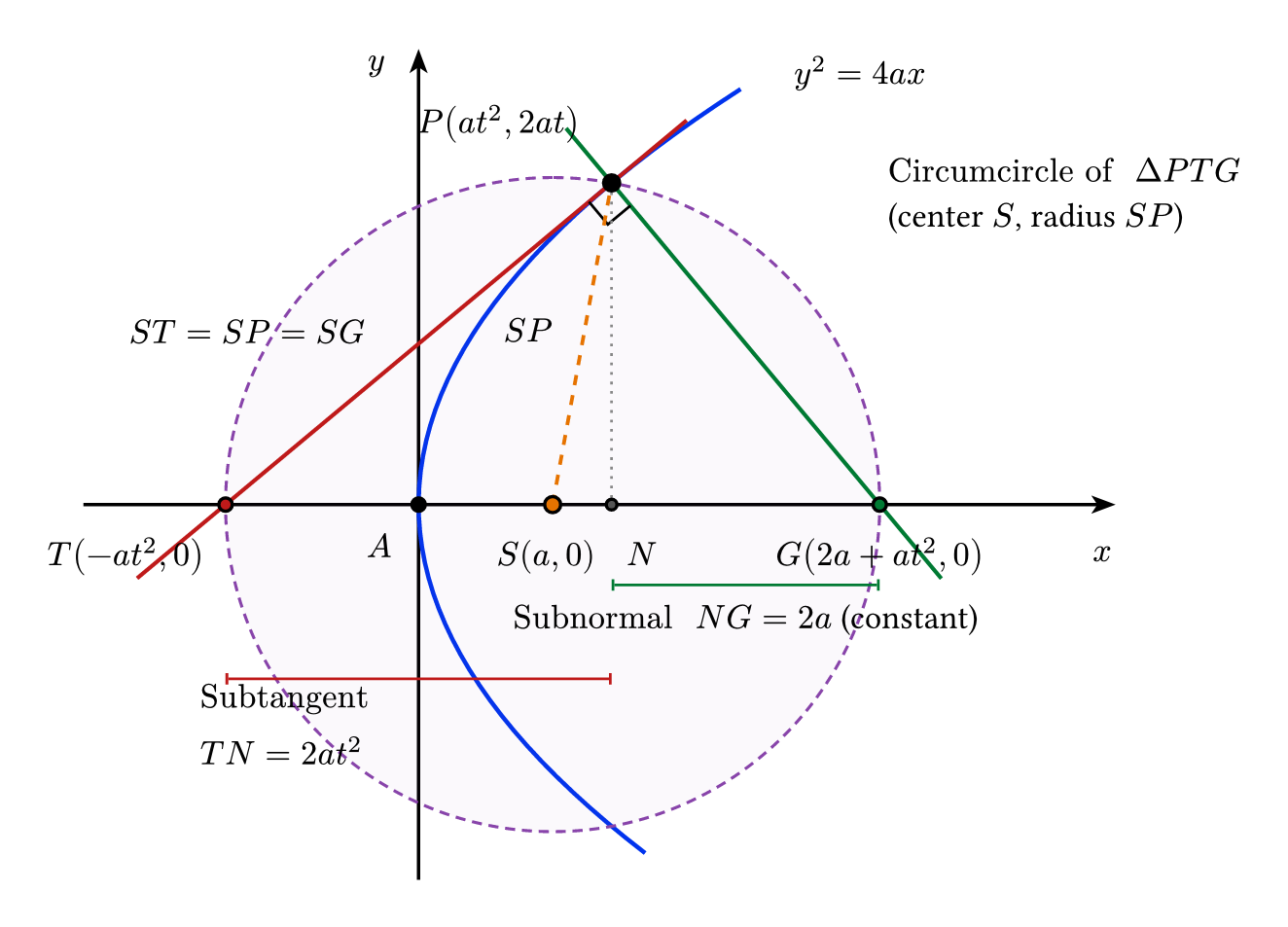
Equations and Axis Intercepts
The equation of the tangent line to the parabola at the point \(P(at^2, 2at)\) is:
Setting \(y = 0\) to determine where the tangent intersects the principal axis (the \(x\)-axis), we obtain \(x = -at^2\). Let this point of intersection be denoted by \(T\):
The equation of the normal line to the parabola at \(P(at^2, 2at)\) is:
Setting \(y = 0\) to find where the normal intersects the principal axis gives \(tx = 2at + at^3\), which yields \(x = 2a + at^2\). Let this point of intersection be denoted by \(G\):
Furthermore, let \(N\) be the foot of the perpendicular drawn from the point of contact \(P(at^2, 2at)\) onto the principal axis:
The Equidistance Theorem
The focal distance of any point \(P(at^2, 2at)\) on the parabola \(y^2 = 4ax\) is given by:
Now consider the distance from the focus \(S(a, 0)\) to the tangent intercept \(T(-at^2, 0)\):
Next, consider the distance from the focus \(S(a, 0)\) to the normal intercept \(G(2a + at^2, 0)\):
Comparing these three distances establishes the classic theorem:
For any point \(P\) on a parabola, the distance from the focus to the point of contact, the distance from the focus to the intersection of the tangent with the axis, and the distance from the focus to the intersection of the normal with the axis are all equal:
\[ST = SP = SG = a(1 + t^2)\]
Geometric Deductions from Equidistance
This equality yields immediate geometric deductions:
Isosceles Triangles: In triangle \(\triangle STP\), since \(ST = SP\), the triangle is isosceles. Therefore:
Similarly, in triangle \(\triangle SPG\), since \(SP = SG\), the triangle is isosceles:
Bisection of the Hypotenuse: Because the tangent and normal at \(P\) are mutually perpendicular, triangle \(\triangle PTG\) is a right-angled triangle with the right angle at \(P\) (\(\angle TPG = 90^\circ\)). The segment \(TG\) on the axis serves as the hypotenuse. The midpoint of \(TG\) has coordinates:
Thus, the focus \(S\) is precisely the midpoint of the hypotenuse \(TG\).
The Circumcircle of the Triangle: In any right-angled triangle, the circumcenter is the midpoint of the hypotenuse, and the circumradius equals half the hypotenuse. Because \(S\) is the midpoint of \(TG\) and \(ST = SG = SP = a(1 + t^2)\), the circumcircle of the right-angled triangle \(\triangle PTG\) has its center at the focus \(S(a, 0)\) and passes through \(P, T,\) and \(G\).
Subtangent and Subnormal
The projections of the tangent and normal segments onto the principal axis are known as the subtangent and subnormal:
Subtangent (\(TN\)): The subtangent is the directed distance between the tangent intercept \(T\) and the foot of the ordinate \(N\):
Notice that the origin \(A(0, 0)\), which is the vertex of the parabola, lies midway between \(T(-at^2, 0)\) and \(N(at^2, 0)\):
Therefore, the subtangent is always bisected at the vertex of the parabola.
Subnormal (\(NG\)): The subnormal is the directed distance between the foot of the ordinate \(N\) and the normal intercept \(G\):
Remarkably, the value \(2a\) is completely free of the parameter \(t\). It is a constant for every single point on the parabola:
The subnormal of a parabola is constant and equal to the semi-latus rectum \(2a\).
Verifying the Equidistance Property and Subnormal
Consider the parabola \(y^2 = 16x\) and the point \(P\) on it having ordinate \(8\).
- Determine the coordinates of the focus \(S\), the vertex \(A\), and the point \(P\).
- Find the intercepts \(T, G,\) and \(N\) on the axis.
- Verify that \(ST = SP = SG\), that the subtangent is bisected at the vertex, and that the subnormal is constant.
Solution:
Comparing \(y^2 = 16x\) with \(y^2 = 4ax\), we have \(4a = 16\), so \(a = 4\).
The vertex is \(A(0, 0)\) and the focus is \(S(a, 0) = (4, 0)\).
Given \(y_P = 8\), substituting into the curve gives \(8^2 = 16x_P \implies 64 = 16x_P \implies x_P = 4\). Thus, \(P(4, 8)\). In parametric form, \(2at = 8 \implies 2(4)t = 8 \implies t = 1\).
-
Tangent Intercept \(T\): The tangent at \(P\) is \(t y = x + a t^2 \implies 1(y) = x + 4(1)^2 \implies y = x + 4\). Setting \(y = 0\) yields \(x = -4\), so \(T(-4, 0)\).
-
Normal Intercept \(G\): The normal at \(P\) is \(y + tx = 2at + at^3 \implies y + 1(x) = 2(4)(1) + 4(1)^3 \implies x + y = 12\). Setting \(y = 0\) yields \(x = 12\), so \(G(12, 0)\).
-
Foot of Ordinate \(N\): Dropping a perpendicular from \(P(4, 8)\) to the \(x\)-axis gives \(N(4, 0)\).
Now we calculate the distances from the focus \(S(4, 0)\):
Hence, \(ST = SP = SG = 8\), verifying the theorem.
For the subtangent:
The vertex \(A(0, 0)\) bisects \(TN\), since \(TA = |-4 - 0| = 4\) and \(AN = |4 - 0| = 4\).
For the subnormal:
which matches the semi-latus rectum \(2(4) = 8\).
Foot of Perpendicular from Focus and the Directrix Reflection
We now turn our attention to the perpendicular dropped from the focus onto any tangent line, and the relationship between this perpendicular and the directrix.
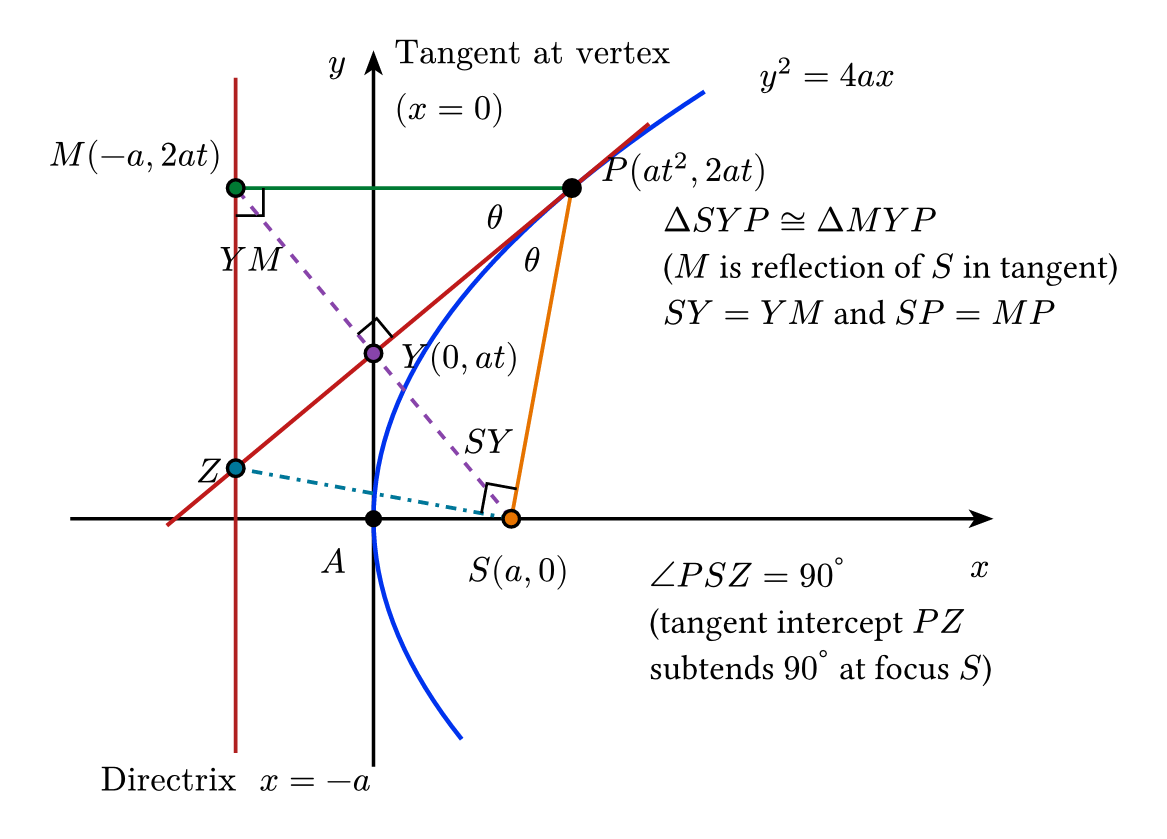
The Foot of the Perpendicular on the Tangent at the Vertex
Let the tangent line at \(P(at^2, 2at)\) be:
Its slope is \(m_T = \frac{1}{t}\). The straight line passing through the focus \(S(a, 0)\) perpendicular to this tangent has slope \(m_\perp = -t\). Its equation is:
To find the point of intersection \(Y\) of the tangent and this perpendicular line, we solve the two linear equations simultaneously:
- \(x - ty = -at^2\)
- \(tx + y = at\)
Multiplying the second equation by \(t\) and adding it to the first:
Substituting \(x = 0\) into \(tx + y = at\) yields \(y = at\). Therefore, the foot of the perpendicular is:
Because the line \(x = 0\) is the tangent to the parabola at its vertex \(A(0, 0)\), we arrive at the theorem:
The foot of the perpendicular drawn from the focus of a parabola onto any tangent lies on the tangent at the vertex.
We also compute the distance \(SY\):
Squaring this distance:
where \(SA = a\) is the distance from the focus to the vertex. Thus, the length of the perpendicular from the focus onto any tangent is the geometric mean between the focal distance of the vertex and the focal distance of the point of contact.
Congruence of Triangles and the Reflection of the Focus
Let \(M\) be the foot of the perpendicular drawn from the point of contact \(P(at^2, 2at)\) onto the directrix \(x = -a\):
Consider the line segment connecting the focus \(S(a, 0)\) and the directrix foot \(M(-a, 2at)\). The midpoint of \(SM\) has coordinates:
Thus, the midpoint of the segment \(SM\) is none other than the point \(Y\), which lies on the tangent line.
Moreover, the slope of the line \(SM\) is:
Since the slope of the tangent at \(P\) is \(\frac{1}{t}\), the product of their slopes is:
Therefore, the segment \(SM\) is strictly perpendicular to the tangent line at \(Y\).
Now examine the two right-angled triangles \(\triangle SYP\) and \(\triangle MYP\):
- \(PY\) is a common side.
- \(\angle SYP = \angle MYP = 90^\circ\), since \(SM \perp PY\).
- \(SY = YM\), because \(Y\) is the midpoint of \(SM\).
By the side-angle-side congruence criterion:
From this congruence, two profound geometric conclusions follow:
The Directrix Reflection Theorem: Because \(SM \perp PY\) and \(SY = YM\), the point \(M\) is the exact mirror image (reflection) of the focus \(S\) across the tangent line \(PY\). Since \(M\) was defined as the foot of the perpendicular on the directrix, \(M\) lies on the line \(x = -a\).
The reflection of the focus of a parabola in any tangent line always lies on the directrix.
Angle Bisection by the Tangent: From the congruence of the triangles, the corresponding angles are equal:
The line \(PM\) is parallel to the principal axis of the parabola (both being perpendicular to the directrix). Hence, the tangent at any point bisects the angle between the focal radius \(SP\) and the line through \(P\) parallel to the axis.
Because the normal \(PG\) is perpendicular to the tangent \(PT\), the normal bisects the supplementary angle formed by \(SP\) and the extension of \(MP\).
Right Angle Subtended at the Focus by the Tangent Intercept
Let the tangent at \(P(at^2, 2at)\) intersect the directrix \(x = -a\) at the point \(Z\).
Substituting \(x = -a\) into the equation of the tangent \(x - ty + at^2 = 0\):
Thus, the coordinates of \(Z\) are:
We now evaluate the slopes of the segments \(SP\) and \(SZ\) meeting at the focus \(S(a, 0)\):
Multiplying these two slopes:
This demonstrates:
The portion of any tangent to a parabola intercepted between the point of contact and the directrix subtends a right angle at the focus (\(SZ \perp SP\)).
Finding the Parabola from Two Tangents and the Focus
The focus of a parabola is at \(S(2, 3)\), and two of its tangents are given by the lines \(L_1: x + y = 1\) and \(L_2: x - 2y = 4\).
- Find the reflections of the focus across each of the two tangent lines.
- Determine the equation of the directrix of the parabola.
- Find the equation of the axis of the parabola.
Solution:
Recall that the reflection of the focus in any tangent line must lie on the directrix. Let \(M_1(h_1, k_1)\) and \(M_2(h_2, k_2)\) be the reflections of \(S(2, 3)\) in \(L_1\) and \(L_2\), respectively.
Reflection in \(L_1: x + y - 1 = 0\):
Using the standard point-reflection formula across a line \(ax + by + c = 0\):
Reflection in \(L_2: x - 2y - 4 = 0\):
Applying the reflection formula:
Equation of the Directrix:
Because both \(M_1\) and \(M_2\) lie on the directrix, the directrix is the line passing through these two points. The slope of \(M_1 M_2\) is:
Using point \(M_1(-2, -1)\):
Thus, the equation of the directrix is \(x + 3y + 5 = 0\).
Equation of the Axis:
The axis of a parabola is the line passing through the focus \(S(2, 3)\) perpendicular to the directrix. Since the directrix has slope \(-\frac{1}{3}\), the axis has slope \(3\):
Hence, the equation of the axis is \(3x - y - 3 = 0\).
The Optical Reflection Property
The angle bisection property established in the previous section is the mathematical foundation for the reflection property of the parabola.
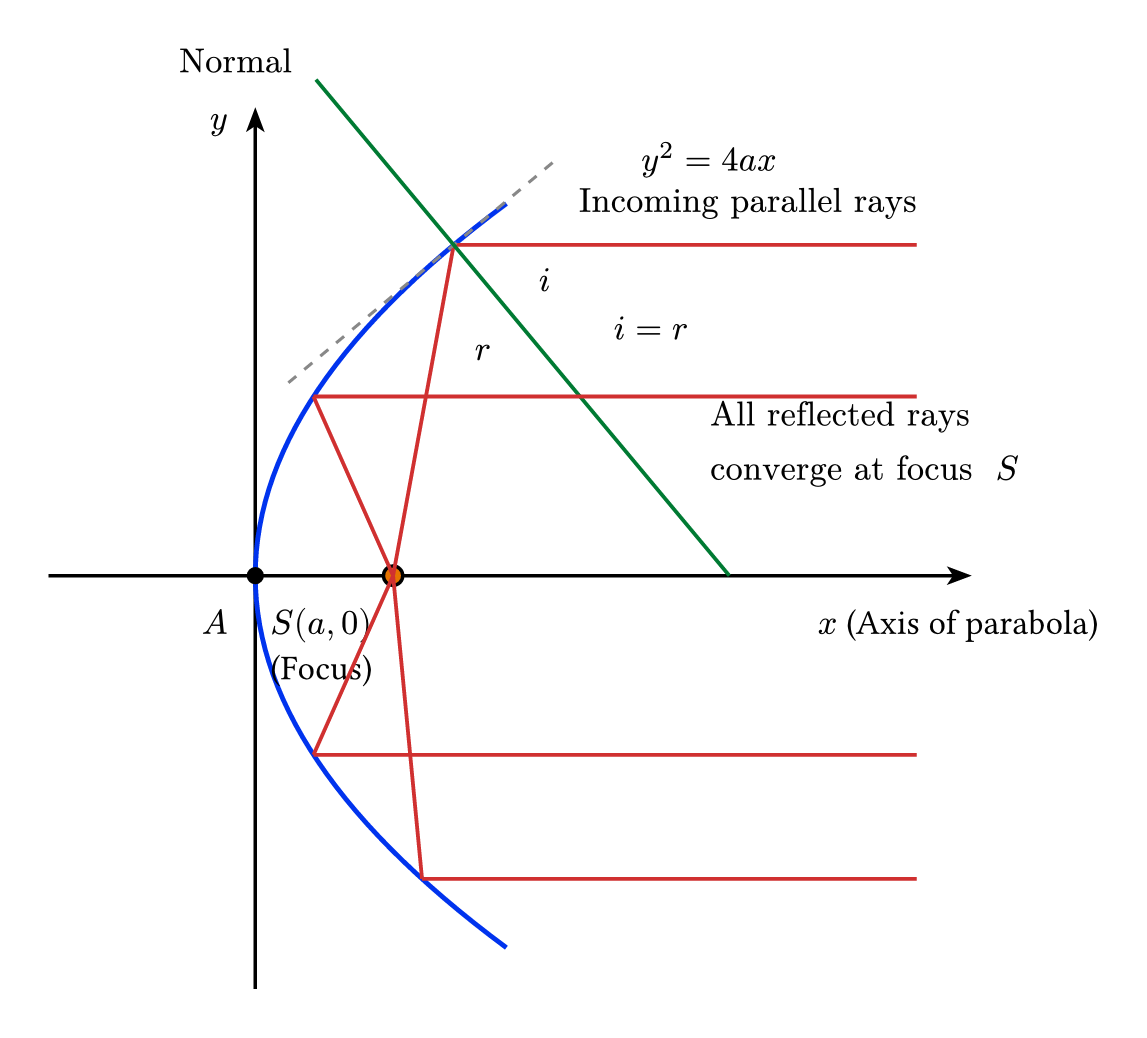
The Law of Reflection at a Parabolic Boundary
According to the physical law of specular reflection, when a ray of light strikes a smooth reflective curve at a point \(P\), the angle of incidence equals the angle of reflection, where both angles are measured with respect to the normal line at \(P\). Equivalently, the incoming ray and the reflected ray make equal angles with the tangent line at \(P\).
Let an incident ray travel parallel to the principal axis of the parabola towards the vertex, moving along the line \(MP\) extended (where \(M\) is on the directrix). The ray strikes the interior concave surface of the parabola at \(P\).
Let \(KP\) denote the incoming ray, so that \(K, P,\) and \(M\) all lie on the same straight line parallel to the axis.
By vertically opposite angles, the angle that the incoming ray \(KP\) makes with the tangent line at \(P\) is equal to \(\angle MPY\).
Furthermore, we proved via triangle congruence that the tangent line bisects \(\angle SPM\):
Therefore, the angle between the incoming ray and the tangent equals the angle between the reflected ray heading towards \(S\) and the tangent:
With respect to the normal \(PG\), which is perpendicular to the tangent:
This establishes the optical theorem:
Every ray of light traveling parallel to the principal axis of a parabola reflects off the parabolic surface and converges precisely at the focus.
The Converse Property: Focal Emission
By the principle of optical reversibility, if a point source of light or electromagnetic radiation is positioned at the focus \(S\) of a parabolic mirror:
Every ray emitted from the focus reflects off the parabolic surface and travels outward in a perfectly collimated beam parallel to the principal axis.
Physical and Engineering Applications
This mathematical property underpins vital everyday technologies:
- Automotive Headlights and Searchlights: Placing a high-intensity bulb at the focus of a parabolic reflector produces a powerful, non-diverging beam of light directed straight ahead.
- Satellite Dishes and Radio Telescopes: Parallel radio waves arriving from distant geostationary satellites or interstellar sources bounce off the dish and concentrate their energy at the receiver located at the focus.
- Solar Concentrators: Sunlight arriving in parallel rays is concentrated at the focal point of a large parabolic trough or dish, generating temperatures sufficient to boil water or drive Stirling heat engines.
- Parabolic Microphones: Sound waves traveling parallel to the axis reflect into a sensitive directional microphone placed at the focal point, enabling high-fidelity audio capture from long distances.
Ray Tracing on a Parabolic Mirror
A ray of light traveling along the horizontal line \(y = 6\) enters a parabolic mirror whose equation is \(y^2 = 12x\).
- Find the coordinates of the point of incidence \(P\).
- Write the equations of the tangent and normal to the parabola at \(P\).
- Find the equation of the reflected ray and verify analytically that it passes through the focus.
Solution:
For the parabola \(y^2 = 12x\), comparing with \(y^2 = 4ax\) gives \(4a = 12\), so \(a = 3\). The focus is \(S(3, 0)\).
Point of Incidence \(P\):
The ray travels along \(y = 6\). Substituting \(y = 6\) into \(y^2 = 12x\):
Thus, the ray strikes the parabola at \(P(3, 6)\). The parameter \(t\) at \(P\) satisfies \(2at = 6 \implies 2(3)t = 6 \implies t = 1\).
Tangent and Normal at \(P\):
Using \(t = 1\) and \(a = 3\), the equation of the tangent is:
The equation of the normal is:
The Reflected Ray:
By the optical reflection theorem, the reflected ray must pass through the point of incidence \(P(3, 6)\) and the focus \(S(3, 0)\). Notice that both points have the exact same abscissa:
Therefore, the line connecting \(P\) and \(S\) is the vertical line:
Let us verify that this satisfies the law of reflection with respect to the normal \(x + y = 9\):
- The slope of the incident ray \(y = 6\) is \(m_{\text{inc}} = 0\).
- The slope of the normal \(x + y = 9\) is \(m_{\text{norm}} = -1\).
- The angle between the incident ray and the normal has tangent \(|\frac{-1 - 0}{1 + 0}| = 1\), so the angle is \(45^\circ\).
- The slope of the reflected ray \(x = 3\) is undefined (\(m_{\text{ref}} = \infty\), vertical).
- The angle between the normal (slope \(-1\)) and the vertical line is also \(45^\circ\).
Since the angles with the normal are equal, the ray \(x = 3\) is indeed the reflected ray, and it passes directly through the focus \(S(3, 0)\).
Properties of Three Tangents to a Parabola
When three distinct tangents are drawn to a parabola, they form a triangle whose circumcircle and orthocenter obey two remarkable theorems.
Theorem: The Circumcircle of Three Tangents Passes Through the Focus
Let \(P(at_1^2, 2at_1)\), \(Q(at_2^2, 2at_2)\), and \(R(at_3^2, 2at_3)\) be three distinct points on the parabola \(y^2 = 4ax\).
The tangents drawn at these three points intersect pairwise to form a triangle \(\triangle T_1 T_2 T_3\). Using the standard formulas for the intersection of two tangents, the vertices of the triangle are:
We now prove:
The circumcircle of the triangle formed by any three tangents to a parabola passes through the focus of the parabola.
Proof
Consider the general equation of a second-degree curve:
Because the coefficients of \(x^2\) and \(y^2\) are equal to \(1\) and there is no \(xy\) term, this equation represents a circle.
To confirm that this is the circumcircle of \(\triangle T_1 T_2 T_3\), we verify that the vertex \(T_3(at_1 t_2, a(t_1 + t_2))\) satisfies the equation. Substituting \(x = at_1 t_2\) and \(y = a(t_1 + t_2)\):
First, group the terms involving \(x\):
Canceling opposite terms:
Now evaluate the terms involving \(y\):
Factoring out \(a^2(t_1 + t_2)\):
Adding the \(x\)-contribution and the \(y\)-contribution together:
Thus, \(T_3\) lies on the circle. By the complete cyclic symmetry of the equation with respect to \(t_1, t_2,\) and \(t_3\), the vertices \(T_1\) and \(T_2\) must also lie on this circle. Therefore, this equation represents the unique circumcircle of triangle \(\triangle T_1 T_2 T_3\).
Now we test whether the focus \(S(a, 0)\) lies on this circumcircle. Substituting \(x = a\) and \(y = 0\):
The coordinates of the focus satisfy the equation identically, completing the proof.
Geometric Insight via Simson's Line
This result can also be understood through classical synthetic geometry. By the Simson Line Theorem, a point lies on the circumcircle of a triangle if and only if the feet of the perpendiculars dropped from that point onto the three side lines are collinear.
We proved earlier that the foot of the perpendicular from the focus onto any tangent line lies on the tangent at the vertex (\(x = 0\)). For the three tangent sides of \(\triangle T_1 T_2 T_3\), the feet of the perpendiculars from \(S\) all lie on the straight line \(x = 0\). Because these three feet are collinear, the focus \(S\) must lie on the circumcircle of \(\triangle T_1 T_2 T_3\).
Theorem: The Orthocenter of Three Tangents Lies on the Directrix
We now examine the orthocenter (the point of concurrency of the altitudes) of the triangle formed by three tangents.
The orthocenter of the triangle formed by any three tangents to a parabola lies on the directrix of the parabola.
Proof
Consider the three sides of triangle \(\triangle T_1 T_2 T_3\), which are the tangents to the parabola at \(P, Q,\) and \(R\):
- Side \(T_2 T_3\) (tangent at \(P\)): \(x - t_1 y + at_1^2 = 0\), having slope \(m_1 = \frac{1}{t_1}\).
- Side \(T_3 T_1\) (tangent at \(Q\)): \(x - t_2 y + at_2^2 = 0\), having slope \(m_2 = \frac{1}{t_2}\).
- Side \(T_1 T_2\) (tangent at \(R\)): \(x - t_3 y + at_3^2 = 0\), having slope \(m_3 = \frac{1}{t_3}\).
Now we determine the equations of the altitudes:
Altitude from \(T_1\) perpendicular to side \(T_2 T_3\): The side \(T_2 T_3\) has slope \(\frac{1}{t_1}\), so the altitude perpendicular to it has slope \(-t_1\). This altitude passes through the opposite vertex \(T_1\left(at_2 t_3, a(t_2 + t_3)\right)\):
Expanding and rearranging:
Altitude from \(T_2\) perpendicular to side \(T_3 T_1\): The side \(T_3 T_1\) has slope \(\frac{1}{t_2}\), so the altitude perpendicular to it has slope \(-t_2\). This altitude passes through the opposite vertex \(T_2\left(at_3 t_1, a(t_3 + t_1)\right)\):
Expanding and rearranging:
The orthocenter \(H(x_H, y_H)\) is the point of intersection of these altitudes. Subtracting the second altitude equation from the first:
Since the three tangents are distinct, \(t_1 \neq t_2\). Dividing both sides by \(t_1 - t_2\):
Because \(x = -a\) is precisely the equation of the directrix of the parabola, the \(x\)-coordinate of the orthocenter is always \(-a\), regardless of the parameters \(t_1, t_2, t_3\).
Substituting \(x = -a\) back into the first altitude equation yields the \(y\)-coordinate:
Thus, the orthocenter is:
Since its abscissa is \(-a\), the orthocenter lies on the directrix, which completes the proof.
Circumcircle and Orthocenter of Three Tangents
Three tangents are drawn to the parabola \(y^2 = 8x\) at the points corresponding to parameters \(t_1 = 1\), \(t_2 = 2\), and \(t_3 = -1\).
- Find the vertices of the triangle formed by these tangents.
- Find the equation of the circumcircle of this triangle and verify that it passes through the focus.
- Find the coordinates of the orthocenter and verify that it lies on the directrix.
Solution:
For \(y^2 = 8x\), we have \(4a = 8 \implies a = 2\). The focus is \(S(2, 0)\) and the directrix is \(x = -2\).
Vertices of the Triangle:
Using the formulas \(T = (a t_i t_j, a(t_i + t_j))\):
The Circumcircle:
We compute the symmetric combinations of the parameters:
The coefficients in the circumcircle equation are:
- For \(x\): \(-a(1 + \sum t_i t_j) = -2(1 - 1) = 0\)
- For \(y\): \(-a(\sum t_i - t_1 t_2 t_3) = -2(2 - (-2)) = -2(4) = -8\)
- Constant term: \(a^2 \sum t_i t_j = 2^2(-1) = -4\)
Thus, the equation of the circumcircle is:
Let us verify that the vertices lie on this circle:
- For \(T_1(-4, 2)\): \((-4)^2 + 2^2 - 8(2) - 4 = 16 + 4 - 16 - 4 = 0\).
- For \(T_2(-2, 0)\): \((-2)^2 + 0^2 - 8(0) - 4 = 4 - 4 = 0\).
- For \(T_3(4, 6)\): \(4^2 + 6^2 - 8(6) - 4 = 16 + 36 - 48 - 4 = 0\).
Now test the focus \(S(2, 0)\):
The focus \(S(2, 0)\) lies on the circumcircle.
The Orthocenter:
The coordinates of the orthocenter are:
Thus, the orthocenter is \(H(-2, 0)\). Because its \(x\)-coordinate is \(-2\), it lies on the directrix \(x = -2\).
Solved Examples
The following problems illustrate advanced locus, geometric, and tangency problems based on the properties developed in this chapter.
Locus of the Foot of Perpendicular from Focus on Normals
Find the locus of the foot of the perpendicular drawn from the focus of the parabola \(y^2 = 4ax\) onto any normal to the parabola.
Solution:
Let the equation of a normal to the parabola \(y^2 = 4ax\) in slope form be:
The slope of this normal line is \(m\). The line through the focus \(S(a, 0)\) perpendicular to this normal has slope \(-\frac{1}{m}\). Its equation is:
Let \((x, y)\) be the coordinates of the foot of the perpendicular, which is the intersection of the normal and this perpendicular line. We substitute \(m = -\frac{x - a}{y}\) into the normal equation:
Multiplying both sides by \(y^3\):
Rearranging the terms:
This equation gives the locus of the foot of the perpendicular from the focus onto the normals of the parabola.
Area of the Triangle Formed by Tangent, Normal, and Axis
For any point \(P(at^2, 2at)\) on the parabola \(y^2 = 4ax\), determine the area of the triangle \(\triangle PTG\) formed by the tangent, the normal, and the principal axis. Find the condition under which this area is minimized for a given value of \(a\) and \(t \neq 0\).
Solution:
From our derivations in Section 1:
- The tangent meets the axis at \(T(-at^2, 0)\).
- The normal meets the axis at \(G(2a + at^2, 0)\).
- The vertex \(P\) has coordinates \((at^2, 2at)\), so its distance from the axis is \(|2at|\).
The base of the triangle along the axis is the segment \(TG\):
The altitude of the triangle corresponding to this base is the vertical distance from \(P\) to the axis:
The area \(\Delta\) of triangle \(\triangle PTG\) is:
Expanding the expression:
Notice that as \(|t| \to 0\) (as \(P\) approaches the vertex), the area \(\Delta \to 0\), because the tangent and normal both collapse onto the coordinate axes. For any non-zero point on the parabola, the area grows strictly monotonically with \(|t|\).
Locus of the Intersection of Perpendicular Tangents
Show that the locus of the point of intersection of two mutually perpendicular tangents to a parabola is its directrix.
Solution:
Let the tangents be drawn from an external point \((h, k)\) to the parabola \(y^2 = 4ax\).
The equation of any tangent to the parabola in slope form is:
Because this tangent passes through \((h, k)\), the coordinates \((h, k)\) must satisfy the equation:
This is a quadratic equation in \(m\). The two roots \(m_1\) and \(m_2\) represent the slopes of the two tangents that can be drawn from \((h, k)\) to the parabola.
By Vieta's formulas, the product of the slopes is:
Given that the two tangents are mutually perpendicular:
Equating the two expressions:
Replacing \(h\) with the running coordinate \(x\), the locus of the point of intersection is:
which is the directrix of the parabola.
This proves that the director circle (the locus of points from which perpendicular tangents can be drawn) of a parabola degenerates into a straight line: its directrix.
Summary of Results
| Property / Concept | Mathematical Expression | Key Geometric Consequence |
|---|---|---|
| Equidistance Theorem | \(ST = SP = SG = a(1 + t^2)\) | Focus \(S\) is midpoint of hypotenuse \(TG\); \(\triangle STP\) and \(\triangle SPG\) are isosceles |
| Circumcircle of \(\triangle PTG\) | Center \(S(a, 0)\), Radius \(a(1 + t^2)\) | Passes through \(P\), \(T(-at^2, 0)\), and \(G(2a + at^2, 0)\) |
| Subtangent | \(TN = 2at^2 = 2x_P\) | Always bisected at the vertex \(A(0, 0)\) (\(TA = AN\)) |
| Subnormal | \(NG = 2a\) | Strictly constant for all points on the parabola |
| Foot of Perpendicular on Tangent | \(Y(0, at)\) | Always lies on the tangent at the vertex (\(x = 0\)); \(SY^2 = SA \cdot SP\) |
| Directrix Reflection Theorem | \(M(-a, 2at)\) is reflection of \(S(a, 0)\) | Reflection of focus in any tangent lies on directrix |
| Angle Bisection | \(\angle SPY = \angle MPY\) | Tangent bisects angle between focal radius and axis-parallel ray |
| Tangent Intercept on Directrix | \(\angle PSZ = 90^\circ\) | Segment of tangent between curve and directrix subtends \(90^\circ\) at focus |
| Optical Reflection Property | \(\angle \text{incidence} = \angle \text{reflection}\) | Rays parallel to axis reflect through focus; focal rays reflect parallel to axis |
| Circumcircle of Three Tangents | Passes through \(S(a, 0)\) | Circumcircle of triangle formed by any three tangents contains the focus |
| Orthocenter of Three Tangents | \(H(-a, a(t_1 + t_2 + t_3 + t_1 t_2 t_3))\) | Orthocenter of triangle formed by any three tangents lies on directrix |
| Director Circle | \(x = -a\) | Locus of intersection of perpendicular tangents is the directrix |