Point of Contact of Tangent and Normal to an Ellipse
When dealing with straight lines that touch or cut orthogonally across an ellipse, finding the exact point of contact (or the foot of the normal) is one of the most frequent tasks in coordinate geometry.
In Tutorial 05, we derived the slope-form coordinates of the contact point:
However, committing these radical formulas—and their even more cumbersome counterparts for normals—to memory is difficult and prone to sign errors. Under exam conditions, trying to memorize multiple variations for general lines \(Ax + By + C = 0\), shifted ellipses, and parametric equations is neither practical nor necessary.
There is a far more elegant, intuitive, and universal technique: The Method of Comparison (Comparing Coefficients).
Instead of memorizing a formula for the point, we simply assume the unknown point of contact \((x_1, y_1)\) or \((a\cos\theta, b\sin\theta)\), write the standard equation of the tangent (or normal) through that point, and equate the ratio of corresponding coefficients with the given line.
The Method of Comparison for Tangents
Let the standard ellipse be:
Suppose a given straight line:
is known (or required) to touch the ellipse. We want to find the exact coordinates of the point of contact \(P\).
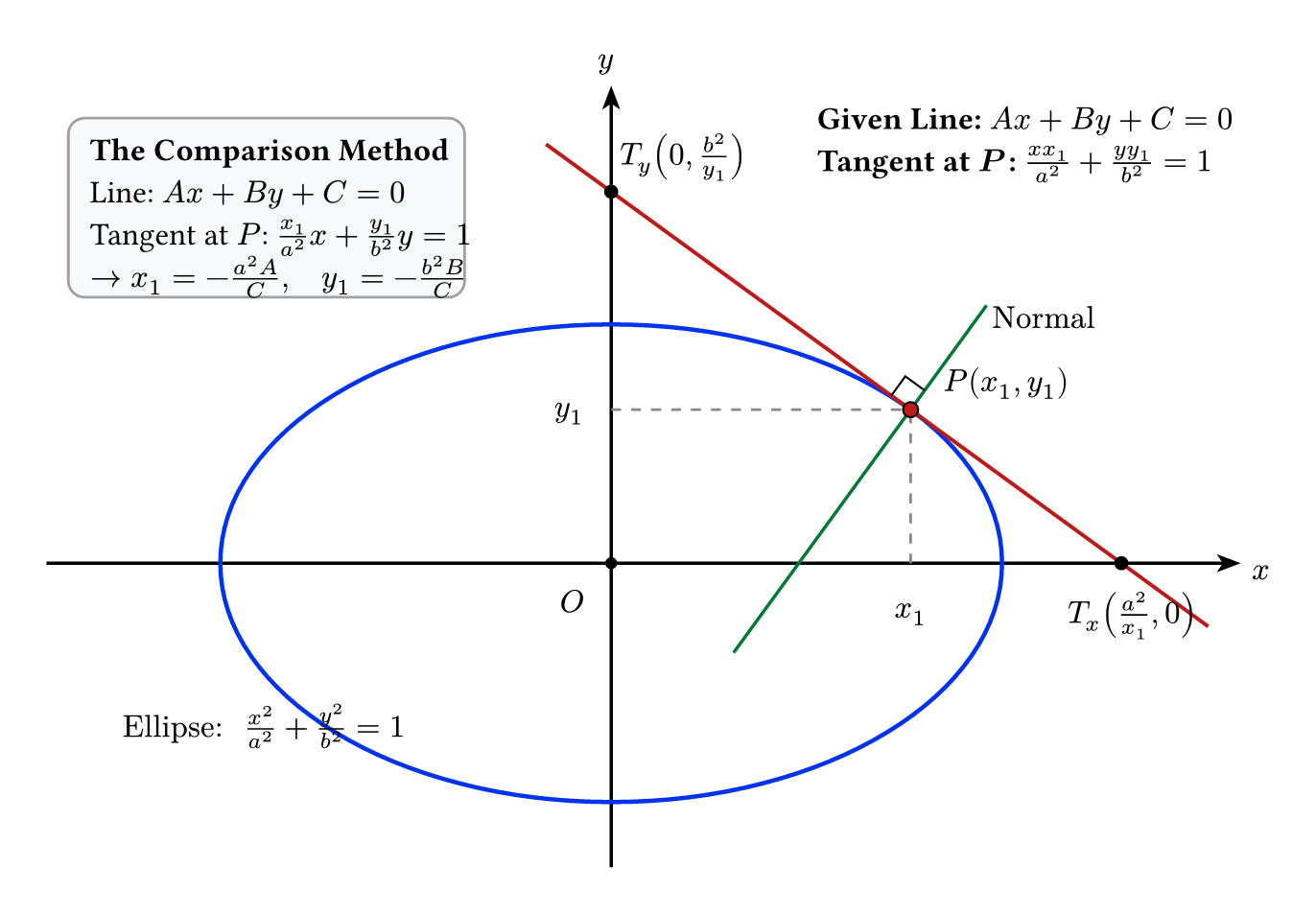
Step-by-Step Procedure in Cartesian Form
Step 1: Assume the unknown point
Let the point of contact on the ellipse be \(P(x_1, y_1)\).
Step 2: Write the tangent equation at this point
Using the point form \(T = 0\), the equation of the tangent at \(P(x_1, y_1)\) is:
Step 3: Compare coefficients with the given line
The given line is \(Ax + By + C = 0\). Since both equations represent the exact same line in the coordinate plane, the coefficients of \(x\), \(y\), and the constant term must be strictly proportional:
Step 4: Solve directly for the coordinates
Application to Slope Form
If the given line is expressed in slope-intercept form \(y = mx + c\), rewrite it as:
Here \(A = m\), \(B = -1\), and \(C = c\). Applying the comparison ratios directly:
Since \(c^2 = a^2 m^2 + b^2 \implies c = \pm \sqrt{a^2 m^2 + b^2}\), the point of contact is:
Whenever \(c\) is known, you never have to compute square roots or debate plus/minus signs. The sign of \(c\) automatically determines the correct quadrant!
Tangents in Parametric Form
When the problem involves trigonometric relations, eccentric angles, or symmetric equations, assuming the point in parametric form is especially powerful.
Procedure
Step 1: Assume the point
Let the point of contact be \(P(a\cos\theta, b\sin\theta)\), where \(\theta \in [0, 2\pi)\) is the eccentric angle.
Step 2: Write the parametric tangent
Step 3: Compare with the line
Write the given line as \(Ax + By = -C\):
Step 4: Solve for the trigonometric ratios
Step 5: Determine the angle and point
The values and signs of \(\cos\theta\) and \(\sin\theta\) directly fix the eccentric angle \(\theta \in [0, 2\pi)\) and identify its quadrant, giving the contact point \((a\cos\theta, b\sin\theta)\) without any sign ambiguity.
Direct Simultaneous Solving: The Perfect Square Method
Can we find the point of contact without using the comparison method or any formula, simply by solving the equations of the line and the ellipse simultaneously?
Yes, absolutely. In fact, this approach directly demonstrates the fundamental algebraic meaning of tangency.
When a straight line touches an ellipse, it intersects the curve at two coincident points. If we eliminate one variable by substituting the linear equation into the ellipse equation, the resulting quadratic equation must have equal roots (\(D = 0\)).
How the Perfect Square Arises
Step 1: Substitute the linear equation into the ellipse
Express one variable from the line equation, for example \(y = mx + c\), and substitute it into the standard ellipse \(\frac{x^2}{a^2} + \frac{y^2}{b^2} = 1\):
Clearing denominators:
Step 2: The discriminant vanishes for a tangent
This is a standard quadratic equation in \(x\) of the form \(A_0 x^2 + B_0 x + C_0 = 0\). Because the line touches the ellipse at a single point of contact, the two points of intersection must coincide, which means the discriminant must be zero:
Step 3: A quadratic with zero discriminant collapses into a perfect square
Whenever any quadratic equation \(A_0 x^2 + B_0 x + C_0 = 0\) has \(D = 0\), it factors into a perfect square:
The single repeated root gives the \(x\)-coordinate of the point of contact directly:
Since \(a^2 m^2 + b^2 = c^2\) at tangency, this simplifies to:
Substituting \(x_1\) back into \(y = mx + c\) immediately gives \(y_1 = \frac{b^2}{c}\).
When to Use Simultaneous Solving vs. The Comparison Method
- Direct Simultaneous Solving: Highly intuitive and requires no memorization at all. When the line and ellipse have simple numeric coefficients, substituting one into the other and factoring the resulting perfect square is fast and straightforward. Moreover, it serves as a self-verifying test: if the quadratic does not factor into a perfect square, the line is simply not tangent to the ellipse!
- The Comparison Method: Much faster and cleaner when dealing with general coefficients (\(Ax + By + C = 0\)), normals, shifted ellipses, or parametric problems, where expanding and solving a quadratic would involve heavy, error-prone algebra.
The Method of Comparison for Normals
A straight line \(Ax + By + C = 0\) can also be a normal to the ellipse. Finding the foot of the normal (the point on the ellipse where the line is perpendicular to the tangent) by traditional formulas is notorious for causing arithmetic blunders.
The comparison method solves this effortlessly.
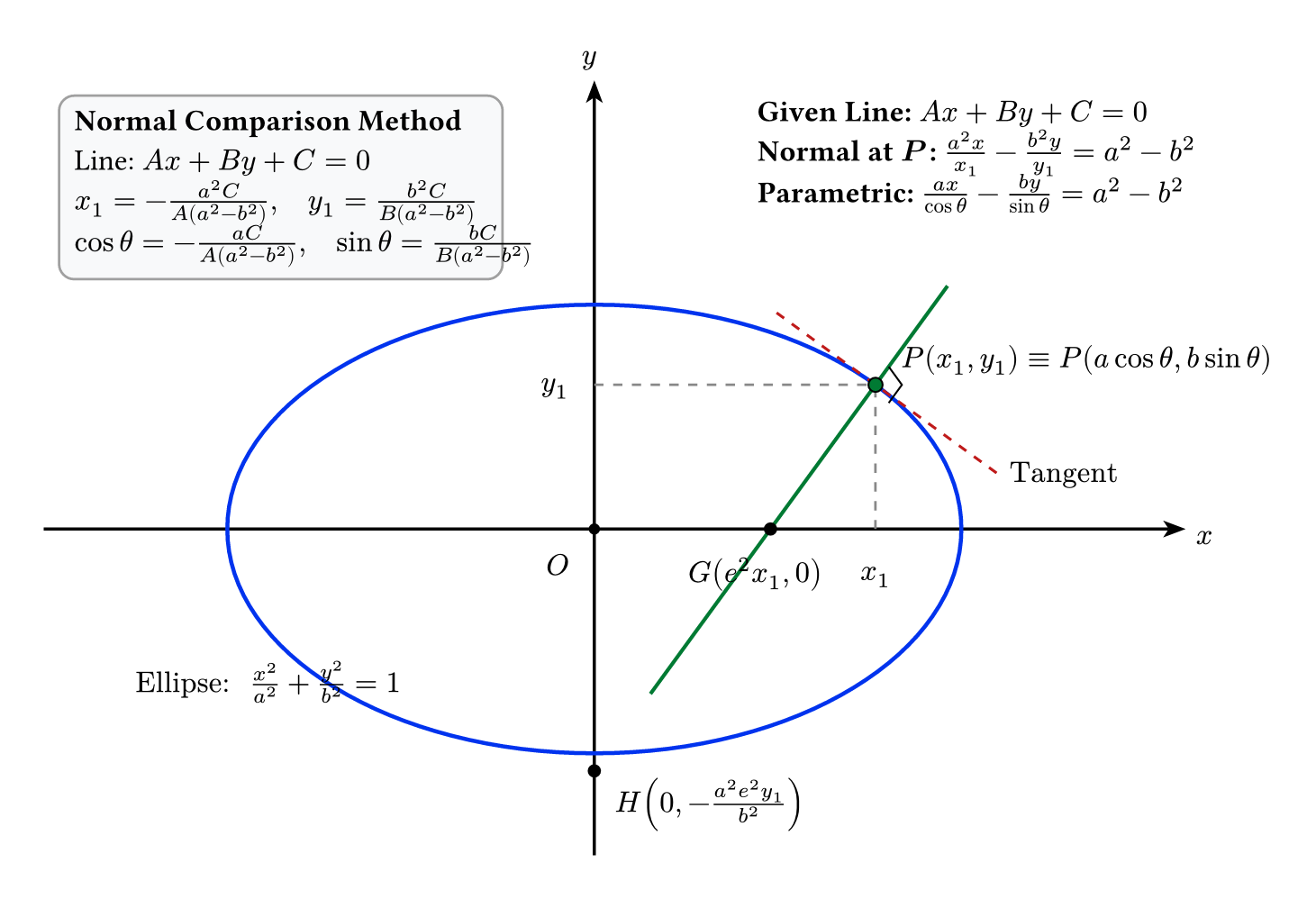
Step-by-Step Procedure in Cartesian Form
Step 1: Assume the unknown foot of the normal
Let the point on the ellipse be \(P(x_1, y_1)\).
Step 2: Write the normal equation at this point
Using the point form derived in Tutorial 05:
Rewrite it in linear form:
Step 3: Compare coefficients with the given line
The given line is \(Ax + By + C = 0\), or \(Ax + By = -C\). Comparing coefficients:
Step 4: Solve for \(x_1\) and \(y_1\)
Normals in Parametric Form
In parametric form, the comparison method for normals is even cleaner.
Step 1: Assume the point
Let the foot of the normal be \(P(a\cos\theta, b\sin\theta)\).
Step 2: Write the parametric normal equation
Step 3: Compare with the line \(Ax + By = -C\)
Step 4: Solve for \(\cos\theta\) and \(\sin\theta\)
Step 5: Determine the foot of the normal
Substitute these directly into \((a\cos\theta, b\sin\theta)\):
Notice that the Cartesian and Parametric comparison methods arrive at identical expressions, but the parametric method gives the eccentric angle \(\theta\) as a bonus!
Summary of the Comparison Method
The following reference table contrasts how the comparison method applies to tangents versus normals for the ellipse \(\frac{x^2}{a^2} + \frac{y^2}{b^2} = 1\) and the line \(Ax + By + C = 0\):
| Feature | Tangent Line | Normal Line |
|---|---|---|
| Point Form Equation | \(\left(\frac{x_1}{a^2}\right)x + \left(\frac{y_1}{b^2}\right)y = 1\) | \(\left(\frac{a^2}{x_1}\right)x - \left(\frac{b^2}{y_1}\right)y = a^2 - b^2\) |
| Parametric Equation | \(\left(\frac{\cos\theta}{a}\right)x + \left(\frac{\sin\theta}{b}\right)y = 1\) | \(\left(\frac{a}{\cos\theta}\right)x - \left(\frac{b}{\sin\theta}\right)y = a^2 - b^2\) |
| Coefficient Ratios | \(\frac{x_1/a^2}{A} = \frac{y_1/b^2}{B} = -\frac{1}{C}\) | \(\frac{a^2/x_1}{A} = \frac{-b^2/y_1}{B} = \frac{a^2 - b^2}{-C}\) |
| Point of Contact \(x_1\) | \(x_1 = -\frac{a^2 A}{C}\) | \(x_1 = -\frac{a^2 C}{A(a^2 - b^2)}\) |
| Point of Contact \(y_1\) | \(y_1 = -\frac{b^2 B}{C}\) | \(y_1 = \frac{b^2 C}{B(a^2 - b^2)}\) |
| Parametric Angle \(\theta\) | \(\cos\theta = -\frac{a A}{C}, \; \sin\theta = -\frac{b B}{C}\) | \(\cos\theta = -\frac{a C}{A(a^2 - b^2)}, \; \sin\theta = \frac{b C}{B(a^2 - b^2)}\) |
Handling Shifted Ellipses
When an ellipse is shifted so its center is \((h, k)\):
Do not expand the equation into general form. Instead, use a temporary coordinate shift:
Step 1: Express the given line in terms of \(X\) and \(Y\) by substituting \(x = X + h\) and \(y = Y + k\).
Step 2: Apply the comparison method to the standard form \(\frac{X^2}{a^2} + \frac{Y^2}{b^2} = 1\) to find the contact point \((X_1, Y_1)\).
Step 3: Transform back to the original coordinates:
This avoids long expansions and keeps the arithmetic clean.
Illustrative Examples
Example 1: Point of Contact of a Tangent Line (Cartesian Form)
Find the point of contact of the straight line \(x + 2y - 4 = 0\) with the ellipse \(x^2 + 4y^2 = 8\).
Method 1: The Comparison Method
Convert the ellipse equation to standard form by dividing by \(8\):
Let the point of contact be \(P(x_1, y_1)\) on the ellipse. The equation of the tangent at \(P\) is:
Rewrite the given line in the same format with constant \(1\) on the right side:
Since both equations describe the exact same straight line, compare their coefficients:
The point of contact is \((2, 1)\).
Method 2: Direct Simultaneous Solving (The Perfect Square)
From the equation of the line \(x + 2y - 4 = 0\), express \(x\) in terms of \(y\):
Substitute this into the ellipse equation \(x^2 + 4y^2 = 8\):
Divide the entire equation by \(8\):
Because the line is truly tangent to the ellipse, the quadratic equation collapses into a perfect square!
The repeated root gives:
Substitute \(y_1 = 1\) back into the linear expression for \(x\):
Thus, the point of contact is \(P(2, 1)\), exactly matching Method 1.
Example 2: Tangents with a Given Slope and Their Contact Points
Find the equations of the tangents to the ellipse \(\frac{x^2}{16} + \frac{y^2}{9} = 1\) having slope \(m = \frac{1}{2}\), and find their points of contact by comparing coefficients.
Solution:
Here \(a^2 = 16\) and \(b^2 = 9\).
For a tangent with slope \(m = \frac{1}{2}\), the condition of tangency gives:
Hence, the two tangent lines are:
Finding the Point of Contact for Tangent 1: \(x - 2y = -2\sqrt{13}\)
Let the point of contact be \(P_1(x_1, y_1)\). The tangent in point form is:
Rewrite the line so the right side is \(1\):
Comparing coefficients:
Thus, the point of contact for the first tangent is:
Finding the Point of Contact for Tangent 2: \(x - 2y = 2\sqrt{13}\)
Rewriting:
Comparing coefficients:
Thus, the point of contact for the second tangent is:
Example 3: Eccentric Angle and Point of Contact (Parametric Form)
The straight line \(2x + 3\sqrt{3}y = 12\) touches the ellipse \(\frac{x^2}{9} + \frac{y^2}{4} = 1\). Determine the eccentric angle of the point of contact, and find its coordinates.
Solution:
Here \(a = 3\) and \(b = 2\).
Let the point of contact be \(P(3\cos\theta, 2\sin\theta)\).
The equation of the tangent at \(P(\theta)\) is:
Divide the given line \(2x + 3\sqrt{3}y = 12\) by \(12\):
Comparing coefficients:
Finding the Angle:
Both \(\cos\theta > 0\) and \(\sin\theta > 0\), so \(\theta\) lies in the first quadrant:
Coordinates of Contact Point:
Example 4: Foot of Normal via Comparison (Cartesian Form)
The straight line \(5x - 5y = 7\) is normal to the ellipse \(\frac{x^2}{16} + \frac{y^2}{9} = 1\). Find the coordinates of the point on the ellipse where this normal is drawn.
Solution:
From the ellipse equation, \(a^2 = 16\) and \(b^2 = 9\), which gives \(a^2 - b^2 = 16 - 9 = 7\).
Let the foot of the normal be \(P(x_1, y_1)\) on the ellipse. The equation of the normal at \(P\) is:
Write this as:
The given line is:
Since both equations represent the same straight line, compare their coefficients directly:
Verification:
Check if \(P\left(\frac{16}{5}, \frac{9}{5}\right)\) lies on the ellipse:
The point lies exactly on the ellipse. Hence, the foot of the normal is:
Notice that without memorizing any formula, the coordinates were found in two simple lines!
Example 5: Foot of Normal via Comparison (Parametric Form)
Find the eccentric angle and the coordinates of the points on the ellipse \(3x^2 + 4y^2 = 12\) where the normal is parallel to the line \(2x - y + 5 = 0\).
Solution:
Standard form of the ellipse:
The difference of squared semi-axes is \(a^2 - b^2 = 4 - 3 = 1\).
The normal must be parallel to \(2x - y + 5 = 0\), so its slope is \(m = 2\).
The equation of the normal at \(P(\theta) = (2\cos\theta, \sqrt{3}\sin\theta)\) is:
Rearranging into slope-intercept form:
Equate the slope to \(2\):
This gives two possible values for \(\theta \in [0, 2\pi)\):
Case 1: \(\theta = \frac{\pi}{3}\)
The foot of the normal is:
The equation of this normal is:
Case 2: \(\theta = \frac{4\pi}{3}\)
The foot of the normal is:
The equation of this normal is:
Example 6: Finding an Unknown Parameter for Normality
Find all values of the constant \(k\) such that the line \(x + y = k\) is a normal to the ellipse \(\frac{x^2}{16} + \frac{y^2}{9} = 1\), and determine the corresponding feet of the normals.
Solution:
From the ellipse equation, \(a^2 = 16\) and \(b^2 = 9\), which gives \(a^2 - b^2 = 16 - 9 = 7\).
Let the foot of the normal be \(P(x_1, y_1)\) on the ellipse. The equation of the normal at \(P\) is:
Write this as:
The given line is:
Comparing coefficients between the normal and the given line:
Now, since the foot of the normal \(P(x_1, y_1)\) lies on the ellipse \(\frac{x_1^2}{16} + \frac{y_1^2}{9} = 1\), we substitute these coordinates:
Notice how the comparison method determines the unknown parameter \(k\) directly without needing to recall any separate formula!
Case 1: When \(k = \frac{7}{5}\)
The foot of the normal is:
Case 2: When \(k = -\frac{7}{5}\)
The foot of the normal is:
Verification:
For \(P_1\): \(x_1 + y_1 = \frac{16}{5} - \frac{9}{5} = \frac{7}{5} = k\). Correct.
Also \(\frac{(16/5)^2}{16} + \frac{(-9/5)^2}{9} = \frac{16}{25} + \frac{9}{25} = 1\). Correct.
Example 7: Shifted Ellipse Tangent and Point of Contact
Find the point of contact of the line \(x + y = 8\) with the shifted ellipse:
Solution:
The ellipse is centered at \((h, k) = (1, 2)\) with \(a^2 = 16\) and \(b^2 = 9\).
Introduce shifted coordinates:
In shifted coordinates, the ellipse is in standard form:
Substitute \(x\) and \(y\) into the given line \(x + y = 8\):
Now, apply the comparison method in \(X-Y\) coordinates:
Let the contact point be \((X_1, Y_1)\). The tangent in point form is:
Divide the line \(X + Y = 5\) by \(5\):
Comparing coefficients:
Check on shifted ellipse:
Finally, convert back to the original \(x-y\) coordinates:
The point of contact on the shifted ellipse is:
Example 8: Locus of the Midpoint of Tangent Intercepts
A tangent to the ellipse \(\frac{x^2}{a^2} + \frac{y^2}{b^2} = 1\) intersects the coordinate axes at \(A\) and \(B\). If \(M(h, k)\) is the midpoint of the segment \(AB\), find the locus of \(M\) and express the point of contact on the ellipse in terms of \(h\) and \(k\).
Solution:
Let the point of contact on the ellipse be \(P(x_1, y_1)\).
The equation of the tangent at \(P\) is:
Find the intercepts by setting \(y = 0\) and \(x = 0\):
- Setting \(y = 0 \implies x_A = \frac{a^2}{x_1} \implies A\left(\frac{a^2}{x_1}, 0\right)\)
- Setting \(x = 0 \implies y_B = \frac{b^2}{y_1} \implies B\left(0, \frac{b^2}{y_1}\right)\)
Since \(M(h, k)\) is the midpoint of \(AB\):
Point of Contact in terms of Midpoint:
Finding the Locus:
Because \(P(x_1, y_1)\) lies on the ellipse \(\frac{x_1^2}{a^2} + \frac{y_1^2}{b^2} = 1\):
Replacing \((h, k)\) by general running coordinates \((x, y)\), the locus of the midpoint \(M\) is:
Key Takeaways
-
Never memorize the point of contact formula: Writing the line as \(Ax + By = -C\) and comparing coefficients with \(\frac{x_1}{a^2}x + \frac{y_1}{b^2}y = 1\) gives \(x_1 = -\frac{a^2 A}{C}\) and \(y_1 = -\frac{b^2 B}{C}\) in seconds.
-
The same method works for normals: Compare \(Ax + By = -C\) with \(\frac{a^2}{x_1}x - \frac{b^2}{y_1}y = a^2 - b^2\) to find the foot of the normal: \(x_1 = -\frac{a^2 C}{A(a^2 - b^2)}\) and \(y_1 = \frac{b^2 C}{B(a^2 - b^2)}\).
-
Parametric form resolves signs automatically: Comparing with parametric equations yields \(\cos\theta\) and \(\sin\theta\). Their signs uniquely fix the quadrant of the eccentric angle \(\theta\), eliminating any guesswork about signs.
-
Shifted ellipses are simplified by substitution: Shift coordinates \(X = x - h, Y = y - k\) first, solve in standard form, and translate back.
-
Simultaneous solving yields a perfect square: If a given line is truly a tangent to the ellipse, substituting the line into the curve equation always produces a quadratic with \(D = 0\), which collapses into a perfect square \((px \pm q)^2 = 0\). The single repeated root directly gives the point of contact coordinate without memorizing any formula.