Equation of Tangent and Normal to an Ellipse
The study of tangents and normals is central to the analytical geometry of the ellipse. A tangent represents the limiting position of a secant line whose two intersection points coincide, while the normal is the line perpendicular to the tangent at the point of contact.
In this chapter, we develop the equations of tangents and normals to the standard ellipse in three fundamental representations: point form, parametric form, and slope form. We also establish the universal condition for a straight line to be normal to an ellipse and explore geometric optimizations arising from tangent intercepts.
Tangent to an Ellipse
Consider the standard ellipse whose center is at the origin and whose major and minor axes lie along the coordinate axes:
A straight line is said to be tangent to the ellipse if it touches the curve at exactly one point, which corresponds algebraically to the condition that the points of intersection of the line and the ellipse coincide.
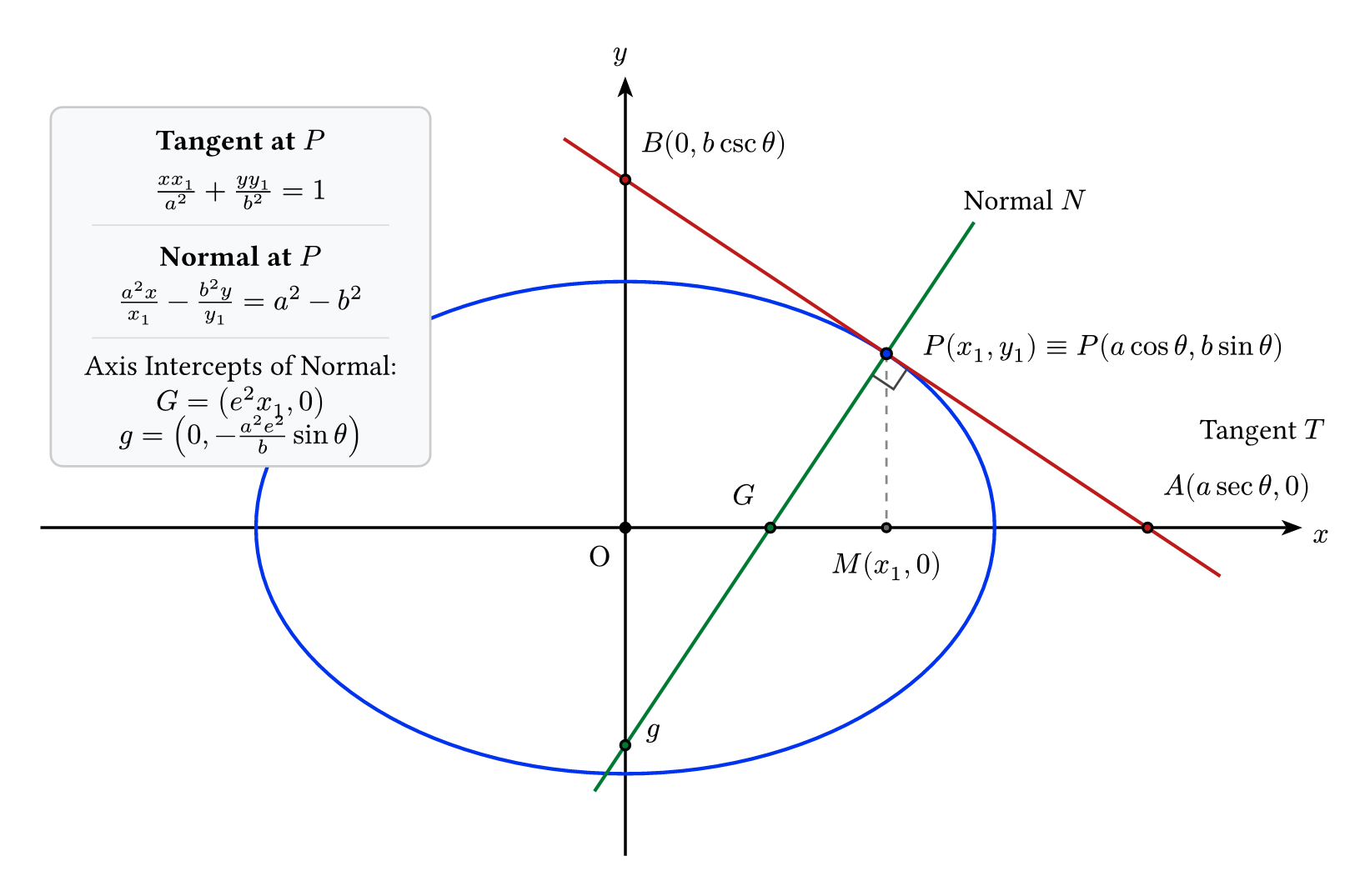
Equation of Tangent in Point Form
Let \(P(x_1, y_1)\) be a point lying on the ellipse \(\frac{x^2}{a^2} + \frac{y^2}{b^2} = 1\). Since \(P\) lies on the curve, its coordinates satisfy:
To determine the slope of the tangent at \(P(x_1, y_1)\), we differentiate the equation of the ellipse implicitly with respect to \(x\):
Solving for the derivative \(\frac{dy}{dx}\):
Evaluating this derivative at the point \(P(x_1, y_1)\) (assuming \(y_1 \neq 0\)), the slope \(m_T\) of the tangent line is:
Using the point-slope equation of a straight line, \(y - y_1 = m_T(x - x_1)\), the equation of the tangent is:
Multiplying both sides by \(y_1\) and dividing by \(b^2\):
Rearranging terms to place current coordinates \((x, y)\) on the left side and constant terms on the right side:
Since \(P(x_1, y_1)\) lies on the ellipse, the right-hand side is equal to \(1\). Thus, the equation of the tangent to the ellipse at \(P(x_1, y_1)\) is:
Behavior at the Vertices:
When \(y_1 = 0\), the point is a vertex \((\pm a, 0)\). Here, the tangent is vertical. Substituting \(x_1 = \pm a\) and \(y_1 = 0\) into our derived formula gives:
which correctly represents the two vertical tangents at the vertices \(A(a, 0)\) and \(A'(-a, 0)\). Hence, the point form holds universally for every point on the ellipse.
The Operator Notation (\(T = 0\)):
Using the standard conic operator \(T\), the equation of the tangent at \(P(x_1, y_1)\) is written concisely as:
For the standard ellipse \(\frac{x^2}{a^2} + \frac{y^2}{b^2} - 1 = 0\), the operator \(T\) is defined by:
For an ellipse shifted to center \((h, k)\):
the equation of the tangent at \((x_1, y_1)\) is obtained by the corresponding linear replacement:
Note on the Universal Tangent Equation to Any Conic (\(T = 0\)):
The method of linear replacement is not limited to standard or shifted ellipses. It applies universally to the general second-degree equation representing any conic section (circle, parabola, ellipse, or hyperbola, whether in standard orientation, translated, or rotated with an \(xy\)-term):
If \(P(x_1, y_1)\) is any point lying on the curve, the equation of the tangent at \(P\) is obtained immediately by applying the universal replacement rules to each term of the general equation:
Carrying out these substitutions yields the linear expression \(T\):
The line \(T = 0\) represents the exact equation of the tangent at \(P(x_1, y_1)\) to any conic represented by the general second-degree equation.
Why this rule works: The substitution \(T = 0\) constructs the unique linear equation (polar line) that passes through \(P(x_1, y_1)\) and shares the exact first-order differential coefficients of the conic at that point. Geometrically, when \(P\) lies on the conic, its polar line coincides identically with the tangent at \(P\). This algebraic principle holds universally across all conics, eliminating the need to perform implicit differentiation \(\frac{dy}{dx}\) from scratch whenever finding a tangent at a known point on the curve.
Equation of Tangent in Parametric Form
In the preceding chapter, we established that any point \(P\) on the standard ellipse can be parameterized by its eccentric angle \(\theta \in [0, 2\pi)\) as:
Substituting these parametric coordinates into the point form of the tangent:
Canceling the common factors of \(a\) and \(b\) yields the standard parametric equation of the tangent:
Slope and Axis Intercepts of the Tangent:
From this parametric equation, we read off the following fundamental properties:
Slope of the Tangent:
Intercept on the Major Axis (\(x\)-axis):
Setting \(y = 0\):
The tangent cuts the \(x\)-axis at the point \(A(a\sec\theta, 0)\).
Intercept on the Minor Axis (\(y\)-axis):
Setting \(x = 0\):
The tangent cuts the \(y\)-axis at the point \(B(0, b\csc\theta)\).
Equation of Tangent in Slope Form
When the slope \(m\) of the tangent line is specified rather than the point of contact, the condition of tangency derived in Tutorial 04 provides the equation directly.
For the straight line \(y = mx + c\) to touch the ellipse \(\frac{x^2}{a^2} + \frac{y^2}{b^2} = 1\), the discriminant of the quadratic equation resulting from their intersection must vanish:
Hence, the equations of the two tangents to the ellipse having slope \(m\) are:
Points of Contact:
Comparing the line \(mx - y = \mp \sqrt{a^2 m^2 + b^2}\) with the point-form tangent \(\frac{x x_1}{a^2} + \frac{y y_1}{b^2} = 1\), we find:
Solving for \(x_1\) and \(y_1\):
Thus, the tangent \(y = mx + \sqrt{a^2 m^2 + b^2}\) touches the ellipse at the point:
and the parallel tangent \(y = mx - \sqrt{a^2 m^2 + b^2}\) touches at the diametrically opposite point:
For every real slope \(m\), there exist exactly two parallel tangents to an ellipse, located symmetrically on opposite sides of the center.
Normal to an Ellipse
The normal to an ellipse at any point \(P\) is defined as the straight line passing through \(P\) and perpendicular to the tangent at \(P\).
Equation of Normal in Point Form
Let \(P(x_1, y_1)\) be a point on the ellipse \(\frac{x^2}{a^2} + \frac{y^2}{b^2} = 1\).
The slope of the tangent at \(P(x_1, y_1)\) is:
Since the normal is perpendicular to the tangent, its slope \(m_N\) satisfies \(m_N \cdot m_T = -1\):
Using the point-slope form with point \((x_1, y_1)\) and slope \(m_N\):
To express this equation symmetrically, divide both sides by \(y_1\) and multiply by \(b^2\):
Rearranging the terms:
Recalling that \(b^2 = a^2(1 - e^2)\), the difference of the squares of the semi-axes is related to eccentricity by \(a^2 - b^2 = a^2 e^2\). Thus, the point form of the normal may also be written as:
Behavior at the Principal Vertices:
At the major axis vertices \((\pm a, 0)\), \(y_1 = 0\), the tangent is vertical (\(x = \pm a\)), and the normal is the horizontal major axis (\(y = 0\)).
At the minor axis vertices \((0, \pm b)\), \(x_1 = 0\), the tangent is horizontal (\(y = \pm b\)), and the normal is the vertical minor axis (\(x = 0\)).
Clearing denominators yields the general form:
which remains valid without division-by-zero singularities at all four vertices.
Equation of Normal in Parametric Form
Substituting the parametric coordinates \(x_1 = a\cos\theta\) and \(y_1 = b\sin\theta\) into the point form of the normal:
Canceling \(a\) and \(b\) from the respective numerators and denominators:
Expressed with reciprocal trigonometric functions, this is:
Slope of the Normal:
Writing the parametric equation in slope-intercept form:
Axis Intercepts of the Normal:
The points where the normal cuts the coordinate axes possess important geometric significance:
Major Axis Intercept (\(G\)):
Setting \(y = 0\) in the parametric equation:
Since \(x_1 = a\cos\theta\), this intercept is simply:
Let \(G\) denote this intercept point on the major axis:
Because \(0 < e < 1\) for an ellipse, we have \(e^2 < 1\), which proves:
Thus, the normal always intersects the major axis strictly between the center \(O(0, 0)\) and the foot of the ordinate \(M(x_1, 0)\). Furthermore, because \(|a e^2 \cos\theta| \le a e^2 < ae\), the intercept \(G\) always lies strictly between the two foci \(S(ae, 0)\) and \(S'(-ae, 0)\).
Minor Axis Intercept (\(g\)):
Setting \(x = 0\) in the parametric equation:
Let \(g\) denote this intercept point on the minor axis:
Equation of Normal in Slope Form
Suppose the slope of the normal is given as \(m\). We seek the equation of the normal in terms of \(m\).
From our parametric derivation, the slope of the normal is:
Using basic trigonometry to express \(\cos\theta\) and \(\sin\theta\) in terms of \(\tan\theta\):
Substituting these expressions into the parametric normal \(\frac{ax}{\cos\theta} - \frac{by}{\sin\theta} = a^2 - b^2\):
Multiplying both sides by \(m\):
Isolating \(y\), we obtain the slope form of the normal to the ellipse:
Points of Contact in Terms of Normal Slope:
The coordinates of the points on the ellipse where the normal has slope \(m\) are:
For each real slope \(m\), there are two parallel normals to the ellipse, touching at diametrically opposite points.
Condition for a General Line to be Normal to an Ellipse
Let a general straight line be given in standard form:
We determine the condition under which this line is a normal to the ellipse \(\frac{x^2}{a^2} + \frac{y^2}{b^2} = 1\).
The equation of a normal at eccentric angle \(\theta\) is:
If \(lx + my + n = 0\) represents this normal, the coefficients of \(x\), \(y\), and the constant terms must be directly proportional:
From these ratios, we isolate \(\cos\theta\) and \(\sin\theta\):
Since \(\theta\) is a real eccentric angle, its coordinates must satisfy the fundamental trigonometric identity \(\cos^2\theta + \sin^2\theta = 1\):
Multiplying through by \(\frac{(a^2 - b^2)^2}{n^2}\), we obtain the celebrated condition of normality:
This condition is both necessary and sufficient for the straight line \(lx + my + n = 0\) to be a normal to the ellipse \(\frac{x^2}{a^2} + \frac{y^2}{b^2} = 1\).
Summary Comparison of Tangents and Normals
The following table brings together the three primary forms of tangents and normals to the standard ellipse \(\frac{x^2}{a^2} + \frac{y^2}{b^2} = 1\):
| Form | Tangent Line | Normal Line | Point of Contact \((x_1, y_1)\) |
|---|---|---|---|
| Point Form | \(\frac{x x_1}{a^2} + \frac{y y_1}{b^2} = 1\) | \(\frac{a^2 x}{x_1} - \frac{b^2 y}{y_1} = a^2 - b^2\) | \((x_1, y_1)\) on the ellipse |
| Parametric Form | \(\frac{x}{a}\cos\theta + \frac{y}{b}\sin\theta = 1\) | \(\frac{ax}{\cos\theta} - \frac{by}{\sin\theta} = a^2 - b^2\) | \((a\cos\theta, b\sin\theta)\) |
| Slope Form | \(y = mx \pm \sqrt{a^2 m^2 + b^2}\) | \(y = mx \pm \frac{m(a^2 - b^2)}{\sqrt{a^2 + b^2 m^2}}\) | \(\left(\mp \frac{a^2 m}{\sqrt{a^2 m^2 + b^2}}, \pm \frac{b^2}{\sqrt{a^2 m^2 + b^2}}\right)\) (for tangent) |
Illustrative Examples
Example 1: Tangent and Normal at a Cartesian Point
Find the equations of the tangent and normal to the ellipse \(x^2 + 4y^2 = 8\) at the point \(P(2, 1)\). Verify that the tangent and normal are mutually perpendicular, and determine the coordinates of their intercepts on the coordinate axes.
Solution:
We first divide the given equation by \(8\) to express it in standard form:
Here, \(a^2 = 8\) and \(b^2 = 2\). Testing the point \(P(2, 1)\):
The point \(P(2, 1)\) lies on the ellipse.
Equation of Tangent:
Using the point form \(\frac{x x_1}{a^2} + \frac{y y_1}{b^2} = 1\) with \(x_1 = 2\) and \(y_1 = 1\):
Multiplying by \(4\):
The slope of this tangent line is \(m_T = -\frac{1}{2}\).
Equation of Normal:
Using the point form of the normal \(\frac{a^2 x}{x_1} - \frac{b^2 y}{y_1} = a^2 - b^2\):
The slope of this normal line is \(m_N = 2\).
Perpendicularity Verification:
The tangent and normal are perpendicular at \(P(2, 1)\).
Axis Intercepts:
For the tangent \(x + 2y = 4\):
- \(x\)-intercept: setting \(y = 0\) gives \(x = 4\), so \(A(4, 0)\).
- \(y\)-intercept: setting \(x = 0\) gives \(y = 2\), so \(B(0, 2)\).
For the normal \(2x - y = 3\):
- Major axis intercept \(G\): setting \(y = 0\) gives \(x = \frac{3}{2}\), so \(G\left(\frac{3}{2}, 0\right)\).
- Minor axis intercept \(g\): setting \(x = 0\) gives \(y = -3\), so \(g(0, -3)\).
Notice that \(e^2 = 1 - \frac{b^2}{a^2} = 1 - \frac{2}{8} = \frac{3}{4}\). The major axis intercept predicted by theory is \(e^2 x_1 = \frac{3}{4}(2) = \frac{3}{2}\), which matches \(G\left(\frac{3}{2}, 0\right)\) exactly.
Example 2: Tangent and Normal in Parametric Form
For the ellipse \(\frac{x^2}{16} + \frac{y^2}{9} = 1\), find the equations of the tangent and normal at the point whose eccentric angle is \(\theta = \frac{\pi}{6}\). Determine the length of the normal segment between the curve and the major axis.
Solution:
From the standard equation, \(a^2 = 16 \implies a = 4\), and \(b^2 = 9 \implies b = 3\).
The coordinates of the point \(P\) at \(\theta = \frac{\pi}{6}\) are:
Equation of the Tangent:
Using the parametric form \(\frac{x}{a}\cos\theta + \frac{y}{b}\sin\theta = 1\):
Multiplying through by \(24\):
Equation of the Normal:
Using the parametric form \(\frac{ax}{\cos\theta} - \frac{by}{\sin\theta} = a^2 - b^2\):
Multiplying through by \(\sqrt{3}\):
Major Axis Intercept of the Normal:
Setting \(y = 0\) in the normal equation:
Thus, the intercept on the major axis is \(G\left(\frac{7\sqrt{3}}{8}, 0\right)\).
Length of the Normal Segment \(PG\):
The length of the segment of the normal between \(P\left(2\sqrt{3}, \frac{3}{2}\right)\) and \(G\left(\frac{7\sqrt{3}}{8}, 0\right)\) is:
Example 3: Minimum Length of Tangent Intercepted Between Coordinate Axes
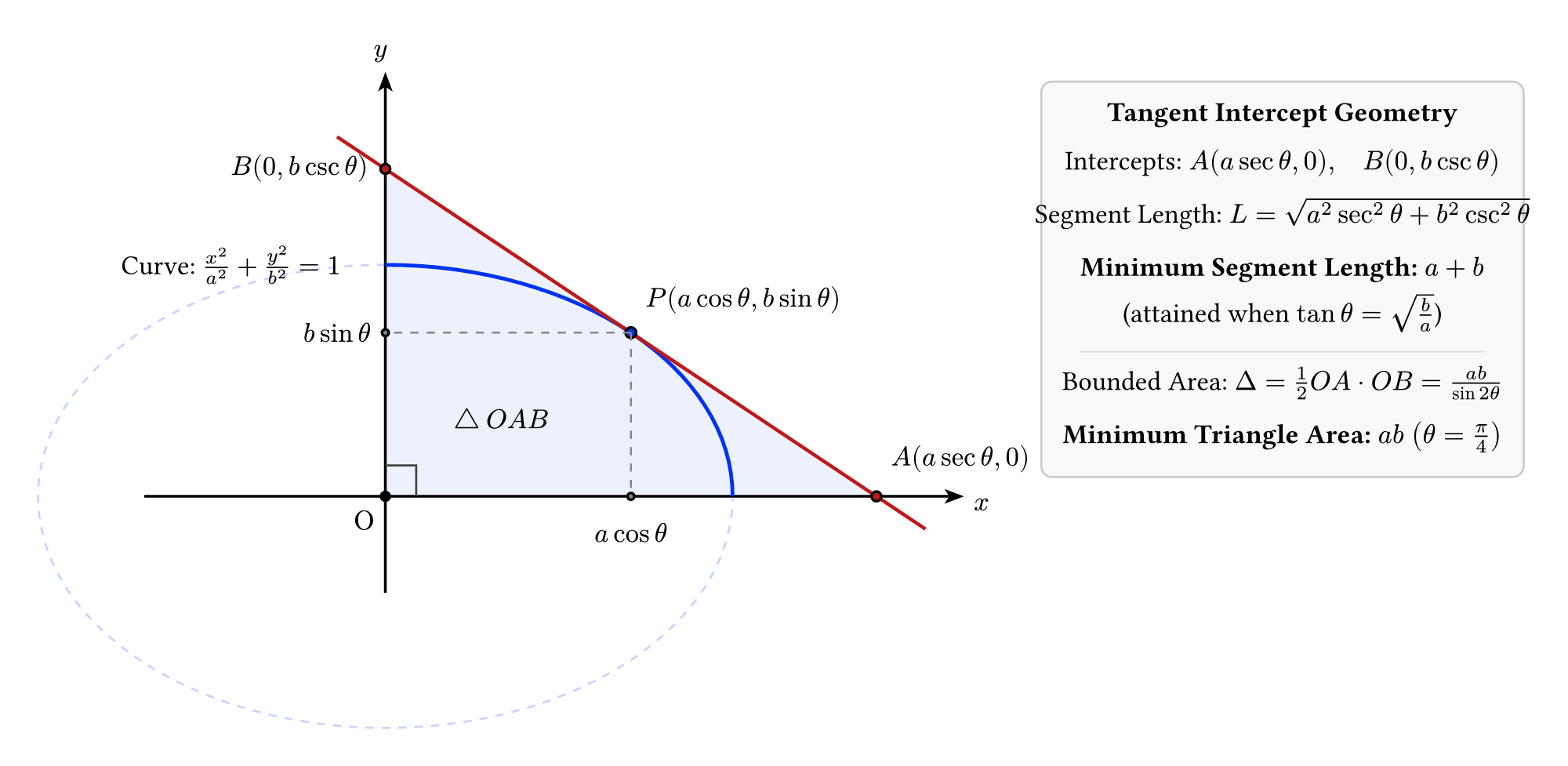
A tangent is drawn to the ellipse \(\frac{x^2}{a^2} + \frac{y^2}{b^2} = 1\) at a point \(P\) in the first quadrant, meeting the \(x\)-axis at \(A\) and the \(y\)-axis at \(B\). Prove that the minimum length of the intercepted segment \(AB\) is \(a + b\), and find the eccentric angle of \(P\) at which this minimum occurs.
Solution:
Let the point of tangency be \(P(a\cos\theta, b\sin\theta)\), where \(\theta \in \left(0, \frac{\pi}{2}\right)\) since \(P\) lies in the first quadrant.
The parametric equation of the tangent is:
Finding the intercepts:
- Setting \(y = 0\) yields \(x_A = a\sec\theta\), so \(A = (a\sec\theta, 0)\).
- Setting \(x = 0\) yields \(y_B = b\csc\theta\), so \(B = (0, b\csc\theta)\).
The length \(L\) of the intercepted segment \(AB\) is:
We express \(\sec^2\theta\) and \(\csc^2\theta\) in terms of \(\tan^2\theta\) and \(\cot^2\theta\):
Completing the square in the variable terms:
Since \(\tan\theta \cot\theta = 1\), the product term simplifies to \(2ab\):
Because \((a\tan\theta - b\cot\theta)^2 \ge 0\) for all real \(\theta\), the minimum value of \(L^2\) is achieved when the squared term vanishes:
Since \(\theta \in \left(0, \frac{\pi}{2}\right)\), \(\tan\theta > 0\), so:
At this optimal eccentric angle, the minimum value of \(L^2\) is:
Alternative Verification by Calculus:
Let \(f(\theta) = a^2\sec^2\theta + b^2\csc^2\theta\). Differentiating with respect to \(\theta\):
Setting \(f'(\theta) = 0\):
Taking the positive square root for the first quadrant:
Substituting \(\tan^2\theta = \frac{b}{a}\) gives \(\sec^2\theta = 1 + \frac{b}{a} = \frac{a+b}{a}\) and \(\csc^2\theta = 1 + \frac{a}{b} = \frac{a+b}{b}\):
Thus, \(L_{\min} = a + b\), which confirms the algebraic result.
Example 4: Minimum Area of Triangle Formed by Tangent and Axes
A tangent is drawn to the ellipse \(\frac{x^2}{a^2} + \frac{y^2}{b^2} = 1\) at a point in the first quadrant, meeting the coordinate axes at \(A\) and \(B\). Find the minimum area of the triangle \(\triangle OAB\), and determine the coordinates of the point of contact where this minimum is achieved.
Solution:
Let the point of contact be \(P(a\cos\theta, b\sin\theta)\) with \(\theta \in \left(0, \frac{\pi}{2}\right)\).
The tangent equation is:
The intercepts on the coordinate axes are \(OA = a\sec\theta\) and \(OB = b\csc\theta\).
Since \(\triangle OAB\) is a right-angled triangle at the origin \(O\), its area \(\Delta\) is:
Using the double-angle identity \(2\sin\theta\cos\theta = \sin 2\theta\):
For \(\theta \in \left(0, \frac{\pi}{2}\right)\), the angle \(2\theta\) satisfies \(0 < 2\theta < \pi\). On this interval:
Because the numerator \(ab\) is constant, the area \(\Delta\) is minimized when the denominator \(\sin 2\theta\) attains its maximum value:
Substituting \(\sin 2\theta = 1\):
Point of Contact:
At \(\theta = \frac{\pi}{4}\):
Thus, the minimum triangle area is \(ab\), achieved when the tangent touches the ellipse at the point \(\left(\frac{a}{\sqrt{2}}, \frac{b}{\sqrt{2}}\right)\).
The equation of this optimal tangent line is:
Example 5: Normals with a Given Slope
Find the equations of the normals to the ellipse \(\frac{x^2}{16} + \frac{y^2}{9} = 1\) that have slope \(m = 1\), and determine the coordinates of their points of contact.
Solution:
From the given equation, \(a^2 = 16\) and \(b^2 = 9\), which gives \(a = 4\), \(b = 3\), and:
The slope of the normal is specified as \(m = 1\).
Equations of the Normals:
Using the slope form of the normal:
Substituting \(m = 1\), \(a^2 - b^2 = 7\), \(a^2 = 16\), and \(b^2 = 9\):
Multiplying through by \(5\):
Thus, the two normals having slope \(1\) are:
Points of Contact:
To find the points of contact, recall the relationship between the slope of the normal and the eccentric angle:
Since \(\tan\theta = \frac{3}{4} > 0\), \(\theta\) lies either in the first or third quadrant:
Case 1: First quadrant (\(\theta\)):
The point of contact is:
Testing this point in the normal equation:
Thus, \(P_1\left(\frac{16}{5}, \frac{9}{5}\right)\) is the point of contact for the normal \(5x - 5y - 7 = 0\).
Case 2: Third quadrant (\(\theta + \pi\)):
The point of contact is:
Testing this point in the normal equation:
Thus, \(P_2\left(-\frac{16}{5}, -\frac{9}{5}\right)\) is the point of contact for the normal \(5x - 5y + 7 = 0\).
Example 6: Tangents Perpendicular to a Given Line
Find the equations of the tangents to the ellipse \(3x^2 + 4y^2 = 12\) that are perpendicular to the line \(2x + y = 4\), and find their points of contact.
Solution:
We first convert the ellipse equation to standard form by dividing by \(12\):
Here, \(a^2 = 4\) and \(b^2 = 3\).
The given line is \(y = -2x + 4\), which has slope \(m_1 = -2\).
Since the required tangents are perpendicular to this line, their slope \(m\) satisfies \(m \cdot (-2) = -1\):
Equations of Tangents:
Using the slope form of the tangent \(y = mx \pm \sqrt{a^2 m^2 + b^2}\):
Multiplying by \(2\):
The two tangents are:
Points of Contact:
The points of contact for tangents of slope \(m\) are:
Here, \(\sqrt{a^2 m^2 + b^2} = 2\).
For the tangent \(y = \frac{1}{2}x + 2\) (\(c = +2\), which corresponds to \(x - 2y + 4 = 0\)):
Point of contact: \(\left(-1, \frac{3}{2}\right)\). Testing in the ellipse equation: \(3(-1)^2 + 4\left(\frac{3}{2}\right)^2 = 3(1) + 4\left(\frac{9}{4}\right) = 3 + 9 = 12\).
For the tangent \(y = \frac{1}{2}x - 2\) (\(c = -2\), which corresponds to \(x - 2y - 4 = 0\)):
Point of contact: \(\left(1, -\frac{3}{2}\right)\). Testing in the ellipse equation: \(3(1)^2 + 4\left(-\frac{3}{2}\right)^2 = 3 + 9 = 12\).
Example 7: Line in Normal Form as a Normal to an Ellipse
If the straight line \(x\cos\alpha + y\sin\alpha = p\) is a normal to the ellipse \(\frac{x^2}{a^2} + \frac{y^2}{b^2} = 1\), prove that:
Solution:
The given straight line is:
Comparing this with the general linear form \(lx + my + n = 0\), we have:
Recall the condition for the general line \(lx + my + n = 0\) to be a normal to the ellipse \(\frac{x^2}{a^2} + \frac{y^2}{b^2} = 1\):
Substituting \(l = \cos\alpha\), \(m = \sin\alpha\), and \(n = -p\):
Since \(\frac{1}{\cos^2\alpha} = \sec^2\alpha\), \(\frac{1}{\sin^2\alpha} = \csc^2\alpha\), and \((-p)^2 = p^2\):
This completes the proof.