Location of a Point with respect to a Parabola
Position of a Point with Respect to a Parabola
We often need to determine whether a given point lies inside, on, or outside a parabola without having to draw its graph. We can do this algebraically by using the focus-directrix property of the parabola.
Let's consider the standard parabola given by the equation:
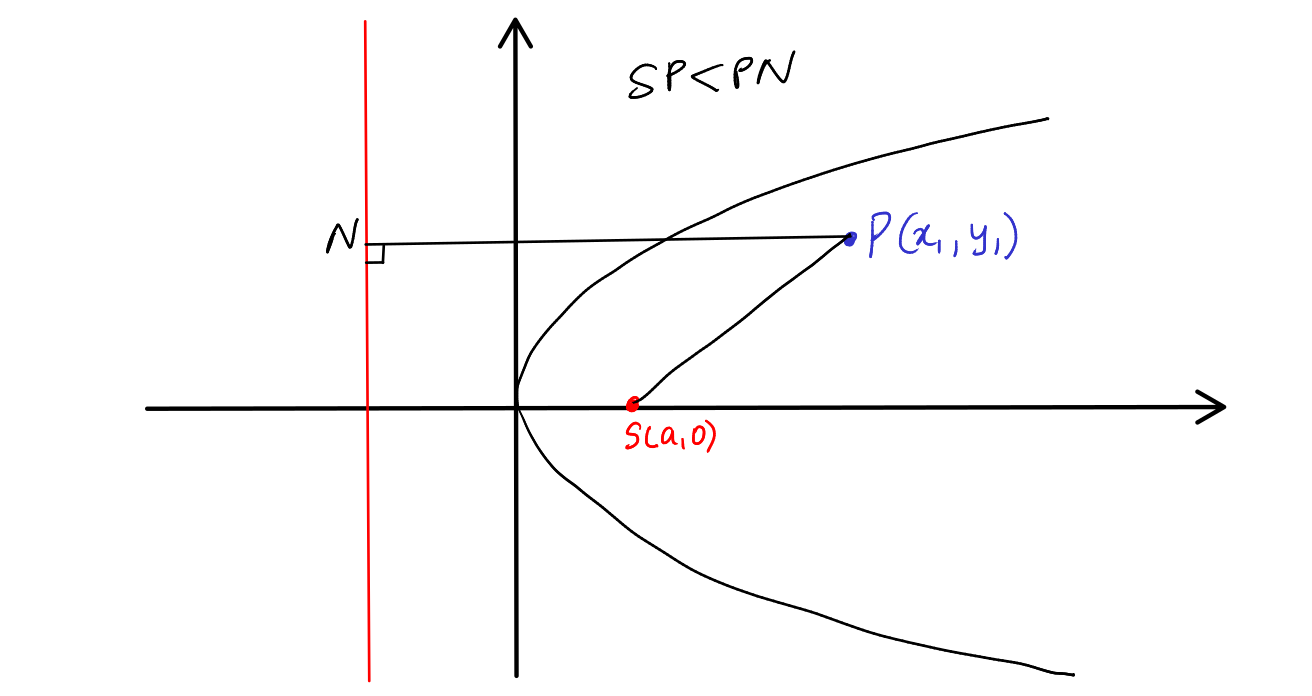
where \(a > 0\). For this parabola, the focus is at the point \(S(a, 0)\) and the directrix is the vertical line with the equation \(x = -a\).
The Defining Property of a Parabola
By definition, any point \(Q(x, y)\) on the parabola is equidistant from the focus \(S\) and the directrix. If we let \(N\) be the foot of the perpendicular from \(Q\) to the directrix, then the defining property is:
Now, let's consider a general point \(P(x_1, y_1)\) in the plane.
- A point \(P\) is inside the parabola if it is closer to the focus than to the directrix. That is, \(SP < PN\).
- A point \(P\) is outside the parabola if it is farther from the focus than from the directrix. That is, \(SP > PN\).
Deriving the Condition
Let's use the distance formula to translate this property into an algebraic condition for a point \(P(x_1, y_1)\).
The distance from \(P(x_1, y_1)\) to the focus \(S(a, 0)\) is:
The perpendicular distance from \(P(x_1, y_1)\) to the directrix \(x = -a\) (or \(x + a = 0\)) is:
For a Point Inside the Parabola
The condition is \(SP < PN\).
Since both sides of the inequality are positive, we can square them without changing the inequality sign:
Now, let's expand the squared terms:
We can cancel the \(x_1^2\) and \(a^2\) terms from both sides:
By moving the \(-2ax_1\) term to the right side, we get our final condition:
Summary 🧐
For a given parabola \(y^2 = 4ax\) and a point \(P(x_1, y_1)\), we can determine its position by evaluating the expression \(y_1^2 - 4ax_1\).
-
If \(y_1^2 - 4ax_1 < 0\) (i.e., \(y_1^2 < 4ax_1\)), the point \(P(x_1, y_1)\) lies inside the parabola.
-
If \(y_1^2 - 4ax_1 = 0\) (i.e., \(y_1^2 = 4ax_1\)), the point \(P(x_1, y_1)\) lies on the parabola.
-
If \(y_1^2 - 4ax_1 > 0\) (i.e., \(y_1^2 > 4ax_1\)), the point \(P(x_1, y_1)\) lies outside the parabola.
This simple algebraic check allows us to determine the position of any point quickly and accurately. The same principle can be applied to other forms of the parabola (e.g., \(x^2 = 4ay\)).