Introduction to Indefinite Integration
In Differential Calculus, our main goal was to find rates of change. Given a function \(F(x)\), we calculated its derivative:
Now, we face the reverse question:
If we are given a derivative \(f(x)\), how do we find the original function \(F(x)\) whose derivative is \(f(x)\)?
This reverse operation is called antidifferentiation or indefinite integration.
While differentiation is like following a clear set of mechanical rules, integration is more like solving a puzzle. It requires spotting patterns, reshaping expressions, and thinking creatively.
The Inverse Problem of Differential Calculus
Let \(f(x)\) be a function defined on an open interval \(I\).
A function \(F(x)\) is called an antiderivative (or a primitive) of \(f(x)\) on \(I\) if its derivative equals \(f(x)\) for every \(x\) in that interval:
Here are three simple examples:
- If \(f(x) = \cos x\), then an antiderivative is \(F(x) = \sin x\), because \(\frac{d}{dx}[\sin x] = \cos x\).
- If \(f(x) = 3x^2\), then an antiderivative is \(F(x) = x^3\), because \(\frac{d}{dx}[x^3] = 3x^2\).
- If \(f(x) = e^{2x}\), then an antiderivative is \(F(x) = \frac{1}{2}e^{2x}\), because \(\frac{d}{dx}\left[\frac{1}{2}e^{2x}\right] = e^{2x}\).
Why an Antiderivative is Never Unique
Notice that an antiderivative is never alone. Consider \(f(x) = 3x^2\). Each of the following functions works equally well:
Why? Because the derivative of any constant \(C\) is zero:
This brings up a natural question: Can two antiderivatives of the same function differ by anything other than an added constant?
The following theorem proves that they cannot.
The Uniqueness Theorem and the Constant of Integration
Theorem: Difference of Two Antiderivatives
If two differentiable functions \(F_1(x)\) and \(F_2(x)\) have the exact same derivative on an interval \(I\), they differ only by an additive constant \(C\):
Proof from First Principles
To prove this, look at the difference between the two functions. Define:
Since \(F_1(x)\) and \(F_2(x)\) are both differentiable, we can differentiate \(H(x)\):
By definition, both \(F_1'(x) = f(x)\) and \(F_2'(x) = f(x)\). Therefore:
for all \(x \in I\).
Now choose any two points \(x_1\) and \(x_2\) in the interval with \(x_1 < x_2\). By the Mean Value Theorem, there must be some point \(c\) between \(x_1\) and \(x_2\) such that:
But we just showed that \(H'(x) = 0\) everywhere on \(I\). In particular, \(H'(c) = 0\). That means:
Since \(x_1\) and \(x_2\) were any two points in the interval, \(H(x)\) takes the exact same value everywhere. That means \(H(x)\) is a constant function:
This completes the proof.
Key Takeaway: Once you find just one antiderivative \(F(x)\) of \(f(x)\), all possible antiderivatives are described by:
\[F(x) + C\]where \(C\) is an arbitrary constant called the constant of integration.
Notation and Terminology
To write the complete family of antiderivatives of \(f(x)\), we use the symbol introduced by Gottfried Wilhelm Leibniz:
Each part of this symbol has a specific meaning:
- The Integral Sign (\(\int\)): An elongated letter 'S', standing for summa (Latin for sum). While we are currently finding antiderivatives, this symbol hints at the deep connection between integration and calculating areas under curves (the Definite Integral).
- The Integrand (\(f(x)\)): The function you want to integrate.
- The Differential (\(dx\)): Tells you that \(x\) is the variable of integration.
- The Indefinite Integral (\(\int f(x)\,dx\)): The entire family of antiderivatives of \(f(x)\).
- The Constant of Integration (\(C\)): An arbitrary real constant that gives each member of the family.
Two Opposite Operations
Differentiation and indefinite integration undo each other, with one small difference:
1. Differentiating an Integral:
Differentiating an indefinite integral brings you right back to the original function \(f(x)\). The constant does not appear.
2. Integrating a Derivative:
Integrating the derivative of a function brings you back to the function, but with an added constant \(C\).
Geometric Interpretation: A Family of Parallel Curves
What does the equation \(y = \int f(x)\,dx = F(x) + C\) look like on a graph?
It does not represent just one single curve. It represents an entire family of curves.
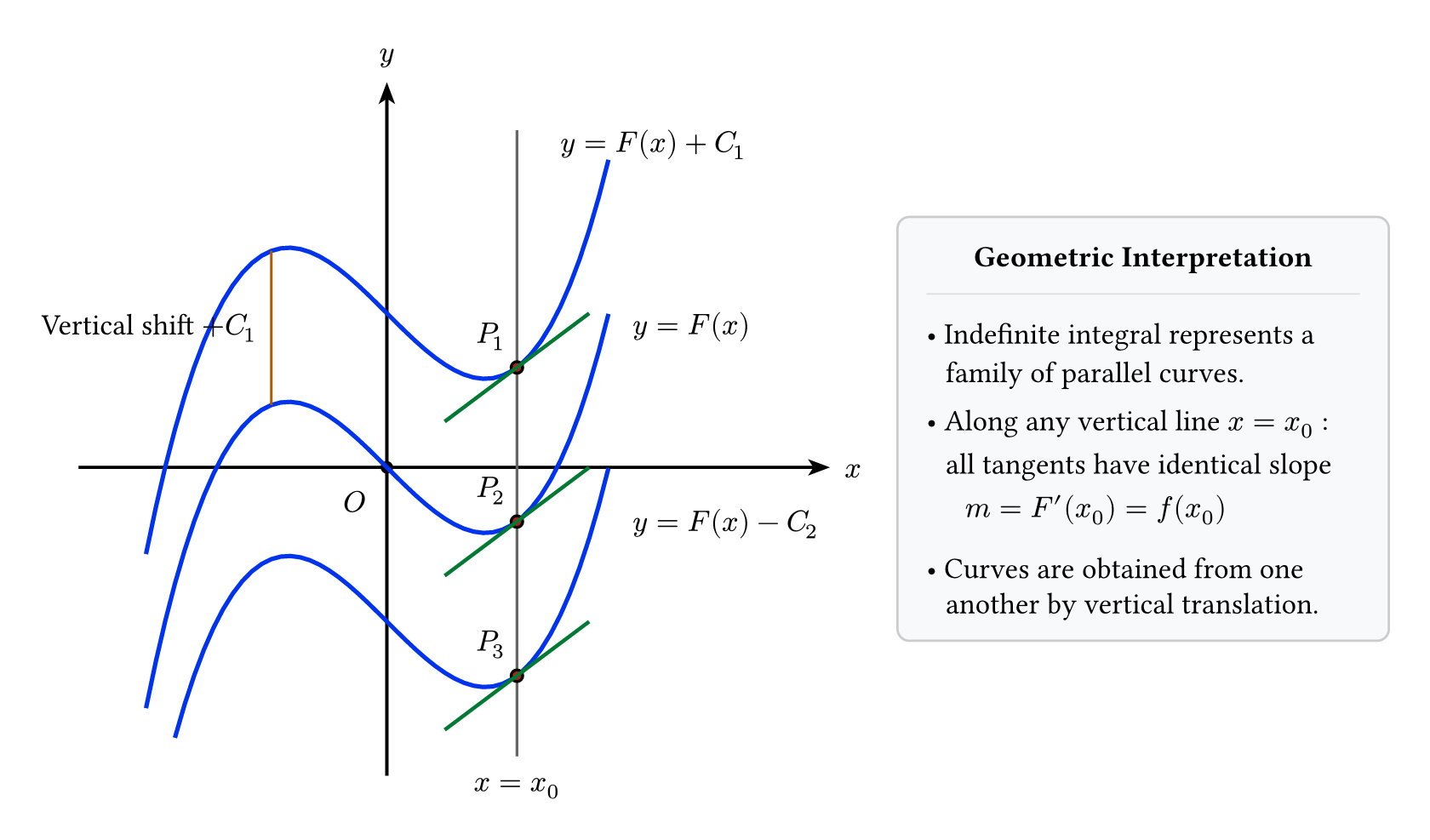
Every curve in this family is simply a vertical shift of the base curve \(y = F(x)\):
- Adding a number to \(C\) shifts the graph straight up.
- Subtracting from \(C\) shifts the graph straight down.
- The horizontal shape never changes.
Equal Slopes Along Any Vertical Line
Now pick any fixed value of \(x\), say \(x = x_0\), and draw a vertical line through it.
This line cuts the curves at different points: \(P_1, P_2, P_3, \dots\)
What is the slope of the tangent at each of these points?
The slope is given by the derivative:
Notice something important: this slope depends only on \(x_0\). It does not depend on \(C\) at all!
Along any vertical line \(x = x_0\), the tangent lines to all curves in the family \(y = F(x) + C\) are parallel, each having the identical slope \(m = f(x_0)\).
So, geometrically, finding an indefinite integral means finding a family of curves whose tangents have a given slope \(f(x)\) at each point \(x\).
The Asymmetry: Differentiation versus Integration
At first, you might think: "If integration is just differentiation in reverse, shouldn't we just undo the steps of differentiation backward?"
The answer is a surprising no. Between differentiation and integration lies a big difference.
Why Differentiation is Straightforward
Differentiation is completely mechanical. No matter how complicated a function looks, you can always find its derivative by following standard rules:
- The Power Rule: \(\frac{d}{dx}[x^n] = n x^{n-1}\)
- The Product Rule: \(\frac{d}{dx}[u v] = u' v + u v'\)
- The Quotient Rule: \(\frac{d}{dx}\left[\frac{u}{v}\right] = \frac{u' v - u v'}{v^2}\)
- The Chain Rule: \(\frac{d}{dx}[f(g(x))] = f'(g(x)) \cdot g'(x)\)
You follow these rules step by step, and the answer comes out directly.
A Complicated Example of Differentiation
Let us see what happens when we differentiate a complicated function.
Consider:
Let us find \(F'(x)\) using the quotient rule:
First, differentiate the numerator \(u(x)\) using the product rule on \(x \cos x\):
Next, differentiate the denominator \(v(x)\) using the product rule on \(x \sin x\):
Now apply the quotient rule:
Now expand the brackets in the numerator:
Look closely at what happens here:
- The middle terms \(+x \sin x \cos x\) and \(-x \sin x \cos x\) cancel each other out completely!
- The remaining terms give \(x^2(\sin^2 x + \cos^2 x)\). Since \(\sin^2 x + \cos^2 x = 1\), the numerator simplifies to just \(x^2\).
The derivative is:
The final answer looks remarkably simple and clean.
The "Spilling Coffee" Analogy
Now suppose someone clears the board and gives you only the final derivative:
and asks you: "What was the original function \(F(x)\)?"
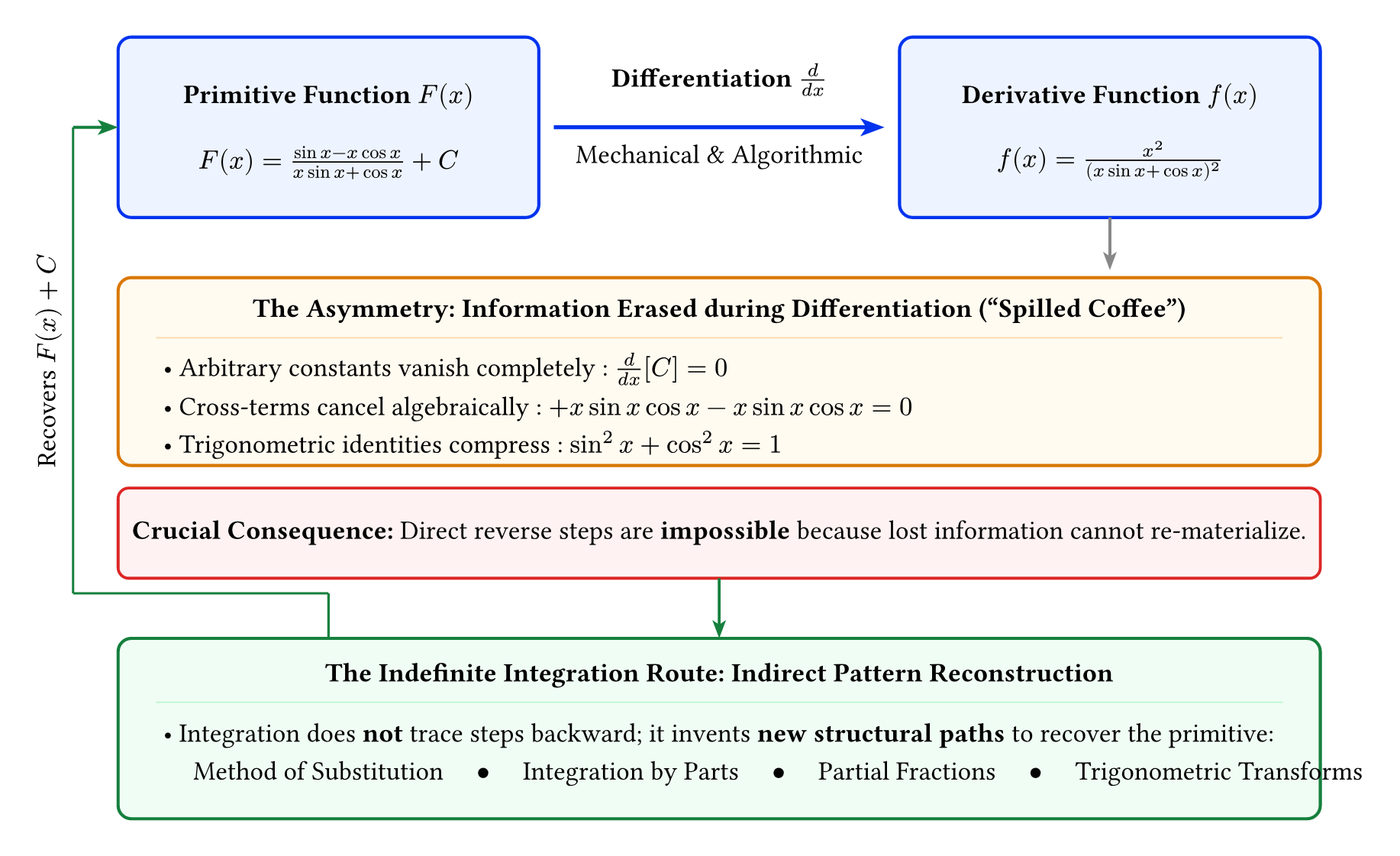
Can you solve this by simply running the differentiation steps backward?
No, you cannot.
Here is why: differentiation erases mathematical information:
Cancellations Disappear:
During differentiation, \(+x \sin x \cos x\) and \(-x \sin x \cos x\) canceled to zero. Once they canceled, every trace of them was gone.
Identities Merge:
The term \(\sin^2 x + \cos^2 x\) combined into \(1\). Looking at \(x^2\), there is no clue telling you that it came from \(x^2(\sin^2 x + \cos^2 x)\).
Constants Vanish:
If the original function had \(+ 50\) at the end, its derivative was \(0\). The number \(50\) completely disappeared.
Differentiation is like spilling a cup of coffee onto a table.
Spilling the coffee takes only a second: the liquid spreads, mixes, and stains the surface. The forward action is quick and follows simple rules of motion.
But once the coffee has spilled, you cannot simply "play the movie backward" to collect it back into the cup. You cannot command each droplet of spilled coffee to retrace its exact path through the air. The information about the original state was lost in the spill.
In the same way, looking at \(\frac{x^2}{(x \sin x + \cos x)^2}\), you cannot just run derivative steps in reverse. You cannot guess out of thin air that you need to add and subtract \(x \sin x \cos x\).
Because we cannot retrace backward steps directly, integration requires indirect, creative strategies:
- Spotting patterns in expressions (like recognizing product or quotient structures).
- Making smart substitutions to convert hard expressions into simpler ones.
- Splitting products using integration by parts.
- Breaking down fractions using partial fractions.
Integration is not just running differentiation backward; it is finding a clever path to rebuild the original function.
Existence versus Closed-Form Expressibility
This brings us to a deep question: Can every function be integrated?
To answer this clearly, we must separate two different ideas: 1. Does an antiderivative exist mathematically? 2. Can we write it down in closed form using functions we already know?
Understanding Closed-Form and Elementary Functions
1. Elementary Functions: These are the everyday functions we study in school:
- Polynomials: like \(x^3 - 4x + 1\)
- Rational functions: fractions of polynomials, like \(\frac{x + 1}{x^2 + 4}\)
- Roots: like \(\sqrt{x}, \sqrt[3]{x^2 + 1}\)
- Exponentials: like \(e^x, 2^x\)
- Logarithms: like \(\ln x, \log_{10} x\)
- Trigonometric functions: \(\sin x, \cos x, \tan x, \sec x, \csc x, \cot x\)
- Inverse trigonometric functions: \(\arcsin x, \arctan x, \dots\)
and anything formed by combining a finite number of these using \(+\), \(-\), \(\times\), \(\div\), and function compositions.
2. Closed Form: A formula is said to be in closed form if it can be written down using a finite combination of these elementary functions.
For example, \(F(x) = \frac{\sin x - x \cos x}{x \sin x + \cos x}\) is a closed-form formula. Infinite series and unevaluated integrals are not closed form.
Does an Antiderivative Always Exist?
Yes. A major result of calculus (the Fundamental Theorem of Calculus) guarantees that every continuous function \(f(x)\) on an interval \([a, b]\) has an antiderivative:
This function \(F(x)\) really exists, is continuous, and satisfies \(F'(x) = f(x)\).
Can it Always be Written in Closed Form?
No. This is one of the most surprising facts in mathematics:
While every elementary function has an elementary derivative, not every elementary function has an elementary antiderivative.
There are simple, smooth functions whose antiderivative exists, but no combination of polynomials, roots, powers, logs, or trigonometric functions can ever express it.
Here are famous examples:
1. The Sinc Function:
The function \(\frac{\sin x}{x}\) is smooth and continuous everywhere (with value \(1\) at \(x = 0\)). Its antiderivative exists, but no formula made of elementary functions can ever give it.
To work with it, mathematicians gave this antiderivative a new name, the Sine Integral:
2. The Bell Curve (Gaussian Function):
The famous bell curve \(y = e^{-x^2}\) is used throughout probability and physics. Its antiderivative cannot be written in closed elementary form. It defines the Error Function:
3. The Logarithmic Integral:
4. The Exponential Integral:
5. Non-Elementary Trigonometric and Elliptic Integrals:
How Do We Know This for Sure?
Could it be that we just have not been smart enough to find the right formula?
No. In 1835, the French mathematician Joseph Liouville proved a celebrated theorem (Liouville's Theorem). Using algebra, he proved with absolute certainty that no elementary formula can ever differentiate to functions like \(\frac{\sin x}{x}\) or \(e^{-x^2}\).
A Reassuring Note for Students: When you struggle with an integral, remember: if an integral cannot be solved with elementary functions, it is not your fault—sometimes an elementary formula simply does not exist! In this course, we will focus exclusively on functions that can be integrated in closed form.
Summary of Core Concepts
| Concept | Mathematical Form | Meaning in Simple Words |
|---|---|---|
| Inverse Problem | Given \(f(x)\), find \(F(x)\) such that \(F'(x) = f(x)\) | The main goal of indefinite integration. |
| Antiderivative (Primitive) | \(F'(x) = f(x)\) | A function whose derivative is the given function. |
| Uniqueness Theorem | \(F_1(x) - F_2(x) = C\) | Any two antiderivatives on an interval differ only by a constant (proved using the Mean Value Theorem). |
| Indefinite Integral | \(\int f(x)\,dx = F(x) + C\) | The entire family of all possible antiderivatives. |
| Geometric Meaning | \(y = F(x) + C\) | Vertically shifted parallel curves; all curves have the exact same tangent slope \(m = f(x_0)\) along any vertical line \(x = x_0\). |
| Asymmetry of Calculus | Forward vs. Reverse | Differentiation erases information like spilled coffee; integration requires smart pattern-matching to reconstruct the primitive. |
| Closed-Form Expressibility | Elementary Functions | Antiderivatives always exist for continuous functions, but some (like \(\frac{\sin x}{x}, e^{-x^2}\)) cannot be written in closed form (Liouville's Theorem). |
What Lies Ahead
Now that we understand what an indefinite integral is and how it works geometrically, we are ready to build our calculation skills:
- In the next tutorial, Standard Integrals and Fundamental Theorems, we establish our standard list of basic formulas, verify key trigonometric and logarithmic forms, and prove three essential theorems for handling constants, sums, and linear arguments (\(ax + b\)).
- After that, we learn the three core techniques for solving harder integrals: the Method of Substitution (reversing the Chain Rule), Integration by Parts (reversing the Product Rule), and Partial Fractions (splitting rational functions).