Pole and Polar with respect to a Parabola
In coordinate geometry, we are familiar with lines that touch a curve directly, such as a tangent at a single point or a normal perpendicular to it. The concept of pole and polar introduces another fundamental relationship between points and straight lines.
Every point in the plane (called the pole) is associated with a unique straight line (called its polar), and conversely, every straight line is associated with a unique pole. This concept connects tangents, chords of contact, harmonic division, and the relationship between the focus and the directrix into one unified framework.
Geometric Definition of Pole and Polar
Consider the standard parabola:
having its vertex at \(O(0, 0)\), focus at \(S(a, 0)\), and the \(x\)-axis as its axis of symmetry.
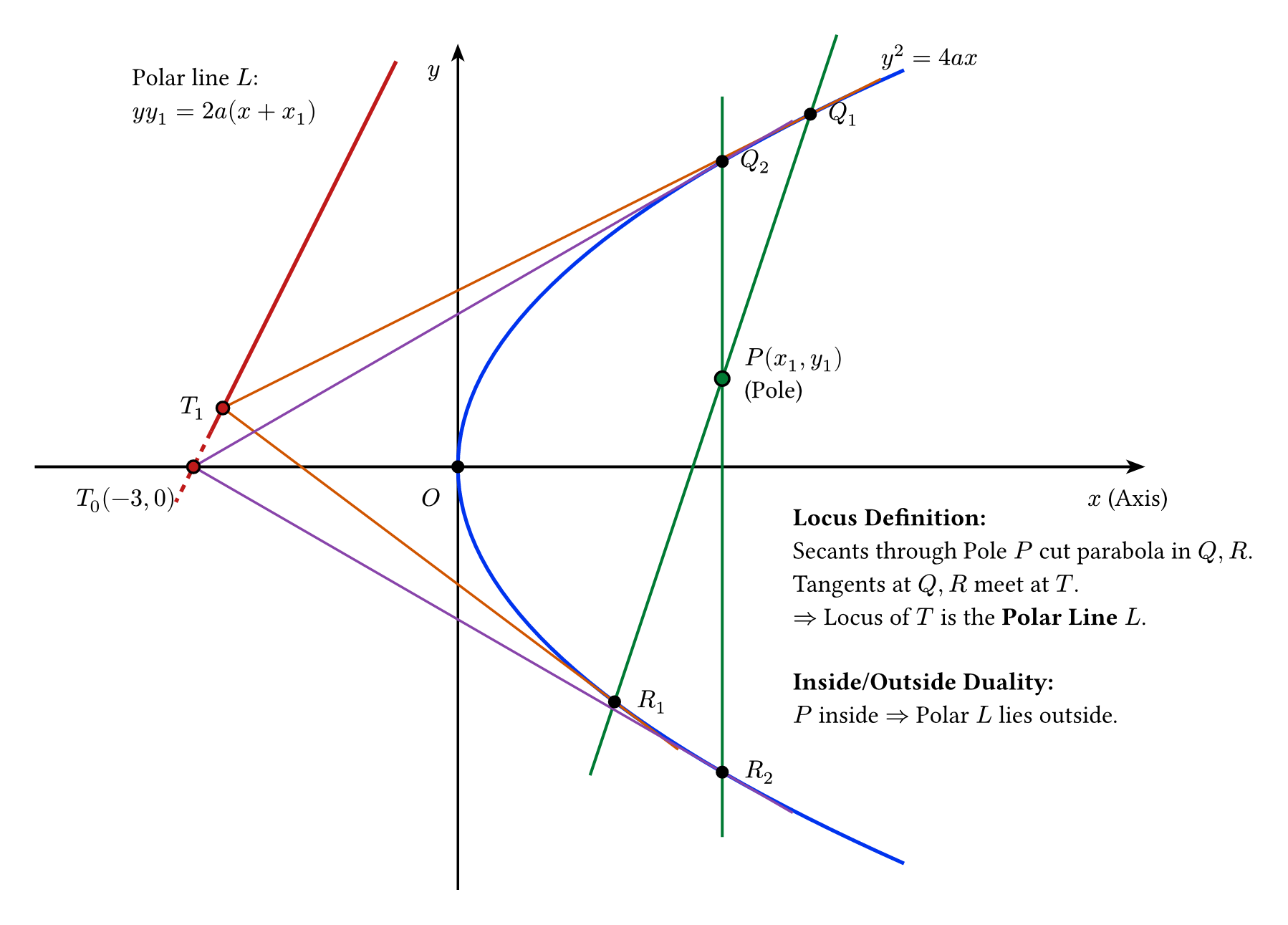
Let \(P(x_1, y_1)\) be a given fixed point in the Cartesian plane. Through \(P\), draw any secant line that intersects the parabola at two points \(Q\) and \(R\).
At these two points of intersection, draw the tangents to the parabola. Let these tangents intersect at a point \(T(h, k)\). As the secant line rotates about the fixed point \(P\), the points of contact \(Q\) and \(R\) move along the parabola, and consequently the point of intersection \(T\) moves in the plane.
The locus of this point of intersection \(T\) is a straight line. This straight line is called the polar of the point \(P\) with respect to the parabola, and the point \(P\) is called the pole of the straight line.
Derivation of the Equation of the Polar
To find the equation of the locus of \(T(h, k)\), consider the geometric relationship from the viewpoint of \(T\).
Let \(T(h, k)\) be any point on the locus. By definition, tangents drawn from \(T(h, k)\) to the parabola touch the curve at \(Q\) and \(R\). Therefore, the straight line \(QR\) is the chord of contact of tangents drawn from \(T(h, k)\) to the parabola \(y^2 = 4ax\).
The equation of the chord of contact for a point \(T(h, k)\) is given by the standard formula:
Because the chord \(QR\) passes through the fixed point \(P(x_1, y_1)\), the coordinates of \(P\) must satisfy this equation:
Rearranging this expression:
To obtain the locus of the point \(T(h, k)\), replace \((h, k)\) with the running coordinates \((x, y)\):
This is a linear equation in \(x\) and \(y\), which proves that the locus of \(T\) is a straight line.
Theorem (Equation of the Polar)
The polar of the point \(P(x_1, y_1)\) with respect to the parabola \(y^2 = 4ax\) is given by:\[yy_1 = 2a(x + x_1)\]In standard \(T\) notation, this is written compactly as \(T = 0\), where:
\[T \equiv yy_1 - 2a(x + x_1)\]
Position of the Pole and Nature of the Polar
The algebraic equation \(T = 0\) represents three distinct geometric lines depending on whether the point \(P(x_1, y_1)\) lies outside, on, or inside the parabola.
Recall the position function for a point \(P(x_1, y_1)\) with respect to \(y^2 = 4ax\):
Case 1: Point \(P\) Lies Outside the Parabola (\(S_1 > 0\))
When \(P(x_1, y_1)\) lies outside the parabola, two real and distinct tangents can be drawn from \(P\) to the curve.
If the rotating secant through \(P\) turns until it becomes one of these tangent lines, the two intersection points \(Q\) and \(R\) merge into the single point of tangency. Consequently, the tangents at \(Q\) and \(R\) meet at that point of tangency on the parabola.
Therefore, the polar line must pass through both points of tangency. This means that when \(P\) lies outside the parabola, its polar is simply the chord of contact of the two tangents drawn from \(P\). The polar intersects the parabola in two distinct real points.
Case 2: Point \(P\) Lies on the Parabola (\(S_1 = 0\))
When \(P(x_1, y_1)\) lies on the curve, the two points of contact coalesce with \(P\) itself.
The chord of contact becomes the tangent line to the parabola at \(P\). Thus, the polar of any point lying on the parabola is the tangent at that point.
Case 3: Point \(P\) Lies Inside the Parabola (\(S_1 < 0\))
When \(P(x_1, y_1)\) lies inside the parabola, no real tangents can be drawn from \(P\) to the curve.
However, every straight line drawn through \(P\) is a real secant that cuts the parabola at two real points \(Q\) and \(R\). The tangents at \(Q\) and \(R\) always intersect outside the parabola.
The locus of these intersection points is a straight line lying entirely outside the parabola. This polar line does not meet the parabola in real points.
| Position of Pole \(P(x_1, y_1)\) | Sign of \(S_1 = y_1^2 - 4ax_1\) | Nature of the Line \(T = 0\) | Intersection with Parabola |
|---|---|---|---|
| Outside Parabola | \(S_1 > 0\) | Chord of contact of tangents from \(P\) | Two distinct real points |
| On Parabola | \(S_1 = 0\) | Tangent line to the parabola at \(P\) | Point of tangency (repeated point) |
| Inside Parabola | \(S_1 < 0\) | Line lying outside the parabola | No real points of intersection |
Illustrative Example: Finding Polars for Different Point Locations
Problem. Find the equations of the polars of the following points with respect to the parabola \(y^2 = 8x\): (a) \(A(4, 8)\), (b) \(B(2, 4)\), and (c) \(C(3, 2)\). State the geometric nature of each polar.
Solution. For the parabola \(y^2 = 8x\), comparing with \(y^2 = 4ax\) gives \(4a = 8 \implies a = 2\).
The general equation of the polar of a point \((x_1, y_1)\) is:
Evaluating each point:
Point \(A(4, 8)\):
Check the position of the point:
Because \(S_1 > 0\), the point \(A\) lies outside the parabola. Its polar is:
This polar is the chord of contact of the two tangents drawn from \(A(4, 8)\) to the parabola, cutting the curve at two distinct points.
Point \(B(2, 4)\):
Check the position of the point:
Because \(S_1 = 0\), the point \(B\) lies on the parabola. Its polar is:
This polar is the tangent line to the parabola at \(B(2, 4)\).
Point \(C(3, 2)\):
Check the position of the point:
Because \(S_1 < 0\), the point \(C\) lies inside the parabola. Its polar is:
This polar lies entirely outside the parabola and does not cut the curve in real points.
Finding the Pole of a Given Straight Line
Because the relationship between a pole and its polar is reciprocal, given any straight line, we can find the unique pole that produces it.
Let the given straight line be:
Let \(P(x_1, y_1)\) be its pole with respect to the parabola \(y^2 = 4ax\).
The equation of the polar of \(P(x_1, y_1)\) is:
Since this line represents the same straight line as \(lx + my + n = 0\), the coefficients of corresponding terms must be proportional:
From the first two ratios:
From the first and third ratios:
Theorem (Coordinates of the Pole)
The pole of the straight line \(lx + my + n = 0\) with respect to the parabola \(y^2 = 4ax\) is given by:\[P\left(x_1, y_1\right) = \left(\frac{n}{l}, -\frac{2am}{l}\right)\]provided that \(l \neq 0\).
If \(l = 0\), the given line is parallel to the axis of the parabola (\(my + n = 0 \implies y = -\frac{n}{m}\)). The formula shows that its pole lies at infinity along the axis, which corresponds to the property that chords parallel to the axis have their tangents meeting at infinity.
Illustrative Example: Finding the Pole of a Given Line
Problem. Find the pole of the straight line \(3x - 2y + 12 = 0\) with respect to the parabola \(y^2 = 6x\).
Solution. For the parabola \(y^2 = 6x\), comparing with \(y^2 = 4ax\) gives:
The given line is:
Here, \(l = 3\), \(m = -2\), and \(n = 12\).
Using the pole formulas:
Thus, the pole is \(P(4, 2)\).
Verification: The polar of \((4, 2)\) with respect to \(y^2 = 6x\) is:
This matches the given line.
Harmonic Properties of Pole and Polar
An important geometric property of pole and polar is its connection with harmonic division.
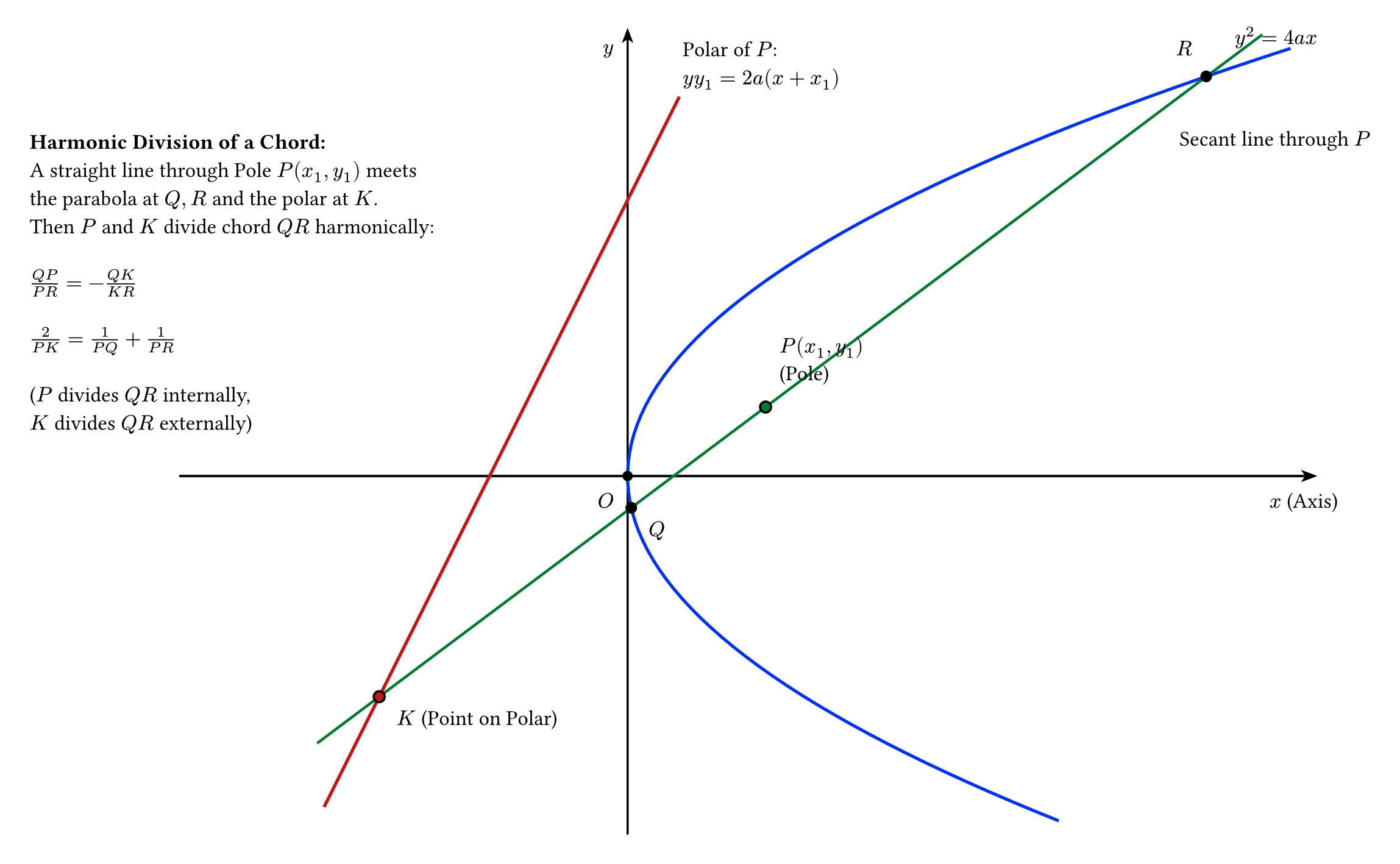
Theorem (Harmonic Division of a Chord)
If any straight line drawn through a pole \(P\) intersects the parabola at two points \(Q\) and \(R\), and intersects the polar of \(P\) at a point \(K\), then the points \(P\) and \(K\) divide the chord \(QR\) harmonically:\[\frac{QP}{PR} = -\frac{QK}{KR}\]In terms of directed distances measured from the pole \(P\):
\[\frac{2}{PK} = \frac{1}{PQ} + \frac{1}{PR}\]
Proof
Let the pole be \(P(x_1, y_1)\). Consider any line drawn through \(P\) making an angle \(\theta\) with the positive \(x\)-axis.
Using the distance form of a straight line, any point on this line at a directed distance \(r\) from \(P\) has coordinates:
To find where this line cuts the parabola \(y^2 = 4ax\), substitute these coordinates into the parabola equation:
Expanding and arranging in powers of \(r\):
This quadratic equation in \(r\) gives two roots \(r_1\) and \(r_2\), which are the directed distances from \(P\) to the two intersection points \(Q\) and \(R\) on the parabola:
By the relations between roots and coefficients:
Dividing the sum by the product gives the sum of the reciprocals:
Now, let \(K\) be the point where this line meets the polar of \(P\). The equation of the polar of \(P(x_1, y_1)\) is:
Let \(r_K = PK\) be the directed distance from \(P\) to \(K\). Substituting \(x = x_1 + r_K\cos\theta\) and \(y = y_1 + r_K\sin\theta\) into the polar equation:
Solving for \(\frac{1}{r_K}\):
Comparing this with the sum \(\frac{1}{r_1} + \frac{1}{r_2}\), we see that:
This proves that \(PK\) is the harmonic mean of \(PQ\) and \(PR\). Thus, \(P\) and \(K\) divide the segment \(QR\) harmonically—one internally and the other externally in the exact same ratio.
Focus and Directrix as Pole and Polar
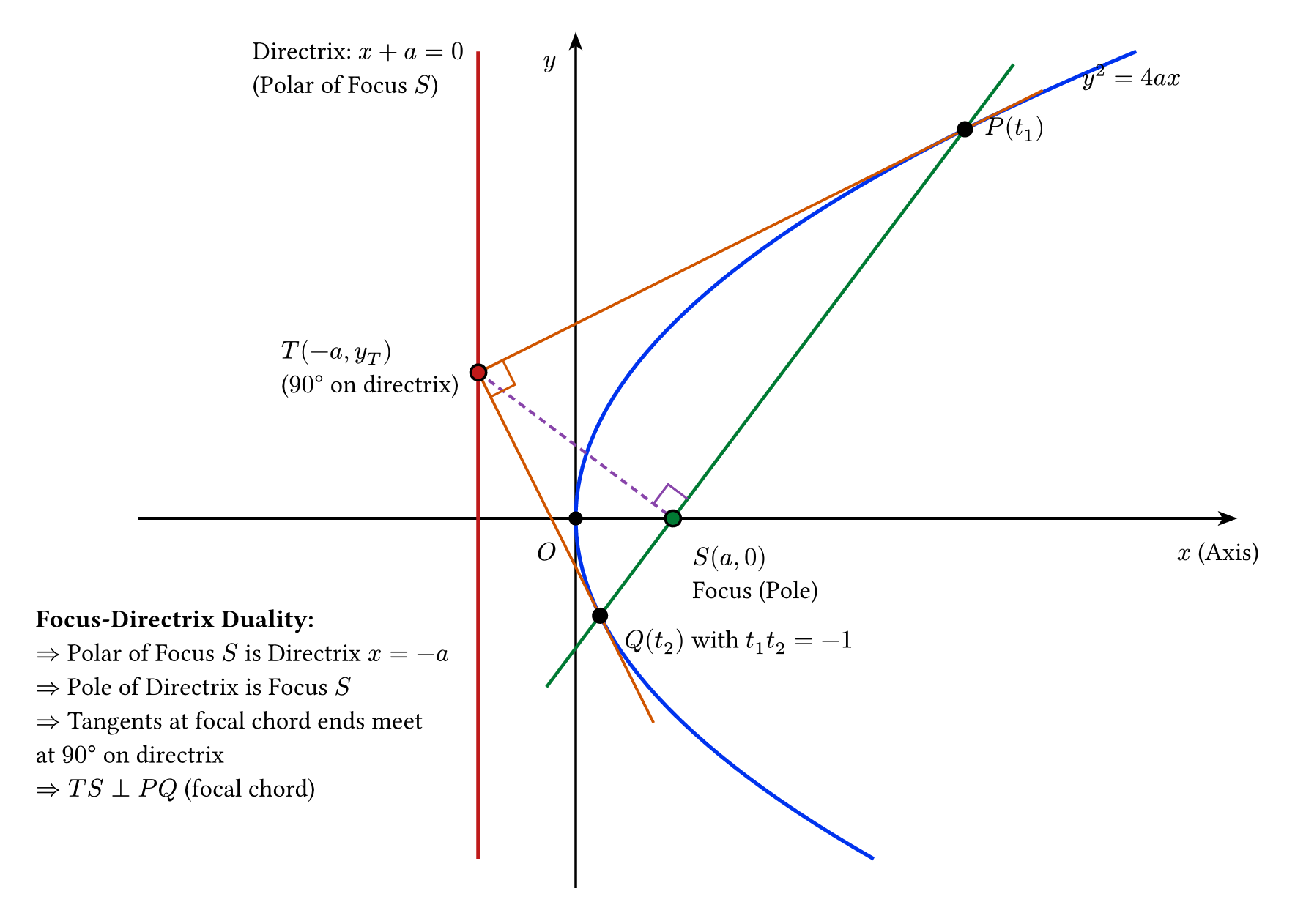
A fundamental property of the parabola is that its focus and directrix are a pole and polar pair.
The Polar of the Focus is the Directrix
Consider the focus of the parabola \(y^2 = 4ax\):
Let \(S(a, 0)\) be the pole. Substituting \(x_1 = a\) and \(y_1 = 0\) into the polar equation \(yy_1 = 2a(x + x_1)\):
Because \(a \neq 0\):
This is the equation of the directrix of the parabola.
Theorem (Polar of the Focus)
The polar of the focus of a parabola is its directrix.
The Pole of the Directrix is the Focus
Conversely, consider the directrix of the parabola \(y^2 = 4ax\):
Here, \(l = 1\), \(m = 0\), and \(n = a\). Using the pole formulas:
Thus, the pole of the directrix is the focus \(S(a, 0)\).
Important Properties of the Focus and Directrix
This focus-directrix pairing gives several useful geometric results:
1. Tangents at the Ends of a Focal Chord Meet on the Directrix:
Any line passing through the focus is a focal chord. By definition, tangents drawn at the ends of any chord through a pole intersect on its polar.
Since the directrix is the polar of the focus, tangents at the extremities of any focal chord always meet on the directrix.
2. Tangents from the Directrix Meet at Right Angles:
Tangents drawn to a parabola from any point on the directrix are perpendicular to each other (\(90^\circ\)). This confirms that the directrix acts as the director circle of the parabola.
3. The Line from the Directrix to the Focus is Perpendicular to the Focal Chord:
Let \(T\) be any point on the directrix, and let \(PQ\) be the corresponding focal chord through \(S\).
The straight line \(TS\) joining \(T\) to the focus is always perpendicular to the focal chord \(PQ\):
Conjugate Points and Conjugate Lines
The idea of polarity naturally leads to pairs of points and pairs of lines that have reciprocal relationships.
Conjugate Points
Definition (Conjugate Points)
Two points \(P(x_1, y_1)\) and \(Q(x_2, y_2)\) are called conjugate points with respect to a parabola if the polar of \(P\) passes through \(Q\).
The polar of \(P(x_1, y_1)\) with respect to \(y^2 = 4ax\) is:
If this line passes through \(Q(x_2, y_2)\), substituting the coordinates of \(Q\) gives:
Notice that this equation is completely symmetric in \((x_1, y_1)\) and \((x_2, y_2)\).
If we write the polar of \(Q(x_2, y_2)\), which is \(yy_2 = 2a(x + x_2)\), and check whether \(P(x_1, y_1)\) lies on it, we obtain the exact same condition:
This gives a reciprocal property:
Theorem (Reciprocal Property of Conjugate Points)
If the polar of a point \(P\) passes through a point \(Q\), then the polar of \(Q\) automatically passes through \(P\).
Conjugate Lines
Definition (Conjugate Lines)
Two straight lines \(L_1\) and \(L_2\) are called conjugate lines with respect to a parabola if the pole of \(L_1\) lies on \(L_2\) (which also means that the pole of \(L_2\) lies on \(L_1\)).
Let the two lines be:
The pole of line \(L_1\) with respect to \(y^2 = 4ax\) is:
For \(L_1\) and \(L_2\) to be conjugate lines, the pole \(P_1\) must lie on line \(L_2\):
Multiplying through by \(l_1\):
Rearranging terms:
Because this condition is symmetric under swapping the indices \(1\) and \(2\), the pole of \(L_2\) also lies on \(L_1\).
Theorem (Condition for Conjugate Lines)
Two straight lines \(l_1 x + m_1 y + n_1 = 0\) and \(l_2 x + m_2 y + n_2 = 0\) are conjugate lines with respect to \(y^2 = 4ax\) if and only if:\[l_1 n_2 + l_2 n_1 = 2a m_1 m_2\]
Self-Conjugate Triangles
A triangle is called a self-conjugate triangle (or polar triangle) with respect to a parabola if each vertex is the pole of the opposite side.
In such a triangle:
- Each side is the polar of the opposite vertex.
- The three vertices form a set of mutually conjugate points.
- The three sides form a set of mutually conjugate lines.
Solved Examples
Example 1: Finding the Locus of Poles of Chords Passing Through a Fixed Point
Problem. Chords of the parabola \(y^2 = 4ax\) pass through a fixed point \((h, k)\). Find the locus of their poles.
Solution. Let the variable chord be \(QR\), and let its pole be \(P(x_1, y_1)\).
The equation of the polar of \(P(x_1, y_1)\) with respect to \(y^2 = 4ax\) is:
By the definition of pole and polar, this polar line is the chord \(QR\).
Since this chord always passes through the fixed point \((h, k)\), the coordinates \((h, k)\) must satisfy the polar equation:
To find the locus of the pole \(P(x_1, y_1)\), replace \((x_1, y_1)\) with running coordinates \((x, y)\):
This locus is a straight line.
Notice that this line is the polar of the fixed point \((h, k)\) with respect to the parabola. This illustrates the reciprocal principle: when a chord turns about a fixed point, its pole moves along the polar of that fixed point.
Example 2: Locus of the Pole of Chords Subtending a Right Angle at the Vertex
Problem. Find the locus of the pole of chords of the parabola \(y^2 = 4ax\) that subtend a right angle at the vertex of the parabola.
Solution. Let \(P(x_1, y_1)\) be the pole of a chord \(QR\).
The equation of the chord \(QR\), which is the polar of \(P(x_1, y_1)\), is:
To find the combined equation of the two straight lines joining the origin \(O(0, 0)\) (the vertex) to the points of intersection \(Q\) and \(R\), homogenize the parabola equation \(y^2 = 4ax\) to second degree using the chord equation:
Multiplying both sides by \(2ax_1\):
Dividing through by \(2a\):
This homogeneous second-degree equation represents the pair of lines \(OQ\) and \(OR\).
For these two lines to be perpendicular (subtending a right angle at the vertex), the sum of the coefficients of \(x^2\) and \(y^2\) must be zero:
Replacing \(x_1\) with \(x\), the required locus of the pole is the straight line:
This locus is a vertical straight line parallel to the directrix, situated at a distance of \(4a\) to the left of the vertex.
Example 3: Condition for Points on the Axis to be Conjugate
Problem. Prove that two points on the axis of the parabola \(y^2 = 4ax\) are conjugate if and only if the vertex bisects the segment joining them, meaning they lie at equal distances from the vertex on opposite sides of the tangent at the vertex.
Solution. Let the two points on the axis (the \(x\)-axis) be \(P(x_1, 0)\) and \(Q(x_2, 0)\), so \(y_1 = 0\) and \(y_2 = 0\).
The condition for two points \((x_1, y_1)\) and \((x_2, y_2)\) to be conjugate with respect to \(y^2 = 4ax\) is:
Substituting \(y_1 = 0\) and \(y_2 = 0\):
Since \(a \neq 0\):
This shows that the \(x\)-coordinates of the two points are equal in magnitude and opposite in sign.
Therefore, the vertex \(O(0, 0)\) is the midpoint of the segment \(PQ\). The two points lie at equal distances from the vertex on opposite sides of the \(y\)-axis (\(x = 0\)).
Example 4: Locus of Poles of Tangents to an Auxiliary Circle
Problem. Tangents are drawn to the circle \(x^2 + y^2 = r^2\). Find the locus of their poles with respect to the parabola \(y^2 = 4ax\).
Solution. Let \(P(x_1, y_1)\) be the pole with respect to the parabola \(y^2 = 4ax\).
The polar of \(P(x_1, y_1)\) with respect to \(y^2 = 4ax\) is:
According to the problem, this line must be a tangent to the circle \(x^2 + y^2 = r^2\).
The condition for a line \(Ax + By + C = 0\) to touch the circle \(x^2 + y^2 = r^2\) centered at the origin is that the perpendicular distance from \((0, 0)\) to the line must equal the radius \(r\):
Here, \(A = 2a\), \(B = -y_1\), and \(C = 2ax_1\). Substituting these values:
Squaring both sides:
Rearranging:
Dividing through by \(4a^2 r^2\):
Replacing \((x_1, y_1)\) with running coordinates \((x, y)\), the required locus is the hyperbola:
Summary of Key Results
| Concept / Property | Algebraic Condition / Formula | Geometric Meaning |
|---|---|---|
| Equation of Polar | \(yy_1 = 2a(x + x_1)\) or \(T = 0\) | Straight line locus of tangent intersections |
| Coordinates of Pole | \(\left(\frac{n}{l}, -\frac{2am}{l}\right)\) | Pole of the line \(lx + my + n = 0\) |
| Exterior Pole (\(S_1 > 0\)) | \(T = 0\) is the chord of contact | Meets parabola at 2 real points |
| Boundary Pole (\(S_1 = 0\)) | \(T = 0\) is the tangent line | Touches parabola at \(P\) |
| Interior Pole (\(S_1 < 0\)) | \(T = 0\) is an external line | Does not meet parabola in real points |
| Harmonic Division | \(\frac{2}{PK} = \frac{1}{PQ} + \frac{1}{PR}\) | \(P\) and \(K\) divide secant chord \(QR\) harmonically |
| Polar of Focus \(S(a, 0)\) | \(x + a = 0\) | The polar of the focus is the directrix |
| Pole of Directrix | \(S(a, 0)\) | The pole of the directrix is the focus |
| Conjugate Points | \(y_1 y_2 = 2a(x_1 + x_2)\) | Polar of each point passes through the other |
| Conjugate Lines | \(l_1 n_2 + l_2 n_1 = 2a m_1 m_2\) | Pole of each line lies on the other line |
| Right-Angled Chords at Vertex | Pole locus is \(x + 4a = 0\) | Chords subtending \(90^\circ\) at vertex have poles on \(x = -4a\) |