Location of a Point and a Line with respect to an Ellipse
Having analyzed the standard and transformed equations of an ellipse, we now turn to fundamental positional relationships: determining whether a given point lies inside, on, or outside an ellipse, and classifying whether a straight line cuts, touches, or misses the curve.
This investigation leads directly to the condition of tangency and the slope form of the tangent, which exhibits an elegant algebraic property that distinguishes the ellipse from the parabola.
Location of a Point with respect to an Ellipse
Let the standard equation of the ellipse be:
We define the quadratic expression:
For any given point \(P(x_1, y_1)\) in the Cartesian plane, the value obtained by substituting its coordinates into \(S\) is denoted by \(S_1\):
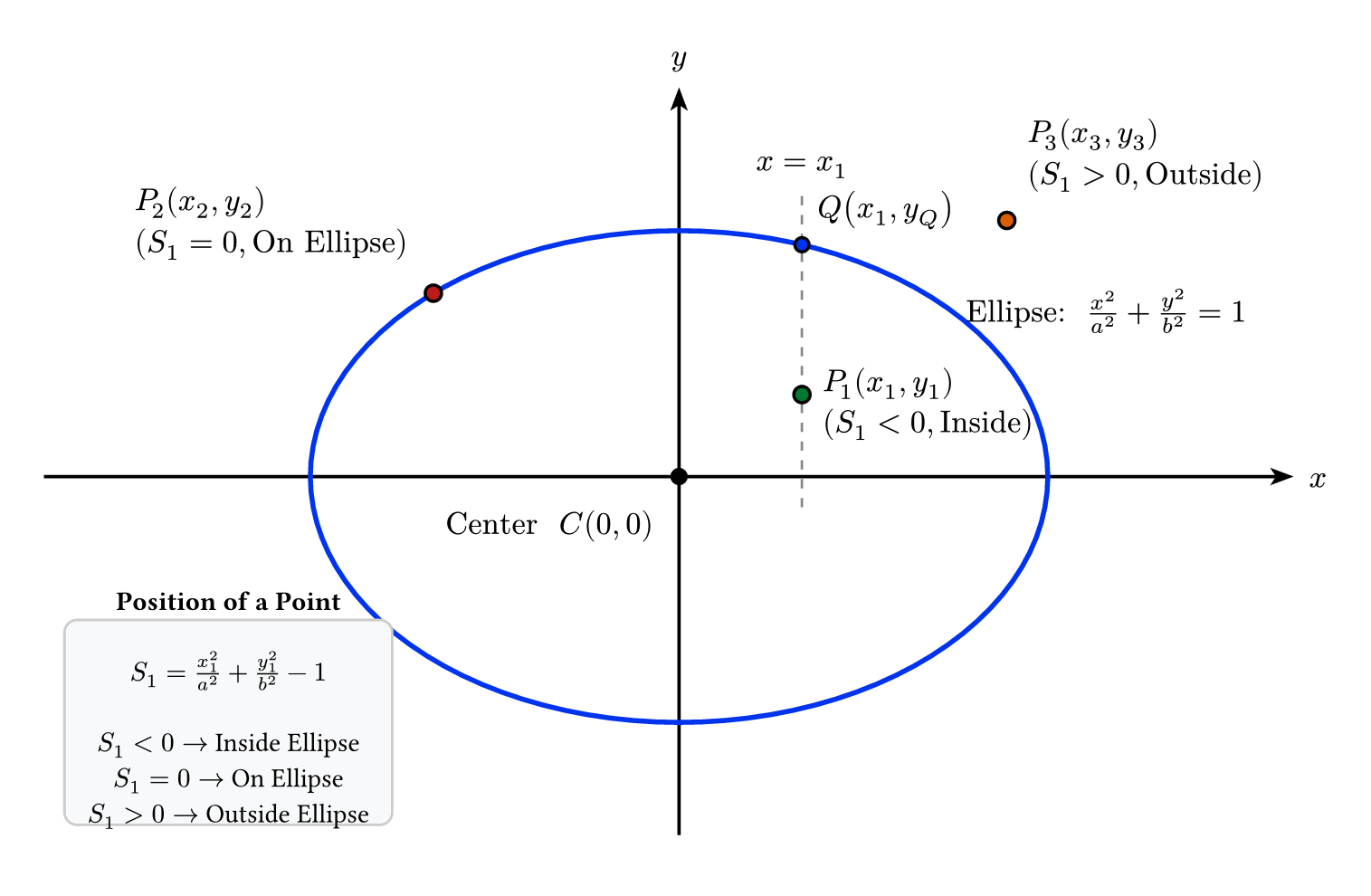
The Position Criterion
The location of \(P(x_1, y_1)\) relative to the ellipse is determined by the sign of \(S_1\):
Point Lies Inside the Ellipse (\(S_1 < 0\)):
The point \(P(x_1, y_1)\) lies in the interior region of the ellipse.
Point Lies on the Ellipse (\(S_1 = 0\)):
The point \(P(x_1, y_1)\) lies on the boundary curve of the ellipse.
Point Lies Outside the Ellipse (\(S_1 > 0\)):
The point \(P(x_1, y_1)\) lies in the exterior region of the ellipse.
Geometric Justification
To understand why the sign of \(S_1\) classifies the position of \(P(x_1, y_1)\), consider a vertical line passing through \(P(x_1, y_1)\) with equation \(x = x_1\).
Let this vertical line intersect the upper half of the ellipse at \(Q(x_1, y_Q)\), where \(y_Q > 0\). Since \(Q\) lies on the ellipse:
Now compare the ordinate \(y_1\) of \(P\) with \(y_Q\):
Case 1: \(P\) lies inside the ellipse (\(|y_1| < |y_Q|\)):
Case 2: \(P\) lies on the ellipse (\(|y_1| = |y_Q|\)):
Case 3: \(P\) lies outside the ellipse (\(|y_1| > |y_Q|\)):
This criterion is completely independent of the choice of vertical or horizontal lines, confirming that \(S_1 < 0, S_1 = 0, S_1 > 0\) partitions the entire coordinate plane into interior, boundary, and exterior regions.
Location with respect to a Shifted Ellipse
For an ellipse with center \(C(h, k)\) given by:
the position of any point \(P(x_1, y_1)\) is determined by substituting \((x_1, y_1)\) into the shifted expression:
The identical criteria apply:
- \(S_1 < 0 \iff P\) lies inside the shifted ellipse.
- \(S_1 = 0 \iff P\) lies on the shifted ellipse.
- \(S_1 > 0 \iff P\) lies outside the shifted ellipse.
Location of a Line with respect to an Ellipse
Consider a straight line \(y = mx + c\) and the standard ellipse:
To determine the points of intersection, substitute \(y = mx + c\) into the equation of the ellipse:
Multiplying through by \(a^2 b^2\):
Group terms in powers of \(x\):
This is a quadratic equation in \(x\) of the form \(A x^2 + B x + C = 0\), where:
Since \(a > 0\) and \(b > 0\), the leading coefficient \(A = a^2 m^2 + b^2 > 0\) for all real slopes \(m\). Therefore, the nature of the roots is entirely governed by the discriminant \(D\):
Factor out \(4a^2\):
Notice that the cross-term \(a^2 m^2 c^2\) cancels:
Factor out \(b^2\):
Since \(4a^2 b^2 > 0\), the sign of the discriminant \(D\) depends solely on the quantity \((a^2 m^2 + b^2 - c^2)\).
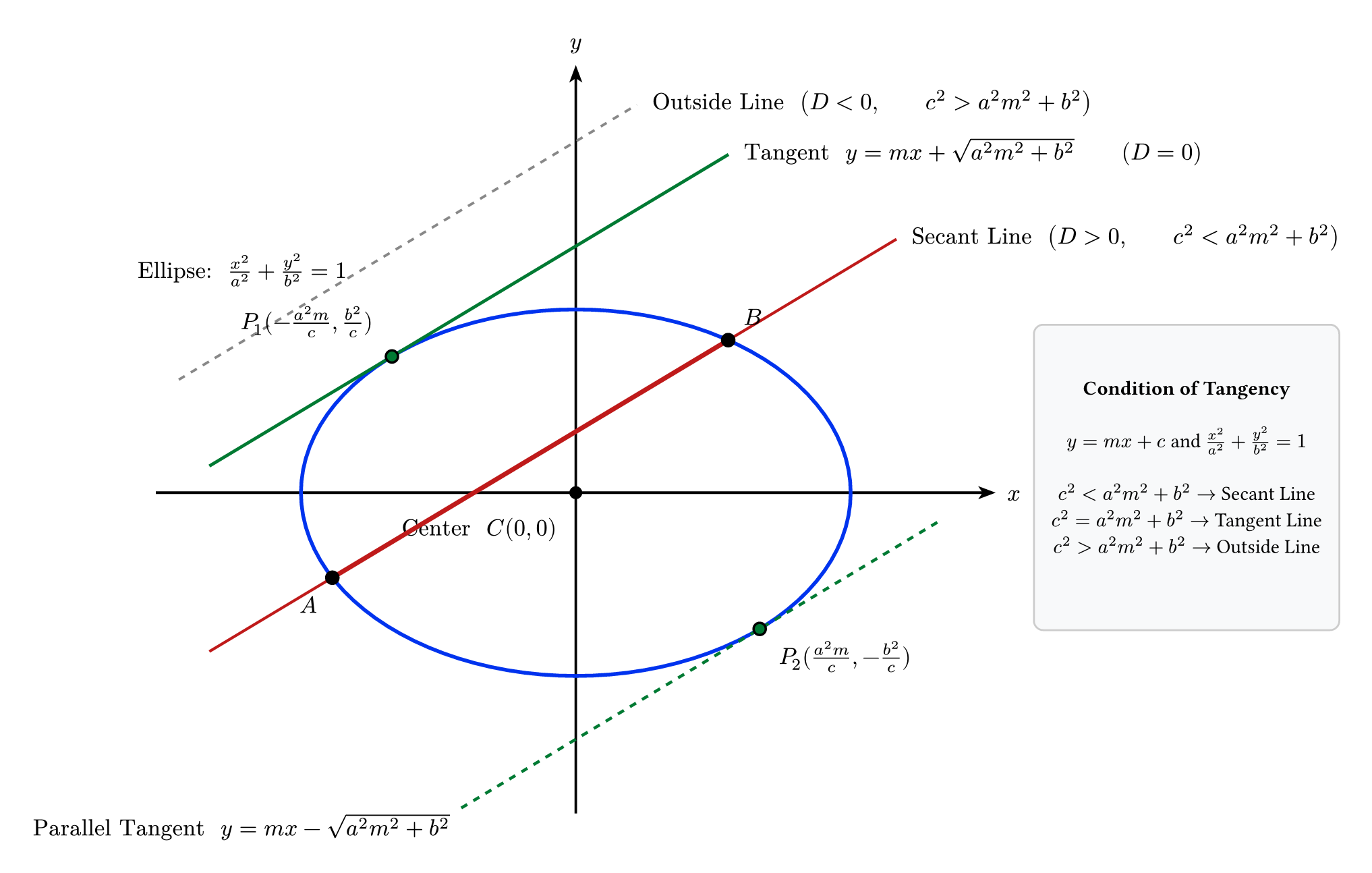
The Three Positional Cases
Case 1: Secant Line (\(D > 0 \iff c^2 < a^2 m^2 + b^2\))
The quadratic equation has two distinct real roots \(x_1\) and \(x_2\). The line intersects the ellipse at two distinct points \(A(x_1, y_1)\) and \(B(x_2, y_2)\), forming a secant line or chord of the ellipse.
Case 2: Tangent Line (\(D = 0 \iff c^2 = a^2 m^2 + b^2\))
The quadratic equation has two coincident real roots (\(x_1 = x_2\)). The line touches the ellipse at exactly one point, making it a tangent line.
Case 3: Non-Intersecting Line (\(D < 0 \iff c^2 > a^2 m^2 + b^2\))
The quadratic equation has no real roots. The line passes entirely outside the ellipse without intersecting or touching it.
Condition of Tangency: A Crucial Contrast with the Parabola
The condition \(D = 0\) yields the celebrated condition of tangency for an ellipse:
A Remarkable Distinction: Ellipse vs. Parabola
It is illuminating to compare this result with the condition of tangency for parabolas:
For a Parabola:
A horizontal parabola \(y^2 = 4ax\) and a vertical parabola \(x^2 = 4ay\) have structurally different equations. Consequently, they require two distinct conditions of tangency:
A student must memorize two separate conditions depending on the orientation of the parabola.
For an Ellipse:
Both the horizontal ellipse (\(a > b\)) and the vertical ellipse (\(b > a\)) are described by the identical algebraic equation:
Because the equation is algebraically identical in both cases, the quadratic resulting from substituting \(y = mx + c\) is identical.
Therefore, one single condition of tangency serves both horizontal and vertical ellipses:
There is no need to switch formulas when dealing with a vertical ellipse. The quantities \(a^2\) and \(b^2\) simply remain the denominators of \(x^2\) and \(y^2\), respectively.
Equation of Tangent in Slope Form
Substituting \(c = \pm \sqrt{a^2 m^2 + b^2}\) into the slope-intercept equation \(y = mx + c\), we obtain the slope form of the tangent:
For any given real slope \(m\), there exist two parallel tangents to the ellipse, one on each side of the center.
Coordinates of the Points of Contact
When \(D = 0\), the repeated root of the quadratic \((a^2 m^2 + b^2)x^2 + 2a^2 mc\,x + a^2(c^2 - b^2) = 0\) is given by:
Using the condition of tangency \(a^2 m^2 + b^2 = c^2\):
Now find the corresponding \(y\)-coordinate by substituting \(x\) into \(y = mx + c\):
Since \(c^2 - a^2 m^2 = b^2\), this simplifies directly to:
Thus, the point of contact for the tangent with intercept \(c\) is:
Substituting the two values of \(c = \pm \sqrt{a^2 m^2 + b^2}\):
For the upper tangent \(y = mx + \sqrt{a^2 m^2 + b^2}\) (\(c > 0\)):
For the lower tangent \(y = mx - \sqrt{a^2 m^2 + b^2}\) (\(c < 0\)):
Notice that the two points of contact are diametrically opposite with respect to the origin: if one is \((x_0, y_0)\), the other is \((-x_0, -y_0)\).
Tangency Condition for the General Line
Let the line be given in general form:
If \(m \ne 0\), rewrite the line in slope-intercept form:
Here, the slope is \(M = -\frac{l}{m}\) and the \(y\)-intercept is \(C = -\frac{n}{m}\).
Applying the condition of tangency \(C^2 = a^2 M^2 + b^2\):
Multiplying through by \(m^2\):
This relation holds even if \(m = 0\) (vertical tangents \(x = \pm a\), where \(l = 1, m = 0, n = \mp a \implies a^2(1)^2 + 0 = a^2\)).
The general condition for the straight line \(lx + my + n = 0\) to touch the ellipse \(\frac{x^2}{a^2} + \frac{y^2}{b^2} = 1\) is:
Tangents to a Shifted Ellipse
Consider an ellipse whose center has been translated to \((h, k)\):
Under the translation \(X = x - h\) and \(Y = y - k\), the equation becomes \(\frac{X^2}{a^2} + \frac{Y^2}{b^2} = 1\).
In the \((X, Y)\) coordinate frame, the equation of a tangent of slope \(m\) is:
Substituting back \(X = x - h\) and \(Y = y - k\), we obtain the equation of the tangent in original coordinates:
The points of contact are obtained by translating the standard points of contact by \((h, k)\):
Length of the Intercepted Chord
When \(c^2 < a^2 m^2 + b^2\), the line \(y = mx + c\) cuts the ellipse in two distinct points \(A(x_1, y_1)\) and \(B(x_2, y_2)\).
The roots \(x_1, x_2\) of the quadratic equation \((a^2 m^2 + b^2)x^2 + 2a^2 mc\,x + a^2(c^2 - b^2) = 0\) satisfy:
The difference between the roots is:
Since both points lie on the line \(y = mx + c\), we have \(y_1 - y_2 = m(x_1 - x_2)\). The length of the chord \(AB\) is:
As \(c^2 \to a^2 m^2 + b^2\), the chord length approaches \(0\), reproducing the condition of tangency.
[!TIP] Practical Method for Problem Solving While the formula above provides valuable theoretical insight into how the chord length varies with \(c\), attempting to memorize it for numerical problems is impractical. In practice, the standard and foolproof method is to eliminate \(y\) between the line and ellipse equations to form a quadratic in \(x\), apply Vieta's formulas for the sum and product of roots (\(x_1 + x_2\) and \(x_1 x_2\)), calculate \(|x_1 - x_2| = \sqrt{(x_1 + x_2)^2 - 4x_1 x_2}\), and evaluate the chord length via \(AB = \sqrt{1 + m^2}|x_1 - x_2|\).
Illustrative Examples
Example 1: Determining the Position of Points
Problem. Determine the positions of the points \(P(1, 2)\), \(Q(2, 3)\), and \(R(3, 1)\) with respect to the ellipse \(4x^2 + 9y^2 = 36\).
Solution. Write the equation in standard form by dividing by \(36\):
Evaluate \(S_1\) for each point:
For \(P(1, 2)\):
Since \(S_1 > 0\), the point \(P(1, 2)\) lies outside the ellipse.
For \(Q(2, 3)\):
Since \(S_1 > 0\), the point \(Q(2, 3)\) lies outside the ellipse.
For \(R(3, 1)\):
Since \(S_1 > 0\), the point \(R(3, 1)\) lies outside the ellipse.
(Note: The point \((0, 1)\) would give \(S_1 = 0 + \frac{1}{4} - 1 = -\frac{3}{4} < 0\), which lies inside the ellipse).
Example 2: Classifying a Line and Finding Intercepted Length
Problem. Determine whether the line \(x + y = 2\) intersects, touches, or misses the ellipse \(2x^2 + 3y^2 = 6\). If it intersects, find the length of the intercepted chord.
Solution. From the equation of the line, express \(y\) in terms of \(x\):
Substitute this into the equation of the ellipse \(2x^2 + 3y^2 = 6\):
This is a quadratic equation in \(x\) with \(A = 5\), \(B = -12\), and \(C = 6\).
Step 1: Classification via the Discriminant
Compute the discriminant \(D\):
Since \(D > 0\), the equation has two distinct real roots \(x_1\) and \(x_2\). Therefore, the line is a secant line intersecting the ellipse at two distinct real points \(A(x_1, y_1)\) and \(B(x_2, y_2)\).
(Alternatively, dividing \(2x^2 + 3y^2 = 6\) by \(6\) gives \(\frac{x^2}{3} + \frac{y^2}{2} = 1\) with \(a^2 = 3, b^2 = 2\). For \(y = -x + 2\), we have \(m = -1, c = 2\). Since \(c^2 = 4 < a^2 m^2 + b^2 = 3(-1)^2 + 2 = 5\), the line is confirmed to be a secant).
Step 2: Length of the Intercepted Chord
Rather than relying on a cumbersome formula, find the length using the standard quadratic relations (Vieta's formulas).
From \(5x^2 - 12x + 6 = 0\):
Compute the square of the difference between the abscissae:
Taking the positive square root:
Since both intersection points lie on the line \(y = -x + 2\), the slope of the line is \(m = -1\). The distance between \(A(x_1, y_1)\) and \(B(x_2, y_2)\) is:
Substitute \(m = -1\) and \(|x_1 - x_2| = \frac{2\sqrt{6}}{5}\):
The length of the intercepted chord is \(\frac{4\sqrt{3}}{5}\).
Example 3: Tangents of Given Slope to a Standard Ellipse
Problem. Find the equations of the tangents to the ellipse \(\frac{x^2}{16} + \frac{y^2}{9} = 1\) which are parallel to the line \(2x - y + 5 = 0\). Also find their points of contact.
Solution. The given line has slope:
For the ellipse \(\frac{x^2}{16} + \frac{y^2}{9} = 1\), we have \(a^2 = 16\) and \(b^2 = 9\).
Compute \(\sqrt{a^2 m^2 + b^2}\):
The equations of the two parallel tangents are:
Now find the points of contact:
Substituting \(a^2 = 16, b^2 = 9, m = 2, \sqrt{a^2 m^2 + b^2} = \sqrt{73}\):
- For \(y = 2x + \sqrt{73}\): Point of contact is \(\left( -\frac{32}{\sqrt{73}}, \; \frac{9}{\sqrt{73}} \right)\).
- For \(y = 2x - \sqrt{73}\): Point of contact is \(\left( \frac{32}{\sqrt{73}}, \; -\frac{9}{\sqrt{73}} \right)\).
Example 4: Tangents of Given Slope to a Shifted Ellipse
Problem. Find the equations of the tangents to the ellipse \(x^2 + 4y^2 - 2x - 16y + 13 = 0\) that are perpendicular to the line \(x + 2y - 7 = 0\).
Solution. First, reduce the ellipse to standard form by completing squares:
Divide by \(4\):
This is a shifted ellipse with:
The given line has slope:
The tangents are perpendicular to this line, so their slope \(m\) satisfies:
Now use the slope form of the tangent for a shifted ellipse:
Compute \(\sqrt{a^2 m^2 + b^2}\):
Substitute \((h, k) = (1, 2)\), \(m = 2\), and \(\sqrt{a^2 m^2 + b^2} = \sqrt{17}\):
The equations of the two perpendicular tangents are:
Summary of Key Results
| Concept | Mathematical Form | Meaning / Criterion |
|---|---|---|
| Point Position \(P(x_1, y_1)\) | \(S_1 = \frac{x_1^2}{a^2} + \frac{y_1^2}{b^2} - 1\) | \(S_1 < 0\): Inside \(S_1 = 0\): On \(S_1 > 0\): Outside |
| Line Position \(y = mx + c\) | \(D = 4a^2 b^2(a^2 m^2 + b^2 - c^2)\) | \(c^2 < a^2 m^2 + b^2\): Secant \(c^2 = a^2 m^2 + b^2\): Tangent \(c^2 > a^2 m^2 + b^2\): Outside |
| Condition of Tangency | \(c^2 = a^2 m^2 + b^2\) | Single universal condition for both horizontal and vertical ellipses |
| Slope Form of Tangent | \(y = mx \pm \sqrt{a^2 m^2 + b^2}\) | Two parallel tangents for any real slope \(m\) |
| Points of Contact | \(\left( \mp \frac{a^2 m}{\sqrt{a^2 m^2 + b^2}}, \; \pm \frac{b^2}{\sqrt{a^2 m^2 + b^2}} \right)\) | Diametrically opposite points on the ellipse |
| General Line Form | \(a^2 l^2 + b^2 m^2 = n^2\) | Condition for \(lx + my + n = 0\) to touch the ellipse |
| Shifted Tangent Form | \(y - k = m(x - h) \pm \sqrt{a^2 m^2 + b^2}\) | Tangents of slope \(m\) to ellipse with center \((h, k)\) |