Pair of Tangents and Chord of Contact
Pair of Tangents from an External Point
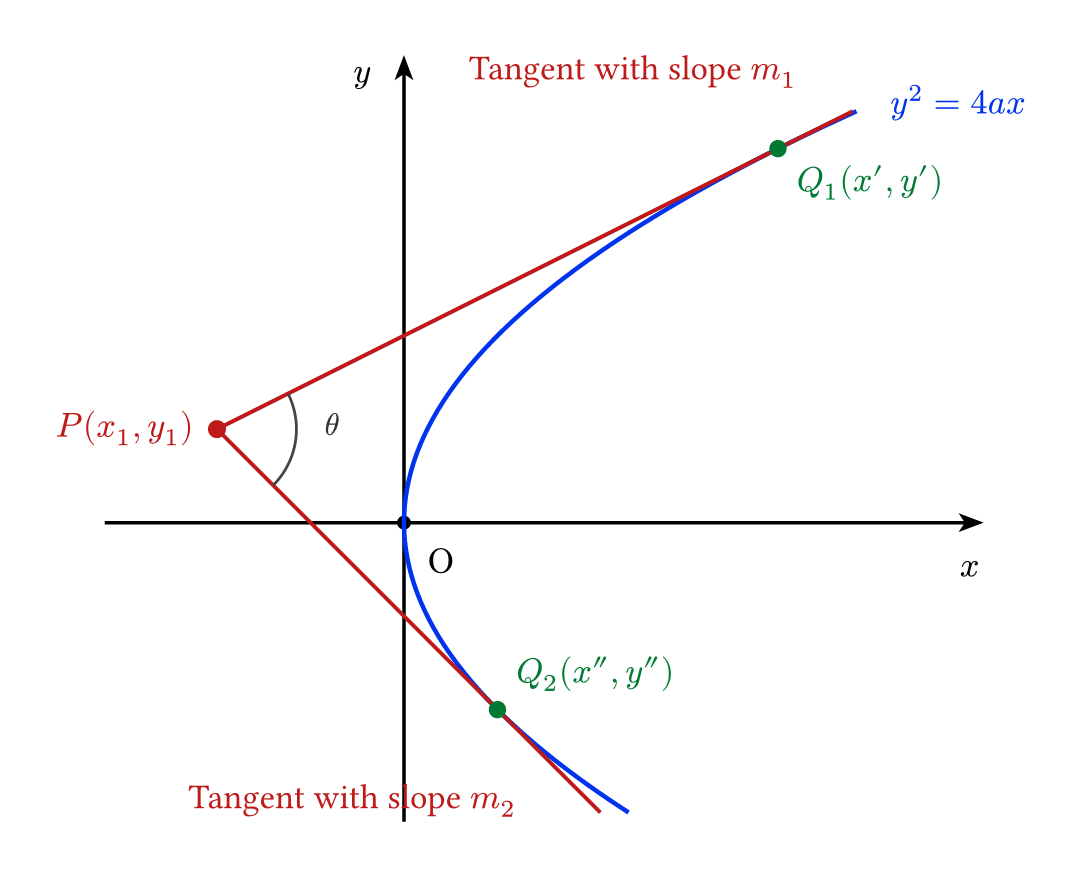
Let \(P(x_1, y_1)\) be a point lying outside the standard parabola \(y^2 = 4ax\). From any such external point, exactly two real and distinct tangents can be drawn to the curve.
The Quadratic Equation in Slope
The equation of any tangent to the parabola \(y^2 = 4ax\) having a non-zero slope \(m\) is given in slope-form by:
If this tangent passes through the point \(P(x_1, y_1)\), the coordinates of \(P\) must satisfy the line equation:
Clearing the fraction by multiplying throughout by \(m\) and rearranging the terms in descending powers of \(m\), we obtain:
This is a quadratic equation in \(m\). Its two roots, \(m_1\) and \(m_2\), represent the slopes of the two tangents that can be drawn from the point \(P(x_1, y_1)\) to the parabola.
By Vieta's relations, the sum and product of these slopes are:
Real, Coincident, and Imaginary Tangents
The nature of the tangents drawn from \(P(x_1, y_1)\) is governed by the discriminant \(\Delta\) of equation (1):
The quantity \(y_1^2 - 4ax_1\) is denoted by \(S_1\) in standard notation for the conic \(S \equiv y^2 - 4ax = 0\):
-
Two Real and Distinct Tangents (\(S_1 > 0\)): When \(y_1^2 - 4ax_1 > 0\), the roots \(m_1\) and \(m_2\) are real and unequal. The point \(P(x_1, y_1)\) lies in the exterior of the parabola, and two distinct tangents can be drawn through it.
-
One Tangent / Coincident Tangents (\(S_1 = 0\)): When \(y_1^2 - 4ax_1 = 0\), the roots are real and coincident (\(m_1 = m_2 = \frac{y_1}{2x_1}\)). The point \(P(x_1, y_1)\) lies on the parabola itself, and the two tangents coincide into the unique tangent at \(P\).
-
Imaginary Tangents (\(S_1 < 0\)): When \(y_1^2 - 4ax_1 < 0\), the roots \(m_1\) and \(m_2\) are complex conjugates. The point \(P(x_1, y_1)\) lies in the interior of the parabola, and no real tangent can be drawn through it.
Equations of the Tangents and Points of Contact
When \(P(x_1, y_1)\) is an external point (\(x_1 \neq 0\) and \(S_1 > 0\)), the two roots of equation (1) are obtained by the quadratic formula:
Denoting these roots by \(m_1\) and \(m_2\), the equations of the two tangents passing through \(P(x_1, y_1)\) are:
For each tangent of slope \(m\), the corresponding point of contact on the parabola \(y^2 = 4ax\) is:
Example
Find the equations of the tangents drawn from the point \(P(-2, 1)\) to the parabola \(y^2 = 4x\), and determine their points of contact.
Solution
Comparing \(y^2 = 4x\) with the standard form \(y^2 = 4ax\), we have \(a = 1\). For the point \(P(x_1, y_1) = (-2, 1)\):
Since \(S_1 > 0\), the point lies outside the parabola. The quadratic equation governing the slopes of the tangents is:
Substituting \(x_1 = -2\), \(y_1 = 1\), and \(a = 1\):
Factoring:
Hence, the slopes of the two tangents are:
Using the point-slope form with \(P(-2, 1)\):
-
The tangent with slope \(m_1 = \frac{1}{2}\) is:
\[y - 1 = \frac{1}{2}(x + 2) \implies \mathbf{x - 2y + 4 = 0}\]Its point of contact is:
\[Q_1\left(\frac{a}{m_1^2},\; \frac{2a}{m_1}\right) = \left(\frac{1}{(1/2)^2},\; \frac{2(1)}{1/2}\right) = \mathbf{(4, 4)}\] -
The tangent with slope \(m_2 = -1\) is:
\[y - 1 = -1(x + 2) \implies \mathbf{x + y + 1 = 0}\]Its point of contact is:
\[Q_2\left(\frac{a}{m_2^2},\; \frac{2a}{m_2}\right) = \left(\frac{1}{(-1)^2},\; \frac{2(1)}{-1}\right) = \mathbf{(1, -2)}\]
The Case where the Point Lies on the Tangent at the Vertex
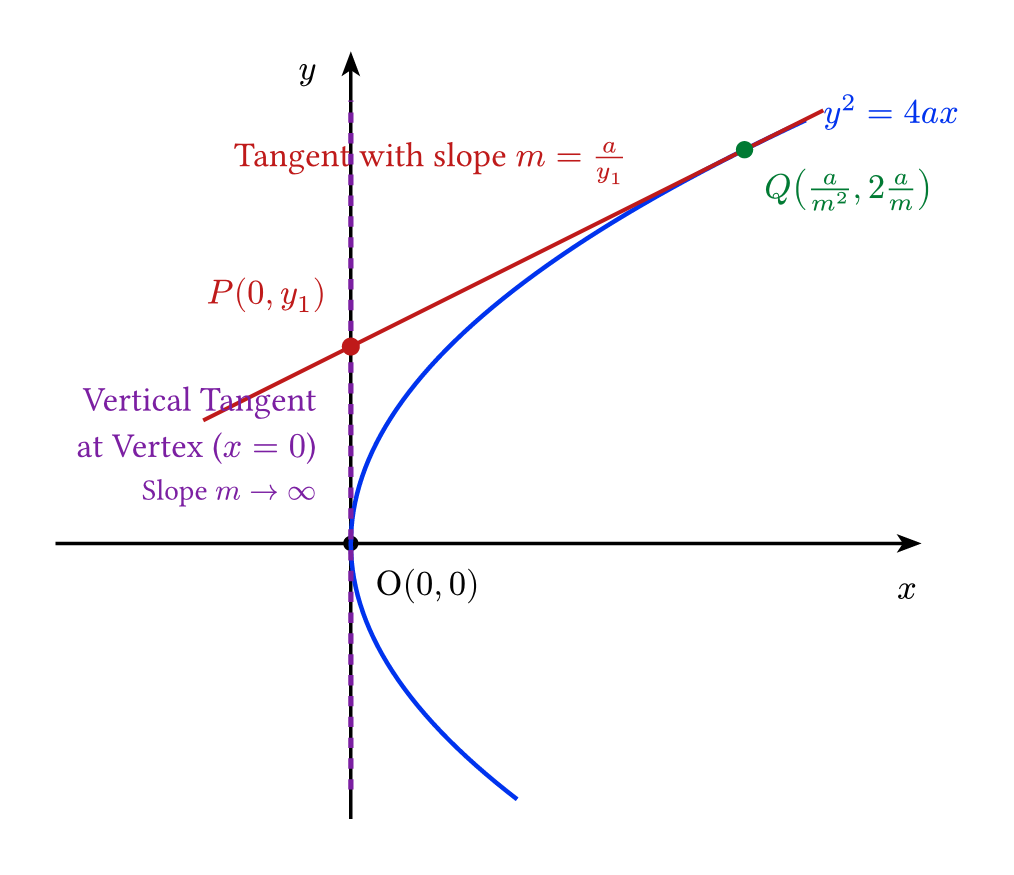
When the point \(P(x_1, y_1)\) lies on the \(y\)-axis, \(x_1 = 0\). The quadratic equation in \(m\):
has the coefficient of its leading term vanish, reducing to the linear equation:
This gives only one finite value of \(m\). The algebraic reason for this behavior is that as \(x_1 \to 0\), one root of the quadratic equation remains finite:
whereas the second root increases without bound:
Geometrically, the \(y\)-axis (\(x = 0\)) is the tangent to the parabola at the vertex \((0, 0)\). Since \(P(0, y_1)\) lies on the \(y\)-axis, the line \(x = 0\) is itself a tangent passing through \(P\). Because this line is vertical, its slope is infinite (\(m \to \infty\)), which explains the apparent disappearance of the second root from the finite quadratic.
Therefore, from any point \(P(0, y_1)\) on the \(y\)-axis (\(y_1 \neq 0\)), the two tangents to \(y^2 = 4ax\) are:
-
The vertical tangent at the vertex:
\[\mathbf{x = 0}\] -
The non-vertical tangent of slope \(m = \frac{a}{y_1}\):
\[y - y_1 = \frac{a}{y_1}(x - 0) \implies \mathbf{ax - y_1 y + y_1^2 = 0}\]which touches the parabola at \(\left(\frac{y_1^2}{a},\; 2y_1\right)\).
Angle Between the Pair of Tangents
Let \(\theta\) denote the acute angle between the two tangents drawn from \(P(x_1, y_1)\) to the parabola \(y^2 = 4ax\).
If \(m_1\) and \(m_2\) are the slopes of the tangents, the angle between them is given by:
From the quadratic equation \(x_1 m^2 - y_1 m + a = 0\), we have:
Using the identity \((m_1 - m_2)^2 = (m_1 + m_2)^2 - 4m_1 m_2\), the difference of the slopes is:
Similarly, the denominator is:
Dividing the two expressions yields the formula for the angle between the tangents:
In terms of the notation \(S_1 = y_1^2 - 4ax_1\):
The Director Circle of a Parabola
When the two tangents drawn from \(P(x_1, y_1)\) are mutually perpendicular, \(\theta = 90^\circ\), so \(\tan\theta \to \infty\). Consequently, the denominator in the expression for \(\tan\theta\) must vanish:
Substituting \(m_1 m_2 = \frac{a}{x_1}\) gives:
This establishes the following fundamental theorem:
Theorem: The Directrix as the Director Circle
The locus of the point of intersection of two mutually perpendicular tangents to the parabola \(y^2 = 4ax\) is the straight line:
which is the directrix of the parabola.
By definition, the locus of points from which perpendicular tangents can be drawn to a conic section is called its director circle. In the case of a parabola, this locus is a straight line, which may be regarded as a circle of infinite radius.
Combined Equation of the Pair of Tangents
Rather than determining the slopes \(m_1\) and \(m_2\) individually, we can obtain a single second-degree Cartesian equation that represents both tangents drawn from an external point \(P(x_1, y_1)\) to the parabola \(y^2 = 4ax\).
Let \(R(x, y)\) be any arbitrary point lying on either of the two tangents drawn from \(P(x_1, y_1)\) to the parabola.
Any point dividing the straight line segment \(PR\) in the ratio \(k : 1\) has coordinates given by the section formula:
If this dividing point lies on the parabola \(y^2 = 4ax\), its coordinates must satisfy the parabola's equation:
Multiplying throughout by \((k + 1)^2\) eliminates the denominators:
Expanding both sides:
Collecting terms by powers of \(k\):
Using standard conic notation:
this relation becomes a quadratic equation in \(k\):
For the line \(PR\) to be a tangent to the parabola, the two points in which the line meets the curve must coincide. Consequently, the quadratic equation in \(k\) must have equal roots, which occurs if and only if its discriminant vanishes:
Written out in full Cartesian coordinates, the combined equation of the pair of tangents is:
This single quadratic equation in \(x\) and \(y\) represents the pair of straight lines that touch the parabola and pass through \(P(x_1, y_1)\).
Chord of Contact
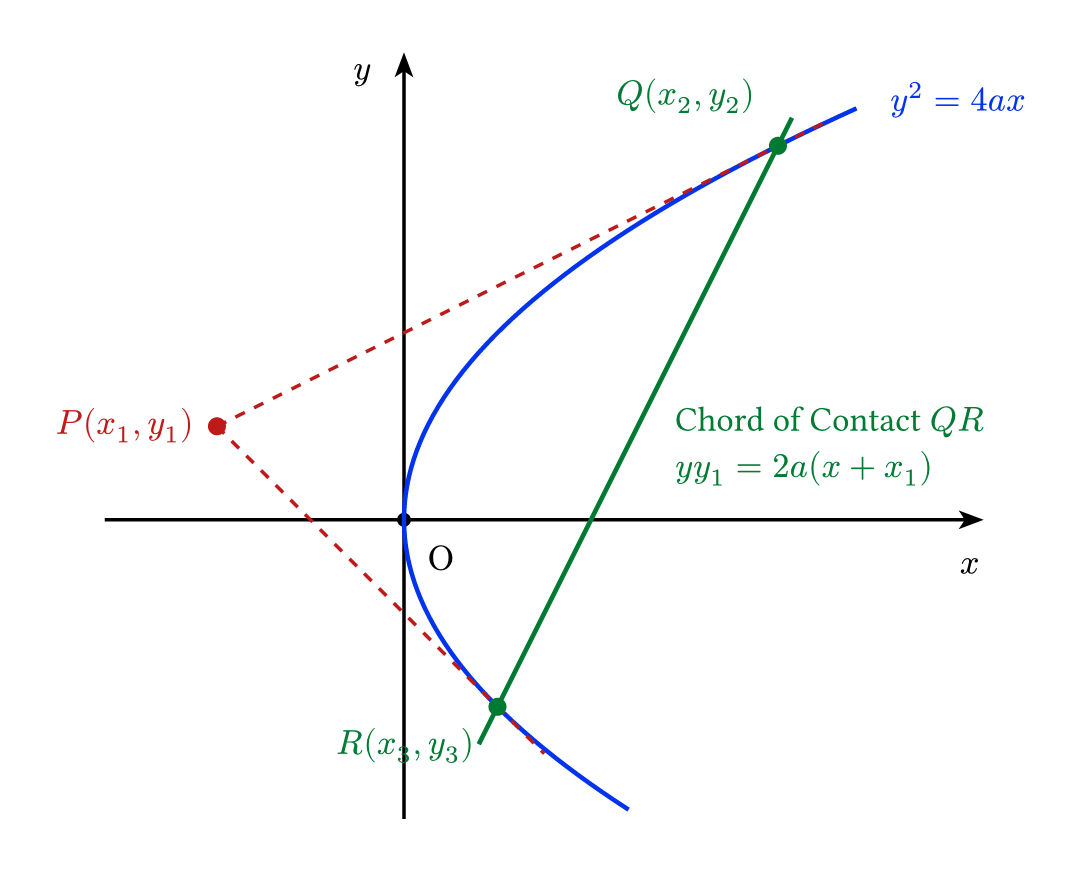
Let \(P(x_1, y_1)\) be an external point to the parabola \(y^2 = 4ax\). From \(P\), two tangents can be drawn to the curve. Let these tangents touch the parabola at the points \(Q(x_2, y_2)\) and \(R(x_3, y_3)\).
The straight line segment joining these two points of contact, \(Q\) and \(R\), is called the chord of contact of tangents drawn from the point \(P(x_1, y_1)\).
Analytical Derivation (Cartesian Method)
The equation of the tangent to the parabola \(y^2 = 4ax\) at the point of contact \(Q(x_2, y_2)\) is:
Since this tangent passes through the external point \(P(x_1, y_1)\), the coordinates of \(P\) must satisfy equation (1):
In exactly the same manner, the equation of the tangent to the parabola at the point of contact \(R(x_3, y_3)\) is:
Since this tangent also passes through the external point \(P(x_1, y_1)\), the coordinates of \(P\) must satisfy equation (3):
Now, consider the relation:
Observe two fundamental properties of equation (5):
- It represents a straight line: Equation (5) is of the first degree in the running coordinates \(x\) and \(y\).
- It passes through both points \(Q\) and \(R\):
- If we substitute the coordinates of \(Q(x_2, y_2)\) into equation (5), we obtain \(y_2 y_1 = 2a(x_2 + x_1)\), which is identically true by virtue of relation (2). Hence, the point \(Q(x_2, y_2)\) lies on the line (5).
- If we substitute the coordinates of \(R(x_3, y_3)\) into equation (5), we obtain \(y_3 y_1 = 2a(x_3 + x_1)\), which is identically true by virtue of relation (4). Hence, the point \(R(x_3, y_3)\) also lies on the line (5).
Since equation (5) represents a straight line and is satisfied by both points of contact \(Q(x_2, y_2)\) and \(R(x_3, y_3)\), by the fundamental geometric axiom that only one straight line can pass through two distinct points, equation (5) must be the equation of the chord of contact \(QR\).
Thus, the equation of the chord of contact of tangents drawn from \(P(x_1, y_1)\) to the parabola \(y^2 = 4ax\) is:
Using the standard notation \(T \equiv y y_1 - 2a(x + x_1)\), this result is expressed compactly as:
Alternative Derivation (Parametric Method)
The equation of the chord of contact can also be derived with great simplicity by representing the points of contact in parametric coordinates.
Let the tangents drawn from the external point \(P(x_1, y_1)\) touch the parabola \(y^2 = 4ax\) at the points \(Q(at_1^2, 2at_1)\) and \(R(at_2^2, 2at_2)\), where \(t_1\) and \(t_2\) are the corresponding parameters.
Recall that the point of intersection of two tangents drawn at the parametric points \(t_1\) and \(t_2\) to the parabola \(y^2 = 4ax\) has coordinates:
Since the tangents intersect at the given point \(P(x_1, y_1)\), equating the coordinates gives:
Now, the chord of contact \(QR\) is simply the chord joining the two points \(Q(t_1)\) and \(R(t_2)\) on the parabola. As established in our study of chords, the equation of the chord joining \(t_1\) and \(t_2\) is:
Substituting the values of \((t_1 + t_2)\) and \(t_1 t_2\) from relations \((A)\) and \((B)\) into this chord equation:
Multiplying the entire equation by \(a\) yields:
Factoring \(2a\) on the right-hand side gives:
which confirms the Cartesian result:
Summary for All Standard Orientations
Following an identical argument for the other standard orientations of the parabola, the equation of the chord of contact from an external point \(P(x_1, y_1)\) is summarized below:
| Equation of Parabola | Equation of Chord of Contact (\(T = 0\)) |
|---|---|
| \(y^2 = 4ax\) | \(y y_1 = 2a(x + x_1)\) |
| \(y^2 = -4ax\) | \(y y_1 = -2a(x + x_1)\) |
| \(x^2 = 4ay\) | \(x x_1 = 2a(y + y_1)\) |
| \(x^2 = -4ay\) | \(x x_1 = -2a(y + y_1)\) |
Comparison Between the Tangent and the Chord of Contact
Notice that the formal algebraic equation for the tangent at a point \((x_1, y_1)\) and for the chord of contact from a point \((x_1, y_1)\) is identical:
However, the geometric interpretation depends entirely on the location of \(P(x_1, y_1)\) with respect to the curve:
- If \(P(x_1, y_1)\) lies on the parabola (\(S_1 = 0\)), \(T = 0\) represents the tangent line at \(P\).
- If \(P(x_1, y_1)\) lies outside the parabola (\(S_1 > 0\)), \(T = 0\) represents the chord of contact joining the two points of tangency \(Q\) and \(R\).
- If \(P(x_1, y_1)\) lies inside the parabola (\(S_1 < 0\)), no real tangents exist, and \(T = 0\) is called the polar line of the pole \(P\) with respect to the parabola.
Illustrative Example: Equation and Points of Contact of a Chord of Contact
Example: Finding the Chord of Contact and Points of Contact
Find the equation of the chord of contact of tangents drawn from the point \(P(-2, 1)\) to the parabola \(y^2 = 4x\). Hence, determine the coordinates of the points of contact on the parabola.
Solution
Comparing the given parabola \(y^2 = 4x\) with \(y^2 = 4ax\), we have \(4a = 4 \implies a = 1\).
The given point is \(P(x_1, y_1) = (-2, 1)\).
The equation of the chord of contact of tangents drawn from \(P(x_1, y_1)\) is:
Substituting \(x_1 = -2\), \(y_1 = 1\), and \(a = 1\):
To find the points of contact \(Q\) and \(R\), we solve this linear equation simultaneously with the equation of the parabola \(y^2 = 4x\).
From the line equation, \(x = \frac{y + 4}{2}\). Substituting this into the parabola equation:
Factoring this quadratic equation:
Thus, the \(y\)-coordinates of the points of contact are:
-
When \(y = 4\), \(x = \frac{4 + 4}{2} = 4\). This gives the first point of contact:
\[\mathbf{Q(4, 4)}\] -
When \(y = -2\), \(x = \frac{-2 + 4}{2} = 1\). This gives the second point of contact:
\[\mathbf{R(1, -2)}\]
These points of contact are identical to the points \(Q_1(4, 4)\) and \(Q_2(1, -2)\) obtained earlier by determining the individual tangents, confirming the validity of the chord of contact theorem.
Length of the Chord of Contact
Let \(P(x_1, y_1)\) be an external point to the parabola \(y^2 = 4ax\), and let \(Q(at_1^2, 2at_1)\) and \(R(at_2^2, 2at_2)\) be the points of contact of the tangents drawn from \(P\).
As proved earlier, the external point has coordinates:
The distance between the two points of contact \(Q(t_1)\) and \(R(t_2)\) is given in parametric form by:
We can express this length directly in terms of the Cartesian coordinates \((x_1, y_1)\) of the external point \(P\):
-
For the factor \(a|t_1 - t_2|\), recall that:
\[S_1 = y_1^2 - 4ax_1 = a^2(t_1 + t_2)^2 - 4a(at_1 t_2) = a^2\bigl[(t_1 + t_2)^2 - 4t_1 t_2\bigr] = a^2(t_1 - t_2)^2\]Taking the positive square root on both sides:
\[a|t_1 - t_2| = \sqrt{y_1^2 - 4ax_1} = \sqrt{S_1}\] -
For the radical factor, since \(t_1 + t_2 = \frac{y_1}{a}\):
\[(t_1 + t_2)^2 + 4 = \left(\frac{y_1}{a}\right)^2 + 4 = \frac{y_1^2 + 4a^2}{a^2}\]Taking the square root:
\[\sqrt{(t_1 + t_2)^2 + 4} = \frac{\sqrt{y_1^2 + 4a^2}}{a}\]
Multiplying these two expressions together yields the Cartesian formula for the length of the chord of contact:
Area of the Triangle Formed by a Pair of Tangents and Their Chord of Contact
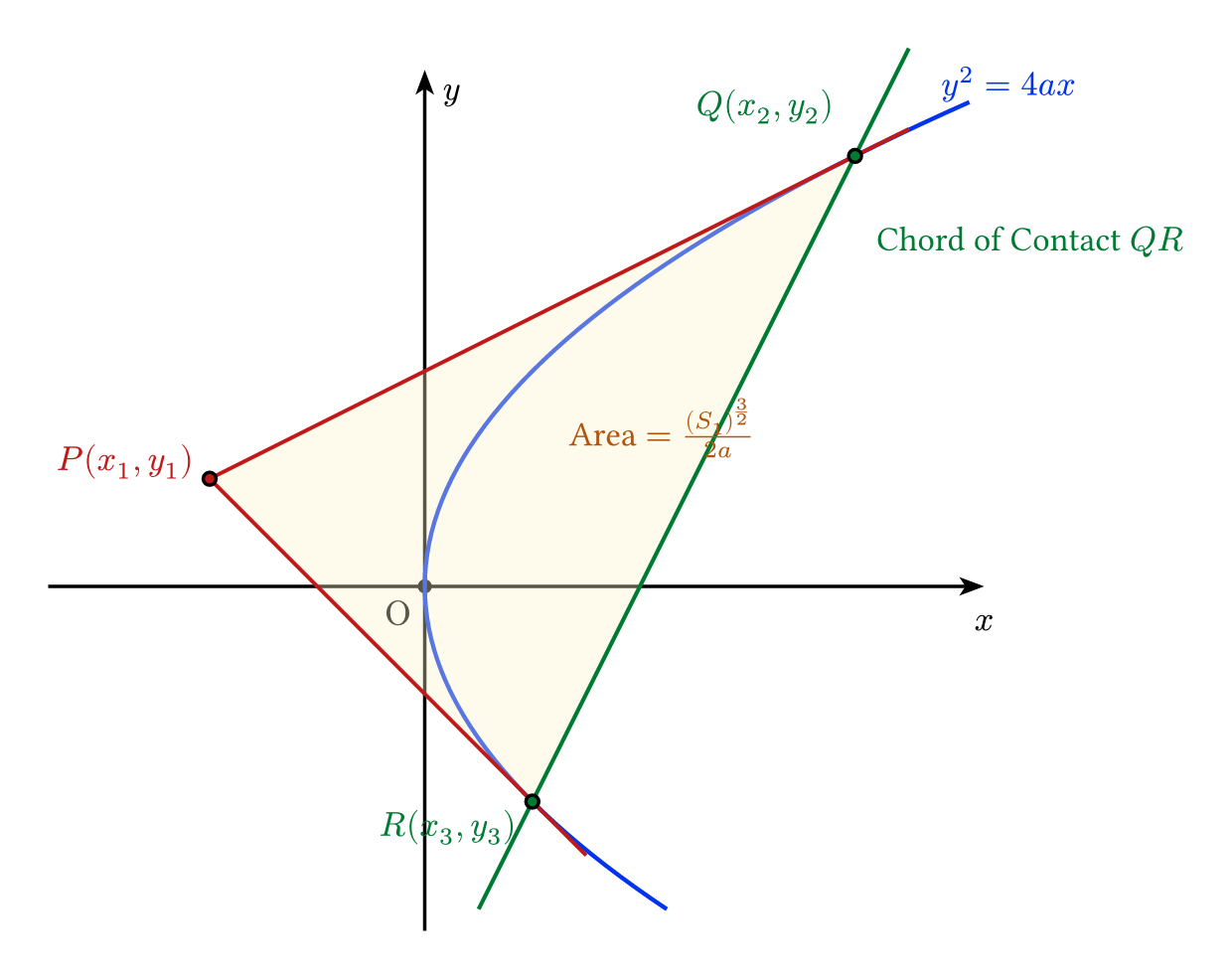
When two tangents are drawn from an external point \(P(x_1, y_1)\) to the parabola \(y^2 = 4ax\), touching the curve at \(Q(at_1^2, 2at_1)\) and \(R(at_2^2, 2at_2)\), the three points enclose a triangle \(\triangle PQR\).
Using the coordinate formula for the area of a triangle with vertices \(P\bigl(at_1 t_2, a(t_1 + t_2)\bigr)\), \(Q(at_1^2, 2at_1)\), and \(R(at_2^2, 2at_2)\):
Substituting the parametric coordinates into the formula:
Factoring out \((t_1 - t_2)\):
To express this area in terms of the Cartesian coordinates \((x_1, y_1)\) of the external point \(P\), we use the relation established earlier:
Cubing both sides gives:
Substituting this expression into the area formula:
This formula shows that the area depends solely on the value of \(S_1\) at the external point and the focal parameter \(a\).
Ratio of Areas for Triangles Formed by Three Tangents
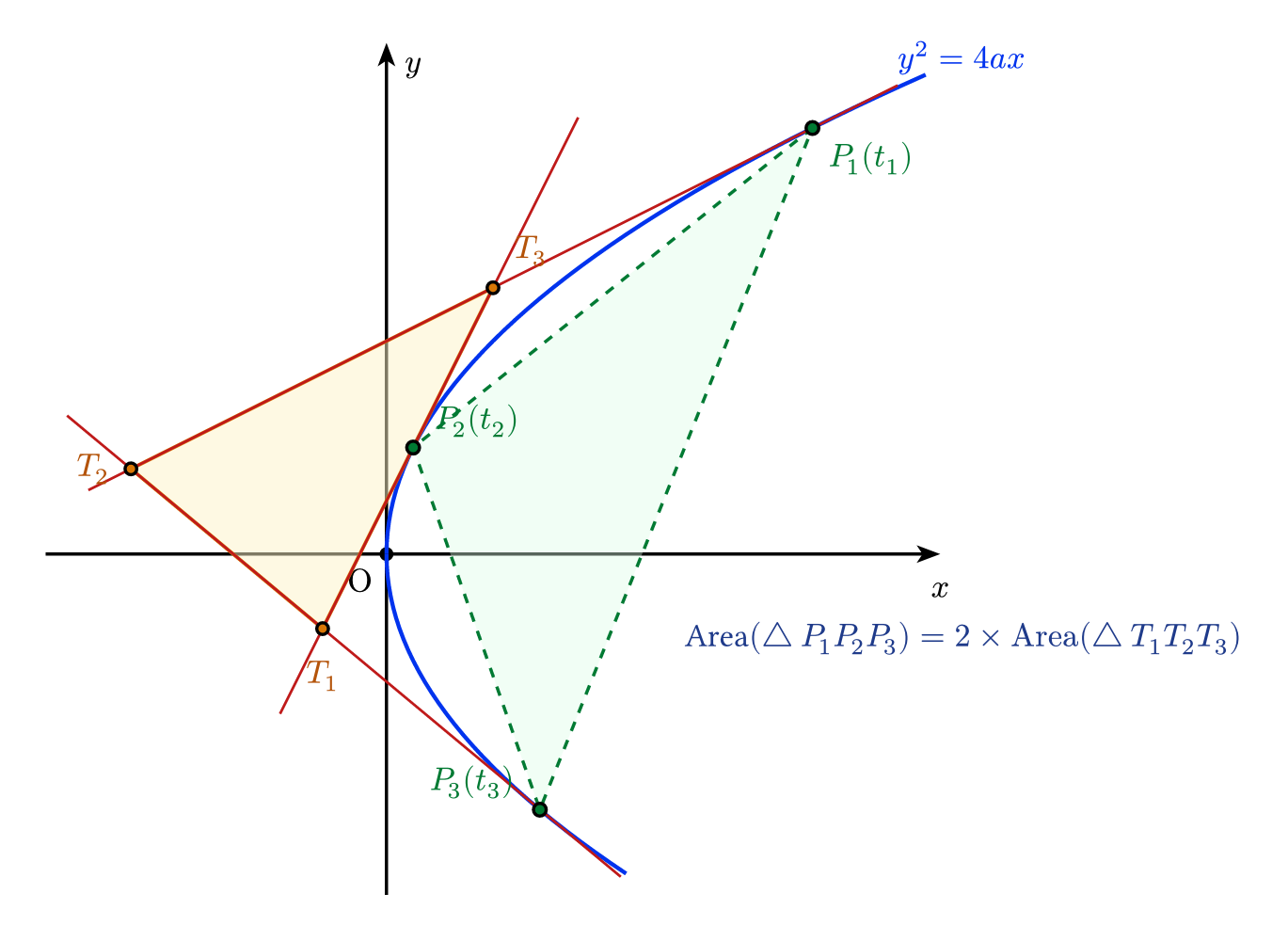
A classical and remarkable theorem connects the area of the triangle formed by any three tangents to a parabola with the area of the triangle formed by their three points of contact.
Let \(P_1(at_1^2, 2at_1)\), \(P_2(at_2^2, 2at_2)\), and \(P_3(at_3^2, 2at_3)\) be three distinct points on the parabola \(y^2 = 4ax\). The tangents drawn at these points taken pairwise intersect at three vertices:
- \(T_3\bigl(at_1 t_2,\, a(t_1 + t_2)\bigr)\) (intersection of tangents at \(P_1\) and \(P_2\))
- \(T_1\bigl(at_2 t_3,\, a(t_2 + t_3)\bigr)\) (intersection of tangents at \(P_2\) and \(P_3\))
- \(T_2\bigl(at_3 t_1,\, a(t_3 + t_1)\bigr)\) (intersection of tangents at \(P_3\) and \(P_1\))
Let \(\Delta_P\) denote the area of the triangle formed by the points of contact \(\triangle P_1 P_2 P_3\), and let \(\Delta_T\) denote the area of the triangle formed by the tangents \(\triangle T_1 T_2 T_3\).
-
Area of the triangle of contact points (\(\Delta_P\)): Using the standard determinant formula for the area of a triangle:
\[\Delta_P = \frac{1}{2}\left|\begin{matrix} at_1^2 & 2at_1 & 1 \\ at_2^2 & 2at_2 & 1 \\ at_3^2 & 2at_3 & 1 \end{matrix}\right| = a^2\left|\begin{matrix} t_1^2 & t_1 & 1 \\ t_2^2 & t_2 & 1 \\ t_3^2 & t_3 & 1 \end{matrix}\right|\]Evaluating this standard Vandermonde-type determinant:
\[\Delta_P = a^2 |(t_1 - t_2)(t_2 - t_3)(t_3 - t_1)|\] -
Area of the triangle of tangents (\(\Delta_T\)): The coordinates of the vertices of \(\triangle T_1 T_2 T_3\) are \(T_1\bigl(at_2 t_3, a(t_2 + t_3)\bigr)\), \(T_2\bigl(at_3 t_1, a(t_3 + t_1)\bigr)\), and \(T_3\bigl(at_1 t_2, a(t_1 + t_2)\bigr)\). Its area is given by:
\[\Delta_T = \frac{1}{2}\left|\begin{matrix} at_2 t_3 & a(t_2 + t_3) & 1 \\ at_3 t_1 & a(t_3 + t_1) & 1 \\ at_1 t_2 & a(t_1 + t_2) & 1 \end{matrix}\right| = \frac{1}{2}a^2\left|\begin{matrix} t_2 t_3 & t_2 + t_3 & 1 \\ t_3 t_1 & t_3 + t_1 & 1 \\ t_1 t_2 & t_1 + t_2 & 1 \end{matrix}\right|\]Subtracting row 2 from row 1, and row 3 from row 2:
\[\Delta_T = \frac{1}{2}a^2\left|\begin{matrix} -t_3(t_1 - t_2) & -(t_1 - t_2) & 0 \\ -t_1(t_2 - t_3) & -(t_2 - t_3) & 0 \\ t_1 t_2 & t_1 + t_2 & 1 \end{matrix}\right|\]Factoring \((t_1 - t_2)\) from row 1 and \((t_2 - t_3)\) from row 2:
\[\Delta_T = \frac{1}{2}a^2 (t_1 - t_2)(t_2 - t_3)\left|\begin{matrix} -t_3 & -1 & 0 \\ -t_1 & -1 & 0 \\ t_1 t_2 & t_1 + t_2 & 1 \end{matrix}\right|\]Expanding along the third column:
\[\left|\begin{matrix} -t_3 & -1 \\ -t_1 & -1 \end{matrix}\right| = t_3 - t_1 = -(t_1 - t_3)\]Taking absolute values:
\[\Delta_T = \frac{1}{2}a^2 |(t_1 - t_2)(t_2 - t_3)(t_3 - t_1)|\] -
Comparison of the two areas: Taking the ratio of \(\Delta_P\) to \(\Delta_T\):
\[\frac{\Delta_P}{\Delta_T} = \frac{a^2 |(t_1 - t_2)(t_2 - t_3)(t_3 - t_1)|}{\frac{1}{2}a^2 |(t_1 - t_2)(t_2 - t_3)(t_3 - t_1)|} = 2\]\[\mathbf{\text{Area}(\triangle P_1 P_2 P_3) = 2 \times \text{Area}(\triangle T_1 T_2 T_3)}\]
The area of the triangle formed by three points of contact on a parabola is always exactly twice the area of the triangle formed by the tangents drawn at those three points.
Focal Properties of a Pair of Tangents: Similarity of Triangles
A fundamental geometric result in coordinate geometry concerns the configuration formed by two tangents drawn from an external point to a parabola and the straight lines connecting their points of contact and their intersection to the focus.
Let \(TP\) and \(TQ\) be two tangents drawn from an external point \(T(x_1, y_1)\) to the standard parabola \(y^2 = 4ax\), touching the curve at the points \(P(at_1^2, 2at_1)\) and \(Q(at_2^2, 2at_2)\) respectively. Let \(S(a, 0)\) be the focus of the parabola.
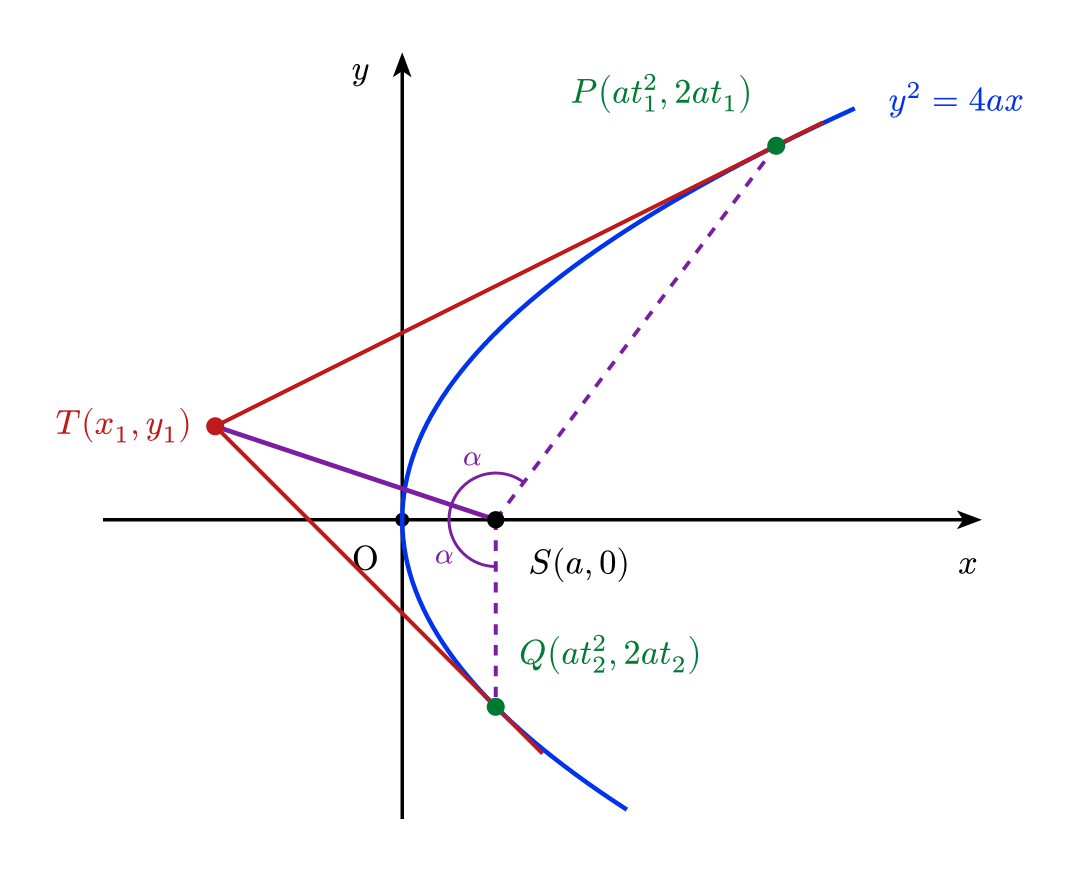
As established previously, the point of intersection \(T\) of the tangents at \(P(t_1)\) and \(Q(t_2)\) has coordinates:
We now analyze the geometric relations between the four points \(S\), \(P\), \(Q\), and \(T\).
Focal Distances of the Points of Contact
By the focal distance property of the parabola, the distance of any point on the curve from the focus equals its distance from the directrix \(x + a = 0\). For points \(P\) and \(Q\), their focal distances are:
Distance of the Intersection Point from the Focus
The distance of the external point \(T\bigl(at_1 t_2, a(t_1 + t_2)\bigr)\) from the focus \(S(a, 0)\) is given by:
Expanding each squared term:
Factoring the expression inside the brackets:
Recognizing \(a(1 + t_1^2) = SP\) and \(a(1 + t_2^2) = SQ\), we arrive at the fundamental relation:
This proves that the distance of the intersection point of two tangents from the focus is the geometric mean between the focal distances of their points of contact.
Lengths of the Tangent Segments
Next, we evaluate the lengths of the tangent segments \(TP\) and \(TQ\). Applying the distance formula between \(T\bigl(at_1 t_2, a(t_1 + t_2)\bigr)\) and \(P(at_1^2, 2at_1)\):
Factoring out \(a^2 (t_1 - t_2)^2\):
By direct symmetry, the length of the tangent segment \(TQ\) from \(T\) to \(Q(at_2^2, 2at_2)\) is:
Dividing these two expressions gives the ratio of the squared lengths of the tangents:
Taking square roots:
The lengths of the two tangents drawn from any point to a parabola are proportional to the square roots of the focal distances of their points of contact.
Similarity of the Focal Triangles
We can now compare the ratios of all three corresponding pairs of sides of the two triangles \(\triangle STP\) and \(\triangle SQT\):
-
For the sides meeting at \(S\):
\[\frac{SP}{ST} = \frac{SP}{\sqrt{SP \cdot SQ}} = \sqrt{\frac{SP}{SQ}}\] -
For the corresponding sides \(ST\) and \(SQ\):
\[\frac{ST}{SQ} = \frac{\sqrt{SP \cdot SQ}}{SQ} = \sqrt{\frac{SP}{SQ}}\] -
For the tangent segments opposite to \(S\):
\[\frac{TP}{TQ} = \sqrt{\frac{SP}{SQ}}\]
Combining these equations, we have:
Since all three pairs of corresponding sides are in the same ratio, by the Side-Side-Side (\(SSS\)) similarity criterion:
with the correspondence of vertices being:
Important Geometric Deductions
From the similarity of triangles \(\triangle STP\) and \(\triangle SQT\), several vital geometrical theorems follow directly:
-
Tangents subtend equal angles at the focus: Since corresponding angles in similar triangles are equal, the angles at the vertex \(S\) are equal:
\[\mathbf{\angle PST = \angle TSQ}\]The straight line joining the focus to the intersection of two tangents bisects the angle subtended by their chord of contact at the focus. In other words, the two tangents drawn from any point subtend equal angles at the focus.
-
Angle correspondences: The remaining pairs of corresponding angles are equal:
\[\mathbf{\angle SPT = \angle STQ} \quad \text{and} \quad \mathbf{\angle STP = \angle SQT}\] -
Geometric mean relation:
\[\mathbf{ST^2 = SP \cdot SQ}\] -
Circumcircle property: If three tangents are drawn to a parabola, the circumcircle of the triangle formed by them passes through the focus of the parabola.
Solved Examples
Example 1
Prove that the locus of a point from which the two tangents drawn to the parabola \(y^2 = 4ax\) are inclined at a constant angle \(\alpha\) to each other is given by:
Hence, deduce the locus when \(\alpha = 90^\circ\) and when \(\alpha = 45^\circ\).
Solution
Let \(P(h, k)\) be any point on the required locus. The equation of any tangent to the parabola \(y^2 = 4ax\) having slope \(m\) is:
Since this tangent passes through \(P(h, k)\), the coordinates must satisfy:
Let \(m_1\) and \(m_2\) denote the roots of this quadratic equation, representing the slopes of the two tangents drawn from \(P(h, k)\). By Vieta's formulas:
The angle between the two tangents is \(\alpha\). Using the angle formula between two straight lines:
From the algebraic identity \((m_1 - m_2)^2 = (m_1 + m_2)^2 - 4m_1 m_2\):
The denominator is:
Substituting these expressions into the formula for \(\tan\alpha\):
Squaring both sides:
Replacing \((h, k)\) with the running coordinates \((x, y)\), the required locus is:
Particular Cases:
-
When \(\alpha = 90^\circ\), we write the equation in the form \((x + a)^2 = (y^2 - 4ax)\cot^2\alpha\). Since \(\cot 90^\circ = 0\), this becomes:
\[(x + a)^2 = 0 \implies \mathbf{x + a = 0}\]which recovers the directrix of the parabola.
-
When \(\alpha = 45^\circ\), \(\tan 45^\circ = 1\), and the locus becomes:
\[\mathbf{(x + a)^2 = y^2 - 4ax}\]which represents a hyperbola.
Example 2
Two tangents are drawn from a point \(P\) to the parabola \(y^2 = 4ax\). Find the locus of \(P\) if:
- The slope of one tangent is twice that of the other.
- The tangents make complementary angles with the axis of the parabola.
Solution
Let \((h, k)\) be the coordinates of \(P\). The slopes \(m_1\) and \(m_2\) of the two tangents drawn from \((h, k)\) to the parabola \(y^2 = 4ax\) are the roots of the quadratic equation:
By Vieta's formulas, the sum and product of the slopes are:
Case 1: The slope of one tangent is twice that of the other (\(m_1 = 2m_2\))
Substituting \(m_1 = 2m_2\) into equation (1):
Substituting \(m_1 = 2m_2\) and \(m_2 = \frac{k}{3h}\) into equation (2):
Assuming \(h \neq 0\), multiplying throughout by \(9h^2\) gives:
Replacing \((h, k)\) with \((x, y)\), the required locus is the parabola:
Case 2: The tangents make complementary angles with the axis of the parabola
Let \(\theta_1\) and \(\theta_2\) denote the angles that the two tangents make with the axis of the parabola (\(x\)-axis), so that \(m_1 = \tan\theta_1\) and \(m_2 = \tan\theta_2\).
Since the angles are complementary, \(\theta_1 + \theta_2 = 90^\circ\), which implies:
Therefore:
Using equation (2), \(m_1 m_2 = \frac{a}{h}\), this condition becomes:
Replacing \(h\) with \(x\), the required locus is the straight line:
which is the line of the latus rectum of the parabola.