Pair of Tangents and Chord of Contact
From any point in the plane, how many tangents can we draw to an ellipse?
If you picture an ellipse drawn on paper, simple geometric intuition gives us an immediate answer:
- If a point lies inside the ellipse, every straight line drawn through it slices right through the interior as a secant chord. No tangent can be drawn.
- If a point lies on the boundary of the ellipse, exactly one line grazes the curve at that point.
- If a point lies outside the ellipse, we can clearly draw two distinct tangents grazing the upper and lower flanks of the ellipse.
Here lies the true beauty and power of mathematics: we do not have to rely on visual imagination or faith. Pure algebra reveals this exact geometric behavior with complete logical precision. More importantly, algebra can guide us even when geometry becomes difficult to visualize, such as in higher dimensions or complex coordinate systems.
In this tutorial, we construct the algebraic equations of lines drawn from an external point to an ellipse, establish the quadratic equation that governs their slopes, and examine how vertical tangents emerge.
Line Through an External Point
Let the equation of the standard ellipse be:
Let \(P(x_1, y_1)\) be a given fixed point in the Cartesian plane.
Any non-vertical straight line passing through \(P(x_1, y_1)\) with slope \(m\) has the point-slope equation:
Rearranging this into slope-intercept form \(y = mx + c\):
Here, the \(y\)-intercept of the line is:
Applying the Condition of Tangency
We already established that for any line \(y = mx + c\) to touch the standard ellipse \(\frac{x^2}{a^2} + \frac{y^2}{b^2} = 1\), it must satisfy the condition of tangency:
Substituting \(c = y_1 - mx_1\) into this condition gives:
Now, expand the squared binomial on the left-hand side:
Collect all terms on one side and group them by powers of \(m\):
This is a fundamental relation in coordinate geometry: a quadratic equation in the slope \(m\).
Each real root of this quadratic equation corresponds to the slope of a valid tangent line that can be drawn from the point \(P(x_1, y_1)\) to the ellipse.
The Number of Tangents: Analyzing the Discriminant
Because the equation governing \(m\) is a quadratic of the form \(A m^2 + B m + C = 0\), where:
the number and nature of the tangent lines are dictated entirely by its discriminant \(\Delta = B^2 - 4AC\):
Notice that the term \(4x_1^2 y_1^2\) cancels out completely:
To express this in terms of the standard position of the point with respect to the ellipse, divide and multiply by \(a^2 b^2\):
Recall from Tutorial 04 that the notation \(S_1\) denotes the power of the point \(P(x_1, y_1)\) with respect to the ellipse:
Therefore, the discriminant simplifies to:
Since \(4a^2 b^2\) is strictly positive for any ellipse (\(a, b > 0\)), the sign of \(\Delta\) depends entirely on the sign of \(S_1\):
-
When \(S_1 > 0\) (Point \(P\) lies outside the ellipse): Here \(\Delta > 0\). The quadratic equation has two real and distinct roots \(m_1\) and \(m_2\). Therefore, exactly two real tangents can be drawn from an external point to an ellipse.
-
When \(S_1 = 0\) (Point \(P\) lies on the ellipse): Here \(\Delta = 0\). The quadratic equation has two equal real roots (\(m_1 = m_2\)). Therefore, only one tangent exists through \(P\), which is the tangent at that point.
-
When \(S_1 < 0\) (Point \(P\) lies inside the ellipse): Here \(\Delta < 0\). The roots are imaginary (complex conjugates). Therefore, no real tangent can be drawn from an internal point to the ellipse.
The algebra reproduces our physical intuition with absolute rigor.
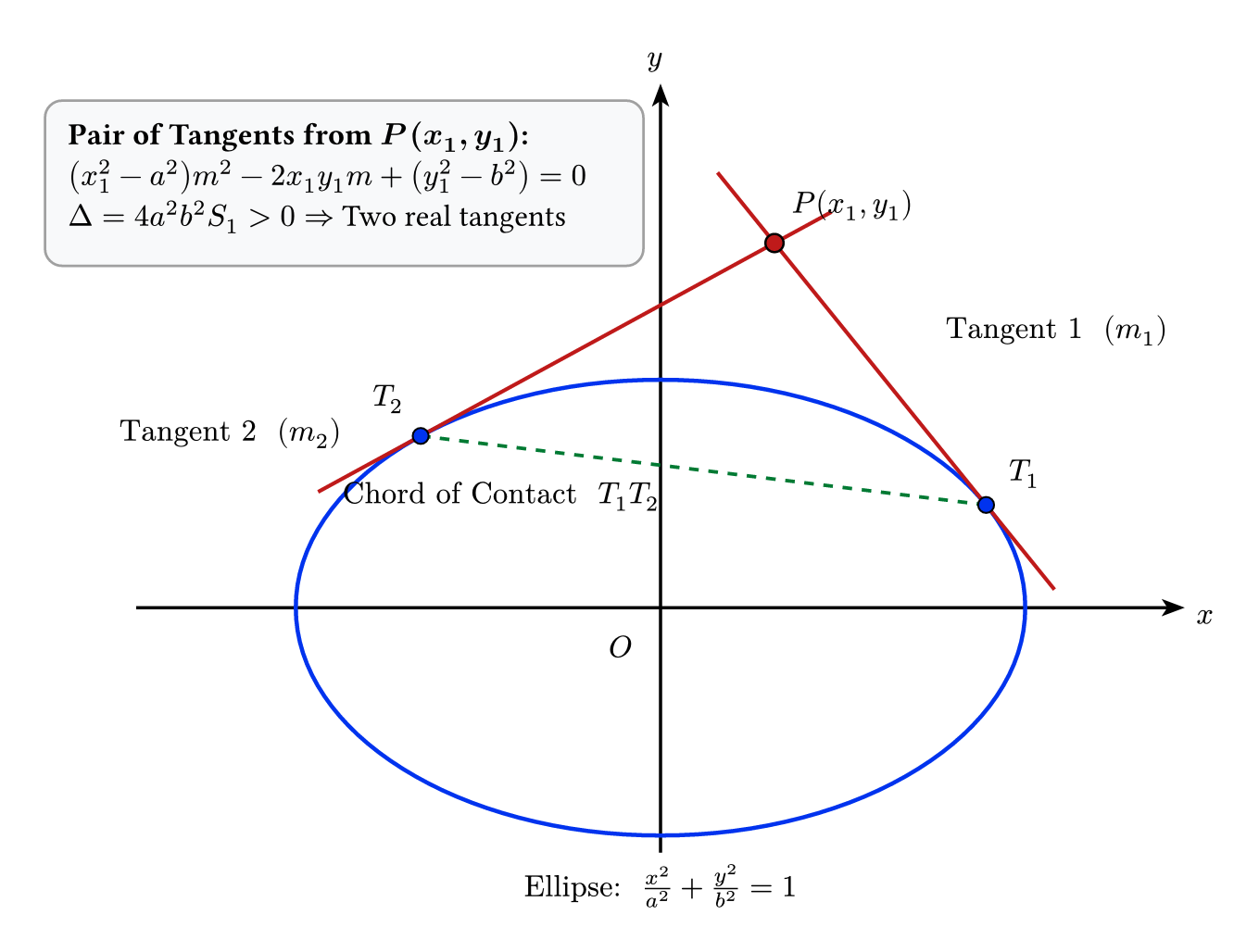
Slopes of the Tangents: Vieta's Relations
When \(P(x_1, y_1)\) lies outside the ellipse (\(S_1 > 0\)) and \(x_1^2 \ne a^2\), the quadratic equation:
yields two real slopes, \(m_1\) and \(m_2\). By Vieta's relations:
Sum of Slopes:
Product of Slopes:
Difference of Slopes:
Angle Between the Tangents
If \(\theta\) is the acute angle between the two tangents drawn from \(P(x_1, y_1)\), then:
Substituting the expressions for \(|m_1 - m_2|\) and \(m_1 m_2\):
This formula gives the angle between the two tangents drawn from any external point \(P(x_1, y_1)\) directly.
The Special Case: When the Equation is Not Quadratic (Vertical Tangents)
Look closely at the leading coefficient of our quadratic equation in \(m\):
The leading coefficient is \(x_1^2 - a^2\).
What happens if the given external point \(P(x_1, y_1)\) has an \(x\)-coordinate equal to \(a\) or \(-a\)?
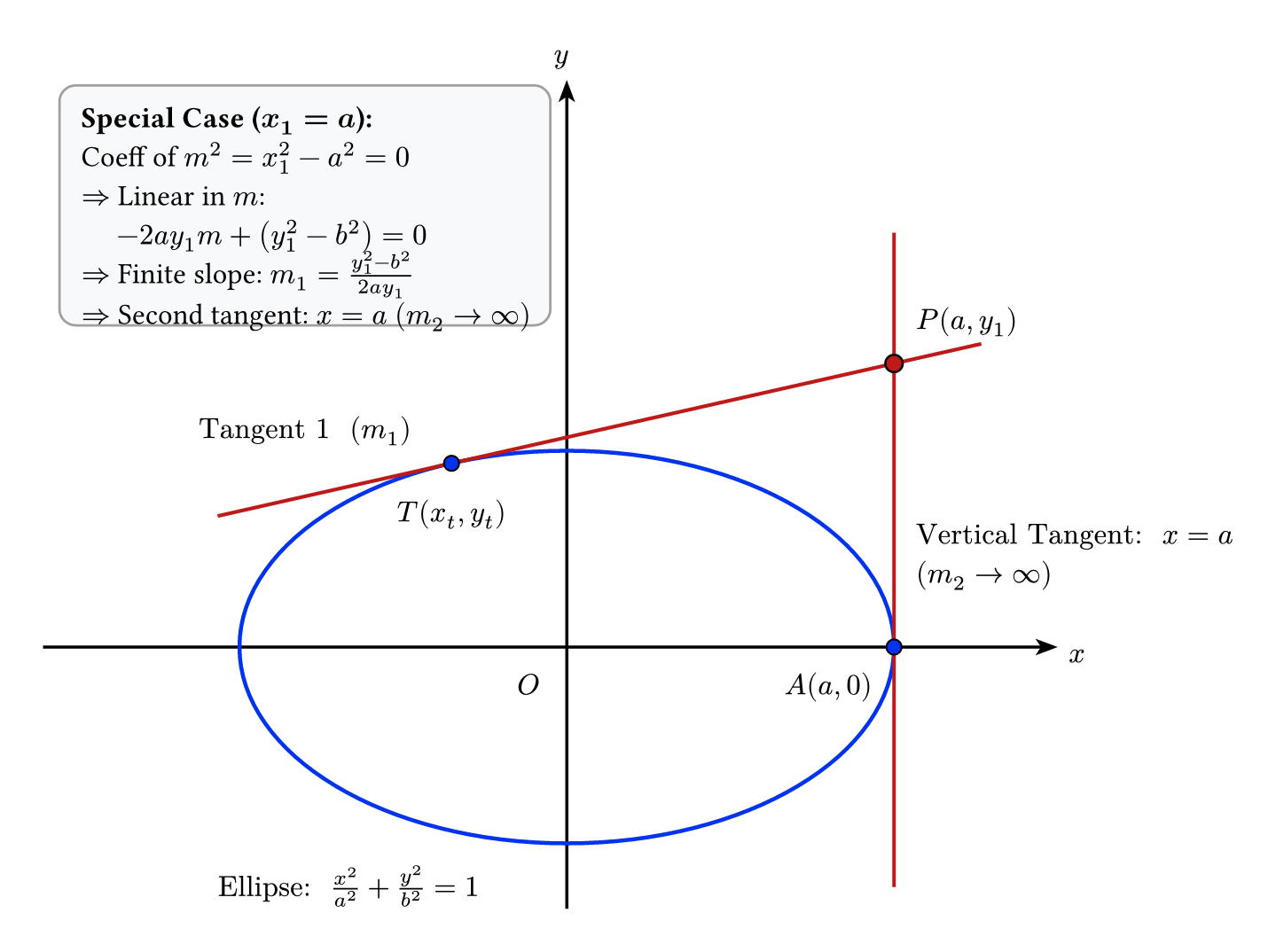
In this situation, the \(m^2\) term vanishes entirely! The equation reduces to a linear equation in \(m\):
Solving this linear equation gives only one finite slope:
Where Did the Second Tangent Go?
A student encountering this in an exam might worry: "Does an external point with \(x_1 = \pm a\) have only one tangent? Where did the other tangent go?"
The second tangent has not vanished.
Recall from basic coordinate geometry that a vertical line has an undefined slope (\(m \to \infty\)). In algebra, whenever the leading coefficient of a quadratic equation approaches zero, one of its roots shoots off to infinity:
Because \(x_1 = a\) (or \(x_1 = -a\)), the point \(P\) lies on the vertical line \(x = a\) (or \(x = -a\)). But \(x = a\) and \(x = -a\) are precisely the vertical tangent lines to the ellipse at its major axis vertices \((a, 0)\) and \((-a, 0)\)!
Therefore, the second tangent is simply the vertical line:
A Crucial Rule for Problem Solving
Whenever you set up the slope equation for tangents from an external point and obtain a linear equation instead of a quadratic:
-
Solve the linear equation to get the single finite slope \(m_1\), which gives the first tangent: \(y - y_1 = m_1(x - x_1)\).
-
Immediately recognize that the second tangent is vertical (\(m_2 = \infty\)), with the equation: \(x = x_1\).
Never conclude that there is only one tangent from an external point. An external point always has two tangents; if one of them has an undefined slope, algebra signals this by dropping the degree of the equation from \(2\) to \(1\).
Illustrative Examples
Example 1: Finding Both Slopes and Tangents from an External Point
Find the equations of the tangents drawn from the point \(P(3, 2)\) to the ellipse:
Solution:
Step 1: Check the position of the point
Here \(a^2 = 4\), \(b^2 = 3\), and \((x_1, y_1) = (3, 2)\).
Since \(S_1 > 0\), the point \(P(3, 2)\) lies strictly outside the ellipse, so exactly two real tangents exist.
Step 2: Set up the equation of a line through \(P(3, 2)\)
Any non-vertical line through \((3, 2)\) with slope \(m\) is:
Here, the \(y\)-intercept is \(c = 2 - 3m\).
Step 3: Apply the condition of tangency
For this line to touch the ellipse \(\frac{x^2}{4} + \frac{y^2}{3} = 1\):
Notice that this matches the formula \((x_1^2 - a^2)m^2 - 2x_1 y_1 m + (y_1^2 - b^2) = 0\):
- \(x_1^2 - a^2 = 3^2 - 4 = 5\)
- \(-2x_1 y_1 = -2(3)(2) = -12\)
- \(y_1^2 - b^2 = 2^2 - 3 = 1\)
Step 4: Solve for the slopes
Using the quadratic formula:
The two slopes are:
Step 5: Write the equations of the tangents
Using \(y - 2 = m(x - 3)\):
First Tangent:
Second Tangent:
Example 2: External Point on a Vertical Tangent Line
Find the equations of the tangents drawn from the point \(P(2, 3)\) to the ellipse:
Solution:
Step 1: Check the position and identify the special coordinate
Here \(a^2 = 4 \implies a = 2\), and \(b^2 = 1 \implies b = 1\).
The given point is \(P(x_1, y_1) = (2, 3)\).
Notice immediately that:
Because \(x_1 = a\), the point lies on the vertical line \(x = 2\), which touches the ellipse at its right vertex \((2, 0)\)!
Let us see what happens when we set up the algebra.
Step 2: Set up the line through \((2, 3)\)
Condition of tangency \(c^2 = a^2 m^2 + b^2\):
Notice that the \(4m^2\) terms cancel out on both sides:
Step 3: Interpret the result and identify both tangents
The quadratic equation reduced to a linear equation because the coefficient of \(m^2\) became zero (\(x_1^2 - a^2 = 2^2 - 4 = 0\)).
This tells us:
- First Tangent (Finite Slope): With slope \(m_1 = \frac{2}{3}\), the line is \(y - 3 = \frac{2}{3}(x - 2) \implies 2x - 3y + 5 = 0\).
- Second Tangent (Vertical Line): With undefined slope (\(m_2 \to \infty\)), the vertical line through \(x = 2\) is \(x = 2\).
Both lines pass through \(P(2, 3)\) and are tangent to the ellipse \(\frac{x^2}{4} + y^2 = 1\).
The Director Circle of an Ellipse
When we draw two tangents from an external point \(P(x_1, y_1)\) to an ellipse, the angle between them varies depending on where \(P\) is placed.
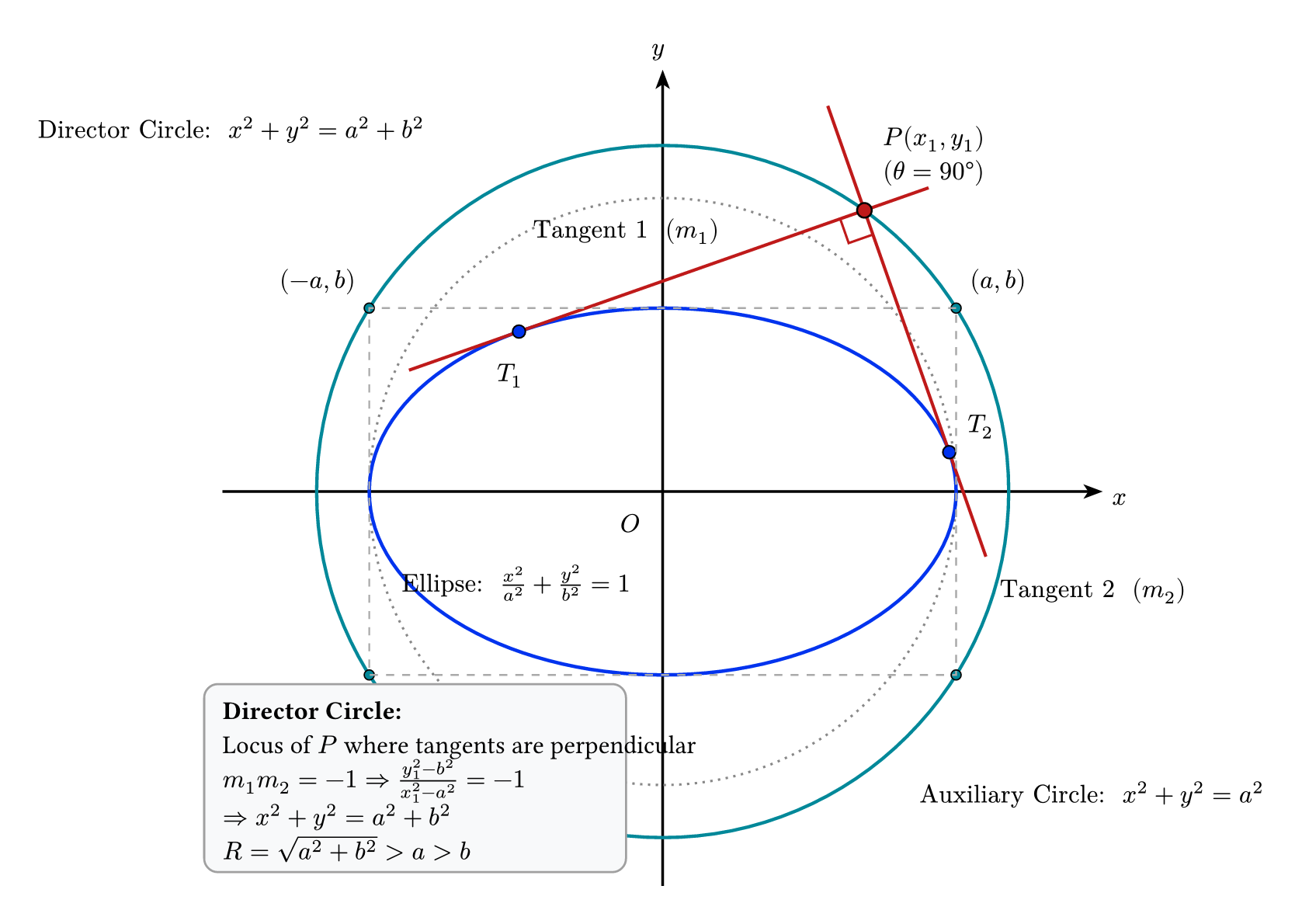
What is the locus of all points \(P(x_1, y_1)\) from which the two tangents are mutually perpendicular?
Derivation of the Locus
From our earlier analysis, the slopes \(m_1\) and \(m_2\) of the two tangents drawn from \(P(x_1, y_1)\) to the standard ellipse \(\frac{x^2}{a^2} + \frac{y^2}{b^2} = 1\) are the roots of the quadratic equation:
For the two tangents to be perpendicular, the product of their slopes must equal \(-1\):
Using Vieta's relation for the product of roots:
Setting this product equal to \(-1\):
Rearranging the terms:
Replacing the coordinates of the moving point \((x_1, y_1)\) with the running coordinates \((x, y)\), we obtain the equation of the locus:
This circle is called the Director Circle of the ellipse.
Geometric Properties of the Director Circle
1. Center and Radius:
The director circle is concentric with the ellipse, having its center at the origin \((0, 0)\). Its radius \(R\) is:
2. Radius Hierarchy:
Comparing the radii of the curves centered at the origin:
- The ellipse extends horizontally to distance \(a\) and vertically to distance \(b\).
- The Auxiliary Circle has radius \(a\): \(x^2 + y^2 = a^2\).
- The Director Circle has radius \(\sqrt{a^2 + b^2}\): \(x^2 + y^2 = a^2 + b^2\).
Therefore, the director circle lies entirely outside both the ellipse and the auxiliary circle.
3. Intersection of Bounding Tangents:
The standard ellipse is bounded by four principal tangents:
- Two vertical tangents: \(x = a\) and \(x = -a\)
- Two horizontal tangents: \(y = b\) and \(y = -b\)
These tangents intersect at the four corner vertices of the circumscribing rectangle:
Since the horizontal and vertical tangents are perpendicular by definition, each of these four vertices must lie on the director circle. Substituting any of these corner points into the circle equation verifies this immediately:
4. Always Real:
Because \(a > 0\) and \(b > 0\), the sum \(a^2 + b^2\) is always strictly positive. Therefore, unlike a hyperbola (where the director circle can be imaginary or degenerate), every real ellipse possesses a real director circle.
Combined Equation of the Pair of Tangents
Rather than calculating the two slopes \(m_1\) and \(m_2\) separately and writing two separate equations, we can find a single second-degree equation in \(x\) and \(y\) that represents both tangent lines simultaneously.
Standard Conic Notation
Recall the standard shorthand notation:
- Curve: \(S \equiv \frac{x^2}{a^2} + \frac{y^2}{b^2} - 1 = 0\)
- Point value at \(P(x_1, y_1)\): \(S_1 \equiv \frac{x_1^2}{a^2} + \frac{y_1^2}{b^2} - 1\)
- Tangent-like expression: \(T \equiv \frac{x x_1}{a^2} + \frac{y y_1}{b^2} - 1\)
Derivation via Section Ratio
Let \(P(x_1, y_1)\) be a fixed external point to the ellipse \(S = 0\).
Let \(Q(x, y)\) be any arbitrary point lying on either of the two tangent lines drawn from \(P\) to the ellipse.
Now consider a point \(R\) dividing the straight line segment \(PQ\) in the ratio \(\lambda : 1\). By the section formula, the coordinates of \(R\) are:
If the point \(R\) lies on the ellipse \(\frac{x^2}{a^2} + \frac{y^2}{b^2} - 1 = 0\), its coordinates must satisfy the ellipse equation:
Multiplying the entire equation by \((\lambda + 1)^2\) eliminates the denominators:
Expanding each squared binomial:
Now, collect all terms according to descending powers of \(\lambda\):
Using our shorthand notations \(S\), \(T\), and \(S_1\), this simplifies to a quadratic equation in \(\lambda\):
The roots of this quadratic equation give the ratios \(\lambda\) for the points where the straight line \(PQ\) intersects the ellipse.
Since the line \(PQ\) is a tangent line, it touches the ellipse at a single point. This means the two intersection points must coincide, so the quadratic equation in \(\lambda\) must have equal roots.
A quadratic equation has equal roots if and only if its discriminant vanishes:
Written out in full Cartesian coordinates:
This single equation represents the pair of tangents drawn from \(P(x_1, y_1)\) to the ellipse.
Connection to the Theory of Pair of Straight Lines
The formula \(SS_1 = T^2\) looks very compact, but when expanded, it is a general second-degree polynomial in \(x\) and \(y\):
Because it factors into two real linear equations passing through \(P(x_1, y_1)\), all the standard theorems from the theory of pairs of straight lines apply directly:
Point of Intersection:
The point of intersection of the two lines represented by \(SS_1 = T^2\) is precisely \(P(x_1, y_1)\).
Angle Between the Lines:
In any second-degree homogeneous-in-shifts equation, the acute angle \(\theta\) between the two lines is given by:
Let us find the coefficients of \(x^2\), \(xy\), and \(y^2\) in \(SS_1 = T^2\):
Coefficient of \(x^2\) (\(A\)):
The term in \(x^2\) on the left is \(\frac{x^2}{a^2} S_1\), and on the right it is \(\left(\frac{x x_1}{a^2}\right)^2 = \frac{x^2 x_1^2}{a^4}\):
Coefficient of \(y^2\) (\(B\)):
Similarly, the term in \(y^2\) is:
Coefficient of \(2xy\) (\(2H\)):
The cross-product term \(2H xy\) comes only from the right-hand side:
Now observe two remarkable results:
Condition for Perpendicular Lines (\(A + B = 0\)):
This reproduces the Director Circle directly from the pair of straight lines condition!
The Angle Formula:
Substituting into \(\tan\theta = \frac{2\sqrt{H^2 - AB}}{|A + B|}\):
This matches our earlier slope-based derivation, confirming the structural harmony of coordinate geometry.
Chord of Contact
When two tangents are drawn from an external point \(P(x_1, y_1)\) to an ellipse, let them touch the curve at two distinct points, say \(Q(x', y')\) and \(R(x'', y'')\).
The straight line segment connecting these two points of contact, \(QR\), is called the chord of contact of tangents from \(P\).
Derivation of the Equation of Chord of Contact
We can derive the equation of the chord of contact using the Cartesian duality argument.
The equation of the tangent line to the ellipse \(\frac{x^2}{a^2} + \frac{y^2}{b^2} = 1\) at the point of contact \(Q(x', y')\) is:
Since this tangent line passes through the external point \(P(x_1, y_1)\), the coordinates \((x_1, y_1)\) must satisfy this equation:
Similarly, the equation of the tangent line at the point of contact \(R(x'', y'')\) is:
Since this tangent line also passes through \(P(x_1, y_1)\), its coordinates must satisfy:
Now, examine the linear equation:
Notice two essential facts about this equation:
- It represents a straight line: Both \(x\) and \(y\) appear to the first power.
- It passes through both points \(Q\) and \(R\):
- Substituting \(Q(x', y')\) into this equation gives \(\frac{x' x_1}{a^2} + \frac{y' y_1}{b^2} = 1\), which is identically true by equation (1).
- Substituting \(R(x'', y'')\) into this equation gives \(\frac{x'' x_1}{a^2} + \frac{y'' y_1}{b^2} = 1\), which is identically true by equation (2).
Since two distinct points uniquely define a straight line in the plane, this line is none other than the chord passing through \(Q\) and \(R\).
Therefore, the equation of the chord of contact of tangents from \(P(x_1, y_1)\) is:
The Inverse Problem: Finding the Point of Intersection Given the Chord
In many problems, the situation is reversed: we are given the equation of a straight line, and we are told that it is the chord of contact of tangents drawn from some unknown external point \(P(x_1, y_1)\). Our goal is to determine the coordinates of \(P\).
Method of Coefficient Comparison
Let the given line be:
We know that the theoretical equation of the chord of contact from an unknown point \(P(x_1, y_1)\) to the standard ellipse \(\frac{x^2}{a^2} + \frac{y^2}{b^2} = 1\) is:
Since both equations represent the exact same straight line, the coefficients of \(x\), \(y\), and the constant term must be in the same proportion:
Solving for \(x_1\) and \(y_1\):
Therefore, the tangents must have been drawn from the point:
Condition for Real Tangents
For these tangents to be real, the point \(P(x_1, y_1)\) must lie strictly outside the ellipse (\(S_1 > 0\)):
- When \(a^2 L^2 + b^2 M^2 > N^2\): The given line cuts the ellipse in two real points, so real tangents can be drawn from \(P\) to form this chord of contact.
- When \(a^2 L^2 + b^2 M^2 = N^2\): The line is tangent to the ellipse. The point \(P\) lies on the ellipse, and the chord of contact degenerates into the point of contact itself.
- When \(a^2 L^2 + b^2 M^2 < N^2\): The line lies entirely outside the ellipse without intersecting it. No real chord of contact exists.
This inverse relationship forms the foundation of the theory of Pole and Polar, where the point \(P\) is called the pole and the line is called its polar.
Important Properties of the Chord of Contact
1. Area of the Triangle Formed by the Tangents and the Chord of Contact
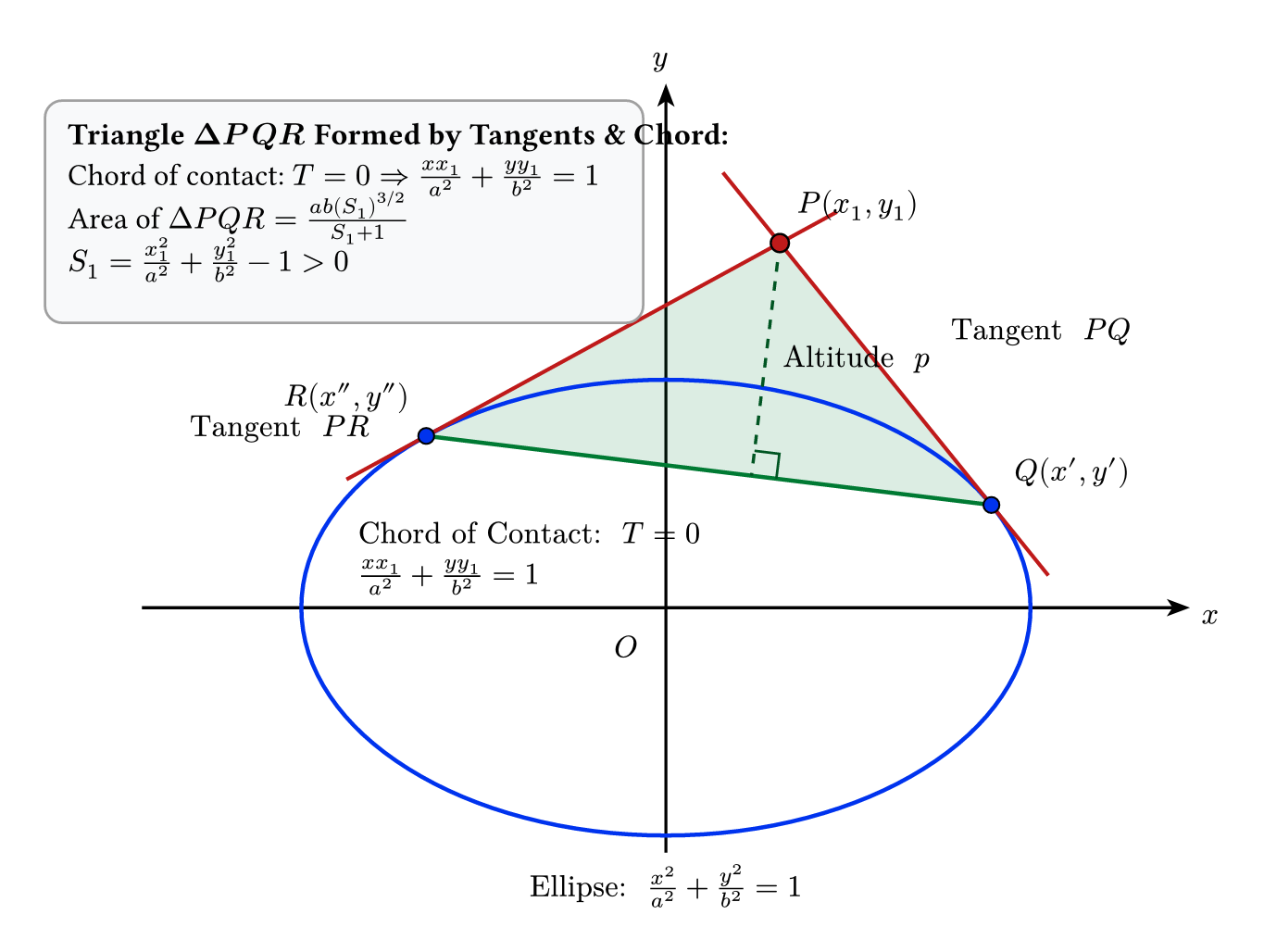
Let tangents drawn from \(P(x_1, y_1)\) touch the ellipse at \(Q\) and \(R\). Together with the external point \(P\), they form a triangle \(\Delta PQR\).
The area of this triangle is given by the formula:
Why this formula holds:
- The perpendicular distance \(p\) from \(P(x_1, y_1)\) to the chord of contact \(T = 0\) is proportional to \(\frac{S_1}{\sqrt{\frac{x_1^2}{a^4} + \frac{y_1^2}{b^4}}}\).
- The length of the chord of contact \(QR\) is proportional to \(\frac{\sqrt{S_1}}{\sqrt{\frac{x_1^2}{a^4} + \frac{y_1^2}{b^4}}}\).
- Multiplying \(\frac{1}{2} \times \text{base} \times \text{height}\) simplifies directly to the expression above.
Notice that if \(P\) approaches the ellipse boundary, \(S_1 \to 0\), and the area of the triangle shrinks to zero, as expected.
2. Length of the Chord of Contact
The length of the chord of contact \(QR\) joining the two points of contact from \(P(x_1, y_1)\) is:
3. Focal Chord of Contact: Focus-Directrix Duality
What happens if the chord of contact \(QR\) passes through one of the foci of the ellipse?
Let the chord of contact pass through the right focus \(S(ae, 0)\).
Since \(S(ae, 0)\) lies on the chord of contact \(\frac{x x_1}{a^2} + \frac{y y_1}{b^2} = 1\), its coordinates must satisfy the equation:
Similarly, if the chord of contact passes through the left focus \(S'(-ae, 0)\):
This establishes a fundamental duality theorem:
- If the chord of contact of tangents drawn from \(P\) passes through a focus of the ellipse, the point \(P\) must lie on the corresponding directrix (\(x = \pm a/e\)).
- Conversely, if tangents are drawn from any point on a directrix to the ellipse, their chord of contact always passes through the corresponding focus.
4. Chord of Contact Subtending a Right Angle at the Center
Let tangents be drawn from \(P(x_1, y_1)\) to the ellipse \(\frac{x^2}{a^2} + \frac{y^2}{b^2} = 1\). What is the locus of \(P\) if the chord of contact \(QR\) subtends a right angle (\(90^\circ\)) at the center of the ellipse \((0, 0)\)?
Derivation via Homogenization:
The equation of the ellipse is:
The equation of the chord of contact \(QR\) is:
To find the combined equation of the two straight lines \(OQ\) and \(OR\) joining the origin \((0, 0)\) to the intersection points of the line and the ellipse, make equation (1) homogeneous of degree \(2\) using equation (2):
Expanding the right-hand side:
Grouping the terms into standard second-degree homogeneous form:
This equation represents the pair of lines \(OQ\) and \(OR\).
For these two lines to be mutually perpendicular, the sum of the coefficients of \(x^2\) and \(y^2\) must vanish:
Replacing \((x_1, y_1)\) with \((x, y)\), the required locus is the concentric ellipse:
Further Worked Examples
Example 3: Verifying Tangents from the Director Circle
Consider the ellipse:
- Find the equation of its director circle.
- Verify that the tangents drawn from the point \(P(4, 3)\) on the director circle are mutually perpendicular.
Solution:
Step 1: Equation of the director circle
Here \(a^2 = 16\) and \(b^2 = 9\).
The equation of the director circle is:
Notice that the point \(P(4, 3)\) satisfies \(4^2 + 3^2 = 25\), so \(P\) lies on the director circle.
Step 2: Find the slopes of tangents from \(P(4, 3)\)
Using the slope quadratic equation \((x_1^2 - a^2)m^2 - 2x_1 y_1 m + (y_1^2 - b^2) = 0\):
- \(x_1^2 - a^2 = 4^2 - 16 = 0\)
- \(-2x_1 y_1 = -2(4)(3) = -24\)
- \(y_1^2 - b^2 = 3^2 - 9 = 0\)
Notice that both the \(m^2\) coefficient and the constant term vanish!
The equation simplifies to:
Since the \(m^2\) coefficient is zero, the second root is infinite:
Step 3: Identify the two tangents and their angle
- First Tangent: With slope \(m_1 = 0\) (a horizontal line) passing through \((4, 3)\), the equation is \(y = 3\). This is the horizontal tangent to the ellipse at its upper vertex \((0, 3)\).
- Second Tangent: With undefined slope \(m_2 \to \infty\) (a vertical line) passing through \((4, 3)\), the equation is \(x = 4\). This is the vertical tangent to the ellipse at its right vertex \((4, 0)\).
Since one line is horizontal (\(y = 3\)) and the other is vertical (\(x = 4\)), the angle between them is precisely \(90^\circ\).
Example 4: Finding the Angle Between Tangents via \(SS_1 = T^2\)
Find the combined equation of the pair of tangents drawn from the point \(P(2, 3)\) to the ellipse:
and determine the acute angle between them.
Solution:
Step 1: Evaluate \(S\), \(S_1\), and \(T\)
For the ellipse \(2x^2 + 3y^2 - 6 = 0\):
At \(P(2, 3)\):
The mixed expression \(T\) is:
Step 2: Apply the combined equation \(SS_1 = T^2\)
Expand both sides:
Left-hand side:
Right-hand side:
Bring all terms to the left-hand side:
Divide the entire equation by \(6\):
This is the combined Cartesian equation of the pair of tangents.
Step 3: Calculate the angle between the tangents
Comparing with \(A x^2 + 2H xy + B y^2 + \dots = 0\):
Using the pair of straight lines angle formula:
Therefore, the acute angle between the tangents is:
Example 5: Finding the Chord of Contact and Its Length
Tangents are drawn from the point \(P(4, 3)\) to the ellipse:
- Find the equation of the chord of contact.
- Find the coordinates of the contact points.
- Calculate the length of the chord of contact.
Solution:
Step 1: Equation of the chord of contact
Using \(T = 0\) with \(P(x_1, y_1) = (4, 3)\), \(a^2 = 8\), \(b^2 = 4\):
Multiply throughout by \(4\):
Step 2: Find the points of contact
Express \(x\) from the chord equation:
Substitute this into the ellipse equation \(\frac{x^2}{8} + \frac{y^2}{4} = 1 \iff x^2 + 2y^2 = 8\):
Multiply by \(4\):
Using the quadratic formula for \(y\):
The corresponding \(x\)-coordinates are obtained from \(x = 2 - \frac{3}{2}y\).
Step 3: Length of the chord of contact
The length of a segment on the line \(2x + 3y = 4\) is related to the difference in \(y\)-coordinates:
Since \(x_1' - x_2' = -\frac{3}{2}(y_1' - y_2')\):
From the roots:
Therefore:
Example 6: The Inverse Problem — Finding the External Point
A straight line \(3x - 2y = 6\) is the chord of contact of tangents drawn from an external point \(P\) to the ellipse:
Find the coordinates of \(P\).
Solution:
Step 1: Put the ellipse in standard form
Divide \(3x^2 + 4y^2 = 12\) by \(12\):
Here \(a^2 = 4\) and \(b^2 = 3\).
Step 2: Write the theoretical equation of the chord of contact
Let \(P(x_1, y_1)\) be the unknown external point. Its chord of contact is:
Step 3: Compare with the given line
Rewrite the given line \(3x - 2y = 6\) in intercept form having constant term \(1\):
Comparing coefficients:
Therefore, the external point is:
Step 4: Check if \(P\) lies outside the ellipse
Since \(S_1 > 0\), \(P(2, -1)\) lies strictly outside the ellipse, confirming that two real tangents can be drawn from \(P\) to produce this chord of contact.
Example 7: Area of the Triangle Formed by Tangents and Chord
Tangents are drawn from the point \(P(3, 4)\) to the ellipse:
Find the area of the triangle formed by these two tangents and their chord of contact.
Solution:
Step 1: Identify parameters and compute \(S_1\)
Here \(a^2 = 9 \implies a = 3\), and \(b^2 = 4 \implies b = 2\).
The point is \(P(x_1, y_1) = (3, 4)\).
Notice that \(S_1 = 4 > 0\), so \(P\) lies outside the ellipse.
Step 2: Apply the triangle area formula
Substitute \(a = 3\), \(b = 2\), and \(S_1 = 4\):
Example 8: Locus of Points Where Tangents are Inclined at a Fixed Angle
Find the locus of a point from which tangents drawn to the ellipse \(\frac{x^2}{a^2} + \frac{y^2}{b^2} = 1\) are inclined at a constant angle \(\alpha\).
Solution:
Let the point be \(P(x_1, y_1)\).
The acute angle \(\theta\) between the tangents drawn from \(P(x_1, y_1)\) satisfies:
Given that the angle between the tangents is \(\alpha\), we set \(\theta = \alpha\):
Square both sides to eliminate the square root and absolute value:
Alternatively, dividing by \(\tan^2\alpha\) gives the form using \(\cot^2\alpha\):
Replacing \((x_1, y_1)\) with \((x, y)\), the required locus is:
Notice that when \(\alpha = 90^\circ\), \(\cot 90^\circ = 0\), so the left-hand side vanishes, leaving:
which once again confirms the equation of the Director Circle.