✒️ The Position of a Line Relative to a Parabola
When we consider a line and a parabola drawn on a plane, their geometric relationship can only be one of three possibilities:
- The line passes by without meeting the parabola at all.
- The line touches the parabola at exactly one point (a tangent).
- The line cuts through the parabola at two distinct points (a secant).
The central question is, how can we determine which of these scenarios applies for any given line and parabola?
You might recall that we solved this very problem for a circle. Our method was beautifully geometric: we compared the perpendicular distance from the circle's center to the line with the length of the radius. This simple comparison gave us a definitive answer.
However, a parabola has no center and no radius. The convenient geometric tools we used for the circle are not available to us here. We need a different approach. Lacking a purely geometric path, we turn to the power of algebra.
The strategy is to solve the equations of the line and the parabola simultaneously. The number of real solutions we find will correspond directly to the number of intersection points, thereby revealing the geometric nature of their interaction.
Position of Line wrt the Standard Parabola
Let the standard equation of the parabola be:
And let the equation of a line be:
To find their common points, we substitute the expression for \(y\) from the line's equation into that of the parabola:
Expanding this expression yields a quadratic equation in the variable \(x\):
The number of real roots of this quadratic equation corresponds directly to the number of intersection points. The nature of these roots is governed by the discriminant, \(\Delta = B^2 - 4AC\).
For the quadratic above, we have:
- \(A = m^2\)
- \(B = 2mc - 4a\)
- \(C = c^2\)
The discriminant is therefore:
The sign of this discriminant definitively tells us which of the three cases we are dealing with.
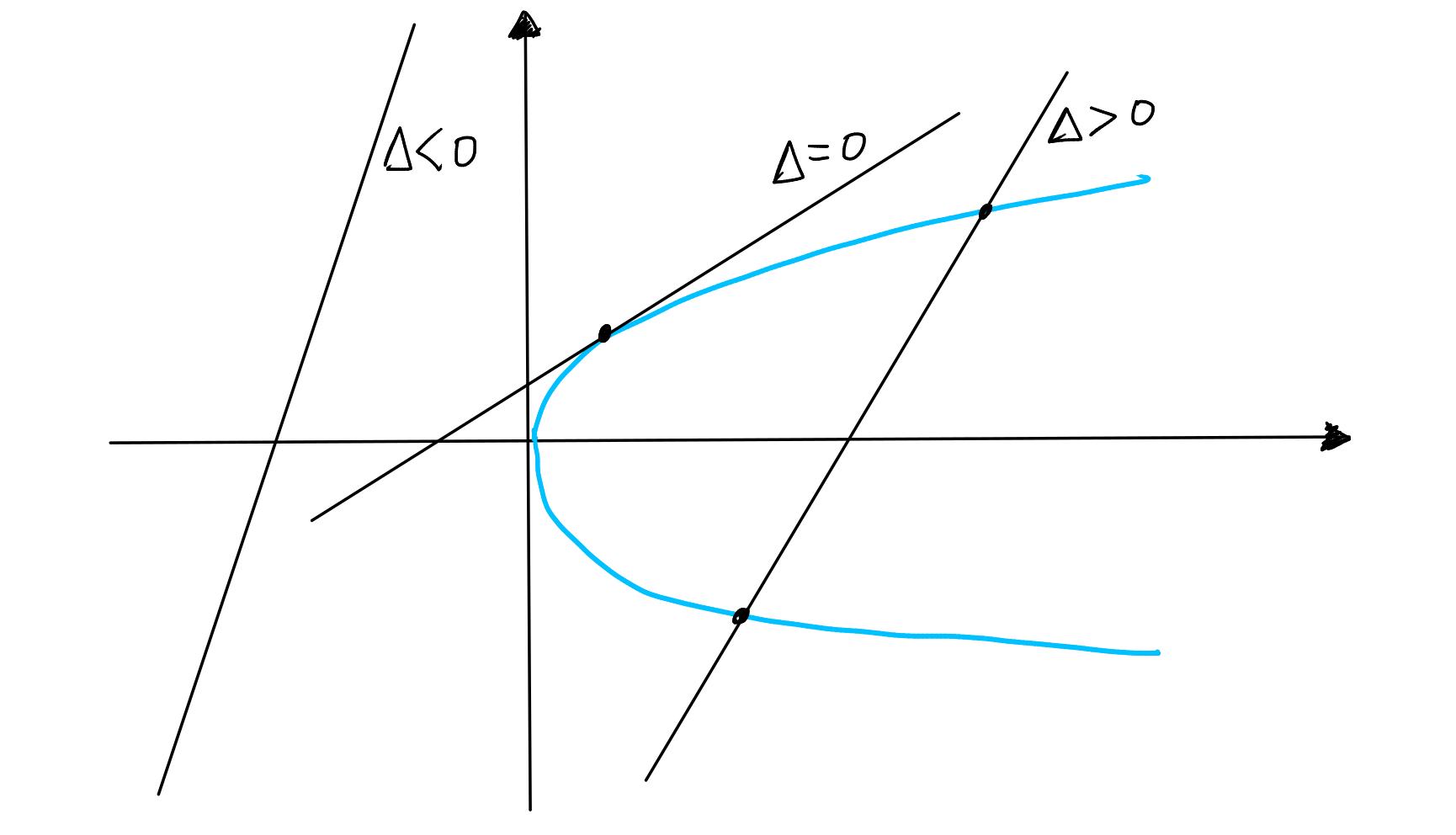
Analysis of Cases
Case I: The Line is a Secant (\(\Delta > 0\))
If \(\Delta > 0\), the quadratic equation has two distinct real roots. This signifies that the line intersects the parabola at two distinct points.
- Condition: \(16a(a - mc) > 0 \implies \mathbf{a > mc}\) (assuming \(a > 0\))
Case II: The Line is a Tangent (\(\Delta = 0\))
If \(\Delta = 0\), the quadratic equation has exactly one real root (a repeated root). This signifies that the line touches the parabola at a single point.
- Condition: \(16a(a - mc) = 0 \implies \mathbf{a = mc}\)
This gives the fundamental condition of tangency:
Case III: The Line Does Not Intersect (\(\Delta < 0\))
If \(\Delta < 0\), the quadratic equation has no real roots. This signifies that the line and the parabola have no points in common.
- Condition: \(16a(a - mc) < 0 \implies \mathbf{a < mc}\) (assuming \(a > 0\))
Summary of Conditions
| Condition (for \(a>0\)) | Discriminant | Geometric Interpretation |
|---|---|---|
| \(a > mc\) | \(\Delta > 0\) | The line is a secant. |
| \(a = mc\) | \(\Delta = 0\) | The line is a tangent. |
| \(a < mc\) | \(\Delta < 0\) | The line does not intersect the parabola. |
💡 A special case arises when a line is parallel to the axis of the parabola (i.e., \(m=0\), giving the line \(y=c\)). This line intersects the parabola at exactly one point, \(x = c^2/(4a)\), but it is not a tangent. Instead, it is a chord parallel to the axis of symmetry.
💡 Conditions of Tangency for All Standard Forms
The "discriminant method" is a universal tool for finding the conditions of tangency. By applying the same logic to the other standard parabolic forms, we can derive their respective conditions.
The Left-Handed Parabola: \(y^2 = -4ax\)
For this parabola, the process is nearly identical to the right-handed case. We invite the reader to verify this as a valuable exercise.
Challenge for the Reader: ✍️
- Substitute \(y = mx + c\) into the equation \(y^2 = -4ax\).
- Arrange the result into a quadratic equation in \(x\).
- Set the discriminant (\(\Delta\)) of this quadratic to zero.
- Solve for \(c\) in terms of \(a\) and \(m\).
By following these steps, you will arrive at the condition of tangency:
Notice that the only difference is a sign change, reflecting the parabola's new orientation.
The Upward-Opening Parabola: \(x^2 = 4ay\)
Here, the variable that is squared has changed, so our substitution is slightly different.
Given the parabola \(x^2 = 4ay\) and the line \(y = mx + c\).
-
Substitute for \(y\) in the parabola's equation:
\[x^2 = 4a(mx + c)\] -
Form the quadratic in \(x\):
\[x^2 - 4amx - 4ac = 0\] -
Set the discriminant to zero (\(\Delta = B^2 - 4AC = 0\)):
- \(A = 1\), \(B = -4am\), \(C = -4ac\)
- \((-4am)^2 - 4(1)(-4ac) = 0\)
- \(16a^2m^2 + 16ac = 0\)
-
Solve for c:
- \(16ac = -16a^2m^2\)
- Assuming \(a \neq 0\), we divide by \(16a\) to get the condition of tangency:
\[\large c = -am^2\]
The Downward-Opening Parabola: \(x^2 = -4ay\)
Following an identical derivation for the downward-opening parabola, which involves substituting \(y=mx+c\) into \(x^2 = -4ay\), we find a similar result, again with a sign change.
The condition for the line \(y = mx + c\) to be tangent to the parabola \(x^2 = -4ay\) is:
Summary of Tangency Conditions
This gives us a complete reference for the line \(y = mx + c\) to be tangent to any standard parabola.
| Parabola Equation | Condition of Tangency |
|---|---|
| \(y^2 = 4ax\) | \(\mathbf{c = \frac{a}{m}}\) |
| \(y^2 = -4ax\) | \(\mathbf{c = -\frac{a}{m}}\) |
| \(x^2 = 4ay\) | \(\mathbf{c = -am^2}\) |
| \(x^2 = -4ay\) | \(\mathbf{c = am^2}\) |
📜 Theorem: Equation of a Tangent in Slope-Form
The equation of a tangent line with a given slope \(m\) to the parabola \(y^2 = 4ax\) is given by:
Proof:
We have already established that a line of the form \(y = mx + c\) is tangent to the parabola \(y^2 = 4ax\) if and only if it satisfies the condition of tangency, which is \(c = a/m\).
By substituting this specific value of \(c\) back into the line's equation, we directly obtain the equation of the tangent line.
Thus, for any non-zero slope \(m\), there is exactly one line with that slope that is tangent to the parabola.
Extension to Shifted Parabolas
This theorem can be elegantly extended to a parabola whose vertex has been shifted from the origin \((0, 0)\) to a new point \((h, k)\).
Consider the parabola \((y-k)^2 = 4a(x-h)\).
We can introduce a new coordinate system \((X, Y)\) such that its origin is at \((h, k)\). The transformations are:
- \(X = x - h\)
- \(Y = y - k\)
In this new system, the parabola's equation is simply \(Y^2 = 4aX\). From our theorem, the tangent to this parabola is:
Now, we translate this equation back into our original \((x, y)\) coordinate system by substituting the transformation equations:
This is the equation of the tangent to the shifted parabola. The logic is that the shape of the parabola and the slope of the tangent are unaffected by the shift; only their positions change.
Summary of Tangents in Slope-Form
The same principles can be applied to all four orientations of a shifted parabola. The results are summarized below.
| Parabola Equation | Equation of the Tangent (Slope-Form) |
|---|---|
| \((y-k)^2 = 4a(x-h)\) | \(\mathbf{y-k = m(x-h) + \frac{a}{m}}\) |
| \((y-k)^2 = -4a(x-h)\) | \(\mathbf{y-k = m(x-h) - \frac{a}{m}}\) |
| \((x-h)^2 = 4a(y-k)\) | \(\mathbf{y-k = m(x-h) - am^2}\) |
| \((x-h)^2 = -4a(y-k)\) | \(\mathbf{y-k = m(x-h) + am^2}\) |
Example
Find the equation of the tangent line with slope 3 to the parabola given by \((x+1)^2 = 16(y-1)\).
Solution
We are given the parabola \((x+1)^2 = 16(y-1)\). By comparing this to the standard form of an upward-opening parabola, \((x-h)^2 = 4a(y-k)\), we can identify its characteristics.
The vertex \((h, k)\) is \((-1, 1)\). The parameter \(4a\) is equal to 16, which implies that \(\mathbf{a = 4}\).
The required tangent line has a slope of \(\mathbf{m = 3}\).
The general equation of a tangent with slope \(m\) to a parabola of the form \((x-h)^2 = 4a(y-k)\) is:
Substituting the known values \(h = -1\), \(k = 1\), \(a = 4\), and \(m = 3\) into this formula yields:
Simplifying the expression gives us the equation of the tangent line:
Thus, the required equation of the tangent is: