Parametric Equation of Parabola
Parametric Equation of a Parabola
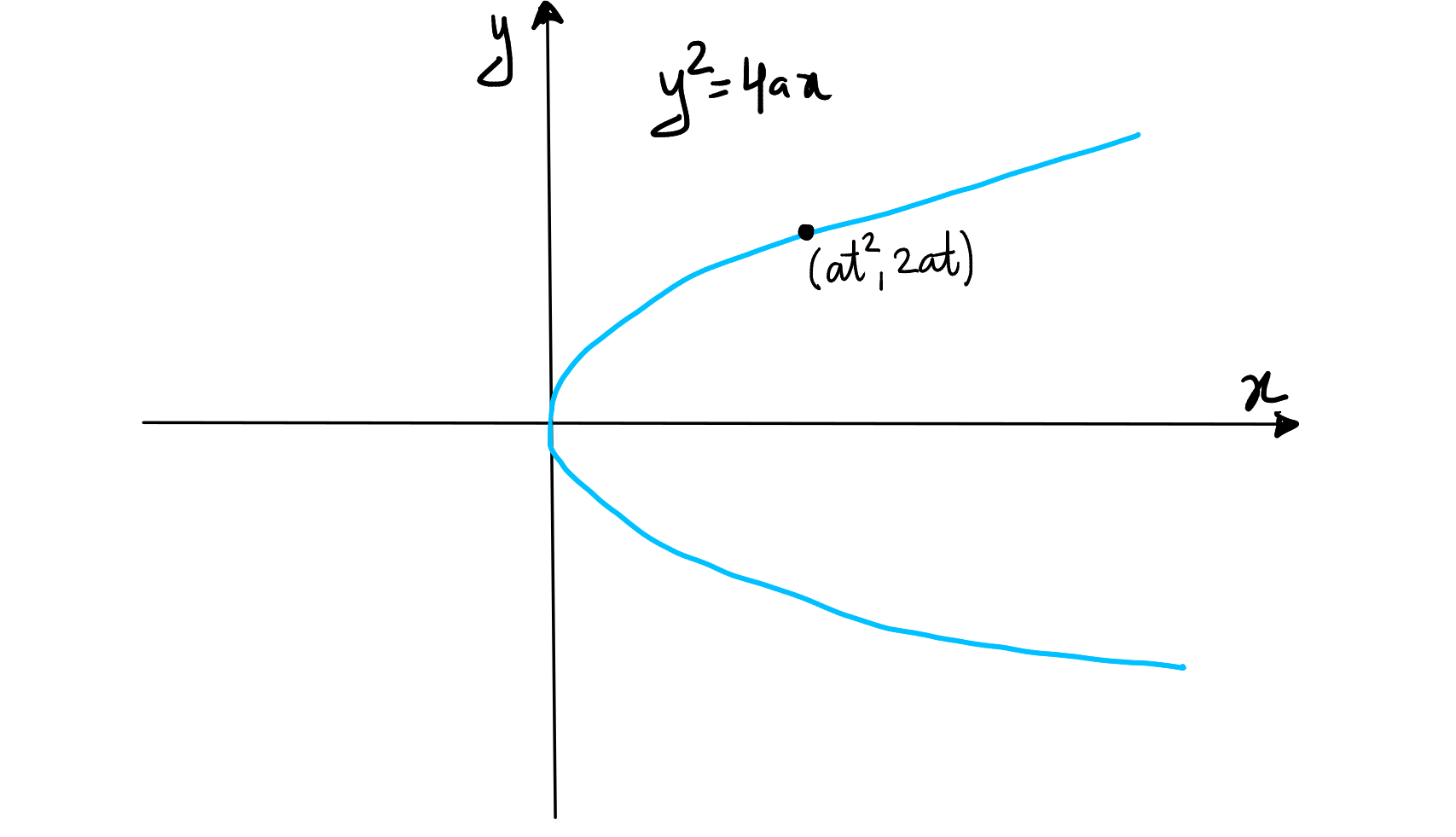
The standard equation of a parabola, \(y^2 = 4ax\), defines a relationship between the \(x\) and \(y\) coordinates. It's often more convenient, however, to express both coordinates in terms of a third variable, or parameter, typically denoted by \(t\). For the parabola \(y^2 = 4ax\), the parametric equations are:
Any point on the parabola can be represented as \((at^2, 2at)\). This point is often referred to simply as the point '\(t\)'.
Derivation of the Equations
The parametric form can be derived directly from the Cartesian equation.
- Start with the standard equation \(y^2 = 4ax\).
-
We can rewrite this as \(y \cdot y = (2a) \cdot (2x)\) and arrange it into a ratio:
\[\frac{y}{2a} = \frac{2x}{y}\] -
Let's set this common ratio equal to a parameter, \(t\).
\[\frac{y}{2a} = t\] -
From this, we can immediately solve for \(y\):
\[y = 2at\] -
Now, using the other half of the ratio, \(\frac{2x}{y} = t\), we get \(x = \frac{yt}{2}\). We can substitute our expression for \(y\) into this equation:
\[x = \frac{(2at)t}{2} = at^2\]
Thus, we arrive at the coordinates \(x=at^2\) and \(y=2at\). We can verify this by substituting them back into \(y^2 = 4ax\):
The equation holds true, confirming our parametric form.
Why is this Useful?
This parametric representation simplifies many of the parabola's properties, particularly in calculus. For instance, let's find the slope of the tangent. Differentiating \(y^2=4ax\) with respect to \(x\) gives:
Instead of using the Cartesian coordinate \(y\), we can substitute its parametric equivalent, \(y = 2at\):
This is an incredibly simple and powerful result. The slope of the tangent at any point '\(t\)' on the parabola is simply \(\frac{1}{t}\). This removes complexity when finding the equations of tangents and normals.
Tracing the Parabola with 't'
The parameter \(t\) can be seen as a controller that traces out the entire curve as its value changes.
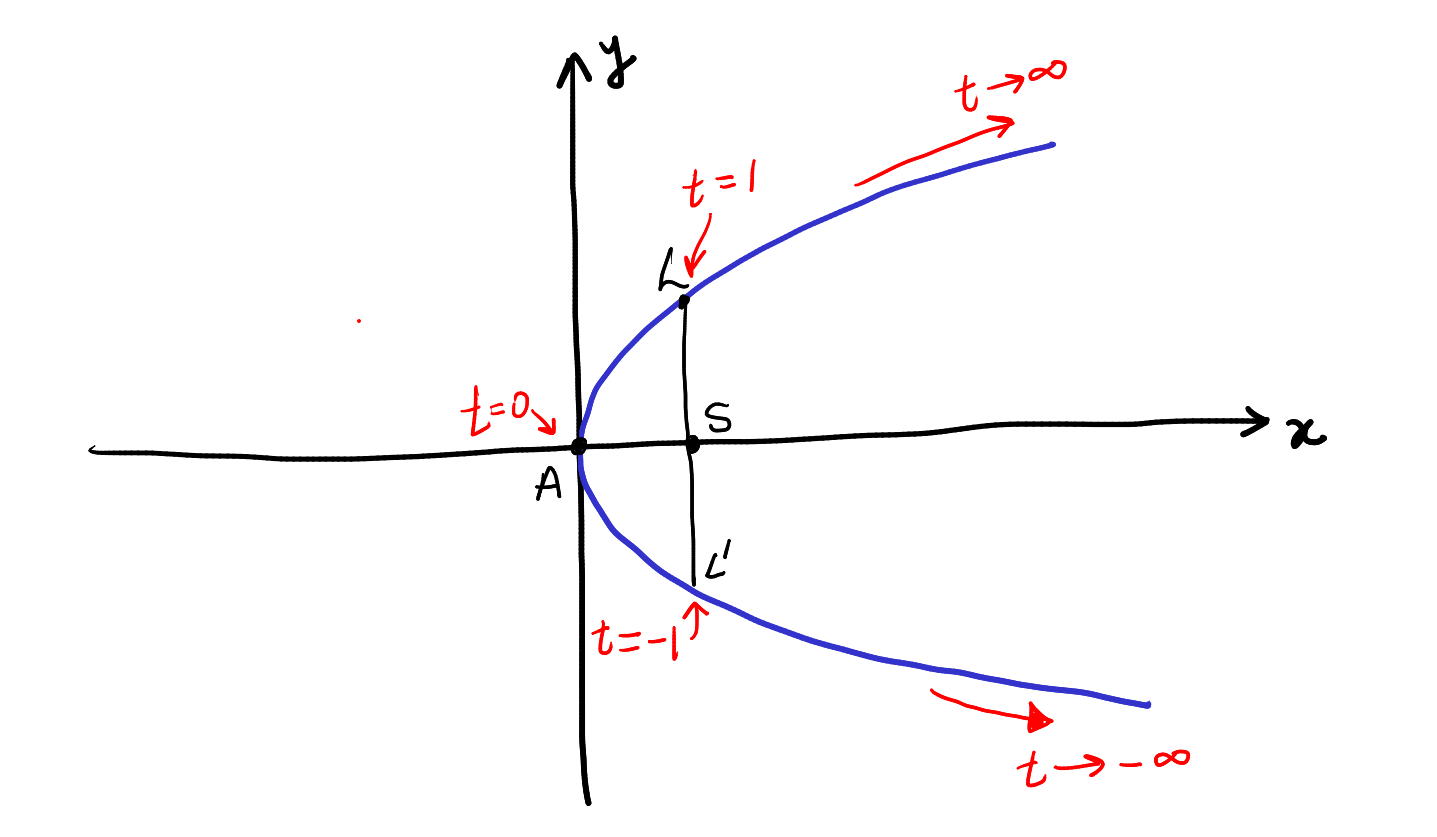
- When \(\mathbf{t = 0}\), the point is \((a(0)^2, 2a(0)) = \mathbf{(0, 0)}\), which is the vertex of the parabola.
- When \(\mathbf{t = 1}\), the point is \((a(1)^2, 2a(1)) = \mathbf{(a, 2a)}\), which is one endpoint of the latus rectum.
- When \(\mathbf{t = -1}\), the point is \((a(-1)^2, 2a(-1)) = \mathbf{(a, -2a)}\), which is the other endpoint of the latus rectum.
As the value of \(t\) changes, the point \((at^2, 2at)\) "moves" along the parabola:
- As \(t\) changes from \(0\) to \(\infty\), the point moves from the vertex up along the upper branch of the parabola.
- Similarly, as \(t\) changes from \(0\) to \(-\infty\), the point moves along the lower branch.
The entire parabola is traced as \(t\) varies over all real numbers.
Parametric Forms for All Orientations
While the parametric form \((at^2, 2at)\) for \(y^2 = 4ax\) is the most common, we can define parametric equations for all orientations of the parabola by making simple adjustments.
Parabolas with Vertex at the Origin
Let's look at the four standard parabolas centered at \((0, 0)\).
-
Right-Handed Parabola: \(y^2 = 4ax\) This is the standard reference form. Any point '\(t\)' on the parabola is given by:
- \(x = at^2\)
- \(y = 2at\)
-
Left-Handed Parabola: \(y^2 = -4ax\) For this parabola, the x-coordinate must always be non-positive (assuming \(a>0\)). We achieve this by negating the x-parameter.
- \(x = -at^2\)
- \(y = 2at\)
-
Upward-Opening Parabola: \(x^2 = 4ay\) Here, the roles of \(x\) and \(y\) are swapped from the standard right-handed case. We reflect this by swapping their parametric representations.
- \(x = 2at\)
- \(y = at^2\)
-
Downward-Opening Parabola: \(x^2 = -4ay\) Following the logic from the upward-opening case, the y-coordinate must now be non-positive. We simply negate the y-parameter.
- \(x = 2at\)
- \(y = -at^2\)
Parabolas with a Shifted Vertex
Now, let's generalize this for any parabola whose vertex is shifted to a new point \(A(h, k)\).
The principle is straightforward: you take the parametric equations for the corresponding parabola at the origin and simply add the shift components \((h, k)\) to the coordinates.
The transformation is:
Applying this to the four cases gives us a complete set of parametric forms.
| Orientation | Cartesian Equation | Parametric Equations |
|---|---|---|
| Right-Handed | \((y-k)^2 = 4a(x-h)\) | \(x = h + at^2\) \(y = k + 2at\) |
| Left-Handed | \((y-k)^2 = -4a(x-h)\) | \(x = h - at^2\) \(y = k + 2at\) |
| Upward-Opening | \((x-h)^2 = 4a(y-k)\) | \(x = h + 2at\) \(y = k + at^2\) |
| Downward-Opening | \((x-h)^2 = -4a(y-k)\) | \(x = h + 2at\) \(y = k - at^2\) |
In every case, the parameter \(t\) traces the entire curve as it varies over the set of real numbers, with \(t=0\) always corresponding to the vertex \((h, k)\).