General Conic Section
A conic section is a curve obtained as the intersection of a right circular double-napped cone with a plane. This definition is purely geometric and does not require any coordinate system or algebraic equation. The entire classification of conics—ellipse, parabola, hyperbola, and their degenerate forms—emerges by examining how a plane, inclined at an angle \(\theta\), intersects a cone whose generators make a fixed angle \(\alpha\) with the vertical axis.
We now describe this classification in complete generality.
The Cone
Let the origin be the vertex of a right circular cone whose axis is vertical. The cone is formed by rotating a straight line (a generator) about this axis such that it always makes a fixed angle \(\alpha \in (0, \frac{\pi}{2})\) with it. This produces two infinite surfaces—called the upper nappe and the lower nappe—that together form the double-napped cone.
Please look at the following source to get a full picture: INTMATH
We now intersect this cone with a plane inclined at angle \(\theta\) to the axis. The nature of the curve formed at the intersection depends on two things:
- The comparison between \(\theta\) and \(\alpha\)
- Whether the plane passes through the vertex or not
We treat the non-degenerate and degenerate cases separately.
I. Non-Degenerate Conics (Plane does not pass through the vertex)
These arise when the cutting plane does not contain the origin.
1. Ellipse
If the plane intersects only one nappe, and
then the intersection is a closed, bounded curve called an ellipse. The cutting plane is oblique but not steep enough to cut both nappes.
A circle arises as a special case when \(\theta = 0\), i.e., the plane is horizontal and perpendicular to the cone’s axis.
Interactive Figure at intmath.com
2. Parabola
If the cutting plane is parallel to exactly one generator, then
The plane touches the cone in such a way that the intersection is an open, unbounded curve called a parabola. The plane intersects only one nappe, but it does so with just enough steepness to prevent closure.
Interactive Figure at intmath.com
3. Hyperbola
If the plane cuts both nappes, then
The intersection is a hyperbola, consisting of two unbounded branches. The plane slices steeply enough to enter one nappe and exit through the other.
Interactive Figure at intmath.com
II. Degenerate Conics (Plane passes through the vertex)
When the cutting plane contains the origin, the intersection curve becomes degenerate, i.e., a limiting form of a conic.
1. Point
If the plane touches only one nappe and
then the intersection is a single point, namely the origin itself. This is a degenerate ellipse.
2. Single Line
If the plane is parallel to a generator and passes through the vertex, so
then the plane intersects the cone in one generator, and the intersection is a single straight line through the vertex. This is a degenerate parabola.
3. Pair of Intersecting Lines
If the plane passes through the vertex and is steeper than the cone:
then the intersection is a pair of straight lines intersecting at the vertex, one from each nappe. This is a degenerate hyperbola.
Summary of Classical Conics via Cone Intersections
This classification completes the geometric definition of conics as sections of a cone. Each conic arises from a precise angular relationship between the cutting plane and the cone, and the vertex plays a critical role in distinguishing degenerate forms. No coordinates are required; all types of conics emerge naturally from this unified spatial construction.
Modern Definition of Conic Sections
A conic section can also be defined as the locus of a point moving in a plane in such a way that its distance from a fixed point is always in a constant ratio to its perpendicular distance from a fixed straight line. This geometric definition, unlike the classical cone-cutting definition, is entirely two-dimensional and coordinate-independent.
Let us formalize this:
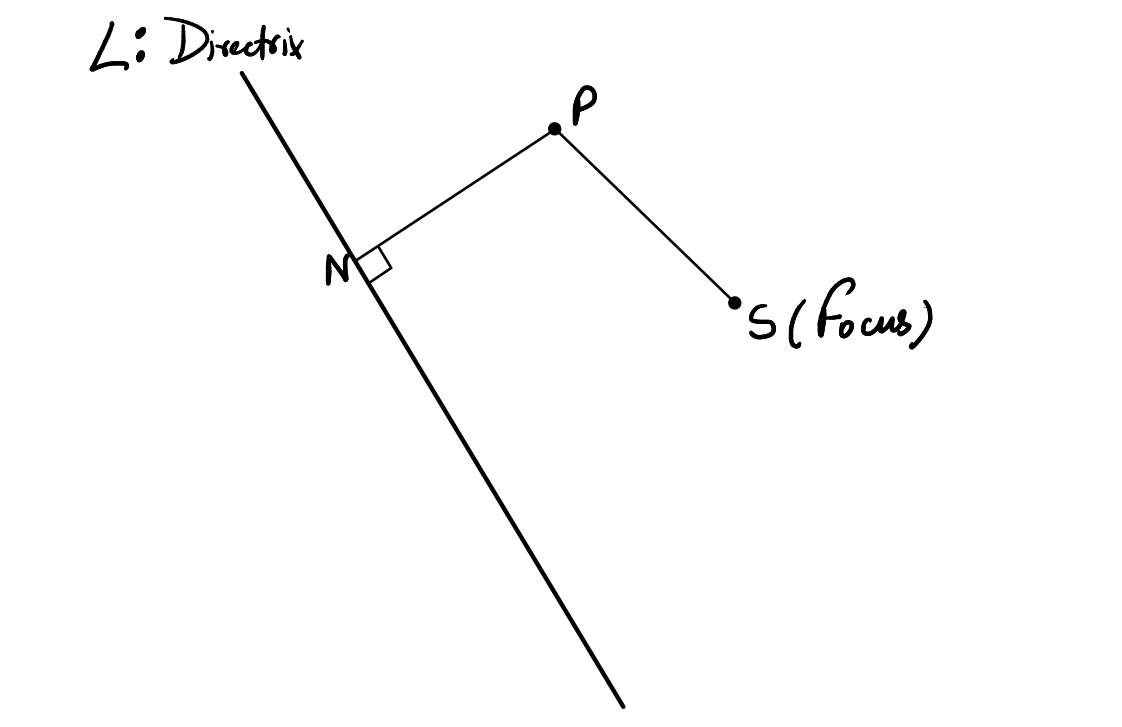
Let there be a fixed point \(S\), called the focus, and a fixed straight line \(L\), called the directrix, both lying in the same plane. Let \(P\) be a point that moves in this plane and satisfies the following condition:
where \(e > 0\) is a given constant, called the eccentricity of the conic. That is,
where \(N\) is the foot of the perpendicular from \(P\) to the line \(L\), and \(SP\) and \(PN\) are the Euclidean distances from \(P\) to the focus and to the directrix respectively.
This definition captures all types of conics by varying the value of \(e\):
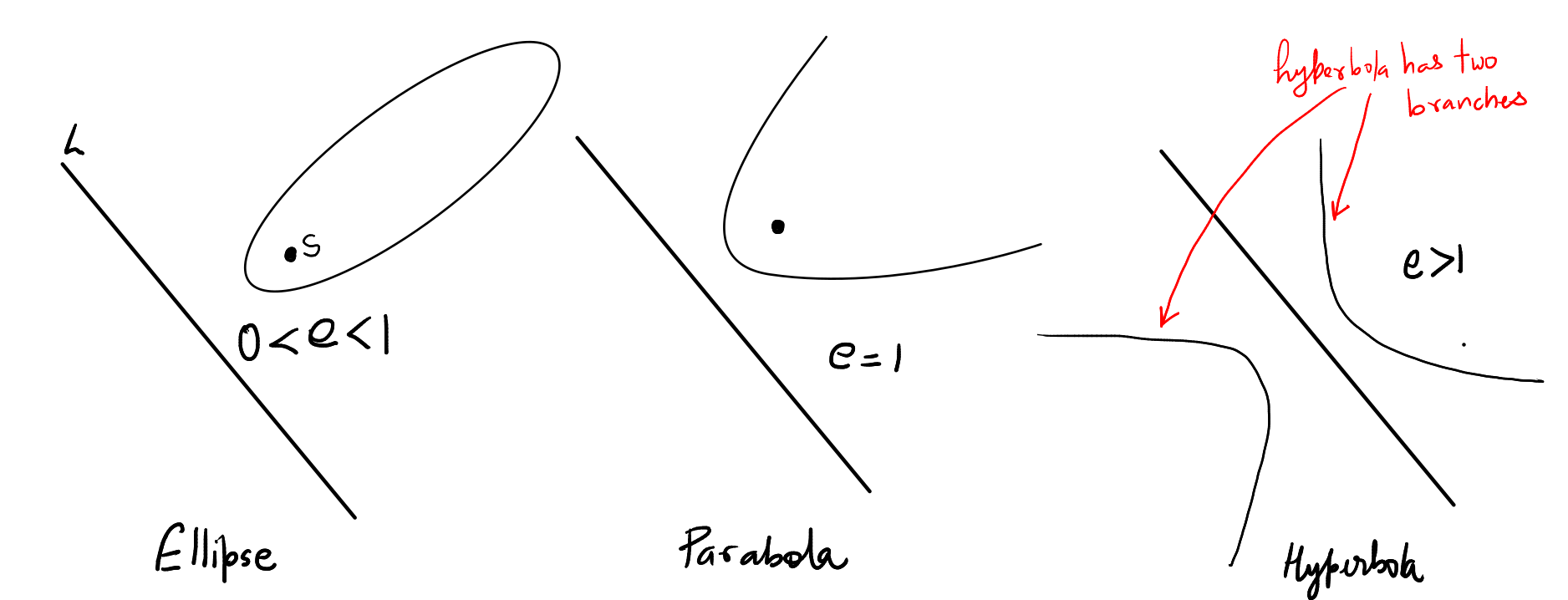
- If \(0 < e < 1\), the point remains closer to the focus than to the directrix. The locus is an ellipse.
- If \(e = 1\), the point remains equally close to both the focus and the directrix. The locus is a parabola.
- If \(e > 1\), the point stays farther from the focus than from the directrix. The locus is a hyperbola.
Let us now give this definition a coordinate expression.
Fix a Cartesian coordinate system. Suppose the directrix has the equation
and the focus is the fixed point \(S(\alpha, \beta)\). Let the moving point \(P(x, y)\) be an arbitrary point on the locus.
By the definition above, the distance from \(P\) to the focus is
and the perpendicular distance from \(P\) to the line \(L\) is given by the formula:
Then the defining condition of the conic becomes:
This equation represents the general form of a conic section as a locus, and the value of \(e\) determines the type of conic, just as before:
To fully understand how different values of \(e\) affect the shape and position of the conic, and to reduce the locus equation into recognizable standard forms, a detailed coordinate analysis is necessary. That study requires further exploration, which we shall undertake soon.
Let us illustrate the locus definition of a conic section with an explicit example.
Example 1: Parabola
Given: Directrix: \(x - 2y + 1 = 0\) Focus: \(S(-1, 1)\) Eccentricity: \(e = 1\) (since it is a parabola)
Let \(P(x, y)\) be a point on the parabola. By definition, its distance from the focus equals its perpendicular distance from the directrix. That is,
Squaring both sides,
Expanding both sides:
Left-hand side:
Right-hand side:
Multiplying through by 5:
Bring all terms to one side:
Hence, the required equation is:
This is a second-degree equation in \(x\) and \(y\). It is of the general form:
where:
This form is important. Any conic—ellipse, parabola, or hyperbola—can be represented as a second-degree equation in \(x\) and \(y\). The symmetric use of \(2h, 2g, 2f\) instead of \(h, g, f\) makes the later development of algebraic results—like rotation, translation, classification, and matrix representation—cleaner and more systematic.
Example 2: Ellipse
Same directrix and focus, but now with eccentricity \(e = \frac{3}{5}\), i.e.,
Squaring both sides:
Multiply both sides by 125:
Expand both sides and simplify:
LHS:
RHS:
Bring all terms to one side:
Hence, the required equation of the ellipse is:
Again, this is of the general conic form:
Thus, we see that all conic sections, whether derived from the locus definition with focus-directrix-eccentricity or from the intersection of a cone with a plane, result in a second-degree equation in \(x\) and \(y\). This equation is what we call the general equation of a conic.
The equation
is called the general equation of a conic section. But a natural question arises: Does every such second-degree equation in two variables represent a conic section? And if it does, how can we determine which conic it is?
The answer is not straightforward. A full classification requires a detailed analysis involving transformations, invariants, and discriminants. Rather than diving into those complexities immediately, we begin by outlining a simpler method that allows us to decide the type of conic represented by the equation—if it is a conic at all.
We start by computing the determinant:
This determinant helps in distinguishing between proper and degenerate conics.
- If \(\Delta = 0\), then the conic is degenerate. It does not represent a parabola, ellipse, or hyperbola. It may represent a pair of straight lines, a single line, or even no real curve at all.
- If \(\Delta \neq 0\), then the conic is non-degenerate and must be one of the three: parabola, ellipse, or hyperbola.
Even when \(\Delta = 0\), further conditions are needed to determine whether the equation actually represents a pair of straight lines, and if so, whether they are real and intersecting, coincident, or imaginary. One such condition is:
which serve as additional tests for real linear factorization.
Now consider the case \(\Delta \neq 0\). Then the equation represents a non-degenerate conic, and we decide the type of conic using the discriminant:
This value governs the nature of the conic:
- If \(h^2 - ab = 0\), the conic is a parabola.
- If \(h^2 - ab < 0\), the conic is an ellipse.
- If \(h^2 - ab > 0\), the conic is a hyperbola.
Furthermore, a circle is a special case of an ellipse. For the conic to be a circle, two additional conditions must be satisfied:
That is, the \(x^2\) and \(y^2\) coefficients are equal, and the \(xy\) term is absent.
Thus, to summarize:
Hence, the second-degree equation
does not always represent a conic, but when it does, the values of \(\Delta\) and \(h^2 - ab\) allow us to classify it precisely.