Chord with a Given Midpoint and Diameter of a Parabola
When a straight line intersects a parabola at two distinct points, the segment connecting those points forms a secant chord. In many geometric and analytical investigations, we are not directly given the coordinates of the two endpoints; instead, we are given the coordinates of the chord's midpoint, or a geometric condition constraining the chords of a parallel family.
In this chapter, we develop the equation of a chord in terms of the coordinates of its midpoint using the parametric representation of the parabola. We then present the comparison method for determining the midpoint of a given chord line, examine the geometry of systems of parallel chords, and explore the diameter of the parabola along with its fundamental tangency and bisection properties.
Equation of a Chord with a Given Midpoint
Consider the standard parabola:
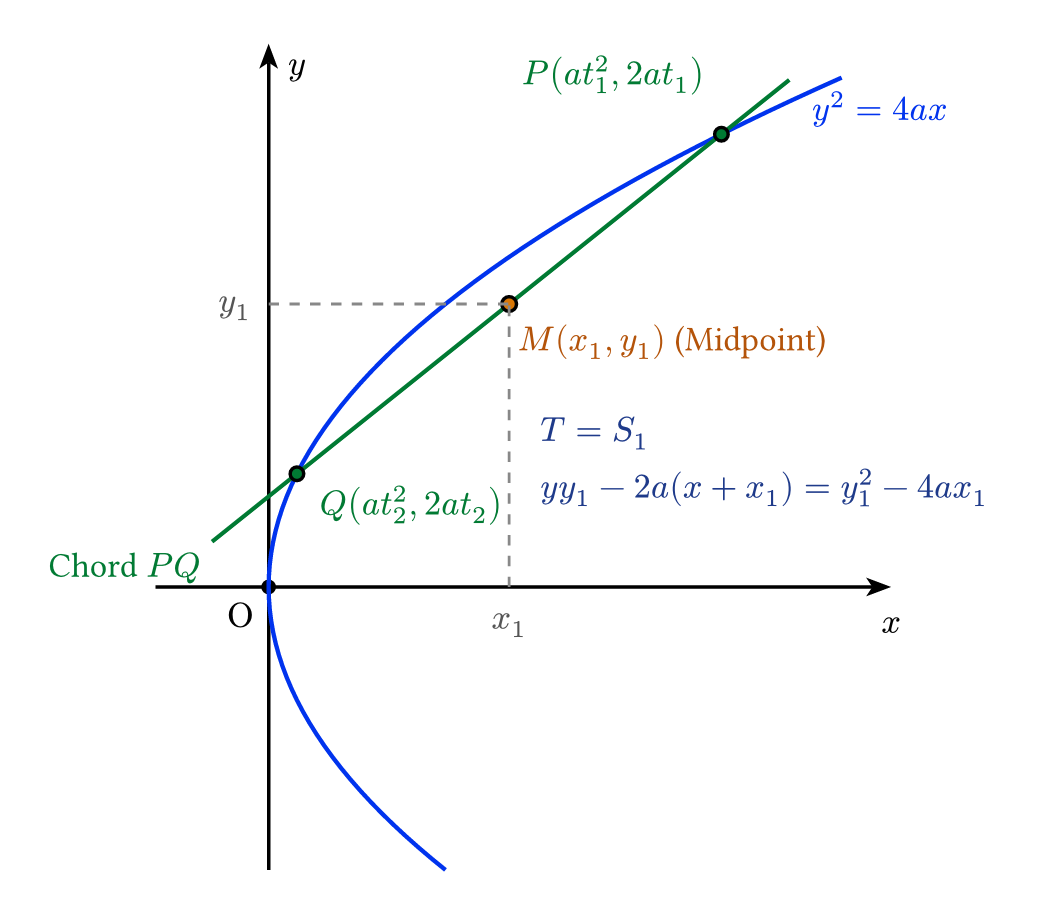
Let \(P(at_1^2, 2at_1)\) and \(Q(at_2^2, 2at_2)\) be two distinct points on the parabola defining a chord \(PQ\).
Parametric Derivation of the Chord Equation
The slope of the secant line passing through \(P\) and \(Q\) is given by:
Using the point-slope form with the point \(P(at_1^2, 2at_1)\), the equation of the line \(PQ\) is:
Clearing fractions by multiplying both sides by \(t_1 + t_2\):
Expanding and rearranging the terms:
Now let \(M(x_1, y_1)\) denote the midpoint of the chord \(PQ\). By the midpoint formula:
From the relation for \(y_1\), the sum of the parameters is directly expressed as:
To express the product \(t_1 t_2\) in terms of the midpoint coordinates \((x_1, y_1)\), we use the algebraic identity \((t_1 + t_2)^2 - (t_1^2 + t_2^2) = 2t_1 t_2\). Substituting \(t_1 + t_2 = \frac{y_1}{a}\) and \(t_1^2 + t_2^2 = \frac{2x_1}{a}\):
Multiplying through by \(a\):
We now substitute \(t_1 + t_2 = \frac{y_1}{a}\) and \(2at_1 t_2 = \frac{y_1^2 - 2ax_1}{a}\) back into the equation of the chord \(y(t_1 + t_2) - 2x = 2at_1 t_2\):
Multiplying both sides of the equation by \(a\):
To write this in standard notation, we subtract \(2ax_1\) from both sides:
Recalling the standard notation for conics with respect to a point \((x_1, y_1)\):
The equation of the chord of the parabola \(y^2 = 4ax\) bisected at the point \(M(x_1, y_1)\) assumes the form:
Condition of Existence of a Real Chord
For the chord to intersect the parabola at two distinct real points \(P\) and \(Q\), the midpoint \(M(x_1, y_1)\) must lie strictly inside the parabola.
Recall that for any point \((x_1, y_1)\), the expression \(S_1 = y_1^2 - 4ax_1\) determines its location:
- If \(S_1 < 0\), the point \(M(x_1, y_1)\) lies in the interior of the parabola. The chord is a real secant line intersecting the curve at two distinct points.
- If \(S_1 = 0\), the point \(M(x_1, y_1)\) lies on the parabola itself. The chord degenerates into the tangent line at \(M\), where \(T = 0\).
- If \(S_1 > 0\), the point \(M(x_1, y_1)\) lies in the exterior of the parabola. No real secant line can have \(M\) as its midpoint, as any line through an exterior point either misses the parabola or intersects it such that \(M\) lies outside the segment joining the intersection points.
Therefore, a real chord with midpoint \(M(x_1, y_1)\) exists if and only if:
Slope of the Chord in Terms of Midpoint Coordinates
From the chord equation \(y y_1 - 2ax = y_1^2 - 2ax_1\), we can express \(y\) in terms of \(x\):
Comparing this with the slope-intercept form \(y = mx + c\), the slope \(m\) of the chord bisected at \((x_1, y_1)\) is:
This formula reveals a fundamental geometric fact: the slope of a chord of a parabola depends exclusively on the ordinate \(y_1\) of its midpoint, and is completely independent of the abscissa \(x_1\).
Equation of a Chord with a Given Midpoint
Find the equation of the chord of the parabola \(y^2 = 8x\) whose midpoint is \((2, 3)\).
Solution:
Comparing \(y^2 = 8x\) with the standard form \(y^2 = 4ax\), we have \(4a = 8\), so \(a = 2\).
The proposed midpoint is \((x_1, y_1) = (2, 3)\). First, we verify whether a real chord exists by checking the position of the point with respect to the parabola:
Since \(S_1 = -7 < 0\), the point lies strictly inside the parabola, confirming that a real chord exists.
Using the midpoint chord formula \(T = S_1\), where \(T = y y_1 - 4(x + x_1)\):
Expanding the terms:
Thus, the equation of the chord is \(4x - 3y + 1 = 0\).
Length of a Chord with a Given Midpoint
Determine the length of the chord of the parabola \(y^2 = 4x\) whose midpoint is \((2, 1)\).
Solution:
Here \(4a = 4\), which gives \(a = 1\). The midpoint is \((x_1, y_1) = (2, 1)\).
Checking the existence condition:
The slope of the chord is:
Using the point-slope form with midpoint \((2, 1)\), the equation of the chord line is:
Multiplying by \(2\), we obtain \(4x = 2y + 6\). Substituting this into the parabola equation \(y^2 = 4x\):
Let the endpoints of the chord be \(P(x_A, y_A)\) and \(Q(x_B, y_B)\). The ordinates \(y_A\) and \(y_B\) are the roots of this quadratic equation. By Vieta's formulas:
The difference between the ordinates is:
Since the chord line satisfies \(x - 2 = \frac{1}{2}(y - 1)\), the difference between the abscissae is:
The length of the chord \(PQ\) is therefore:
Hence, the length of the chord is \(\sqrt{35}\).
Finding the Midpoint of a Chord by the Comparison Method
When the equation of a chord is already known in the general linear form \(lx + my + n = 0\), we frequently need to locate its midpoint without solving the quadratic equation that yields the intersection points. The comparison method provides a direct and elegant algebraic solution.
Analytical Procedure
Let the given chord of the parabola \(y^2 = 4ax\) be:
Assume that the coordinates of the unknown midpoint are \(M(x_1, y_1)\). The equation of the chord having midpoint \((x_1, y_1)\) is given by \(T = S_1\):
Rearranging this into the standard linear form \(Ax + By + C = 0\):
Because this line represents the exact same chord as \(lx + my + n = 0\), their corresponding coefficients must be strictly proportional:
From the equality of the first two ratios:
Next, equating the first and third ratios:
Solving for \(2ax_1\):
Substituting the expression \(y_1 = -\frac{2am}{l}\) into this equation:
Dividing both sides by \(2a\):
Thus, the coordinates of the midpoint \(M(x_1, y_1)\) are determined directly as:
Finding the Midpoint by Comparison
Find the midpoint of the chord \(2x - y - 4 = 0\) of the parabola \(y^2 = 4x\).
Solution:
Comparing \(y^2 = 4x\) with \(y^2 = 4ax\), we have \(a = 1\). The given line is:
Let the unknown midpoint be \(M(x_1, y_1)\). The equation of the chord with midpoint \((x_1, y_1)\) is:
Comparing the coefficients of this line with the given line \(2x - y - 4 = 0\):
The first ratio evaluates to \(-1\). Equating each of the other ratios to \(-1\):
Substituting \(y_1 = 1\):
To ensure this represents a valid interior midpoint, we evaluate \(S_1\):
Since \(S_1 < 0\), the midpoint is valid, and its coordinates are \(\left(\frac{5}{2}, 1\right)\).
System of Parallel Chords and the Diameter
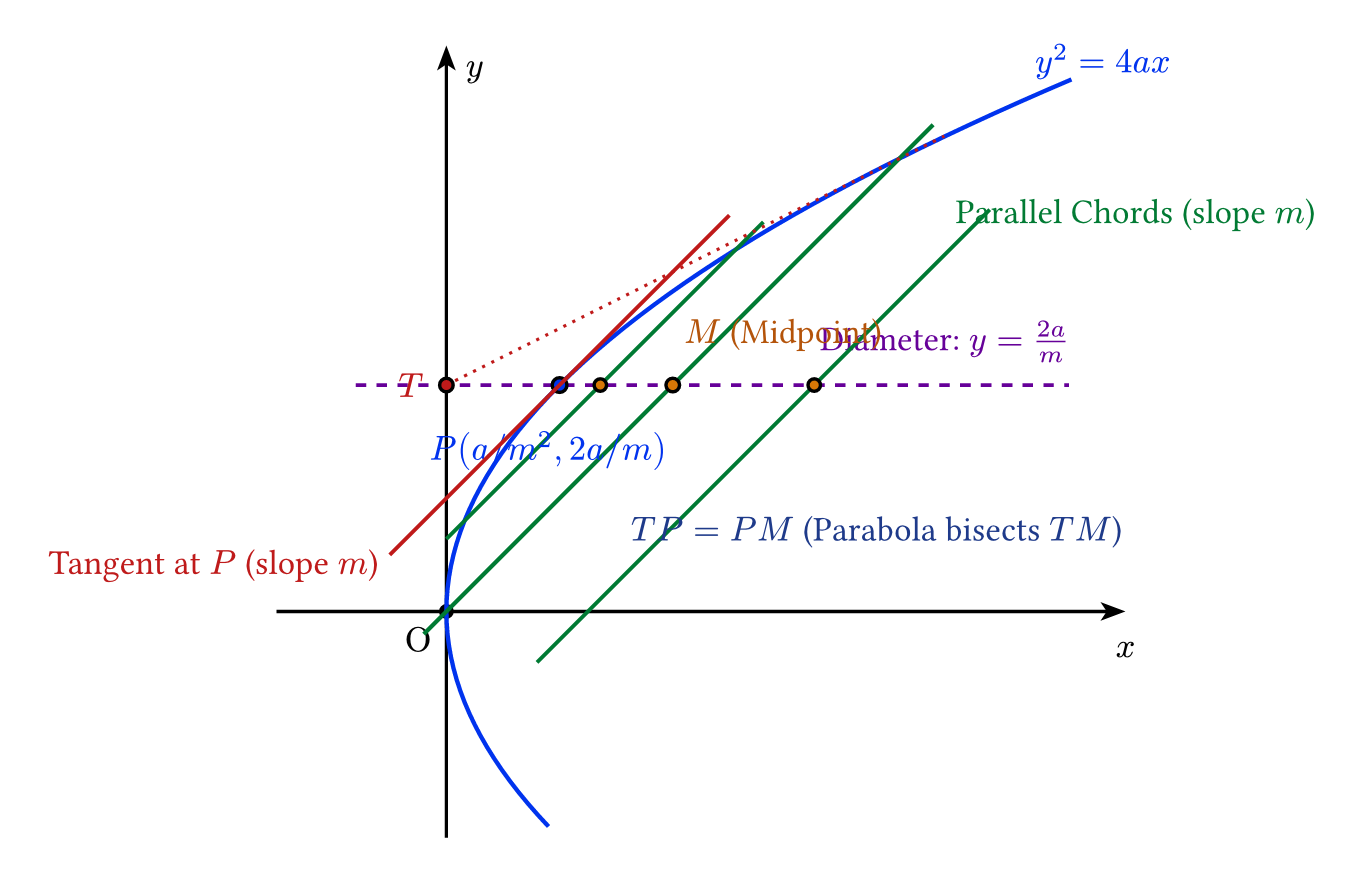
Now consider a family of parallel chords of the parabola \(y^2 = 4ax\), each having a fixed slope \(m \neq 0\).
Every line in this family can be represented by the equation:
where \(m\) is constant and \(c\) is an arbitrary real parameter varying across the family.
Locus of Midpoints of Parallel Chords
Let \(M(h, k)\) be the midpoint of an arbitrary chord belonging to this family. Since \(M\) bisects the chord, the slope of the chord in terms of the midpoint coordinates must equal \(m\):
Notice that the ordinate \(k\) depends exclusively on the fixed slope \(m\) and the parameter \(a\) of the parabola; it is entirely independent of the intercept \(c\).
Replacing \((h, k)\) by the running coordinates \((x, y)\), the locus of the midpoints of all chords having slope \(m\) is:
Definition of Diameter
In coordinate geometry, the diameter of a conic section is defined as the locus of the midpoints of a system of parallel chords.
For the parabola \(y^2 = 4ax\):
- The diameter corresponding to chords of slope \(m\) is the straight line \(y = \frac{2a}{m}\).
- Because this line has a constant ordinate, every diameter of a standard parabola is parallel to its principal axis (the \(x\)-axis).
- Conversely, every line parallel to the axis of a parabola bisects a family of parallel chords. If the line is \(y = k\), the chords it bisects have slope \(m = \frac{2a}{k}\).
Diameter Corresponding to an Inclination
Find the equation of the diameter of the parabola \(y^2 = 12x\) that bisects chords inclined at an angle of \(45^\circ\) to the \(x\)-axis.
Solution:
For the parabola \(y^2 = 12x\), comparing with \(y^2 = 4ax\) yields \(4a = 12\), so \(a = 3\).
The inclination of the chords is \(\theta = 45^\circ\), which gives their slope:
The equation of the diameter bisecting chords of slope \(m\) is:
Thus, the required diameter is the horizontal line \(y = 6\).
Fundamental Properties of the Diameter
The diameter of a parabola exhibits three interconnected geometric properties involving the extremity of the diameter, the tangents at the chord endpoints, and the bisection of the intercepting diameter segment.
Property 1: Tangent at the Extremity of a Diameter
The diameter \(y = \frac{2a}{m}\) intersects the parabola \(y^2 = 4ax\) at a single point \(P\), known as the extremity of the diameter.
Substituting \(y = \frac{2a}{m}\) into the equation of the parabola:
Hence, the extremity of the diameter on the parabola is:
In parametric form, this corresponds to the parameter \(t = \frac{1}{m}\), since \(x = at^2 = a(1/m)^2\) and \(y = 2at = 2a(1/m)\).
The equation of the tangent line to the parabola at \(P\) is:
Dividing both sides by \(\frac{2a}{m}\):
The slope of this tangent line is precisely \(m\). This establishes a fundamental theorem:
The tangent drawn at the extremity of any diameter of a parabola is parallel to the system of chords bisected by that diameter.
Property 2: Intersection of Tangents at the Extremities of a Chord
Let \(Q(at_1^2, 2at_1)\) and \(R(at_2^2, 2at_2)\) be the endpoints of any chord belonging to the parallel family of slope \(m\).
Since the slope of the chord \(QR\) is \(m\):
Let \(T(x_T, y_T)\) be the point of intersection of the tangents drawn at \(Q\) and \(R\). Using the standard formulas for the intersection of tangents:
Substituting \(t_1 + t_2 = \frac{2}{m}\) into the expression for \(y_T\):
Notice that \(y_T\) is identical to the equation of the diameter \(y = \frac{2a}{m}\). This proves:
The tangents drawn at the extremities of any chord of a parallel system intersect at a point that lies on the diameter bisecting that system.
Property 3: The Parabola Bisector Property
Consider the three collinear points lying along the diameter \(y = \frac{2a}{m}\):
- The point of intersection of the tangents at the chord endpoints, \(T(x_T, y_T)\).
- The extremity of the diameter on the parabola, \(P(x_P, y_P)\).
- The midpoint of the chord, \(M(x_M, y_M)\).
All three points share the same ordinate:
Let us analyze their abscissae:
We evaluate the directed segment \(TP = x_P - x_T\):
Next, we evaluate the directed segment \(PM = x_M - x_P\):
Comparing the two expressions:
This leads to the bisection theorem:
The segment of a diameter intercepted between a chord and the point of intersection of the tangents at its ends is bisected by the parabola at the extremity of the diameter.
Equivalently, the point \(P\) where the diameter meets the curve is the exact midpoint of the segment \(TM\).
Verification of the Diameter Bisection Property
Consider the parabola \(y^2 = 8x\) and the chord joining \(Q(2, 4)\) and \(R(8, -8)\).
- Determine the slope \(m\) of the chord and the equation of its bisecting diameter.
- Find the coordinates of the midpoint \(M\), the extremity \(P\), and the intersection of tangents \(T\).
- Verify that \(TP = PM\).
Solution:
For \(y^2 = 8x\), we have \(a = 2\).
The coordinates of the endpoints are \(Q(2, 4)\) and \(R(8, -8)\). The slope of the chord \(QR\) is:
The equation of the diameter corresponding to chords of slope \(m = -2\) is:
Now we calculate the three key points:
Midpoint \(M\):
Extremity \(P\) on the parabola:
Substituting \(y = -2\) into \(y^2 = 8x\):
Intersection of tangents \(T\):
The parametric values for \(Q\) and \(R\) satisfy \(2at = y\):
The intersection point \(T\) is given by:
All three points lie on the line \(y = -2\). Calculating the horizontal distances:
Since \(TP = PM = \frac{9}{2}\), the segment \(TM\) is bisected by the parabola at \(P\).
Solved Examples
The following problems demonstrate how the equation of a chord with a given midpoint and the properties of diameters are applied to solve locus and geometric problems.
Locus of Midpoints of Focal Chords
Find the locus of the midpoints of the focal chords of the parabola \(y^2 = 4ax\).
Solution:
Let \(M(h, k)\) be the midpoint of an arbitrary focal chord of the parabola \(y^2 = 4ax\).
The equation of the chord having midpoint \((h, k)\) is given by \(T = S_1\):
Since the chord is a focal chord, it must pass through the focus \(S(a, 0)\). Substituting \(x = a\) and \(y = 0\) into the chord equation:
Rearranging this relation:
Replacing \((h, k)\) with running coordinates \((x, y)\), the required locus is:
This locus is another parabola having:
- Vertex at \((a, 0)\)
- Axis along the line \(y = 0\) (\(x\)-axis)
- Latus rectum of length \(2a\), which is exactly half the latus rectum of the original parabola.
Locus of Midpoints of Chords Subtending a Right Angle at the Vertex
Find the locus of the midpoints of the chords of the parabola \(y^2 = 4ax\) which subtend a right angle at the vertex of the parabola.
Solution:
Let \(M(h, k)\) be the midpoint of the chord. The equation of the chord is:
Since \(M\) is an interior point, \(k^2 - 2ah \neq 0\). We express the equation in the form where the constant term is unity:
To find the lines connecting the vertex \((0, 0)\) to the intersection points of the chord with the parabola \(y^2 = 4ax\), we homogenize the second-degree equation of the parabola using the linear equation:
Multiplying by \(k^2 - 2ah\):
This homogeneous equation represents a pair of straight lines through the origin \((0, 0)\). For these lines to be mutually perpendicular, the sum of the coefficients of \(x^2\) and \(y^2\) must equal zero:
Rearranging the equation:
Replacing \((h, k)\) by \((x, y)\), the locus of the midpoint is:
This is a parabola with vertex at \((4a, 0)\) and latus rectum \(2a\).
Locus of Midpoints of Chords Passing Through a Fixed Point
Find the locus of the midpoints of chords of the parabola \(y^2 = 4ax\) that pass through a fixed point \((x_0, y_0)\).
Solution:
Let \(M(h, k)\) be the midpoint of any chord passing through the point \((x_0, y_0)\).
The equation of the chord with midpoint \((h, k)\) is:
Since this chord passes through the fixed point \((x_0, y_0)\), the coordinates \((x_0, y_0)\) must satisfy the equation:
Rearranging the terms:
Replacing \((h, k)\) by \((x, y)\), the locus is:
Completing the square in \(y\):
This represents a parabola whose axis is parallel to the \(x\)-axis, with vertex at \(\left(x_0 - \frac{y_0^2}{8a}, \frac{y_0}{2}\right)\) and latus rectum \(2a\).
Notice that when the fixed point is the origin \((0, 0)\), setting \(x_0 = 0\) and \(y_0 = 0\) yields \(y^2 = 2ax\), which is the locus of midpoints of chords passing through the vertex.
Locus of Midpoints of Chords of Constant Length
Find the locus of the midpoints of chords of the parabola \(y^2 = 4ax\) having a constant length \(2l\).
Solution:
Let the endpoints of the chord be \(P(at_1^2, 2at_1)\) and \(Q(at_2^2, 2at_2)\), and let its midpoint be \(M(h, k)\).
From the coordinates of the midpoint:
Solving for \(2t_1 t_2\):
Now we express \((t_1 - t_2)^2\) in terms of \(h\) and \(k\):
The square of the distance between \(P\) and \(Q\) is:
Factoring out \(a^2(t_1 - t_2)^2\):
Given that \(PQ = 2l\), we have \(PQ^2 = 4l^2\). Substituting \((t_1 - t_2)^2 = \frac{4ah - k^2}{a^2}\) and \(t_1 + t_2 = \frac{k}{a}\):
Multiplying both sides by \(a^2\):
Replacing \((h, k)\) by \((x, y)\), the required locus is:
Rewriting with \(S_1 = y^2 - 4ax\):
Since \(4a^2 l^2 > 0\) and \(y^2 + 4a^2 > 0\), this confirms that \(4ax - y^2 > 0\), meaning \(y^2 - 4ax < 0\). The locus lies entirely within the interior of the parabola.
Summary of Results
| Concept | Equation / Formula | Notes |
|---|---|---|
| Chord with Midpoint \((x_1, y_1)\) | \(T = S_1 \iff y y_1 - 2a(x + x_1) = y_1^2 - 4ax_1\) | Real chord requires \(S_1 < 0\) |
| Slope of Bisected Chord | \(m = \frac{2a}{y_1}\) | Depends only on the midpoint ordinate \(y_1\) |
| Comparison Method | \(\frac{-2a}{l} = \frac{y_1}{m} = \frac{-(y_1^2 - 2ax_1)}{n}\) | For given line \(lx + my + n = 0\) |
| Diameter of Parabola | \(y = \frac{2a}{m}\) | Parallel to axis of parabola |
| Extremity of Diameter | \(P\left(\frac{a}{m^2}, \frac{2a}{m}\right)\) | Point of tangency parallel to chords |
| Tangents Intersection | \(T\left(at_1 t_2, \frac{2a}{m}\right)\) | Lies on the diameter of the chord |
| Parabola Bisection Property | \(TP = PM\) | Parabola bisects segment between \(T\) and \(M\) |
| Midpoints of Focal Chords | \(y^2 = 2a(x - a)\) | Parabola with vertex \((a, 0)\), latus rectum \(2a\) |
| Midpoints of Right-Angled Chords | \(y^2 = 2a(x - 4a)\) | Subtends \(90^\circ\) at vertex \((0, 0)\) |
| Midpoints of Chords through \((x_0, y_0)\) | \(y^2 - y_0 y = 2a(x - x_0)\) | Parabola passing through \((0, 0)\) and \((x_0, y_0)\) |