Co-normal Points and Normals to a Parabola
When investigating tangents to a conic section from an external point, algebraic analysis leads to a quadratic equation, confirming that from any point outside the curve, exactly two tangents can be drawn. When the same inquiry is directed toward normals, a fundamentally richer structure emerges. The condition that a normal to a parabola passes through a specified point \((h, k)\) produces a cubic equation in the slope or parameter of the normal.
Because every cubic polynomial with real coefficients has at least one real root and at most three real roots, it follows that from any point in the plane, at least one and at most three normals can be drawn to a parabola. When three distinct normals exist, their feet on the parabola are known as co-normal points. The geometric relationships connecting these points, their centroid, their circumcircle, and the conditions under which normals meet on the curve or at an axis point form one of the most elegant chapters of classical coordinate geometry.
The Cubic Equation of Normals
Consider the standard parabola:
having its vertex at \(O(0, 0)\), focus at \(S(a, 0)\), and the \(x\)-axis as its principal axis of symmetry.
Slope Form Formulation
Let \(m\) denote the slope of a normal to the parabola. As established in the study of normal lines, the equation of the normal in terms of its slope \(m\) is:
The point of contact on the parabola, which constitutes the foot of this normal, is uniquely determined by the slope:
Suppose this normal line passes through a given point \(N_0(h, k)\) in the plane. Substituting \(x = h\) and \(y = k\) into the normal equation yields:
Rearranging this into standard polynomial form with descending powers of \(m\), we obtain the fundamental cubic equation of normals:
Dividing by the leading coefficient \(a \neq 0\), the equation can be expressed as:
Because this is a polynomial equation of degree three with real coefficients, the Fundamental Theorem of Algebra guarantees three roots in the complex field. Complex roots of real polynomials always occur in conjugate pairs. Consequently, the equation has either:
- Three distinct real roots, corresponding to three distinct real normals drawn from \((h, k)\) to the parabola.
- One real root and two equal real roots, corresponding to one distinct normal and one repeated normal line (a normal that is tangent to the locus of intersection points).
- One real root and two complex conjugate roots, in which case exactly one real normal can be drawn from \((h, k)\).
In all cases, from any point in the plane, at least one real normal can always be drawn to a parabola.
Parametric Formulation
Alternatively, let the foot of the normal be represented in standard parametric coordinates:
The tangent line at \(P(t)\) has slope \(m_T = \frac{1}{t}\). Because the normal line is perpendicular to the tangent, its slope is:
The equation of the normal at the parametric point \(t\) is:
If this normal passes through the given point \(N_0(h, k)\), substituting \(x = h\) and \(y = k\) produces:
Rearranging in powers of \(t\), we obtain the cubic equation in the parameter \(t\):
Notice that this cubic equation in \(t\) is directly related to the cubic equation in \(m\) by the substitution \(t = -m\). The three roots \(t_1, t_2, t_3\) are simply the negatives of the three slopes \(m_1, m_2, m_3\):
The three corresponding feet on the parabola are given directly by:
Fundamental Properties of Co-normal Points
Let \(m_1, m_2, m_3\) be the three roots of the cubic equation:
and let \(t_1, t_2, t_3\) be the roots of the corresponding parametric cubic:
Applying Vieta's formulas to these cubics reveals several invariant geometric properties.
Vieta's Relations
Because the coefficient of \(m^2\) in the cubic is identically zero, the elementary symmetric polynomials of the slopes satisfy:
Similarly, for the parametric roots \(t_1, t_2, t_3\):
The Sum of the Ordinates is Zero
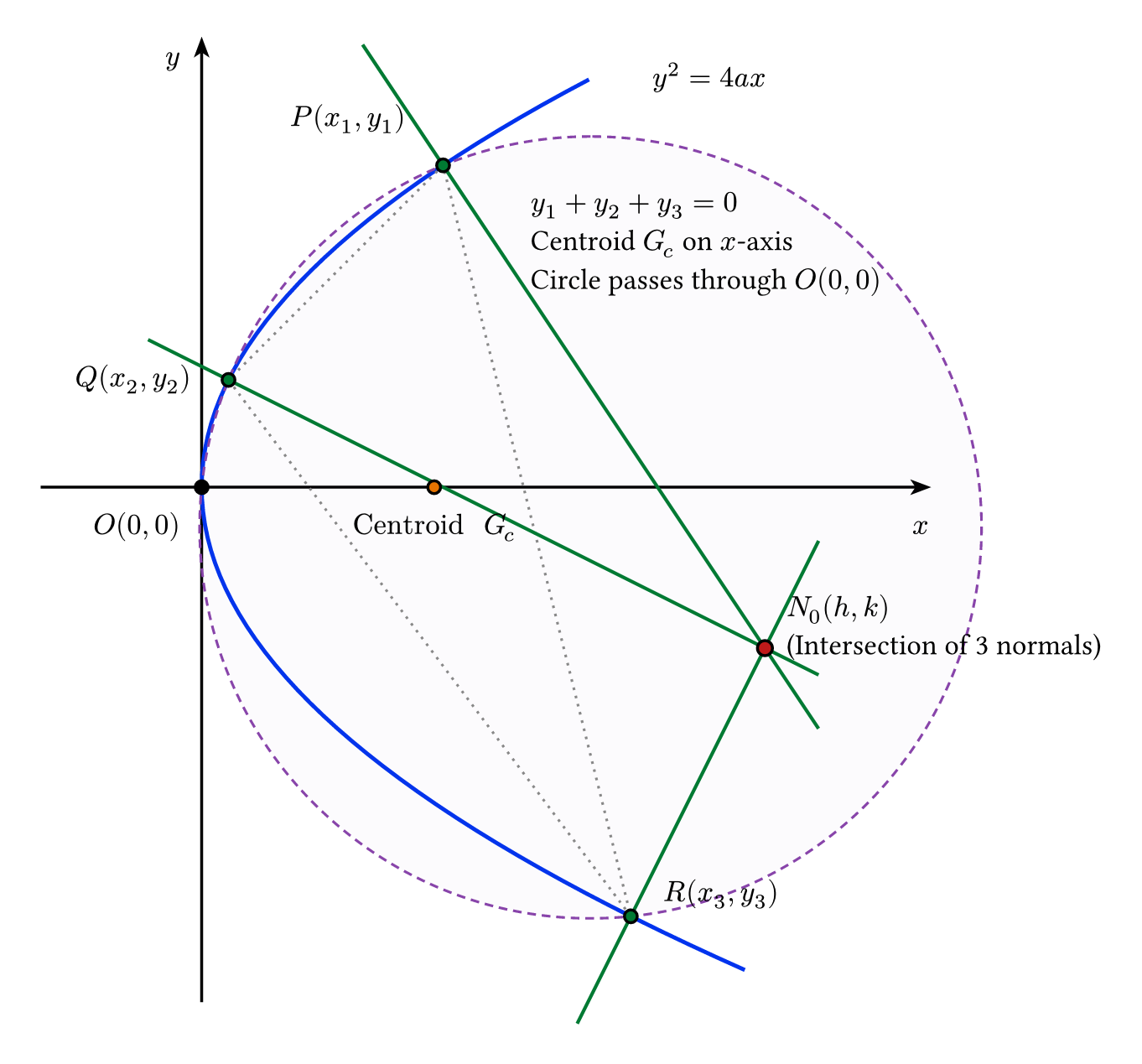
Let \(P(x_1, y_1)\), \(Q(x_2, y_2)\), and \(R(x_3, y_3)\) denote the three co-normal points. The ordinate of each foot is given by \(y_i = -2am_i = 2at_i\).
Computing the algebraic sum of the three ordinates:
Since the sum of the roots is zero, we obtain the invariant result:
The algebraic sum of the ordinates of the feet of three normals drawn from any point in the plane to a parabola is identically zero.
The Centroid of Co-normal Points Lies on the Axis
Consider the triangle formed by the three co-normal points \(P(x_1, y_1)\), \(Q(x_2, y_2)\), and \(R(x_3, y_3)\). Let \(G_c(x_G, y_G)\) denote its centroid.
The \(y\)-coordinate of the centroid is:
Because its ordinate is zero, the centroid of the three co-normal points always lies on the principal axis of the parabola (the \(x\)-axis).
To determine the abscissa \(x_G\), we compute the sum of the \(x\)-coordinates:
Using the algebraic identity:
and substituting \(t_1 + t_2 + t_3 = 0\), we find:
Substituting this sum into the expression for the centroid's abscissa gives:
The centroid of the triangle formed by the feet of three normals drawn from the point \((h, k)\) to the parabola \(y^2 = 4ax\) is:
Notice that the position of the centroid along the axis depends solely on the abscissa \(h\) of the point from which the normals are drawn, and is completely independent of its ordinate \(k\).
Illustrative Example: Computing Co-normal Points and Their Centroid
Problem. Three normals are drawn from the point \(N_0(9, 6)\) to the parabola \(y^2 = 4x\). Determine the slopes of these normals, the coordinates of the three co-normal points, and verify that the algebraic sum of their ordinates is zero and their centroid lies on the axis.
Solution. Comparing \(y^2 = 4x\) with the standard form \(y^2 = 4ax\) gives \(a = 1\). The point of concurrency is \((h, k) = (9, 6)\).
The cubic equation for the slopes of the normals is:
Factoring this cubic polynomial:
The three slopes are:
Verifying the sum of slopes:
The foot of each normal is given by the formula \(\left(am^2, -2am\right) = \left(m^2, -2m\right)\):
Notice that the third foot \(R(9, 6)\) coincides with the point of concurrency \(N_0(9, 6)\), meaning that the normal at \(R\) passes through \(R\) itself (the normal is orthogonal to the tangent at \(R\)).
Summing the ordinates of the three feet:
Computing the centroid \(G_c(x_G, y_G)\) of \(\triangle PQR\):
Using the theoretical formula:
The computed coordinates match the theoretical predictions.
Normals from a Point on the Axis
A particularly illuminating special case occurs when the point from which the normals are drawn lies directly on the axis of symmetry of the parabola.
Let the point be \(B(b, 0)\), so that \(h = b\) and \(k = 0\).
Derivation of the Existence Condition
Substituting \(h = b\) and \(k = 0\) into the cubic equation of slopes gives:
Factoring out \(m\):
This factorized form reveals two separate factors:
The root \(m = 0\): This root always exists for every real value of \(b\). The normal corresponding to \(m = 0\) is:
which is the \(x\)-axis itself. The foot of this normal is the vertex \(O(0, 0)\). Because the tangent at the vertex is the \(y\)-axis (\(x = 0\)), the principal axis (\(y = 0\)) is perpendicular to it, confirming that the axis of the parabola is always a normal line.
The quadratic factor \(am^2 + 2a - b = 0\): Solving for \(m^2\):
The nature of the remaining two normals depends entirely on the sign of \(b - 2a\):
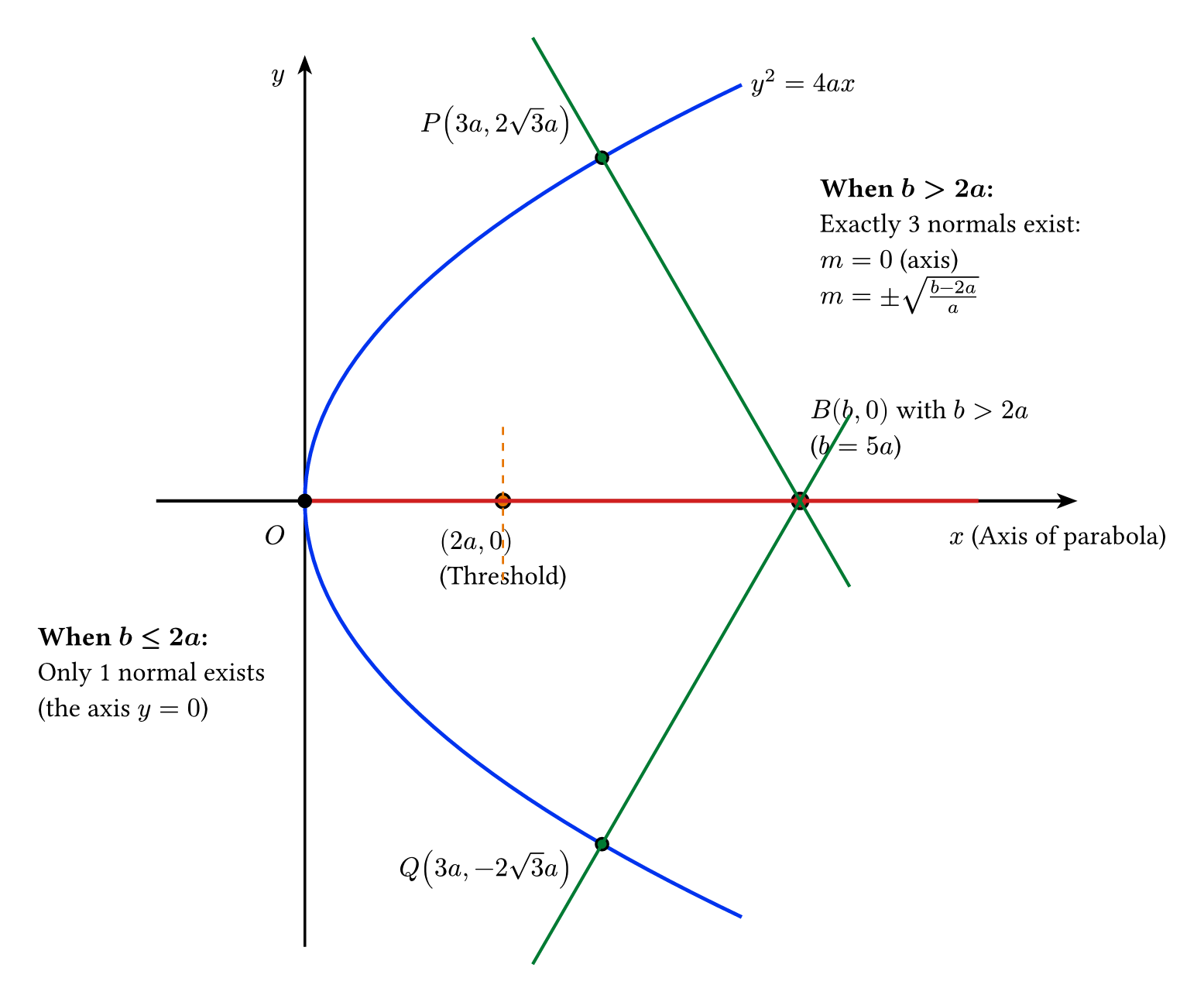
Case 1: \(b > 2a\). The quantity \(\frac{b - 2a}{a}\) is strictly positive. Therefore, \(m^2 > 0\) yields two distinct, non-zero, real slopes:
Combined with \(m = 0\), there exist exactly three distinct real normals drawn from \((b, 0)\) to the parabola.
Case 2: \(b = 2a\). The quantity \(\frac{b - 2a}{a} = 0\), so \(m^2 = 0\). All three roots of the cubic collapse into \(m = 0\). Only one distinct real normal exists (the axis itself), occurring with multiplicity three.
Case 3: \(b < 2a\). The quantity \(\frac{b - 2a}{a} < 0\), so \(m^2 < 0\). The roots for \(m\) are purely imaginary conjugate numbers. Consequently, there are no oblique real normals, and only one real normal (the axis \(y = 0\)) can be drawn.
Theorem (Three Normals from an Axis Point)
From a point \((b, 0)\) on the axis of the parabola \(y^2 = 4ax\), three distinct real normals can be drawn if and only if:\[b > 2a\]If \(b \le 2a\), only one real normal can be drawn from \((b, 0)\) to the parabola, which is the axis of symmetry itself.
The point \((2a, 0)\) serves as the critical threshold on the axis. It is located at twice the focal distance from the vertex. No point on the axis between the vertex and \((2a, 0)\), nor any point to the left of the vertex, can emit more than one real normal.
Coordinates of the Feet of the Oblique Normals
When \(b > 2a\), let the two oblique normals have slopes \(m = \pm \sqrt{\frac{b - 2a}{a}}\). The feet of these normals on the parabola are:
Both oblique feet share the identical abscissa \(x = b - 2a\). Therefore, the chord joining the feet of the two oblique normals drawn from an axis point is perpendicular to the axis of the parabola.
Illustrative Example: Angle Between Oblique Normals from an Axis Point
Problem. Normals are drawn from the point \((5a, 0)\) on the axis to the parabola \(y^2 = 4ax\). Find the equations of the three normals, their feet on the curve, and determine the angle between the two oblique normals.
Solution. Here, the point on the axis is \((b, 0) = (5a, 0)\), so \(b = 5a\). Because \(5a > 2a\), three distinct real normals exist.
The cubic equation for the slopes is:
The three slopes are:
The equations of the three normals are:
For \(m_1 = 0\), we have \(y = 0\) (the axis of the parabola), with foot \(O(0, 0)\).
For \(m_2 = \sqrt{3}\), using \(y = mx - 2am - am^3\):
The foot is \(\left(a(\sqrt{3})^2, -2a(\sqrt{3})\right) = (3a, -2\sqrt{3}a)\).
For \(m_3 = -\sqrt{3}\):
The foot is \((3a, 2\sqrt{3}a)\).
Let \(\theta\) denote the acute angle between the two oblique normals with slopes \(m_2 = \sqrt{3}\) and \(m_3 = -\sqrt{3}\):
Therefore, the angle between the two oblique normals is:
The Boundary Curve for Three Real Normals
Having established that three distinct real normals can be drawn from an axis point \((b, 0)\) if and only if \(b > 2a\), we now extend this analysis to determine the exact geometric region in the entire \(xy\)-plane from which three distinct real normals can be drawn.
Consider a general point \((h, k)\) not restricted to the axis. The cubic equation governing the slopes of the normals is:
where:
The Discriminant Condition
For a cubic polynomial of the form \(m^3 + pm + q = 0\) to possess three distinct real roots, two conditions must be satisfied:
Existence of local extrema: The derivative \(f'(m) = 3m^2 + p\) must have two distinct real roots, which requires \(p < 0\):
This confirms that no point with abscissa \(h \le 2a\) can ever emit three distinct real normals.
Opposite signs of local extrema: The polynomial values at the local maximum and minimum must have opposite signs, which is equivalent to requiring that the cubic polynomial discriminant be strictly positive:
Substituting \(p = \frac{2a - h}{a}\) and \(q = \frac{k}{a}\) into this inequality:
Multiplying both sides by the positive quantity \(a^3\):
Replacing the coordinates of the test point \((h, k)\) with current coordinates \((x, y)\), we obtain the condition for three distinct real normals:
Geometric Character of the Region
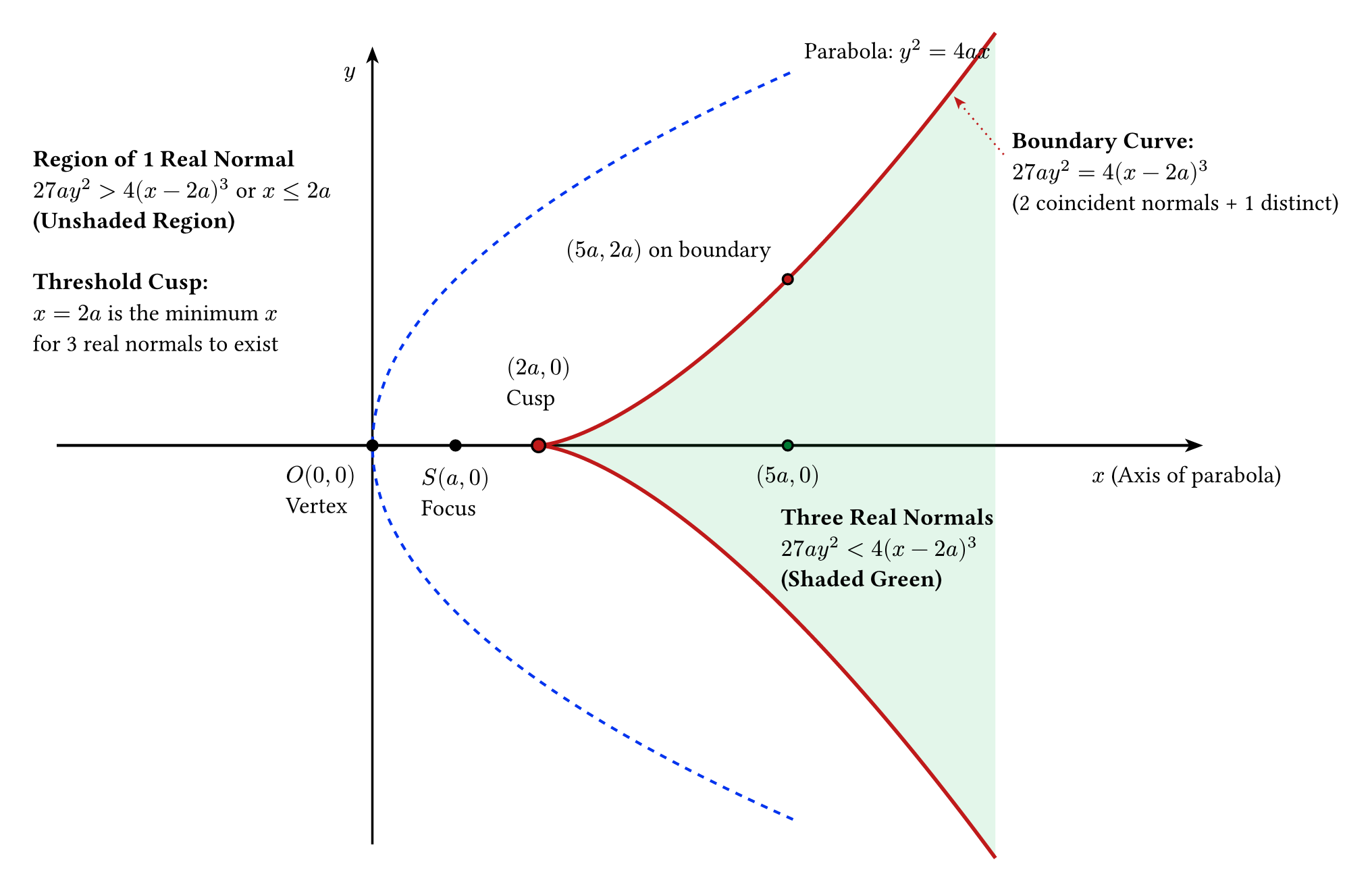
The equation defining the boundary of this region is:
This boundary curve is a semicubical parabola with the following distinctive geometric characteristics:
- Cusp at the threshold point: Setting \(y = 0\) yields \(x = 2a\). The curve originates at the critical threshold point \((2a, 0)\) on the axis, where it possesses a sharp cusp pointing toward the vertex of the parabola.
- Symmetry: The curve is symmetric about the principal axis of the parabola, as replacing \(y\) with \(-y\) leaves the equation invariant.
- Orientation: For real values of \(y\), we must have \((x - 2a)^3 \ge 0\), which restricts the entire curve to the right half-plane \(x \ge 2a\).
This boundary curve partitions the plane into three distinct regions:
- The interior region (\(27 a y^2 < 4(x - 2a)^3\)): From every point lying strictly within the convex region enclosed by the two branches of the curve (to the right of the cusp), exactly three distinct real normals can be drawn to the parabola.
- The boundary curve (\(27 a y^2 = 4(x - 2a)^3\)): From every point lying directly on the curve, the cubic has a repeated root. Two of the three normals coincide, resulting in one distinct normal and one repeated normal. At the cusp \((2a, 0)\) itself, all three normals coincide with the axis \(y = 0\).
- The exterior region (\(27 a y^2 > 4(x - 2a)^3\), or \(x \le 2a\)): From every point outside the boundary curve, the cubic has one real root and two complex conjugate roots. Consequently, only one real normal can be drawn to the parabola.
Illustrative Example: Determining the Number of Real Normals
Problem. Determine the number of real normals that can be drawn to the parabola \(y^2 = 4x\) from each of the following points: (a) \(A(1, 3)\), (b) \(B(5, 2)\), (c) \(C(8, 4\sqrt{2})\), and (d) \(D(3, 1)\).
Solution. For the parabola \(y^2 = 4x\), we have \(4a = 4 \implies a = 1\). The threshold abscissa is \(2a = 2\).
The boundary condition is determined by evaluating the quantity:
Evaluating each point:
Point \(A(1, 3)\): The abscissa is \(x = 1 \le 2a = 2\). Because \(x < 2a\), the point lies to the left of the cusp line. Therefore, only 1 real normal can be drawn.
Point \(B(5, 2)\): The coordinates give \(x = 5\) and \(y = 2\). Evaluating \(E\):
Because \(E(5, 2) = 0\), the point \(B\) lies directly on the boundary curve. Therefore, 2 coincident normals and 1 distinct normal (effectively 2 distinct real normals) can be drawn.
Point \(C(8, 4\sqrt{2})\): Here \(x = 8\) and \(y = 4\sqrt{2}\):
The point \(C\) also lies on the boundary curve, yielding 2 coincident normals and 1 distinct normal.
Point \(D(3, 1)\): Here \(x = 3 > 2\) and \(y = 1\):
Because \(E(3, 1) > 0\), the point lies in the exterior region where \(27ay^2 > 4(x - 2a)^3\). Therefore, only 1 real normal can be drawn.
Circle of Maximum Radius and the Collision of Intersections
An important geometric application connecting normal theory with coordinate geometry concerns finding the circle centered on the axis that touches a parabola, or equivalently, determining the shortest distance from an axis point to the curve.
Consider a circle centered at \(C(h, 0)\) on the axis of the parabola \(y^2 = 4ax\), with radius \(r\):
Perspective 1: Quadratic Equation Theory and the Collision of Roots
To find the intersection of the circle with the parabola, substitute \(y^2 = 4ax\) into the equation of the circle:
Expanding and collecting like terms in powers of \(x\):
This is a quadratic equation in the abscissa \(x\). For any real, positive root \(x\), the parabola provides two symmetric values of \(y\):
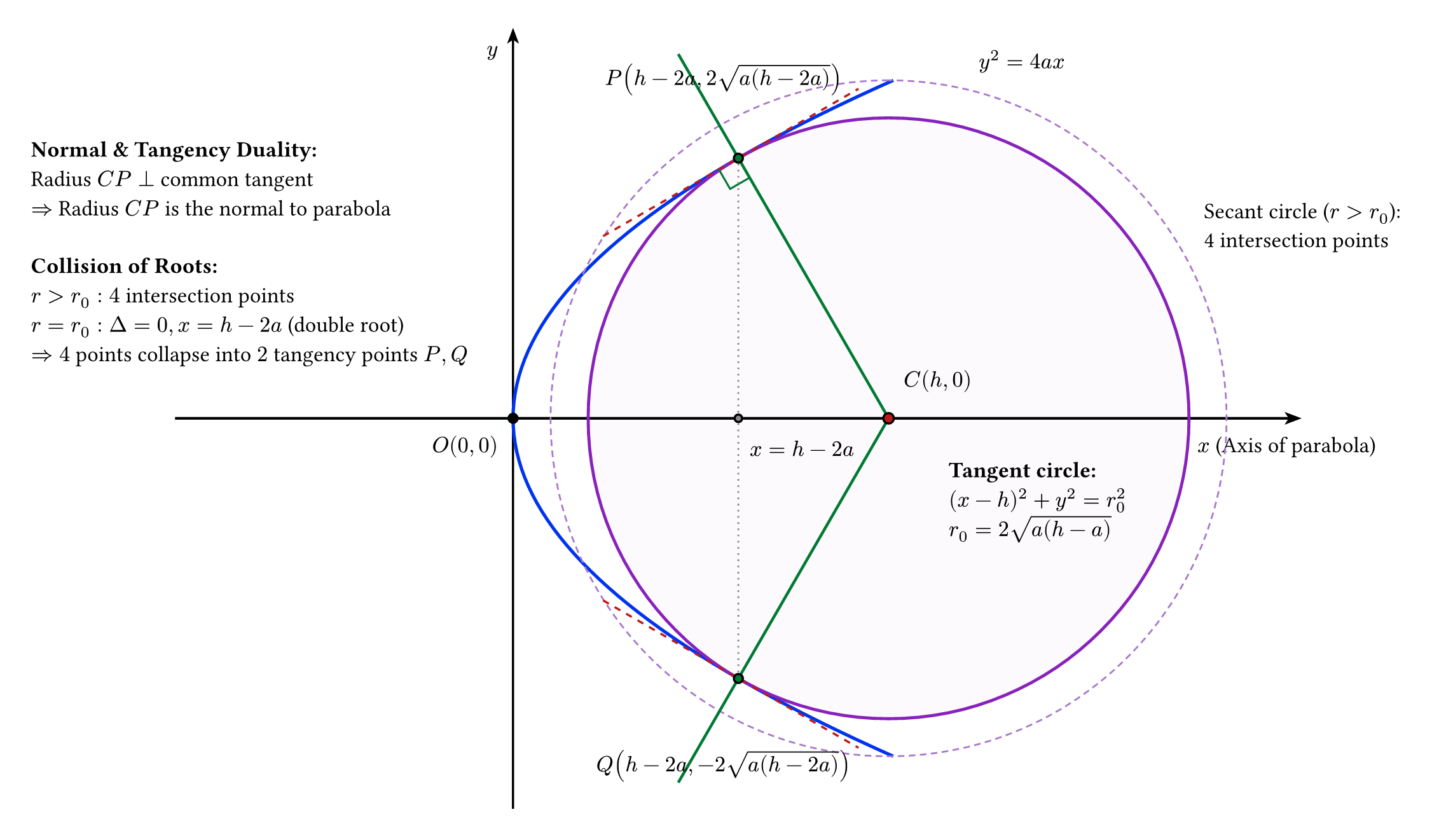
Consequently: If the quadratic equation has two distinct positive real roots \(x_1\) and \(x_2\), each root yields two ordinates, producing four distinct points of intersection between the circle and the parabola.
As the radius \(r\) of the circle decreases, the circle contracts. The two roots \(x_1\) and \(x_2\) move toward each other along the axis. When the radius reaches a critical threshold \(r_0\), the two roots collide and merge into a single double root.
At this exact moment of collision, the discriminant of the quadratic equation vanishes:
Dividing by 4:
Solving for \(r^2\):
When \(r = r_0\), the discriminant is zero, and the quadratic equation possesses the unique double root:
At this double abscissa, the four intersection points have collapsed in symmetric pairs into two distinct points of tangency \(P\) and \(Q\):
For these points to be real and distinct from the vertex, the double root must satisfy \(x > 0\), which requires:
This requirement matches the condition for the existence of oblique normals from \((h, 0)\).
If \(h \le 2a\), the quadratic equation cannot have a positive double root. In that case, as the circle expands from the center \((h, 0)\), it first contacts the parabola at the vertex \(O(0, 0)\), where the radius is simply \(r = h\).
Perspective 2: Normal Theory and Shortest Distance
The geometric principle governing smooth curves states that at any point where two curves are tangent, they share a common tangent line and a common normal line.
For any circle, the normal line at any point on its circumference passes through its center. Therefore, if a circle centered at \(C(h, 0)\) touches the parabola at a point \(P\), the line segment \(CP\) must simultaneously be a radius of the circle and the normal line to the parabola at \(P\).
Let \(P\) be parameterized as \(\left(at^2, 2at\right)\). The equation of the normal to the parabola at \(P\) is:
Because this normal must pass through the circle's center \(C(h, 0)\), we substitute \(x = h\) and \(y = 0\):
Excluding the axis root \(t = 0\) (which corresponds to contact at the vertex), the oblique contact points satisfy:
This is identical to the double root derived from the quadratic discriminant.
The radius of the circle is the Euclidean distance from \(C(h, 0)\) to \(P\left(at^2, 2at\right)\):
The normal line interpretation confirms that the radius vector of the tangent circle is the normal to the parabola, and the collision of roots in algebra corresponds to the geometric contact of the curves.
Illustrative Example: Largest Circle Contained Inside a Parabola
Problem. A circle is centered at \(C(6, 0)\) on the axis of the parabola \(y^2 = 4x\). Find the radius of the circle when it is tangent to the parabola, the coordinates of the points of contact, and verify the result using both the quadratic discriminant and normal line methods.
Solution. For \(y^2 = 4x\), we have \(a = 1\). The center is \(C(h, 0) = (6, 0)\), so \(h = 6\). Notice that \(h = 6 > 2a = 2\), so symmetric oblique points of contact exist.
Method 1: Quadratic Discriminant Method.
The equation of the circle is \((x - 6)^2 + y^2 = r^2\). Substituting \(y^2 = 4x\):
For tangency, the four intersection points collapse into two points of contact, requiring a single double root for \(x\). Setting the discriminant to zero:
The double root for the abscissa is:
The ordinates are:
The points of contact are \(P(4, 4)\) and \(Q(4, -4)\).
Method 2: Normal Line Method.
The normal to \(y^2 = 4x\) at \(P(t^2, 2t)\) is \(y + tx = 2t + t^3\). Passing through \(C(6, 0)\):
For the oblique normals, \(t = \pm 2\).
The feet on the parabola are:
- For \(t = 2\): \(P(2^2, 2(2)) = (4, 4)\).
- For \(t = -2\): \(Q((-2)^2, 2(-2)) = (4, -4)\).
The radius is the normal distance from \(C(6, 0)\) to \(P(4, 4)\):
Both methods yield identical results.
Condition for Normals to Intersect on the Parabola
An intriguing question in parabola geometry is: under what conditions can two normals to a parabola intersect at a third point that also lies on the parabola?
Let \(P\left(at_1^2, 2at_1\right)\) and \(Q\left(at_2^2, 2at_2\right)\) be two distinct points on the parabola \(y^2 = 4ax\) with \(t_1 \neq t_2\).
Suppose the normals at \(P\) and \(Q\) intersect at a point \(R\left(at_3^2, 2at_3\right)\) that also lies on the parabola.
Derivation of the Condition
Recall the property of normal chords: the normal to the parabola at a parametric point \(t\) intersects the parabola again at a point with parameter \(t'\), where:
Because the normal at \(P(t_1)\) passes through \(R(t_3)\), the parameter \(t_3\) must satisfy:
Similarly, because the normal at \(Q(t_2)\) also passes through \(R(t_3)\), the parameter \(t_3\) must simultaneously satisfy:
Equating these two expressions for \(t_3\):
Rearranging terms:
Factoring out \((t_2 - t_1)\):
Because \(P\) and \(Q\) are distinct points, \(t_1 \neq t_2\), so \(t_2 - t_1 \neq 0\). Dividing by \(t_2 - t_1\) yields the condition:
Theorem (Normals Meeting on the Parabola)
The normals at two distinct points \(P(t_1)\) and \(Q(t_2)\) on the parabola \(y^2 = 4ax\) intersect at a point on the parabola itself if and only if:\[t_1 t_2 = 2\]
Geometric Consequences
The condition \(t_1 t_2 = 2\) gives rise to two geometric properties:
1. Chord \(PQ\) Passes Through a Fixed Point
The equation of the chord joining \(P(t_1)\) and \(Q(t_2)\) is:
Substituting \(t_1 t_2 = 2\):
To find where this chord intersects the principal axis, set \(y = 0\):
The chord joining the feet of two normals that intersect on the parabola always passes through the fixed point \((-2a, 0)\) on the axis of the parabola.
2. Minimum Abscissa of the Intersection Point
The parameter \(t_3\) of the meeting point \(R\) is related to \(t_1\) and \(t_2\) by:
Squaring both sides:
Substituting \(t_1 t_2 = 2\):
Because \(P\) and \(Q\) are distinct real points, \((t_1 - t_2)^2 > 0\). Therefore:
The abscissa of the intersection point \(R\) on the parabola is:
Two normals to a parabola can intersect on the parabola itself only at points whose abscissa is strictly greater than \(8a\).
Illustrative Example: Locus of the Midpoint of Chord \(PQ\)
Problem. Normals at \(P(t_1)\) and \(Q(t_2)\) to the parabola \(y^2 = 4ax\) intersect at a point on the parabola. Find the locus of the midpoint of the chord \(PQ\).
Solution. Let \(M(h_0, k_0)\) denote the midpoint of the chord joining \(P\left(at_1^2, 2at_1\right)\) and \(Q\left(at_2^2, 2at_2\right)\).
The coordinates of \(M\) are:
Expressing \(t_1^2 + t_2^2\) in terms of the sum and product:
Because the normals at \(P\) and \(Q\) intersect on the parabola, the parameters satisfy \(t_1 t_2 = 2\). Substituting this relation:
Substituting this into the expression for \(h_0\):
Multiplying both sides by \(2a\):
Replacing \((h_0, k_0)\) with current coordinates \((x, y)\), the locus of the midpoint is:
This locus is an identical parabola shifted to the left, having its vertex at \((-2a, 0)\) and latus rectum equal to \(2a\).
Circumcircle of Three Co-normal Points
When three distinct normals can be drawn from a point \((h, k)\) to the parabola \(y^2 = 4ax\), their feet \(P(t_1)\), \(Q(t_2)\), and \(R(t_3)\) define a triangle. The circumcircle of this triangle possesses remarkable properties.
Derivation of the Circumcircle Equation
Let the equation of any circle in the Cartesian plane be written in general form:
To determine the points where this circle intersects the parabola \(y^2 = 4ax\), substitute the parametric coordinates \(x = at^2\) and \(y = 2at\):
Expanding and ordering by descending powers of \(t\):
This is a quartic equation in \(t\). By Vieta's formulas, the sum of the four roots \(t_1, t_2, t_3, t_4\) is given by the coefficient of \(t^3\), which is zero:
Now, suppose three of these intersection points \(t_1, t_2, t_3\) are the co-normal points corresponding to normals drawn from \((h, k)\).
As established earlier, the sum of the parameters of three co-normal points is identically zero:
Substituting this into the sum of the four roots:
The parameter \(t_4 = 0\) corresponds to the point:
which is the vertex of the parabola.
Because \(t = 0\) is a root of the quartic, substituting \(t = 0\) into the equation gives:
Theorem (Circumcircle Passes Through the Vertex)
The circumcircle of any three co-normal points on a parabola always passes through the vertex of the parabola.
Coefficients of the Circumcircle
With \(c = 0\) and \(t_4 = 0\), we find the coefficients \(g\) and \(f\) by applying Vieta's formulas to the remaining relations of the quartic.
For the sum of products taken two at a time:
Since \(t_4 = 0\), all products involving \(t_4\) vanish, leaving:
From the cubic equation of co-normal points, we know:
Equating these two expressions:
Multiplying by \(a\):
For the sum of products taken three at a time:
Since \(t_4 = 0\):
From the cubic equation of co-normal points:
Equating:
Substituting \(2g = -(h + 2a)\), \(2f = -\frac{k}{2}\), and \(c = 0\) into the general equation of the circle yields the circumcircle equation:
Properties of the Circumcircle
Center of the circumcircle:
Radius of the circumcircle: Since the circle passes through the origin \((0, 0)\), its radius \(R\) is simply the distance from the center to the origin:
Solved Examples
Example 1: Locus of Points Emitting Two Mutually Perpendicular Normals
Problem. Find the locus of a point from which two of the three normals drawn to the parabola \(y^2 = 4ax\) are mutually perpendicular.
Solution. Let the point be \((h, k)\), and let the slopes of the three normals drawn from \((h, k)\) be \(m_1, m_2, m_3\).
These slopes are the roots of the cubic equation:
By Vieta's formulas:
Suppose two of the normals are perpendicular:
Substituting \(m_1 m_2 = -1\) into the product of roots:
Because \(m_3\) is a root of the cubic equation, it must satisfy \(am_3^3 + (2a - h)m_3 + k = 0\):
Assuming \(k \neq 0\) (the normals are not symmetric about the axis), divide both sides by \(k\):
Multiplying through by \(a\):
Replacing \((h, k)\) with \((x, y)\), the required locus is:
This locus is itself a parabola with vertex at \((3a, 0)\), axis along \(y = 0\), and latus rectum equal to \(a\).
Example 2: Locus When Normals Have Slopes in the Ratio \(2:1\)
Problem. Find the locus of the point \((h, k)\) if the slopes of two of the three normals drawn from it to \(y^2 = 4ax\) are in the ratio \(2:1\).
Solution. Let the slopes be \(m_1, m_2, m_3\) with \(m_1 = 2m_2\).
From the sum of roots:
Now, using the sum of products taken two at a time:
Substituting \(m_1 = 2m_2\) and \(m_3 = -3m_2\):
Next, using the product of the three roots:
To eliminate \(m_2\), square the expression for \(m_2^3\) and cube the expression for \(m_2^2\):
Simplifying:
Replacing \((h, k)\) with current coordinates \((x, y)\), the locus is:
Example 3: Area of the Triangle Formed by Three Co-normal Points
Problem. Show that the area \(\Delta\) of the triangle formed by three co-normal points \(P(t_1)\), \(Q(t_2)\), and \(R(t_3)\) on the parabola \(y^2 = 4ax\) is given by:
Solution. The coordinates of the three points are \(\left(at_1^2, 2at_1\right)\), \(\left(at_2^2, 2at_2\right)\), and \(\left(at_3^2, 2at_3\right)\).
The area of \(\triangle PQR\) is given by the coordinate determinant:
Factoring out \(a\) from the first column and \(2a\) from the second column:
This is the standard Vandermonde determinant of order 3:
Taking absolute values:
Wait, let's verify the factor of \(1/2\): The standard formula for the area of a triangle with vertices \((x_i, y_i)\) is:
Here:
Thus, the exact area is:
Example 4: Circle Touching Parabola at the Ends of Latus Rectum
Problem. Find the center and radius of the circle that has its center on the axis of \(y^2 = 4ax\) and touches the parabola at the extremities of its latus rectum.
Solution. The extremities of the latus rectum of \(y^2 = 4ax\) are \(L(a, 2a)\) and \(L'(a, -2a)\).
At the point of contact \(L(a, 2a)\), the radius of the circle must lie along the normal to the parabola.
The parametric coordinate of \(L(a, 2a)\) is \(t = 1\) (since \(at^2 = a \implies t = 1\)).
The equation of the normal to \(y^2 = 4ax\) at \(t = 1\) is:
Because the center of the circle lies on the axis of the parabola (\(y = 0\)), setting \(y = 0\) in the normal equation gives:
Thus, the center of the circle is \(C(3a, 0)\).
The radius \(R\) is the distance from \(C(3a, 0)\) to \(L(a, 2a)\):
Notice that this result agrees with our earlier general formula: for contact at abscissa \(x = h - 2a\), we have \(a = h - 2a \implies h = 3a\). The radius is \(r_0 = 2\sqrt{a(h - a)} = 2\sqrt{a(3a - a)} = 2\sqrt{2a^2} = 2\sqrt{2}a\).
The equation of the circle is:
Summary of Key Results
| Property / Quantity | Algebraic Condition / Formula | Geometric Meaning |
|---|---|---|
| Cubic Equation in \(m\) | \(am^3 + (2a - h)m + k = 0\) | Yields slopes of normals drawn from \((h, k)\) |
| Cubic Equation in \(t\) | \(at^3 + (2a - h)t - k = 0\) | Yields parameters of feet of normals (\(t_i = -m_i\)) |
| Foot of Normal | \(\left(am^2, -2am\right) = \left(at^2, 2at\right)\) | Exact coordinates of each co-normal point |
| Sum of Slopes / Parameters | \(\sum m_i = 0, \quad \sum t_i = 0\) | Due to the absence of degree-2 term |
| Sum of Ordinates | \(y_1 + y_2 + y_3 = 0\) | Algebraic sum of ordinates is always zero |
| Centroid of Co-normal Points | \(G_c\left(\frac{2(h - 2a)}{3}, 0\right)\) | Always lies on the axis of the parabola |
| Normals from Axis Point \((b, 0)\) | \(b > 2a \implies 3\) normals; \(b \le 2a \implies 1\) normal | Threshold point on axis is \((2a, 0)\) |
| Oblique Feet from \((b, 0)\) | \(x = b - 2a, \quad y = \mp 2\sqrt{a(b - 2a)}\) | Chord connecting oblique feet is perpendicular to axis |
| Boundary Curve for 3 Normals | \(27 a y^2 \le 4(x - 2a)^3\) | Region to the right of cusp \((2a, 0)\) admits 3 real normals |
| Circle-Parabola Tangency | \(r = 2\sqrt{a(h - a)}\) with \(x = h - 2a\) | \(\Delta = 0\) collapses 4 intersections into 2 contact points |
| Normals Meeting on Parabola | \(t_1 t_2 = 2\) | Chord \(PQ\) passes through \((-2a, 0)\); \(x_R > 8a\) |
| Circumcircle of Co-normal Points | \(x^2 + y^2 - (h + 2a)x - \frac{k}{2}y = 0\) | Circle always passes through vertex \(O(0, 0)\) |