Chord of a Parabola
Equation of the Chord Joining Two Points on a Parabola
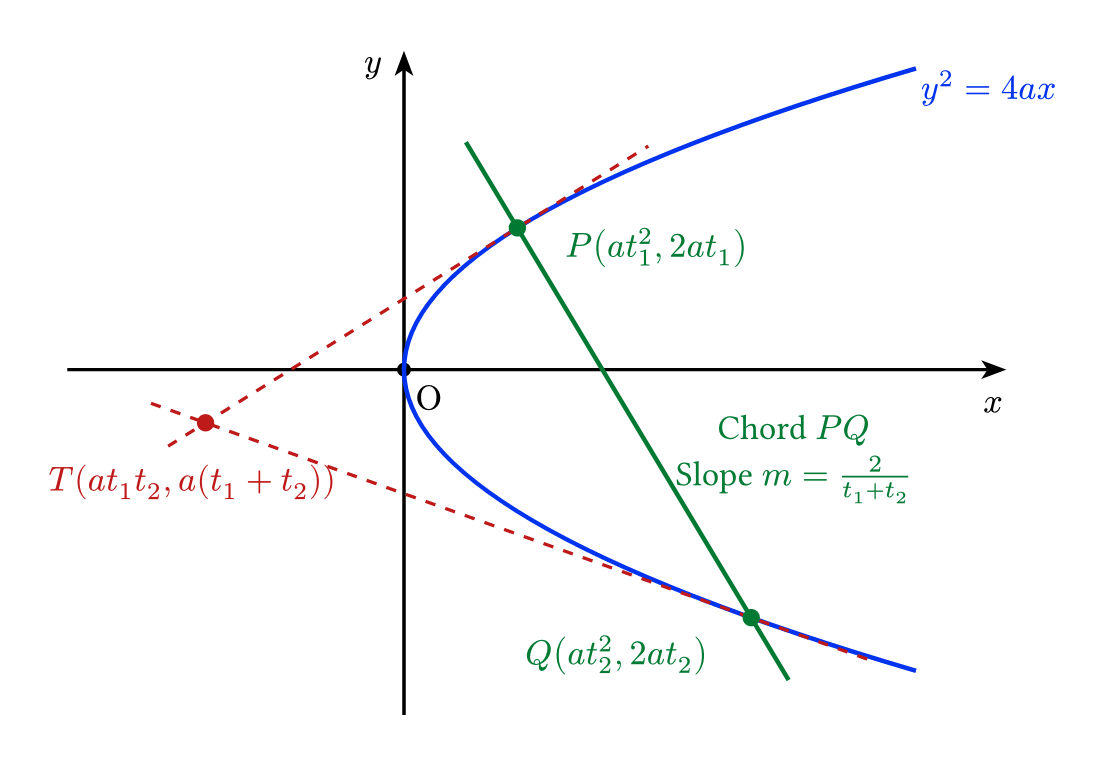
Let \(P(at_1^2, 2at_1)\) and \(Q(at_2^2, 2at_2)\) be any two distinct points on the standard parabola \(y^2 = 4ax\), with parameters \(t_1\) and \(t_2\) respectively (\(t_1 \neq t_2\)). The straight line segment joining \(P\) and \(Q\) is called a chord of the parabola.
Slope of the Parametric Chord
Using the two-point slope formula \(m = \frac{y_2 - y_1}{x_2 - x_1}\), the slope of the chord \(PQ\) is:
Factoring \(2a\) from the numerator and \(a(t_2 - t_1)(t_2 + t_1)\) from the denominator yields:
Since \(P\) and \(Q\) are distinct points (\(t_1 \neq t_2\)), we can cancel the non-zero factor \(a(t_2 - t_1)\) to obtain a remarkably simple formula for the slope of the chord:
Important Observation: Limiting Case of the Secant
The slope of the chord joining \(t_1\) and \(t_2\) is:
Notice what happens when the point \(Q(t_2)\) moves along the parabola and approaches the point \(P(t_1)\), i.e., as \(t_2 \to t_1\). The secant line \(PQ\) becomes the tangent line at \(P(t_1)\), and its slope becomes:
This immediately recovers the slope of the tangent at the point \(t_1\).
Deriving the Equation of the Chord
Now that we know the slope of the chord is \(m = \frac{2}{t_1 + t_2}\) and that it passes through the point \(P(at_1^2, 2at_1)\), we can write its equation using the point-slope form \(y - y_1 = m(x - x_1)\):
Multiplying both sides by \((t_1 + t_2)\) to clear the denominator gives:
Expanding both sides:
Canceling the \(-2at_1^2\) term from both sides, we arrive at the standard equation of the chord joining the points \(t_1\) and \(t_2\):
By following the exact same procedure for the other standard orientations of the parabola (for instance, swapping \(x\) and \(y\) for the upward-opening parabola \(x^2 = 4ay\) gives \(2y = x(t_1 + t_2) - 2at_1 t_2\)), we obtain the following summary:
| Equation of Parabola | Parametric Endpoints | Slope of Chord | Equation of Chord |
|---|---|---|---|
| \(y^2 = 4ax\) | \((at_1^2, 2at_1),\; (at_2^2, 2at_2)\) | \(\frac{2}{t_1 + t_2}\) | \(y(t_1 + t_2) = 2x + 2at_1 t_2\) |
| \(y^2 = -4ax\) | \((-at_1^2, 2at_1),\; (-at_2^2, 2at_2)\) | \(-\frac{2}{t_1 + t_2}\) | \(y(t_1 + t_2) = -2x + 2at_1 t_2\) |
| \(x^2 = 4ay\) | \((2at_1, at_1^2),\; (2at_2, at_2^2)\) | \(\frac{t_1 + t_2}{2}\) | \(2y = x(t_1 + t_2) - 2at_1 t_2\) |
| \(x^2 = -4ay\) | \((2at_1, -at_1^2),\; (2at_2, -at_2^2)\) | \(-\frac{t_1 + t_2}{2}\) | \(2y = -x(t_1 + t_2) + 2at_1 t_2\) |
Length of a Chord
1. Length of the Chord Intercepted by a Straight Line
Suppose a straight line \(y = mx + c\) intersects the standard parabola \(y^2 = 4ax\) at two distinct points \(P(x_1, y_1)\) and \(Q(x_2, y_2)\). We wish to find the length \(L = PQ\) of the chord intercepted by the parabola on this line.
By the distance formula, the length of the segment \(PQ\) is:
Since both points \(P(x_1, y_1)\) and \(Q(x_2, y_2)\) lie on the line \(y = mx + c\), their coordinates satisfy:
Subtracting the second equation from the first gives the relation between the differences of coordinates along a line of slope \(m\):
Substituting \(y_1 - y_2 = m(x_1 - x_2)\) into equation (1), we can factor out \((x_1 - x_2)^2\) from under the radical:
(Alternatively, substituting \(x_1 - x_2 = \frac{1}{m}(y_1 - y_2)\) into equation (1) expresses the chord length in terms of the \(y\)-coordinates:)
Expressing the Coordinate Difference in Terms of the Line Parameters
To find \(|x_1 - x_2|\) without explicitly solving for the individual points \(P\) and \(Q\), we substitute \(y = mx + c\) into the parabola equation \(y^2 = 4ax\):
Expanding and rearranging terms in descending powers of \(x\) yields a quadratic equation whose roots are \(x_1\) and \(x_2\):
By Vieta's formulas, the sum and product of the roots \(x_1\) and \(x_2\) are:
Now, we use the standard algebraic identity \((x_1 - x_2)^2 = (x_1 + x_2)^2 - 4x_1 x_2\):
Canceling \(4m^2 c^2\) in the numerator and factoring out \(16a\) gives:
Taking the non-negative square root of both sides:
Finally, substituting this expression for \(|x_1 - x_2|\) into equation (2), \(L = |x_1 - x_2|\sqrt{1 + m^2}\), we obtain the formula for the length of the chord intercepted by \(y = mx + c\) on \(y^2 = 4ax\):
Geometric Interpretation of the Factor \((a - mc)\)
Look at the term \((a - mc)\) inside the square root of the chord length formula:
- When \(a - mc > 0\) (i.e., \(c < \frac{a}{m}\) for \(m > 0\)): The quantity under the square root is positive, so the line is a secant intersecting the parabola at two distinct points, and \(L > 0\).
- When \(a - mc = 0\) (i.e., \(c = \frac{a}{m}\)): The length of the chord becomes \(L = 0\). The two points of intersection coincide, recovering the condition of tangency \(c = \frac{a}{m}\).
- When \(a - mc < 0\): The quantity under the radical is negative, meaning the line does not intersect the parabola in real points.
2. Length of a Chord in Parametric Form
If the endpoints of a chord on the parabola \(y^2 = 4ax\) are given in parametric form as \(P(at_1^2, 2at_1)\) and \(Q(at_2^2, 2at_2)\), we can also express the length of the chord directly in terms of \(t_1\) and \(t_2\):
Using \(t_1^2 - t_2^2 = (t_1 - t_2)(t_1 + t_2)\), we factor \(a^2(t_1 - t_2)^2\) from both terms inside the square root:
Point of Intersection of Tangents at the Endpoints of a Chord
Suppose we draw the tangent lines to the parabola \(y^2 = 4ax\) at the two endpoints \(P(at_1^2, 2at_1)\) and \(Q(at_2^2, 2at_2)\) of the chord \(PQ\). Let these two tangents intersect at the point \(T(x, y)\).
From our earlier study of tangents in parametric form, the equations of the tangents at \(t_1\) and \(t_2\) are:
To find the coordinates of their point of intersection \(T(x, y)\), we solve equations (1) and (2) simultaneously. Subtracting equation (2) from equation (1) eliminates \(x\):
Factoring the right-hand side as \(a(t_1 - t_2)(t_1 + t_2)\):
Since \(t_1 \neq t_2\), we divide both sides by \((t_1 - t_2)\) to obtain the \(y\)-coordinate:
Next, we substitute \(y = a(t_1 + t_2)\) back into equation (1) to find \(x\):
Canceling \(at_1^2\) from both sides gives the \(x\)-coordinate:
Thus, the point of intersection of the tangents drawn at the points \(t_1\) and \(t_2\) on the parabola \(y^2 = 4ax\) is:
Geometric Meaning of the Coordinates of \(T\)
Look closely at the coordinates of \(T\bigl(at_1 t_2,\; a(t_1 + t_2)\bigr)\) in relation to the endpoints \(P(at_1^2, 2at_1)\) and \(Q(at_2^2, 2at_2)\):
- The \(x\)-coordinate (\(at_1 t_2\)) has magnitude equal to the geometric mean of the \(x\)-coordinates of \(P\) and \(Q\), since \(\sqrt{(at_1^2)(at_2^2)} = a|t_1 t_2|\).
-
The \(y\)-coordinate (\(a(t_1 + t_2)\)) is the arithmetic mean of the \(y\)-coordinates of \(P\) and \(Q\):
\[\frac{y_1 + y_2}{2} = \frac{2at_1 + 2at_2}{2} = a(t_1 + t_2)\]This means the horizontal line passing through \(T\) always bisects the chord \(PQ\).
Point of Intersection of Normals at the Endpoints of a Chord
In a similar manner, let us find the point of intersection \(N(x, y)\) of the normals drawn to the parabola \(y^2 = 4ax\) at the points \(P(at_1^2, 2at_1)\) and \(Q(at_2^2, 2at_2)\).
The equations of the normals at \(t_1\) and \(t_2\) in parametric form are:
Subtracting equation (2) from equation (1) eliminates \(y\):
Using the algebraic identity \(t_1^3 - t_2^3 = (t_1 - t_2)(t_1^2 + t_1 t_2 + t_2^2)\), we can factor \((t_1 - t_2)\) from the entire right-hand side:
Since the points are distinct (\(t_1 \neq t_2\)), dividing both sides by \((t_1 - t_2)\) gives the \(x\)-coordinate of the point of intersection:
To find the \(y\)-coordinate, we substitute this expression for \(x\) back into equation (1):
Expanding the brackets on the right-hand side:
Notice that the terms \(2at_1\) and \(at_1^3\) cancel out completely, leaving:
Therefore, the point of intersection of the normals at \(t_1\) and \(t_2\) is:
Focal Chord and Its Properties
A chord of a parabola that passes through its focus is called a focal chord.
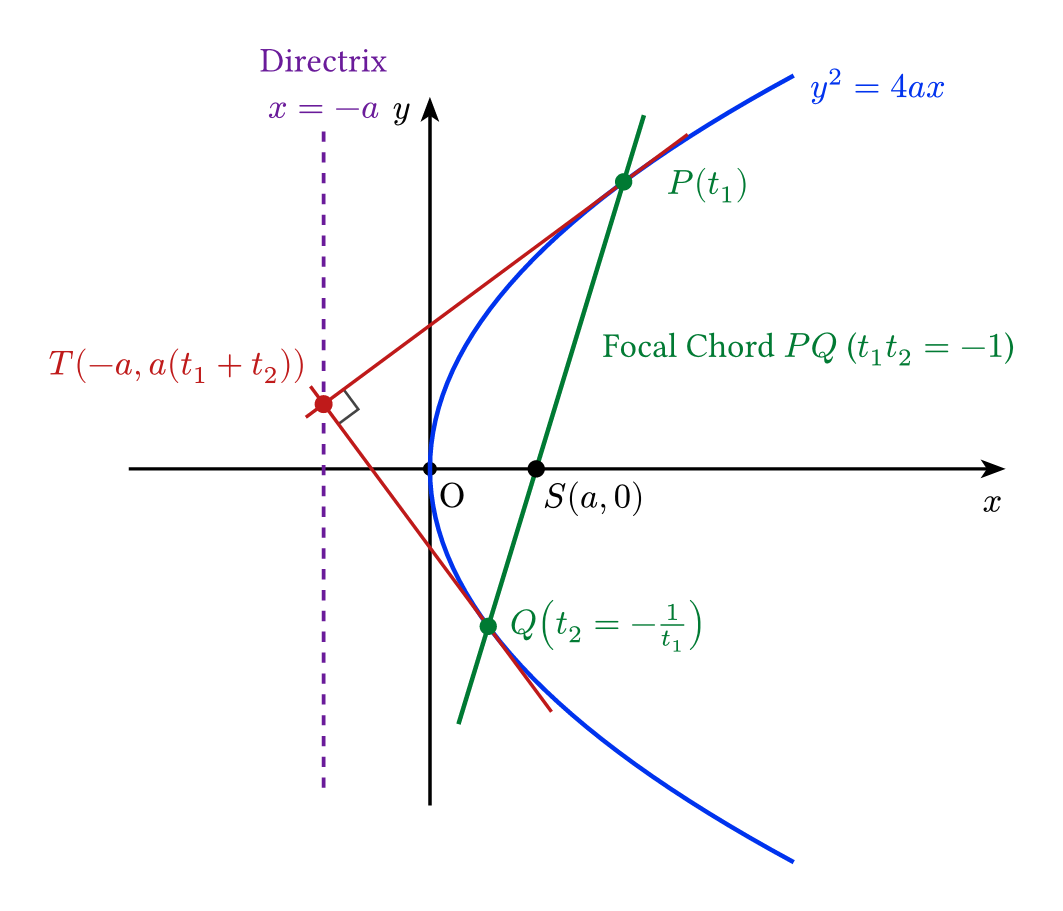
Condition for a Chord to be a Focal Chord
Consider the chord joining the points \(P(at_1^2, 2at_1)\) and \(Q(at_2^2, 2at_2)\) on the parabola \(y^2 = 4ax\). Its equation is:
If this chord is a focal chord, it must pass through the focus \(S(a, 0)\) of the parabola. Substituting \(x = a\) and \(y = 0\) into the chord equation gives:
Since \(a \neq 0\), we can divide by \(2a\) to obtain the fundamental condition for a focal chord:
Parametric Coordinates of the Extremities of a Focal Chord
Whenever one extremity of a focal chord of \(y^2 = 4ax\) is taken as \(P(at^2, 2at)\), the other extremity can immediately be written with parameter \(-\frac{1}{t}\) as:
Key Properties of a Focal Chord
Property 1: Tangents at the Extremities of a Focal Chord Intersect at Right Angles on the Directrix
Let \(P(t_1)\) and \(Q(t_2)\) be the extremities of a focal chord of the parabola \(y^2 = 4ax\), so that:
- The tangents are mutually perpendicular: The slope of the tangent at \(P(t_1)\) is \(m_1 = \frac{1}{t_1}\), and the slope of the tangent at \(Q(t_2)\) is \(m_2 = \frac{1}{t_2}\). Taking the product of their slopes:
Since \(m_1 m_2 = -1\), the tangents at the extremities of any focal chord intersect at a right angle (\(90^\circ\)).
- Their point of intersection lies on the directrix: We established earlier that the tangents at \(t_1\) and \(t_2\) intersect at the point:
Substituting the focal chord condition \(t_1 t_2 = -1\) into the \(x\)-coordinate gives:
Thus, the point of intersection is \(T\bigl(-a,\; a(t_1 + t_2)\bigr)\). Since its \(x\)-coordinate is always \(-a\), the point of intersection lies strictly on the line \(x = -a\), which is the directrix of the parabola.
(Converse: Since the locus of the point of intersection of mutually perpendicular tangents to a parabola is its directrix, the directrix is called the director circle of the parabola.)
Property 2: Ray from Focus to Intersection of Tangents is Perpendicular to the Chord
Let \(T\left(-a, a\left(t - \frac{1}{t}\right)\right)\) be the point of intersection of the tangents drawn at the extremities \(P(at^2, 2at)\) and \(Q\left(\frac{a}{t^2}, -\frac{2a}{t}\right)\) of a focal chord passing through the focus \(S(a, 0)\).
The slope of the straight line joining the focus \(S(a, 0)\) to the intersection point \(T\left(-a, a\left(t - \frac{1}{t}\right)\right)\) is:
At the same time, the slope of the focal chord \(PQ\) joining \(P(t)\) and \(Q\left(-\frac{1}{t}\right)\) is:
Multiplying the two slopes:
Since the product of their slopes is \(-1\), the straight line joining the focus to the intersection of the tangents is always perpendicular to the focal chord:
In the right-angled triangle \(\triangle PTQ\) (with hypotenuse \(PQ\) and right angle at \(T\)), the segment \(ST\) represents the altitude drawn from the right-angled vertex \(T\) to the hypotenuse \(PQ\).
Property 3: Circle on a Focal Chord as Diameter Touches the Directrix
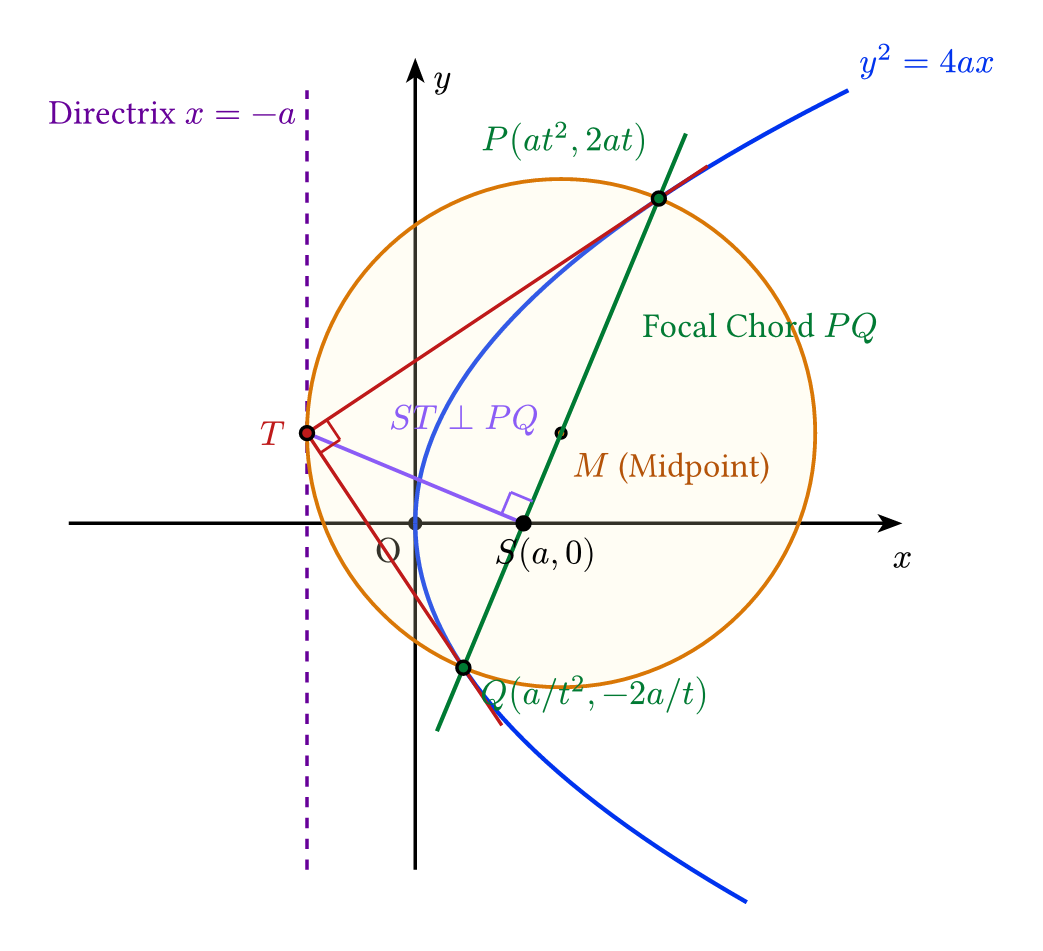
Let \(P(at^2, 2at)\) and \(Q\left(\frac{a}{t^2}, -\frac{2a}{t}\right)\) be the endpoints of a focal chord. The midpoint \(M\) of \(PQ\), which serves as the center of the circle described on \(PQ\) as diameter, has coordinates:
The radius \(R\) of this circle is half the length of the focal chord \(PQ = a\left(t + \frac{1}{t}\right)^2\):
Now consider the perpendicular distance \(d\) from the center \(M\) to the vertical directrix \(x + a = 0\) (i.e., \(x = -a\)):
Notice that \(d = R\). Because the perpendicular distance from the center \(M\) to the line \(x = -a\) equals the radius of the circle, the circle described on any focal chord as diameter touches the directrix of the parabola.
Furthermore, because the tangents at \(P\) and \(Q\) meet at \(T\left(-a, a\left(t - \frac{1}{t}\right)\right)\) at a right angle (\(\angle PTQ = 90^\circ\)), the point \(T\) must lie on the circle by the converse of Thales's theorem. Since the \(x\)-coordinate of \(T\) is \(-a\) and its \(y\)-coordinate equals \(y_M = a\left(t - \frac{1}{t}\right)\), the segment \(MT\) is horizontal and perpendicular to the vertical directrix. Therefore, the circle touches the directrix precisely at the intersection point of the tangents \(T\).
Property 4: Circle on a Focal Radius as Diameter Touches the Tangent at the Vertex
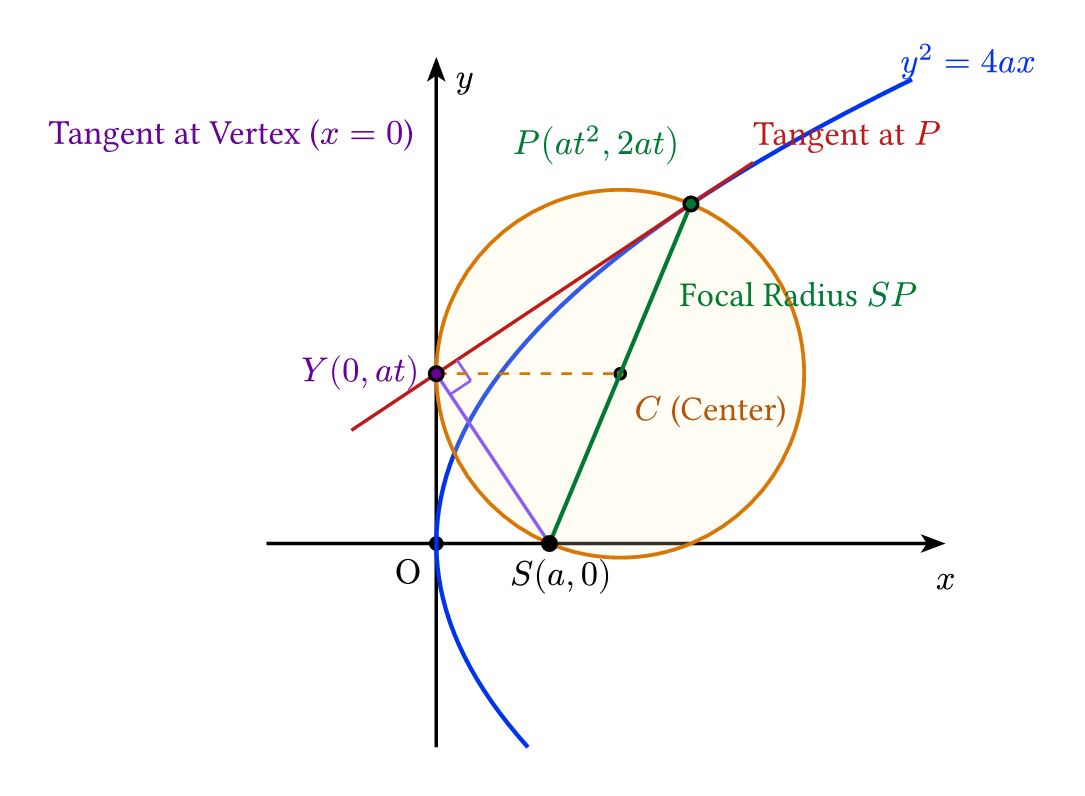
Let \(P(at^2, 2at)\) be any point on the parabola \(y^2 = 4ax\), and let \(S(a, 0)\) be the focus. The focal distance of \(P\) is:
The midpoint \(C\) of the focal segment \(SP\) has coordinates:
The radius \(R\) of the circle described on \(SP\) as diameter is:
The perpendicular distance from the center \(C\) to the tangent at the vertex (\(y\)-axis, \(x = 0\)) is simply the \(x\)-coordinate of \(C\):
Because the distance from the center to the \(y\)-axis equals the radius \(R\), the circle described on any focal radius \(SP\) as diameter touches the tangent at the vertex (\(y\)-axis).
The point of contact with the \(y\)-axis is obtained by setting \(x = 0\) in the equation of the tangent at \(P\), \(ty = x + at^2\), which yields:
The segment \(SY\) joining the focus \(S(a, 0)\) to \(Y(0, at)\) has slope:
Since the slope of the tangent at \(P\) is \(m_{\text{tangent}} = \frac{1}{t}\), we have \(m_{SY} \cdot m_{\text{tangent}} = (-t)\left(\frac{1}{t}\right) = -1\). Thus, \(SY\) is the perpendicular drawn from the focus to the tangent at \(P\), establishing that \(\angle SYP = 90^\circ\). Hence, \(Y\) lies on the circle, and the horizontal segment \(CY\) is perpendicular to the \(y\)-axis, confirming that \(Y(0, at)\) is the exact point of tangency.
Property 5: Length of a Focal Chord and Its Inclination to the Axis
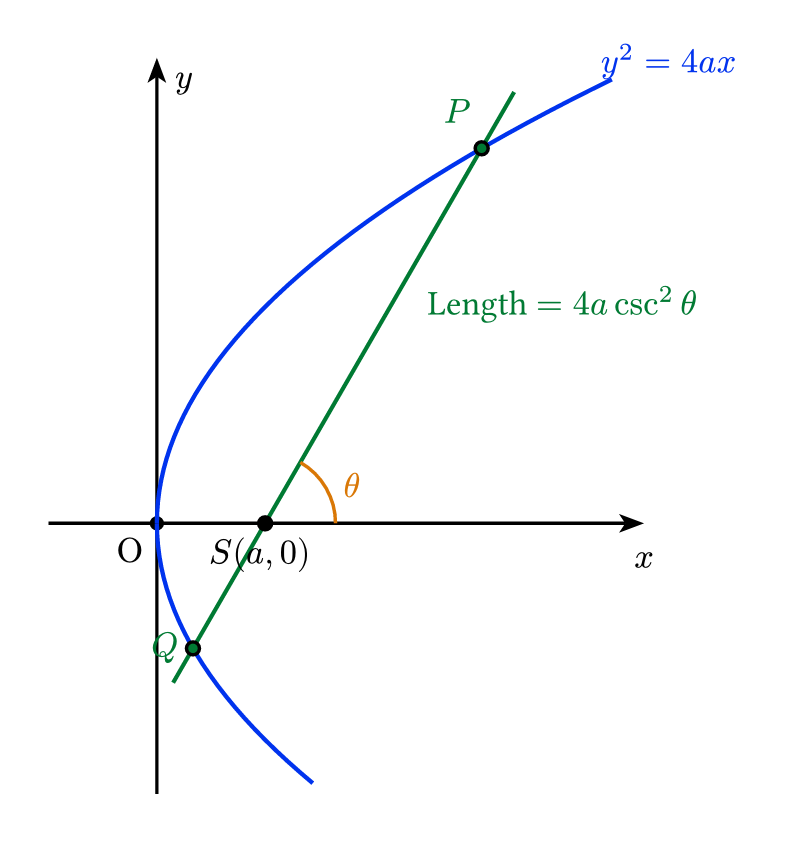
Let \(P(at^2, 2at)\) and \(Q\left(\frac{a}{t^2}, -\frac{2a}{t}\right)\) be the extremities of a focal chord passing through the focus \(S(a, 0)\).
By the focal distance property, the distance of any point on the parabola from the focus \(S(a, 0)\) equals its perpendicular distance from the directrix \(x + a = 0\):
-
Focal distance of \(P\):
\[SP = x_1 + a = at^2 + a = a(t^2 + 1)\] -
Focal distance of \(Q\):
\[SQ = x_2 + a = \frac{a}{t^2} + a = a\left(\frac{1}{t^2} + 1\right)\]
Since \(S\) lies between \(P\) and \(Q\) on the focal chord, the total length \(PQ\) is the sum of the two focal segments:
Length in Terms of Inclination to the Axis:
Let the focal chord make an angle \(\theta\) (\(0 < \theta < \pi\), \(\theta \neq 0\)) with the positive direction of the axis of the parabola (\(x\)-axis). The slope of the focal chord joining \(P(t)\) and \(Q\left(-\frac{1}{t}\right)\) is:
Solving for \(\left(t - \frac{1}{t}\right)\):
Using the algebraic identity \(\left(t + \frac{1}{t}\right)^2 = \left(t - \frac{1}{t}\right)^2 + 4\):
Substituting this into the parametric length expression \(PQ = a\left(t + \frac{1}{t}\right)^2\) gives:
Minimum Length of a Focal Chord:
Since \(\sin^2\theta \le 1\) for all real \(\theta\), the value of \(4a\csc^2\theta\) attains its minimum when \(\sin^2\theta = 1\), which occurs when \(\theta = 90^\circ\) (or \(t = \pm 1\)). In that case:
This confirms that the latus rectum (which is perpendicular to the axis of the parabola) is the shortest focal chord.
Property 6: Semi-Latus Rectum is the Harmonic Mean of Focal Segments
For any focal chord \(PQ\) passing through the focus \(S\), the lengths of the two focal segments are \(SP = a(t^2 + 1)\) and \(SQ = \frac{a(t^2 + 1)}{t^2}\). Taking the sum of their reciprocals:
Multiplying both sides by \(2\), the harmonic mean of the two focal segments is:
Thus, the semi-latus rectum (\(2a\)) of a parabola is the harmonic mean of the two segments of any focal chord.
Property 7: Angle Subtended by a Focal Chord at the Vertex
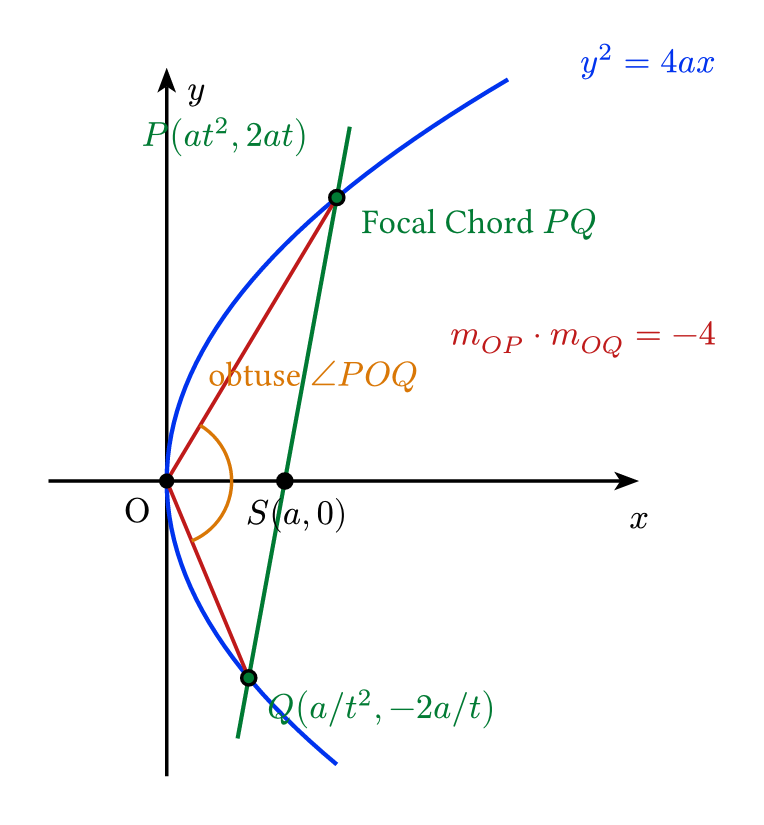
Let \(O(0, 0)\) be the vertex of the parabola \(y^2 = 4ax\), and let \(P(at^2, 2at)\) and \(Q\left(\frac{a}{t^2}, -\frac{2a}{t}\right)\) be the extremities of any focal chord.
The slopes of the straight lines \(OP\) and \(OQ\) joining the vertex to the chord extremities are:
Multiplying these two slopes together:
Because the product of their slopes is a negative constant (\(-4\)), the segments \(OP\) and \(OQ\) always lie on opposite sides of the axis of the parabola. Furthermore, because \(m_{OP} \cdot m_{OQ} = -4 < 0\) and does not equal \(-1\), the angle \(\angle POQ\) subtended by the chord at the vertex is always obtuse:
Since \(\left|t + \frac{1}{t}\right| \ge 2\) by the AM–GM inequality, we find:
The minimum angle occurs when \(t = \pm 1\) (the latus rectum), where \(\tan(\angle POQ) = \frac{4}{3}\), corresponding to \(\angle POQ = 2\arctan 2 \approx 126.87^\circ\). For all other focal chords, \(\angle POQ\) is even larger, approaching \(180^\circ\) as \(|t| \to \infty\) or \(|t| \to 0\).
Normal Chord and Its Properties
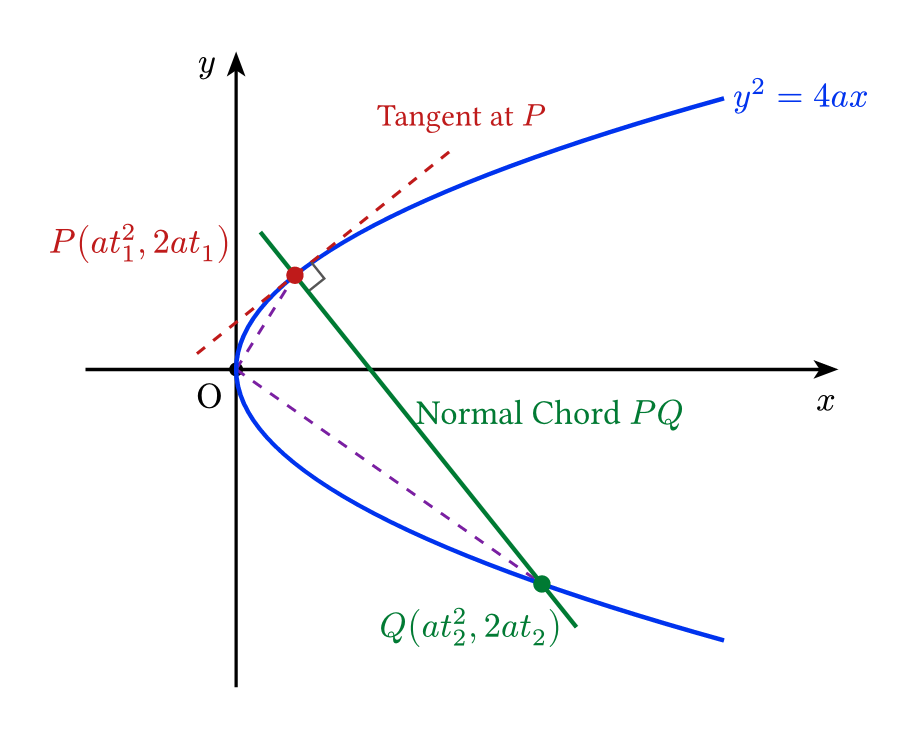
A chord of a parabola that is normal to the curve at one of its endpoints is called a normal chord.
Finding the Other Endpoint When One Endpoint is Known
Suppose the normal drawn to the parabola \(y^2 = 4ax\) at a known point \(P(at_1^2, 2at_1)\) is extended to meet the parabola again at another point \(Q(at_2^2, 2at_2)\). We wish to express the parameter \(t_2\) of the second endpoint in terms of the known parameter \(t_1\).
We can derive this fundamental relation in two ways.
Method 1: By Equating the Slope of the Chord and the Slope of the Normal
-
Since \(PQ\) is a chord joining the points \(P(t_1)\) and \(Q(t_2)\) on the parabola, its slope is given by our chord slope formula:
\[m_{\text{chord}} = \frac{2}{t_1 + t_2}\] -
At the same time, the line \(PQ\) is the normal to the parabola at the point \(P(t_1)\), so its slope is:
\[m_{\text{normal}} = -t_1\] -
Since both expressions represent the slope of the exact same line \(PQ\), we equate them:
\[\frac{2}{t_1 + t_2} = -t_1\] -
Dividing by \(-t_1\) (where \(t_1 \neq 0\)) and solving for \(t_2\):
\[t_1 + t_2 = -\frac{2}{t_1}\]\[t_2 = -t_1 - \frac{2}{t_1}\]
Method 2: By Substituting the Second Endpoint into the Equation of the Normal
The equation of the normal to \(y^2 = 4ax\) at \(P(at_1^2, 2at_1)\) is:
Since this normal passes through \(Q(at_2^2, 2at_2)\), the coordinates of \(Q\) must satisfy its equation:
Grouping corresponding terms on the left-hand side:
Factoring \(a(t_2 - t_1)\) from both terms:
Since \(P\) and \(Q\) are distinct points (\(t_2 \neq t_1\)) and \(a \neq 0\), we divide by \(a(t_2 - t_1)\):
Summary: Parameter of the Other Endpoint of a Normal Chord
If the normal at the point \(P(t_1)\) on the parabola \(y^2 = 4ax\) meets the parabola again at \(Q(t_2)\), then:
Equivalently, this relation can be written in two very useful forms:
- Sum of parameters: \(t_1 + t_2 = -\frac{2}{t_1}\)
- Product of parameters: \(t_1 t_2 = -t_1^2 - 2\)
Key Properties of a Normal Chord
Property 1: Direction and Position of the Second Endpoint
From the relation \(t_1 t_2 = -t_1^2 - 2\), observe that for any real non-zero \(t_1\):
This reveals three important geometric facts:
- \(t_1\) and \(t_2\) always have opposite signs (\(t_1 t_2 < 0\)): If \(P(t_1)\) lies on the upper branch of the parabola (\(t_1 > 0\)), the normal at \(P\) always crosses the axis of the parabola and meets the curve again at \(Q(t_2)\) on the lower branch (\(t_2 < 0\)), and vice versa.
- The normal at the vertex (\(t_1 = 0\)) does not meet the curve again: At the vertex \((0, 0)\), the normal is the \(x\)-axis itself (\(y = 0\)), which is the axis of symmetry and never intersects the parabola at a second point.
- \(Q(t_2)\) is always farther from the vertex than \(P(t_1)\): Since \(|t_2| = |t_1| + \frac{2}{|t_1|} > |t_1|\), we always have \(at_2^2 > at_1^2\).
Property 2: Normal Chord Subtending a Right Angle at the Vertex
Suppose the normal chord \(PQ\) (drawn as normal at \(P(t_1)\)) subtends a right angle (\(90^\circ\)) at the vertex \(O(0, 0)\) of the parabola.
The slope of the line \(OP\) joining \((0, 0)\) to \(P(at_1^2, 2at_1)\) is:
Similarly, the slope of the line \(OQ\) joining \((0, 0)\) to \(Q(at_2^2, 2at_2)\) is:
For \(\angle POQ = 90^\circ\), the lines \(OP\) and \(OQ\) must be mutually perpendicular (\(m_{OP} \cdot m_{OQ} = -1\)):
Note that \(t_1 t_2 = -4\) is the general condition for any chord \(PQ\) to subtend a right angle at the vertex.
Now, because \(PQ\) is also a normal chord at \(P(t_1)\), we substitute \(t_1 t_2 = -t_1^2 - 2\):
Thus, the normal at \(P(t_1)\) subtends a right angle at the vertex if and only if \(t_1 = \pm\sqrt{2}\), i.e., at the points \((2a, \pm 2\sqrt{2}\,a)\).
Property 3: Length of a Normal Chord and the Shortest Normal Chord
From our earlier formula for the length of a parametric chord joining \(P(t_1)\) and \(Q(t_2)\), we have:
For a normal chord at \(P(t_1)\), we substitute \(t_2 = -t_1 - \frac{2}{t_1}\):
- \(t_1 + t_2 = -\frac{2}{t_1}\)
- \(t_2 - t_1 = -2t_1 - \frac{2}{t_1} = -\frac{2(t_1^2 + 1)}{t_1}\)
Substituting these two expressions into our length formula gives:
Minimum Length of a Normal Chord: To find the shortest normal chord, let \(u = t_1^2 > 0\) and consider \(f(u) = \frac{(u + 1)^{3/2}}{u}\). Differentiating with respect to \(u\):
Setting \(f'(u) = 0\) gives \(u = 2\), i.e., \(t_1^2 = 2\) (\(t_1 = \pm\sqrt{2}\)). Substituting \(t_1^2 = 2\) into the length formula yields the minimum length of a normal chord:
Notice that the shortest normal chord occurs at \(t_1 = \pm\sqrt{2}\)—the exact same normal chord that subtends a right angle at the vertex!
Solved Examples
Example 1
Prove that the circle described on any focal chord of a parabola as diameter touches the directrix of the parabola.
Solution
Let \(P(at_1^2, 2at_1)\) and \(Q(at_2^2, 2at_2)\) be the extremities of a focal chord of the parabola \(y^2 = 4ax\), so that:
Using the diameter form of the equation of a circle, \((x - x_1)(x - x_2) + (y - y_1)(y - y_2) = 0\), the circle having \(PQ\) as diameter is:
To find where this circle intersects the directrix \(x = -a\), we substitute \(x = -a\) into the equation of the circle:
Factoring \(-a\) from the first two brackets gives \(a^2(1 + t_1^2)(1 + t_2^2)\):
Now, substitute the focal chord condition \(t_1 t_2 = -1\) (so that \(t_1^2 t_2^2 = 1\)):
Since \(-2 = 2(-1) = 2t_1 t_2\), we can write \(t_1^2 + t_2^2 - 2 = t_1^2 + t_2^2 + 2t_1 t_2 = (t_1 + t_2)^2\). The quadratic in \(y\) becomes:
Since this quadratic equation in \(y\) has two equal roots, \(y = a(t_1 + t_2)\), the line \(x = -a\) (the directrix) touches the circle at the single point \(\bigl(-a,\; a(t_1 + t_2)\bigr)\)—which is precisely the point of intersection of the tangents at \(P\) and \(Q\).
Example 2
Find the locus of the point of intersection of the normals drawn at the extremities of a focal chord of the parabola \(y^2 = 4ax\).
Solution
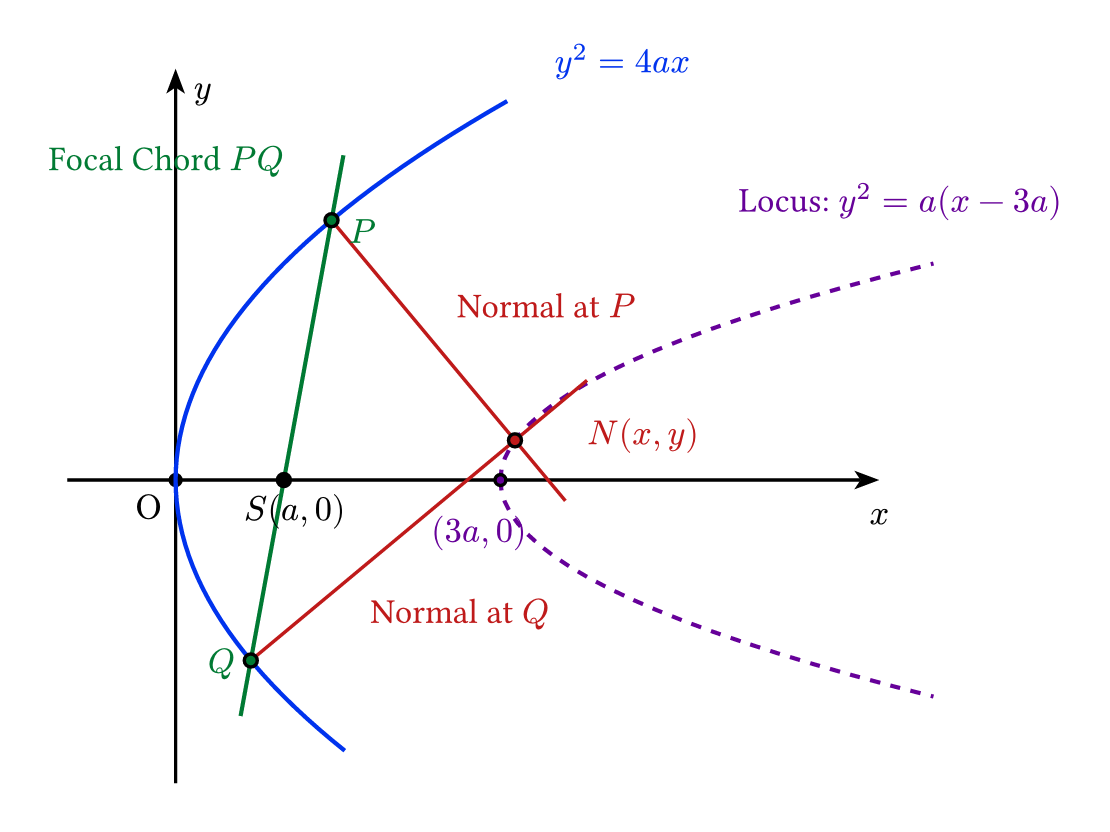
Let \(P(t_1)\) and \(Q(t_2)\) be the extremities of a focal chord of the parabola \(y^2 = 4ax\). Because \(PQ\) is a focal chord, the parameters satisfy:
Let \((h, k)\) be the point of intersection of the normals at \(P(t_1)\) and \(Q(t_2)\). From our derivation for the intersection of two normals, we have:
Substituting \(t_1 t_2 = -1\) into equation (3) gives:
Next, we rewrite \(t_1^2 + t_1 t_2 + t_2^2\) in terms of \((t_1 + t_2)\) and \(t_1 t_2\):
Substituting \(t_1 t_2 = -1\) and \(t_1 + t_2 = \frac{k}{a}\) into equation (2):
Rearranging terms to isolate \(k^2\):
Replacing \((h, k)\) with the general coordinates \((x, y)\), the required locus is the parabola:
Example 3
If the normal to the parabola \(y^2 = 12x\) at the point \(P(3, 6)\) meets the parabola again at the point \(Q\), find the coordinates of \(Q\) and the length of the normal chord \(PQ\).
Solution
Comparing the given parabola \(y^2 = 12x\) with the standard form \(y^2 = 4ax\), we get:
Any parametric point on this parabola is \((at^2, 2at) = (3t^2, 6t)\). Comparing this with the given point \(P(3, 6)\):
Since the normal at \(P(t_1)\) meets the parabola again at \(Q(t_2)\), the parameter \(t_2\) is given by:
Therefore, the coordinates of the second endpoint \(Q\) are:
Finally, the length of the normal chord \(PQ\) is:
(Verification using formula: \(PQ = \frac{4a(t_1^2 + 1)^{3/2}}{t_1^2} = \frac{12(1 + 1)^{3/2}}{1} = 12(2\sqrt{2}) = 24\sqrt{2}\).)
Example 4
If the normals to the parabola \(y^2 = 4ax\) at two distinct points \(P(t_1)\) and \(Q(t_2)\) intersect on the parabola itself at a third point \(R(t_3)\), prove that:
- \(t_1 t_2 = 2\)
- \(t_1 + t_2 + t_3 = 0\)
- The chord \(PQ\) always passes through the fixed point \((-2a, 0)\) on the axis of the parabola.
Solution
Part 1: Proving \(t_1 t_2 = 2\)
Since the normal at \(P(t_1)\) meets the parabola again at \(R(t_3)\), the parameter \(t_3\) is given by:
Similarly, since the normal at \(Q(t_2)\) also meets the parabola at the same point \(R(t_3)\), we have:
Equating the right-hand sides of equations (1) and (2):
Rearranging terms:
Since \(P\) and \(Q\) are distinct points (\(t_1 \neq t_2\)), we divide by \((t_1 - t_2)\) to obtain:
Part 2: Proving \(t_1 + t_2 + t_3 = 0\)
From equation (1), we have:
However, from Part 1 we proved that \(t_1 t_2 = 2\), which implies \(\frac{2}{t_1} = t_2\). Substituting \(\frac{2}{t_1} = t_2\) into the equation above yields:
Part 3: Fixed point on the chord \(PQ\)
The equation of the chord joining \(P(t_1)\) and \(Q(t_2)\) is:
Substituting \(t_1 t_2 = 2\) from Part 1 into the chord equation:
For any value of \((t_1 + t_2)\), this line is identically satisfied when \(y = 0\) and \(x + 2a = 0\), i.e., at \((x, y) = (-2a, 0)\). Hence, the chord \(PQ\) always passes through the fixed point \(\mathbf{(-2a, 0)}\).