Equation of Tangent to a Parabola
Equation of Tangent to a Standard Parabola at a Given Point
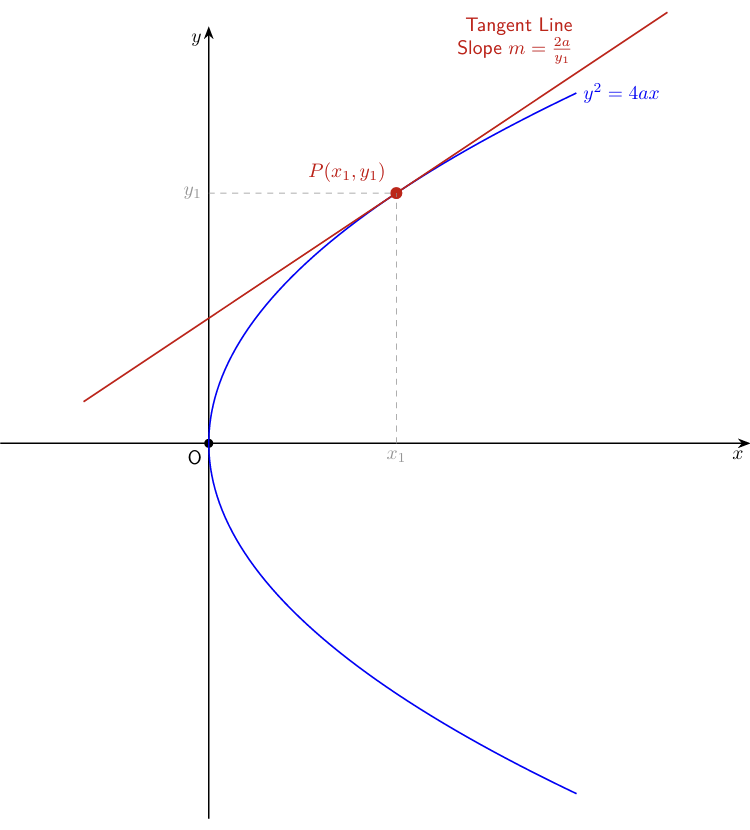
Let \(P(x_1, y_1)\) be a point lying on the parabola whose standard equation is \(y^2 = 4ax\). We wish to find the equation of the tangent line to the curve at this specific point.
To determine the slope of the tangent line, we first differentiate the equation of the parabola with respect to \(x\). Applying the chain rule to the left side yields:
Solving for the derivative, we find the general expression for the slope at any point \((x, y)\) on the curve:
The slope \(m\) of the tangent specifically at the point \(P(x_1, y_1)\) is found by substituting the y-coordinate of our point into this derivative:
Now, recall the point-slope form for the equation of a straight line: \(y - y_1 = m(x - x_1)\). Substituting our point \(P(x_1, y_1)\) and the calculated slope \(m\), the equation of the tangent becomes:
To simplify this equation, we multiply both sides by \(y_1\) to eliminate the denominator:
At this stage, we utilize a crucial piece of information: because the point \(P(x_1, y_1)\) lies on the parabola, its coordinates must satisfy the parabola's original equation. Therefore, we know that:
We can substitute this value of \(4ax_1\) in place of \(y_1^2\) in our tangent equation:
Adding \(4ax_1\) to both sides to isolate the \(y y_1\) term gives:
Finally, factoring out \(2a\) on the right side provides the standard, symmetric form of the equation. Thus, the equation of the tangent to the parabola \(y^2 = 4ax\) at the point \((x_1, y_1)\) is:
By applying the exact same calculus-based procedure—differentiating the equation to find the slope and utilizing the point-slope form—we can readily derive the equations of the tangents for the other standard orientations of the parabola at a given point \((x_1, y_1)\).
These results are summarized in the following table:
| Equation of Parabola | Point of Tangency | Equation of Tangent |
|---|---|---|
| \(y^2 = 4ax\) | \((x_1, y_1)\) | \(yy_1 = 2a(x + x_1)\) |
| \(y^2 = -4ax\) | \((x_1, y_1)\) | \(yy_1 = -2a(x + x_1)\) |
| \(x^2 = 4ay\) | \((x_1, y_1)\) | \(xx_1 = 2a(y + y_1)\) |
| \(x^2 = -4ay\) | \((x_1, y_1)\) | \(xx_1 = -2a(y + y_1)\) |
Did you notice a pattern in these derivations? There is a remarkable and systematic symmetry in how the equation of the curve transforms into the equation of its tangent. For instance, in the equation \(y^2 = 4ax\), which can be written as \(y \cdot y = 2a(2x)\), replacing one \(y\) with \(y_1\) and \(2x\) with \((x + x_1)\) directly yields the tangent equation \(yy_1 = 2a(x + x_1)\).
This observation leads to a powerful mathematical shortcut. To write the equation of the tangent to a conic section at a point \((x_1, y_1)\) that lies strictly on the curve, one can bypass the process of differentiation entirely by applying a standard set of substitutions to the original equation of the curve:
- Replace \(x^2\) with \(xx_1\)
- Replace \(y^2\) with \(yy_1\)
- Replace \(x\) with \(\frac{x + x_1}{2}\)
- Replace \(y\) with \(\frac{y + y_1}{2}\)
- Replace \(xy\) with \(\frac{xy_1 + x_1y}{2}\)
- Leave any constant term \(c\) unchanged.
This elegant rule is not merely a convenient coincidence for standard parabolas; it is a fundamental property valid for any general conic section.
Consider the general equation of a second-degree curve, which can represent a circle, parabola, ellipse, or hyperbola depending on its coefficients:
By applying the substitution rules directly to this general equation, we obtain the universal equation for the tangent line at the point \((x_1, y_1)\):
Simplifying this expression yields the standard form of the tangent for any general conic:
Often, the expression on the left side of this equation is denoted by the symbol \(T\). Thus, the equation of the tangent at a point \((x_1, y_1)\) on the curve is compactly written as \(T = 0\). This rule provides an immediate, algebraic method for finding tangents without the need for explicitly computing derivatives.
Tangents to Shifted Parabolas
Having established the elegant substitution rule (\(T=0\)) for standard conic sections, we can effortlessly extend our findings to parabolas whose vertices have been shifted away from the origin.
Consider a right-handed parabola with its vertex shifted to the point \((h, k)\). Its standard equation is:
Suppose we want to find the equation of the tangent line at a specific point \(P(x_1, y_1)\) that lies on this curve. We could certainly use calculus and differentiate the equation implicitly, or we could translate the axes as we did earlier. However, the most efficient method is to apply the universal substitution rule we just discovered.
First, let us expand the equation of our shifted parabola so that the individual \(x\), \(y\), \(x^2\), and \(y^2\) terms are clearly visible:
Now, we apply our standard tangent substitutions. We replace \(y^2\) with \(yy_1\), replace \(y\) with \(\frac{y+y_1}{2}\), and replace \(x\) with \(\frac{x+x_1}{2}\). The constant terms (\(k^2\) and \(4ah\)) remain completely untouched:
Next, we simplify the equation by canceling the \(2\)s in the denominators:
Distributing the \(-k\) on the left side gives:
Now, look closely at the left side of this equation. We can factor it by grouping. Factoring \(y\) from the first two terms and \(-k\) from the last two terms yields:
Finally, we can factor out \(2a\) on the right side to tidy up the expression:
To match the structure of the original shifted parabola equation \((y-k)^2 = 4a(x-h)\), we can pull a \(2\) out of the right-side parentheses, expressing the final equation of the tangent as:
This result is beautifully intuitive. Notice how the term \((y-k)^2\), which means \((y-k)(y-k)\), simply transforms into \((y-k)(y_1-k)\). Likewise, the linear term \((x-h)\) transforms by replacing the \(x\) with the average of the coordinates, \(\frac{x+x_1}{2}\), yielding \(\left(\frac{x+x_1}{2} - h\right)\).
This principle holds true for all shifted conic sections. For example, if we have an upward-opening shifted parabola given by \((x-h)^2 = 4a(y-k)\), the tangent at \((x_1, y_1)\) is immediately written as:
Equation of Tangent in Parametric Form
As we have previously seen, any point on the standard parabola \(y^2 = 4ax\) can be conveniently represented by the parametric coordinates \((at^2, 2at)\), where \(t\) is the parameter. We will now determine the equation of the tangent line at this general point "t".
To find the equation of the tangent, we first need its slope, \(m = \frac{dy}{dx}\). Since our coordinates are given parametrically, we apply the chain rule for parametric differentiation:
Differentiating the parametric equations \(x = at^2\) and \(y = 2at\) with respect to \(t\) yields:
Substituting these into our slope formula, we get:
The Geometric Significance of the Parameter 't'
This remarkably simple derivative, \(m = \frac{1}{t}\), reveals the precise geometric (and physical) significance of the parameter \(t\). The value of \(t\) at any point on the parabola is exactly the reciprocal of the slope of the tangent line at that point.
Because \(t = \frac{1}{m}\), knowing the parameter of a point immediately gives us the direction of the tangent line. Conversely, if we are looking for a point on the parabola where the tangent has a specific slope \(m\), we immediately know that the point corresponds to the parameter \(t = \frac{1}{m}\).
Deriving the Equation
Now that we have the slope \(m = \frac{1}{t}\) and the point \((at^2, 2at)\), we can use the point-slope form of a linear equation, \(y - y_1 = m(x - x_1)\), to find the equation of the tangent:
Multiplying the entire equation by \(t\) to clear the fraction gives:
Adding \(2at^2\) to both sides yields the standard parametric equation of the tangent:
Alternatively, by dividing the equation by \(t\), we can express the tangent in the explicit slope-intercept form (\(y = mx + c\)):
This form clearly displays the slope \(\frac{1}{t}\) and the y-intercept \(at\).
(Note: We can also derive this result instantly using our \(T=0\) substitution rule. If we take the Cartesian tangent equation \(yy_1 = 2a(x + x_1)\) and substitute \(x_1 = at^2\) and \(y_1 = 2at\), we get \(y(2at) = 2a(x + at^2)\). Canceling \(2a\) from both sides immediately leaves us with \(ty = x + at^2\), confirming our calculus-based derivation.)
Similarly, we can write the equation of the tangent to the other standard parabolas in parametric form as:
| Equation of Parabola | Parametric Point | Equation of Tangent |
|---|---|---|
| \(y^2 = 4ax\) | \((at^2, 2at)\) | \(ty = x + at^2\) |
| \(y^2 = -4ax\) | \((-at^2, 2at)\) | \(-ty = x + at^2\) or \(ty = -x - at^2\) |
| \(x^2 = 4ay\) | \((2at, at^2)\) | \(tx = y + at^2\) |
| \(x^2 = -4ay\) | \((2at, -at^2)\) | \(-tx = y + at^2\) or \(tx = -y - at^2\) |
Parametric form of tangent for shifted parabolas
Consider a right-handed parabola with vertex shifted to the point \((h, k)\). Its standard equation is:
The parametric coordinates of any point P on this parabola can be expressed as:
The equation of the tangent at this point is:
Similarly, for other shifted parabolas, the equation of the tangent can be written as:
| Equation of Parabola | Parametric Point | Equation of Tangent |
|---|---|---|
| \((y-k)^2 = 4a(x-h)\) | \((h + at^2, k + 2at)\) | \((y-k)t = (x-h) + at^2\) |
| \((y-k)^2 = -4a(x-h)\) | \((h - at^2, k + 2at)\) | \((y-k)t = -(x-h) + at^2\) or \((y-k)t = (h-x) + at^2\) |
| \((x-h)^2 = 4a(y-k)\) | \((h + 2at, k + at^2)\) | \((x-h)t = (y-k) + at^2\) |
| \((x-h)^2 = -4a(y-k)\) | \((h + 2at, k - at^2)\) | \((x-h)t = -(y-k) + at^2\) or \((x-h)t = (k-y) + at^2\) |
Note that the equation of the tangent to the shifted parabola is similar to the equation of the tangent to the standard parabola. The only difference is that the equation of the tangent to the shifted parabola is in terms of \((x-h)\) and \((y-k)\) instead of \(x\) and \(y\).
Note
The equation of tangent at a given point '\(t\)' on the parabola, \((y-k)^2 = 4a(x-h)\), can be written as:
But an equation of given slope '\(m\)' on the parabola, \((y-k)^2 = 4a(x-h)\), can be written as: