Equation of Parabola
Definition of a Parabola
A parabola is the locus of a point that moves in a plane such that its distance from a fixed point is always equal to its distance from a fixed straight line in that plane.
As we have seen before, this means the eccentricity of a parabola is \(1\). The fixed point is called the focus and the fixed line is called the directrix.
The General Equation of a Parabola
Let's introduce a Cartesian coordinate system in the plane containing the focus and the directrix. Suppose with respect to this system, the coordinates of the focus, which we'll call S, are \((\alpha, \beta)\). Let the equation of the directrix be \(ax + by + c = 0\).
Now, consider a point P(x, y) that is moving on the parabola. According to the definition of a parabola, the distance from the moving point P to the focus S must be equal to the perpendicular distance from P to the directrix. Let's call the foot of the perpendicular from P onto the directrix N. Therefore, the condition is:
Using the distance formula, the distance SP between the points \(P(x, y)\) and \(S(\alpha, \beta)\) is given by:
The perpendicular distance PN from the point \(P(x, y)\) to the line \(ax + by + c = 0\) is given by:
Equating SP and PN, we get the equation of the parabola:
If we square both sides and simplify this equation, it will take the general form of a second-degree equation in \(x\) and \(y\):
While this general equation correctly represents a parabola, its complexity makes it unsuitable for easily learning about and deriving the various properties of the parabola. A much simpler, standard equation is needed. We can achieve this by choosing an appropriate and more convenient coordinate system, which we will explore in the next section.
The Standard Equation of a Parabola
As we discussed, the general equation of a parabola is quite complex. We can derive a much simpler form by choosing a specific coordinate system.
Choosing an Appropriate Coordinate System
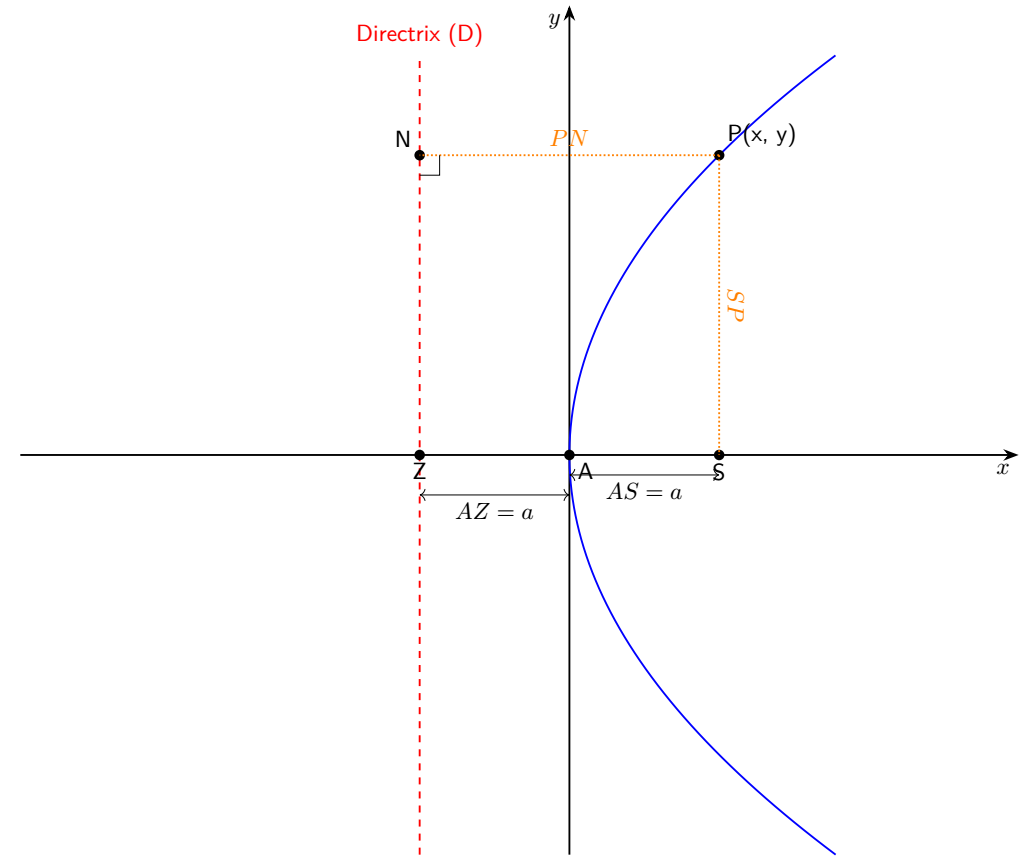
Let D be the directrix and S be the focus of a parabola. We start by drawing a line through the focus S that is perpendicular to the directrix D. This line is called the axis of the parabola. Let's say this axis intersects the directrix at point Z.
By the definition of a parabola, for any point P on it, the condition \(SP = PN\) must be satisfied, where N is the foot of the perpendicular from P to the directrix.
Now, consider the point A on the axis of the parabola that lies exactly midway between the focus S and the point Z on the directrix. This point A is called the vertex of the parabola. Since A is equidistant from the focus S and the directrix D (as \(AS = AZ\)), it satisfies the condition for being on the parabola. Therefore, the parabola passes through its vertex A.
Let the distance \(AS = a\). Since A is the midpoint of the segment SZ, it follows that \(AZ = a\).
To simplify our equation, let's set up our coordinate system as follows:
- Origin: The vertex A is the origin \((0, 0)\).
- x-axis: The axis of the parabola (the line ZS), with the positive direction pointing from A towards the focus S.
- y-axis: The line passing through the vertex A and perpendicular to the x-axis (and thus, parallel to the directrix).
In this coordinate system, the coordinates of the focus S are clearly (a, 0), and the coordinates of the point Z are (-a, 0).
The directrix is a vertical line passing through Z and parallel to the y-axis. Therefore, the equation of the directrix is \(x = -a\).
Deriving the Equation
Let P(x, y) be any point on the parabola. The distance from P to the focus S (\(a, 0\)) is given by the distance formula:
The perpendicular distance from the point P(x, y) to the directrix, the line \(x = -a\) (or \(x+a=0\)), is given by:
Since for this parabola the point P(x,y) will always be to the right of the directrix \(x = -a\), the value of \(x\) will always be greater than \(-a\), which means \(x+a\) is always positive. So, we can write \(PN = x+a\).
Now, we apply the fundamental condition of the parabola, \(PS = PN\):
To simplify, we square both sides of the equation:
Canceling the \(x^2\) and \(a^2\) terms from both sides, we get:
Finally, rearranging the terms gives us the simple, standard equation of a parabola:
The simplest or standard form of a parabola's equation is \(y^2 = 4ax\). This equation is defined by a single parameter, \(a\), which represents the focal length—the distance from the parabola's vertex to its focus.
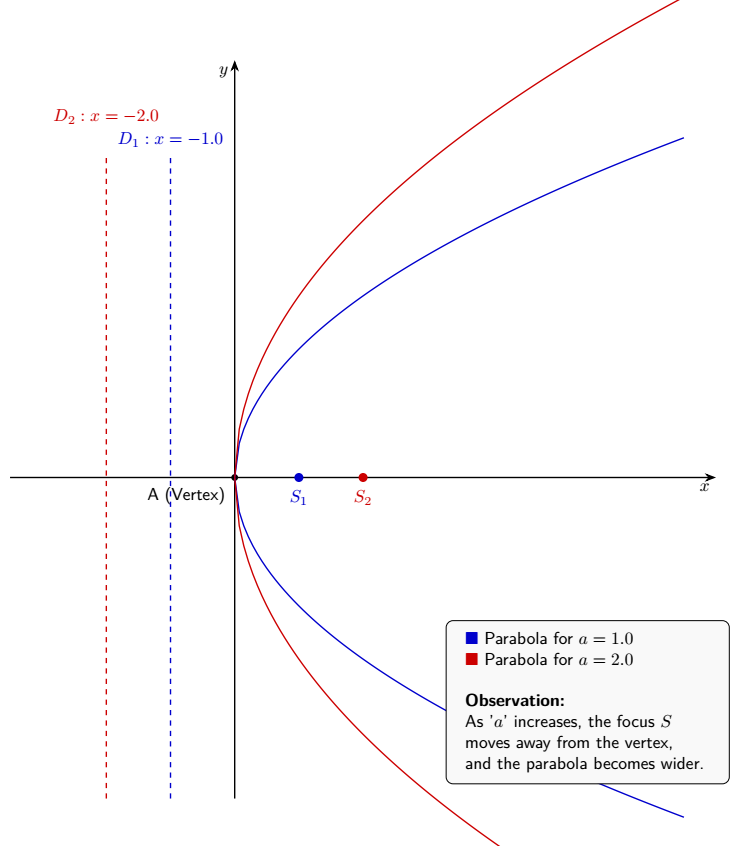
This parameter \(a\) is the sole factor that determines the parabola's shape and scale. A larger value for \(a\) results in a wider, more gently curving parabola, as the focus is farther from the vertex. Conversely, a smaller value for \(a\) produces a narrower, more sharply curved parabola.
Terminology of the Parabola
In relation to the standard parabola with the equation \(y^2 = 4ax\), the following terms are frequently used to describe its various geometric properties.
1. Chord
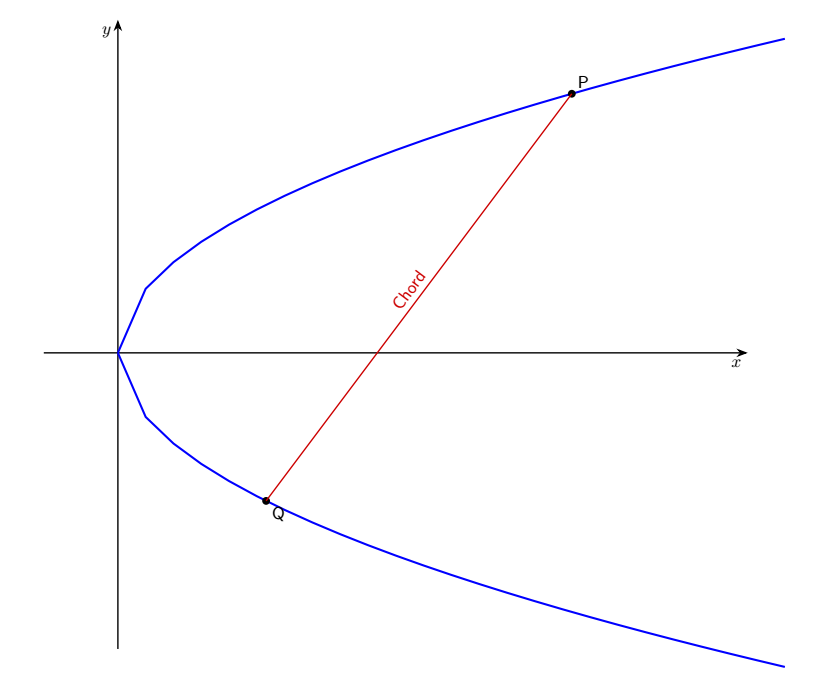
A chord is defined as any line segment that joins two distinct points on the parabola. If \(P_1\) and \(P_2\) are any two points on the curve, the line segment \(P_1P_2\) is a chord of the parabola.
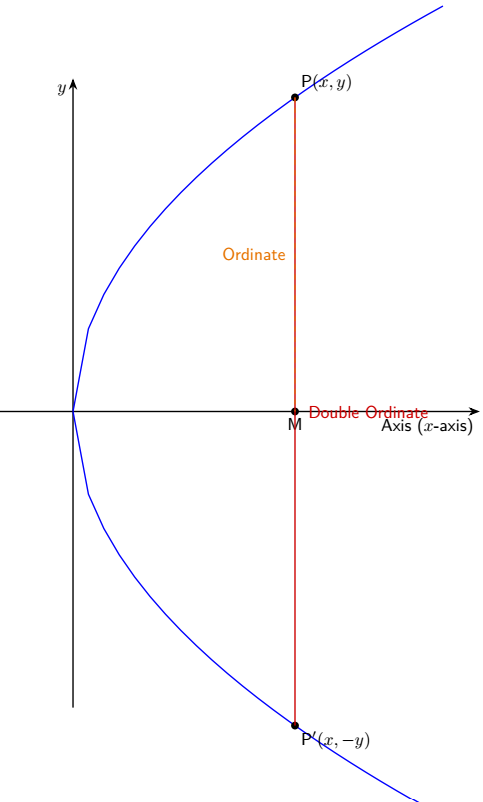
2. Ordinate and Double Ordinate
Let \(P(x_1, y_1)\) be any point on the parabola \(y^2 = 4ax\).
- The ordinate of the point \(P\) is the value of its y-coordinate, \(y_1\). Geometrically, this corresponds to the length of the perpendicular line segment from the point \(P\) to the axis of the parabola (the x-axis).
- A double ordinate is a chord that is perpendicular to the axis of the parabola. The double ordinate passing through \(P(x_1, y_1)\) is the line segment connecting it to the point \(P'(x_1, -y_1)\). The length of this chord is \(2|y_1|\).
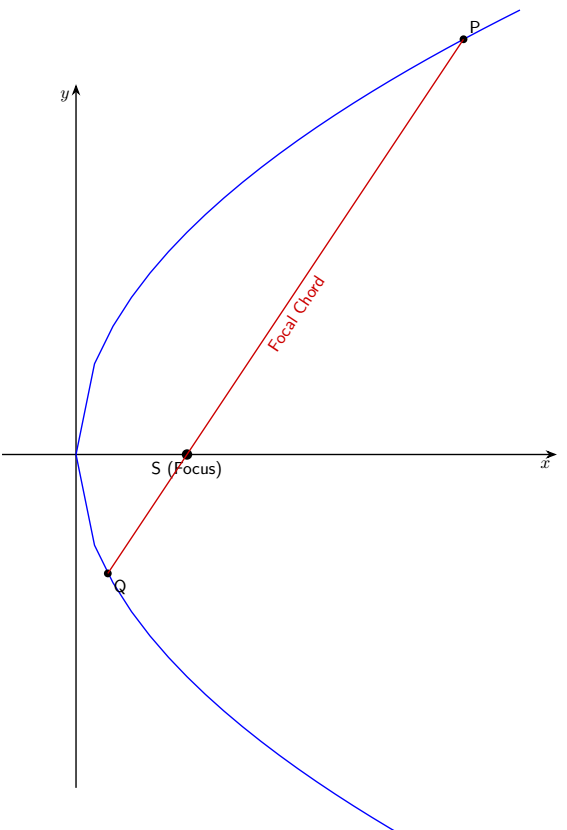
3. Focal Chord
A focal chord is any chord of the parabola that passes through its focus, \(S(a, 0)\).
4. Focal Distance (or Focal Radius)
The focal distance of any point P on a parabola is its distance from the focus S. This is also sometimes called the focal radius.
Let \(P(x, y)\) be any point on the standard parabola \(y^2 = 4ax\). By the fundamental definition of a parabola, the distance from P to the focus (SP) is equal to the perpendicular distance from P to the directrix (PN).
We also know from the definition that:
The equation of the directrix is \(x = -a\). The perpendicular distance PN from the point \(P(x, y)\) to the line \(x = -a\) is given by:
For the standard parabola \(y^2 = 4ax\) (where \(a > 0\)), any point \(P(x, y)\) on the curve will have an x-coordinate such that \(x \ge 0\). Therefore, the quantity \(x+a\) is always positive. We can thus remove the absolute value bars.
Since the focal distance \(SP = PN\), we arrive at the important result:
5. Latus Rectum
The latus rectum of a parabola is the focal chord that runs perpendicular to the axis of the parabola. It is the double ordinate that passes through the focus.
For the standard parabola \(y^2 = 4ax\), the focus is at \(S(a, 0)\). Since the latus rectum, let's call it \(LL'\), is perpendicular to the x-axis and passes through \(S\), the x-coordinate of its endpoints \(L\) and \(L'\) must be \(a\).
Endpoints and Length
To find the y-coordinates of the endpoints, we substitute \(x=a\) into the parabola's equation:
This means the endpoints of the latus rectum are \(L(a, 2a)\) and \(L'(a, -2a)\).
The semi-latus rectum is half of this chord, representing the distance from the focus to one endpoint (e.g., \(LS\)). Its length is \(2a\).
The full length of the latus rectum is the distance between \(L\) and \(L'\), which is the difference in their y-coordinates:
Since \(a\) is considered a positive distance in the standard form, the length of the latus rectum is simply \(4a\). This value is exactly the coefficient of the \(x\) term in the standard equation \(y^2 = 4ax\).
Horizontal and Vertical Parabolas
We have established that the equation \(y^2 = 4ax\) represents a parabola with its vertex at the origin, opening towards the positive direction of the x-axis. Its focus is at \(S(a, 0)\) and its directrix is the line \(x = -a\).
Now, let's consider what happens if we change the orientation of the parabola in the plane while keeping its vertex at the origin.
The Left-Handed Parabola
Imagine a parabola that, instead of opening to the right, opens to the left. In this scenario, the focus must still lie inside the curve, so it would be located on the negative x-axis. Let's place the focus at \(S(-a, 0)\), where \(a\) is still a positive distance. Consequently, the directrix, which must be on the opposite side of the vertex, will be the line \(x = a\).
How does this change our equation? We can verify it using the fundamental definition. Let \(P(x, y)\) be any point on this new parabola. Its distance from the focus \(S(-a, 0)\) must equal its perpendicular distance to the directrix \(x=a\).
Expanding both sides gives:
Canceling terms and simplifying, we are left with:
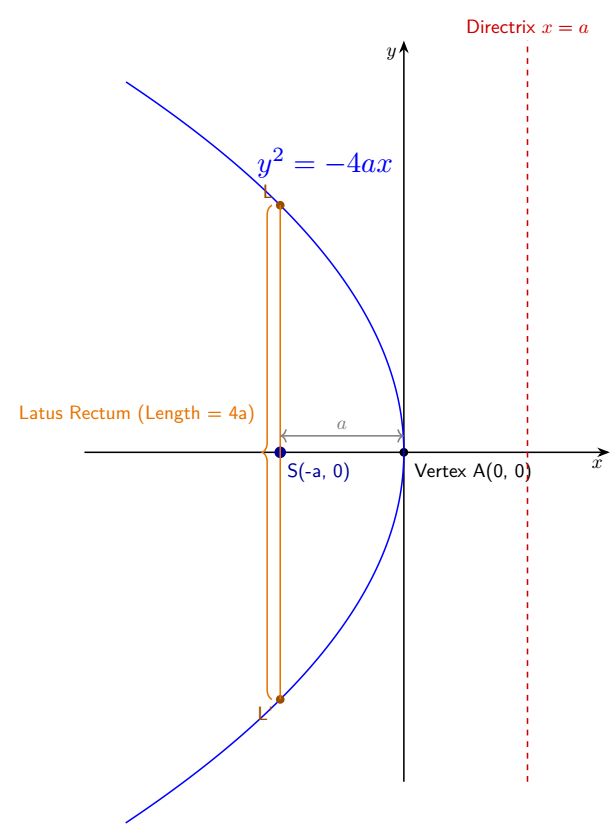
This is the standard equation for a parabola opening to the left. Its key features are:
- Vertex: \(A(0, 0)\)
- Focus: \(S(-a, 0)\)
- Directrix: \(x = a\)
- Axis of Symmetry: The x-axis (\(y=0\))
- Length of Latus Rectum: \(4a\)
The Vertical Parabolas
So far, our parabolas have been symmetric with respect to the x-axis. What if the axis of symmetry is the y-axis? This will give us parabolas that open either upwards or downwards. We can deduce their equations simply by interchanging the roles of \(x\) and \(y\) from our previous findings.
The Upward-Opening Parabola
For a parabola that opens upwards, its focus must be on the positive y-axis. We place it at \(S(0, a)\). The directrix will then be the horizontal line \(y = -a\). By swapping \(x\) and \(y\) in our original equation, \(y^2=4ax\), we arrive at the new standard form:
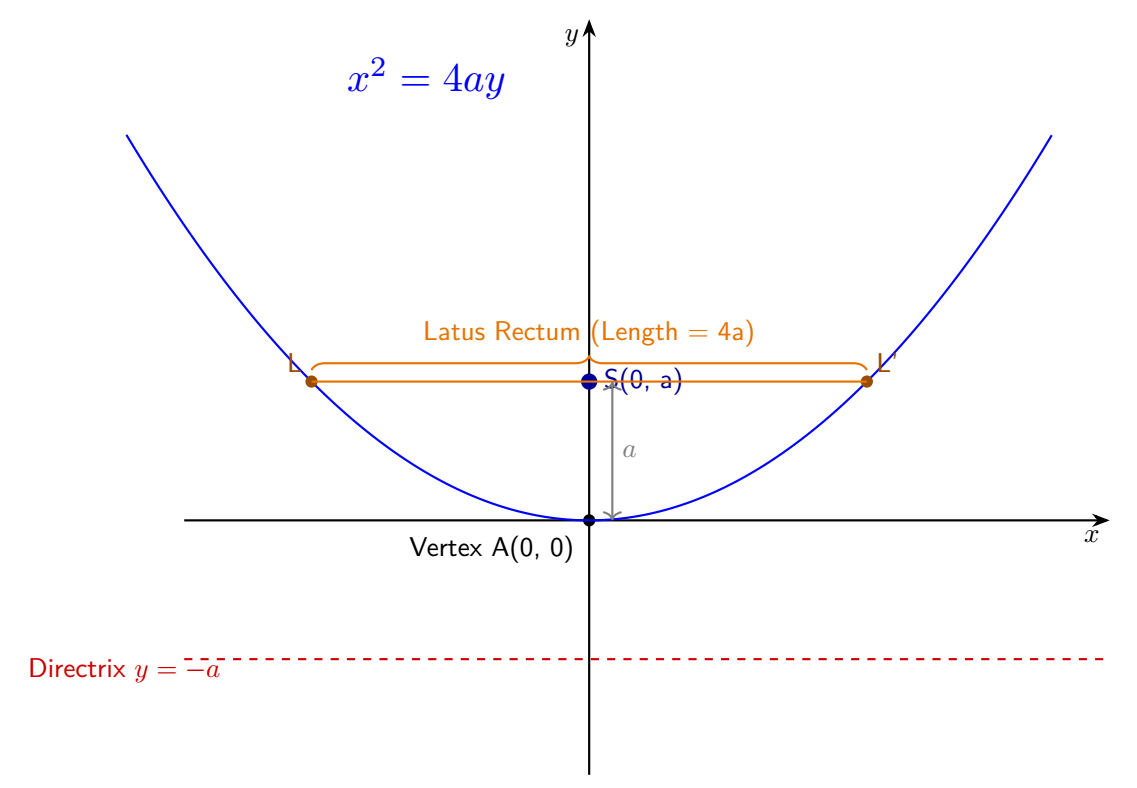
This parabola has the following properties:
- Vertex: \(A(0, 0)\)
- Focus: \(S(0, a)\)
- Directrix: \(y = -a\)
- Axis of Symmetry: The y-axis (\(x=0\))
- Length of Latus Rectum: \(4a\)
The Downward-Opening Parabola
Finally, consider a parabola opening downwards. This is a mirror image of the upward-opening parabola across the x-axis. Its focus will be on the negative y-axis at \(S(0, -a)\), and its directrix will be the horizontal line \(y = a\).
Following the same logic, we swap the roles of \(x\) and \(y\) in the left-handed parabola's equation, \(y^2 = -4ax\), to get the equation for the downward-opening parabola:
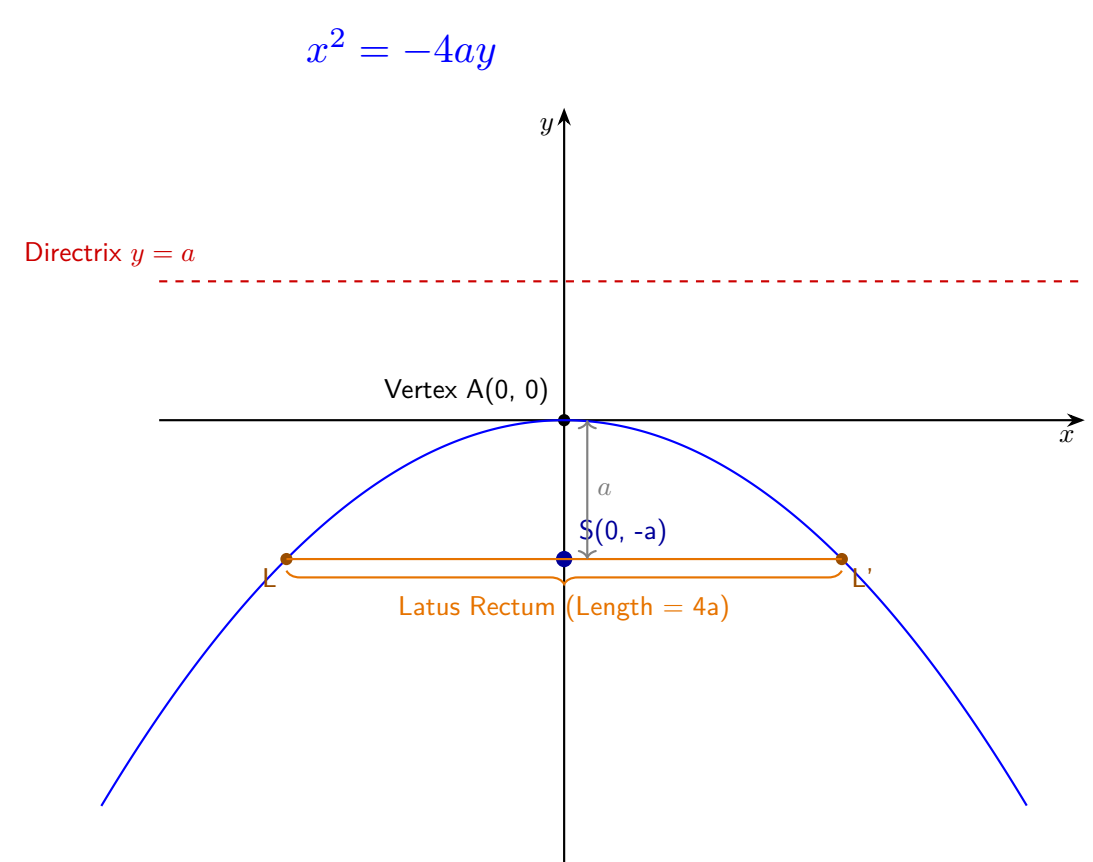
Its features are:
- Vertex: \(A(0, 0)\)
- Focus: \(S(0, -a)\)
- Directrix: \(y = a\)
- Axis of Symmetry: The y-axis (\(x=0\))
- Length of Latus Rectum: \(4a\)
Focal Distance of a Point \(P(x, y)\)
The focal distance of a point on a parabola is its distance from the focus. This distance is always equal to the point's perpendicular distance to the directrix. For any given point \(P(x, y)\) on one of the four standard parabolas, the focal distance (\(SP\)) can be calculated as follows:
-
For the Right-Handed Parabola (\(y^2 = 4ax\)):
The focal distance is given by the formula:
\[SP = x + a\] -
For the Left-Handed Parabola (\(y^2 = -4ax\)):
The focal distance is given by the formula:
\[SP = a - x\] -
For the Upward-Opening Parabola (\(x^2 = 4ay\)):
The focal distance is given by the formula:
\[SP = y + a\] -
For the Downward-Opening Parabola (\(x^2 = -4ay\)):
The focal distance is given by the formula:
\[SP = a - y\]
The Shifted Parabola
We have established the standard forms for parabolas whose vertices are located at the origin \((0,0)\). However, in many applications, the vertex may be situated at any arbitrary point in the Cartesian plane. This leads to the concept of a shifted parabola.
The Principle of Translation
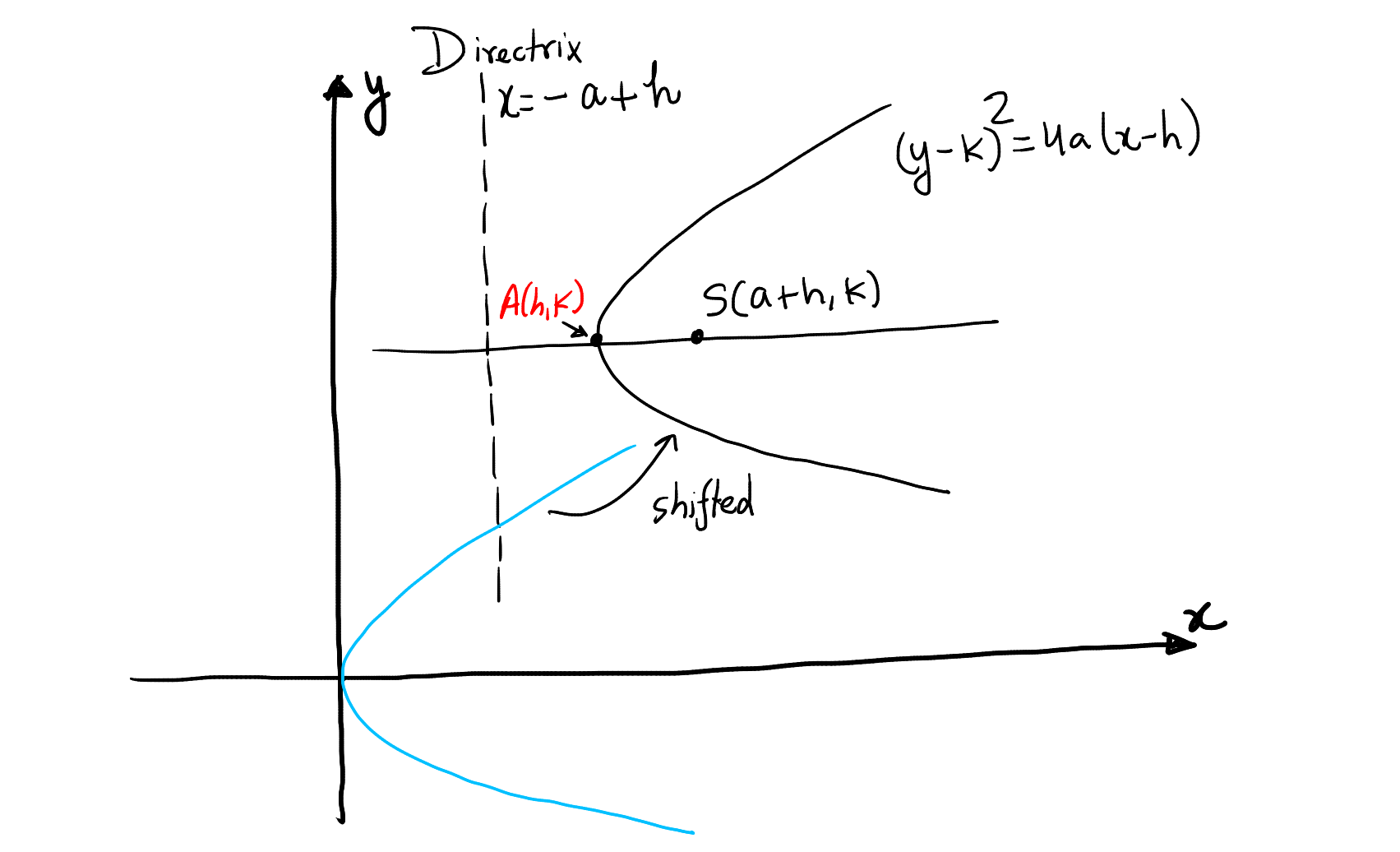
The key to understanding the equations of shifted parabolas lies in the translation of axes. Imagine that we move our coordinate system's origin from \(O(0,0)\) to a new point, \(A(h, k)\). Let us denote the coordinates with respect to this new origin by \((X, Y)\).
A point \(P\) that has coordinates \((X, Y)\) in the new system will have coordinates \((x, y)\) in the original system, where the relationship is:
Rearranging these gives us the transformation from the original coordinates to the new ones:
Now, consider a standard right-handed parabola. In the new \((X, Y)\) coordinate system, with its vertex at the new origin \(A\), its equation is simply:
To find the equation of this parabola in our original \((x, y)\) system, we can substitute the expressions for \(X\) and \(Y\):
This is the general equation of a right-handed parabola with its vertex at the point \((h, k)\).
Properties of the Shifted Parabola
All properties of the parabola are translated along with the vertex. To find the new focus, directrix, and axis, we simply apply the same shift \((h, k)\) to their original positions.
Let's analyze the properties of the parabola given by \((y-k)^2 = 4a(x-h)\):
- Vertex: The vertex is, by definition, at the point \(A(h, k)\).
- Focus: In the standard form, the focus was at \((a, 0)\) relative to the vertex. We apply the shift to this point:
- New focus coordinates: \((h+a, k+0) = (h+a, k)\).
- Axis of Symmetry: The axis for the standard parabola \(Y^2=4aX\) was the line \(Y=0\). In the original system, this becomes the line \(y-k=0\), or simply \(y=k\).
- Directrix: The directrix for the standard parabola was the line \(X=-a\). In the original system, this becomes \(x-h=-a\), or \(x=h-a\).
- Latus Rectum: The length of the latus rectum is an intrinsic property of the parabola's shape, determined by the parameter \(a\). A translation does not change the shape of the curve, so the length remains \(4a\).
Summary of Standard Shifted Forms
This principle of translation applies to all four orientations. The results are summarized below, where the vertex in each case is at \(A(h, k)\).
-
Right-Handed Parabola
- Equation: \((y-k)^2 = 4a(x-h)\)
- Focus: \((h+a, k)\)
- Directrix: \(x = h-a\)
-
Left-Handed Parabola
- Equation: \((y-k)^2 = -4a(x-h)\)
- Focus: \((h-a, k)\)
- Directrix: \(x = h+a\)
-
Upward-Opening Parabola
- Equation: \((x-h)^2 = 4a(y-k)\)
- Focus: \((h, k+a)\)
- Directrix: \(y = k-a\)
-
Downward-Opening Parabola
- Equation: \((x-h)^2 = -4a(y-k)\)
- Focus: \((h, k-a)\)
- Directrix: \(y = k+a\)
General Equations of horizontal and vertical shifted Parabolas
The standard shifted forms can be expanded and rearranged to produce a general form for parabolas whose axes are parallel to the coordinate axes. This is often the form you will encounter equations in before you complete the square to find the vertex, focus, and directrix.
Vertical Parabola (Axis parallel to the y-axis)
Let's start with the standard equation for an upward or downward-opening parabola:
If we expand the squared term and rearrange the equation to solve for \(y\), we can see how it relates to a general quadratic form.
-
Expand the equation: \(x^2 - 2hx + h^2 = 4ay - 4ak\)
-
Isolate the terms with y: \(4ay = x^2 - 2hx + h^2 + 4ak\)
-
Solve for y: \(y = \frac{1}{4a}x^2 - \frac{2h}{4a}x + \frac{h^2 + 4ak}{4a}\)
This equation looks complicated, but notice that \(h\), \(k\), and \(a\) are all constants for any given parabola. Therefore, the coefficients of \(x^2\), \(x\), and the constant term are also just numbers.
Let's define new constants:
- \(A = \frac{1}{4a}\)
- \(B = -\frac{h}{2a}\)
- \(C = \frac{h^2 + 4ak}{4a}\)
By substituting these, we get the familiar quadratic equation:
Therefore, any equation of the form \(y = ax^2 + bx + c\) represents a vertical parabola, with its axis of symmetry parallel to the y-axis.
Horizontal Parabola (Axis parallel to the x-axis)
Similarly, let's take the standard equation for a right-handed or left-handed parabola:
This time, we will rearrange the equation to solve for \(x\).
-
Expand the equation: \(y^2 - 2ky + k^2 = 4ax - 4ah\)
-
Isolate the terms with x: \(4ax = y^2 - 2ky + k^2 + 4ah\)
-
Solve for x: \(x = \frac{1}{4a}y^2 - \frac{2k}{4a}y + \frac{k^2 + 4ah}{4a}\)
Just like before, the coefficients are constants. We can define:
- \(A = \frac{1}{4a}\)
- \(B = -\frac{k}{2a}\)
- \(C = \frac{k^2 + 4ah}{4a}\)
Substituting these gives a quadratic equation in terms of \(y\):
Thus, any equation of the form \(x = ay^2 + by + c\) represents a horizontal parabola, with its axis of symmetry parallel to the x-axis.
Example
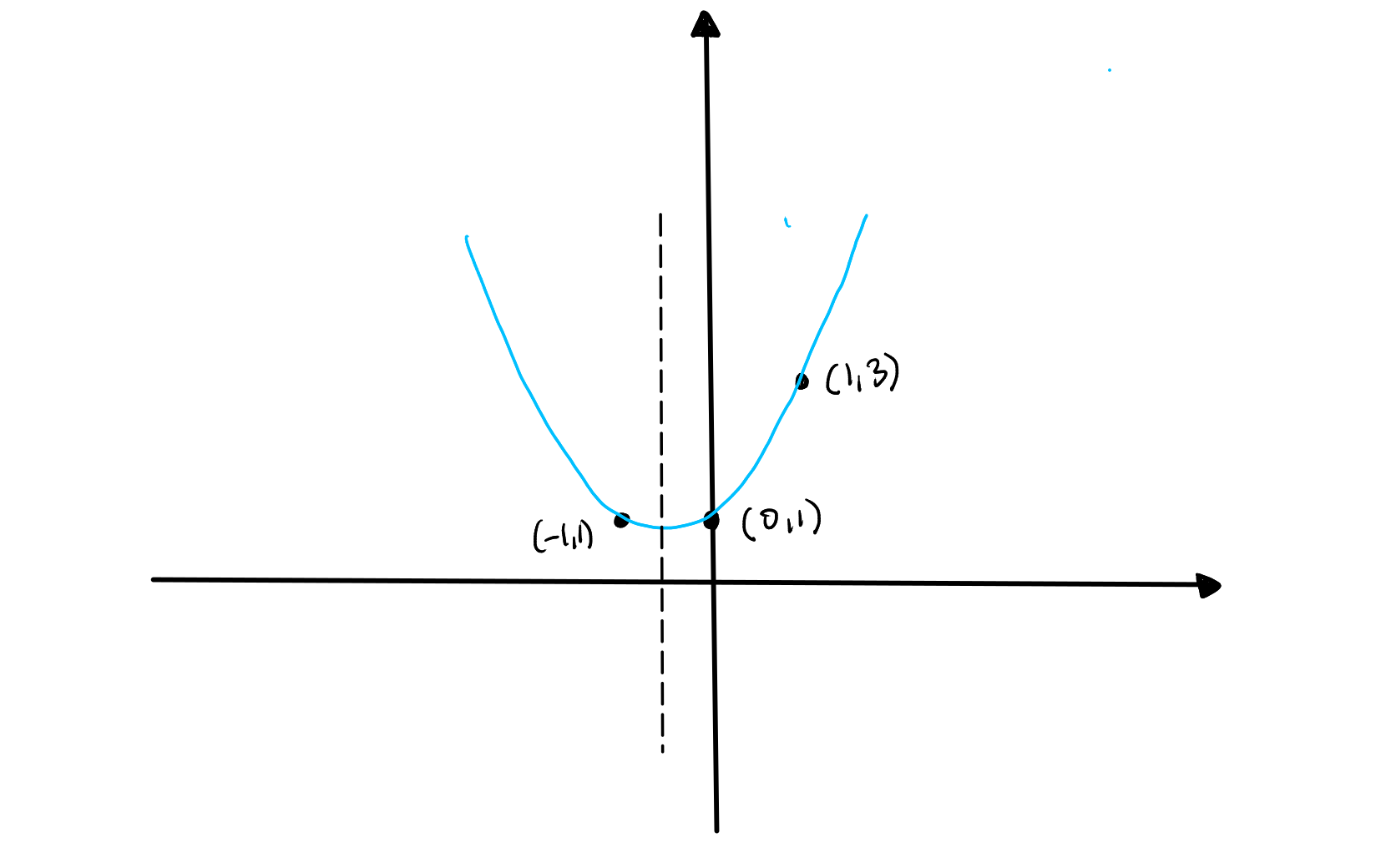
Let's find the equation of a parabola whose axis is parallel to the y-axis and which passes through the points \((1, 3)\), \((0, 1)\), and \((-1, 1)\).
Since the parabola's axis is parallel to the y-axis, its general equation is of the form:
The parabola passes through the three given points, so their coordinates must satisfy this equation.
-
For point \((1, 3)\):
\(3 = a(1)^2 + b(1) + c \implies a + b + c = 3 \quad \cdots(i)\)
-
For point \((0, 1)\):
\(1 = a(0)^2 + b(0) + c \implies c = 1 \quad \cdots(ii)\)
-
For point \((-1, 1)\):
\(1 = a(-1)^2 + b(-1) + c \implies a - b + c = 1 \quad \cdots(iii)\)
Now, we solve this system of linear equations.
Substitute \(c=1\) from equation \((ii)\) into equations \((i)\) and \((iii)\):
- From \((i)\): \(a + b + 1 = 3 \implies a + b = 2 \quad \cdots(iv)\)
- From \((iii)\): \(a - b + 1 = 1 \implies a - b = 0 \quad \cdots(v)\)
Adding equations \((iv)\) and \((v)\):
Substituting \(a=1\) into equation \((v)\):
Thus, we have found the coefficients: \(a=1\), \(b=1\), and \(c=1\).
The required equation of the parabola is: