Intersection of a Circle and a Parabola
When a straight line intersects a parabola, it does so in at most two points. When a circle intersects a parabola, both curves are described by equations of the second degree in \(x\) and \(y\).
Eliminating one of the variables between their two equations leads to a polynomial equation of degree 4. Therefore, a circle and a parabola can intersect in at most four points:
These four points of intersection (which may be real and distinct, coincident, or complex) satisfy several simple and elegant geometric properties:
- The sum of their ordinates (\(y\)-coordinates) is always zero.
- Their centroid always lies on the axis of the parabola.
- Any two common chords joining them are equally inclined to the axis of symmetry.
Studying the intersection of a circle and a parabola also connects two important topics: co-normal points (which occur when the circle passes through the vertex of the parabola) and the circle of curvature (which occurs when three of the intersection points merge into one).
Algebraic Formulation of the Intersection
Consider the standard parabola:
with its vertex at the origin \(O(0, 0)\) and its axis along the \(x\)-axis (\(y = 0\)).
Let the general equation of a circle in the Cartesian plane be:
having its center at \(C(-g, -f)\) and radius \(R = \sqrt{g^2 + f^2 - c}\).
To determine the points common to both curves, we can eliminate either \(x\) or the parametric variable \(t\).
Cartesian Formulation
From the equation of the parabola, expressing \(x\) in terms of \(y\):
Substituting this expression into the equation of the circle:
Expanding the squared term:
Multiplying the entire equation by \(16a^2\) to clear fractions:
Grouping terms by powers of \(y\):
This is a polynomial equation of degree 4 in \(y\). Therefore, it has four roots: \(y_1, y_2, y_3, y_4\).
For each real root \(y_i\), the corresponding \(x\)-coordinate is given by the equation of the parabola:
Parametric Formulation
The parametric representation of any point on the parabola \(y^2 = 4ax\) is:
where \(t\) is a real parameter.
Substituting these parametric coordinates directly into the circle equation \(x^2 + y^2 + 2gx + 2fy + c = 0\):
Expanding each term:
Factoring out \(t^2\):
Since \(a \neq 0\) for a non-degenerate parabola, we divide through by \(a^2\):
This is a quartic equation in \(t\). Its four roots \(t_1, t_2, t_3, t_4\) give the parameters of the four points of intersection \(P_1, P_2, P_3, P_4\).
Fundamental Properties of Four Concyclic Points
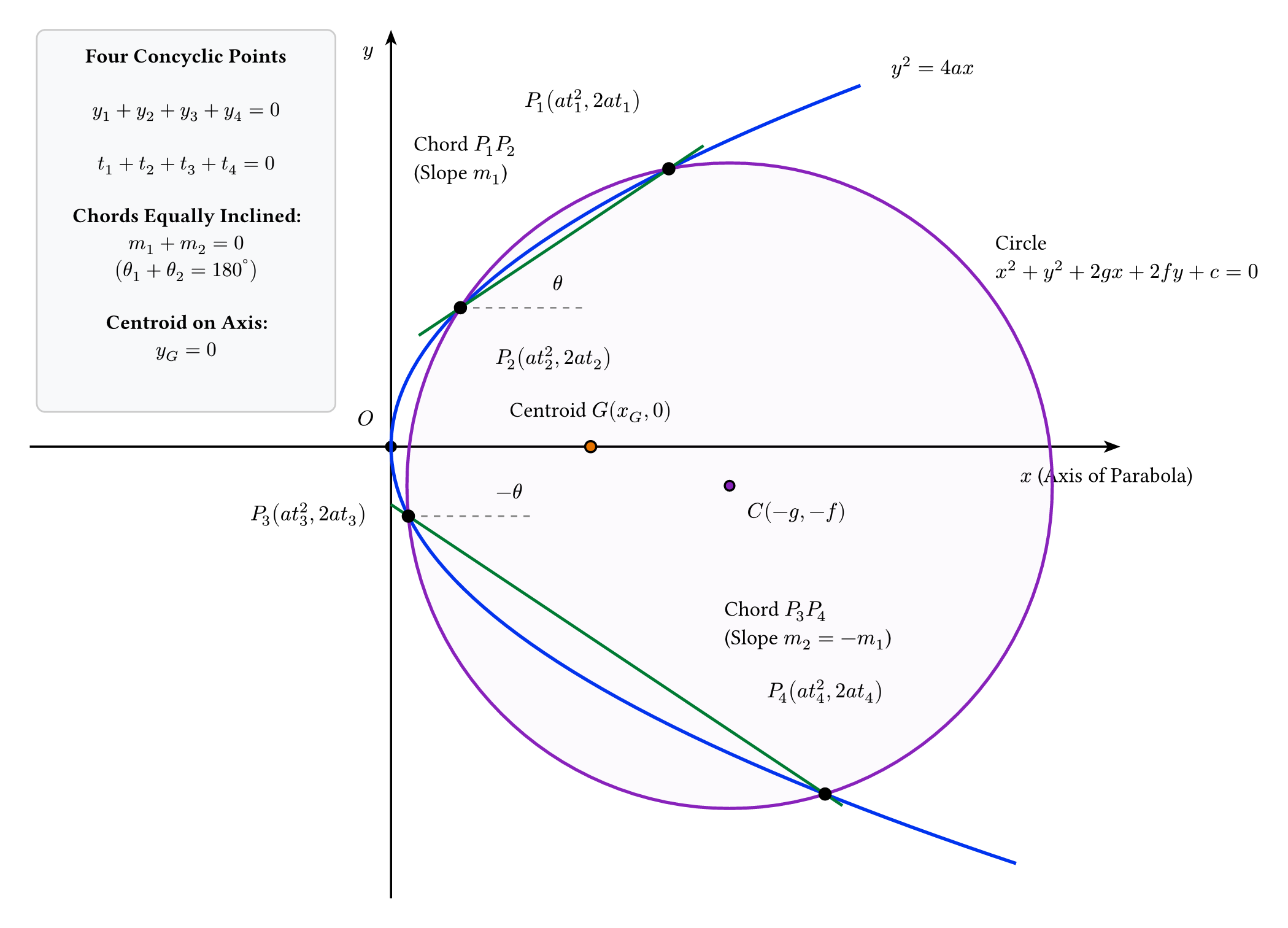
Points that lie on a common circle are called concyclic. When four points on a parabola are concyclic, their coordinates obey three fundamental geometric laws.
The Sum of the Ordinates is Zero
Observe the quartic equation in \(y\):
The cubic term \(y^3\) is absent; its coefficient is identically zero.
From the relation between the roots and coefficients of a polynomial equation:
Similarly, in the parametric quartic equation:
The coefficient of \(t^3\) is identically zero. Therefore:
This gives the fundamental condition for four concyclic points on a parabola:
This condition carries an immediate geometric consequence: all four points of intersection can never lie on the same side of the axis of the parabola. If three intersection points lie above the axis (\(y > 0\)), the fourth point must necessarily lie below the axis (\(y < 0\)), and its distance from the axis equals the sum of the distances of the other three.
The Centroid of the Four Points Lies on the Axis
Let \(P_1, P_2, P_3, P_4\) be the four concyclic points. The coordinates of their centroid \(G(x_G, y_G)\) are the arithmetic means of their coordinates:
Since the sum of the ordinates is zero:
The centroid of four concyclic points on a parabola always lies on the axis of the parabola.
Now consider the \(x\)-coordinate of the centroid. In terms of the parameters:
Recall the standard algebraic expansion for the sum of squares:
Using the relations between roots and coefficients for the quartic in \(t\):
Substituting these values:
Now compute \(x_G\):
Recall that the center of the circle \(x^2 + y^2 + 2gx + 2fy + c = 0\) is \(C(-g, -f)\). The \(x\)-coordinate of the circle's center is \(x_C = -g\).
Therefore:
The \(x\)-coordinate of the centroid of the four intersection points depends solely on the \(x\)-coordinate of the center of the circle and the parameter \(a\) of the parabola. It is entirely independent of \(f\) (the vertical position of the circle) and \(c\) (the radius of the circle).
Common Chords are Equally Inclined to the Axis
Let the four concyclic points be paired to form chords of the parabola. Consider the two chords \(P_1 P_2\) and \(P_3 P_4\).
The slope of the chord connecting any two points \(P_1(at_1^2, 2at_1)\) and \(P_2(at_2^2, 2at_2)\) on the parabola is:
Similarly, the slope of the chord \(P_3 P_4\) is:
Because the four points are concyclic:
Substituting this relation into the slope \(m_2\):
Therefore:
Let \(\theta_1\) and \(\theta_2\) be the angles of inclination that the chords \(P_1 P_2\) and \(P_3 P_4\) make with the positive direction of the \(x\)-axis. Since \(m_1 = \tan \theta_1\) and \(m_2 = \tan \theta_2\):
Assuming neither chord is perpendicular to the axis:
The common chords \(P_1 P_2\) and \(P_3 P_4\) are equally inclined to the axis of the parabola.
This equal-inclination property holds for all three ways of pairing the four points into common chords:
- Chords \(P_1 P_2\) and \(P_3 P_4\): \(m(P_1 P_2) + m(P_3 P_4) = 0\)
- Chords \(P_1 P_3\) and \(P_2 P_4\): \(m(P_1 P_3) + m(P_2 P_4) = 0\)
- Chords \(P_1 P_4\) and \(P_2 P_3\): \(m(P_1 P_4) + m(P_2 P_3) = 0\)
This theorem provides an immediate geometric criterion to test whether four points on a parabola are concyclic: join them in pairs. If the chords of any pair make supplementary angles with the axis of symmetry, all four points lie on a circle.
Finding the Fourth Point of Intersection
If a circle intersects a parabola at three known points \(P_1(t_1), P_2(t_2), P_3(t_3)\), the parameter of the fourth point of intersection \(P_4(t_4)\) is uniquely determined by:
In terms of Cartesian coordinates, if the ordinates of three intersection points are \(y_1, y_2, y_3\), the ordinate of the fourth point is:
Once \(y_4\) is known, its abscissa is \(x_4 = \frac{y_4^2}{4a}\).
Circle Passing Through the Vertex and Three Co-normal Points
A particularly beautiful theorem arises when the circle passes through the vertex of the parabola.
Connection to Co-normal Points
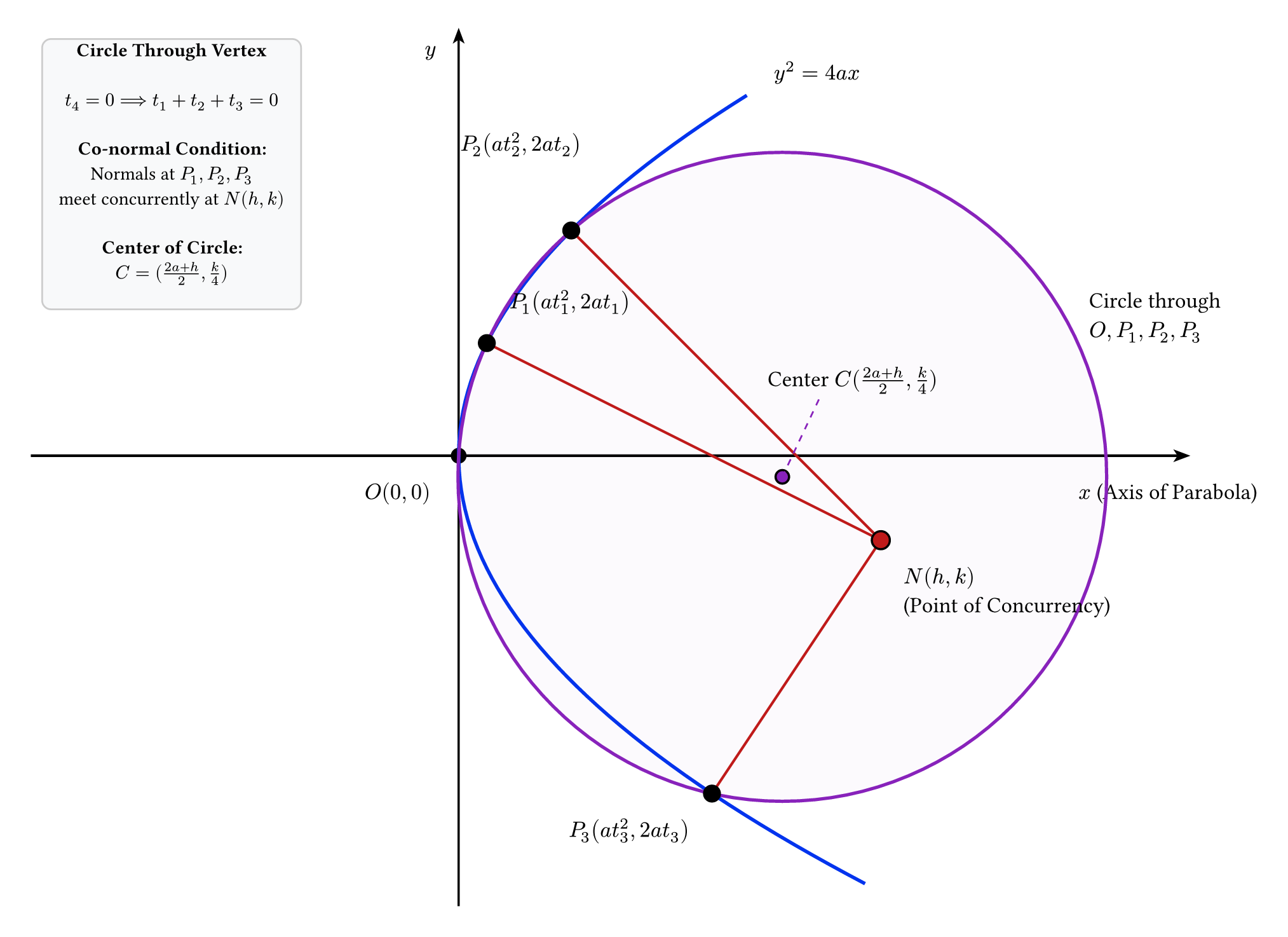
Let the circle pass through the vertex \(O(0, 0)\) of the parabola \(y^2 = 4ax\). Because the vertex is one of the four intersection points, its parameter is:
Substituting \(t_4 = 0\) into the invariant \(\sum_{i=1}^4 t_i = 0\):
In the study of normals to a parabola, three points \(P_1, P_2, P_3\) are called co-normal if the normals drawn to the parabola at these three points meet concurrently at a single point \(N(h, k)\).
The equation of the normal at any point \((at^2, 2at)\) is:
If this normal passes through the point \(N(h, k)\):
Dividing by \(a\):
The sum of the roots of this cubic equation is:
The condition for three points on a parabola to be co-normal is identically \(t_1 + t_2 + t_3 = 0\).
Therefore, any circle passing through the vertex of a parabola and two co-normal points must also pass through the third co-normal point. The vertex and the three co-normal points form a concyclic set of four points.
Equation and Center of the Circle
Because the circle passes through \(O(0, 0)\), its constant term is \(c = 0\). Its equation is:
Substituting \(x = at^2, y = 2at\) with \(c = 0\):
Factoring out \(t\) (corresponding to the vertex \(t = 0\)):
Dividing by \(a^2\):
This cubic equation must have the same roots \(t_1, t_2, t_3\) as the co-normal cubic equation:
Equating corresponding coefficients:
Equating the coefficient of \(t\):
Equating the constant term:
Substituting \(2g = -(2a + h)\) and \(2f = -k/2\) into the circle equation:
The coordinates of the center \(C(-g, -f)\) of this circle are:
The radius \(R\) of the circle is:
Locus of the Center of the Circle
Suppose the point of concurrency of the normals \(N(h, k)\) lies on the parabola itself, so that \(k^2 = 4ah\). What is the locus of the center \(C(x_C, y_C)\) of the circle passing through the vertex and the three co-normal points?
From the center coordinates:
Substitute these expressions into the parabola condition \(k^2 = 4ah\):
Dividing both sides by 8:
Replacing \((x_C, y_C)\) with running coordinates \((x, y)\), the locus of the center of the circle is:
This locus is another parabola having its vertex at \((a, 0)\) and its latus rectum equal to \(a/2\).
The Circle of Curvature (Osculating Circle)
When two points of intersection of a circle and a parabola coincide (\(t_1 = t_2\)), the circle touches the parabola at that point (simple tangency).
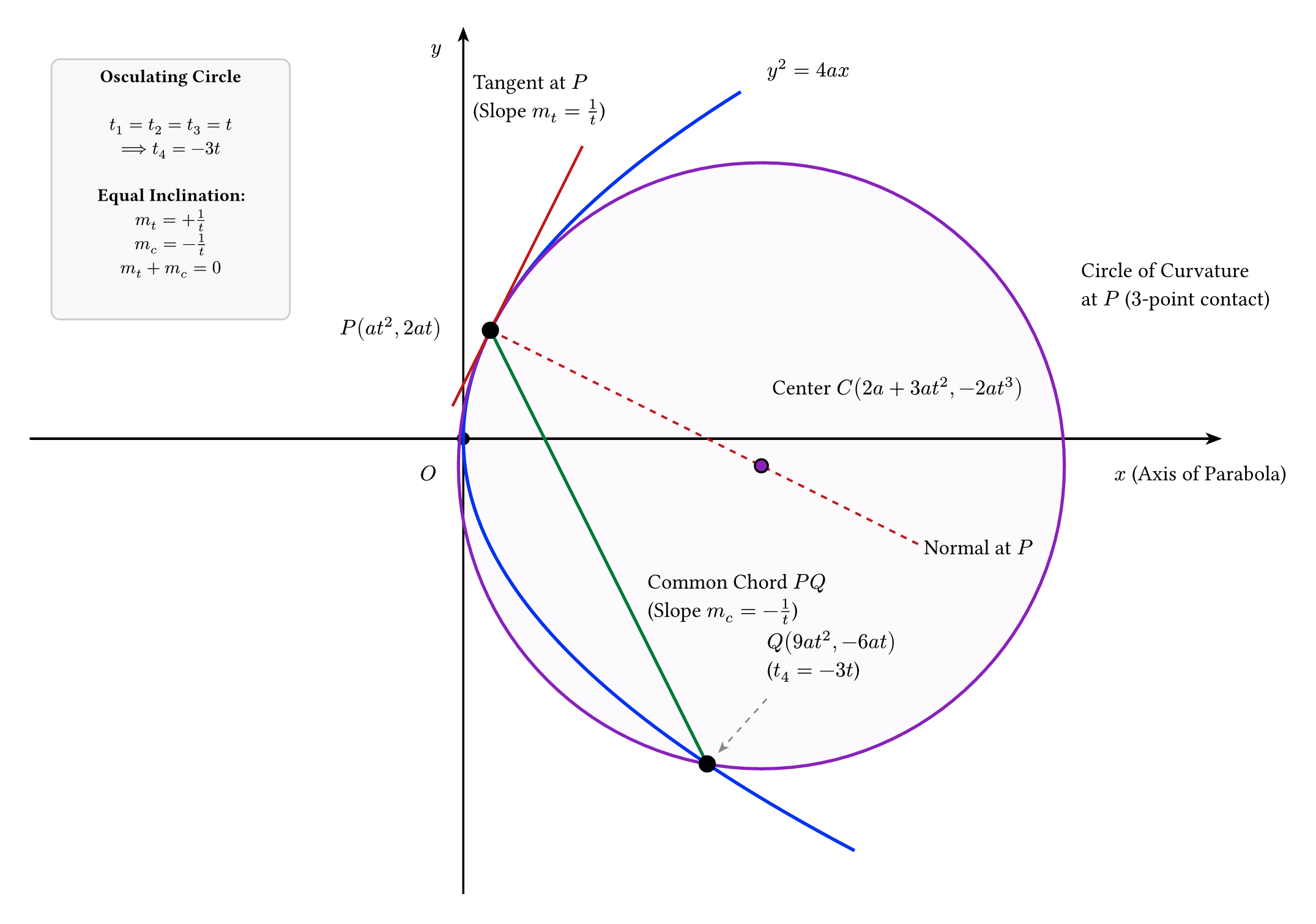
When three points of intersection merge into a single point (\(t_1 = t_2 = t_3 = t\)), the circle fits the curve even more closely: it shares the same point, the same tangent line, and the same rate of turning (curvature). This circle is known as the circle of curvature (or osculating circle) at \(P\).
The Fourth Point of Intersection
Let three intersection points coalesce at the point \(P(at^2, 2at)\), so that \(t_1 = t_2 = t_3 = t\).
Because the sum of all four parameters must equal zero:
The circle of curvature at any point \(P(at^2, 2at)\) intersects the parabola again at a single fourth point \(Q\):
Equal Inclination of the Tangent and the Common Chord
The chord joining the point of contact \(P(t)\) to the fourth intersection point \(Q(-3t)\) is the common chord of the circle of curvature and the parabola.
The slope of the common chord \(PQ\) is:
Recall that the equation of the tangent line at \(P(at^2, 2at)\) is \(ty = x + at^2\), which has slope:
Comparing the two slopes:
The common chord of the circle of curvature and the tangent line at the point of contact are equally inclined to the axis of the parabola.
If the tangent line makes an angle \(\theta\) with the \(x\)-axis, the common chord \(PQ\) makes an angle of \(180^\circ - \theta\) (or \(-\theta\)).
Length of the Common Chord
The distance between the point of contact \(P(at^2, 2at)\) and the fourth point of intersection \(Q(9at^2, -6at)\) is:
Factoring out \(64a^2 t^2\):
Center and Radius of Curvature
The center \(C\) of the circle of curvature is called the center of curvature, and its radius \(\rho\) is the radius of curvature.
Because the circle of curvature touches the parabola at \(P\), its center \(C\) must lie on the normal line to the parabola at \(P\).
In coordinate geometry, the coordinates of the center of curvature \(C(x_C, y_C)\) at \(P(at^2, 2at)\) are given by:
The radius of curvature \(\rho\) is the distance from \(C\) to \(P\):
Circle of Curvature at the Vertex
At the vertex \(O(0, 0)\), the parameter is \(t = 0\).
Substituting \(t = 0\):
All four points of intersection coincide at the origin (\(t_1 = t_2 = t_3 = t_4 = 0\)), giving a 4-point contact with the parabola.
The coordinates of the center of curvature at \(t = 0\) are:
The radius of curvature is:
The equation of the circle of curvature at the vertex is:
This circle has its center at \((2a, 0)\), touches the \(y\)-axis (the tangent at the vertex) at the origin, and passes through the point \((4a, 0)\).
Illustrative Examples
Example 1: Finding the Fourth Concyclic Point
Problem. A circle intersects the parabola \(y^2 = 4x\) at three points whose ordinates are \(2\), \(4\), and \(-10\). Find the coordinates of the fourth point of intersection and verify the concyclic condition.
Solution. Here, the parabola is \(y^2 = 4x\), so \(4a = 4 \implies a = 1\).
The ordinates of the three given points are \(y_1 = 2\), \(y_2 = 4\), and \(y_3 = -10\).
For any four concyclic points on a parabola, the sum of their ordinates must equal zero:
Substituting the given values:
Now compute the \(x\)-coordinate of the fourth point:
Therefore, the fourth point of intersection is \((4, 4)\).
Notice that \(y_4 = 4\) is identical to \(y_2 = 4\). This indicates that two of the four intersection points coincide at \((4, 4)\), meaning the circle is tangent to the parabola at the point \((4, 4)\) and intersects it transversely at \((1, 2)\) and \((25, -10)\).
Example 2: Common Chords and Equal Inclination
Problem. A circle intersects the parabola \(y^2 = 8x\) at four points \(P_1, P_2, P_3, P_4\) corresponding to parameters \(t_1 = 1\), \(t_2 = 3\), \(t_3 = -2\), and \(t_4 = -2\). Show that the chords \(P_1 P_2\) and \(P_3 P_4\) are equally inclined to the axis of the parabola.
Solution. For the parabola \(y^2 = 8x\), \(4a = 8 \implies a = 2\).
The parameters are \(t_1 = 1\), \(t_2 = 3\), \(t_3 = -2\), and \(t_4 = -2\).
First, verify the concyclic invariant:
The slope of chord \(P_1 P_2\) is:
The slope of chord \(P_3 P_4\) (which here represents the tangent at \(t = -2\) since \(t_3 = t_4\)) is:
The sum of the slopes is:
Let \(\theta_1\) and \(\theta_2\) be the inclinations with the \(x\)-axis:
Hence \(\theta_1 + \theta_2 = 180^\circ\). The two chords are equally inclined to the axis of symmetry of the parabola.
Example 3: Circle Through Vertex and Three Co-normal Points
Problem. The normals at three points of the parabola \(y^2 = 4x\) meet at the point \(N(11, -6)\). Find the equation of the circle passing through the vertex of the parabola and these three co-normal points, and find its center and radius.
Solution. The parabola is \(y^2 = 4x\), so \(a = 1\).
The point of concurrency of the normals is \((h, k) = (11, -6)\).
The circle passing through the vertex \(O(0, 0)\) and the three co-normal points has the standard equation:
Substituting \(a = 1\), \(h = 11\), and \(k = -6\):
Substituting these values into the equation:
The center \(C\) of this circle is:
The radius \(R\) of the circle is:
Example 4: Circle of Curvature at a Point
Problem. Find the coordinates of the fourth point of intersection of the parabola \(y^2 = 4x\) with the circle of curvature at the point \(P(1, 2)\). Also find the length of the common chord.
Solution. For \(y^2 = 4x\), \(a = 1\).
The point \(P(1, 2)\) has parametric coordinates \((at^2, 2at) = (t^2, 2t)\).
Comparing coordinates:
At a point with parameter \(t\), the fourth point of intersection \(Q\) of the circle of curvature has parameter:
The coordinates of \(Q\) are:
Therefore, the fourth point of intersection is \(Q(9, -6)\).
The length of the common chord \(PQ\) can be calculated using the distance formula or the parametric formula:
Verifying with the Cartesian distance between \(P(1, 2)\) and \(Q(9, -6)\):
Both methods yield \(8\sqrt{2}\).
Solved Problems
Problem 1: Parabola and Circle Intersecting in Four Points
Problem. A circle touches the parabola \(y^2 = 4ax\) at the point \(P(at^2, 2at)\) and cuts it at the points \(Q(at_1^2, 2at_1)\) and \(R(at_2^2, 2at_2)\). Prove that the chord \(QR\) always passes through a fixed point on the axis of the parabola, and determine its coordinates.
Solution. Because the circle touches the parabola at \(P(at^2, 2at)\), two of the four intersection points coincide at \(P\). Therefore, the four parameters of intersection are:
Applying the concyclic invariant \(\sum t_i = 0\):
The equation of the chord \(QR\) passing through \(Q(at_1^2, 2at_1)\) and \(R(at_2^2, 2at_2)\) is:
We are given that the circle touches at \(P(t)\) and passes through \(Q\) and \(R\). The slope of chord \(QR\) is:
The slope of the tangent at \(P(t)\) is \(m_t = 1/t\).
Thus \(m_{QR} + m_t = 0\). The chord \(QR\) is parallel to the normal chord or equally inclined.
Now consider the point where the chord \(QR\) intersects the axis of the parabola (\(y = 0\)). Setting \(y = 0\) in the chord equation:
If the circle is the circle of curvature (so three points coalesce and \(t_1 = t\)), then \(t_2 = -3t\), giving \(t_1 t_2 = -3t^2\), and \(x = 3at^2\).
In general, whenever two intersection points coincide at \(P(t)\), the chord joining the other two intersections satisfies \(t_1 + t_2 = -2t\), so its slope is always \(-1/t\), which is the negative of the slope of the tangent at \(P\).
Problem 2: Center Locus for Common Chords Meeting on the Axis
Problem. A circle and the parabola \(y^2 = 4ax\) intersect at four points \(P_1, P_2, P_3, P_4\). If the common chords \(P_1 P_2\) and \(P_3 P_4\) intersect at a point on the axis of the parabola, prove that the center of the circle must lie on the axis of the parabola (\(f = 0\)).
Solution. Let the four intersection points have parameters \(t_1, t_2, t_3, t_4\). Since they are concyclic:
The equation of the chord \(P_1 P_2\) is:
The chord \(P_1 P_2\) intersects the axis of the parabola (\(y = 0\)) at:
Similarly, the equation of the chord \(P_3 P_4\) is:
The chord \(P_3 P_4\) intersects the axis (\(y = 0\)) at:
We are given that both chords intersect at the same point on the axis. Therefore, their \(x\)-intercepts must be equal:
Now recall the parametric quartic equation for concyclic points:
By Vieta's formulas, the coefficient of \(t\) gives the sum of the products of roots taken three at a time:
Expanding this symmetric sum:
Grouping terms:
Since \(t_1 t_2 = t_3 t_4\), substitute \(t_3 t_4 = t_1 t_2\):
Factoring out \(t_1 t_2\):
Because the four points are concyclic, \(t_1 + t_2 + t_3 + t_4 = 0\). Therefore:
The center of the circle is \(C(-g, -f) = (-g, 0)\), which lies on the \(x\)-axis (the axis of the parabola).
Problem 3: Common Chords of a Fixed Circle and Parabola
Problem. A circle has its center at \((h, 0)\) and radius \(r\). It intersects the parabola \(y^2 = 4ax\) at four real points. Show that the algebraic sum of the slopes of the tangents drawn to the parabola at these four points is zero.
Solution. Let the four points of intersection have parameters \(t_1, t_2, t_3, t_4\).
The equation of the circle centered at \((h, 0)\) with radius \(r\) is:
Comparing this with the general circle equation \(x^2 + y^2 + 2gx + 2fy + c = 0\):
The four points of intersection lie on the parabola \(y^2 = 4ax\), so their parameters satisfy the concyclic condition:
The slope of the tangent to the parabola at any point with parameter \(t_i\) is:
The sum of the slopes of the tangents is:
From the quartic equation in \(t\):
Since the circle center lies on the \(x\)-axis, \(f = 0\). Therefore:
Hence:
The algebraic sum of the slopes of the tangents at the four intersection points is zero.
Problem 4: Circle of Curvature at the End of the Latus Rectum
Problem. Find the equation of the circle of curvature to the parabola \(y^2 = 4ax\) at an extremity of the latus rectum \(L(a, 2a)\). Find its radius, center of curvature, and the coordinates of the fourth point where it intersects the parabola.
Solution. The point \(L(a, 2a)\) corresponds to:
Center of Curvature:
Substitute \(t = 1\) into the formulas for the center of curvature:
The center of curvature is \(C(5a, -2a)\).
Radius of Curvature:
Substitute \(t = 1\) into the radius formula:
Equation of the Circle of Curvature:
Expanding:
Fourth Point of Intersection:
The fourth intersection point \(Q\) has parameter:
Its coordinates are:
The fourth point of intersection is \(Q(9a, -6a)\).
Problem 5: Algebraic Sum of Distances from Common Points to Any Line
Problem. If a circle intersects the parabola \(y^2 = 4ax\) in four points \(P_1, P_2, P_3, P_4\), prove that the sum of the algebraic distances of these four points from the axis of the parabola is zero, and that the sum of the squares of their distances from the axis depends only on the focal parameter \(a\) and the center of the circle.
Solution. The distance of any point \(P_i(x_i, y_i)\) from the axis of the parabola (\(y = 0\)) is simply its ordinate \(y_i\).
As established by the absent \(y^3\) term in the quartic intersection equation:
Now consider the sum of the squares of the distances from the axis:
Using the algebraic identity for sum of squares:
From the Cartesian quartic equation:
By Vieta's relations:
Substituting these values:
Recall that the center of the circle is \(C(-g, -f)\), so \(x_C = -g \implies g = -x_C\).
Substituting \(g = -x_C\):
This sum of squares depends exclusively on the parameter \(a\) of the parabola and the abscissa \(x_C\) of the center of the circle. It is completely independent of the vertical position of the circle (\(f\)) and its radius (\(c\)).
Summary of Key Results
| Property / Concept | Algebraic Formula / Condition | Geometric Meaning |
|---|---|---|
| Quartic in \(y\) | \(y^4 + (16a^2 + 8ag)y^2 + 32a^2fy + 16a^2c = 0\) | Yields the four ordinates of intersection |
| Quartic in \(t\) | \(t^4 + \left(4 + \frac{2g}{a}\right)t^2 + \frac{4f}{a}t + \frac{c}{a^2} = 0\) | Yields the four parameters of intersection |
| Sum of Ordinates | \(y_1 + y_2 + y_3 + y_4 = 0\) | Points are distributed symmetrically about the axis |
| Sum of Parameters | \(t_1 + t_2 + t_3 + t_4 = 0\) | Characteristic invariant of concyclic points |
| Centroid of 4 Points | \(y_G = 0, \quad x_G = x_C - 2a\) | Centroid always lies on the axis of the parabola |
| Common Chords | \(m_1 + m_2 = 0 \implies \theta_1 + \theta_2 = 180^\circ\) | Chords are equally inclined to the axis of the parabola |
| Fourth Point Formula | \(t_4 = -(t_1 + t_2 + t_3)\) | Fourth intersection determined by the first three |
| Circle Through Vertex | \(t_1 + t_2 + t_3 = 0\) | Circle through vertex passes through 3 co-normal points |
| Co-normal Circle Center | \(C = \left(\frac{2a + h}{2}, \frac{k}{4}\right)\) | Center of circle through vertex and co-normal points |
| Co-normal Circle Equation | \(x^2 + y^2 - (2a + h)x - \frac{k}{2}y = 0\) | Circle through origin and normals concurrent at \((h, k)\) |
| Osculating Circle (4th point) | \(t_4 = -3t \implies Q(9at^2, -6at)\) | Circle of curvature meets parabola again at \(t_4 = -3t\) |
| Chord of Curvature | \(m_c = -1/t, \quad PQ = 8a\|t\|\sqrt{1 + t^2}\) | Common chord equally inclined to tangent at contact |
| Center of Curvature | \(x_C = 2a + 3at^2, \quad y_C = -2at^3\) | Center of the osculating circle at \(P(at^2, 2at)\) |
| Radius of Curvature | \(\rho = 2a(1 + t^2)^{3/2}\) | Radius of the osculating circle at \(P(at^2, 2at)\) |
| Osculating Circle at Vertex | \(x^2 + y^2 - 4ax = 0\) | 4-point contact at origin, center \((2a, 0)\), radius \(2a\) |