Equation of Ellipse
In our study of conic sections, we defined a conic section by the focus-directrix property: the locus of a point that moves in a plane such that the ratio of its distance from a fixed point to its perpendicular distance from a fixed straight line is a constant \(e\), called the eccentricity.
When the eccentricity is equal to \(1\) (\(e = 1\)), the curve is a parabola. When the eccentricity is strictly between \(0\) and \(1\) (\(0 < e < 1\)), the curve is an ellipse.
In this chapter, we begin with this fundamental geometric definition. We first write the equation of an ellipse in an arbitrary position and observe why analyzing it directly is difficult. We then follow a natural geometric construction to place the coordinate axes in the most convenient position, arriving at the celebrated standard equation of an ellipse.
The Geometric Definition of an Ellipse
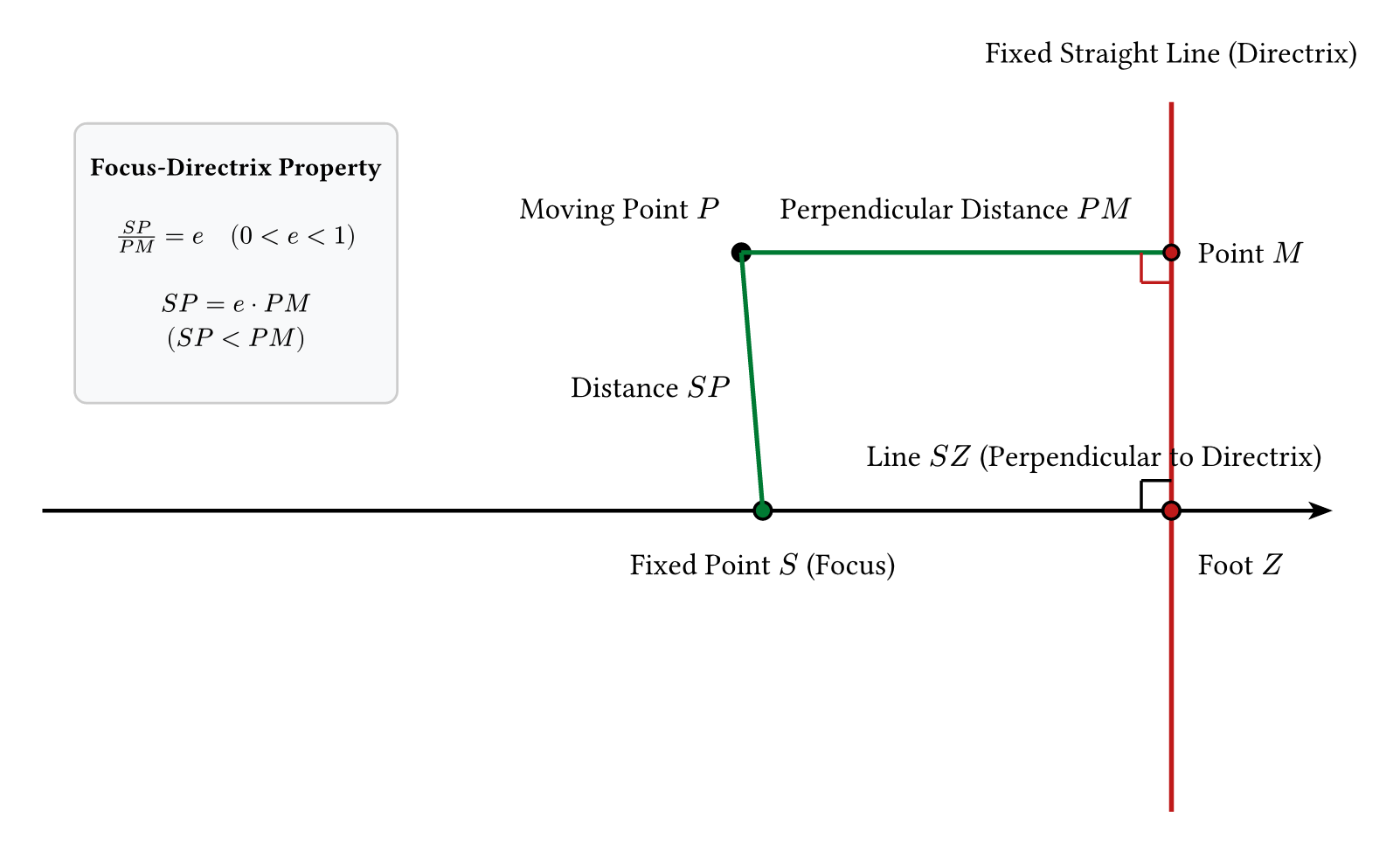
An ellipse is the locus of a point \(P\) moving in a plane such that the ratio of its distance from a fixed point \(S\) to its perpendicular distance from a fixed straight line is a constant \(e\), where \(0 < e < 1\).
- The fixed point \(S\) is called the focus.
- The fixed straight line is called the directrix.
- The constant ratio \(e\) is called the eccentricity (\(0 < e < 1\)).
If \(P\) is any point on the ellipse, and \(PM\) is the perpendicular drawn from \(P\) onto the directrix, then by definition:
Because \(e < 1\), the distance of any point on the ellipse from the focus is always strictly less than its perpendicular distance from the directrix:
An Example in an Arbitrary Coordinate System
To appreciate why a carefully chosen coordinate system is necessary, consider an ellipse whose focus and directrix are chosen arbitrarily in the plane.
Let the focus be the point \(S(1, 2)\), the directrix be the line \(x + 2y - 3 = 0\), and the eccentricity be \(e = \frac{1}{2}\).
Let \(P(x, y)\) be any point on this ellipse.
The distance between the point \(P(x, y)\) and the focus \(S(1, 2)\) is:
The perpendicular distance \(PM\) from \(P(x, y)\) to the directrix line \(x + 2y - 3 = 0\) is:
According to the focus-directrix definition:
Squaring both sides:
Substituting the expressions for \(SP\) and \(PM\):
Multiplying both sides by \(20\):
Expanding both sides:
Collecting all terms on the left-hand side:
This is the Cartesian equation of our ellipse.
Why Analyzing the General Equation is Difficult
Examining the equation obtained above:
we notice several complications:
- The Cross-Term (\(xy\)): The presence of \(-4xy\) indicates that the axes of symmetry of the ellipse are tilted at an angle to the \(x\)- and \(y\)-axes.
- The Linear Terms (\(x\) and \(y\)): The terms \(-34x\) and \(-68y\) indicate that the center of the ellipse is displaced away from the origin \((0, 0)\).
- Bulky Coefficients: Simple geometric quantities—such as the lengths of the axes, the coordinates of the center, the vertices, and the equations of tangents—are obscured by the coefficients.
The shape and geometric properties of an ellipse are intrinsic to the curve itself. They depend only on the relative positions of the focus and directrix and the value of \(e\), not on the coordinate axes chosen to describe them.
To study the geometric properties of the ellipse with clarity, we must choose a coordinate system whose origin and axes align with the natural symmetry of the curve.
Constructing the Standard Coordinate System
To obtain the simplest possible equation, we set up the coordinate axes using the intrinsic geometry of the curve.
The Axis Perpendicular to the Directrix
Let \(S\) be the fixed focus, and let the directrix be a fixed straight line placed on the right side.
From the focus \(S\), draw a straight line perpendicular to the directrix, meeting the directrix at the point \(Z\).
This line passing through \(S\) and \(Z\) is called the axis of the ellipse.
Locating the Vertices on the Axis
As a point \(P\) moves such that \(\frac{SP}{PM} = e\), consider where the curve cuts the straight line \(SZ\).
For any point lying on the line \(SZ\), the perpendicular distance to the directrix is measured directly along the line \(SZ\) to the point \(Z\). Therefore, a point on the line \(SZ\) belongs to the ellipse if and only if:
Because \(0 < e < 1\), the distance of such a point from \(S\) must be strictly less than its distance from \(Z\). There are two distinct points on the line \(SZ\) that satisfy this condition:
1. The Internal Division Point: Between \(S\) and \(Z\), there exists a unique point \(A\) dividing the segment \(SZ\) internally in the ratio \(e : 1\):
Because \(A\) satisfies the focus-directrix definition, the moving point \(P\) passes through \(A\).
2. The External Division Point: On the line \(SZ\), to the left of \(S\) (on the side away from \(Z\)), there exists a unique point \(A'\) dividing the segment \(SZ\) externally in the ratio \(e : 1\):
Because \(A'\) also satisfies the focus-directrix definition, the moving point \(P\) passes through \(A'\).
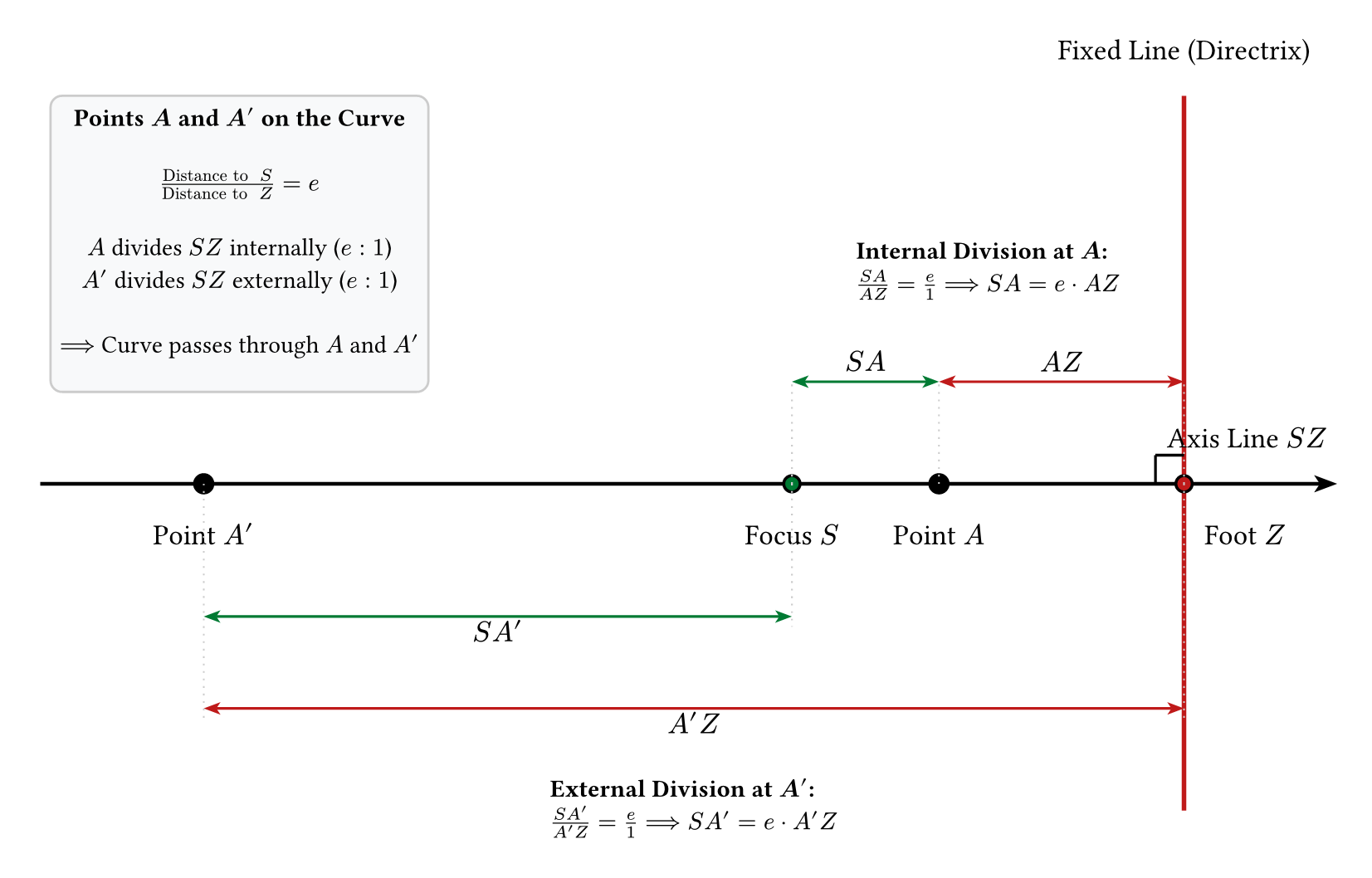
The points \(A\) and \(A'\) are called the vertices of the ellipse. The ellipse crosses its axis at these two points. The segment \(A'A\) is called the major axis.
Determining the Center and Distances
Let \(C\) be the midpoint of the segment \(A'A\). This point \(C\) is called the center of the ellipse.
Let the total length of the major axis \(A'A\) be \(2a\). Since \(C\) is the midpoint:
Along the line from left to right, the points lie in the order:
We can express the distances appearing in our division relations in terms of the distances from the center \(C\):
- \(SA = CA - CS = a - CS\)
- \(AZ = CZ - CA = CZ - a\)
- \(SA' = A'C + CS = a + CS\)
- \(A'Z = CZ + CA' = CZ + a\)
Substituting these expressions into the internal and external division equations:
To find \(CZ\), add the two equations:
Dividing both sides by \(2e\):
To find \(CS\), subtract the first equation from the second:
Dividing both sides by \(2\):
These two fundamental relations determine the exact positions of the focus and the directrix relative to the center \(C\):
Setting up the Coordinate Axes
With the positions of \(C\), \(S\), \(A\), \(A'\), and \(Z\) established, we define our coordinate system:
- Origin: Take the center \(C\) as the origin \((0, 0)\).
- \(x\)-axis: Take the line \(A'C S A Z\) as the \(x\)-axis, with the positive direction pointing from \(C\) towards the focus \(S\) and directrix foot \(Z\).
- \(y\)-axis: Take the straight line passing through \(C\) perpendicular to the \(x\)-axis as the \(y\)-axis.
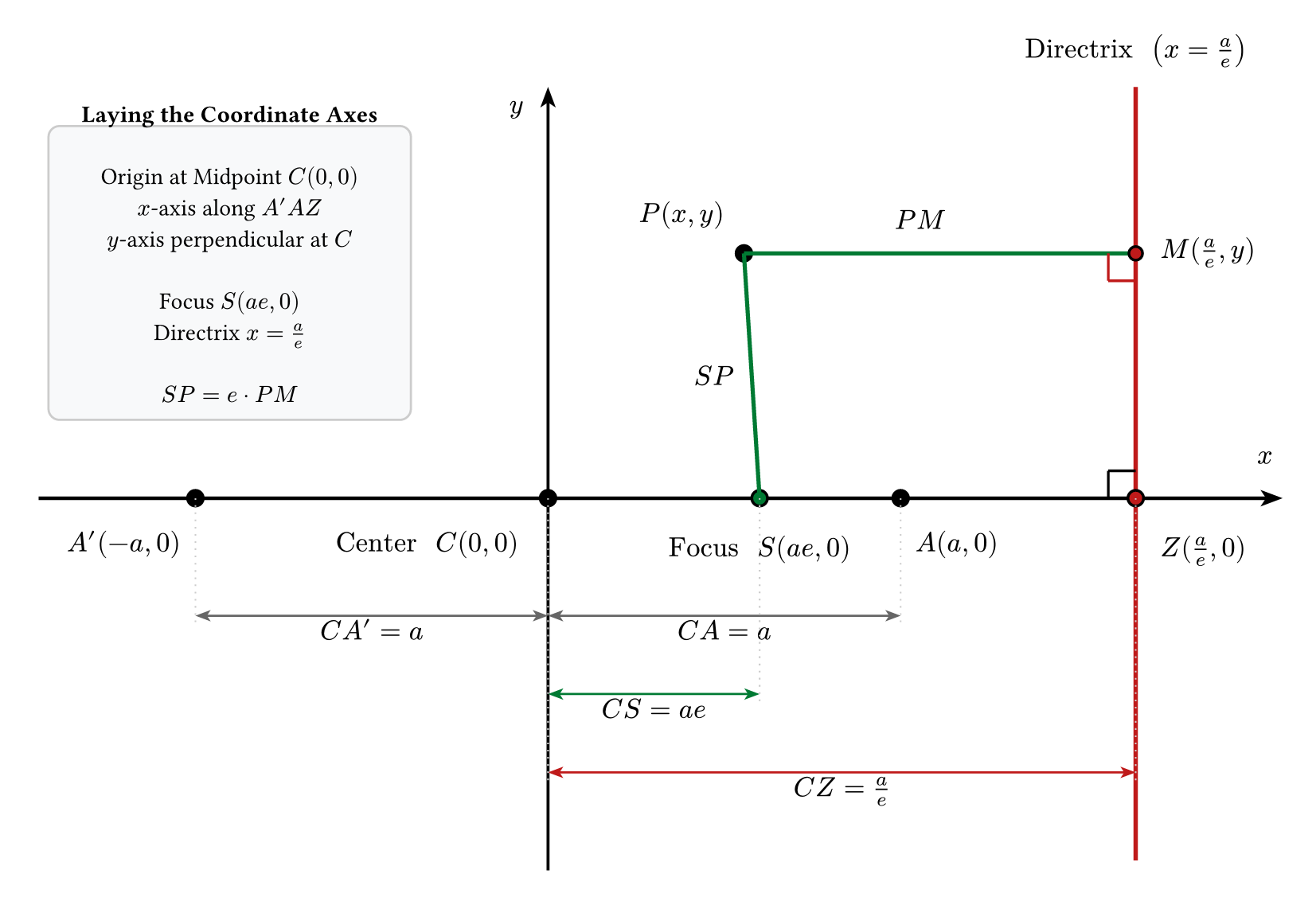
In this coordinate system, the coordinates of the points on the axis are:
- Center: \(C(0, 0)\)
- Vertices: \(A(a, 0)\) and \(A'(-a, 0)\)
- Focus: \(S(ae, 0)\)
- Directrix foot: \(Z\left(\frac{a}{e}, 0\right)\)
Because the directrix is perpendicular to the \(x\)-axis and passes through \(Z\left(\frac{a}{e}, 0\right)\), its equation is:
Derivation of the Standard Equation
Now let \(P(x, y)\) be any point on the ellipse in this coordinate system.
The distance of \(P(x, y)\) from the focus \(S(ae, 0)\) is:
The directrix is the vertical line \(x = \frac{a}{e}\), which can be written as \(x - \frac{a}{e} = 0\).
The perpendicular distance \(PM\) from \(P(x, y)\) to this vertical line is the horizontal distance between \(P(x, y)\) and the line:
By the focus-directrix definition of the ellipse:
Squaring both sides:
Substituting the expressions for \(SP\) and \(PM\):
Since \(\left|\frac{a}{e} - x\right|^2 = \left(\frac{a - ex}{e}\right)^2\):
Expanding the squares on both sides:
Notice that the cross-term \(-2aex\) appears on both sides with the same sign and cancels out:
Collecting the terms containing \(x^2\) on the left-hand side and constant terms on the right-hand side:
Factoring common terms:
Dividing the entire equation by \(a^2(1 - e^2)\):
Because \(0 < e < 1\), the quantity \(1 - e^2\) is strictly positive:
Therefore, \(a^2(1 - e^2)\) is a positive real quantity that is strictly less than \(a^2\). We denote this positive quantity by \(b^2\):
Substituting \(b^2\) into our equation gives the standard equation of an ellipse:
Symmetry and the Second Focus and Directrix
The standard equation of the ellipse reveals a remarkable symmetry that is not immediately obvious from the single focus-directrix definition.
Consider the equation:
Symmetry about the \(y\)-axis: Replacing \(x\) with \(-x\) leaves the equation unchanged:
The curve is symmetric about the \(y\)-axis.
Symmetry about the \(x\)-axis: Replacing \(y\) with \(-y\) leaves the equation unchanged:
The curve is symmetric about the \(x\)-axis.
Symmetry about the Origin: Replacing \((x, y)\) with \((-x, -y)\) leaves the equation unchanged:
The origin \(C(0, 0)\) is a center of symmetry for the curve.
The Second Focus and Directrix
Because the curve is completely symmetric with respect to the \(y\)-axis (\(x = 0\)), every feature that exists on the positive side of the \(x\)-axis has an exact counterpart on the negative side:
- Corresponding to the focus \(S(ae, 0)\) on the right, there exists a second focus \(S'(-ae, 0)\) on the left.
- Corresponding to the directrix \(x = \frac{a}{e}\) on the right, there exists a second directrix \(x = -\frac{a}{e}\) on the left.
If we had started our derivation using \(S'(-ae, 0)\) as the focus and \(x = -\frac{a}{e}\) as the directrix with the condition \(S'P = e \cdot PM'\), we would have arrived at the identical equation:
Every ellipse possesses two foci and two directrices:
Anatomy and Terminology of the Standard Ellipse
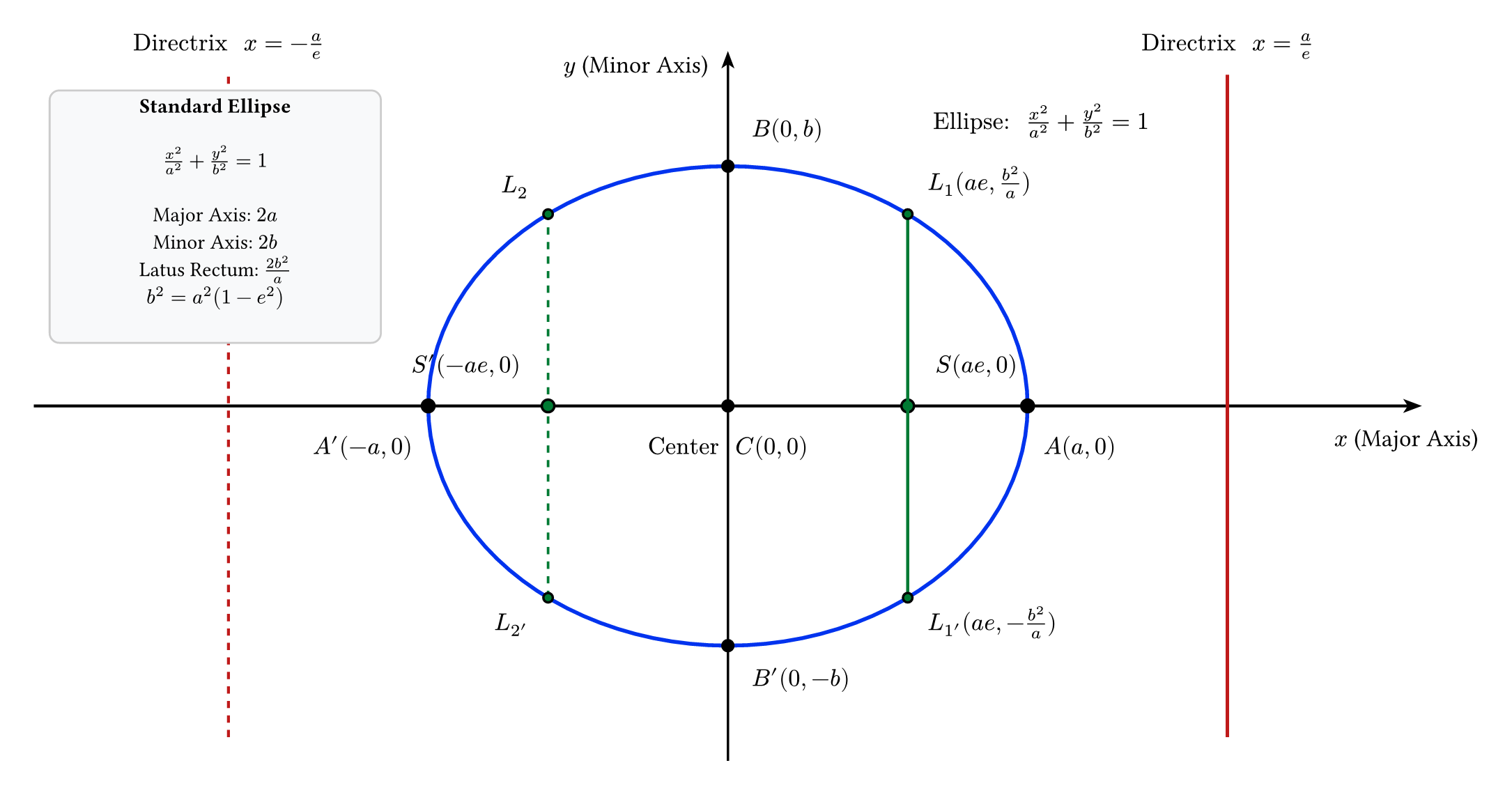
For the standard ellipse \(\frac{x^2}{a^2} + \frac{y^2}{b^2} = 1\) with \(a > b > 0\):
Center
The midpoint of the segment joining the two foci, or the midpoint of the segment joining the two vertices, is the center \(C(0, 0)\). Every chord passing through the center is bisected at the center.
Major Axis
The line segment joining the two vertices \(A(a, 0)\) and \(A'(-a, 0)\) is called the major axis.
- The major axis lies along the \(x\)-axis (\(y = 0\)).
- Its length is \(A'A = 2a\).
- The quantity \(a\) is called the semi-major axis.
Minor Axis
The line segment joining the points \(B(0, b)\) and \(B'(0, -b)\), where the ellipse crosses the \(y\)-axis, is called the minor axis.
- The minor axis lies along the \(y\)-axis (\(x = 0\)).
- Its length is \(B'B = 2b\).
- The quantity \(b\) is called the semi-minor axis.
Since \(b^2 = a^2(1 - e^2)\) and \(0 < e < 1\), we always have \(b < a\). The major axis is always longer than the minor axis.
Vertices
The points where the ellipse intersects its major axis are the vertices:
Eccentricity
From the defining relation \(b^2 = a^2(1 - e^2)\):
Distance Between Foci
The two foci are \(S(ae, 0)\) and \(S'(-ae, 0)\). The distance between them is:
Distance Between Directrices
The two directrices are \(x = \frac{a}{e}\) and \(x = -\frac{a}{e}\). The distance between them is:
Double Ordinates and the Latus Rectum
Double Ordinate
A chord of the ellipse perpendicular to the major axis (the \(x\)-axis) is called a double ordinate. If the abscissa of the chord is \(x_1\), its equation is \(x = x_1\), and its endpoints have coordinates \((x_1, y_1)\) and \((x_1, -y_1)\).
Latus Rectum
A double ordinate that passes through either focus is called a latus rectum of the ellipse.
Because there are two foci, \(S(ae, 0)\) and \(S'(-ae, 0)\), there are two latera recta:
- One passing through \(S(ae, 0)\), having the equation \(x = ae\).
- One passing through \(S'(-ae, 0)\), having the equation \(x = -ae\).
Length of the Latus Rectum
To find the length of the latus rectum, substitute \(x = ae\) into the equation of the ellipse:
Recall that \(b^2 = a^2(1 - e^2)\), which gives \(1 - e^2 = \frac{b^2}{a^2}\). Substituting this:
Taking the square root:
Therefore, the coordinates of the endpoints of the latus rectum through \(S(ae, 0)\) are:
Similarly, the endpoints of the latus rectum through \(S'(-ae, 0)\) are:
The length of the latus rectum is the distance between its endpoints:
The semi-latus rectum \(l\) is:
Using \(b^2 = a^2(1 - e^2)\), the length can also be written in terms of \(a\) and \(e\):
Focal Distances of a Point
A characteristic property of any point \(P(x_1, y_1)\) lying on the ellipse \(\frac{x^2}{a^2} + \frac{y^2}{b^2} = 1\) is the simple expression for its distances from the two foci.
Let \(M\) and \(M'\) be the feet of the perpendiculars from \(P(x_1, y_1)\) to the directrices \(x = \frac{a}{e}\) and \(x = -\frac{a}{e}\), respectively.
Distance from the right focus \(S(ae, 0)\):
By the focus-directrix definition:
Since \(M\) has coordinates \(\left(\frac{a}{e}, y_1\right)\) and \(x_1 \le a < \frac{a}{e}\):
Therefore:
Distance from the left focus \(S'(-ae, 0)\):
By the focus-directrix definition:
Since \(M'\) has coordinates \(\left(-\frac{a}{e}, y_1\right)\) and \(x_1 \ge -a > -\frac{a}{e}\):
Therefore:
Constant Sum of Focal Distances
Adding the two focal distances:
The sum of the distances of any point on the ellipse from the two foci is constant and equal to the length of the major axis (\(2a\)).
This provides an alternative, classical definition of an ellipse (known as the bifocal or gardener's definition): an ellipse is the locus of a point that moves such that the sum of its distances from two fixed points (the foci) is constant and greater than the distance between them.
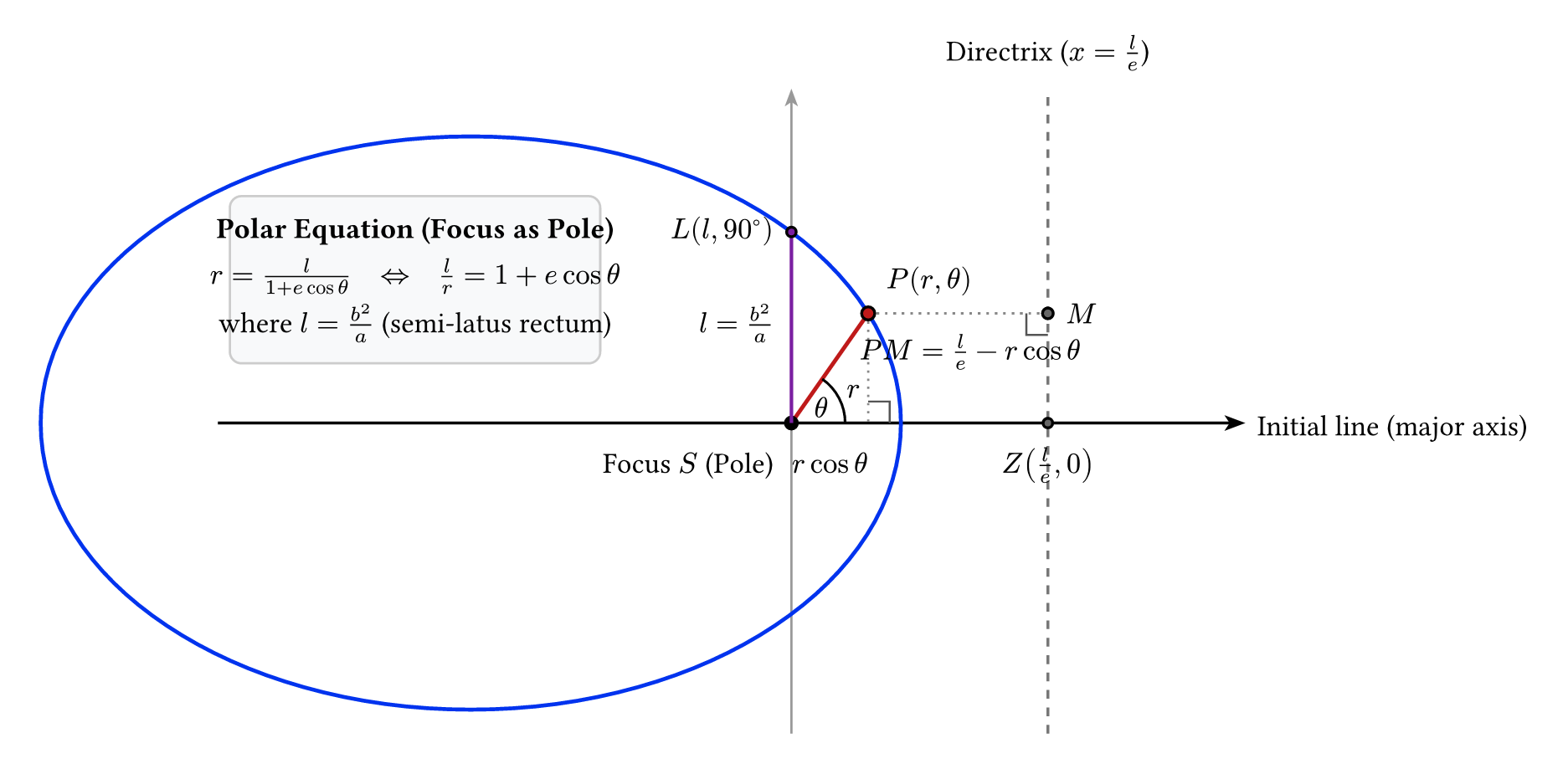
Polar Equation of an Ellipse with Focus as Pole
In Cartesian coordinates, choosing the center of the ellipse as the origin gives the balanced equation \(\frac{x^2}{a^2} + \frac{y^2}{b^2} = 1\).
However, in physics and celestial mechanics (such as Kepler's laws of planetary motion), the Sun or central gravitating body sits at a focus, not at the center. Planets move along an ellipse with the Sun at one focus. For problems involving orbits, focal radii, and focal chords, it is far more natural and powerful to place the origin (pole) directly at the focus.
Derivation from the Focus-Directrix Property
Let the focus \(S\) be taken as the pole \((0, 0)\), and let the positive major axis directed toward the nearer directrix be chosen as the initial line (polar axis).
Let \(P(r, \theta)\) be any point on the ellipse, where:
- \(r = SP\) is the focal distance from \(S\) to \(P\).
- \(\theta\) is the angle made by the radius vector \(SP\) with the positive major axis.
The distance from the focus \(S(ae, 0)\) to the corresponding directrix \(x = \frac{a}{e}\) is:
Recall that the semi-latus rectum \(l\) of an ellipse is:
Therefore, the distance \(d\) between the focus and its corresponding directrix can be written very neatly as:
From the point \(P(r, \theta)\), draw a perpendicular \(PM\) to the directrix.
The projection of the segment \(SP\) onto the initial line is \(r\cos\theta\). Looking at the geometry along the major axis:
Now apply the fundamental focus-directrix definition (\(SP = e \cdot PM\)):
Rearranging the terms:
Dividing by \(r\):
This is the standard polar equation of an ellipse with the focus as pole and the initial line directed toward the nearer directrix.
Alternative Orientations:
If the initial line is taken in the opposite direction (directed away from the nearer directrix), \(\theta\) is replaced by \(\pi - \theta\). Since \(\cos(\pi - \theta) = -\cos\theta\), the polar equation becomes:
More generally, if the major axis is inclined at an angle \(\alpha\) to the initial line, the equation is:
Key Properties and Physical Importance
The polar form reveals several remarkable geometric and physical insights:
Closest and Farthest Points from the Focus (Perihelion and Aphelion):
Since \(-1 \le \cos\theta \le 1\), the focal distance \(r\) varies between two extreme values:
Perihelion (Closest Approach):
Occurs when \(\theta = 0^\circ\) (\(\cos\theta = 1\)):
This is the distance from the focus to the nearest vertex \(A(a, 0)\). In astronomy, this point of closest approach to the Sun is called the perihelion.
Aphelion (Farthest Distance):
Occurs when \(\theta = 180^\circ\) (\(\cos\theta = -1\)):
This is the distance from the focus to the farthest vertex \(A'(-a, 0)\). In astronomy, this point is called the aphelion.
Adding the minimum and maximum distances gives the total major axis:
Semi-Latus Rectum as a Geometric Parameter:
When \(\theta = 90^\circ\) or \(270^\circ\), the radius vector is perpendicular to the major axis (\(\cos\theta = 0\)):
Thus, the semi-latus rectum \(l\) is simply the focal radius perpendicular to the major axis.
Harmonic Mean of Focal Chords:
A straight line passing through the focus at an inclination \(\theta\) intersects the ellipse at two opposite points: \(P\) at angle \(\theta\), and \(Q\) at angle \(\theta + \pi\).
Because \(\cos(\theta + \pi) = -\cos\theta\), their focal distances are:
Adding their reciprocals:
Notice that the angle \(\theta\) completely cancels out! This proves that the sum of the reciprocals of the segments of any focal chord is constant, meaning that the semi-latus rectum \(l\) is always the harmonic mean between the two segments of any focal chord.
A Unified Equation for All Conic Sections:
The equation \(\frac{l}{r} = 1 + e\cos\theta\) is not just for ellipses---it represents all conic sections with a focus as pole:
- When \(e = 0\): \(r = l\) (a circle with radius \(l\)).
- When \(0 < e < 1\): an ellipse.
- When \(e = 1\): \(r = \frac{l}{1 + \cos\theta}\) (a parabola).
- When \(e > 1\): a hyperbola.
This unified form allows physicists and mathematicians to study gravitational trajectories (bound elliptical orbits, parabolic escape paths, and hyperbolic flybys) using a single, elegant equation.
Illustrative Examples
Example 1: Finding the Standard Attributes of an Ellipse
Problem. For the ellipse \(9x^2 + 16y^2 = 144\), find:
- The lengths of the major and minor axes.
- The coordinates of the center and vertices.
- The eccentricity.
- The coordinates of the foci.
- The equations of the directrices.
- The length of the latus rectum.
Solution. Divide the given equation through by \(144\):
Comparing this with the standard form \(\frac{x^2}{a^2} + \frac{y^2}{b^2} = 1\):
Since \(a > b\), the major axis lies along the \(x\)-axis.
Lengths of Axes: The length of the major axis is \(2a = 2(4) = 8\). The length of the minor axis is \(2b = 2(3) = 6\).
Center and Vertices: The center is \(C(0, 0)\). The vertices are \(A(\pm a, 0) = (\pm 4, 0)\).
Eccentricity:
Foci:
The foci are \(S(\pm ae, 0) = (\pm \sqrt{7}, 0)\).
Directrices:
The equations of the directrices are \(x = \pm \frac{16}{\sqrt{7}}\).
Length of Latus Rectum:
Example 2: Finding the Equation from Given Geometric Conditions
Problem. Find the equation of the ellipse whose axes lie along the coordinate axes, whose distance between foci is \(8\), and whose distance between directrices is \(18\).
Solution. Let the equation of the ellipse be \(\frac{x^2}{a^2} + \frac{y^2}{b^2} = 1\) with \(a > b\).
The distance between the foci is given by:
The distance between the directrices is given by:
Multiplying these two relations:
Dividing the first relation by the second:
Now compute \(b^2\):
Substituting \(a^2 = 36\) and \(b^2 = 20\) into the standard form:
Example 3: Completing Squares to Find the Standard Form
Problem. Find the center, eccentricity, foci, and vertices of the ellipse:
Solution. Group terms in \(x\) and \(y\):
Complete the squares inside the parentheses:
Dividing through by \(36\):
Let \(X = x - 2\) and \(Y = y + 3\). The equation becomes:
Here \(a^2 = 9 \implies a = 3\), and \(b^2 = 4 \implies b = 2\).
Center: \(X = 0 \implies x - 2 = 0 \implies x = 2\). \(Y = 0 \implies y + 3 = 0 \implies y = -3\). The center is \((2, -3)\).
Eccentricity:
Foci: In the \((X, Y)\) system, the foci are \((\pm ae, 0) = (\pm \sqrt{5}, 0)\). For the right focus: \(X = \sqrt{5} \implies x = 2 + \sqrt{5}, \quad Y = 0 \implies y = -3\). For the left focus: \(X = -\sqrt{5} \implies x = 2 - \sqrt{5}, \quad Y = 0 \implies y = -3\). The foci are \((2 \pm \sqrt{5}, -3)\).
Vertices: In the \((X, Y)\) system, the vertices are \((\pm a, 0) = (\pm 3, 0)\). For the right vertex: \(X = 3 \implies x = 5, \quad Y = 0 \implies y = -3\). For the left vertex: \(X = -3 \implies x = -1, \quad Y = 0 \implies y = -3\). The vertices are \((5, -3)\) and \((-1, -3)\).
Summary of Key Results
| Feature / Quantity | Formula / Value | Geometric Description |
|---|---|---|
| Standard Equation | \(\frac{x^2}{a^2} + \frac{y^2}{b^2} = 1\) (\(a > b\)) | Symmetrical about both axes, centered at \((0, 0)\) |
| Relation Between Parameters | \(b^2 = a^2(1 - e^2)\) | Defines semi-minor axis \(b\) (\(b < a\)) |
| Eccentricity | \(e = \sqrt{1 - \frac{b^2}{a^2}} < 1\) | Ratio \(SP/PM\) for any point on the curve |
| Center | \(C(0, 0)\) | Midpoint of major and minor axes |
| Vertices | \(A(a, 0)\) and \(A'(-a, 0)\) | Points where the ellipse crosses the major axis |
| Foci | \(S(ae, 0)\) and \(S'(-ae, 0)\) | Two fixed points of the focus-directrix property |
| Directrices | \(x = \frac{a}{e}\) and \(x = -\frac{a}{e}\) | Two fixed lines of the focus-directrix property |
| Length of Major Axis | \(2a\) | Length of the segment \(A'A\) along the \(x\)-axis |
| Length of Minor Axis | \(2b\) | Length of the segment \(B'B\) along the \(y\)-axis |
| Distance Between Foci | \(2ae\) | Distance between \(S\) and \(S'\) |
| Distance Between Directrices | \(\frac{2a}{e}\) | Distance between the two directrix lines |
| Endpoints of Latus Rectum | \(\left(\pm ae, \pm \frac{b^2}{a}\right)\) | Coordinates of the 4 extremities of latera recta |
| Length of Latus Rectum | \(\frac{2b^2}{a} = 2a(1 - e^2)\) | Total length of the focal chord perpendicular to major axis |
| Focal Distances of \(P(x_1, y_1)\) | \(SP = a - ex_1, \quad S'P = a + ex_1\) | Distances from the two foci to any point on the curve |
| Sum of Focal Distances | \(SP + S'P = 2a\) | Constant sum equal to the major axis length |
| Polar Equation (Focus as Pole) | \(\frac{l}{r} = 1 + e\cos\theta\) | Origin at focus \(S\), \(l = \frac{b^2}{a}\) (semi-latus rectum) |