Focal Distances and Focal Chords of an Ellipse
In earlier chapters, we defined an ellipse using a focus and a directrix (\(SP = e \cdot PM\)). An ellipse also possesses a second fundamental definition based entirely on its two foci:
The sum of the distances of any point on an ellipse from its two foci is always constant and equal to the length of the major axis:
This two-focus property is very practical—it is the principle behind the simple pins-and-string method used to draw an ellipse, and it is fundamental in physics and astronomy for describing planetary orbits.
In this chapter, we will:
- Derive the formulas for the focal distances \(SP\) and \(S'P\) of any point on the ellipse, and prove that their sum is always \(2a\).
- Prove the converse theorem: if a point moves such that the sum of its distances from two fixed points \(A\) and \(B\) is constant (\(PA + PB = 2k\), where \(AB < 2k\)), its path is always an ellipse.
- Study focal chords: their parametric equations, the relationship between the eccentric angles of their endpoints, their lengths, and the harmonic mean property of focal segments.
Focal Distances of a Point on the Ellipse
Consider the standard horizontal ellipse with center at the origin:
where \(b^2 = a^2(1 - e^2)\) and \(e = \sqrt{1 - \frac{b^2}{a^2}} \in (0, 1)\).
The ellipse has two foci:
and two corresponding directrices:
Definition of Focal Distance
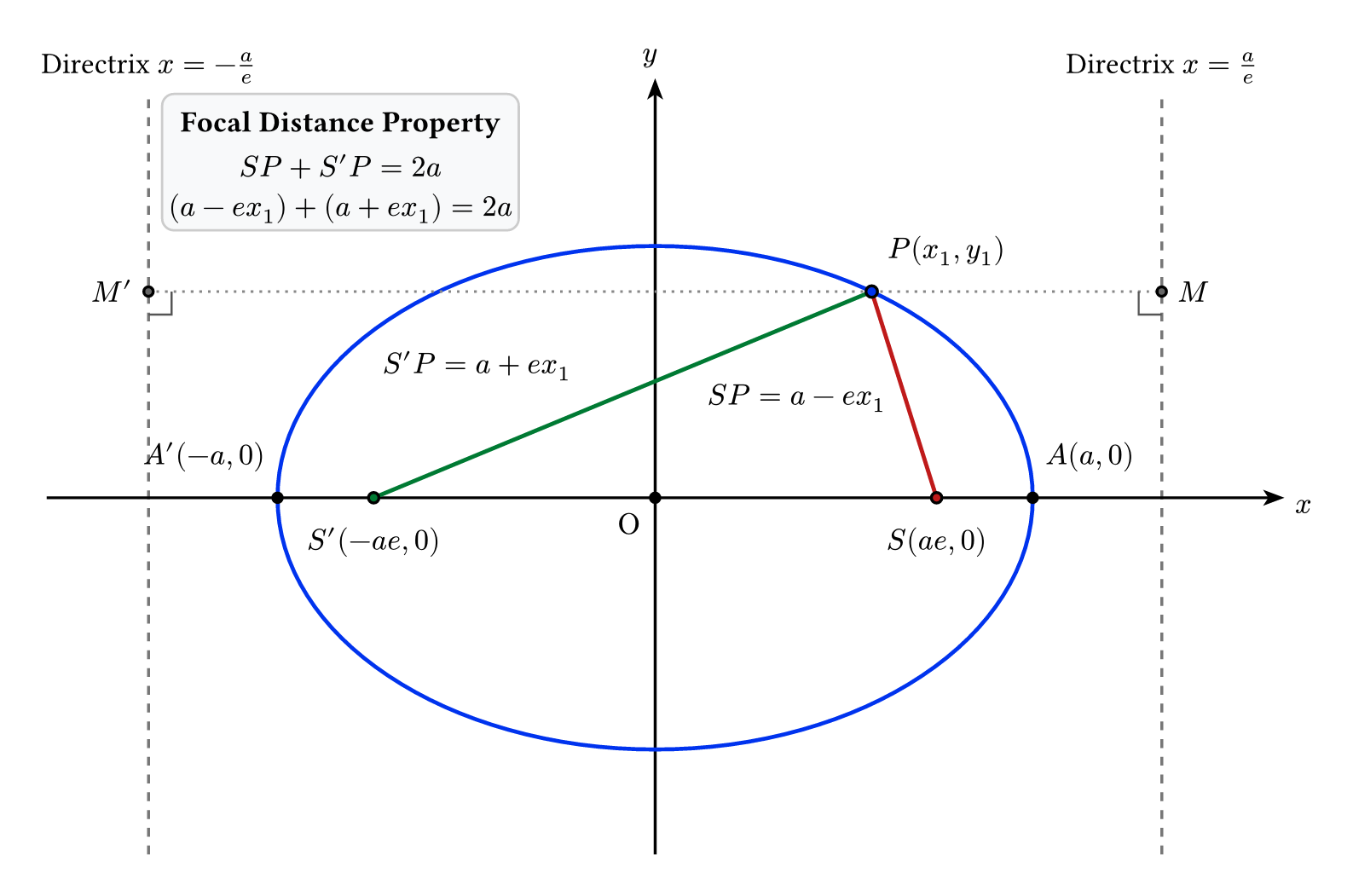
The distance from any point \(P(x_1, y_1)\) on the ellipse to a focus is called a focal distance (or focal radius).
Because there are two foci, every point \(P\) has two focal distances:
- \(SP\): the distance from \(P\) to the right-hand focus \(S(ae, 0)\).
- \(S'P\): the distance from \(P\) to the left-hand focus \(S'(-ae, 0)\).
Derivation Using the Focus-Directrix Property
Let \(P(x_1, y_1)\) be any point on the ellipse. Draw perpendiculars from \(P\) to both directrices:
- Let \(M\) be the foot of the perpendicular from \(P\) to the right directrix \(x = \frac{a}{e}\).
- Let \(M'\) be the foot of the perpendicular from \(P\) to the left directrix \(x = -\frac{a}{e}\).
Since \(P(x_1, y_1)\) lies on the ellipse, its \(x\)-coordinate satisfies \(-a \le x_1 \le a\). Since \(0 < e < 1\), we have \(\frac{a}{e} > a\). Both directrices lie strictly outside the ellipse:
The perpendicular distance from \(P(x_1, y_1)\) to the right directrix \(x = \frac{a}{e}\) is:
By the focus-directrix definition (\(SP = e \cdot PM\)):
Similarly, the perpendicular distance from \(P(x_1, y_1)\) to the left directrix \(x = -\frac{a}{e}\) is:
Using the focus-directrix property with respect to \(S'(-ae, 0)\) (\(S'P = e \cdot PM'\)):
Thus, we obtain two simple formulas for the focal distances in terms of the \(x\)-coordinate of \(P\):
Verification Using the Distance Formula
We can also verify these formulas directly using the standard distance formula between two Cartesian points.
The squared distance from \(P(x_1, y_1)\) to \(S(ae, 0)\) is:
Since \(P(x_1, y_1)\) lies on the ellipse \(\frac{x_1^2}{a^2} + \frac{y_1^2}{b^2} = 1\), we have:
Substitute \(b^2 = a^2(1 - e^2)\):
Substitute this expression for \(y_1^2\) into \(SP^2\):
The terms \(x_1^2\) and \(a^2 e^2\) cancel out:
Because \(-a \le x_1 \le a\) and \(0 < e < 1\), the product \(|e x_1| < a\), so the quantity \(a - e x_1\) is strictly positive. Taking the square root:
Following the exact same algebra for \(S'(-ae, 0)\):
The Constant Sum of Focal Distances
Now, add the two focal distances together:
The variable coordinate \(x_1\) cancels out completely. This proves the fundamental theorem:
Theorem. The sum of the focal distances of any point on an ellipse is constant and equal to the length of the major axis (\(2a\)).
Difference of Focal Distances:
Subtracting the two focal distances:
Since \(-a \le x_1 \le a\), the difference satisfies:
Notice that:
- At the ends of the minor axis (\(x_1 = 0\)), \(SP = S'P = a\), so the difference is zero.
- At the vertices \((\pm a, 0)\), the difference reaches its maximum value of \(2ae\), which is the distance between the two foci \(SS'\).
Focal Distances for a Vertical Ellipse
For a vertical ellipse where the major axis lies along the \(y\)-axis:
the eccentricity is \(e = \sqrt{1 - \frac{a^2}{b^2}}\), the foci are \(S(0, be)\) and \(S'(0, -be)\), and the directrices are \(y = \pm \frac{b}{e}\).
For any point \(P(x_1, y_1)\) on this ellipse, the focal distances depend on the \(y\)-coordinate:
Their sum is constant and equal to the length of the major axis (\(2b\)):
Drawing an Ellipse: The Pins-and-String Method
The constant-sum property \(SP + S'P = 2a\) gives us an easy, practical way to draw a perfect ellipse:
- Fix two pins into a board at the focus positions \(S\) and \(S'\), separated by distance \(2c = 2ae\).
- Tie a piece of non-elastic string of length \(2a\) between the two pins.
- Place a pencil tip at \(P\) and pull the string taut so that it forms a triangle with base \(SS'\).
- Keeping the string tight, move the pencil around. The tip traces out an ellipse with foci \(S, S'\) and major axis \(2a\).
The Two-Focus Definition (The Converse Theorem)
We have just proven that every point on an ellipse satisfies \(SP + S'P = 2a\).
Now let us ask the reverse question:
If a point \(P\) moves in a plane such that the sum of its distances from two fixed points \(A\) and \(B\) is always constant (\(2k\)), does \(P\) always trace out an ellipse?
The answer is yes, provided that the constant sum is greater than the distance between the two fixed points (\(2k > AB\)).
Statement of the Converse Theorem
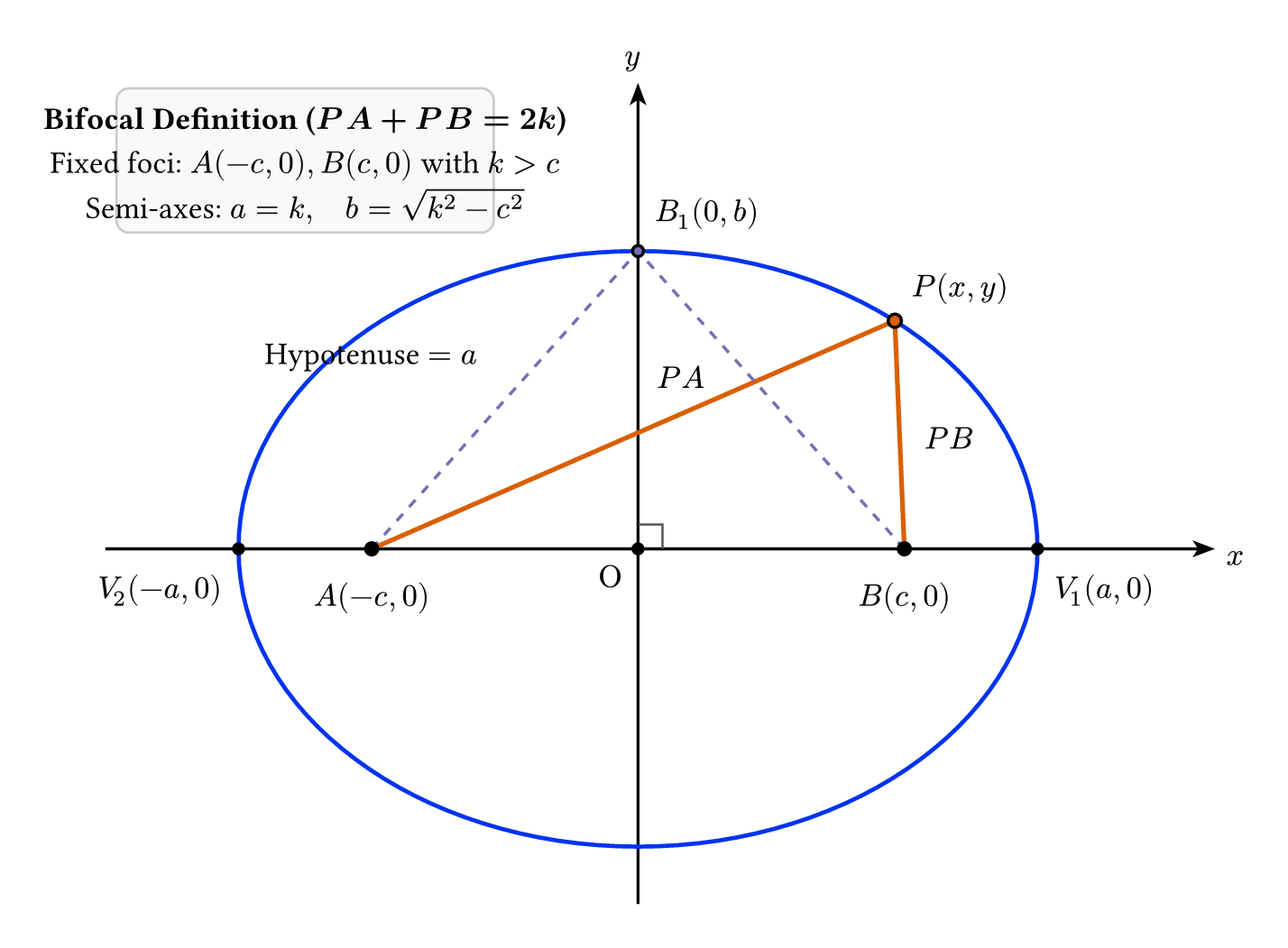
Theorem. Let \(A\) and \(B\) be two fixed points in a plane separated by distance \(AB = 2c\), and let \(k\) be a constant such that \(k > c\) (that is, \(2k > AB\)). If a point \(P\) moves such that
then the locus of \(P\) is an ellipse whose foci are \(A\) and \(B\), whose center is the midpoint of \(AB\), whose semi-major axis is \(a = k\), and whose semi-minor axis is \(b = \sqrt{k^2 - c^2}\).
Step-by-Step Proof
To keep the algebra simple, choose coordinate axes based on the positions of \(A\) and \(B\):
- Place the origin \(O(0, 0)\) at the midpoint of the segment \(AB\).
- Choose the straight line passing through \(A\) and \(B\) as the \(x\)-axis.
- Choose the perpendicular bisector of \(AB\) through \(O\) as the \(y\)-axis.
Since the total distance between \(A\) and \(B\) is \(2c\), the coordinates of the two fixed points are:
Let \(P(x, y)\) be any point on the path. The distances \(PA\) and \(PB\) are:
The condition \(PA + PB = 2k\) gives the equation:
To remove the square roots, isolate one radical on the right side:
Square both sides:
Expand the squared terms:
Cancel the common terms \(x^2\), \(c^2\), and \(y^2\) from both sides:
Rearrange to bring the square root to the left side:
Divide both sides by \(4\):
Square both sides a second time to remove the remaining square root:
Expand both sides:
Cancel the term \(2k^2 cx\) from both sides:
Collect the variable terms (\(x\) and \(y\)) on the left side, and the constants on the right side:
Factor \(k^2\) on the right side:
Since \(2k > AB = 2c\), we have \(k > c > 0\), so \(k^2 - c^2\) is strictly positive:
Let us define:
Substitute \(a^2\) and \(b^2\) into the equation:
Divide both sides by \(a^2 b^2\):
This is the standard equation of an ellipse centered at \((0, 0)\) with semi-major axis \(a = k\) and semi-minor axis \(b = \sqrt{k^2 - c^2}\).
The eccentricity is:
Since \(c < k\), we have \(0 < e < 1\). The foci are located at \((\pm ae, 0) = (\pm c, 0)\), which are precisely the initial fixed points \(B\) and \(A\).
Special and Limiting Cases
Why is the condition \(2k > AB\) necessary?
In any triangle \(\triangle PAB\), the sum of any two sides must be greater than or equal to the third side:
Let us examine what happens when we test the boundaries of this condition:
Case 1: When \(2k = AB\) (\(k = c\)):
The condition becomes \(PA + PB = AB\). Geometrically, this means \(P\) cannot form a triangle with \(A\) and \(B\); the point \(P\) must lie directly on the line segment connecting \(A\) and \(B\).
Algebraically, setting \(k = c\) in \((k^2 - c^2)x^2 + k^2 y^2 = k^2(k^2 - c^2)\) gives:
The locus is simply the flat line segment \(AB\).
Case 2: When \(2k < AB\) (\(k < c\)):
By the triangle inequality, the sum of distances from \(P\) to \(A\) and \(B\) cannot be less than the direct distance \(AB\).
No real point in the plane can satisfy \(PA + PB < AB\). The locus is therefore empty (no real curve exists).
Focal Chords of an Ellipse
A chord of an ellipse is a straight line joining any two points on the curve.
Definition of a Focal Chord
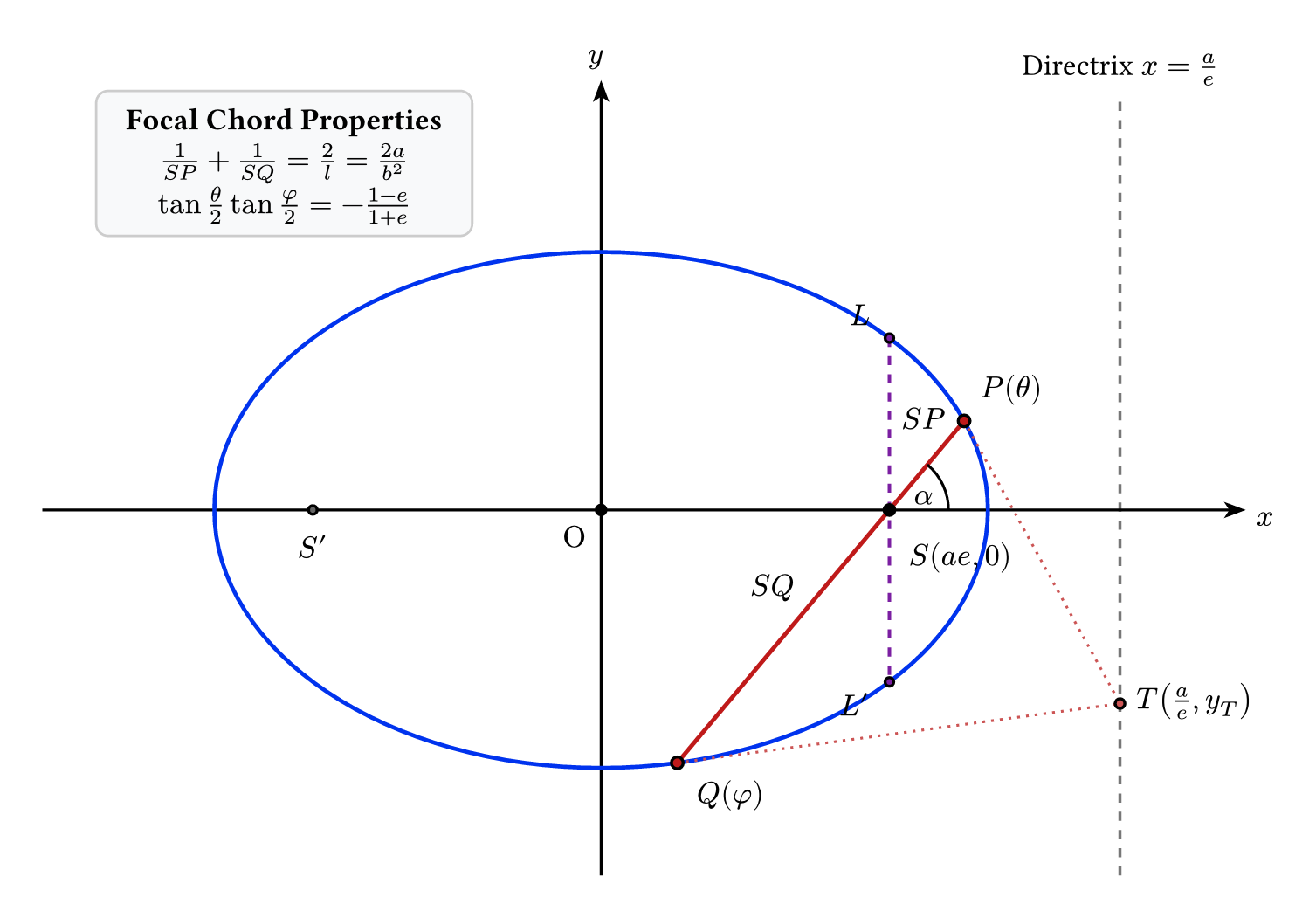
Any chord of an ellipse that passes through either of its foci is called a focal chord.
An ellipse has two families of focal chords:
- Chords passing through the right-hand focus \(S(ae, 0)\).
- Chords passing through the left-hand focus \(S'(-ae, 0)\).
When a focal chord is perpendicular to the major axis, it is the latus rectum.
Parametric Condition for a Focal Chord
Let \(P(a\cos\theta, b\sin\theta)\) and \(Q(a\cos\phi, b\sin\phi)\) be two points on the ellipse \(\frac{x^2}{a^2} + \frac{y^2}{b^2} = 1\), with eccentric angles \(\theta\) and \(\phi\).
From Tutorial 03, the equation of the chord joining \(P(\theta)\) and \(Q(\phi)\) is:
We now find the condition on \(\theta\) and \(\phi\) for this chord to pass through each focus.
Chord Passing Through the Positive Focus
If the chord passes through the positive focus \(S(ae, 0)\), substitute \(x = ae\) and \(y = 0\) into the chord equation:
Write this as a ratio:
Apply componendo and dividendo:
Using the standard trigonometric product formulas:
- \(\cos(A - B) - \cos(A + B) = 2\sin A \sin B\)
- \(\cos(A - B) + \cos(A + B) = 2\cos A \cos B\)
with \(A = \frac{\theta}{2}\) and \(B = \frac{\phi}{2}\):
This is the condition connecting the eccentric angles of the two endpoints of any focal chord passing through \(S(ae, 0)\).
Chord Passing Through the Negative Focus
If the chord passes through the negative focus \(S'(-ae, 0)\), substitute \(x = -ae\) and \(y = 0\):
Applying componendo and dividendo:
Comparison with the Parabola:
Recall that for a parabola \(y^2 = 4ax\), if a focal chord connects points with parameters \(t_1\) and \(t_2\), we have:
For an ellipse, the quantities \(\tan\frac{\theta}{2}\) and \(\tan\frac{\phi}{2}\) play the exact same role as \(t_1\) and \(t_2\). Their product is a constant determined entirely by the eccentricity \(e\).
Key Theorems on Focal Chords
Theorem 1: Harmonic Mean Property of Focal Segments
Let a focal chord of an ellipse pass through the focus \(S\), dividing the chord into two segments \(SP\) and \(SQ\).
Theorem. The semi-latus rectum \(l = \frac{b^2}{a}\) of an ellipse is the harmonic mean of the two segments \(SP\) and \(SQ\) of any focal chord:
Proof Using Polar Coordinates
The cleanest proof uses the polar form of the ellipse with the focus \(S\) as the origin (pole), which we derived in Tutorial 01.
Recall that the distance \(r\) from the focus to any point on the ellipse inclined at an angle \(\alpha\) to the major axis is:
where \(\alpha\) is the angle made with the initial line, and \(l = \frac{b^2}{a}\) is the semi-latus rectum.
Let \(PSQ\) be any focal chord inclined at angle \(\alpha\) to the major axis.
Focal segment \(SP\): The point \(P\) corresponds to angle \(\alpha\), so:
Focal segment \(SQ\): The point \(Q\) lies in the opposite direction, corresponding to angle \(\alpha + \pi\). Since \(\cos(\alpha + \pi) = -\cos\alpha\):
Now take the reciprocals of both focal segments:
Add these two equations:
Substitute \(l = \frac{b^2}{a}\):
Notice that the angle \(\alpha\) has canceled out completely.
This means that no matter what direction the focal chord points, the sum of the reciprocals \(\frac{1}{SP} + \frac{1}{SQ}\) is always constant and equal to \(\frac{2}{l}\). Therefore, the semi-latus rectum \(l\) is the harmonic mean of the two segments \(SP\) and \(SQ\).
Theorem 2: Length of a Focal Chord
Let \(PSQ\) be a focal chord passing through \(S\) inclined at an angle \(\alpha\) to the major axis.
The total length of the chord is the sum of its two focal segments:
Using the polar expressions for \(SP\) and \(SQ\):
Combine the fractions:
Substitute \(l = \frac{b^2}{a}\):
Maximum and Minimum Lengths:
Since \(0 \le \cos^2\alpha \le 1\), we can immediately find the extremal lengths of any focal chord:
Minimum Length (The Latus Rectum):
The denominator is largest when \(\cos^2\alpha = 0\), which occurs when \(\alpha = 90^\circ\) (chord perpendicular to the major axis):
The shortest focal chord of an ellipse is its latus rectum.
Maximum Length (The Major Axis):
The denominator is smallest when \(\cos^2\alpha = 1\), which occurs when \(\alpha = 0^\circ\) (chord along the major axis):
Since \(b^2 = a^2(1 - e^2)\), this simplifies to:
The longest focal chord of an ellipse is the major axis itself.
Thus, the length of any focal chord \(PQ\) always lies between the latus rectum and the major axis:
Theorem 3: Intersection of Tangents at the Ends of a Focal Chord
Theorem. The tangents drawn at the two ends of any focal chord intersect on the corresponding directrix.
Proof
Let \(P(\theta)\) and \(Q(\phi)\) be the endpoints of a focal chord passing through \(S(ae, 0)\).
The equations of the tangents at \(P\) and \(Q\) are:
The point of intersection \(T(x_0, y_0)\) of these two tangents has coordinates:
Since \(PQ\) is a focal chord passing through \(S(ae, 0)\), we know from earlier that:
Substitute this ratio directly into \(x_0\):
The \(x\)-coordinate of the intersection point is always \(\frac{a}{e}\), which does not depend on \(\theta\) or \(\phi\).
Since \(x = \frac{a}{e}\) is the directrix corresponding to the focus \(S(ae, 0)\), the intersection point \(T\) always lies on this directrix.
Similarly, tangents drawn at the ends of a focal chord through \(S'(-ae, 0)\) intersect on the directrix \(x = -\frac{a}{e}\).
Summary of Key Results
| Concept | Mathematical Formula | Notes |
|---|---|---|
| Focal Distances (\(a > b\)) | \(SP = a - ex_1, \quad S'P = a + ex_1\) | Distances from \(P(x_1, y_1)\) to foci \((\pm ae, 0)\) |
| Sum of Focal Distances | \(SP + S'P = 2a\) | Constant, equals the length of major axis |
| Difference of Focal Distances | \(\|S'P - SP\| = 2e\|x_1\|\) | Equals \(0\) at minor axis, \(2ae\) at vertices |
| Two-Focus Locus Condition | \(PA + PB = 2k \quad (2k > AB)\) | Gives an ellipse with \(a = k, b = \sqrt{k^2 - c^2}\) |
| Focal Chord through \(S(ae, 0)\) | \(\tan\frac{\theta}{2}\tan\frac{\phi}{2} = -\frac{1 - e}{1 + e}\) | Product of half-angle tangents of endpoints |
| Focal Chord through \(S'(-ae, 0)\) | \(\tan\frac{\theta}{2}\tan\frac{\phi}{2} = -\frac{1 + e}{1 - e}\) | Product of half-angle tangents of endpoints |
| Harmonic Mean Property | \(\frac{1}{SP} + \frac{1}{SQ} = \frac{2a}{b^2} = \frac{2}{l}\) | Semi-latus rectum is the harmonic mean of \(SP\) and \(SQ\) |
| Length of a Focal Chord | \(PQ = \frac{2b^2}{a(1 - e^2\cos^2\alpha)}\) | Inclined at angle \(\alpha\) to the major axis |
Illustrative Examples
Example 1: Calculating Focal Distances
Find the focal distances of the point \(P\left(2, \frac{5}{3}\right)\) on the ellipse \(5x^2 + 9y^2 = 45\).
Solution:
Write the ellipse in standard form by dividing both sides by \(45\):
Here, \(a^2 = 9 \implies a = 3\), and \(b^2 = 5 \implies b = \sqrt{5}\).
Check that \(P\left(2, \frac{5}{3}\right)\) lies on the ellipse:
The eccentricity \(e\) is:
The foci are at \((\pm ae, 0) = \left(\pm 3 \cdot \frac{2}{3}, 0\right) = (\pm 2, 0)\).
Using the focal distance formulas with \(x_1 = 2\):
Check the sum of the focal distances:
which matches \(2(3) = 6\) exactly.
Example 2: Finding an Ellipse Equation from Foci and String Length
A point \(P\) moves such that the sum of its distances from two fixed points \(A(-4, 0)\) and \(B(4, 0)\) is always equal to \(10\). Find the equation of the path traced by \(P\), its eccentricity, and the lengths of its axes.
Solution:
The two fixed points are \(A(-4, 0)\) and \(B(4, 0)\). The distance between them is:
The constant sum of distances is:
Since \(2k = 10 > AB = 8\), the converse theorem guarantees that the path is an ellipse.
Because the midpoint of \(AB\) is the origin \((0, 0)\) and \(AB\) lies along the \(x\)-axis, the equation has standard horizontal form:
From the theorem, the semi-major axis is \(a = k = 5\), and the focal distance is \(c = 4\).
The semi-minor axis \(b\) is:
Thus, the equation of the ellipse is:
The eccentricity is:
The length of the major axis is \(2a = 10\), and the length of the minor axis is \(2b = 6\).
Example 3: Finding the Other Endpoint of a Focal Chord
One endpoint of a focal chord of the ellipse \(\frac{x^2}{25} + \frac{y^2}{16} = 1\) passing through the positive focus has eccentric angle \(\theta = \frac{\pi}{3}\). Find the eccentric angle and coordinates of the other endpoint.
Solution:
Here, \(a^2 = 25 \implies a = 5\), and \(b^2 = 16 \implies b = 4\).
The eccentricity is:
The chord passes through the positive focus \(S(ae, 0) = (3, 0)\).
The relation between the eccentric angles \(\theta\) and \(\phi\) of the endpoints of a focal chord through \(S\) is:
Given \(\theta = \frac{\pi}{3}\), we have \(\frac{\theta}{2} = \frac{\pi}{6}\), so:
Substitute \(e = \frac{3}{5}\):
Therefore:
To find the coordinates of the other endpoint \(Q(a\cos\phi, b\sin\phi)\), use the half-angle formulas:
The coordinates of the second endpoint \(Q\) are:
Thus, \(Q = \left(\frac{65}{19}, -\frac{32\sqrt{3}}{19}\right)\).
Example 4: Applying the Harmonic Mean Property
For the ellipse \(\frac{x^2}{100} + \frac{y^2}{64} = 1\), a focal chord through \(S(ae, 0)\) has one segment of length \(SP = 4\). Find the length of the other segment \(SQ\) and the total length of the chord.
Solution:
From the ellipse equation, \(a^2 = 100 \implies a = 10\), and \(b^2 = 64 \implies b = 8\).
The semi-latus rectum is:
By the harmonic mean property of focal segments:
Substitute \(SP = 4\) and \(\frac{2a}{b^2} = \frac{2(10)}{64} = \frac{20}{64} = \frac{5}{16}\):
The total length of the focal chord is:
Example 5: Finding the Length of a Focal Chord from its Inclination
Find the length of the focal chord of the ellipse \(\frac{x^2}{36} + \frac{y^2}{20} = 1\) that makes an angle of \(60^\circ\) with the major axis.
Solution:
Here, \(a^2 = 36\) and \(b^2 = 20\), which gives \(a = 6\).
The eccentricity is:
The inclination of the chord is \(\alpha = 60^\circ\). Therefore:
Use the formula for the length of a focal chord:
Calculate the denominator:
Substitute into the formula:
The length of the focal chord is \(\frac{15}{2}\).
Example 6: Locus of the Incenter of a Focal Triangle
If \(P\) is a variable point on the ellipse \(\frac{x^2}{a^2} + \frac{y^2}{b^2} = 1\) with foci \(S\) and \(S'\), find the locus of the incenter of triangle \(\triangle SPS'\).
Solution:
Let \(P(x_1, y_1) = (a\cos\theta, b\sin\theta)\) be any point on the ellipse.
The three vertices of triangle \(\triangle SPS'\) are:
- \(S(c, 0)\), where \(c = ae\)
- \(S'(-c, 0)\)
- \(P(x_1, y_1)\)
The lengths of the sides opposite these three vertices are:
- Opposite \(P\): the distance between the foci, \(a_P = SS' = 2c = 2ae\).
- Opposite \(S\): the focal distance \(a_S = S'P = a + ex_1\).
- Opposite \(S'\): the focal distance \(a_{S'} = SP = a - ex_1\).
The perimeter of \(\triangle SPS'\) is:
Let \(I(x, y)\) be the incenter of \(\triangle SPS'\). Using the standard incenter formula:
Expand the numerator:
Divide by the perimeter \(2a(1 + e)\):
Now find the \(y\)-coordinate of the incenter:
Since \(y_S = 0\) and \(y_{S'} = 0\):
Since \(P(x_1, y_1)\) lies on the ellipse \(\frac{x_1^2}{a^2} + \frac{y_1^2}{b^2} = 1\), substitute \(x_1\) and \(y_1\):
This locus is another ellipse centered at the origin, with semi-major axis \(ae\) and semi-minor axis \(\frac{be}{1 + e}\).