Auxiliary Circle and Parametric Equation of Ellipse
The standard Cartesian equation of an ellipse, \(\frac{x^2}{a^2} + \frac{y^2}{b^2} = 1\), expresses the coordinates \(x\) and \(y\) implicitly. While powerful for algebraic analysis, studying geometric properties such as chords, tangents, areas, and loci is often far more tractable when the position of any point on the ellipse can be expressed using a single real parameter.
Because \(\cos^2 \theta + \sin^2 \theta = 1\), trigonometric parameterization arises naturally. However, the parameter \(\theta\) is not merely an algebraic device—it possesses a precise geometric construction based on a companion curve known as the auxiliary circle.
The Auxiliary Circle
Consider the standard horizontal ellipse:
The major axis of this ellipse is the segment \(A'A\) joining the vertices \(A'(-a, 0)\) and \(A(a, 0)\), having length \(2a\) and center at the origin \(C(0, 0)\).
Definition
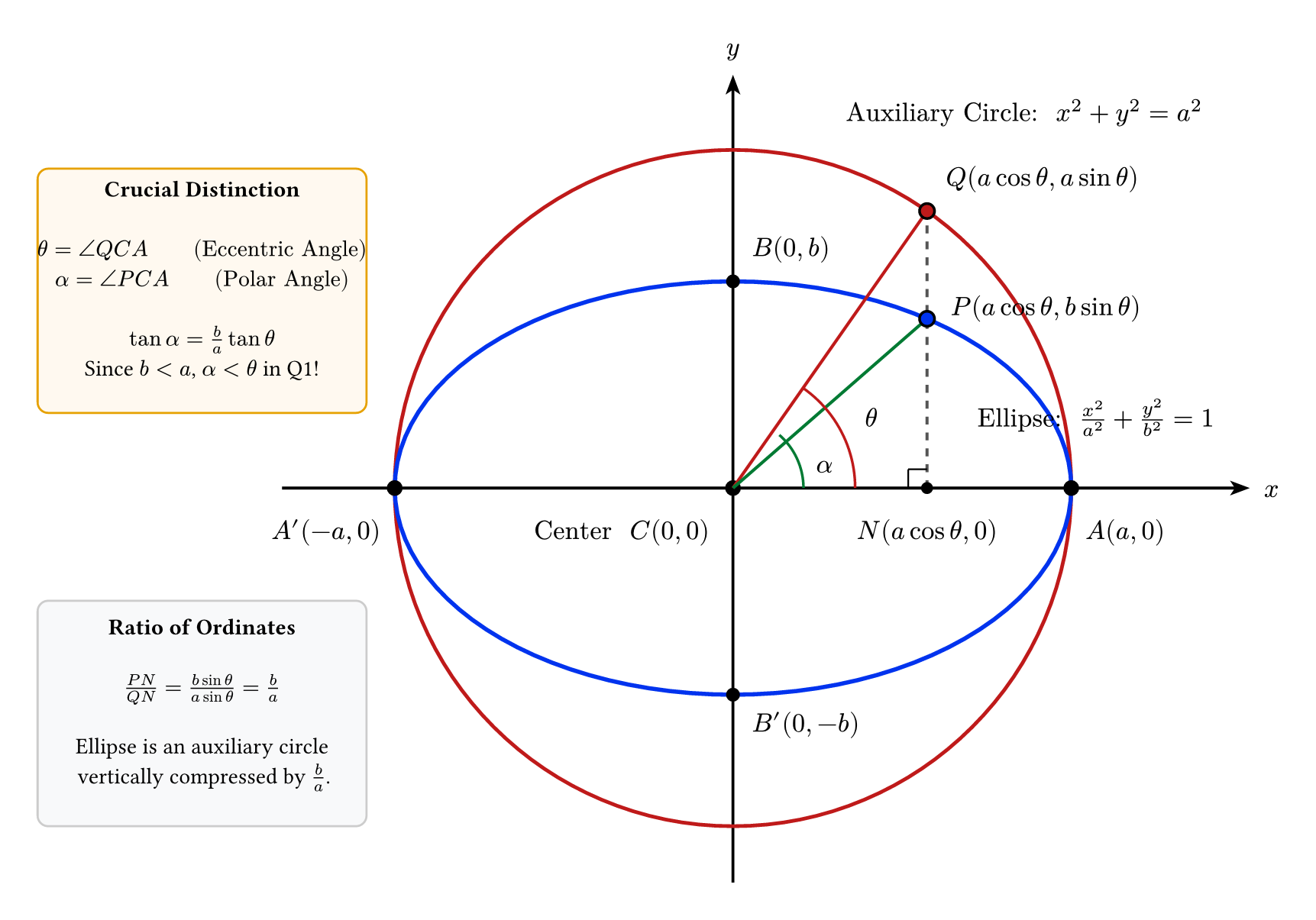
The circle described on the major axis \(A'A\) of an ellipse as diameter is called the auxiliary circle of the ellipse.
Equation of the Auxiliary Circle
Since the diameter is \(A'A = 2a\), the radius of this circle is \(a\), and its center is the center of the ellipse \(C(0, 0)\).
The standard equation of the auxiliary circle is therefore:
Since \(a > b\), the auxiliary circle completely encloses the ellipse, touching it only at the two principal vertices \(A(a, 0)\) and \(A'(-a, 0)\).
Geometric Construction of the Parametric Coordinates
To establish the parametric coordinates of any point on the ellipse, we construct a geometric mapping between the ellipse and its auxiliary circle.
Corresponding Points
Let \(P(x, y)\) be any point on the ellipse \(\frac{x^2}{a^2} + \frac{y^2}{b^2} = 1\).
Drop a perpendicular from \(P\) to the major axis (the \(x\)-axis), meeting it at the foot \(N(x, 0)\).
Produce the ordinate \(NP\) (in the direction of \(P\)) to intersect the auxiliary circle at a point \(Q(x, y')\).
The point \(Q\) is called the corresponding point of \(P\) on the auxiliary circle.
By construction:
- \(P\) and \(Q\) have the identical \(x\)-coordinate: \(x_P = x_Q = x\).
- The ordinates \(y_P\) and \(y_Q\) have the same sign (both positive, both negative, or both zero), meaning \(P\) and \(Q\) lie on the same side of the major axis.
Derivation of the Parametric Equations
Join the center \(C(0, 0)\) to the point \(Q\) on the auxiliary circle.
Let the radius vector \(CQ\) make an angle \(\theta\) with the positive direction of the \(x\)-axis (the segment \(CA\)):
Since \(Q\) lies on the auxiliary circle \(x^2 + y^2 = a^2\) at an angular displacement \(\theta\), its Cartesian coordinates are:
Because \(P\) has the same abscissa as \(Q\):
To find the ordinate \(y\) of \(P\), substitute \(x = a \cos \theta\) into the equation of the ellipse:
Taking the square root and noting that \(y\) has the same sign as \(y_Q = a \sin \theta\):
The Parametric Form
Any point \(P\) on the ellipse \(\frac{x^2}{a^2} + \frac{y^2}{b^2} = 1\) can be represented in terms of the single parameter \(\theta\) as:
This point is commonly denoted as \(P(\theta)\) or simply \((a \cos \theta, b \sin \theta)\).
The angle \(\theta\) is called the eccentric angle of the point \(P\). As the eccentric angle \(\theta\) varies continuously over the interval \([0, 2\pi)\) (or \((-\pi, \pi]\)), the point \(P(\theta)\) traverses the entire perimeter of the ellipse.
Critical Warning: What is the Eccentric Angle Exactly?
A very common and serious misconception among students is confusing the eccentric angle \(\theta\) of a point \(P\) with its polar angle (vectorial angle) \(\angle PCA\).
The Misconception
The eccentric angle \(\theta\) is not the angle made by the radius vector \(CP\) of the point itself with the major axis!
Rather, \(\theta\) is the angle made by the radius vector \(CQ\) of the corresponding point \(Q\) on the auxiliary circle with the major axis:
Relation between Polar Angle and Eccentric Angle
Let \(\alpha = \angle PCA\) be the actual polar angle of the point \(P(a \cos \theta, b \sin \theta)\) with the positive \(x\)-axis.
In the right-angled triangle \(\triangle PNC\):
Since \(b < a\) for a horizontal ellipse, the ratio satisfies:
This yields fundamental insights:
In the First Quadrant (\(0 < \theta < \frac{\pi}{2}\)):
The ray \(CP\) always lies strictly below the ray \(CQ\).
At the Vertices:
- At \(\theta = 0\): \(\alpha = 0\) (Point \(A(a, 0)\)).
- At \(\theta = \frac{\pi}{2}\): \(\alpha = \frac{\pi}{2}\) (Point \(B(0, b)\)).
- At \(\theta = \pi\): \(\alpha = \pi\) (Point \(A'(-a, 0)\)).
- At \(\theta = \frac{3\pi}{2}\): \(\alpha = \frac{3\pi}{2}\) (Point \(B'(0, -b)\)).
The polar angle \(\alpha\) and the eccentric angle \(\theta\) coincide only at the four vertices of the ellipse. At all other points, \(\alpha \ne \theta\).
Movement of a Point on the Ellipse as the Parameter Varies
As the parameter \(\theta\) increases continuously from \(0\) to \(2\pi\), the point \(Q(a \cos \theta, a \sin \theta)\) moves counterclockwise along the auxiliary circle at a uniform distance \(a\) from the center.
Simultaneously, the point \(P(a \cos \theta, b \sin \theta)\) traces out the ellipse counterclockwise:
Interval \(0 \le \theta \le \frac{\pi}{2}\) (First Quadrant):
- At \(\theta = 0\): \(P = (a, 0)\), the right vertex \(A\).
- As \(\theta\) increases, \(x\) decreases from \(a\) to \(0\), and \(y\) increases from \(0\) to \(b\).
- At \(\theta = \frac{\pi}{2}\): \(P = (0, b)\), the upper vertex \(B\).
Interval \(\frac{\pi}{2} \le \theta \le \pi\) (Second Quadrant):
- As \(\theta\) increases, \(x\) decreases from \(0\) to \(-a\), and \(y\) decreases from \(b\) to \(0\).
- At \(\theta = \pi\): \(P = (-a, 0)\), the left vertex \(A'\).
Interval \(\pi \le \theta \le \frac{3\pi}{2}\) (Third Quadrant):
- As \(\theta\) increases, \(x\) increases from \(-a\) to \(0\), and \(y\) decreases from \(0\) to \(-b\).
- At \(\theta = \frac{3\pi}{2}\): \(P = (0, -b)\), the lower vertex \(B'\).
Interval \(\frac{3\pi}{2} \le \theta \le 2\pi\) (Fourth Quadrant):
- As \(\theta\) increases, \(x\) increases from \(0\) to \(a\), and \(y\) increases from \(-b\) to \(0\).
- At \(\theta = 2\pi\): \(P = (a, 0)\), completing one full revolution back at vertex \(A\).
The Constant Ratio of Ordinates
A defining geometric property connecting the ellipse and its auxiliary circle is the ratio of their ordinates.
For any point \(P(a \cos \theta, b \sin \theta)\) on the ellipse and its corresponding point \(Q(a \cos \theta, a \sin \theta)\) on the auxiliary circle, consider their distances from the major axis (the \(x\)-axis):
Taking their ratio for any point not on the major axis (\(\sin \theta \ne 0\)):
Geometric Interpretation: Affine Compression
The ratio of the ordinate of any point on an ellipse to the ordinate of the corresponding point on the auxiliary circle is constant and equal to \(\frac{b}{a}\) (the ratio of the semi-minor axis to the semi-major axis).
Geometrically, this means that an ellipse of semi-axes \(a\) and \(b\) can be obtained by uniformly compressing a circle of radius \(a\) perpendicular to its diameter by a constant factor \(\frac{b}{a}\).
Every vertical segment in the auxiliary circle is scaled by the constant factor \(\frac{b}{a}\) to produce the corresponding segment in the ellipse.
Area of an Inscribed Triangle and the Maximum Area
The constant ratio of ordinates provides an extraordinarily elegant method for computing areas of figures inscribed in an ellipse.
Area of a Triangle Inscribed in an Ellipse
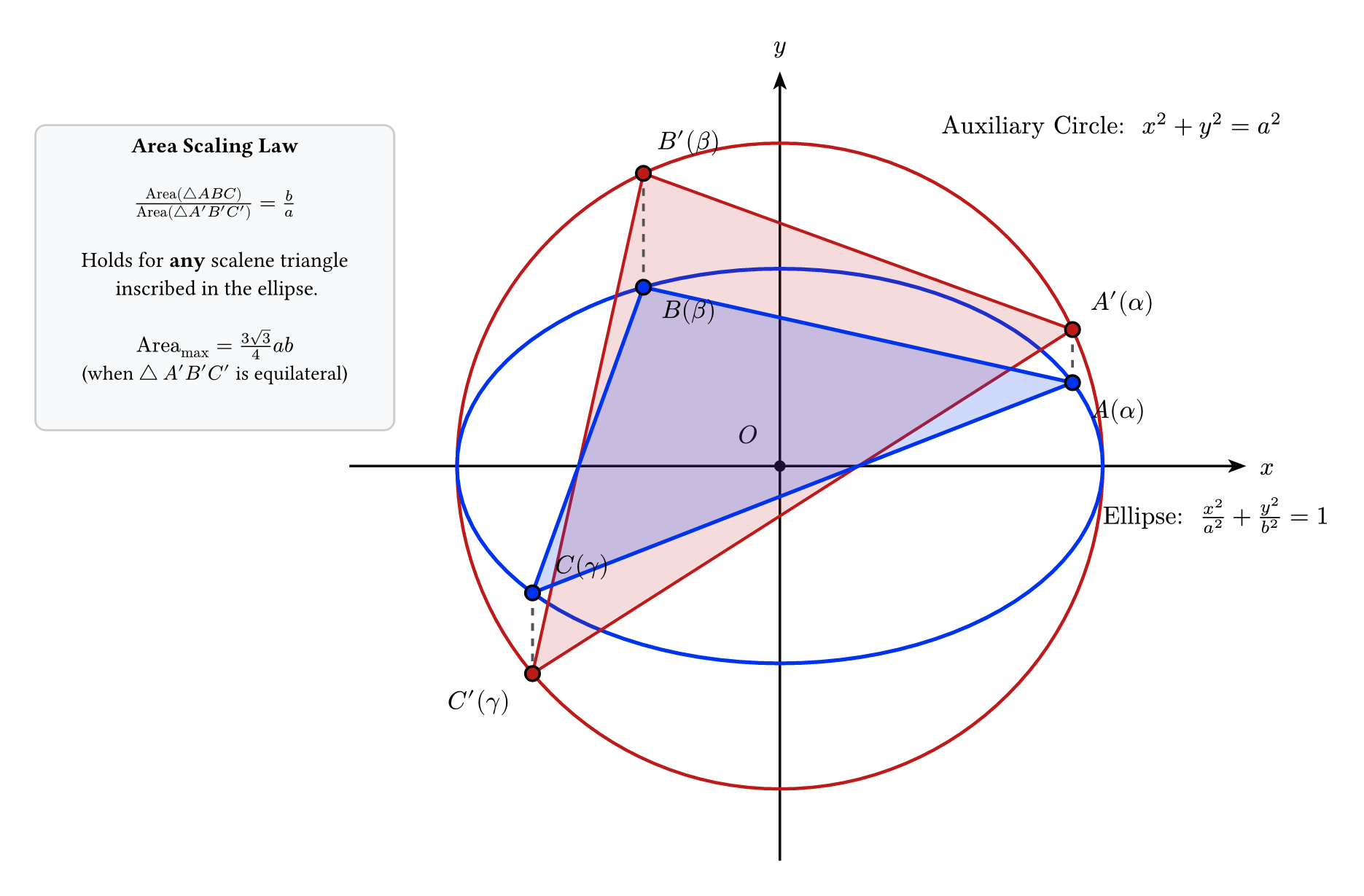
Let three points on the ellipse \(\frac{x^2}{a^2} + \frac{y^2}{b^2} = 1\) have eccentric angles \(\alpha, \beta, \gamma\):
The area of \(\triangle ABC\) is given by the standard coordinate determinant:
Factor out \(a\) from the first column and \(b\) from the second column:
Now consider the corresponding points on the auxiliary circle:
The area of the corresponding triangle \(\triangle A'B'C'\) inscribed in the auxiliary circle is:
Comparing the two expressions:
The area of any triangle inscribed in an ellipse is always \(\frac{b}{a}\) times the area of the corresponding triangle inscribed in its auxiliary circle!
Maximum Area of an Inscribed Triangle
To maximize the area of \(\triangle ABC\) inscribed in the ellipse, we need only maximize the area of the corresponding triangle \(\triangle A'B'C'\) inscribed in the auxiliary circle \(x^2 + y^2 = a^2\).
From Euclidean geometry, the triangle of maximum area inscribed in a given circle of radius \(a\) is an equilateral triangle.
For an equilateral triangle inscribed in a circle of radius \(a\), the side length \(s\) is:
The area of this equilateral triangle is:
Therefore, the maximum area of a triangle inscribed in the ellipse \(\frac{x^2}{a^2} + \frac{y^2}{b^2} = 1\) is:
Condition for Maximum Area
The maximum area is attained when \(\triangle A'B'C'\) is equilateral, which requires that the vertices on the auxiliary circle are spaced equally around the circumference by \(120^\circ\) (\(\frac{2\pi}{3}\) radians):
Thus, the eccentric angles of the vertices of the maximum triangle on the ellipse differ successively by \(\frac{2\pi}{3}\)!
Corollary: Total Area of an Ellipse
The constant ratio of areas extends to any inscribed polygon, and by a limiting process (Riemann sums of vertical strips), to the entire curve.
The area of the auxiliary circle is:
Because every vertical strip is scaled by the factor \(\frac{b}{a}\), the total area enclosed by the ellipse is:
Equation of the Chord Joining Two Points
Let \(P(\theta)\) and \(Q(\phi)\) be two points on the ellipse \(\frac{x^2}{a^2} + \frac{y^2}{b^2} = 1\):
Derivation
The slope of the secant line passing through \(P\) and \(Q\) is:
Apply the standard trigonometric sum-to-product identities:
Assuming the two points are distinct (\(\theta \ne \phi\)), the factor \(\sin\left(\frac{\theta - \phi}{2}\right) \ne 0\) cancels:
Now write the equation of the line using the point-slope form with point \(P(a \cos \theta, b \sin \theta)\):
Divide both sides by \(b\), multiply by \(\sin\left(\frac{\theta + \phi}{2}\right)\), and rearrange:
The right-hand side is the expansion of \(\cos(A - B)\) with \(A = \theta\) and \(B = \frac{\theta + \phi}{2}\):
Therefore:
This is the standard equation of the chord joining points with eccentric angles \(\theta\) and \(\phi\).
Tangent as a Limiting Case of a Chord
As the point \(Q\) approaches \(P\) along the ellipse, \(\phi \to \theta\):
Since \(\cos(0) = 1\), the chord equation becomes:
This is the parametric equation of the tangent to the ellipse at the point \(P(\theta)\).
Condition for a Focal Chord
A chord joining \(P(\theta)\) and \(Q(\phi)\) is a focal chord if it passes through one of the foci.
Chord Passing through the Right Focus
Substitute \(x = ae\) and \(y = 0\) into the chord equation:
Expand the cosine terms:
Divide through by \(\cos\frac{\theta}{2}\cos\frac{\phi}{2}\):
Chord Passing through the Left Focus
Substituting \(x = -ae\) and \(y = 0\):
Following identical steps:
Parametric Form for Transformed Ellipses
Shifted Ellipse with Displaced Center
For an ellipse with center \(C(h, k)\) and axes parallel to the coordinate axes:
Under the translation \(X = x - h\) and \(Y = y - k\):
Therefore, the parametric equations are:
Vertical Ellipse
For a vertical ellipse \(\frac{x^2}{a^2} + \frac{y^2}{b^2} = 1\) with \(b > a\), the major axis of length \(2b\) lies along the \(y\)-axis.
The auxiliary circle is described on the major axis as diameter, so its radius is \(b\):
The parameterization remains:
where \(\frac{x^2}{a^2} + \frac{y^2}{b^2} = \cos^2 \theta + \sin^2 \theta = 1\) identically holds.
Illustrative Examples
Example 1: Finding the Eccentric Angle from the Polar Angle
Problem. For the ellipse \(\frac{x^2}{25} + \frac{y^2}{16} = 1\), find the eccentric angle of a point in the first quadrant whose polar angle (angle with the positive \(x\)-axis from the center) is \(30^\circ\).
Solution. Here \(a^2 = 25 \implies a = 5\), and \(b^2 = 16 \implies b = 4\).
Let \(\alpha = 30^\circ\) be the polar angle and \(\theta\) be the eccentric angle.
The relation between polar angle and eccentric angle is:
Substitute \(\alpha = 30^\circ, a = 5, b = 4\):
Since \(\tan 30^\circ = \frac{1}{\sqrt{3}}\):
Notice that \(\frac{5\sqrt{3}}{12} \approx \frac{8.66}{12} \approx 0.722\), while \(\tan 30^\circ \approx 0.577\). Thus \(\theta \approx 35.8^\circ > 30^\circ\), confirming that \(\theta > \alpha\) in the first quadrant.
Example 2: Maximum Area of an Inscribed Triangle
Problem. Find the maximum possible area of a triangle inscribed in the ellipse \(9x^2 + 16y^2 = 144\).
Solution. Dividing the equation by \(144\):
The maximum area of a triangle inscribed in the ellipse \(\frac{x^2}{a^2} + \frac{y^2}{b^2} = 1\) is:
Substitute \(a = 4\) and \(b = 3\):
Example 3: Chord Joining Given Eccentric Angles
Problem. Find the equation of the chord joining the points on the ellipse \(\frac{x^2}{36} + \frac{y^2}{9} = 1\) whose eccentric angles are \(\theta = \frac{\pi}{3}\) and \(\phi = \frac{\pi}{6}\).
Solution. Here \(a = 6\) and \(b = 3\).
Compute the half-sum and half-difference of the angles:
The equation of the chord is:
Since \(\cos\frac{\pi}{4} = \sin\frac{\pi}{4} = \frac{1}{\sqrt{2}}\), and \(\cos\frac{\pi}{12} = \frac{\sqrt{6} + \sqrt{2}}{4}\):
Multiply through by \(6\sqrt{2}\):
The equation of the chord is:
Summary of Key Results
| Concept | Mathematical Form | Geometric Meaning |
|---|---|---|
| Auxiliary Circle | \(x^2 + y^2 = a^2\) | Circle described on the major axis \(2a\) as diameter |
| Parametric Coordinates | \((a \cos \theta, \; b \sin \theta)\) | Parameter \(\theta\) is the eccentric angle (\(0 \le \theta < 2\pi\)) |
| Eccentric Angle \(\theta\) | \(\theta = \angle QCA\) | Angle of corresponding point \(Q\) on the auxiliary circle |
| Polar Angle \(\alpha\) vs. \(\theta\) | \(\tan \alpha = \frac{b}{a} \tan \theta\) | \(\alpha < \theta\) in the first quadrant; coincides only at vertices |
| Ratio of Ordinates | \(\frac{y_{\text{ellipse}}}{y_{\text{circle}}} = \frac{b}{a}\) | Ellipse is an auxiliary circle vertically compressed by \(\frac{b}{a}\) |
| Chord Equation | \(\frac{x}{a}\cos\frac{\theta+\phi}{2} + \frac{y}{b}\sin\frac{\theta+\phi}{2} = \cos\frac{\theta-\phi}{2}\) | Secant line through points \(P(\theta)\) and \(Q(\phi)\) |
| Tangent at \(P(\theta)\) | \(\frac{x}{a}\cos \theta + \frac{y}{b}\sin \theta = 1\) | Limiting chord as \(\phi \to \theta\) |
| Focal Chord through \((ae, 0)\) | \(\tan\frac{\theta}{2} \tan\frac{\phi}{2} = -\frac{1-e}{1+e}\) | Product of half-angle tangents is constant |
| Max Inscribed Triangle Area | \(\text{Area}_{\max} = \frac{3\sqrt{3}}{4} ab\) | Occurs when eccentric angles differ by \(\frac{2\pi}{3}\) |
| Total Ellipse Area | \(\text{Area} = \pi ab\) | Scaled from auxiliary circle area \(\pi a^2\) by factor \(\frac{b}{a}\) |