Integration by Substitution
In our previous tutorials, we integrated functions by matching them to standard forms using algebra and trigonometry.
However, many functions cannot be simplified by algebra alone. For example, consider:
Here, the argument of the cosine is \(x^2\), not a linear term \(ax + b\). But notice that \(x^2\) is multiplied by its derivative, \(2x\).
To integrate such functions, we reverse the Chain Rule of differentiation. This technique is called Integration by Substitution (or Change of Variable).
Changing the Variable of Integration
Let us understand why substitution works by deriving it from the definition of an antiderivative and the Chain Rule.
The Starting Integral
Suppose we wish to evaluate:
If \(F(x)\) is an antiderivative of \(f(x)\), then:
which means:
Introducing a New Variable
Now suppose the variable \(x\) depends on another variable \(t\) through a differentiable relation:
Since \(x = g(t)\), we can write the antiderivative \(F(x)\) in terms of \(t\) as a composite function:
Differentiating with Respect to the New Variable
What is the derivative of \(F(g(t))\) with respect to \(t\)?
Applying the Chain Rule:
Since \(F'(x) = f(x)\), evaluating this at \(x = g(t)\) gives:
Substituting this into the Chain Rule equation:
Integrating with Respect to the New Variable
This equation shows that the derivative of \(F(g(t))\) with respect to \(t\) is \(f(g(t)) \cdot g'(t)\).
Therefore, by the definition of an antiderivative:
Connecting Both Sides
Since \(F(g(t)) = F(x)\), and \(F(x) + C = \int f(x)\,dx\), we get:
Why Does This Make Integration Easier?
At first glance, this identity might seem to make things harder:
We started with a single function \(f(x)\), and now we have a product of two functions: \(f(g(t))\) and an extra factor \(g'(t)\).
Why would this help?
Because an expression that is difficult to handle in terms of \(x\) may simplify completely in terms of \(t\).
- Simplifying Stubborn Expressions: An algebraic term like \(\sqrt{1 - x^2}\) cannot be simplified using basic algebra. But if we replace \(x\) with a trigonometric function like \(\sin\theta\), the identity \(1 - \sin^2\theta = \cos^2\theta\) removes the square root entirely.
- Help from the Derivative Factor: The extra factor \(g'(t)\) is not extra baggage. It often cancels an awkward denominator or combines with the rest of the expression to produce a standard formula from our integration table.
Let us see how this works with two concrete examples using \(x = \sin\theta\).
Example 1
Evaluate:
Solution:
Here, \(f(x) = \frac{1}{\sqrt{1 - x^2}}\). We cannot simplify \(\sqrt{1 - x^2}\) using basic algebra.
Let us change the variable by setting:
Here \(g(\theta) = \sin\theta\). Its derivative is:
Now evaluate \(f(g(\theta))\):
Since \(\theta \in \left(-\frac{\pi}{2}, \frac{\pi}{2}\right)\), \(\cos\theta > 0\), so \(\sqrt{\cos^2\theta} = \cos\theta\):
Now form the product \(f(g(\theta)) \cdot g'(\theta)\):
The denominator \(\cos\theta\) and the derivative \(g'(\theta) = \cos\theta\) cancel out completely. The integral becomes:
Finally, we express the answer in terms of \(x\). Since \(x = \sin\theta\), we have \(\theta = \sin^{-1} x\):
Example 2
Evaluate:
Solution:
Here, the denominator contains \((1 - x^2)^{3/2} = (\sqrt{1 - x^2})^3\). Algebra cannot simplify this directly.
Use the same substitution:
The derivative is:
Transform \(f(x) = \frac{1}{(1 - x^2)^{3/2}}\):
Now multiply by \(g'(\theta) = \cos\theta\):
The radical fraction has simplified into \(\sec^2\theta\), which is directly in our table of standard integrals:
To express the answer in terms of \(x\), draw a reference right triangle with acute angle \(\theta\):
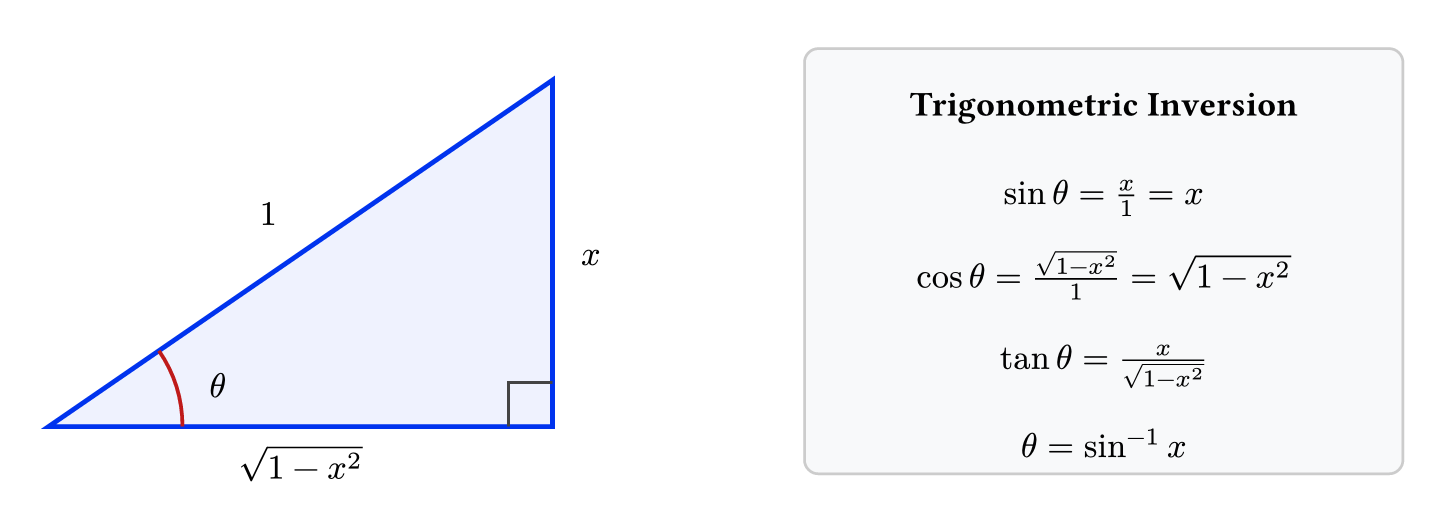
From the triangle:
- The side opposite to \(\theta\) is \(x\).
- The hypotenuse is \(1\).
- By the Pythagorean theorem, the adjacent side is \(\sqrt{1 - x^2}\).
Therefore:
Substituting this back gives:
We can verify this result by differentiating:
which matches the original integrand.
The Meaning of dx and the Beauty of Leibniz Notation
When learning differential calculus, students are often taught:
"Do not treat \(\frac{dy}{dx}\) as an ordinary fraction! It is not \(dy\) divided by \(dx\); it is a single limit symbol representing \(\lim_{\Delta x \to 0} \frac{\Delta y}{\Delta x}\)."
Because of this warning, many students assume that the symbol \(dx\) in an integral \(\int f(x)\,dx\) is just a punctuation mark—a harmless label telling you that \(x\) is the variable of integration.
In integral calculus, however, \(dx\) plays a very real algebraic role.
What Are Differentials?
When a variable \(x\) depends on another variable \(t\) through a differentiable relation:
its rate of change is given by the derivative:
We now define two quantities, called differentials:
- The differential of the independent variable \(t\) is denoted by \(dt\).
- The differential of \(x\), denoted by \(dx\), is defined as:
Notice what this definition accomplishes. If you formally divide both sides by \(dt\), you recover the derivative:
By defining \(dx\) this way, the derivative \(\frac{dx}{dt}\) really does behave like the quotient of two quantities, \(dx\) and \(dt\).
Treating dx as an Algebraic Quantity
Now compare this definition of \(dx\) with the change-of-variable theorem we proved earlier using the Chain Rule:
Look at what this means in practice:
- Everywhere you see \(x\), you substitute \(g(t)\).
- Everywhere you see \(\mathbf{dx}\), you substitute \(\mathbf{g'(t)\,dt}\).
In other words, you can treat \(dx\) and \(dt\) as genuine algebraic quantities!
Whenever you make a substitution \(x = g(t)\), you do not need to re-derive the Chain Rule each time. You simply:
- Differentiate \(x\) with respect to \(t\): \(\frac{dx}{dt} = g'(t)\).
- "Multiply across" by \(dt\) to find the differential: \(dx = g'(t)\,dt\).
- Substitute \(g(t)\) for \(x\) and substitute \(g'(t)\,dt\) for \(dx\) directly into the integral.
This is the beauty of the notation created by Gottfried Wilhelm Leibniz in the 1670s. Leibniz deliberately designed his notation so that the algebra of differentials would automatically enforce the deep rules of calculus. When you algebraically replace \(dx\) by \(g'(t)\,dt\), the Chain Rule takes care of itself behind the scenes.
Another Forward Substitution
Before we reverse our perspective, let us look at one more forward substitution where trigonometric relations dissolve a sum of squares.
Example 3
Evaluate:
Solution:
In terms of \(x\), the denominator is the sum of squares \(x^2 + a^2\). Standard polynomial algebra cannot factor this over the real numbers.
Recall the Pythagorean identity \(1 + \tan^2\theta = \sec^2\theta\). To factor out \(a^2\), we set:
Differentiating gives the differential \(dx\):
Now rewrite the denominator:
Substitute both the denominator and \(dx\) into the integral:
Cancel the common factor \(a\sec^2\theta\):
Return to \(x\) by inverting the substitution:
Therefore:
This first-principles derivation proves the standard inverse tangent formula from our table.
Reading the Substitution Rule in Reverse
In Examples 1, 2, and 3, we used substitution in the forward direction: we started with an integral in \(x\), decided that \(x\) was trapped in an awkward expression, and substituted \(x = g(t)\) to unlock it.
Now let us pause and look at our fundamental theorem in the reverse direction—from right to left.
In mathematics, every equality works both ways:
Notice what this reverse perspective is telling us:
Suppose you are given an integral that already contains:
- An inner function: \(g(x)\).
- An outer function: \(f(\dots)\) evaluated at \(g(x)\).
- The derivative of the inner function: \(g'(x)\), multiplying \(dx\).
If you see this structure, you can define:
Then the differential of \(t\) is:
Now watch how the integral transforms:
Why Reverse Substitution Works
Why would we do this?
Because the original integral in \(x\) looked cluttered and complicated. But in terms of \(t\), the derivative factor \(g'(x)\) is completely absorbed into \(dt\), and the inner expression \(g(x)\) becomes a single variable \(t\).
We are left with \(\int f(t)\,dt\), which is often an elementary formula from our standard table!
Once we evaluate the integral:
we simply replace \(t\) with \(g(x)\) to express the final answer in terms of \(x\):
The Skill of Pattern Recognition
In theory, reverse substitution looks straightforward. But in practice, students face an immediate challenge:
Integrals do not come with labels telling you who is \(g(x)\) and where \(g'(x)\) is located.
To use reverse substitution successfully, you must train yourself to spot this hidden structure. When looking at any integral, ask yourself three questions:
- Where is the inner function? Look for an expression trapped inside a power, under a square root, in an exponent, or in a denominator. Call this candidate \(g(x)\).
- What is its derivative? Compute \(g'(x)\) mentally.
- Is that derivative present outside? Scan the rest of the integrand. Is \(g'(x)\) (or a constant multiple of it) multiplying \(dx\)?
Let us see how this pattern recognition works in straightforward cases.
Example 4
Evaluate:
Solution:
- Spot the inner function: The cosine function acts on \(x^2\). So our candidate is \(g(x) = x^2\).
- Compute its derivative: \(\frac{d}{dx}[x^2] = 2x\).
- Locate the derivative: The factor \(2x\) is sitting right next to \(dx\)!
Let:
Then:
Substitute into the integral:
Substitute back \(t = x^2\):
Example 5
Evaluate:
Solution:
- Spot the inner function: Inside the seventh power sits \(x^3 + 5\).
- Compute its derivative: \(\frac{d}{dx}[x^3 + 5] = 3x^2\).
- Locate the derivative: Outside we have \(x^2\). This matches \(3x^2\) up to a constant scalar factor of \(3\).
Let:
Differentiating gives:
Substitute into the integral:
Substitute back \(t = x^3 + 5\):
Example 6
Evaluate:
Solution:
Write \(\tan x\) as a quotient:
The denominator is \(\cos x\), and its derivative is \(-\sin x\), which is present in the numerator.
Let:
Then:
Substitute into the integral:
Using \(-\ln|A| = \ln|1/A|\) and \(1/\cos x = \sec x\):
Example 7
Evaluate:
Solution:
Rewrite the integrand as:
The inner function is \(\ln x\), and its derivative is \(\frac{1}{x}\).
Let:
Then:
Substitute into the integral:
Hidden Substitutions and Algebraic Manipulation
The examples above were clean because the derivative \(g'(x)\) was sitting right in plain sight.
In advanced integration, however, \(g'(x)\) is almost never visible at first glance.
If you simply look at the expression as given, you will not see a function and its derivative. You must first perform algebraic or trigonometric manipulation to manufacture or reveal the pair \(g(x)\) and \(g'(x)\).
This connects our previous study of algebraic manipulation with the method of substitution: we often reshape an integrand specifically to create a substitution.
Let us study five challenging examples where algebraic surgery is required to uncover the hidden substitution.
Example 8
Evaluate:
Solution:
At first glance, if we try \(t = x^4 + 1\), its derivative is \(4x^3\). But we do not have \(x^3\) in the numerator; we have \(x^2\) in the denominator! The substitution fails immediately.
How can we reveal a hidden derivative?
Factor out \(x^4\) from inside the bracket:
Now combine \(x^3\) with the \(x^2\) already in the denominator:
The integrand becomes:
Now examine what has happened!
Look at the inner expression: \(g(x) = 1 + x^{-4}\).
Compute its derivative:
The factor \(x^{-5}\) is now sitting in the numerator! By factoring out \(x^4\), we manufactured the exact derivative needed.
Let:
Then:
Substitute into the integral:
Integrate using the power rule:
Substitute back \(t = 1 + x^{-4} = \frac{x^4 + 1}{x^4}\):
Example 9
Evaluate:
Solution:
Neither the numerator nor the denominator is the derivative of the other. Long division does not help because the degree of the numerator is smaller than the denominator.
Divide both numerator and denominator by \(x^2\):
Now examine the numerator: \(1 - \frac{1}{x^2}\).
Ask yourself: What function has \(1 - \frac{1}{x^2}\) as its derivative?
Recall that:
This tells us that our substitution must be:
Can we rewrite the denominator \(x^2 + \frac{1}{x^2}\) in terms of \(t\)?
Complete the square:
The entire integral transforms into:
This is a standard form from our table: \(\int \frac{dt}{t^2 - a^2} = \frac{1}{2a}\ln\left|\frac{t - a}{t + a}\right|\) with \(a = \sqrt{2}\):
Substitute back \(t = x + \frac{1}{x} = \frac{x^2 + 1}{x}\):
Therefore:
Example 10
Evaluate:
Solution:
The denominator is \(1 + e^x\), but there is no \(e^x\) in the numerator to serve as its derivative.
How can we create the derivative?
Multiply both numerator and denominator by \(e^{-x}\):
Now look at the fraction:
The denominator is \(e^{-x} + 1\). Its derivative is \(-e^{-x}\), which is now present in the numerator!
Let:
Then:
Substitute into the integral:
Substitute back \(t = e^{-x} + 1\):
This can also be written in an alternative clean form:
Example 11
Evaluate:
Solution:
Here sine and cosine are multiplied in the denominator. There is no obvious derivative in the numerator.
Recall from trigonometry that dividing powers of sine and cosine by powers of \(\cos x\) produces \(\tan x\) and \(\sec x\).
Notice the total power of trigonometric terms in the denominator is \(1 + 3 = 4\).
Divide both numerator and denominator by \(\cos^4 x\):
Rewrite \(\sec^4 x\) as \((1 + \tan^2 x)\sec^2 x\):
Now the substitution is obvious!
The inner function is \(\tan x\), and its derivative \(\sec^2 x\) is multiplying \(dx\).
Let:
Then:
Substitute into the integral:
Integrate term by term:
Substitute back \(t = \tan x\):
Example 12
Evaluate:
Solution:
If we try setting \(u = x^6 - 1\), its derivative requires an \(x^5\) in the numerator, which is completely missing.
Let us manufacture the missing \(x^5\) by multiplying both the numerator and the denominator by \(x^5\):
Now look at what we have created:
- In the denominator, we have \(x^6\) and \(\sqrt{x^6 - 1}\).
- In the numerator, we have \(x^5\,dx\), which is proportional to the differential of \(x^6\).
Let:
Square both sides:
Differentiating both sides:
Now substitute everything into the integral:
- Replace \(x^5\,dx\) with \(\frac{t\,dt}{3}\).
- Replace \(x^6\) with \(t^2 + 1\).
- Replace \(\sqrt{x^6 - 1}\) with \(t\).
The variable factor \(t\) cancels out completely, leaving the standard inverse tangent integral:
Substitute back \(t = \sqrt{x^6 - 1}\):
Two Canonical Substitution Patterns
There are two special forms of reverse substitution that appear so frequently in calculus that you should learn to recognize them on sight.
The Logarithmic Derivative Pattern
Whenever the numerator of a fraction is the exact derivative of its denominator:
Derivation:
Let \(t = f(x)\). Differentiating gives \(dt = f'(x)\,dx\).
Substituting into the integral:
This single pattern allows us to derive the fundamental trigonometric integrals for \(\cot x\), \(\sec x\), and \(\csc x\) that were introduced in Tutorial 02.
For \(\cot x\), we express it as \(\frac{\cos x}{\sin x}\):
Since \(\frac{d}{dx}[\sin x] = \cos x\), the numerator is the derivative of the denominator:
For \(\sec x\), the derivative is not immediately visible. But we can manufacture the pattern by multiplying the numerator and denominator by \((\sec x + \tan x)\):
Notice that the derivative of the denominator is:
The numerator is the exact derivative of the denominator! Therefore:
Similarly, for \(\csc x\), multiply numerator and denominator by \((\csc x - \cot x)\):
Since \(\frac{d}{dx}[\csc x - \cot x] = -\csc x \cot x - (-\csc^2 x) = \csc^2 x - \csc x \cot x\), we have:
The Extended Power Pattern
Whenever a function raised to a constant power is multiplied by its derivative:
Derivation:
Let \(t = f(x)\). Then \(dt = f'(x)\,dx\). The integral transforms into the standard power rule: