Transformation of Ellipse
In the previous tutorial, we derived the standard equation of an ellipse whose center is at the origin and whose major axis lies along the \(x\)-axis:
In general geometric and physical problems, an ellipse does not always present itself in this orientation or position. The major axis may lie along the \(y\)-axis (a vertical ellipse), or the center may be shifted away from the origin to an arbitrary point \((h, k)\), or both.
Understanding how the equation changes under these geometric transformations—and how to extract the key geometric attributes (center, foci, vertices, directrices, and latera recta) from any transformed equation—is fundamental to coordinate geometry.
The Vertical Ellipse
Consider the equation:
At first glance, this algebraic equation appears identical in form to the horizontal ellipse. However, the condition \(b > a\) fundamentally alters the geometric roles of the two axes: the major axis now stretches vertically along the \(y\)-axis, while the minor axis lies horizontally along the \(x\)-axis.
Derivation from the Focus-Directrix Definition
To understand why the axes swap roles when \(b > a\), let us construct the curve directly from the focus-directrix definition.
Let the focus be placed on the positive \(y\)-axis at \(S(0, be)\), where \(0 < e < 1\), and let the corresponding directrix be the horizontal line:
Let \(P(x, y)\) be any point on the ellipse. The distance of \(P\) from the focus \(S\) is:
The perpendicular distance \(PM\) from \(P(x, y)\) to the directrix \(y - \frac{b}{e} = 0\) is:
By definition of the ellipse, \(SP = e \cdot PM\). Squaring both sides:
Expanding both sides:
Cancel the cross-term \(-2bey\) from both sides:
Dividing both sides by \(b^2(1 - e^2)\):
Since \(0 < e < 1\), the quantity \(1 - e^2\) is positive and less than \(1\). Therefore, \(b^2(1 - e^2) < b^2\).
Defining a positive constant \(a\) by:
we obtain:
This confirms that the equation \(\frac{x^2}{a^2} + \frac{y^2}{b^2} = 1\) represents an ellipse with its major axis along the \(y\)-axis whenever the denominator of \(y^2\) exceeds the denominator of \(x^2\).
Anatomy of the Vertical Ellipse
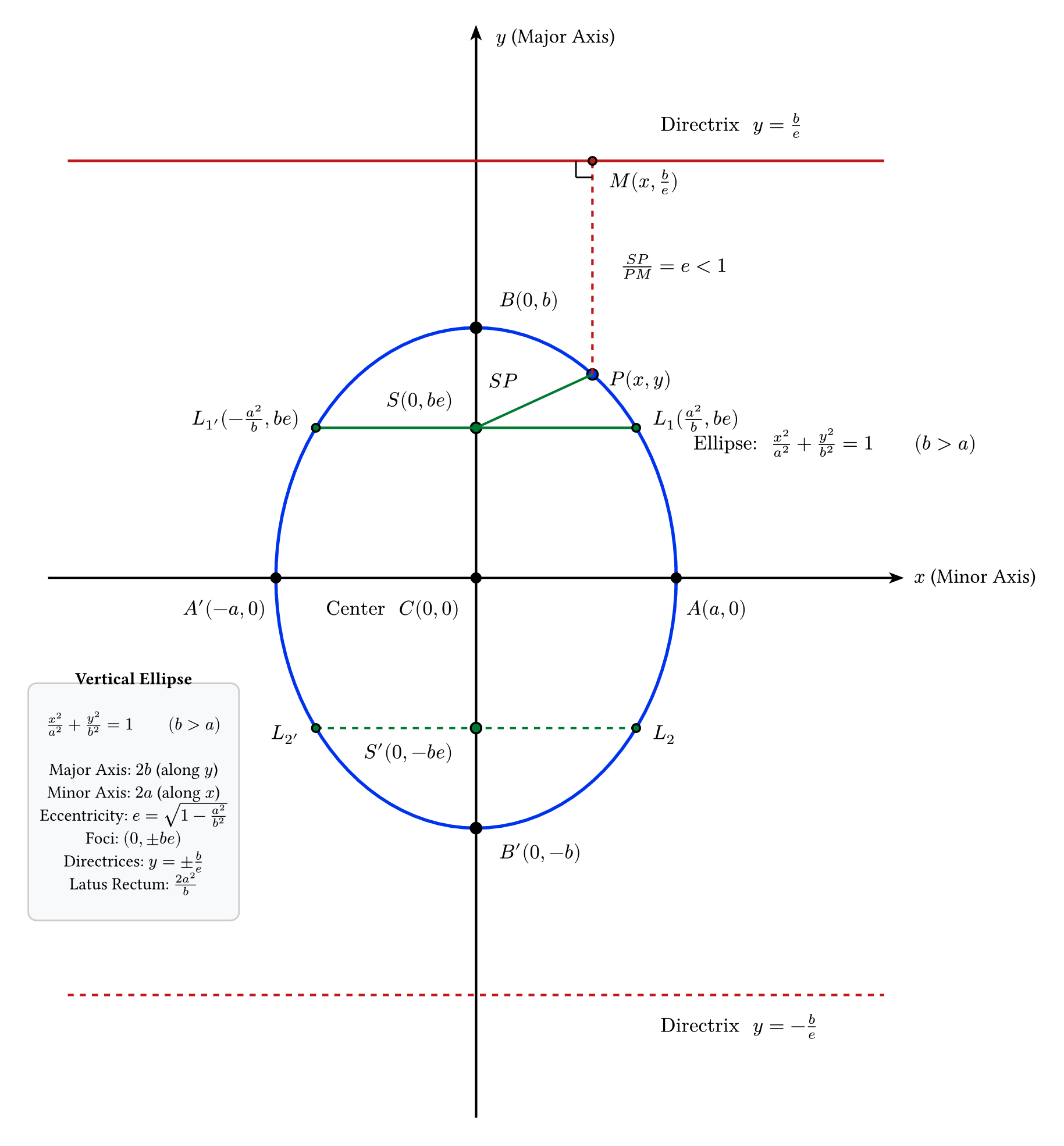
Let \(\frac{x^2}{a^2} + \frac{y^2}{b^2} = 1\) with \(b > a\). The geometric features are derived as follows:
Major and Minor Axes
Setting \(x = 0\) yields \(\frac{y^2}{b^2} = 1 \implies y = \pm b\). The curve intersects the \(y\)-axis at the points:
The segment \(B'B\) is called the major axis. Its length is:
The equation of the major axis is \(x = 0\) (the \(y\)-axis).
Setting \(y = 0\) yields \(\frac{x^2}{a^2} = 1 \implies x = \pm a\). The curve intersects the \(x\)-axis at the points:
The segment \(A'A\) is called the minor axis. Its length is:
The equation of the minor axis is \(y = 0\) (the \(x\)-axis).
Since \(b > a\), the major axis is vertical and the minor axis is horizontal.
Center and Vertices
The point of intersection of the major and minor axes is the center of the ellipse:
The endpoints of the major axis are the principal vertices:
The endpoints of the minor axis are:
Eccentricity
From the relation \(a^2 = b^2(1 - e^2)\), we solve for \(e\):
Notice the structural rule:
Foci
The two foci lie on the major axis (the \(y\)-axis) at a distance \(be\) from the center:
The distance between the two foci is:
Directrices
The two directrices are straight lines perpendicular to the major axis (horizontal lines parallel to the \(x\)-axis) at a distance \(\frac{b}{e}\) from the center:
The distance between the two directrices is:
Latus Rectum
A latus rectum is a focal chord perpendicular to the major axis. For a vertical ellipse, the major axis is the \(y\)-axis, so the latera recta are horizontal line segments parallel to the \(x\)-axis passing through the foci \(S(0, be)\) and \(S'(0, -be)\).
To find the coordinates of the extremities of the latus rectum through \(S(0, be)\), substitute \(y = be\) into the equation of the ellipse:
Since \(a^2 = b^2(1 - e^2)\), we have \(1 - e^2 = \frac{a^2}{b^2}\). Substituting this:
Thus, the extremities of the latus rectum passing through \(S(0, be)\) are:
Similarly, for the focus \(S'(0, -be)\), substituting \(y = -be\) yields the extremities:
The length of each latus rectum is the horizontal distance between its extremities:
The semi-latus rectum \(l\) is:
In general terms:
Focal Distances of a Point
Let \(P(x_1, y_1)\) be any point on the vertical ellipse \(\frac{x^2}{a^2} + \frac{y^2}{b^2} = 1\) (\(b > a\)).
Let \(M\) and \(M'\) be the feet of the perpendiculars from \(P(x_1, y_1)\) onto the directrices \(y = \frac{b}{e}\) and \(y = -\frac{b}{e}\), respectively.
Distance to the upper focus \(S(0, be)\):
By the focus-directrix definition:
Since \(P\) lies on the ellipse, \(-b \le y_1 \le b < \frac{b}{e}\), so the distance \(PM\) is:
Therefore:
Distance to the lower focus \(S'(0, -be)\):
By the focus-directrix definition:
Since \(y_1 \ge -b > -\frac{b}{e}\), the distance \(PM'\) is:
Therefore:
Sum of Focal Distances:
Adding the two focal distances:
The sum of the distances of any point on the vertical ellipse from its two foci is constant and equals the length of the major axis (\(2b\)).
Comparison: Horizontal vs. Vertical Ellipse
The following table summarizes the correspondence between the horizontal ellipse (\(a > b\)) and the vertical ellipse (\(b > a\)) for the standard equation:
| Attribute | Horizontal Ellipse (\(a > b\)) | Vertical Ellipse (\(b > a\)) |
|---|---|---|
| Major Axis | Along \(x\)-axis (\(y = 0\)), length \(= 2a\) | Along \(y\)-axis (\(x = 0\)), length \(= 2b\) |
| Minor Axis | Along \(y\)-axis (\(x = 0\)), length \(= 2b\) | Along \(x\)-axis (\(y = 0\)), length \(= 2a\) |
| Center | \((0, 0)\) | \((0, 0)\) |
| Vertices on Major Axis | \((\pm a, 0)\) | \((0, \pm b)\) |
| Vertices on Minor Axis | \((0, \pm b)\) | \((\pm a, 0)\) |
| Fundamental Relation | \(b^2 = a^2(1 - e^2)\) | \(a^2 = b^2(1 - e^2)\) |
| Eccentricity \(e\) | \(\sqrt{1 - \frac{b^2}{a^2}} = \frac{\sqrt{a^2 - b^2}}{a}\) | \(\sqrt{1 - \frac{a^2}{b^2}} = \frac{\sqrt{b^2 - a^2}}{b}\) |
| Foci | \((\pm ae, 0)\) | \((0, \pm be)\) |
| Distance between Foci | \(2ae\) | \(2be\) |
| Equations of Directrices | \(x = \pm \frac{a}{e}\) | \(y = \pm \frac{b}{e}\) |
| Distance between Directrices | \(\frac{2a}{e}\) | \(\frac{2b}{e}\) |
| Length of Latus Rectum | \(\frac{2b^2}{a}\) | \(\frac{2a^2}{b}\) |
| Extremities of Latus Rectum | \(\left(\pm ae, \pm \frac{b^2}{a}\right)\) | \(\left(\pm \frac{a^2}{b}, \pm be\right)\) |
| Focal Distances of \(P(x_1, y_1)\) | \(a \mp ex_1\) | \(b \mp ey_1\) |
| Sum of Focal Distances | \(SP + S'P = 2a\) | \(SP + S'P = 2b\) |
The Universal Rule for Ellipses at the Origin
To avoid confusion between letters \(a\) and \(b\), memorize the universal geometric principle:
- Orientation: In the equation \(\frac{x^2}{\alpha} + \frac{y^2}{\beta} = 1\), the larger denominator is the square of the semi-major axis. Its corresponding variable identifies whether the major axis is horizontal (along \(x\)) or vertical (along \(y\)).
- Minor Axis: The smaller denominator is the square of the semi-minor axis.
- Eccentricity: The eccentricity is determined entirely by the ratio of denominators:
- Foci and Directrices: The foci and major vertices lie along the coordinate axis associated with the larger denominator, while the directrices are perpendicular to it.
- Latus Rectum: The length of each latus rectum depends only on the semi-axes:
Translation of Axes: Ellipse with Displaced Center
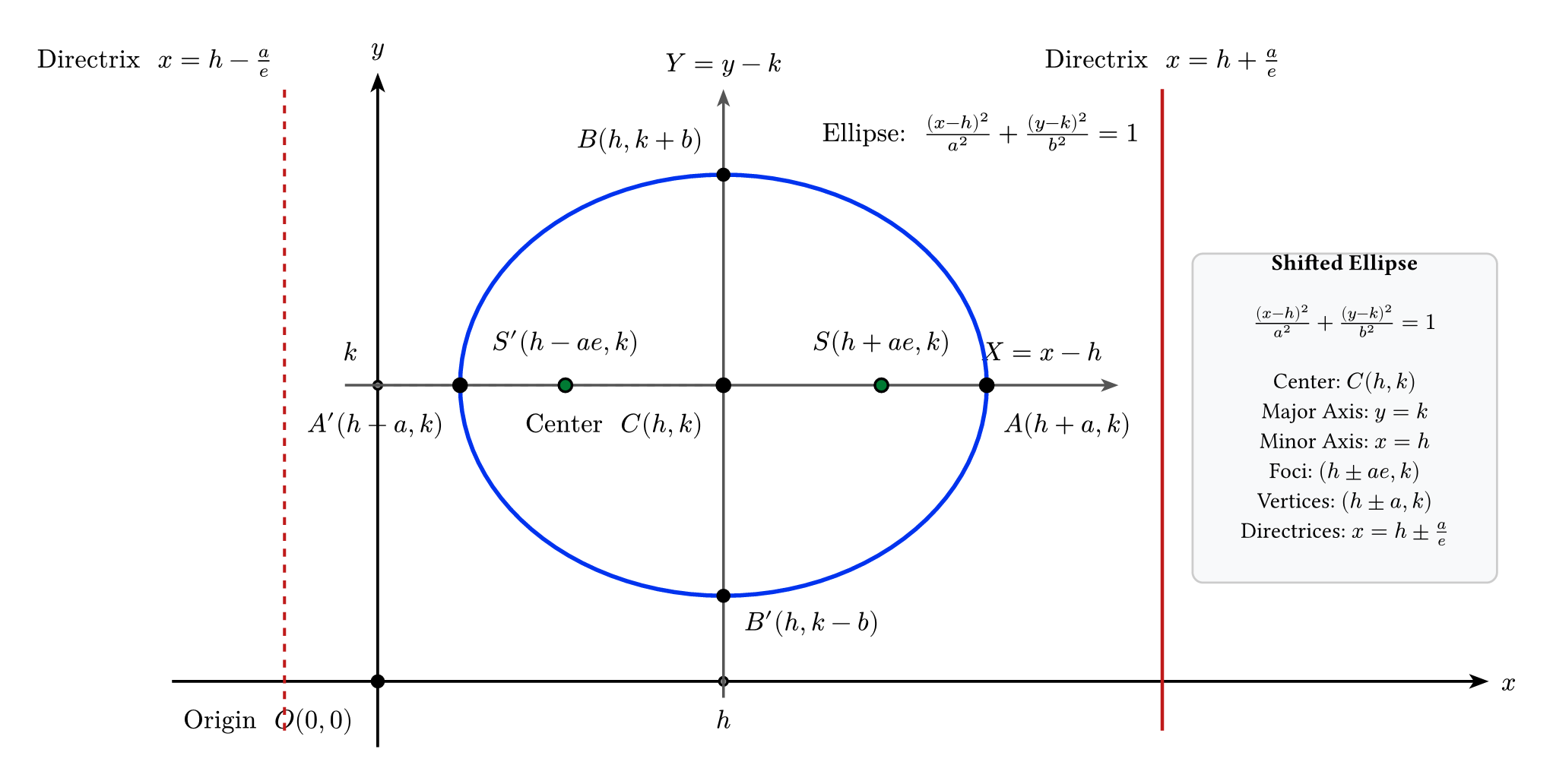
When an ellipse has its major and minor axes parallel to the coordinate axes, but its center is shifted from the origin \((0, 0)\) to an arbitrary point \(C(h, k)\), its equation undergoes a translation.
The Translation Transformation
Let a new coordinate system \((X, Y)\) be established with its origin at \(C(h, k)\), such that the \(X\)-axis and \(Y\)-axis are parallel to the original \(x\)-axis and \(y\)-axis, respectively.
If a point has coordinates \((x, y)\) in the original system and \((X, Y)\) in the new system, the transformation equations are:
In the new \((X, Y)\) frame, the center of the ellipse is at the origin \((0, 0)\).
Horizontal Ellipse with Displaced Center
If the major axis is parallel to the \(x\)-axis, the equation in the \((X, Y)\) system is:
Substituting \(X = x - h\) and \(Y = y - k\), the equation in original coordinates is:
Translating each geometric feature from \((X, Y)\) to \((x, y)\) by adding \(h\) to \(X\) and \(k\) to \(Y\):
- Center: \((h, k)\)
- Major Axis: The line \(Y = 0 \implies y = k\), with length \(2a\).
- Minor Axis: The line \(X = 0 \implies x = h\), with length \(2b\).
- Vertices: \((h \pm a, k)\) and \((h, k \pm b)\)
- Foci: \((h \pm ae, k)\)
- Directrices: \(X = \pm \frac{a}{e} \implies x - h = \pm \frac{a}{e} \implies x = h \pm \frac{a}{e}\)
- Latera Recta Equations: \(x = h \pm ae\)
- Length of Latus Rectum: \(\frac{2b^2}{a}\)
Vertical Ellipse with Displaced Center
If the major axis is parallel to the \(y\)-axis, the equation in the \((X, Y)\) system is:
Substituting \(X = x - h\) and \(Y = y - k\):
The geometric features in original coordinates are:
- Center: \((h, k)\)
- Major Axis: The line \(X = 0 \implies x = h\), with length \(2b\).
- Minor Axis: The line \(Y = 0 \implies y = k\), with length \(2a\).
- Vertices: \((h, k \pm b)\) and \((h \pm a, k)\)
- Foci: \((h, k \pm be)\)
- Directrices: \(Y = \pm \frac{b}{e} \implies y - k = \pm \frac{b}{e} \implies y = k \pm \frac{b}{e}\)
- Latera Recta Equations: \(y = k \pm be\)
- Length of Latus Rectum: \(\frac{2a^2}{b}\)
Reduction of General Second-Degree Equation to Standard Form
A general second-degree equation of the form:
represents an ellipse with axes parallel to the coordinate axes if and only if:
- Both quadratic coefficients \(A\) and \(B\) have the same sign (conventionally positive, \(A > 0, B > 0\)).
- \(A \ne B\) (if \(A = B\), the equation represents a circle or degenerate circle).
- The cross-term \(xy\) is absent (which ensures that the axes of the ellipse are parallel to the coordinate axes).
The Method of Completing Squares
To convert \(Ax^2 + By^2 + 2gx + 2fy + c = 0\) into standard form:
Group terms in \(x\) and \(y\):
Complete the square for each variable:
Let the right-hand side be denoted by \(\Delta'\):
Three distinct geometric possibilities arise depending on the sign of \(\Delta'\):
Case 1: \(\Delta' > 0\) (Real Ellipse)
Dividing through by \(\Delta'\):
This is the standard translated ellipse \(\frac{(x - h)^2}{\alpha} + \frac{(y - k)^2}{\beta} = 1\) with center:
- If \(\frac{\Delta'}{A} > \frac{\Delta'}{B}\) (which occurs when \(A < B\)), the major axis is horizontal.
- If \(\frac{\Delta'}{B} > \frac{\Delta'}{A}\) (which occurs when \(B < A\)), the major axis is vertical.
Case 2: \(\Delta' = 0\) (Point Ellipse)
The equation becomes:
Since \(A > 0\) and \(B > 0\), the sum of two non-negative terms can only equal zero when each term is independently zero:
This represents a single real point \(\left(-\frac{g}{A}, -\frac{f}{B}\right)\), also called a degenerate or point ellipse.
Case 3: \(\Delta' < 0\) (Empty Set / Imaginary Ellipse)
The sum of non-negative terms \(A\left(x + \frac{g}{A}\right)^2 + B\left(y + \frac{f}{B}\right)^2\) cannot equal a strictly negative quantity for any real coordinates \((x, y)\). No real points satisfy the equation.
Rotation of Axes: The General Ellipse
When an ellipse is rotated such that its axes are not parallel to the coordinate axes, a non-zero cross-term \(2hxy\) appears in the general second-degree equation:
From the general theory of conic sections, this equation represents an ellipse if and only if:
To eliminate the \(xy\)-term and reduce the equation to standard form, the coordinate axes must be rotated through an angle \(\theta\) given by:
or \(\theta = 45^\circ\) if \(a = b\).
The study of rotated ellipses demonstrates that the eccentricity and lengths of axes are intrinsic geometric invariants of the curve, independent of the orientation of the reference frame.
Illustrative Examples
Example 1: Analysis of a Pure Vertical Ellipse
Problem. For the ellipse \(25x^2 + 9y^2 = 225\), determine:
- The lengths of the major and minor axes.
- The coordinates of the vertices.
- The eccentricity.
- The coordinates of the foci.
- The equations of the directrices.
- The length of the latus rectum.
Solution. Divide both sides by \(225\):
Compare this with \(\frac{x^2}{a^2} + \frac{y^2}{b^2} = 1\):
Since \(b > a\) (\(25 > 9\)), this is a vertical ellipse whose major axis lies along the \(y\)-axis.
Lengths of Axes:
- Semi-major axis \(b = 5 \implies \text{Length of Major Axis} = 2b = 10\).
- Semi-minor axis \(a = 3 \implies \text{Length of Minor Axis} = 2a = 6\).
Vertices:
- Vertices on major axis (\(y\)-axis): \(B(0, \pm b) = (0, \pm 5)\).
- Vertices on minor axis (\(x\)-axis): \(A(\pm a, 0) = (\pm 3, 0)\).
Eccentricity:
Foci: The foci lie on the \(y\)-axis at \((0, \pm be)\):
The foci are \(S(0, 4)\) and \(S'(0, -4)\).
Directrices: The directrices are horizontal lines:
Length of Latus Rectum:
Example 2: Determining Orientation and Attributes
Problem. Find the eccentricity, foci, and length of latus rectum for the ellipse \(4x^2 + y^2 = 16\).
Solution. Dividing by \(16\):
Here the denominator of \(y^2\) (\(16\)) is greater than the denominator of \(x^2\) (\(4\)).
Therefore, the ellipse is vertical with:
Eccentricity:
Foci:
The foci are \((0, \pm 2\sqrt{3})\).
Length of Latus Rectum:
Example 3: Shifted Vertical Ellipse via Completing Squares
Problem. Analyze the curve given by \(9x^2 + 4y^2 - 18x + 16y - 11 = 0\). Find its center, vertices, foci, eccentricity, equations of directrices, and length of latus rectum.
Solution. Group terms in \(x\) and \(y\):
Complete the squares:
Divide through by \(36\):
Let \(X = x - 1\) and \(Y = y + 2\). The equation becomes:
Here \(a^2 = 4 \implies a = 2\), and \(b^2 = 9 \implies b = 3\).
Since \(b > a\), this is a vertical ellipse in the \((X, Y)\) coordinate frame.
Center:
In the \((X, Y)\) system, the center is \((0, 0)\):
The center in original coordinates is \(C(1, -2)\).
Eccentricity:
Vertices: In \((X, Y)\), the major vertices are \((0, \pm b) = (0, \pm 3)\):
- \(X = 0 \implies x = 1\)
- \(Y = 3 \implies y + 2 = 3 \implies y = 1 \implies (1, 1)\)
- \(Y = -3 \implies y + 2 = -3 \implies y = -5 \implies (1, -5)\)
The major vertices are \((1, 1)\) and \((1, -5)\).
The minor vertices are \((\pm a, 0) = (\pm 2, 0)\):
- \(X = 2 \implies x = 3, \quad Y = 0 \implies y = -2 \implies (3, -2)\)
- \(X = -2 \implies x = -1, \quad Y = 0 \implies y = -2 \implies (-1, -2)\)
Foci: In \((X, Y)\), the foci are \((0, \pm be)\):
Thus \(X = 0 \implies x = 1\), and \(Y = \pm \sqrt{5} \implies y = -2 \pm \sqrt{5}\).
The foci are \((1, -2 + \sqrt{5})\) and \((1, -2 - \sqrt{5})\).
Directrices: In \((X, Y)\), the directrices are \(Y = \pm \frac{b}{e}\):
Length of Latus Rectum:
Example 4: Constructing the Equation from Geometric Data
Problem. Find the equation of the ellipse whose axes are parallel to the coordinate axes, center is at \((2, -1)\), one vertex is at \((2, 4)\), and eccentricity is \(\frac{2}{3}\).
Solution. The center is \(C(2, -1)\) and a vertex is \(V(2, 4)\).
Notice that both the center and the vertex share the same \(x\)-coordinate (\(x = 2\)). Therefore, the line joining them is vertical:
This line is the major axis of the ellipse. Consequently, this is a vertical ellipse with center \((h, k) = (2, -1)\).
The distance from the center to the vertex gives the semi-major axis \(b\):
Given \(e = \frac{2}{3}\), compute \(a^2\) using \(a^2 = b^2(1 - e^2)\):
The equation of the shifted vertical ellipse is:
Substituting \(h = 2\), \(k = -1\), \(a^2 = \frac{125}{9}\), and \(b^2 = 25\):
Multiplying through by \(125\):
Expanding:
Summary of Key Transformation Principles
| Transformation Type | Standard Form | Identification Rule |
|---|---|---|
| Horizontal Ellipse | \(\frac{x^2}{a^2} + \frac{y^2}{b^2} = 1\) (\(a > b\)) | Denominator of \(x^2 >\) Denominator of \(y^2\); foci on \(x\)-axis |
| Vertical Ellipse | \(\frac{x^2}{a^2} + \frac{y^2}{b^2} = 1\) (\(b > a\)) | Denominator of \(y^2 >\) Denominator of \(x^2\); foci on \(y\)-axis |
| Shifted Horizontal | \(\frac{(x - h)^2}{a^2} + \frac{(y - k)^2}{b^2} = 1\) (\(a > b\)) | Center at \((h, k)\); major axis horizontal line \(y = k\) |
| Shifted Vertical | \(\frac{(x - h)^2}{a^2} + \frac{(y - k)^2}{b^2} = 1\) (\(b > a\)) | Center at \((h, k)\); major axis vertical line \(x = h\) |
| General Parallel Form | \(Ax^2 + By^2 + 2gx + 2fy + c = 0\) | \(A, B > 0\), \(A \ne B\), no \(xy\)-term; complete squares |