Auxiliary Circle and Parametric Equation of Hyperbola
The Cartesian equation \(\frac{x^2}{a^2} - \frac{y^2}{b^2} = 1\) relates \(x\) and \(y\) implicitly. Many geometric problems—such as finding chords, loci, or minimum distances—become much simpler when we express \((x, y)\) in terms of a single parameter \(\theta\).
Because \(\sec^2\theta - \tan^2\theta = 1\), trigonometric parameterization fits the hyperbola naturally. Just as in the ellipse, the parameter \(\theta\) is not merely an algebraic trick—it has a concrete geometric meaning through the auxiliary circle.
1. The Auxiliary Circle of a Hyperbola
Consider the standard horizontal hyperbola:
Its transverse axis is the segment \(A'A\) joining the vertices \(A'(-a, 0)\) and \(A(a, 0)\), with length \(2a\) and center \(C(0, 0)\).
Definition and Equation
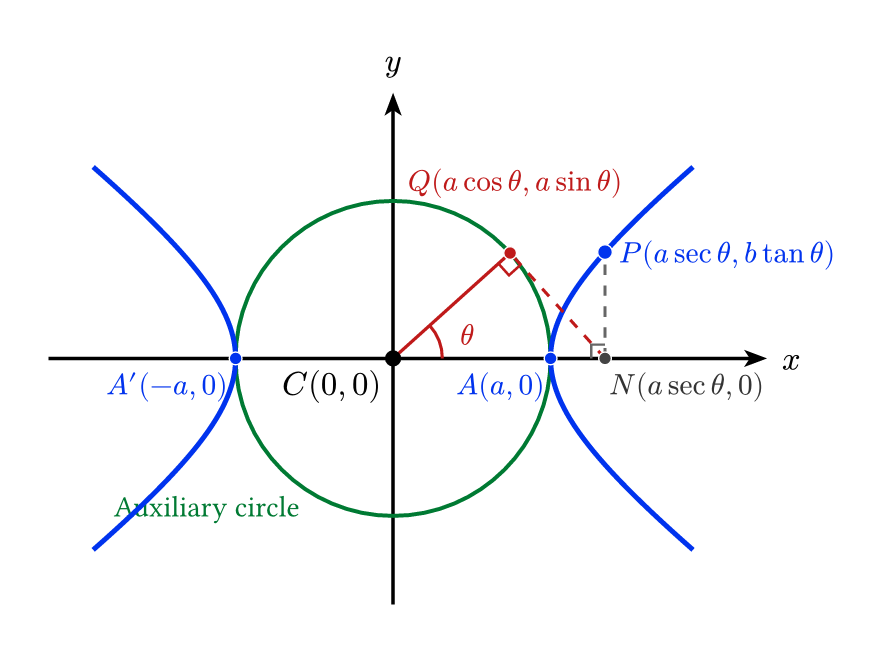
The circle described on the transverse axis \(A'A\) of a hyperbola as diameter is called the auxiliary circle of the hyperbola.
Since the diameter is \(A'A = 2a\), its center is \(C(0, 0)\) and its radius is \(a\). Therefore, the equation of the auxiliary circle is:
Comparison with the Ellipse: For an ellipse, \(|x| \le a\) and \(|y| \le b < a\), so the auxiliary circle encloses the ellipse. For a hyperbola, every point satisfies \(|x| \ge a\), while every point on the auxiliary circle satisfies \(|x| \le a\). Hence, the auxiliary circle lies between the two branches, touching the hyperbola only at its two vertices \(A(a, 0)\) and \(A'(-a, 0)\).
2. Geometric Construction of the Parametric Form
Let us see how the auxiliary circle generates the parametric coordinates \((a\sec\theta,\; b\tan\theta)\).
Corresponding Point on the Auxiliary Circle
Let \(P(x, y)\) be any point on the hyperbola \(\frac{x^2}{a^2} - \frac{y^2}{b^2} = 1\) (take \(x > a, y > 0\) in the first quadrant for clarity).
- Drop a perpendicular from \(P\) to the transverse axis (\(x\)-axis), meeting it at \(N(x, 0)\), so \(CN = x > a\).
- From \(N\), locate the point \(Q\) on the auxiliary circle \(x^2 + y^2 = a^2\) (on the same side of the \(x\)-axis as \(P\)) such that \(\angle CQN = 90^\circ\) (i.e., \(NQ \perp CQ\)).
- Join \(C\) to \(Q\), and let the radius \(CQ\) make an angle \(\theta\) with the positive \(x\)-axis:
Deriving the Parametric Coordinates
Since \(Q\) lies on the auxiliary circle of radius \(a\) at angle \(\theta\):
In the right-angled triangle \(\triangle CQN\) (right-angled at \(Q\)), we have \(CQ = a\) and hypotenuse \(CN = x\):
Now substitute \(x = a\sec\theta\) into the hyperbola equation \(\frac{x^2}{a^2} - \frac{y^2}{b^2} = 1\):
Choosing \(y\) with the same sign as \(\tan\theta\) gives the standard parametric equations of the hyperbola:
A point with parameter \(\theta\) is denoted \(P(\theta)\) or \((a\sec\theta, b\tan\theta)\), and \(\theta\) is called the eccentric angle of \(P\).
Eccentric Angle vs. Polar Angle
Just as in the ellipse, do not confuse the eccentric angle \(\theta\) with the polar angle \(\alpha = \angle PCA\) made by \(CP\) with the positive \(x\)-axis:
- \(\theta = \angle QCA\) is the angle of the auxiliary-circle radius \(CQ\).
- \(\alpha = \angle PCA\) satisfies:
So \(\theta\) and \(\alpha\) are not equal in general (they coincide only at the vertices \(A\) and \(A'\) when \(\theta = 0\) and \(\theta = \pi\)).
3. Tracing Both Branches as the Parameter Varies
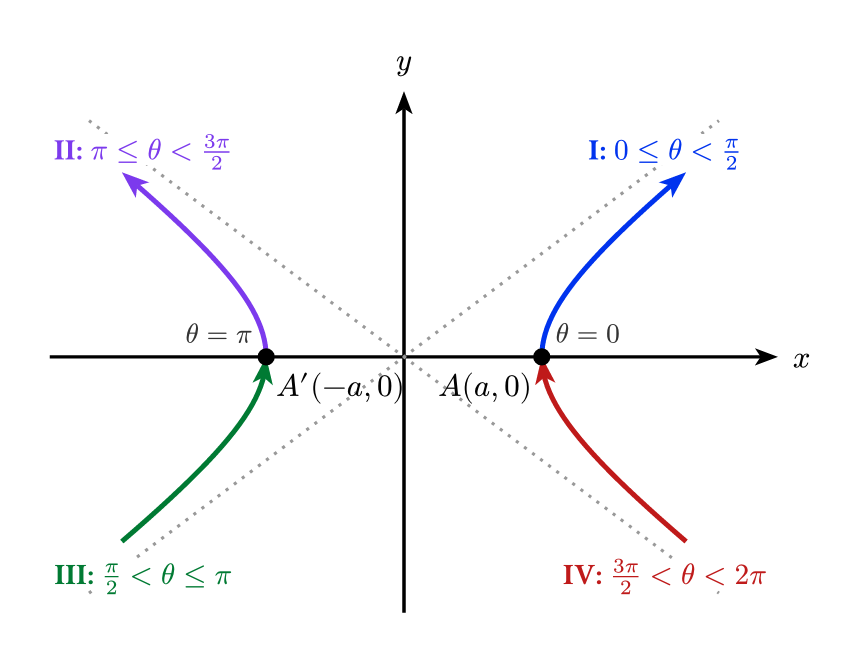
As \(\theta\) varies over \([0, 2\pi)\) (excluding \(\theta = \frac{\pi}{2}\) and \(\theta = \frac{3\pi}{2}\) where \(\sec\theta\) and \(\tan\theta\) are undefined), the point \(P(a\sec\theta, b\tan\theta)\) traces both branches of the hyperbola:
| Interval of \(\theta\) | Value & Sign of \(\sec\theta\) | Value & Sign of \(\tan\theta\) | Quadrant & Branch |
|---|---|---|---|
| \(0 \le \theta < \frac{\pi}{2}\) | \(\sec\theta \ge 1 \; (+)\) | \(\tan\theta \ge 0 \; (+)\) | Quadrant I (upper half of right branch) |
| \(\frac{\pi}{2} < \theta \le \pi\) | \(\sec\theta \le -1 \; (-)\) | \(\tan\theta \le 0 \; (-)\) | Quadrant III (lower half of left branch) |
| \(\pi \le \theta < \frac{3\pi}{2}\) | \(\sec\theta \le -1 \; (-)\) | \(\tan\theta \ge 0 \; (+)\) | Quadrant II (upper half of left branch) |
| \(\frac{3\pi}{2} < \theta < 2\pi\) | \(\sec\theta \ge 1 \; (+)\) | \(\tan\theta \le 0 \; (-)\) | Quadrant IV (lower half of right branch) |
Notice that as \(\theta\) approaches \(\frac{\pi}{2}\) or \(\frac{3\pi}{2}\), both \(|x|\) and \(|y|\) grow without bound—the point moves out along the asymptotes toward infinity!
4. Parametric Form for Vertical and Shifted Hyperbolas
The identity \(\sec^2\theta - \tan^2\theta = 1\) adapts immediately to vertical and shifted hyperbolas. Always match \(\sec\theta\) to the positive squared term (the transverse-axis direction) and \(\tan\theta\) to the negative squared term (the conjugate-axis direction).
Standard Vertical Hyperbola
For \(\frac{y^2}{b^2} - \frac{x^2}{a^2} = 1\):
- Transverse axis: Along the \(y\)-axis, length \(2b\).
- Auxiliary circle: \(x^2 + y^2 = b^2\) (circle on the transverse axis \(B'B\) as diameter).
- Parametric coordinates:
Check: \(\frac{(b\sec\theta)^2}{b^2} - \frac{(a\tan\theta)^2}{a^2} = \sec^2\theta - \tan^2\theta = 1\).
Shifted Horizontal Hyperbola
For \(\frac{(x - h)^2}{a^2} - \frac{(y - k)^2}{b^2} = 1\) with center \(C(h, k)\):
- Auxiliary circle: \((x - h)^2 + (y - k)^2 = a^2\)
- Parametric coordinates:
Shifted Vertical Hyperbola
For \(\frac{(y - k)^2}{b^2} - \frac{(x - h)^2}{a^2} = 1\) with center \(C(h, k)\):
- Auxiliary circle: \((x - h)^2 + (y - k)^2 = b^2\)
- Parametric coordinates:
5. Equation of a Chord and Focal Chord Condition
One of the greatest strengths of parametric coordinates is writing the equation of a chord joining two points \(P(\theta_1)\) and \(Q(\theta_2)\) cleanly.
Chord Joining Two Points on a Horizontal Hyperbola
Let \(P(a\sec\theta_1, b\tan\theta_1)\) and \(Q(a\sec\theta_2, b\tan\theta_2)\) be two points on \(\frac{x^2}{a^2} - \frac{y^2}{b^2} = 1\).
The slope of \(PQ\) is:
Using \(\sin(\theta_2 - \theta_1) = 2\sin\frac{\theta_2 - \theta_1}{2}\cos\frac{\theta_2 - \theta_1}{2}\) and \(\cos\theta_1 - \cos\theta_2 = 2\sin\frac{\theta_1 + \theta_2}{2}\sin\frac{\theta_2 - \theta_1}{2}\):
Writing the line \(y - b\tan\theta_1 = m(x - a\sec\theta_1)\) and simplifying gives the symmetric chord equation:
(You can verify directly that \((a\sec\theta_1, b\tan\theta_1)\) satisfies this by expanding \(\cos\left(\theta_1 - \frac{\theta_1 + \theta_2}{2}\right) = \cos\left(\frac{\theta_1 - \theta_2}{2}\right)\).)
Condition for a Focal Chord
If the chord \(PQ\) passes through the right focus \(S(ae, 0)\), substitute \(x = ae, y = 0\):
Applying componendo and dividendo (or dividing by \(\cos\frac{\theta_1}{2}\cos\frac{\theta_2}{2}\)):
Wait—watch the signs carefully: \(\cos(A + B) - \cos(A - B) = -2\sin A\sin B\) and \(\cos(A + B) + \cos(A - B) = 2\cos A\cos B\), so:
Similarly, if the chord passes through the left focus \(S'(-ae, 0)\), replacing \(e\) by \(-e\) gives:
6. Problems Where Parametric Form Wins
Example 1: Auxiliary Circle Connection and Polar Angle
A point \(P\) on the hyperbola \(\frac{x^2}{16} - \frac{y^2}{9} = 1\) has eccentric angle \(\theta = \frac{\pi}{3}\). Find:
- The Cartesian coordinates of \(P\),
- The coordinates of the corresponding point \(Q\) on the auxiliary circle, and
- The polar angle \(\alpha = \angle PCA\) made by \(CP\) with the positive \(x\)-axis.
Solution:
Here \(a^2 = 16 \implies a = 4\) and \(b^2 = 9 \implies b = 3\).
- Coordinates of \(P\):
So \(P = (8,\; 3\sqrt{3})\).
- Corresponding point \(Q\) on the auxiliary circle \(x^2 + y^2 = 16\):
(Check: \(CQ \cdot CN\)? Let \(N = (8, 0)\). Then \(CQ^2 + QN^2 = 16 + (36 + 12) = 64 = CN^2\), confirming \(\angle CQN = 90^\circ\)!)
- Polar angle \(\alpha = \angle PCA\):
Notice \(\alpha \approx 33^\circ\), which is clearly different from the eccentric angle \(\theta = 60^\circ\).
Example 2: Harmonic Property of a Focal Chord (Parametric Win)
If \(PQ\) is a focal chord on the right branch of the hyperbola \(\frac{x^2}{a^2} - \frac{y^2}{b^2} = 1\) passing through \(S(ae, 0)\), prove that
Solution:
Trying to solve this in Cartesian coordinates by intersecting a line \(y = m(x - ae)\) with the hyperbola requires heavy quadratic root algebra. With parametric coordinates, the half-angle substitution makes it effortless!
Let \(P(\theta_1)\) and \(Q(\theta_2)\) be on the right branch (\(\sec\theta_1 > 0, \sec\theta_2 > 0\)). From Section 01, the focal distance of any point on the right branch is:
Let \(t_1 = \tan\frac{\theta_1}{2}\) and \(t_2 = \tan\frac{\theta_2}{2}\). Using \(\sec\theta = \frac{1 + t^2}{1 - t^2}\):
Since \(PQ\) passes through \(S(ae, 0)\), the focal chord condition gives \(t_1 t_2 = \frac{1 - e}{1 + e}\), so \(t_2 = -\frac{e - 1}{(e + 1)t_1}\). Substituting \(t_2\) into \(e\sec\theta_2 - 1\):
Now add the reciprocals:
Expanding the numerator:
The factor \(\left[(e - 1) + (e + 1)t_1^2\right]\) cancels completely! Thus:
Dividing by \(a\) and recalling that \(b^2 = a^2(e^2 - 1)\):
Example 3: Minimum Distance from a Shifted Hyperbola to a Line
Find the shortest distance from any point \(P\) on the shifted hyperbola \(\frac{(x - 1)^2}{9} - \frac{(y + 2)^2}{16} = 1\) to the line \(5x - 3y - 11 = 0\).
Solution:
Here \(h = 1, k = -2, a = 3, b = 4\). Any point on this shifted horizontal hyperbola can be written as:
The perpendicular distance \(d\) from \(P(\theta)\) to the line \(5x - 3y - 11 = 0\) is:
To minimize \(d\), we need the minimum value of \(|k|\), where \(k = 15\sec\theta - 12\tan\theta\). Multiply through by \(\cos\theta\):
By the standard trigonometric bound \(|A\cos\theta + B\sin\theta| \le \sqrt{A^2 + B^2}\), we must have:
Therefore, the minimum distance is:
Example 4: Locus on a Shifted Vertical Hyperbola
A point \(P\) moves on the shifted vertical hyperbola \(\frac{(y - 1)^2}{9} - \frac{(x + 2)^2}{16} = 1\). Find the locus of the centroid \(G\) of \(\triangle CPS\), where \(C(-2, 1)\) is the center and \(S(-2, 6)\) is the upper focus.
Solution:
For \(\frac{(y - 1)^2}{9} - \frac{(x + 2)^2}{16} = 1\), we have \(h = -2, k = 1, b = 3, a = 4\), and indeed \(be = \sqrt{b^2 + a^2} = 5\), so \(S(-2, 1 + 5) = (-2, 6)\).
Take any point \(P\) on this shifted vertical hyperbola in parametric form:
Let \(G(x, y)\) be the centroid of \(\triangle CPS\). Averaging the coordinates of \(C(-2, 1)\), \(S(-2, 6)\), and \(P(-2 + 4\tan\theta, 1 + 3\sec\theta)\):
Eliminate \(\theta\) immediately using \(\sec^2\theta - \tan^2\theta = 1\):
This is a shifted vertical hyperbola centered at \(\left(-2, \frac{8}{3}\right)\), obtained in just a few lines without solving any quadratic equations.
7. Quick Reference Summary
| Hyperbola Form | Auxiliary Circle | Parametric Coordinates \((x, y)\) |
|---|---|---|
| \(\dfrac{x^2}{a^2} - \dfrac{y^2}{b^2} = 1\) | \(x^2 + y^2 = a^2\) | \((a\sec\theta,\; b\tan\theta)\) |
| \(\dfrac{y^2}{b^2} - \dfrac{x^2}{a^2} = 1\) | \(x^2 + y^2 = b^2\) | \((a\tan\theta,\; b\sec\theta)\) |
| \(\dfrac{(x - h)^2}{a^2} - \dfrac{(y - k)^2}{b^2} = 1\) | \((x - h)^2 + (y - k)^2 = a^2\) | \((h + a\sec\theta,\; k + b\tan\theta)\) |
| \(\dfrac{(y - k)^2}{b^2} - \dfrac{(x - h)^2}{a^2} = 1\) | \((x - h)^2 + (y - k)^2 = b^2\) | \((h + a\tan\theta,\; k + b\sec\theta)\) |