Rectangular Hyperbola
In our study of conic sections, we have encountered standard curves whose geometric behavior simplifies dramatically under special symmetry conditions. For an ellipse, setting the semi-major axis equal to the semi-minor axis (\(a = b\)) collapses the eccentricity to zero and produces a circle.
What happens when we impose the exact same condition \(a = b\) on a hyperbola?
Instead of collapsing into a circle, the hyperbola unfolds into one of the most elegant curves in all of mathematics: the rectangular hyperbola (also historically known as an equilateral hyperbola). In this chapter, we explore its standard geometry, its transformation into the familiar reciprocal form \(xy = c^2\) via a \(45^\circ\) coordinate rotation, its tangency and normal conditions, and the remarkable geometric theorems that make it a favorite subject in competitive examinations like JEE.
Definition and Standard Form
A hyperbola whose semi-transverse axis \(a\) is equal to its semi-conjugate axis \(b\) is called a rectangular hyperbola or equilateral hyperbola.
Taking the standard equation of a horizontal hyperbola:
and substituting \(b = a\), we obtain the standard equation:
Geometric Features of the Standard Rectangular Hyperbola
Let us compute the fundamental parameters of \(x^2 - y^2 = a^2\):
1. Eccentricity (\(e\)): Recall the eccentricity formula for a hyperbola:
Setting \(b = a\):
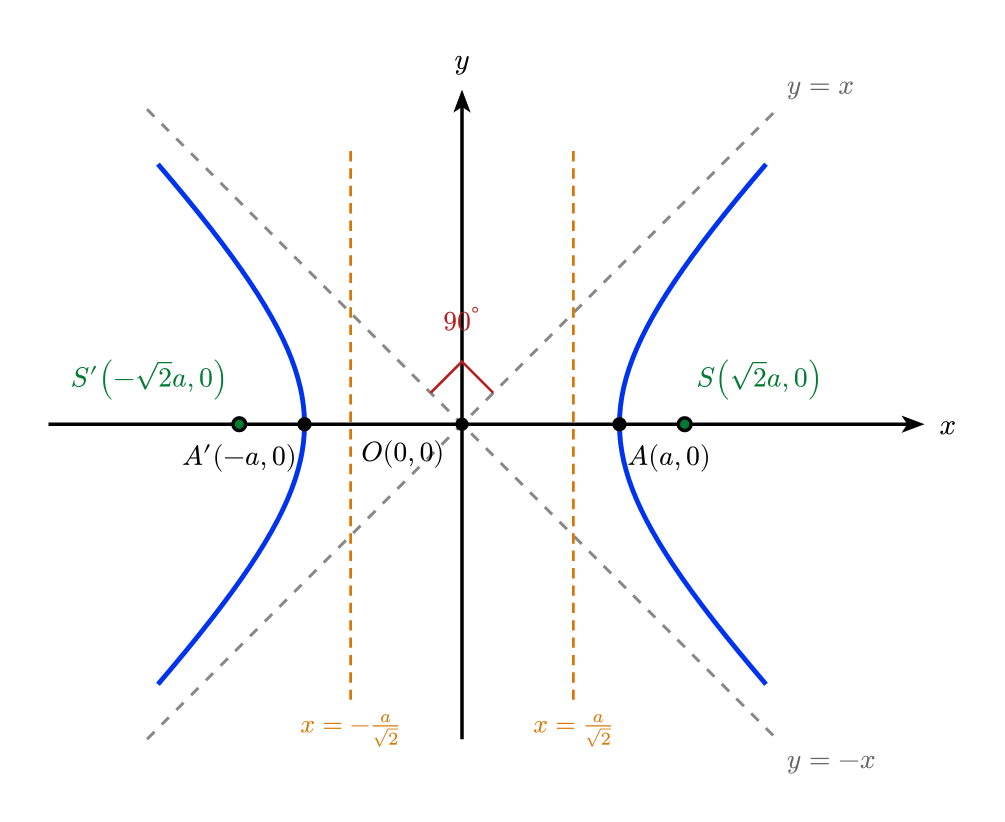
Every rectangular hyperbola has an eccentricity strictly equal to \(\sqrt{2}\), completely independent of the scale parameter \(a\).
2. Asymptotes: The equations of the asymptotes to \(\frac{x^2}{a^2} - \frac{y^2}{b^2} = 1\) are \(y = \pm \frac{b}{a} x\). Substituting \(b = a\) gives:
The slopes of the two asymptotes are \(m_1 = 1\) and \(m_2 = -1\). Notice that:
The asymptotes are mutually perpendicular (they intersect at an angle of \(90^\circ\)). This perpendicular (right-angled) relationship is precisely why the curve is named a rectangular hyperbola.
3. Foci: The focal distance from the center is \(c_{\text{focal}} = ae = a\sqrt{2}\). The foci are:
4. Directrices: The directrices are located at \(x = \pm \frac{a}{e}\):
5. Vertices: The vertices lie on the transverse axis (\(x\)-axis) at:
6. Length of Latus Rectum:
The length of the latus rectum equals the length of the transverse axis (\(2a\)).
Rotation of Axes by 45 Degrees
In the standard Cartesian orientation, the asymptotes are the lines \(y = x\) and \(y = -x\), inclined at \(45^\circ\) and \(135^\circ\) to the positive \(x\)-axis.
Because the asymptotes are perpendicular straight lines, they form an ideal candidate for a new Cartesian coordinate system! What happens if we rotate our coordinate axes clockwise by \(45^\circ\) so that the coordinate axes coincide with the asymptotes?
Derivation of the Transformation
To rotate the coordinate axes clockwise by \(45^\circ\), the angle of rotation is \(\theta = -45^\circ\).
Recall the standard rotation transformation formulas expressing the old coordinates \((x, y)\) in terms of the new coordinates \((X, Y)\):
Substituting \(\theta = -45^\circ\):
This gives:
Now, substitute these expressions for \(x\) and \(y\) into the equation \(x^2 - y^2 = a^2\):
Expanding the squares:
Notice that the \(X^2\) and \(Y^2\) terms cancel out completely:
Dividing both sides by \(2\):
Defining the positive constant \(c^2 = \frac{a^2}{2}\) (so that \(c = \frac{a}{\sqrt{2}}\)), and returning to lowercase notation \((x, y)\) for the new coordinate axes, we arrive at the classic equation:
Anatomy of the Rectangular Hyperbola xy = c^2
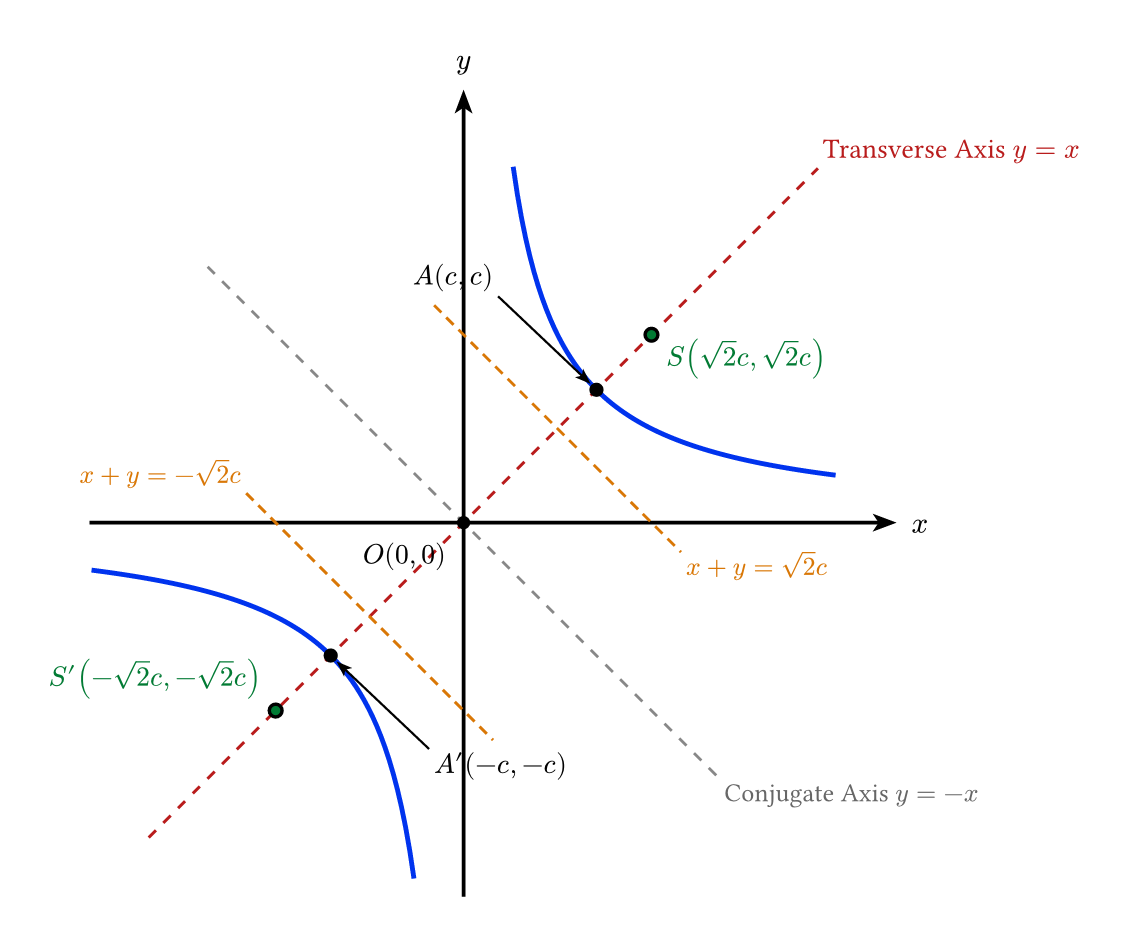
The equation \(xy = c^2\) represents a rectangular hyperbola whose asymptotes are the coordinate axes (\(x = 0\) and \(y = 0\)).
Since \(c^2 > 0\), the product \(xy\) is always positive. This means:
- If \(x > 0\), then \(y > 0\) (the curve lies in Quadrant I).
- If \(x < 0\), then \(y < 0\) (the curve lies in Quadrant III).
No point on \(xy = c^2\) can lie in Quadrant II or Quadrant IV.
Geometric Parameters of the Rotated Hyperbola
Let us establish every geometric parameter of \(xy = c^2\) using the relation \(c = \frac{a}{\sqrt{2}}\) (or \(a = c\sqrt{2}\)):
1. Center: The center is the point of intersection of the two asymptotes (the origin):
2. Asymptotes: The asymptotes are the coordinate axes themselves:
3. Transverse Axis: In the original system, the transverse axis was the line \(y = 0\). Substituting the transformation \(y = \frac{Y - X}{\sqrt{2}} = 0\), we find \(Y = X\). Thus, the transverse axis is the line:
Length of the transverse axis: \(2a = 2(c\sqrt{2}) = 2\sqrt{2}c\).
4. Conjugate Axis: In the original system, the conjugate axis was the line \(x = 0\). Substituting \(x = \frac{X + Y}{\sqrt{2}} = 0\), we find \(Y = -X\). Thus, the conjugate axis is the line:
Length of the conjugate axis: \(2b = 2a = 2\sqrt{2}c\).
5. Vertices: The vertices are the points where the hyperbola intersects its transverse axis \(y = x\). Substituting \(y = x\) into \(xy = c^2\):
Therefore, the vertices are:
The distance from the center \(O(0, 0)\) to each vertex is \(\sqrt{c^2 + c^2} = c\sqrt{2} = a\).
6. Foci: The foci lie on the transverse axis \(y = x\) at a distance \(ae = (c\sqrt{2})(\sqrt{2}) = 2c\) from the center. Moving a distance \(2c\) along the line \(y = x\) (inclined at \(45^\circ\) to the positive \(x\)-axis):
Therefore, the foci are:
The distance between the two foci is \(2(2c) = 4c\).
7. Directrices: In the original system, the directrices were \(x = \pm \frac{a}{\sqrt{2}} = \pm c\). Substituting \(x = \frac{X + Y}{\sqrt{2}}\):
Therefore, the directrices are the straight lines:
Notice that these directrices are perpendicular to the transverse axis \(y = x\) (slopes \(-1\) and \(+1\)).
8. Length of Latus Rectum:
Conjugate Rectangular Hyperbola
What if the product \(xy\) is negative? That is:
Since \(xy < 0\), the branches must lie in Quadrant II (\(x < 0, y > 0\)) and Quadrant IV (\(x > 0, y < 0\)).
This curve is the conjugate hyperbola of \(xy = c^2\). Its geometric properties are:
- Center: \((0, 0)\)
- Asymptotes: \(x = 0\) and \(y = 0\) (the coordinate axes)
- Transverse Axis: \(y = -x\) (length \(2\sqrt{2}c\))
- Conjugate Axis: \(y = x\) (length \(2\sqrt{2}c\))
- Vertices: \((-c, c)\) and \((c, -c)\)
- Foci: \((-c\sqrt{2}, c\sqrt{2})\) and \((c\sqrt{2}, -c\sqrt{2})\)
- Directrices: \(x - y = \pm c\sqrt{2}\)
- Eccentricity: \(e = \sqrt{2}\)
Shifted Rectangular Hyperbola and General Form
If the center of the rectangular hyperbola is translated from \((0, 0)\) to \((h, k)\), while keeping the asymptotes parallel to the coordinate axes, its equation becomes:
For this shifted curve:
- Center: \((h, k)\)
- Asymptotes: \(x = h\) and \(y = k\)
- Transverse Axis: \(y - k = x - h \implies y - x = k - h\)
- Conjugate Axis: \(y - k = -(x - h) \implies y + x = k + h\)
- Vertices: \((h + c, k + c)\) and \((h - c, k - c)\)
- Foci: \((h + c\sqrt{2}, k + c\sqrt{2})\) and \((h - c\sqrt{2}, k - c\sqrt{2})\)
The General Equation Axy + Bx + Cy + D = 0
In many exam problems, the equation of a rectangular hyperbola whose asymptotes are parallel to the axes is given in expanded form:
We can systematically reduce this to standard shifted form \((x - h)(y - k) = c^2\) using algebraic factorization:
Step 1: Multiply the entire equation by \(A\):
Step 2: Group the terms to complete the product of two binomials:
Step 3: Move the constant term to the right-hand side:
Step 4: Divide both sides by \(A^2\):
Comparing this directly with \((x - h)(y - k) = c^2\), we extract the key parameters:
- Center: \((h, k) = \left(-\frac{C}{A}, -\frac{B}{A}\right)\)
- Asymptotes: \(x = -\frac{C}{A}\) and \(y = -\frac{B}{A}\)
- Scale Constant: \(c^2 = \frac{BC - AD}{A^2}\)
Important Note (Non-Degeneracy Condition):
If \(BC - AD = 0\), the equation factorizes into \((Ax + C)(Ay + B) = 0\), which represents a pair of perpendicular straight lines intersecting at \((h, k)\). For the equation to represent a genuine rectangular hyperbola, we must have \(BC - AD \neq 0\).If \(\frac{BC - AD}{A^2} > 0\), the branches lie in Quadrants I and III relative to the center \((h, k)\). If \(\frac{BC - AD}{A^2} < 0\), the branches lie in Quadrants II and IV relative to \((h, k)\).
Condition of Tangency
Let us determine when the line \(y = mx + d\) is tangent to the rectangular hyperbola \(xy = c^2\).
Substitute \(y = mx + d\) into \(xy = c^2\):
This is a quadratic equation in \(x\). The line is tangent to the hyperbola if and only if this quadratic equation has two equal real roots, which requires the discriminant \(\Delta\) to be zero:
Critical Insight: Sign of the Slope m
Because \(d^2 \ge 0\) for real lines and \(c^2 > 0\), the condition \(d^2 = -4mc^2\) forces:
Crucial Geometric Insight (Sign of Slope \(m\)):
All tangents to \(xy = c^2\) must have strictly negative slope (\(m < 0\))!Geometrically, this is self-evident: the branches of \(xy = c^2\) reside entirely in Quadrants I and III, where \(y = c^2/x\). Since \(\frac{dy}{dx} = -\frac{c^2}{x^2} < 0\) everywhere, the curve slopes downwards from top-left to bottom-right at every single point. No line with a positive or zero slope can ever touch \(xy = c^2\)!
Solving for \(d\):
The equation of a tangent of slope \(m\) (\(m < 0\)) to \(xy = c^2\) is:
The \(x\)-coordinate of the point of contact is the repeated root \(x = -\frac{d}{2m}\):
and the corresponding \(y\)-coordinate is:
Condition of Tangency for xy = -c^2
For the conjugate rectangular hyperbola \(xy = -c^2\), substitution yields:
Here, tangency requires \(m > 0\) strictly! Every tangent to \(xy = -c^2\) must have a positive slope:
Parametric Form P(ct, c/t)
The simplest and most powerful way to analyze \(xy = c^2\) is through parametric coordinates.
For any point \(P(x, y)\) on \(xy = c^2\), if we set \(x = ct\), then:
Thus, any point on \(xy = c^2\) can be uniquely represented by a single non-zero real parameter \(t\):
- When \(t > 0\), \(x > 0\) and \(y > 0\), tracing the branch in Quadrant I.
- As \(t \to +\infty\), \((ct, c/t) \to (+\infty, 0)\), approaching the positive \(x\)-axis.
- As \(t \to 0^+\), \((ct, c/t) \to (0, +\infty)\), approaching the positive \(y\)-axis.
- At \(t = 1\), we reach the vertex \(A(c, c)\).
- When \(t < 0\), \(x < 0\) and \(y < 0\), tracing the branch in Quadrant III.
- At \(t = -1\), we reach the opposite vertex \(A'(-c, -c)\).
Equation of Tangent at P(t)
Differentiating \(y = \frac{c^2}{x}\) with respect to \(x\):
Using the point-slope form with point \(\left(ct, \frac{c}{t}\right)\) and slope \(-\frac{1}{t^2}\):
Multiply through by \(t^2\):
Dividing the entire equation by \(t\), we obtain the remarkably symmetric form:
Cartesian Form (\(T = 0\)):
For the curve \(xy - c^2 = 0\), replacing \(xy\) by \(\frac{xy_1 + x_1 y}{2}\) gives the tangent equation \(x y_1 + x_1 y = 2c^2\). Substituting the parametric coordinates \((x_1, y_1) = (ct, c/t)\) recovers \(x\left(\frac{c}{t}\right) + (ct)y = 2c^2 \implies \frac{x}{t} + yt = 2c\).
Equation of Normal at P(t)
The slope of the tangent at \(P(t)\) is \(m_T = -\frac{1}{t^2}\).
Since the normal is perpendicular to the tangent:
Using the point-slope form with point \(\left(ct, \frac{c}{t}\right)\) and slope \(t^2\):
Multiply through by \(t\):
Rearranging terms gives the standard equation of the normal:
or written as:
Equation of Chord Joining P(t1) and Q(t2)
Let \(P(ct_1, c/t_1)\) and \(Q(ct_2, c/t_2)\) be two distinct points on \(xy = c^2\) (\(t_1 \neq t_2\)).
The slope of the secant line \(PQ\) is:
Using the point-slope form through \(P(ct_1, c/t_1)\):
Multiply through by \(t_1 t_2\):
Connection to Tangent Line:
When \(t_2 \to t_1 = t\), the secant chord becomes the tangent line \(x + t^2 y = 2ct\).
Five Landmark Theorems of the Rectangular Hyperbola
Because of its extraordinary symmetry, the rectangular hyperbola satisfies five classic geometric theorems that appear frequently in advanced coordinate geometry.
Theorem 1: Point of Contact as Midpoint of Tangent Intercept
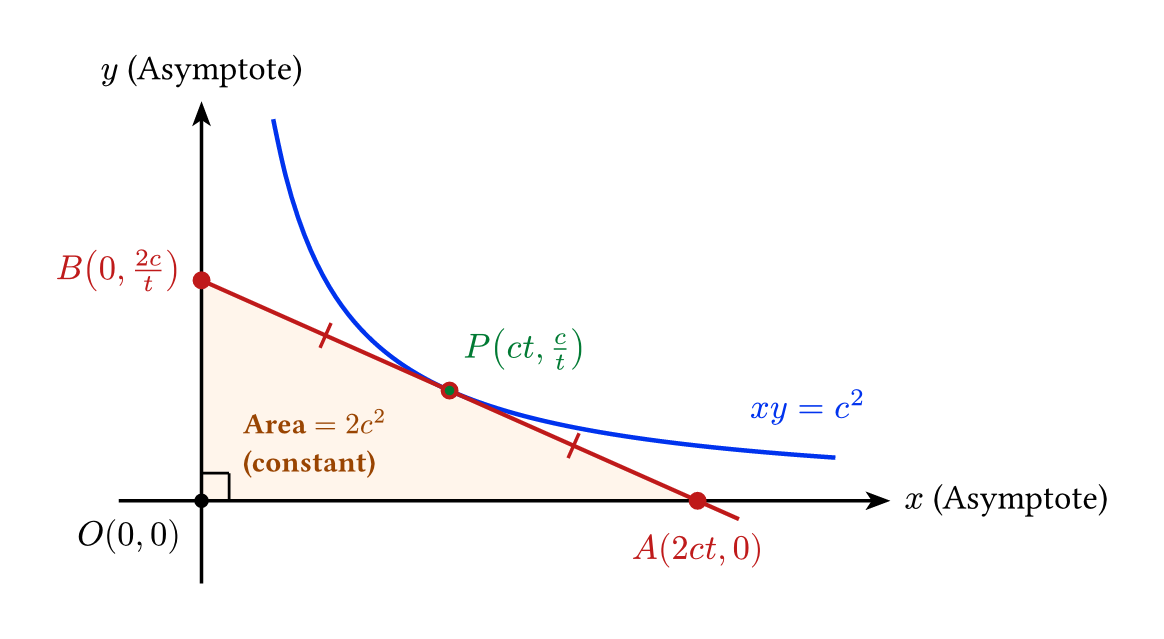
Statement: The segment of any tangent to a rectangular hyperbola intercepted between its asymptotes is bisected at the point of contact.
Proof: Consider the tangent at \(P(ct, c/t)\) to \(xy = c^2\):
The asymptotes are the \(x\)-axis (\(y = 0\)) and the \(y\)-axis (\(x = 0\)). Let the tangent intersect the asymptotes at points \(A\) and \(B\):
Intersection with the \(x\)-axis (\(y = 0\)):
Intersection with the \(y\)-axis (\(x = 0\)):
Now compute the midpoint \(M\) of segment \(AB\):
Thus, the point of contact \(P\) is the exact midpoint of \(AB\):
This completes the proof. \(\blacksquare\)
Theorem 2: Constant Area of Tangent Triangle
Statement: The area of the triangle formed by any tangent to a rectangular hyperbola and its asymptotes is constant and equal to \(2c^2 = a^2\).
Proof: From Theorem 1, the tangent at \(P(ct, c/t)\) meets the asymptotes (coordinate axes) at \(A(2ct, 0)\) and \(B(0, 2c/t)\).
Since the asymptotes are perpendicular, \(\triangle OAB\) is a right-angled triangle with legs along the axes:
The area of \(\triangle OAB\) is:
Recall from our rotation derivation that \(c^2 = \frac{a^2}{2} \implies 2c^2 = a^2\).
Therefore:
The area is completely independent of the parameter \(t\) and point of contact \(P\)!
This completes the proof. \(\blacksquare\)
Theorem 3: Normal Meeting the Hyperbola Again
Statement: If the normal at point \(P(t)\) on the rectangular hyperbola \(xy = c^2\) meets the curve again at point \(Q(t')\), then \(t' = -\frac{1}{t^3}\).
Proof: The equation of the normal to \(xy = c^2\) at \(P(ct, c/t)\) is:
Since the point \(Q(ct', c/t')\) lies on this normal line, its coordinates must satisfy the equation:
Dividing both sides by the non-zero constant \(c\):
Multiply the entire equation by \(t'\):
Rearranging into a quadratic in \(t'\):
We already know that \(t' = t\) must be a root of this quadratic, because the normal line by definition passes through \(P(t)\)!
Factoring out \((t' - t)\):
Since \(Q\) is the second point of intersection (\(t' \neq t\)), we must have:
The coordinates of \(Q\) are therefore:
This completes the proof. \(\blacksquare\)
Theorem 4: Orthocenter of an Inscribed Triangle
Statement: If a triangle is inscribed in a rectangular hyperbola, its orthocenter also lies on the hyperbola.
Proof: Let the vertices of the inscribed triangle be \(A(t_1)\), \(B(t_2)\), and \(C(t_3)\) on \(xy = c^2\), where:
From our chord formula, the slope of side \(BC\) joining \(B(t_2)\) and \(C(t_3)\) is:
The altitude drawn from vertex \(A\) is perpendicular to \(BC\), so its slope is:
The equation of the altitude from \(A\left(ct_1, \frac{c}{t_1}\right)\) is:
By cyclical symmetry, the altitude from vertex \(B\left(ct_2, \frac{c}{t_2}\right)\) perpendicular to \(AC\) has slope \(t_1 t_3\), and its equation is:
The orthocenter \(H(x_H, y_H)\) is the intersection of these two altitudes. Subtracting the second equation from the first:
Dividing both sides by \((t_1 - t_2) \neq 0\):
Now substitute \(x_H\) back into the altitude equation to find \(y_H\):
Now, multiply the coordinates of the orthocenter \(H\):
Because \(x_H y_H = c^2\), the orthocenter \(H\) lies directly on the rectangular hyperbola!
Moreover, its parametric coordinate is:
This completes the proof. \(\blacksquare\)
Theorem 5: Concyclic Points on a Rectangular Hyperbola
Statement: If a circle intersects the rectangular hyperbola \(xy = c^2\) in four distinct points with parameters \(t_1, t_2, t_3, t_4\), then \(t_1 t_2 t_3 t_4 = 1\).
Proof: Let the equation of any circle in the plane be:
To find where this circle intersects \(xy = c^2\), substitute the parametric point \(\left(ct, \frac{c}{t}\right)\):
Multiply the entire equation by \(t^2\) to eliminate fractions:
This is a degree-4 polynomial (quartic equation) in \(t\). Its four roots \(t_1, t_2, t_3, t_4\) are the parameters of the four intersection points.
Applying Vieta's formulas for the product of roots:
This completes the proof. \(\blacksquare\)
Remarkable Consequences of Concyclic Points
Vieta's formulas for the quartic \(c^2 t^4 + 2gc t^3 + k t^2 + 2fc t + c^2 = 0\) give three additional powerful relationships:
1. Sum of Roots:
2. Sum of Reciprocal Roots:
Dividing the third Vieta relation \(\sum t_1 t_2 t_3 = -\frac{2fc}{c^2} = -\frac{2f}{c}\) by \(t_1 t_2 t_3 t_4 = 1\):
3. Centroid and Circle Center:
The centroid \(G(\bar{x}, \bar{y})\) of the four concyclic points is:
The center of the intersecting circle is \(C_{\text{circle}}(-g, -f)\). Comparing coordinates:
The center of the circle is exactly twice the centroid of the four concyclic points!
4. Circumcircle and Orthocenter Connection:
If three points \(A(t_1), B(t_2), C(t_3)\) define an inscribed triangle, their circumcircle intersects the hyperbola in a fourth point \(D(t_4)\). From \(t_1 t_2 t_3 t_4 = 1\):
Recall from Theorem 4 that the orthocenter of \(\triangle ABC\) is \(H(t_H)\) with parameter:
Since \(t_H = -t_4\), the point \(H\) has coordinates \(\left(-ct_4, -\frac{c}{t_4}\right) = -D\).
Thus, the orthocenter \(H\) and the fourth point of intersection \(D\) are diametrically opposite points with respect to the center \((0, 0)\) of the hyperbola!
Worked Examples
Example 1: Standard Rectangular Hyperbola Parameters
Find the eccentricity, coordinates of the foci, equations of the directrices, and equations of the asymptotes of the hyperbola:
Solution:
1. Semi-transverse axis \(a\):
Comparing \(x^2 - y^2 = 16\) with \(x^2 - y^2 = a^2\):
2. Eccentricity:
Since the coefficients of \(x^2\) and \(y^2\) are equal and opposite (\(a = b = 4\)), this is a rectangular hyperbola:
3. Foci:
The focal distance is \(ae = 4\sqrt{2}\). The foci are:
4. Directrices:
The equations of the directrices are:
5. Asymptotes:
The equations of the asymptotes are:
Example 2: Factorizing the General Form
Find the center, asymptotes, and the value of \(c^2\) for the rectangular hyperbola:
Solution:
Step 1: Multiply by the leading coefficient \(A = 2\):
Step 2: Group the linear terms into binomial factors:
Verify the expansion: \((2x + 6)(2y - 4) = 4xy - 8x + 12y - 24\). Adding \(10\) recovers the equation:
Step 3: Factor out the leading coefficients:
Step 4: Extract geometric parameters:
Comparing with \((x - h)(y - k) = -c^2\):
- Center: \((h, k) = (-3, 2)\)
- Asymptotes: \(x = -3\) and \(y = 2\)
- Scale constant: \(c^2 = \frac{5}{2}\) (since the right side is negative, the branches lie in Quadrants II and IV relative to the center \((-3, 2)\)).
Example 3: Tangent of Given Slope
Find the equations of the tangents to the rectangular hyperbola \(xy = 18\) that are perpendicular to the line \(x - 2y + 7 = 0\).
Solution:
Step 1: Determine the required slope:
The given line \(x - 2y + 7 = 0\) has slope \(m_{\text{line}} = \frac{1}{2}\). Since the required tangent is perpendicular to this line, its slope \(m\) must satisfy:
Notice that \(m = -2 < 0\), which satisfies the mandatory condition that all tangents to \(xy = c^2\) must have strictly negative slope.
Step 2: Apply the condition of tangency:
Here \(c^2 = 18\). The condition of tangency for slope \(m\) is \(d = \pm 2c\sqrt{-m}\):
Step 3: Form the tangent equations:
The equations of the two tangents are:
or in general linear form:
Example 4: Verifying the Midpoint and Constant Area Properties
For the rectangular hyperbola \(xy = 16\), find the equation of the tangent at \(P(8, 2)\). Determine its intercepts on the coordinate axes, verify that \(P\) is their midpoint, and compute the area of the triangle formed by the tangent and the axes.
Solution:
Step 1: Identify the parameter \(t\):
Here \(c^2 = 16 \implies c = 4\).
At \(P(8, 2)\), setting \(x = ct\) gives \(8 = 4t \implies t = 2\).
Check: \(y = c/t = 4/2 = 2\).
Step 2: Equation of the tangent:
Using \(x + t^2 y = 2ct\) at \(t = 2\):
Step 3: Find the intercepts on the axes:
- For the \(x\)-intercept (\(y = 0\)): \(x = 16 \implies A(16, 0)\).
- For the \(y\)-intercept (\(x = 0\)): \(4y = 16 \implies y = 4 \implies B(0, 4)\).
Step 4: Verify the midpoint property:
The midpoint \(M\) of segment \(AB\) is:
The point of contact \(P(8, 2)\) is indeed the midpoint of \(AB\)!
Step 5: Compute the area of \(\triangle OAB\):
Notice that \(2c^2 = 2(16) = 32\). The area equals \(2c^2\) exactly, independent of \(t\).
Example 5: Normal Meeting the Hyperbola Again
A normal is drawn to the rectangular hyperbola \(xy = 4\) at the point \(P\) where \(t = 2\). Find:
- The equation of the normal.
- The coordinates of the second point \(Q\) where the normal intersects the hyperbola.
- The length of the normal chord \(PQ\).
Solution:
1. Equation of the normal:
Here \(c = 2\). At \(t = 2\), the point is \(P(ct, c/t) = (4, 1)\).
The equation of the normal at \(t = 2\) is:
2. Second point of intersection \(Q\):
Using Theorem 3, the second point of intersection has parameter:
The coordinates of \(Q\) are:
Thus, \(Q = \left(-\frac{1}{4}, -16\right)\).
(Check: \(4x_Q - y_Q = 4(-1/4) - (-16) = -1 + 16 = 15\), which satisfies the normal equation.)
3. Length of the normal chord \(PQ\):
Factoring out \(17\):
Example 6: Orthocenter of Inscribed Triangle
A triangle is inscribed in the rectangular hyperbola \(xy = 9\) with vertices corresponding to parameters \(t_1 = 1\), \(t_2 = 2\), and \(t_3 = 3\).
- Find the coordinates of the three vertices.
- Find the coordinates of the orthocenter of the triangle.
- Verify that the orthocenter lies on the hyperbola.
Solution:
1. Coordinates of the vertices:
Here \(c = 3\).
- Vertex \(A(t_1 = 1)\): \(\left(3(1), \frac{3}{1}\right) = (3, 3)\)
- Vertex \(B(t_2 = 2)\): \(\left(3(2), \frac{3}{2}\right) = \left(6, \frac{3}{2}\right)\)
- Vertex \(C(t_3 = 3)\): \(\left(3(3), \frac{3}{3}\right) = (9, 1)\)
2. Coordinates of the orthocenter:
From Theorem 4, the parameter of the orthocenter \(H\) is:
Therefore, the coordinates of \(H\) are:
Thus, \(H = \left(-\frac{1}{2}, -18\right)\).
3. Verification:
Check if \(H\) satisfies \(xy = 9\):
The orthocenter lies directly on the rectangular hyperbola.
Example 7: Circle and Centroid Relation
A circle intersects the rectangular hyperbola \(xy = 1\) in four points \(P, Q, R, S\). If the mean (centroid) of these four points is \(\left(\frac{3}{2}, 2\right)\), find:
- The center of the circle.
- The product of the abscissae (x-coordinates) of the four points.
Solution:
1. Center of the circle:
Here \(c = 1\). Let the parameters of the four points be \(t_1, t_2, t_3, t_4\).
The centroid \(G(\bar{x}, \bar{y})\) of the four points is given as:
From our concyclic points theorem:
The center of the circle is \((-g, -f) = (3, 4)\).
Notice this is simply \(2G = 2\left(\frac{3}{2}, 2\right) = (3, 4)\)!
2. Product of the abscissae:
The \(x\)-coordinates of the points are \(x_i = ct_i = t_i\) (since \(c = 1\)):
The product of the abscissae is \(1\).
Summary of Key Formulas
| Property | Standard Form \(x^2 - y^2 = a^2\) | Rotated Form \(xy = c^2\) (\(c = a/\sqrt{2}\)) |
|---|---|---|
| Eccentricity (\(e\)) | \(\sqrt{2}\) | \(\sqrt{2}\) |
| Center | \((0, 0)\) | \((0, 0)\) |
| Asymptotes | \(y = \pm x\) (\(90^\circ\) angle) | \(x = 0\) and \(y = 0\) (coordinate axes) |
| Transverse Axis | \(y = 0\) (\(x\)-axis, length \(2a\)) | \(y = x\) (length \(2\sqrt{2}c = 2a\)) |
| Conjugate Axis | \(x = 0\) (\(y\)-axis, length \(2a\)) | \(y = -x\) (length \(2\sqrt{2}c = 2a\)) |
| Vertices | \((\pm a, 0)\) | \((c, c)\) and \((-c, -c)\) |
| Foci | \((\pm a\sqrt{2}, 0)\) | \((c\sqrt{2}, c\sqrt{2})\) and \((-c\sqrt{2}, -c\sqrt{2})\) |
| Directrices | \(x = \pm \frac{a}{\sqrt{2}}\) | \(x + y = \pm c\sqrt{2}\) |
| Length of L.R. | \(2a\) | \(2\sqrt{2}c = 2a\) |
| Parametric Point | \((a\sec\theta, a\tan\theta)\) | \(\left(ct, \frac{c}{t}\right)\) |
| Tangent at \(P\) | \(\frac{x\sec\theta}{a} - \frac{y\tan\theta}{a} = 1\) | \(x + t^2 y = 2ct\) (or \(\frac{x}{t} + yt = 2c\)) |
| Normal at \(P\) | \(ax\cos\theta + ay\cot\theta = 2a^2\) | \(xt^3 - yt = c(t^4 - 1)\) |
| Chord \(P(t_1)Q(t_2)\) | — | \(x + t_1 t_2 y = c(t_1 + t_2)\) |
| Tangency Condition | \(d^2 = a^2(m^2 - 1)\) ($ | m |
| Tangent Intercepts | — | Midpoint of intercept \(AB\) is \(P(ct, c/t)\) |
| Tangent Triangle Area | — | Area\((\triangle OAB) = 2c^2 = a^2\) (constant) |
| Normal Intersects Curve Again | — | \(t' = -\frac{1}{t^3}\) |
| Orthocenter of Inscribed \(\triangle\) | — | Lies on hyperbola at \(t_H = -\frac{1}{t_1 t_2 t_3}\) |
| Concyclic Points | — | \(t_1 t_2 t_3 t_4 = 1\), Center \(= 2 \times \text{Centroid}\) |