Symmetry and Transformation Properties
In the previous sections, evaluating a definite integral \(\int_a^b f(x)\,dx\) relied almost exclusively on finding an elementary antiderivative \(F(x)\) such that \(F'(x) = f(x)\), and then computing \(F(b) - F(a)\).
However, mathematical reality frequently presents integrands whose antiderivatives cannot be expressed in terms of elementary functions at all. Consider, for example, the following integrals:
Attempting to find an indefinite integral for any of these functions using standard integration techniques is completely impossible. Yet, each of these definite integrals can be evaluated in two or three lines of exact arithmetic!
The secret lies in symmetry and geometric transformations. A definite integral does not merely compute an antiderivative; it measures the net accumulated area under a geometric curve over a specific interval. If the curve possesses reflective, rotational, or periodic symmetries across that interval, we can transform, flip, or fold the region without altering its total area. By combining the transformed integral with the original, the intractable parts of the integrand often cancel out entirely, leaving behind a simple constant.
The Reflection Property: King's Rule
The most versatile transformation property in definite integration is the reflection property.
[!NOTE] Origin of the Name "King's Rule" In competitive calculus pedagogy, the reflection property:
\[ \int_a^b f(x) \, dx = \int_a^b f(a + b - x) \, dx \]is widely known as King's Rule (or King's Property). It earned this title because it is universally the first, most powerful, and most frequently successful transformation to test on definite integrals where the integrand contains complementary or symmetric trigonometric, exponential, or rational terms.
We first examine the standard form on the interval \([0, a]\).
The Reflection Property on the Standard Interval
For any integrable function \(f(x)\) on \([0, a]\):
Geometric Derivation
Why does replacing \(x\) with \(a - x\) leave the definite integral completely unchanged?
Consider the sequence of standard geometric transformations that takes the graph \(y = f(x)\) to \(y = f(a - x)\):
Step 1 (Horizontal Shift): Replacing \(x\) with \(x + a\) shifts the entire graph horizontally to the left by \(a\) units:
Step 2 (Reflection across the \(y\)-axis): Next, replacing \(x\) with \(-x\) reflects this shifted graph horizontally across the vertical axis \(y\):
What is the net geometric effect of these two steps combined? The original points on \([0, a]\) are transformed as follows: - The left endpoint \(x = 0\) is sent to \(x = a\). - The right endpoint \(x = a\) is sent to \(x = 0\). - The midpoint \(x = a/2\) remains fixed: \(a - a/2 = a/2\).
Therefore, the graph \(y = f(a - x)\) is simply the horizontal reflection (mirror image) of \(y = f(x)\) across the vertical line:
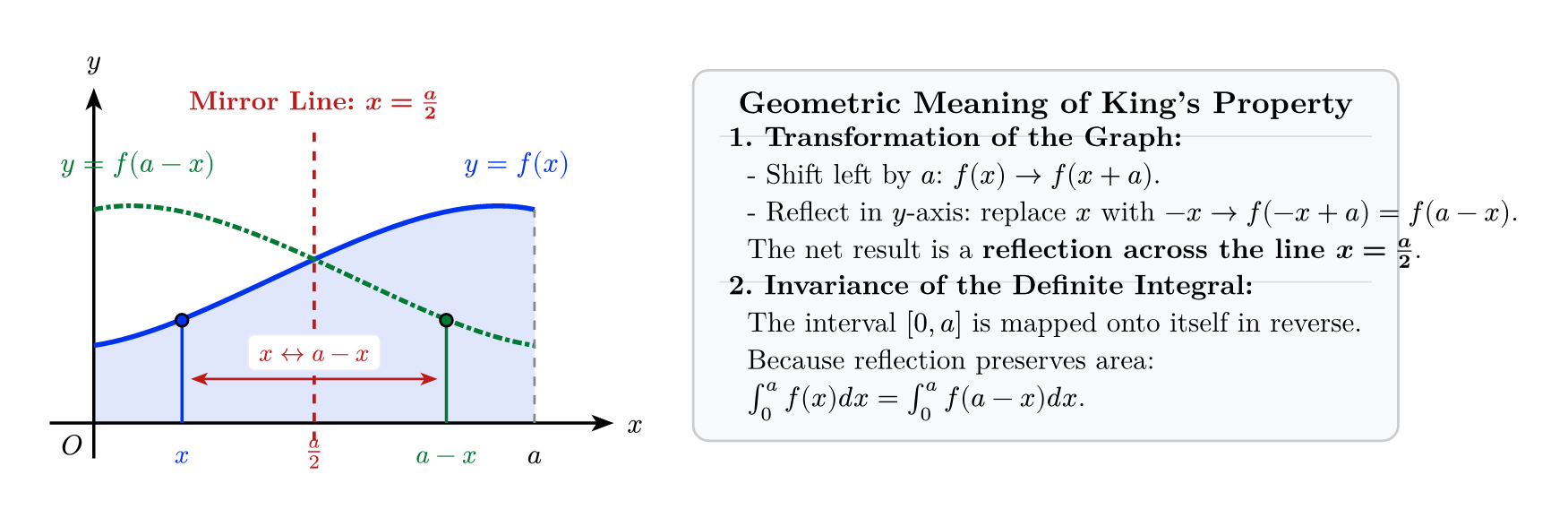
Because a reflection is a rigid geometric transformation, the shape of the region under the curve is preserved. Flipping a flat region across its vertical centerline reverses the order of the vertical slices, but the sum of their areas remains identical:
Algebraic Proof
We can confirm this result algebraically using the substitution rule:
Let:
Now determine the transformed limits: - When the lower limit is \(x = 0\), \(t = a - 0 = a\). - When the upper limit is \(x = a\), \(t = a - a = 0\).
Substituting into the integral:
Using the reversal property \(\int_a^0 (\dots)\,(-dt) = \int_0^a (\dots)\,dt\):
Because the integration variable is a dummy variable, replacing \(t\) with \(x\) yields:
The Fundamental Doubling Technique
Knowing that \(\int_0^a f(x)\,dx = \int_0^a f(a-x)\,dx\) is useful, but the true power of King's Rule emerges when we add the two expressions together.
Suppose we define our integral as \(I\):
By King's Rule, the same integral can be written as:
Adding these two equations:
Solving for \(I\):
[!TIP] Why is \(f(x) + f(a - x)\) Simpler than \(f(x)\)? While \(f(x)\) by itself may be algebraically complicated or non-integrable, the combined sum \(f(x) + f(a - x)\) pairs each value with its symmetric partner. When the function involves complementary relationships:
- \(\sin\left(\frac{\pi}{2} - x\right) = \cos x\) and \(\cos\left(\frac{\pi}{2} - x\right) = \sin x\)
- \(\tan\left(\frac{\pi}{4} - x\right) = \frac{1 - \tan x}{1 + \tan x}\)
- Rational fractions where denominators match after reflection
the sum \(f(x) + f(a - x)\) often collapses into a constant \(C\). When \(f(x) + f(a - x) = C\):
\[ 2I = \int_0^a C \, dx = C \cdot a \implies I = \frac{C \cdot a}{2} \]
Let us work through several examples illustrating this principle.
Example 1: The Complementary Power Integral
Evaluate:
Solution:
Here \(a = \pi/2\). Apply King's Rule by replacing \(x\) with \(\pi/2 - x\):
Using the co-function identities \(\sin(\pi/2 - x) = \cos x\) and \(\cos(\pi/2 - x) = \sin x\):
Now add the original expression for \(I\) and this transformed expression:
Because both fractions share the exact same denominator:
Dividing by \(2\):
Notice that this result holds for any real number \(n\) (whether \(n = 1\), \(n = 2026\), \(n = 1/2\), or \(n = -\sqrt{3}\))! The power \(n\) has no bearing on the final value because the integrand and its reflection always sum to \(1\).
Example 2: The Logarithmic Tangent Integral
Evaluate:
Solution:
Here the upper limit is \(a = \pi/4\). Apply King's Rule:
Recall the angle-subtraction identity for tangent:
Substitute this into the logarithm:
Therefore:
Splitting the integral:
The second integral is our original \(I\):
Bringing \(-I\) to the left side:
Example 3: Eliminating an Extraneous Linear Factor
Evaluate:
Solution:
The presence of the algebraic factor \(x\) in the numerator prevents standard substitutions like \(u = \cos x\). We can eliminate \(x\) by applying King's Rule with \(a = \pi\):
Since \(\sin(\pi - x) = \sin x\) and \(\cos(\pi - x) = -\cos x \implies \cos^2(\pi - x) = \cos^2 x\):
The second term is the original integral \(I\):
Adding \(I\) to both sides:
The factor \(x\) has been eliminated. Now substitute \(u = \cos x \implies du = -\sin x\,dx\): - When \(x = 0\), \(u = 1\). - When \(x = \pi\), \(u = -1\).
Evaluating at the endpoints:
The General Form of King's Rule: Arbitrary Intervals
When the lower limit of integration is not zero, the reflection property generalizes naturally to any interval \([a, b]\).
Theorem: The General Reflection Property
If \(f(x)\) is integrable on \([a, b]\), then:
Proof
Let \(t = a + b - x \implies dx = -dt\). - When \(x = a\), \(t = a + b - a = b\). - When \(x = b\), \(t = a + b - b = a\).
Substituting into the integral:
Renaming the dummy variable \(t\) to \(x\):
Geometric Interpretation
The transformation \(x \to a + b - x\) reflects the interval \([a, b]\) across its midpoint:
Because the distance from any point \(x\) to the midpoint is \(\left|x - \frac{a+b}{2}\right|\), replacing \(x\) with \(a + b - x\) produces the exact same distance on the opposite side:
The entire curve is reflected across the vertical line \(x = \frac{a+b}{2}\), preserving the enclosed area.
The Midpoint Sum Formula
If the integrand satisfies the symmetry condition \(f(x) + f(a + b - x) = C\) for some constant \(C\), then:
In particular, for any quotient of the form:
the sum of the integrand and its reflection is always identically \(1\), so the value of the integral is simply:
Example 4: A General Interval Quotient
Evaluate:
Solution:
First rewrite \(\tan x\) in terms of sine and cosine:
Here the limits are \(a = \pi/6\) and \(b = \pi/3\). The sum of the limits is:
Applying King's Rule, replace \(x\) with \(\pi/2 - x\):
Adding the two equations:
Dividing by \(2\):
Example 5: Root Functions on an Arbitrary Interval
Evaluate:
Solution:
The sum of the limits is \(a + b = 2 + 4 = 6\). Replace \(x\) with \(6 - x\):
Adding the two integrals:
The Interval Halving Property: Queen's Rule
While King's Rule reflects the entire interval \([0, a]\) onto itself, Queen's Rule splits the interval in half at \(a/2\) and folds the right half onto the left half.
[!IMPORTANT] Formulating the Halving Property We express the interval halving property strictly on \([0, a]\) with the reduced limit \(a/2\):
\[ \int_0^a f(x) \, dx = \int_0^{a/2} \big[ f(x) + f(a - x) \big] \, dx \]Many older textbooks write this property using \(2a\) as the upper limit and \(a\) as the halved limit. In practice, writing the upper limit as \(2a\) frequently causes confusion when the upper limit is an odd multiple like \(\pi\) or \(1\). Writing the property as halving from \(a\) to \(a/2\) makes the geometric operation immediately clear.
Derivation from the Splitting Property
Queen's Rule is not an independent axiom; it is a direct consequence of splitting the interval \([0, a]\) at its midpoint \(a/2\) and applying King's reflection to the second half:
Look closely at the second integral, \(J = \int_{a/2}^a f(x)\,dx\). Substitute:
- When \(x = a/2\), \(t = a - a/2 = a/2\).
- When \(x = a\), \(t = a - a = 0\).
Therefore:
Plugging \(J\) back into the original sum:
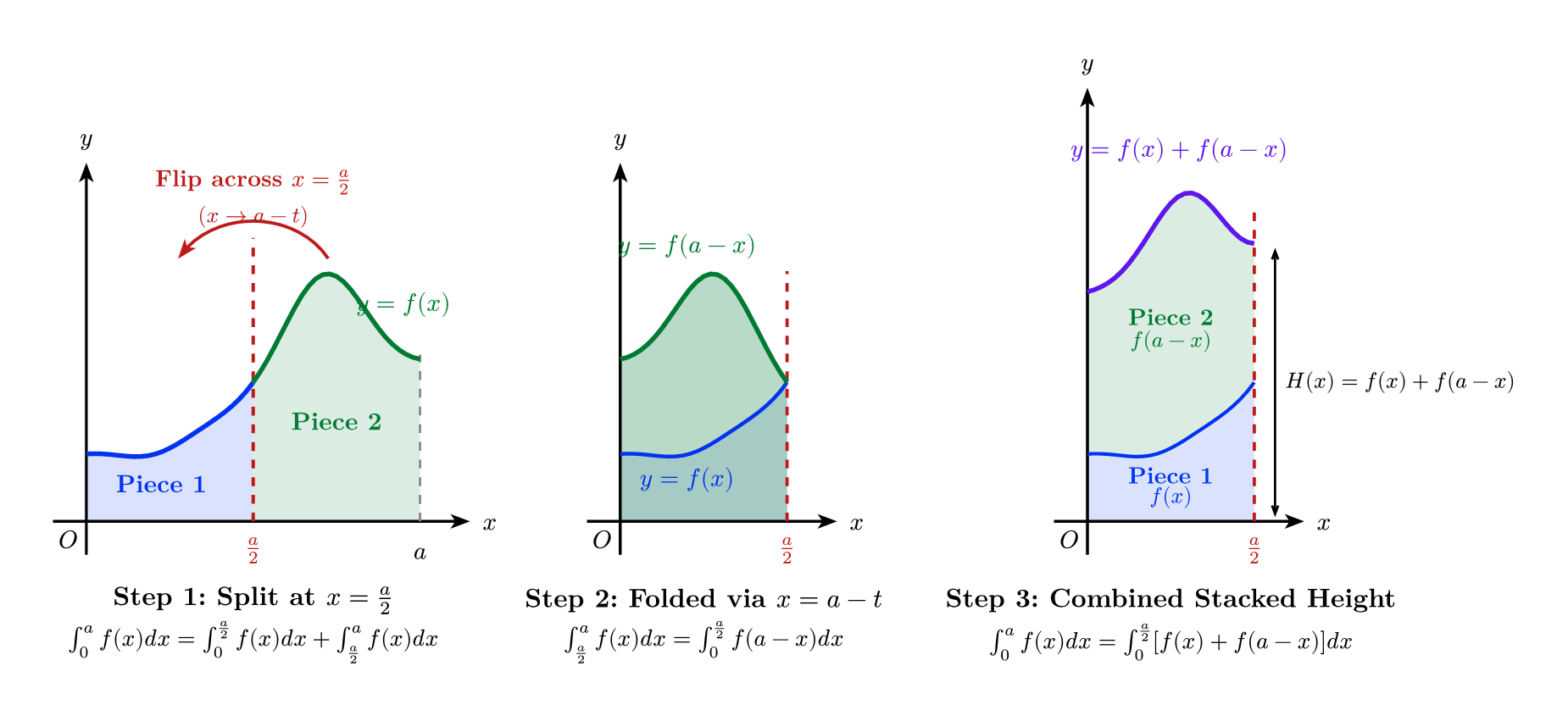
Geometrically, the second half \([a/2, a]\) is flipped horizontally and overlaid onto \([0, a/2]\). At every point \(x \in [0, a/2]\), the height of the folded piece, \(f(a - x)\), is added on top of the original height, \(f(x)\), creating a combined height \(H(x) = f(x) + f(a - x)\).
Two Crucial Special Cases
Depending on how the integrand behaves when reflected across \(a/2\), Queen's Rule leads to two immediate simplifications:
Case 1: Symmetric Function Across the Midpoint (\(f(a - x) = f(x)\))
If the curve is symmetric about the vertical line \(x = a/2\), the folded height doubles:
Case 2: Anti-Symmetric Function Across the Midpoint (\(f(a - x) = -f(x)\))
If the curve is anti-symmetric about the midpoint, the two heights cancel out completely:
The Misconception: Why Queen's Property is Essential
A common question students ask is: "If King's Rule already gives \(f(a - x)\), why do we ever need Queen's Rule?"
At first glance, it might seem that Queen's Rule is merely King's Rule in disguise. However, Queen's Rule solves two profound challenges that King's Rule cannot handle alone:
1. Breaking the King's Rule Deadlock
When a function satisfies \(f(a - x) = f(x)\) on \([0, a]\), King's Rule yields:
Adding them gives \(2I = 2I\), which produces no new information! King's Rule is deadlocked.
However, Queen's Rule halves the upper limit:
On the new smaller interval \([0, a/2]\), the function is no longer evaluated at \(a - x\), but at \((a/2) - x\). For trigonometric functions, this often converts \(\sin x\) into \(\cos x\), unlocking a second application of King's Rule that solves the integral!
2. Eliminating Interior Discontinuities and Vertical Asymptotes
To truly appreciate why Queen's Property is indispensable, consider what happens when a substitution introduces an interior vertical asymptote.
Consider the classic definite integral:
The integrand is strictly positive and completely continuous across the entire closed interval \([0, \pi]\) because the denominator \(a^2 \cos^2 x + b^2 \sin^2 x\) never vanishes. Therefore, the area under the curve must be a positive real number (\(I > 0\)).
The Fatal Trap: Blind Substitution without Halving the Limit
A standard textbook method for evaluating rational trigonometric functions of \(\cos^2 x\) and \(\sin^2 x\) is to divide the numerator and denominator by \(\cos^2 x\):
A student might now blindly set:
Looking at the limits: - When the lower limit is \(x = 0\), \(u = \tan 0 = 0\). - When the upper limit is \(x = \pi\), \(u = \tan \pi = 0\).
Plugging these limits into the transformed integral:
How could the accumulated area under a strictly positive curve over an interval of width \(\pi\) possibly be zero?
The Root Cause of the Disaster: The substitution function \(u = \tan x\) is not continuous on \([0, \pi]\). It has an infinite vertical jump discontinuity right in the middle of the interval at \(x = \pi/2\):
As \(x\) passes through \(\pi/2\), \(\tan x\) plunges from \(+\infty\) to \(-\infty\), skipping the entire real continuum! Applying the Fundamental Theorem of Calculus through an interior infinite discontinuity is mathematically invalid and produces completely bogus results.
The Resolution: How Queen's Property Saves the Day
Before attempting any substitution, test the reflection symmetry of the integrand across \(x = \pi/2\):
Because \(f(\pi - x) = f(x)\), the graph is perfectly symmetric about the vertical line \(x = \pi/2\).
Applying Queen's Property allows us to halve the interval from \([0, \pi]\) to \([0, \pi/2]\):
Now examine what happens on the halved interval \([0, \pi/2)\): - The function \(u = \tan x\) is strictly continuous, monotonic, and differentiable throughout the interior \([0, \pi/2)\). - The asymptote at \(x = \pi/2\) is no longer an interior singularity—it has been pushed to the upper boundary, turning the problem into a standard, well-behaved improper integral!
Now dividing numerator and denominator by \(\cos^2 x\):
Substituting \(u = \tan x \implies du = \sec^2 x \, dx\): - When \(x = 0\), \(u = 0\). - As \(x \to \pi/2^-\), \(u \to +\infty\).
Using the standard arctangent integral:
Evaluating at the limits:
Notice how natural, exact, and strictly positive this answer is! For instance: - If \(a = 1\) and \(b = 1\), the integral is \(\int_0^\pi dx = \pi\), which perfectly matches \(\frac{\pi}{1 \cdot 1} = \pi\). - If \(a = 1\) and \(b = 2\), the integral is \(\frac{\pi}{2}\), rather than the absurd \(0\) produced by blind substitution.
This classic example reveals why Queen's Property is far from redundant: halving the interval eliminates interior points of discontinuity, making powerful substitutions like \(u = \tan x\) mathematically valid and robust.
The Benchmark Integral: The Definite Integral of Log-Sine
We are now equipped to evaluate one of the most famous and beautiful definite integrals in all of calculus:
Step 1: King's Rule on the Interval
By King's Rule, replace \(x\) with \(\pi/2 - x\):
Step 2: Adding the Integrals
Adding the two equations:
Use the double-angle identity \(\sin x \cos x = \frac{\sin 2x}{2}\):
Splitting into two integrals:
Step 3: Substitution into the First Term
In the integral \(K = \int_0^{\pi/2} \ln(\sin 2x)\,dx\), substitute \(u = 2x \implies dx = \frac{du}{2}\): - When \(x = 0\), \(u = 0\). - When \(x = \pi/2\), \(u = \pi\).
Step 4: Applying Queen's Rule to Halve the Limit
Consider the integral \(\int_0^\pi \ln(\sin u)\,du\). Here the upper limit is \(\pi\). Notice that:
Because the integrand satisfies \(f(\pi - u) = f(u)\), we apply Queen's Rule to halve the limit from \(\pi\) to \(\pi/2\):
Substituting this into \(K\):
Because \(u\) is a dummy variable, this is precisely our original integral \(I\):
Step 5: Solving for the Integral
Substitute \(K = I\) back into our equation from Step 2:
Subtracting \(I\) from both sides:
We have established the master identities:
Immediate Corollaries of the Benchmark Integral
With this benchmark established, many related integrals can be computed instantly:
The Log-Tangent Integral:
The Log-Secant Integral:
Integrals on Symmetric Intervals: Even and Odd Functions
When the interval of integration is symmetric about the origin, \([-a, a]\), the parity of the function provides an immediate shortcut.
Theorem: The Symmetric Interval Property
For any integrable function \(f(x)\) on \([-a, a]\):
Proof
Split the integral at \(x = 0\):
In the first integral, substitute \(x = -t \implies dx = -dt\): - When \(x = -a\), \(t = a\). - When \(x = 0\), \(t = 0\).
Combining the two parts gives:
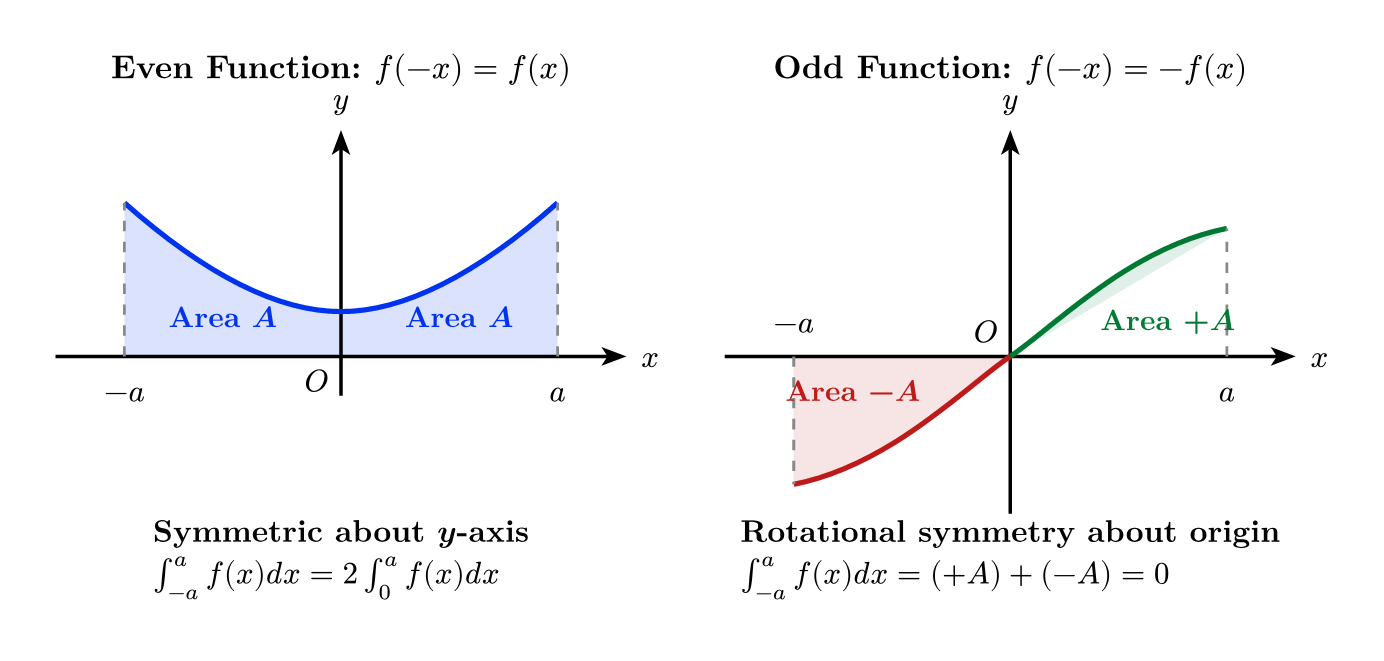
The Even and Odd Corollaries
Even Function (\(f(-x) = f(x)\)): The graph has reflectional symmetry across the \(y\)-axis. The area on \([-a, 0]\) is identical to the area on \([0, a]\):
Odd Function (\(f(-x) = -f(x)\)): The graph has rotational (point) symmetry of \(180^\circ\) about the origin. The signed area on \([-a, 0]\) is the exact negative of the area on \([0, a]\), canceling to zero:
Decomposing an Arbitrary Function into Even and Odd Parts
Every function \(f(x)\) defined on \([-a, a]\) can be uniquely split into the sum of an even component \(f_{\text{even}}(x)\) and an odd component \(f_{\text{odd}}(x)\):
When integrating over \([-a, a]\), the odd part vanishes automatically:
This property allows us to discard massive collections of complicated odd terms in a single glance!
Example 6: Vanishing Odd Terms
Evaluate:
Solution:
Check the parity of each term: - For \(x^7 \cos x\): \((-x)^7 \cos(-x) = -x^7 \cos x\) (odd). - For \(\sin^5 x\): \(\sin^5(-x) = (-\sin x)^5 = -\sin^5 x\) (odd). - For \(x^2\): \((-x)^2 = x^2\) (even). - For \(\cos x\): \(\cos(-x) = \cos x\) (even).
The integral of the odd terms over \([-\pi/2, \pi/2]\) is identically zero:
Evaluating the remaining even terms:
The Exponential Fraction Symmetry Trick
A very common pattern in definite integrals is an integrand with an exponential denominator of the form \(\frac{1}{1 + e^x}\) multiplied by an even function \(g(x)\):
Notice the algebraic identity:
Applying the symmetric interval property:
Since \(g(-x) = g(x)\):
The factor \(\frac{1}{1 + e^x}\) completely disappears!
Example 7: An Exponential Denominator on a Symmetric Interval
Evaluate:
Solution:
The numerator \(\cos x\) is even, and the denominator is of the form \(1 + a^x\) where \(a = 2026 > 0\).
Applying the symmetric interval formula:
Since \(\cos(-x) = \cos x\) and \(\frac{1}{1 + 2026^{-x}} = \frac{2026^x}{2026^x + 1}\):
Shifting and Scaling Properties
When transforming a definite integral—for instance, to move limits to \(0\), center an interval around \(0\) to reveal even/odd symmetry, or simplify \(f(2x - 4)\) into \(f(x)\)—students often write out a full substitution (\(u = x + c\) or \(u = kx\)), compute \(du\), change limits step by step, and rewrite the integral.
The shifting and scaling properties let you skip all of that boilerplate. They make your job faster and cleaner by transforming the limits and the integrand in a single direct step, using pure geometry.
1. The Shifting (Translation) Property
Theorem: Horizontal Shift of Limits
For any real constant \(c\):
Geometric Meaning and Quick Proof
Shifting the graph of \(y = f(x)\) horizontally by \(c\) units to the right produces the curve \(y = f(x - c)\) over \([a + c, b + c]\). Because rigid horizontal translation does not stretch or compress the region, the enclosed area remains identical.
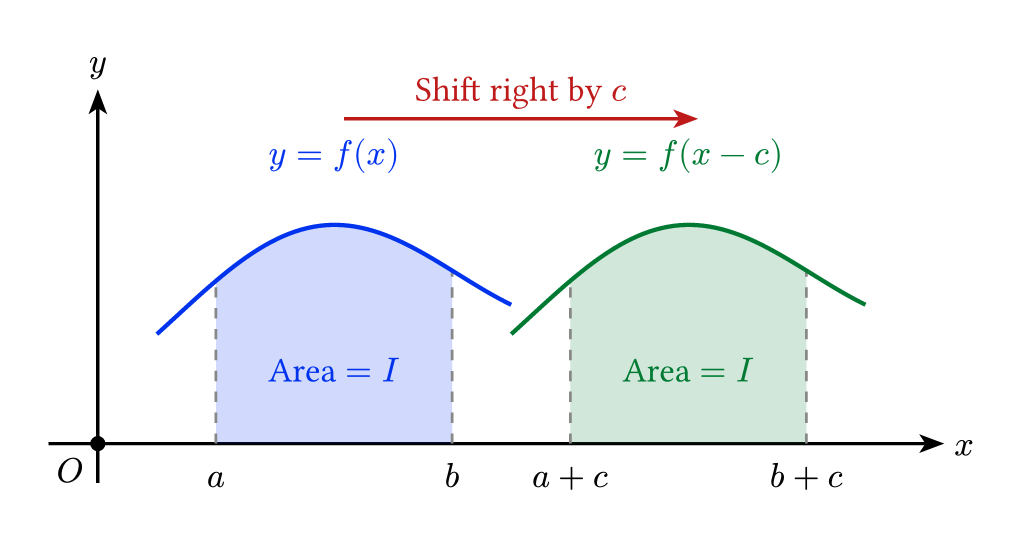
Algebraically, setting \(t = x - c\) (so \(dt = dx\)) in \(\int_{a+c}^{b+c} f(x - c)\,dx\) gives \(\int_a^b f(t)\,dt\) directly. Once you remember the rule below, you never need to write out this substitution again.
Rule of Thumb (Opposite Operations):
- Add \(c\) to both limits \(\iff\) replace \(x\) with \(x - c\) inside \(f(x)\).
- Subtract \(c\) from both limits \(\iff\) replace \(x\) with \(x + c\) inside \(f(x)\).
Example: Centering an Interval to Reveal Odd Symmetry
Evaluate:
Solution: Instead of substituting \(u = x - 2\), subtract \(2\) from both limits and replace \(x\) with \(x + 2\) inside the integrand:
Since \(x^5 \cos x\) is an odd function on the symmetric interval \([-1, 1]\), we obtain immediately:
Example: Simplifying an Irrational Integrand
Evaluate:
Solution: Subtract \(2\) from both limits and replace \(x\) with \(x + 2\) inside the integrand:
Evaluating directly:
2. The Scaling (Dilation) Property
Theorem: Horizontal Scaling of Limits
For any nonzero real constant \(k \neq 0\):
Equivalently, to simplify a scaled argument \(f(kx)\) back to \(f(x)\):
(Note: When \(k < 0\), multiplying or dividing the limits by \(k\) reverses their order, and the factor \(k\) or \(\frac{1}{k}\) automatically carries the minus sign needed to keep the signed area exact.)
Geometric Meaning and Quick Proof
Replacing \(x\) with \(kx\) (for \(k > 0\)) compresses the graph horizontally by a factor of \(k\), shrinking the interval \([a, b]\) to \([a/k, b/k]\) while keeping every height \(y\) unchanged. Since the width shrinks by a factor of \(k\), the area shrinks by a factor of \(k\)—so multiplying the new integral by \(k\) restores the original area.
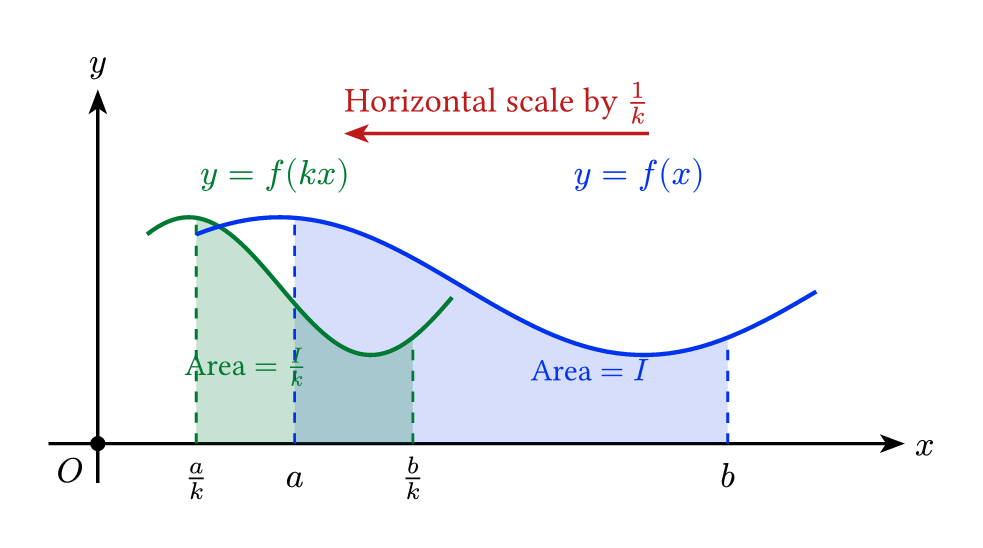
Algebraically, setting \(t = kx\) (so \(dt = k\,dx\)) in \(\int_{a/k}^{b/k} f(kx)\,dx\) yields \(\frac{1}{k}\int_a^b f(t)\,dt\).
Rule of Thumb:
- Divide both limits by \(k\) \(\iff\) replace \(x\) with \(kx\) and multiply the integral by \(k\).
- Multiply both limits by \(k\) \(\iff\) replace \(kx\) with \(x\) and divide the integral by \(k\).
Example: Fast Scaling to Standard Trigonometric Limits
Evaluate:
Solution: Multiply both limits by \(2\), replace \(2x\) with \(x\), and divide the integral by \(2\):
From King's Rule on \([0, \pi/2]\) (Example 1), the integral equals \(\frac{\pi}{4}\). Therefore:
Example: Combining Shifting and Scaling in Two Direct Steps
Evaluate:
Solution: First, shift the limits by \(-2\) (replace \(x\) with \(x + 2\), so \(2x - 4\) becomes \(2(x+2) - 4 = 2x\)):
Next, scale by multiplying the limits by \(2\) (replace \(2x\) with \(x\) and divide by \(2\)):
Using even symmetry on \([-2, 2]\):
Miscellaneous Examples
Example 8: Eliminating Discontinuities Using Queen's Rule
Evaluate:
Solution:
First eliminate the algebraic factor \(x\) using King's Rule on \([0, \pi]\): Replace \(x\) with \(\pi - x\):
Since \(\tan(\pi - x) = -\tan x\), \(\sec(\pi - x) = -\sec x\), and \(\cos(\pi - x) = -\cos x\):
Adding the original and transformed integrals:
Now convert the trigonometric terms to sines and cosines:
So:
Notice that \(\sin(\pi - x) = \sin x\) and \(\cos^2(\pi - x) = \cos^2 x\). The integrand is symmetric about \(\pi/2\). Apply Queen's Rule to halve the upper limit:
Therefore:
Substitute \(u = \cos x \implies du = -\sin x\,dx\): - When \(x = 0\), \(u = 1\). - When \(x = \pi/2\), \(u = 0\).
Example 9: Combining Substitution with King's Rule
Evaluate:
Solution:
The presence of \(1 + x^2\) in the denominator suggests the trigonometric substitution:
- When \(x = 0\), \(\theta = 0\).
- When \(x = 1\), \(\theta = \pi/4\).
Substituting:
This is precisely the integral evaluated in Example 2! By King's Rule on \([0, \pi/4]\):
Example 10: Symmetry about a Shifted Linear Denominator
Evaluate:
Solution:
The factor \(2x - \pi\) in the denominator vanishes at \(x = \pi/2\). Let us test King's Rule with \(a = \pi\) by replacing \(x\) with \(\pi - x\):
- The denominator becomes: \(2(\pi - x) - \pi = \pi - 2x = -(2x - \pi)\).
- \(\sin 2(\pi - x) = \sin(2\pi - 2x) = -\sin 2x\).
- \(\cos(\pi - x) = -\cos x \implies \sin\left(\frac{\pi}{2}\cos(\pi - x)\right) = \sin\left(-\frac{\pi}{2}\cos x\right) = -\sin\left(\frac{\pi}{2}\cos x\right)\).
Substituting these into the integral:
Adding the original and transformed integrals:
The problematic factor \(2x - \pi\) cancels out completely:
Now expand \(\sin 2x = 2\sin x \cos x\):
Substitute \(u = \frac{\pi}{2}\cos x \implies du = -\frac{\pi}{2}\sin x\,dx \implies \sin x\,dx = -\frac{2}{\pi}\,du\): - Also \(\cos x = \frac{2}{\pi}u\). - When \(x = 0\), \(u = \pi/2\). - When \(x = \pi\), \(u = -\pi/2\).
Notice that \(u \sin u\) is an even function because \((-u)\sin(-u) = (-u)(-\sin u) = u\sin u\). Therefore:
Integrate by parts: \(\int u \sin u\,du = -u \cos u + \int \cos u\,du = -u \cos u + \sin u\):
Thus:
Example 11: Anti-Symmetry in Logarithmic Rational Functions
Evaluate:
Solution:
Check the parity of the integrand \(f(x) = \ln\left(\frac{2 - x}{2 + x}\right) \frac{1}{1 + x^2}\):
Using the reciprocal property of logarithms \(\ln(1/u) = -\ln u\):
Therefore:
The integrand is an odd function over the symmetric interval \([-1, 1]\). By the odd function property:
Summary of Symmetry and Transformation Properties
| Property Name | Formula | Key Structural Trigger |
|---|---|---|
| King's Rule (\(0\) to \(a\)) | \(\int_0^a f(x)\,dx = \int_0^a f(a - x)\,dx\) | Trigonometric complements (\(\sin \leftrightarrow \cos\)), linear factor \(x\) in numerator |
| King's Rule (\(a\) to \(b\)) | \(\int_a^b f(x)\,dx = \int_a^b f(a + b - x)\,dx\) | Quotients matching \(g(x) + g(a+b-x)\), endpoints sum to simple angle |
| Queen's Rule (Halving) | \(\int_0^a f(x)\,dx = \int_0^{a/2} [f(x) + f(a - x)]\,dx\) | Upper limit is \(\pi\) or \(2\pi\), symmetry \(f(a-x) = f(x)\), interior discontinuity at \(a/2\) |
| Symmetric Interval (Even) | \(\int_{-a}^a f(x)\,dx = 2\int_0^a f(x)\,dx\) | \(f(-x) = f(x)\), cosine, even powers of \(x\) |
| Symmetric Interval (Odd) | \(\int_{-a}^a f(x)\,dx = 0\) | \(f(-x) = -f(x)\), sine, odd powers of \(x\), \(\ln((a-x)/(a+x))\) |
| Exponential Fraction | \(\int_{-a}^a \frac{g(x)}{1 + e^x}\,dx = \int_0^a g(x)\,dx\) | Denominator \(1 + e^x\) or \(1 + a^x\) over \([-a, a]\) with even numerator \(g(x)\) |
| Shifting Property | \(\int_a^b f(x)\,dx = \int_{a+c}^{b+c} f(x - c)\,dx\) | Shifted argument \(f(x \pm c)\), centering an interval around \(0\) |
| Scaling Property | \(\int_a^b f(kx)\,dx = \frac{1}{k}\int_{ka}^{kb} f(x)\,dx\) | Scaled argument \(f(kx)\), matching standard limits like \([0, \pi/2]\) |