Pair of Tangents and Chord of Contact
In this section, we study the pair of tangents that can be drawn from an external point to a hyperbola, along with the straight line joining their points of contact, known as the chord of contact.
While the algebraic formulas for a hyperbola (\(S S_1 = T^2\) and \(T = 0\)) look identical to those for an ellipse, the geometry of a hyperbola introduces fascinating peculiarities:
- The region "outside" the hyperbola is the central region between the two open branches (\(S_1 < 0\)).
- Tangents drawn from the center \((0, 0)\) degenerate into the asymptotes.
- Tangents drawn from an external point can touch the same branch or touch opposite branches, depending on whether the point lies in the lateral or conjugate asymptote sectors.
- A chord of contact can connect two points on the same branch or bridge across from the left branch to the right branch.
Pair of Tangents from an External Point
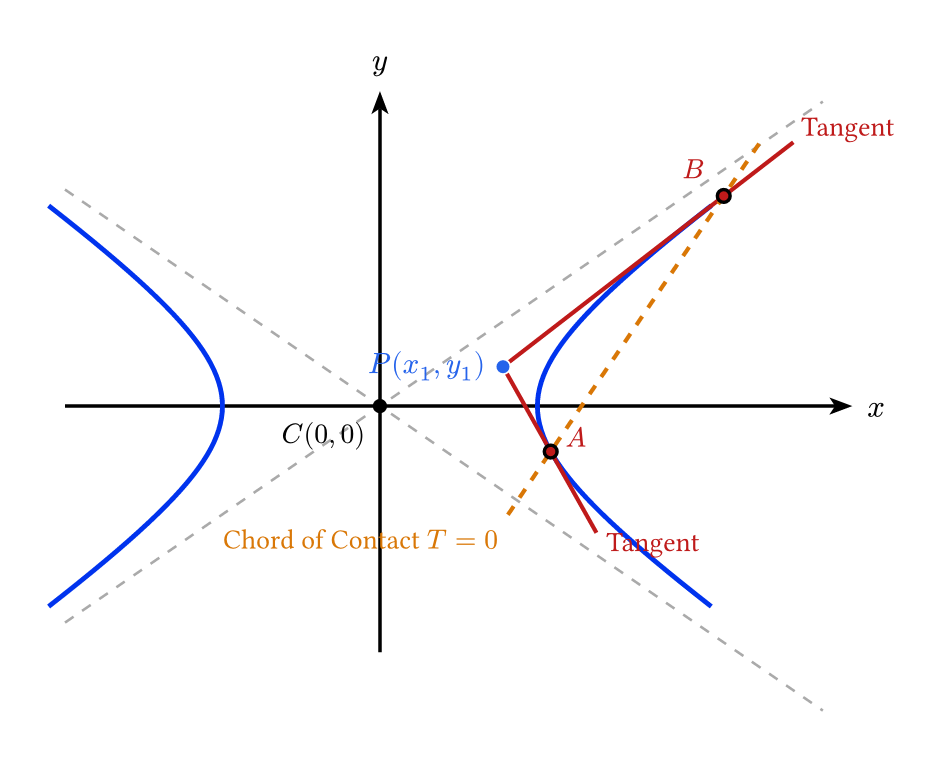
Let \(P(x_1, y_1)\) be a point lying outside the horizontal hyperbola:
Recall that the exterior of the hyperbola corresponds to:
From any such external point, exactly two straight lines can be drawn that touch the hyperbola.
Combined Equation of the Pair of Tangents (S S1 = T^2)
The combined (joint) equation representing both tangents drawn from \(P(x_1, y_1)\) to the hyperbola is given by:
where:
Proof of S S1 = T^2
Let \(Q(x, y)\) be any point lying on either of the two tangent lines passing through \(P(x_1, y_1)\).
Any point \(R\) dividing the directed line segment \(PQ\) in the ratio \(k : 1\) has coordinates given by the section formula:
If the point \(R\) lies on the hyperbola \(\frac{x^2}{a^2} - \frac{y^2}{b^2} - 1 = 0\), its coordinates must satisfy the hyperbola's equation:
Multiplying the entire equation by \((k + 1)^2\):
Expanding each term:
Collecting powers of \(k\):
Using our standard notations \(S\), \(T\), and \(S_1\), this is a quadratic equation in \(k\):
Condition for Tangency:
The straight line \(PQ\) will be a tangent to the hyperbola if and only if it touches the hyperbola at exactly one point (having two coincident points of intersection).
For the line \(PQ\) to touch the curve, the two values of the division ratio \(k\) given by the quadratic equation must be equal. Therefore, the discriminant of this quadratic in \(k\) must be zero:
Since \(Q(x, y)\) is any arbitrary point on either tangent, the equation \(S S_1 = T^2\) is the combined equation of the pair of tangents drawn from \(P(x_1, y_1)\).
Condition for Tangents to be Real (The Slope Quadratic)
To understand when real tangents can be drawn, let a line passing through \(P(x_1, y_1)\) have slope \(m\):
Comparing this with the slope-form condition of tangency \(c^2 = a^2 m^2 - b^2\), where \(c = y_1 - m x_1\):
Rearranging into a quadratic equation in \(m\):
The discriminant \(D\) of this quadratic equation determines the reality of the slopes \(m\):
Dividing and multiplying by \(a^2 b^2\):
This equation reveals the geometry of tangents to a hyperbola:
- When \(S_1 < 0\) (Point outside the hyperbola): \(D = -4a^2 b^2 S_1 > 0\). The quadratic has two distinct real roots, meaning two real and distinct tangents can be drawn from \(P\).
- When \(S_1 = 0\) (Point on the hyperbola): \(D = 0\). Exactly one tangent exists (touching at \(P\)).
- When \(S_1 > 0\) (Point inside either branch): \(D < 0\). No real tangents can be drawn from \(P\) to the hyperbola.
Peculiarities of Tangents to a Hyperbola
The geometry of tangents to a hyperbola has unique characteristics that do not occur in parabolas or ellipses.
1. Tangents from the Center Degenerate into the Asymptotes
What happens if we attempt to draw tangents from the center \(C(0, 0)\) of the hyperbola?
At \((x_1, y_1) = (0, 0)\):
Substituting these into \(S S_1 = T^2\):
Factoring this difference of squares:
This is the combined equation of the two asymptotes of the hyperbola!
Geometric Meaning:
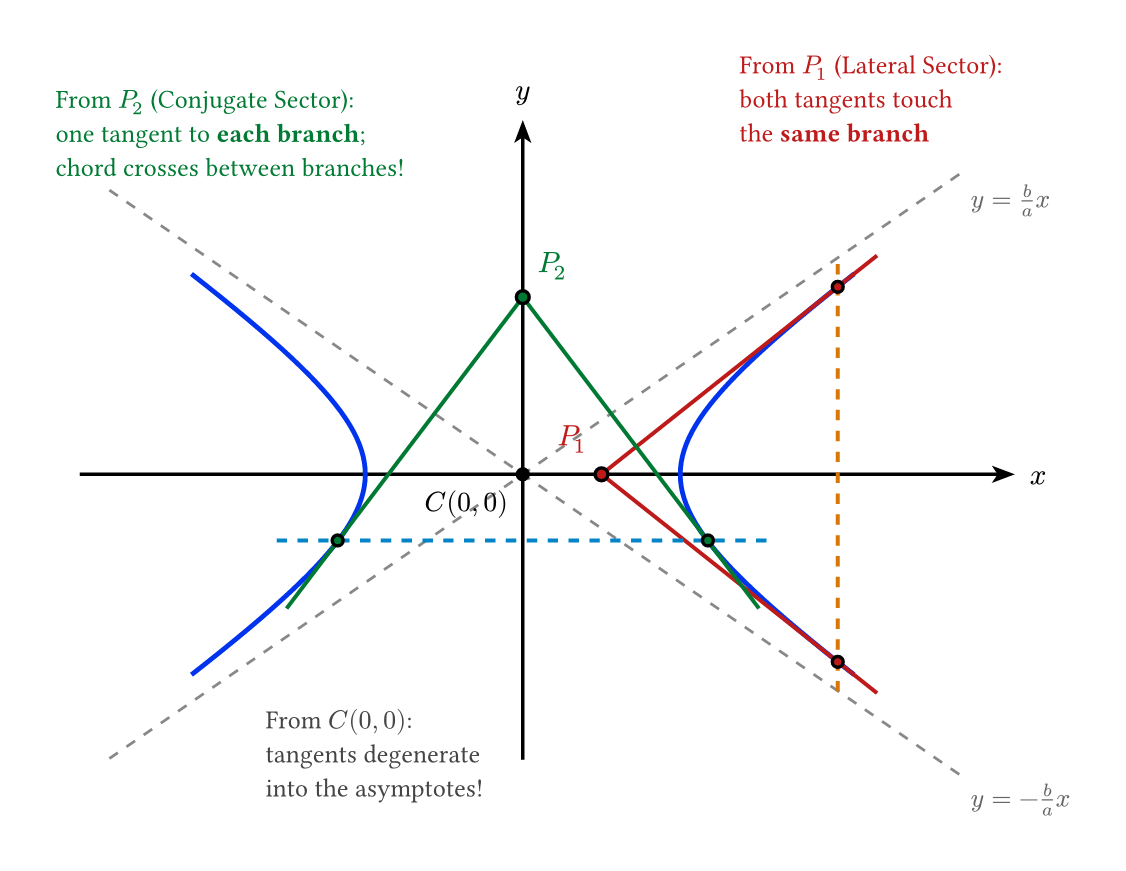
The asymptotes are the limiting tangents to the hyperbola whose points of contact have receded to infinity. Therefore, from the center \((0, 0)\), no finite tangent can be drawn; the "pair of tangents" from the center are the asymptotes themselves!
2. Tangents Touching the Same Branch vs. Opposite Branches
The two asymptotes \(\frac{x}{a} \pm \frac{y}{b} = 0\) divide the exterior region (\(S_1 < 0\)) into distinct geometric sectors:
Case A: The Lateral Sectors
In these sectors (surrounding the transverse axis between the center and each vertex, where \(|x_1|/a > |y_1|/b\) and \(S_1 < 0\)), the point \(P(x_1, y_1)\) lies between the asymptotes and one of the branches.
From any point \(P_1\) in a lateral sector:
- Both tangents touch the same branch (the branch adjacent to that sector).
- The chord of contact joins two points lying on the same branch.
Case B: The Conjugate / Vertical Sectors
In these sectors (surrounding the conjugate axis, where \(|y_1|/b > |x_1|/a\)), the point \(P_2(x_1, y_1)\) lies above or below the asymptotes.
From any point \(P_2\) in the conjugate sector:
- One tangent touches the right branch, and the other tangent touches the left branch!
- The chord of contact connects a point on the right branch to a point on the left branch, crossing directly between the two branches!
Chord of Contact
Let \(P(x_1, y_1)\) be a point outside the hyperbola \(\frac{x^2}{a^2} - \frac{y^2}{b^2} = 1\). The two tangents drawn from \(P\) touch the hyperbola at two points \(A(x_A, y_A)\) and \(B(x_B, y_B)\).
The straight line segment \(AB\) connecting these two points of contact is called the chord of contact of \(P\) with respect to the hyperbola.
Equation of the Chord of Contact (T = 0)
The equation of the chord of contact of tangents drawn from \(P(x_1, y_1)\) to the hyperbola \(\frac{x^2}{a^2} - \frac{y^2}{b^2} = 1\) is:
Proof:
Since \(A(x_A, y_A)\) lies on the hyperbola, the equation of the tangent at \(A\) is:
Because this tangent passes through the external point \(P(x_1, y_1)\), the coordinates \((x_1, y_1)\) satisfy this equation:
Similarly, since \(B(x_B, y_B)\) lies on the hyperbola, the equation of the tangent at \(B\) is:
Because this tangent also passes through \(P(x_1, y_1)\):
Now examine the linear equation in variables \((x, y)\):
Equations \((1)\) and \((2)\) prove that both points \(A(x_A, y_A)\) and \(B(x_B, y_B)\) satisfy this linear equation.
Since two distinct points uniquely determine a straight line, this linear equation must be the equation of the straight line passing through \(A\) and \(B\). Therefore, the chord of contact is:
For the Vertical Hyperbola:
For \(\frac{y^2}{b^2} - \frac{x^2}{a^2} = 1\), the chord of contact of \(P(x_1, y_1)\) is:
Finding the Point of Intersection of Tangents at the Ends of a Chord
A frequent problem asks: Given the equation of a chord of a hyperbola, find the point where the tangents drawn at the ends of this chord intersect.
Method:
Let the given chord have equation:
Let the tangents at the endpoints of this chord intersect at \(P(x_1, y_1)\).
Then the given chord is the chord of contact of \(P(x_1, y_1)\) with respect to the hyperbola \(\frac{x^2}{a^2} - \frac{y^2}{b^2} = 1\). Its equation must therefore be:
Since equation \((1)\) and equation \((2)\) represent the same straight line, the coefficients of \(x\), \(y\), and the constant terms must be proportional:
Equating the first and third ratios:
Equating the second and third ratios:
Thus, the point of intersection of the tangents at the ends of the chord is:
Angle Between the Pair of Tangents
Let the pair of tangents from \(P(x_1, y_1)\) have slopes \(m_1\) and \(m_2\).
Recall the quadratic equation in \(m\) satisfied by the tangent slopes:
By Vieta's formulas:
The acute angle \(\theta\) between the tangents is given by:
Substituting the sum and product of slopes:
Therefore:
The Director Circle
When the pair of tangents are mutually perpendicular, \(\theta = 90^\circ\), which requires \(\tan\theta \to \infty\), or equivalently:
Replacing \((x_1, y_1)\) with general coordinates \((x, y)\), the locus of points from which perpendicular tangents can be drawn to the hyperbola is:
This circle is called the director circle of the hyperbola.
- If \(a > b\): The director circle is a real circle centered at \((0, 0)\) with radius \(\sqrt{a^2 - b^2}\).
- If \(a = b\) (Rectangular Hyperbola): The director circle degenerates to the single point \((0, 0)\).
- If \(a < b\): \(a^2 - b^2 < 0\), so no real point exists from which perpendicular tangents can be drawn (the director circle is imaginary).
Summary Comparison
| Concept | Horizontal Hyperbola \(\frac{x^2}{a^2} - \frac{y^2}{b^2} = 1\) | Ellipse \(\frac{x^2}{a^2} + \frac{y^2}{b^2} = 1\) |
|---|---|---|
| Combined Tangents Equation | \(S S_1 = T^2\) | \(S S_1 = T^2\) |
| Exterior Condition for Real Tangents | \(S_1 < 0\) (central region between branches) | \(S_1 > 0\) (unbounded outer plane) |
| Discriminant of Slope Quadratic | \(\Delta = -4a^2 b^2 S_1 > 0\) | \(\Delta = 4a^2 b^2 S_1 > 0\) |
| Tangents from Center \((0, 0)\) | Degenerate into asymptotes \(\frac{x^2}{a^2} - \frac{y^2}{b^2} = 0\) | No tangents (center is inside) |
| Branch Distribution | Same branch in lateral sector; opposite branches in vertical sector | N/A (single closed curve) |
| Chord of Contact | \(T = 0 \implies \frac{x x_1}{a^2} - \frac{y y_1}{b^2} = 1\) | \(T = 0 \implies \frac{x x_1}{a^2} + \frac{y y_1}{b^2} = 1\) |
| Chord Spanning | Can connect points on same branch or bridge opposite branches | Always inside the single oval |
| Director Circle | \(x^2 + y^2 = a^2 - b^2\) (real only if \(a > b\)) | \(x^2 + y^2 = a^2 + b^2\) (always real) |
Illustrative Examples
Example 1: Combined Equation of Pair of Tangents
Find the combined equation of the pair of tangents drawn from the point \(P(1, 2)\) to the hyperbola \(\frac{x^2}{4} - \frac{y^2}{9} = 1\). Also find the angle between them.
Solution:
Here \(a^2 = 4, b^2 = 9\), and \((x_1, y_1) = (1, 2)\).
Step 1: Compute S, S1, and T:
Since \(S_1 = -\frac{43}{36} < 0\), the point \(P(1, 2)\) lies outside the hyperbola, so two real tangents exist.
Step 2: Form S S1 = T^2:
Multiply through by \(36^2 = 1296\):
The left-hand side becomes:
The right-hand side is:
Expanding \((9x - 8y - 36)^2\):
Equating the two sides:
Moving all terms to one side:
Dividing the entire equation by \(36\):
This is the combined equation of the pair of tangents.
Step 3: Angle Between the Tangents:
In the second-degree equation \(A x^2 + 2H x y + B y^2 + 2G x + 2F y + C = 0\):
The angle \(\theta\) between the lines is given by:
Example 2: Determining Branch Contact
Determine whether the tangents drawn from the following points touch the same branch or opposite branches of the hyperbola \(\frac{x^2}{9} - \frac{y^2}{16} = 1\):
- \(P(2, 1)\)
- \(Q(1, 3)\)
- \(R(0, 0)\)
Solution:
Here \(a^2 = 9 \implies a = 3\), and \(b^2 = 16 \implies b = 4\).
The asymptotes are \(y = \pm \frac{4}{3}x\), or \(\frac{|x|}{3} = \frac{|y|}{4}\).
For P(2, 1):
Evaluate \(S_1\):
Since \(S_1 < 0\), real tangents exist. Now compare coordinates to the asymptote ratios:
Since \(\frac{|x_1|}{a} > \frac{|y_1|}{b}\), the point \(P(2, 1)\) lies in the lateral sector (surrounding the positive \(x\)-axis). Therefore, both tangents touch the same branch (the right branch).
For Q(1, 3):
Evaluate \(S_1\):
Since \(S_1 < 0\), real tangents exist. Comparing coordinates to the asymptote ratios:
Since \(\frac{|y_1|}{b} > \frac{|x_1|}{a}\), the point \(Q(1, 3)\) lies in the conjugate / vertical sector (surrounding the positive \(y\)-axis). Therefore, one tangent touches the right branch and the other tangent touches the left branch! The chord of contact crosses directly between the two branches.
For R(0, 0):
The point \(R\) is the center of the hyperbola. Substituting \((0, 0)\) into \(S S_1 = T^2\) yields the pair of asymptotes:
No finite tangents exist; the tangents degenerate into the two asymptotes with points of contact at infinity.
Example 3: Finding the Intersection Point of Tangents from a Given Chord
Find the point of intersection of the tangents drawn at the ends of the chord \(3x - 2y + 6 = 0\) with respect to the hyperbola \(\frac{x^2}{9} - \frac{y^2}{4} = 1\).
Solution:
Let the tangents at the ends of the chord intersect at \(P(x_1, y_1)\).
The equation of the chord of contact of \(P(x_1, y_1)\) with respect to \(\frac{x^2}{9} - \frac{y^2}{4} = 1\) is:
The given chord is:
Divide by \(-6\) to make the constant term \(-1\):
Comparing coefficients:
Thus, the tangents at the ends of the chord intersect at:
Example 4: Locus of the Point of Intersection of Perpendicular Tangents
Prove that the locus of the point of intersection of mutually perpendicular tangents to the hyperbola \(\frac{x^2}{a^2} - \frac{y^2}{b^2} = 1\) is the circle \(x^2 + y^2 = a^2 - b^2\). Discuss the case when \(a = b\).
Solution:
Let the point of intersection be \(P(h, k)\).
Any tangent of slope \(m\) to the hyperbola \(\frac{x^2}{a^2} - \frac{y^2}{b^2} = 1\) is:
Since this tangent passes through \(P(h, k)\):
Squaring both sides:
Rearranging as a quadratic in \(m\):
Let the two roots of this equation be \(m_1\) and \(m_2\), representing the slopes of the two tangents passing through \(P(h, k)\).
By Vieta's relations, the product of the slopes is:
Since the tangents are mutually perpendicular:
Generalizing \((h, k) \to (x, y)\), the required locus is:
Special Case: Rectangular Hyperbola (\(a = b\)):
When \(a = b\), the hyperbola is rectangular (its asymptotes are perpendicular, \(y = \pm x\)).
The equation of the director circle becomes:
The only real solution to \(x^2 + y^2 = 0\) is the origin \((0, 0)\).
Remarkable Geometric Insight:
For a rectangular hyperbola, the only point from which perpendicular tangents can be drawn is the center \((0, 0)\). And as shown earlier, the "tangents" drawn from the center are the asymptotes themselves, which are indeed perpendicular!