Equation of Hyperbola
In our study of conic sections, we defined every conic using the focus-directrix property: the locus of a point moving in a plane such that the ratio of its distance from a fixed point (the focus) to its perpendicular distance from a fixed straight line (the directrix) is a constant \(e\), called the eccentricity.
- When \(0 < e < 1\), the conic is an ellipse (a closed loop).
- When \(e = 1\), the conic is a parabola (a single open curve).
- When \(e > 1\), the conic is a hyperbola (an open curve with two distinct, unbounded branches).
Following the same logical path we used for the ellipse, we first see why an arbitrarily placed hyperbola gives a complicated equation, then build the natural coordinate system aligned with its symmetry to derive the standard equation of a hyperbola.
The Geometric Definition of a Hyperbola
A hyperbola is the locus of a point \(P\) moving in a plane such that the ratio of its distance from a fixed point \(S\) to its perpendicular distance from a fixed straight line is a constant \(e\), where \(e > 1\).
- The fixed point \(S\) is called the focus.
- The fixed straight line is called the directrix.
- The constant ratio \(e\) is called the eccentricity (\(e > 1\)).
If \(P\) is any point on the hyperbola, and \(PM\) is the perpendicular drawn from \(P\) onto the directrix, then by definition:
Because \(e > 1\), the distance of any point on the hyperbola from the focus is always strictly greater than its perpendicular distance from the directrix:
An Example in an Arbitrary Coordinate System
Consider a hyperbola whose focus is \(S(1, 2)\), directrix is \(x + 2y - 3 = 0\), and eccentricity is \(e = 2\).
Let \(P(x, y)\) be any point on this hyperbola.
The distance from \(P(x, y)\) to the focus \(S(1, 2)\) is:
The perpendicular distance \(PM\) from \(P(x, y)\) to the directrix \(x + 2y - 3 = 0\) is:
Applying the defining condition \(SP = 2 \cdot PM\) and squaring both sides:
Multiply both sides by \(5\):
Expanding both sides:
Collecting all terms on the left-hand side gives:
Just as with a tilted ellipse, this equation is inconvenient to analyze directly:
- The \(xy\) cross-term (\(-16xy\)) indicates that the axes of symmetry are tilted relative to the coordinate axes.
- The linear terms (\(14x\) and \(28y\)) show that the center of the hyperbola does not lie at the origin \((0, 0)\).
To study the intrinsic properties of a hyperbola cleanly, we align our coordinate axes with the natural symmetry of the curve.
Constructing the Standard Coordinate System
The Axis Perpendicular to the Directrix
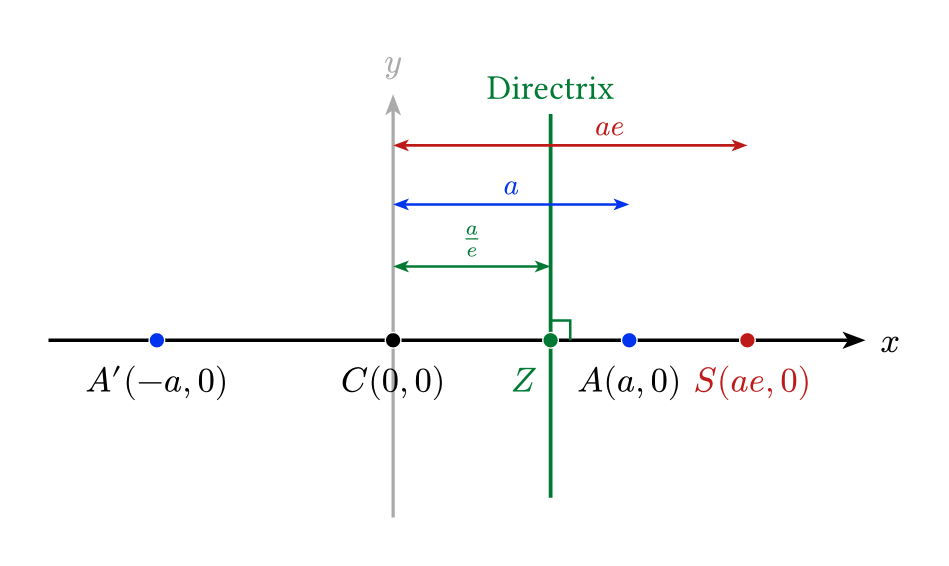
Let the focus \(S\) lie to the right of the directrix. Draw a straight line through \(S\) perpendicular to the directrix, meeting it at the point \(Z\).
This line \(ZS\) is an axis of symmetry of the hyperbola (called the transverse axis line).
Locating the Vertices on the Axis
For any point \(P\) lying on the line \(ZS\), its perpendicular distance to the directrix is simply its distance to \(Z\). Thus, \(P\) lies on the hyperbola if and only if:
Because \(e > 1\), the point must be farther from \(S\) than from \(Z\). Exactly two points on the line \(ZS\) satisfy this condition:
1. The Internal Division Point:
Between \(Z\) and \(S\), there is a unique point \(A\) dividing the segment \(ZS\) internally in the ratio \(1 : e\) (meaning \(SA = e \cdot AZ\)). Since \(e > 1\), \(A\) lies closer to \(Z\) than to \(S\).
2. The External Division Point:
To the left of \(Z\) (on the side of the directrix away from \(S\)), there is a unique point \(A'\) dividing \(ZS\) externally such that \(SA' = e \cdot A'Z\).
(Notice why \(A'\) cannot lie to the right of \(S\): any point to the right of \(S\) is closer to \(S\) than to \(Z\), so \(SP / PZ < 1 < e\), which is impossible.)
The points \(A\) and \(A'\) are the vertices of the hyperbola. The segment \(A'A\) joining them is called the transverse axis.
Determining the Center and Fundamental Distances
Let \(C\) be the midpoint of the segment \(A'A\), called the center of the hyperbola, and let the length of \(A'A\) be \(2a\), so:
From left to right along the line, the points lie in the order:
Notice that \(Z\) lies inside the segment \(A'A\) (to the right of \(C\), as \(A\) is closer to \(Z\) than \(A'\) is). Expressing the vertex distances in terms of distances from \(C\):
- \(SA = CS - CA = CS - a\)
- \(AZ = CA - CZ = a - CZ\)
- \(SA' = A'C + CS = a + CS\)
- \(A'Z = A'C + CZ = a + CZ\)
Substitute these into \(SA = e \cdot AZ\) and \(SA' = e \cdot A'Z\):
To find \(CS\), add the two equations:
To find \(CZ\), subtract the first equation from the second:
Because \(e > 1\), we have \(\frac{a}{e} < a < ae\), which matches our geometric ordering \(C \to Z \to A \to S\).
Setting Up the Standard Axes
We now place our Cartesian axes using the geometry above:
- Origin: Place \((0, 0)\) at the center \(C\).
- \(x\)-axis: Along the line \(A' C Z A S\), with positive direction toward \(S\).
- \(y\)-axis: Through \(C\), perpendicular to the \(x\)-axis.
In this system:
- Center: \(C(0, 0)\)
- Vertices: \(A(a, 0)\) and \(A'(-a, 0)\)
- Directrix foot: \(Z\left(\frac{a}{e}, 0\right)\), so the directrix is the line \(x = \frac{a}{e}\)
- Focus: \(S(ae, 0)\)
Derivation of the Standard Equation
Let \(P(x, y)\) be any point on the hyperbola.
- Distance from the focus \(S(ae, 0)\):
- Perpendicular distance from the directrix \(x = \frac{a}{e}\):
By the focus-directrix definition \(SP = e \cdot PM\):
Expand both sides:
Cancel \(-2aex\) from both sides:
Group \(x^2\) terms and constant terms:
Divide both sides by \(a^2(e^2 - 1)\):
Because \(e > 1\), the quantity \(e^2 - 1\) is strictly positive. Defining \(b^2 = a^2(e^2 - 1) > 0\) gives the standard equation of a hyperbola:
(Note: Unlike the ellipse where \(b < a\) was forced, here \(e^2 - 1\) can be less than, equal to, or greater than \(1\), so \(b\) may be less than, equal to, or greater than \(a\).)
Symmetry, Second Focus, and Tracing the Branches
The standard equation \(\frac{x^2}{a^2} - \frac{y^2}{b^2} = 1\) contains only even powers of \(x\) and \(y\), which immediately reveals three symmetries:
- Symmetry about the \(y\)-axis (\(x \to -x\)): Replacing \(x\) by \(-x\) leaves the equation unchanged.
- Symmetry about the \(x\)-axis (\(y \to -y\)): Replacing \(y\) by \(-y\) leaves the equation unchanged.
- Symmetry about the origin (\((x, y) \to (-x, -y)\)): Replacing both signs leaves the equation unchanged, so \(C(0, 0)\) is the center of symmetry.
Existence of the Second Focus and Directrix
Our derivation started from just one focus \(S(ae, 0)\) and one directrix \(x = \frac{a}{e}\), using the defining condition:
Notice what \(y\)-axis symmetry implies. Because the hyperbola is symmetric about \(x = 0\), whenever \(P(x, y)\) lies on the curve, its reflection \(P'(-x, y)\) also lies on the curve and must satisfy \(\frac{P'S}{P'M_{\text{right}}} = e\). Reflecting the entire figure across the \(y\)-axis sends \(P' \to P\), sends \(S(ae, 0) \to S'(-ae, 0)\), and sends the right directrix \(x = \frac{a}{e}\) to the second directrix \(x = -\frac{a}{e}\). Since reflection preserves distances (\(P'S = PS'\) and \(P'M_{\text{right}} = PM'\)), every point \(P(x, y)\) on the hyperbola simultaneously satisfies:
where \(PM' = \left|x + \frac{a}{e}\right|\) is the perpendicular distance from \(P\) to \(x = -\frac{a}{e}\).
We can verify this directly in algebra as well. Expanding \((PS')^2 = e^2 (PM')^2\) gives:
Here the \(+2aex\) cross-terms cancel from both sides, reducing to \((e^2 - 1)x^2 - y^2 = a^2(e^2 - 1)\), which is the exact same standard equation \(\frac{x^2}{a^2} - \frac{y^2}{b^2} = 1\). Thus, either pair—\((S(ae, 0),\, x = \frac{a}{e})\) or \((S'(-ae, 0),\, x = -\frac{a}{e})\)—generates the entire hyperbola (both branches).
Shape and Extent of the Curve
Solving the standard equation for \(y\):
- For real values of \(y\), we must have \(x^2 - a^2 \ge 0\), which means \(x \ge a\) or \(x \le -a\).
- No part of the hyperbola lies in the strip \(-a < x < a\). In particular, the curve does not intersect the \(y\)-axis (\(x = 0\) gives \(y^2 = -b^2\), no real solution).
- As \(|x|\) increases beyond \(a\), \(|y|\) grows without bound. Thus, the hyperbola consists of two open, symmetric branches opening away from each other along the \(x\)-axis.
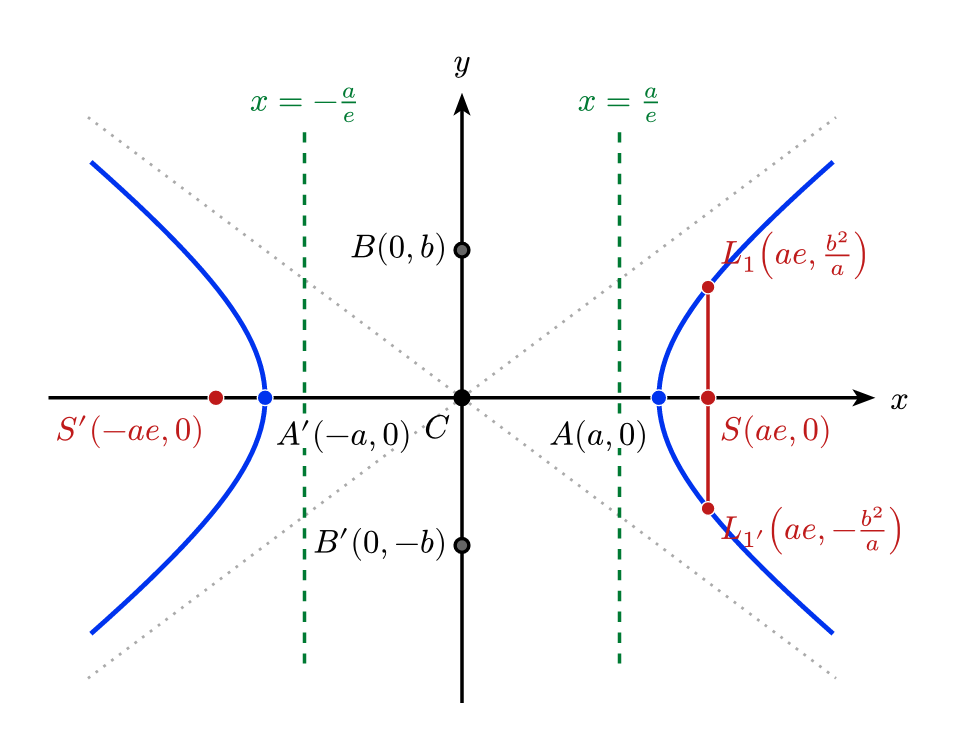
Anatomy and Terminology of the Standard Hyperbola
For the standard hyperbola \(\frac{x^2}{a^2} - \frac{y^2}{b^2} = 1\):
Center: \(C(0, 0)\), the midpoint of \(A'A\) and \(S'S\). Every chord through \(C\) is bisected at \(C\).
Transverse Axis: The line segment joining the vertices \(A(a, 0)\) and \(A'(-a, 0)\), of length \(2a\).
Conjugate Axis: The line segment along the \(y\)-axis joining \(B(0, b)\) and \(B'(0, -b)\), of length \(2b\). Although \(B\) and \(B'\) do not lie on the hyperbola, \(2b\) determines the vertical opening of the curve (and, as we will see in the next section, the slopes of its asymptotes).
Eccentricity: From \(b^2 = a^2(e^2 - 1)\):
Notice carefully the sign difference compared to an ellipse:
- Ellipse: \(e = \sqrt{1 - \frac{b^2}{a^2}} < 1\)
- Hyperbola: \(e = \sqrt{1 + \frac{b^2}{a^2}} > 1\)
Foci and Directrices:
The distance between the two foci is \(2ae\), and the distance between the two directrices is \(\frac{2a}{e}\).
Latus Rectum
A focal chord perpendicular to the transverse axis is called a latus rectum. Substituting \(x = ae\) into \(\frac{x^2}{a^2} - \frac{y^2}{b^2} = 1\):
Hence, the four endpoints of the latera recta are \(\left(\pm ae, \pm \frac{b^2}{a}\right)\), and:
Focal Distances and Constant Difference Property
Just as every point on an ellipse has simple linear expressions for its two focal distances, every point \(P(x_1, y_1)\) on the hyperbola \(\frac{x^2}{a^2} - \frac{y^2}{b^2} = 1\) also has simple focal distances to \(S(ae, 0)\) and \(S'(-ae, 0)\).
Let \(M\left(\frac{a}{e}, y_1\right)\) and \(M'\left(-\frac{a}{e}, y_1\right)\) be the feet of the perpendiculars drawn from \(P(x_1, y_1)\) onto the right directrix \(x = \frac{a}{e}\) and the left directrix \(x = -\frac{a}{e}\), respectively.
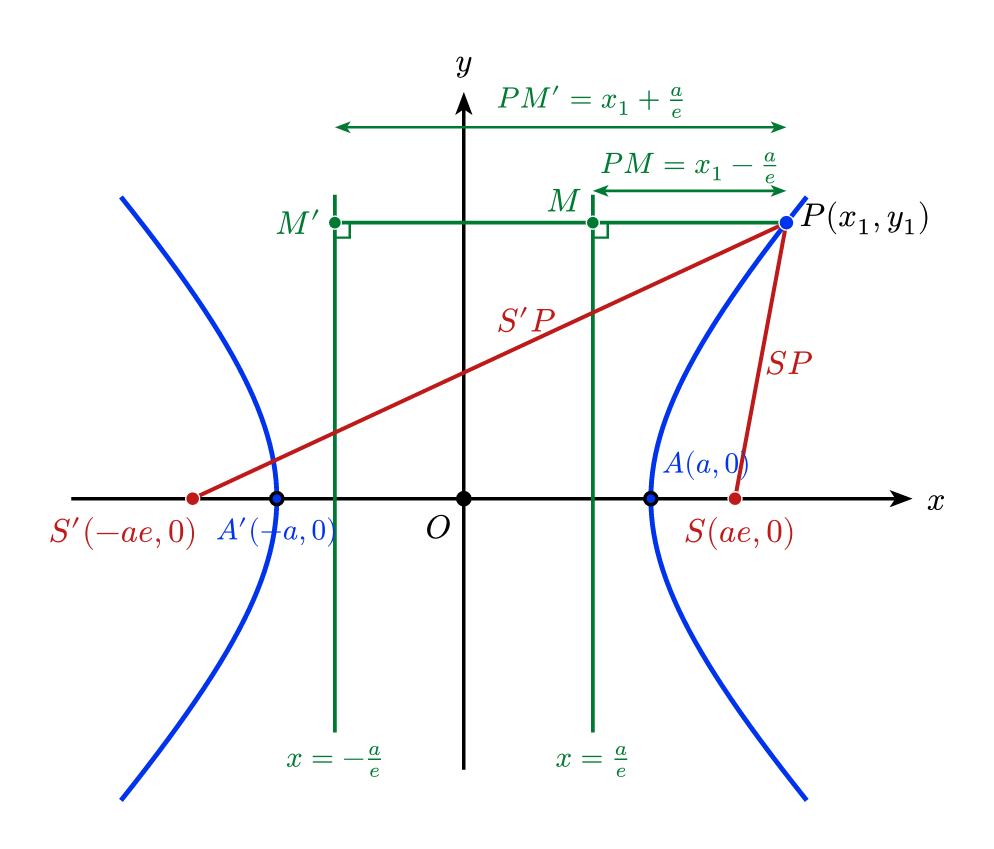
By the focus-directrix property applied to each focus and its corresponding directrix:
Because \(e > 1\), we have \(\frac{a}{e} < a\), so both directrices lie inside the empty strip \(-a < x < a\) between the two vertices. Depending on which branch \(P\) lies on, the horizontal distances \(PM = \left|x_1 - \frac{a}{e}\right|\) and \(PM' = \left|x_1 + \frac{a}{e}\right|\) drop their absolute value signs differently.
Case 1: Point Lies on the Right Branch
When \(P(x_1, y_1)\) lies on the right branch, \(x_1 \ge a > \frac{a}{e} > -\frac{a}{e}\), so \(P\) sits strictly to the right of both directrices (as shown in the figure above). Both horizontal perpendicular distances are therefore positive as written:
Multiplying by \(e\) gives the two focal distances:
Geometrically, any point on the right branch is closer to \(S\) than to \(S'\), so \(S'P > SP\). Subtracting the smaller distance from the larger gives:
Case 2: Point Lies on the Left Branch
When \(P(x_1, y_1)\) lies on the left branch, \(x_1 \le -a < -\frac{a}{e} < \frac{a}{e}\), so \(x_1\) is negative and \(P\) sits strictly to the left of both directrices. To keep both perpendicular lengths positive, we subtract \(x_1\) from each directrix coordinate:
Multiplying by \(e\) gives:
(Note that both values are positive: since \(x_1 \le -a\) and \(e > 1\), we have \(-ex_1 \ge ae > a\), so both \(a - ex_1 > 0\) and \(-a - ex_1 > 0\).)
On the left branch, \(P\) is closer to \(S'\) than to \(S\), so \(SP > S'P\). Subtracting again gives:
The Constant Difference Property and Bifocal Definition
Combining both branches, for every point \(P\) on the hyperbola, the absolute difference between its distances from the two foci is constant and equal to the length of the transverse axis:
Notice that the sign of the difference even identifies which branch \(P\) lies on:
- \(S'P - SP = 2a\) corresponds to the right branch (points closer to \(S\)).
- \(SP - S'P = 2a\) corresponds to the left branch (points closer to \(S'\)).
This gives the bifocal definition of a hyperbola: a hyperbola is the locus of a point moving in a plane such that the absolute difference of its distances from two fixed points \(S\) and \(S'\) (the foci) is a positive constant (\(2a\)) that is strictly less than the distance between the foci (\(SS'\)).
(Why is \(2a < SS'\) required? By the triangle inequality in \(\triangle PSS'\), the difference between two sides \(|S'P - SP|\) is always strictly less than the third side \(SS'\). Equivalently, \(SS' = 2ae > 2a\) because \(e > 1\). Compare this with the ellipse, where the sum \(SP + S'P = 2a\) is constant and satisfies \(2a > SS'\).)
Polar Equation with Focus as Pole
In orbital mechanics (such as a spacecraft or comet passing a star on an unbound trajectory) and optical systems, it is often much cleaner to place the origin at a focus \(S\) and express points on the hyperbola in polar coordinates \((r, \theta)\), where \(r = SP\) is the radial distance from \(S\) and \(\theta\) is the angle made with the transverse axis.
Derivation
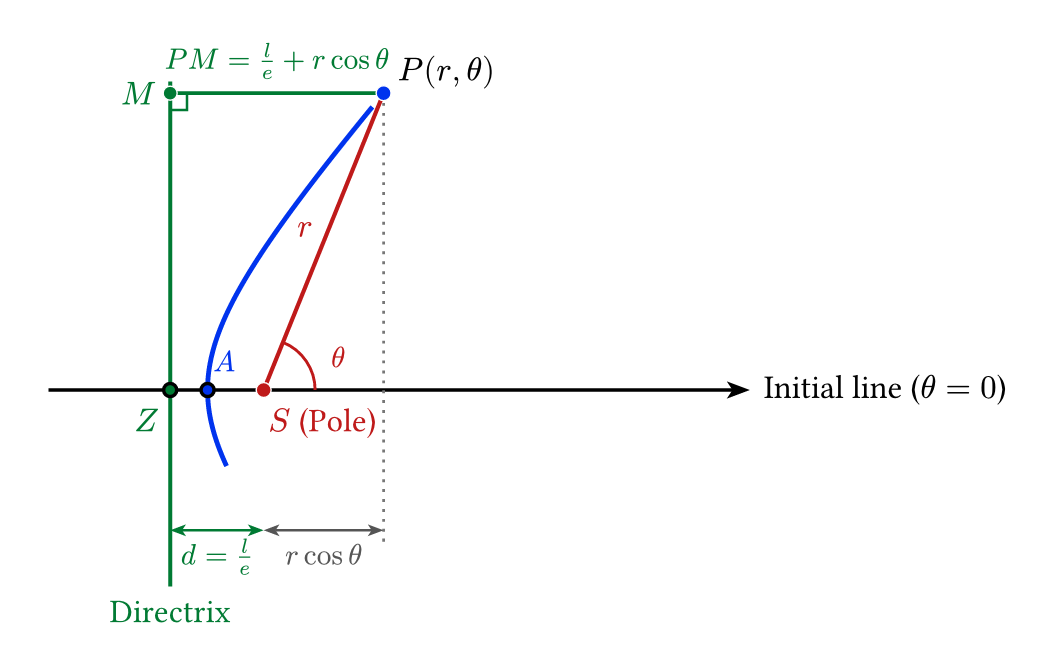
Take the right focus \(S\) as the pole \((0, 0)\) and choose the positive \(x\)-axis pointing away from the directrix \(x = \frac{a}{e}\) as the initial line (\(\theta = 0\)).
First compute the distance \(SZ = d\) from the focus \(S\) to its corresponding directrix:
where \(l = \frac{b^2}{a} = a(e^2 - 1)\) is the semi-latus rectum of the hyperbola. Since the directrix lies at distance \(d = \frac{l}{e}\) behind \(S\) (to the left in the diagram), any point \(P(r, \theta)\) on the right branch has horizontal projection \(r\cos\theta\) from \(S\). Therefore, its perpendicular distance \(PM\) to the directrix is:
Applying the focus-directrix definition \(SP = e \cdot PM\) (with \(SP = r\)):
Rearranging terms in \(r\):
Alternative Orientation: If instead we point the initial line \(\theta = 0\) toward the directrix (replacing \(\theta\) by \(\pi - \theta\), so \(\cos\theta \to -\cos\theta\)), the polar equation becomes:
Important Features in Polar Form
Using \(\frac{l}{r} = 1 - e\cos\theta\) (with \(e > 1\)):
Closest Approach (Vertex \(A\)): When \(\theta = \pi\) (looking back toward the directrix), \(\cos\pi = -1\), so the denominator \(1 - e\cos\theta\) reaches its maximum value \(1 + e\). This gives the minimum distance from \(S\) to the right branch:
This matches our Cartesian vertex distance \(SA = ae - a\).
Semi-Latus Rectum: When \(\theta = \frac{\pi}{2}\) or \(\frac{3\pi}{2}\) (perpendicular to the transverse axis), \(\cos\theta = 0\), giving \(r = l = \frac{b^2}{a}\).
Focal Chord on the Same Branch (Harmonic Mean Property): Let \(PQ\) be a focal chord through \(S\) whose endpoints \(P(r_1, \theta)\) and \(Q(r_2, \theta + \pi)\) lie on the same branch (which occurs whenever \(|\cos\theta| < \frac{1}{e}\), so both \(1 - e\cos\theta > 0\) and \(1 + e\cos\theta > 0\)). Then:
Thus, just as in the parabola and ellipse, the semi-latus rectum \(l\) is the harmonic mean of \(SP\) and \(SQ\) whenever both endpoints lie on the same branch.
Asymptotic Directions: Because \(e > 1\), there exist directions \(\theta\) where \(1 - e\cos\theta = 0\), i.e., \(\cos\theta = \frac{1}{e}\). Along these directions, the radial distance \(r = \frac{l}{1 - e\cos\theta} \to \infty\), meaning the ray never meets the branch at a finite point. These special angles point along the asymptotes of the hyperbola, which we study in the next section!
Unified Conic Equation: Every conic section with a focus at the pole obeys the same polar equation \(\frac{l}{r} = 1 \pm e\cos\theta\): an ellipse when \(0 < e < 1\), a parabola when \(e = 1\), and a hyperbola when \(e > 1\).
Illustrative Examples
Example 1: Finding Standard Attributes
Find the vertices, foci, eccentricity, directrices, and latus rectum of the hyperbola \(9x^2 - 16y^2 = 144\).
Solution:
Divide through by \(144\):
Comparing with \(\frac{x^2}{a^2} - \frac{y^2}{b^2} = 1\): \(a^2 = 16 \implies a = 4\), and \(b^2 = 9 \implies b = 3\).
-
Vertices: \((\pm a, 0) = (\pm 4, 0)\).
-
Eccentricity: \(e = \sqrt{1 + \frac{b^2}{a^2}} = \sqrt{1 + \frac{9}{16}} = \frac{5}{4}\).
-
Foci: \((\pm ae, 0) = (\pm 5, 0)\).
-
Directrices: \(x = \pm \frac{a}{e} = \pm \frac{16}{5}\).
-
Length of Latus Rectum: \(\frac{2b^2}{a} = \frac{2(9)}{4} = \frac{9}{2}\).
Example 2: Finding the Standard Equation from Geometric Data
Find the standard equation of the hyperbola centered at the origin with transverse axis along the \(x\)-axis whose foci are at \((\pm 13, 0)\) and the distance between whose directrices is \(\frac{50}{13}\).
Solution:
Let the standard hyperbola be \(\frac{x^2}{a^2} - \frac{y^2}{b^2} = 1\).
From the given foci \((\pm ae, 0) = (\pm 13, 0)\):
The directrices are \(x = \pm \frac{a}{e}\), so the distance between them is \(\frac{2a}{e}\):
Multiply the two relations to eliminate \(e\):
Now find \(b^2\) from \(b^2 = a^2(e^2 - 1) = (ae)^2 - a^2\):
Therefore, the standard equation of the hyperbola is:
Example 3: Focal Distances and the Constant Difference Property
A point \(P(x_1, y_1)\) lies on the hyperbola \(\frac{x^2}{9} - \frac{y^2}{16} = 1\). If its distance from the right focus \(S\) is \(SP = 7\), find:
- The eccentricity of the hyperbola and the coordinates of both foci.
- The coordinates of \(P\) and its distance \(S'P\) from the left focus \(S'\).
Solution:
1. Eccentricity and foci:
Comparing with \(\frac{x^2}{a^2} - \frac{y^2}{b^2} = 1\), we have \(a^2 = 9 \implies a = 3\) and \(b^2 = 16 \implies b = 4\).
So \(ae = 3 \cdot \frac{5}{3} = 5\), and the foci are \(S(5, 0)\) and \(S'(-5, 0)\).
2. Coordinates of \(P\) and value of \(S'P\):
First check which branch \(P\) can lie on:
- If \(P\) lay on the left branch (\(x_1 \le -3\)), then \(SP = a - ex_1 = 3 - \frac{5}{3}x_1 \ge 3 - \frac{5}{3}(-3) = 8\), which contradicts \(SP = 7\).
- Therefore, \(P\) must lie on the right branch (\(x_1 \ge 3\)), where \(SP = ex_1 - a\):
Substitute \(x_1 = 6\) into the hyperbola equation to find \(y_1\):
Thus, the possible positions of \(P\) are \((6, 4\sqrt{3})\) and \((6, -4\sqrt{3})\).
Finally, by the constant difference property for the right branch (\(S'P - SP = 2a\)):
(Checking directly: \(S'P = ex_1 + a = \frac{5}{3}(6) + 3 = 13\).)
Summary of Key Results
| Feature / Quantity | Formula (\(\frac{x^2}{a^2} - \frac{y^2}{b^2} = 1\)) | Geometric Description |
|---|---|---|
| Relation of Parameters | \(b^2 = a^2(e^2 - 1)\) | Connects semi-axes and eccentricity |
| Eccentricity | \(e = \sqrt{1 + \frac{b^2}{a^2}} > 1\) | Constant ratio \(\frac{SP}{PM}\) |
| Center | \(C(0, 0)\) | Midpoint of \(A'A\) and \(S'S\) |
| Vertices | \((\pm a, 0)\) | Endpoints of the transverse axis |
| Foci | \(S(ae, 0)\) and \(S'(-ae, 0)\) | Two focal points along the transverse axis |
| Directrices | \(x = \pm \frac{a}{e}\) | Lines perpendicular to the transverse axis |
| Length of Transverse Axis | \(2a\) | Distance between the two vertices |
| Length of Conjugate Axis | \(2b\) | Distance between \((0, b)\) and \((0, -b)\) |
| Length of Latus Rectum | \(\frac{2b^2}{a} = 2a(e^2 - 1)\) | Focal chord perpendicular to transverse axis |
| Focal Distances | \(\|ex_1 - a\|\) and \(\|ex_1 + a\|\) | Distances from \(P(x_1, y_1)\) to \(S\) and \(S'\) |
| Constant Difference Property | \(\|S'P - SP\| = 2a\) | Difference of focal distances is constant |
| Polar Form (Focus as Pole) | \(\frac{l}{r} = 1 \pm e\cos\theta\) | Origin at focus \(S\), where \(l = \frac{b^2}{a}\) |