Definite Integral Reduction Formulas and Walli's Theorem
In indefinite integration, a reduction formula keeps track of a complicated algebraic or trigonometric boundary term at every step. In definite integration, something far cleaner happens: when we choose natural limits like \([0, \pi/4]\), \([0, \pi/2]\), \([0, 1]\), or \([0, \infty)\), the boundary terms either vanish completely or collapse to simple numbers.
As a result, a definite integral \(I_n\) depending on an integer parameter \(n\) satisfies a pure numerical recurrence relation—relating \(I_n\) directly to \(I_{n-1}\) or \(I_{n-2}\). We can then step \(n\) down to a trivial base case, telescope sums, or even extract limits as \(n \to \infty\) without ever finding an antiderivative!
Across definite integration, these recurrences come from two main engines:
- Identities and Telescoping Differences, where \(I_n + I_{n-2}\) or \(I_n - I_{n-1}\) simplifies the integrand before integrating.
- Definite Integration by Parts, where the boundary term \(\big[u v\big]_a^b\) vanishes or becomes a constant.
Tangent and Cotangent Powers on Quarter-Period Intervals
(Note: Let us evaluate these on their standard quarter-period intervals where \(\tan x\) and \(\cot x\) run between \(0\) and \(1\).)
Definite Reduction for Tangent Powers
For integers \(n \ge 0\), define:
For \(n \ge 2\), add \(I_n\) and \(I_{n-2}\) together and factor out \(\tan^{n-2} x\):
Since \(\frac{d}{dx}(\tan x) = \sec^2 x\), the integral evaluates immediately:
Notice how clean this is: there is no \(+C\) and no variable expression left—just a single number \(\frac{1}{n - 1}\).
Definite Reduction for Cotangent Powers
For integers \(n \ge 0\), define:
By King's Rule on \([0, \pi/2]\) (or substituting \(x = \frac{\pi}{2} - t\)), \(\cot(\frac{\pi}{2} - t) = \tan t\) and the interval \([\pi/4, \pi/2]\) maps to \([0, \pi/4]\). Hence \(J_n = I_n\) for every \(n \ge 0\), and it satisfies the exact same recurrence:
Examples: Tangent and Cotangent Reductions
Example 1: Evaluating High Powers Step by Step
Evaluate \(I_5 = \int_0^{\pi/4} \tan^5 x\,dx\) and \(I_6 = \int_0^{\pi/4} \tan^6 x\,dx\).
Solution: First compute the two base cases:
Using \(I_n = \frac{1}{n-1} - I_{n-2}\) for odd powers:
And for even powers:
Example 2: A Recurrence Sum
Let \(I_n = \int_0^{\pi/4} \tan^n x\,dx\) for \(n \ge 0\). Evaluate \(\sum_{n=1}^{20} n (I_{n-1} + I_{n+1})\).
Solution: Replacing \(n\) by \(n + 1\) in \(I_n + I_{n-2} = \frac{1}{n - 1}\) gives \(I_{n+1} + I_{n-1} = \frac{1}{n}\). Multiplying by \(n\) yields \(n(I_{n-1} + I_{n+1}) = 1\) for every \(n \ge 1\). Therefore:
Example 3: Sandwiching a Limit via Definite Reduction
Using \(I_n = \int_0^{\pi/4} \tan^n x\,dx\), prove that \(\lim_{n \to \infty} n I_n = \frac{1}{2}\).
Solution: On the open interval \((0, \pi/4)\), we have \(0 < \tan x < 1\), so \(\tan^{n+2} x < \tan^n x < \tan^{n-2} x\) for \(n \ge 2\). Integrating over \([0, \pi/4]\) preserves the strict inequality:
Adding \(I_n\) to all parts and applying the reduction formula:
Combining both bounds gives:
Multiplying by \(n\):
As \(n \to \infty\), both outer bounds approach \(\frac{1}{2}\). By the Sandwich Theorem, \(\lim_{n \to \infty} n I_n = \frac{1}{2}\).
Secant and Cosecant Powers on Definite Intervals
When we integrate powers of \(\sec x\) or \(\csc x\) on \([0, \pi/4]\) or \([\pi/4, \pi/2]\), definite integration by parts produces a clean numerical recurrence.
Definite Reduction for Secant Powers
For integers \(n \ge 1\), define:
For \(n \ge 2\), split \(\sec^n x = \sec^{n-2} x \cdot \sec^2 x\) and integrate by parts with \(u = \sec^{n-2} x\) and \(dv = \sec^2 x\,dx\) (so \(v = \tan x\)):
At \(x = \pi/4\), \(\sec(\pi/4) = \sqrt{2}\) and \(\tan(\pi/4) = 1\); at \(x = 0\), \(\tan 0 = 0\). Replace \(\tan^2 x = \sec^2 x - 1\):
Collecting \(I_n\) on the left gives:
Definite Reduction for Cosecant Powers
Similarly, for \(J_n = \int_{\pi/4}^{\pi/2} \csc^n x\,dx\), substituting \(x = \frac{\pi}{2} - t\) shows \(J_n = I_n\), so:
Example 4: Evaluating Odd Secant Powers on Zero to Pi/4
Evaluate \(I_3 = \int_0^{\pi/4} \sec^3 x\,dx\) and \(I_5 = \int_0^{\pi/4} \sec^5 x\,dx\).
Solution: Start with \(I_1 = \int_0^{\pi/4} \sec x\,dx = \big[\ln|\sec x + \tan x|\big]_0^{\pi/4} = \ln(\sqrt{2} + 1)\).
For \(n = 3\):
For \(n = 5\):
Sine and Cosine Powers: Walli's Theorem
The most celebrated definite reduction formula governs powers of \(\sin x\) and \(\cos x\) on \([0, \pi/2]\), where the boundary term vanishes identically.
Single-Power Reduction on the Quarter Period
For integers \(n \ge 0\), define:
(The two integrals are equal by King's Rule: \(\sin(\frac{\pi}{2} - x) = \cos x\).)
For \(n \ge 2\), write \(\sin^n x = \sin^{n-1} x \cdot \sin x\) and integrate by parts with \(u = \sin^{n-1} x\) and \(dv = \sin x\,dx\) (so \(v = -\cos x\)):
Because \(n - 1 \ge 1\), the boundary term \(\sin^{n-1} x \cos x\) is \(0\) at both \(x = 0\) and \(x = \pi/2\). Replacing \(\cos^2 x = 1 - \sin^2 x\) gives:
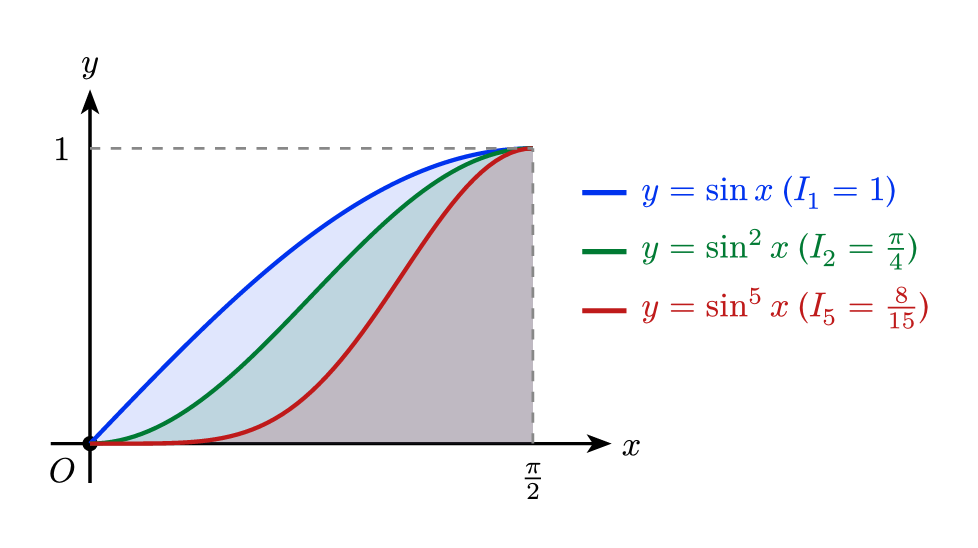
Unrolling this recurrence down to \(W_0 = \int_0^{\pi/2} 1\,dx = \frac{\pi}{2}\) (for even \(n\)) or \(W_1 = \int_0^{\pi/2} \sin x\,dx = 1\) (for odd \(n\)) gives Walli's Formula:
where:
The Combined Product: General Walli's Theorem
Now consider the two-parameter family for integers \(m, n \ge 0\):
Derivation
Assume \(m \ge 2\). Group one factor of \(\sin x\) with \(\cos^n x\):
Then \(du = (m - 1)\sin^{m-2} x \cos x\,dx\) and \(v = -\frac{\cos^{n+1} x}{n + 1}\). Integrating by parts:
Since \(m - 1 \ge 1\) and \(n + 1 \ge 1\), the boundary term vanishes at both \(0\) and \(\pi/2\). Writing \(\cos^{n+2} x = \cos^n x (1 - \sin^2 x)\) gives:
Hence:
By symmetry (\(I_{m, n} = I_{n, m}\) via King's Rule), whenever \(n \ge 2\):
Unrolling Both Exponents: Walli's Theorem
Stepping \(m\) down by \(2\)'s until it hits \(0\) or \(1\), and then stepping \(n\) down by \(2\)'s until it hits \(0\) or \(1\), produces a denominator that starts at \(m + n\) and steps down by \(2\) at every stage:
where:
(If \(m \le 1\), take the factor \((m - 1)(m - 3)\cdots\) as \(1\); likewise if \(n \le 1\).)
Notice why \(K = \frac{\pi}{2}\) only when both \(m\) and \(n\) are even: the four possible terminal base cases \(I_{r, s}\) (\(r, s \in \{0, 1\}\)) are \(I_{0,0} = \frac{\pi}{2}\), \(I_{1,0} = 1\), \(I_{0,1} = 1\), and \(I_{1,1} = \frac{1}{2}\) (where the \(\frac{1}{2}\) already comes from the final denominator factor \(1 + 1 = 2\), leaving \(K = 1\)).
Examples: Walli's Theorem in Action
Example 5: Direct and Substituted Walli's Integrals
Evaluate:
- \(\int_0^{\pi/2} \sin^6 x \cos^4 x\,dx\)
- \(\int_0^1 x^4 (1 - x^2)^{3/2}\,dx\)
- \(\int_0^{2a} x^3 \sqrt{2ax - x^2}\,dx \quad (a > 0)\)
Solution:
(1) Both \(m = 6\) and \(n = 4\) are even, so \(m + n = 10\) and \(K = \frac{\pi}{2}\):
(2) Substitute \(x = \sin\theta\), so \(dx = \cos\theta\,d\theta\) and \(\theta\) runs from \(0\) to \(\pi/2\):
(3) Complete the square: \(2ax - x^2 = a^2 - (x - a)^2\). Substitute \(x = 2a\sin^2\theta\), so \(dx = 4a\sin\theta\cos\theta\,d\theta\), \(\sqrt{2ax - x^2} = 2a\sin\theta\cos\theta\), and \(\theta \in [0, \pi/2]\):
Example 6: Combining Queen's Rule and Even/Odd Symmetry with Walli's Theorem
Evaluate \(\int_{-\pi/2}^{\pi} \sin^4 x \cos^5 x\,dx\).
Solution: Split the interval at \(0\) and \(\pi/2\), or use periodicity/symmetry carefully:
On \([-\pi/2, \pi/2]\), \(\sin^4 x \cos^5 x\) is an even function, so the first integral equals \(2\int_0^{\pi/2} \sin^4 x \cos^5 x\,dx\).
On \([\pi/2, \pi]\), shift by \(-\pi/2\) (replace \(x\) with \(x + \pi/2\)): \(\sin(x + \pi/2) = \cos x\) and \(\cos(x + \pi/2) = -\sin x\), so:
Adding the two pieces leaves just one copy:
Example 7: A Hidden Combinatorial Identity from Walli's Theorem
Prove that for every positive integer \(n\):
and deduce that \(\int_0^{\pi/2} \sin^n x \cos^n x\,dx = 2^{-n} \int_0^{\pi/2} \sin^n x\,dx\).
Solution: From Walli's Formula for \(2n\) (even):
Multiply both numerator and denominator by \(2n(2n - 2)\cdots 2 = 2^n n!\):
For the second identity, write \(\sin x \cos x = \frac{\sin(2x)}{2}\):
By the scaling property (\(2x = t\), multiplying limits by \(2\) and dividing by \(2\)):
Since \(\sin(\pi - t) = \sin t\), Queen's Rule on \([0, \pi]\) gives \(\int_0^\pi \sin^n t\,dt = 2\int_0^{\pi/2} \sin^n t\,dt\), leaving:
Telescoping Trigonometric Quotients
A rich class of definite integral reductions involves quotients with \(\sin x\) or \(\sin^2 x\) in the denominator. Here, integration by parts does not help at all. Instead, we compute the difference \(I_n - I_{n-1}\) so that a sum-to-product identity cancels the denominator!
Family 1: Even Multiples in the Numerator
For integers \(n \ge 1\), define:
Subtract \(I_{n-1}\) from \(I_n\) (taking \(I_0 = 0\)):
Using \(\sin A - \sin B = 2\cos\left(\frac{A + B}{2}\right)\sin\left(\frac{A - B}{2}\right)\):
The \(\sin x\) denominator cancels cleanly:
Summing from \(k = 1\) to \(n\):
Family 2: Odd Multiples in the Numerator (An Exact Invariant)
Now replace \(2nx\) with the odd multiple \((2n - 1)x\) for integers \(n \ge 1\):
Compute \(J_{n+1} - J_n\):
Integrating directly:
Since \(J_{n+1} = J_n\) for every \(n \ge 1\), the integral is completely independent of \(n\):
Family 3: Squared Sine Quotients
Next, for integers \(n \ge 0\), define:
Subtract \(K_{n-1}\) from \(K_n\) for \(n \ge 1\):
Using \(\sin^2 A - \sin^2 B = \sin(A + B)\sin(A - B)\):
By Family 2, \(J_n = \frac{\pi}{2}\) for every \(n \ge 1\)! Therefore \(K_n - K_{n-1} = \frac{\pi}{2}\), which telescopes from \(K_0 = 0\) to give:
Family 4: Related Quotients on Zero to Pi
Applying the scaling and half-angle identities unlocks two more classic families on \([0, \pi]\):
- Cosine Difference Quotient: Let \(L_n = \int_0^\pi \frac{1 - \cos(nx)}{1 - \cos x}\,dx\). Using \(1 - \cos\theta = 2\sin^2(\theta/2)\) and scaling \(x = 2t\):
- Full Half-Period Sine Quotient: Let \(M_n = \int_0^\pi \frac{\sin(nx)}{\sin x}\,dx\). Subtracting \(M_n - M_{n-2} = \int_0^\pi 2\cos\big((n - 1)x\big)\,dx = 0\) (\(n \ge 2\)) reduces everything to \(M_0 = 0\) and \(M_1 = \pi\):
Advanced Examples in Quotient Reduction
Example 8: Using a Second-Order Trigonometric Difference
For a fixed parameter \(\alpha \in (0, \pi)\) and integers \(n \ge 0\), evaluate:
Solution: First check the base cases: \(P_0 = 0\) and \(P_1 = \int_0^\pi 1\,dx = \pi\).
Now form the three-term combination \(P_{n+1} + P_{n-1} - 2\cos\alpha\, P_n\) for \(n \ge 1\):
Recall the identity \(\cos\big((n+1)\theta\big) + \cos\big((n-1)\theta\big) = 2\cos(n\theta)\cos\theta\). Thus the second bracket vanishes identically, and the first bracket equals \(2\cos(nx)(\cos x - \cos\alpha)\). Cancelling \(\cos x - \cos\alpha\) gives:
Hence \(P_{n+1} = 2\cos\alpha\, P_n - P_{n-1}\). Computing the first few terms:
- \(P_0 = 0\)
- \(P_1 = \pi = \pi \frac{\sin\alpha}{\sin\alpha}\)
- \(P_2 = 2\pi\cos\alpha = \pi \frac{\sin(2\alpha)}{\sin\alpha}\)
Assuming \(P_k = \pi \frac{\sin(k\alpha)}{\sin\alpha}\) for \(k \le n\), induction gives:
Therefore, for every integer \(n \ge 0\):
Example 9: Alternating Series with Cosine-Weighted Quotients
Evaluate \(S_n = \int_0^{\pi/2} \frac{\sin(2nx)\cos x}{\sin x}\,dx\) for \(n \ge 1\).
Solution: Write \(\sin(2nx)\cos x = \frac{1}{2}\big[\sin\big((2n+1)x\big) + \sin\big((2n-1)x\big)\big]\):
By Family 2, \(J_{n+1} = J_n = \frac{\pi}{2}\) for all \(n \ge 1\), so:
Definite Algebraic, Exponential, and Logarithmic Reductions
Outside trigonometry, definite limits like \([0, 1]\) and \([0, \infty)\) make integration-by-parts recurrences collapse into some of the most illuminating formulas in mathematics.
1. Logarithmic Powers and Factorials
For \(m \ge 0\) and integers \(n \ge 0\), define:
For \(n \ge 1\), integrate by parts with \(u = (\ln x)^n\) and \(dv = x^m\,dx\):
Because \(\lim_{x \to 0^+} x^{m+1}(\ln x)^n = 0\) and \(\ln 1 = 0\), the boundary term vanishes completely:
Stepping down to \(I_0 = \int_0^1 x^m\,dx = \frac{1}{m + 1}\) yields:
In particular, setting \(m = 0\) gives the integral representation of the factorial:
2. Polynomial-Exponential Reduction on the Unit Interval
Define:
Integrating by parts with \(u = x^n\) and \(dv = e^x\,dx\):
With \(I_0 = e - 1\), this generates \(I_1 = 1\), \(I_2 = e - 2\), \(I_3 = 6 - 2e\), \(I_4 = 9e - 24\), and so on.
3. Infinite-Interval Rational Reduction and Walli's Connection
For integers \(n \ge 1\) and \(a > 0\), define the improper definite integral:
For \(n \ge 2\), split \(1 = \frac{(x^2 + a^2) - x^2}{a^2}\) inside \(I_{n-1}\):
Evaluate the first term by parts with \(u = x\) and \(dv = \frac{x\,dx}{(x^2 + a^2)^n}\) (so \(v = -\frac{1}{2(n - 1)(x^2 + a^2)^{n-1}}\)):
The boundary term vanishes at both \(0\) and \(\infty\) (since \(2(n - 1) \ge 2 > 1\)). Solving for \(I_n\) gives:
Starting from \(I_1 = \int_0^\infty \frac{dx}{x^2 + a^2} = \frac{\pi}{2a}\), we get:
(Why does this match Walli's Formula? Substituting \(x = a\tan\theta\) transforms \(\int_0^\infty \frac{dx}{(x^2+a^2)^n}\) directly into \(\frac{1}{a^{2n-1}}\int_0^{\pi/2}\cos^{2n-2}\theta\,d\theta\)!)
4. Two-Parameter Beta Reduction and Shifted Intervals
For integers \(m, n \ge 0\), define:
For \(n \ge 1\), integrate by parts with \(u = (1 - x)^n\) and \(dv = x^m\,dx\):
Repeating this \(n\) times down to \(B(m + n, 0) = \int_0^1 x^{m+n}\,dx = \frac{1}{m + n + 1}\) yields:
By shifting and scaling (\(x = a + (b - a)t\)), for any real numbers \(a < b\):
Advanced Mixed Examples
Example 10: Rational Recurrence, Sandwich Bounds, and the Alternating Harmonic Series
Let \(I_n = \int_0^1 \frac{x^n}{1 + x}\,dx\) for integers \(n \ge 0\).
- Find a reduction relation between \(I_n\) and \(I_{n-1}\).
- Prove that \(\lim_{n \to \infty} n I_n = \frac{1}{2}\).
- Deduce the alternating harmonic series \(\sum_{k=1}^\infty \frac{(-1)^{k-1}}{k} = \ln 2\).
Solution:
(1) Add \(I_n\) and \(I_{n-1}\):
(2) On \((0, 1)\), we have \(x^{n+1} < x^n < x^{n-1}\), so \(I_{n+1} < I_n < I_{n-1}\). Therefore:
Thus:
By the Sandwich Theorem, \(\lim_{n \to \infty} n I_n = \frac{1}{2}\).
(3) Notice that \(I_0 = \int_0^1 \frac{1}{1 + x}\,dx = \ln 2\). Unrolling \(I_{k-1} + I_k = \frac{1}{k}\) with alternating signs:
Since \(0 < I_n < \frac{1}{2n} \to 0\) as \(n \to \infty\), taking the limit gives \(\sum_{k=1}^\infty \frac{(-1)^{k-1}}{k} = \ln 2\).
Example 11: Binomial Powers and a Combinatorial Sum
For integers \(n \ge 0\) and \(p \ge 1\), evaluate \(I_n = \int_0^1 (1 - x^p)^n\,dx\). Then deduce the value of \(\sum_{k=0}^n \frac{(-1)^k}{2k + 1} \binom{n}{k}\).
Solution: For \(n \ge 1\), integrate by parts with \(u = (1 - x^p)^n\) and \(dv = dx\) (so \(v = x\)):
Write \(x^p = 1 - (1 - x^p)\) inside the integral:
Solving for \(I_n\) gives \(I_n = \frac{np}{np + 1} I_{n-1}\). With \(I_0 = 1\), this unrolls to:
Setting \(p = 2\):
On the other hand, expanding \((1 - x^2)^n = \sum_{k=0}^n (-1)^k \binom{n}{k} x^{2k}\) and integrating term by term on \([0, 1]\) gives:
Example 12: Shifted Beta Integral Without Expansion
Evaluate \(\int_1^4 (x - 1)^3 (4 - x)^4\,dx\).
Solution: Using the shifted Beta reduction formula \(\int_a^b (x - a)^m (b - x)^n\,dx = (b - a)^{m + n + 1} \frac{m!\, n!}{(m + n + 1)!}\) with \(a = 1\), \(b = 4\), \(m = 3\), and \(n = 4\):
Summary of Definite Integral Reduction Formulas
| Definite Integral | Reduction Formula | Closed Form / Base Case |
|---|---|---|
| \(I_n = \int_0^{\pi/4} \tan^n x\,dx\) | \(I_n + I_{n-2} = \frac{1}{n - 1}\) | \(I_0 = \frac{\pi}{4},\; I_1 = \frac{1}{2}\ln 2\) |
| \(I_n = \int_0^{\pi/4} \sec^n x\,dx\) | \((n - 1)I_n = (\sqrt{2})^{n-2} + (n - 2)I_{n-2}\) | \(I_1 = \ln(\sqrt{2} + 1),\; I_2 = 1\) |
| \(W_n = \int_0^{\pi/2} \sin^n x\,dx\) | \(W_n = \frac{n - 1}{n} W_{n-2}\) | Walli's Formula (\(W_0 = \frac{\pi}{2},\; W_1 = 1\)) |
| \(I_{m,n} = \int_0^{\pi/2} \sin^m x \cos^n x\,dx\) | \(I_{m,n} = \frac{m - 1}{m + n} I_{m-2, n}\) | Walli's Product Formula |
| \(I_n = \int_0^{\pi/2} \frac{\sin(2nx)}{\sin x}\,dx\) | \(I_n - I_{n-1} = \frac{2(-1)^{n-1}}{2n - 1}\) | \(I_n = 2\sum_{k=1}^n \frac{(-1)^{k-1}}{2k - 1}\) |
| \(J_n = \int_0^{\pi/2} \frac{\sin((2n-1)x)}{\sin x}\,dx\) | \(J_{n+1} - J_n = 0\) | \(J_n = \frac{\pi}{2}\) for all \(n \ge 1\) |
| \(K_n = \int_0^{\pi/2} \frac{\sin^2(nx)}{\sin^2 x}\,dx\) | \(K_n - K_{n-1} = \frac{\pi}{2}\) | \(K_n = \frac{n\pi}{2}\) |
| \(I_n = \int_0^1 x^m (\ln x)^n\,dx\) | \(I_n = -\frac{n}{m + 1} I_{n-1}\) | \(I_n = \frac{(-1)^n n!}{(m + 1)^{n+1}}\) |
| \(I_n = \int_0^\infty \frac{dx}{(x^2 + a^2)^n}\) | \(I_n = \frac{2n - 3}{2(n - 1)a^2} I_{n-1}\) | \(I_1 = \frac{\pi}{2a}\) |
| \(B(m, n) = \int_0^1 x^m (1 - x)^n\,dx\) | \(B(m, n) = \frac{n}{m + 1} B(m + 1, n - 1)\) | \(\frac{m!\, n!}{(m + n + 1)!}\) |
| \(I_n = \int_0^1 (1 - x^p)^n\,dx\) | \(I_n = \frac{np}{np + 1} I_{n-1}\) | \(\frac{n!\, p^n}{(p + 1)(2p + 1)\cdots(np + 1)}\) |