Improper Integrals
Up to this point, our definition of the definite integral \(\int_a^b f(x) \, dx\) has relied on two basic assumptions:
- The interval of integration \([a, b]\) has finite length (\(a\) and \(b\) are finite real numbers).
- The integrand \(f(x)\) is bounded on \([a, b]\) (it does not shoot off to \(+\infty\) or \(-\infty\) anywhere on the interval).
When either of these two conditions fails—because the interval extends to \(\pm\infty\), or because the curve has a vertical asymptote where \(f(x) \to \pm\infty\)—the integral is called an improper integral.
How can an unbounded region possibly have a finite area? The secret is simple: we first integrate over a safe, finite interval using the First Fundamental Theorem of Calculus, and then take the limit as the boundary moves toward infinity or toward the vertical asymptote!
- If this limit exists as a finite real number, we say the improper integral converges (or exists), and that limit is its value.
- If the limit is \(\pm\infty\) or does not exist, we say the improper integral diverges (does not exist).
1. Type 1 Improper Integrals: Infinite Intervals of Integration
In a Type 1 improper integral, the function \(f(x)\) is continuous, but one or both limits of integration are infinite (\(\infty\) or \(-\infty\)).
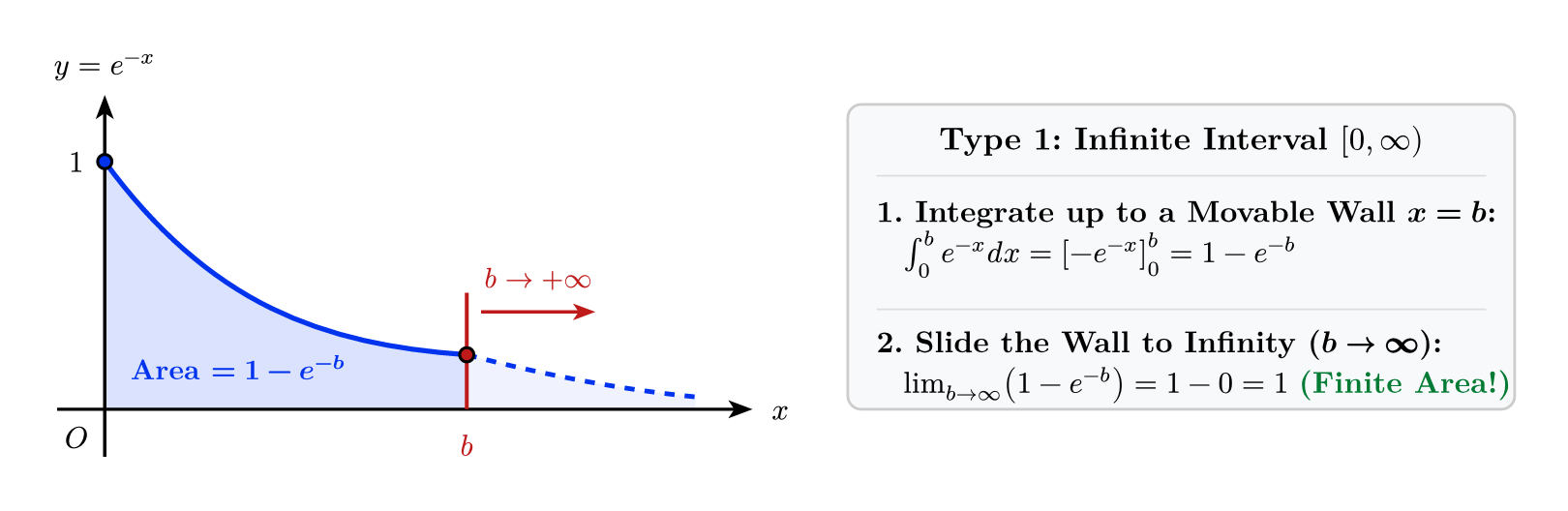
We evaluate it by placing a movable vertical wall at a finite position (\(x = b\) or \(x = a\)), finding the exact area up to the wall, and then sliding the wall to infinity:
Case 1 (Upper Limit at \(+\infty\)): If \(f(x)\) is continuous on \([a, \infty)\), then:
Case 2 (Lower Limit at \(-\infty\)): If \(f(x)\) is continuous on \((-\infty, b]\), then:
Case 3 (Both Limits Infinite, \(-\infty\) to \(+\infty\)): If \(f(x)\) is continuous on \((-\infty, \infty)\), we split the integral at any convenient real number \(c\) (usually \(c = 0\)) into two separate Type 1 integrals:
[!CAUTION] Both Pieces Must Converge Independently: For \(\int_{-\infty}^\infty f(x) \, dx\) to exist, both limits \(\lim_{a \to -\infty} \int_a^0 f(x) \, dx\) and \(\lim_{b \to \infty} \int_0^b f(x) \, dx\) must exist as finite numbers independently! If either piece goes to \(\pm\infty\), the entire integral diverges.
Example 1: Area Under the Exponential Tail
Evaluate:
Solution:
Look at the region under \(y = e^{-x}\) for \(x \ge 0\) in the figure above. Although the region stretches infinitely far to the right, the curve \(y = e^{-x}\) drops toward the \(x\)-axis so rapidly that the tail becomes vanishingly thin.
First, we integrate from \(x = 0\) up to a finite movable wall \(x = b\):
Next, we slide the wall to infinity (\(b \to \infty\)). Since \(\lim_{b \to \infty} e^{-b} = \lim_{b \to \infty} \frac{1}{e^b} = 0\), we obtain:
Thus, the infinite region under \(y = e^{-x}\) on \([0, \infty)\) has an exact, finite area of \(1\)!
Example 2: Comparing Reciprocal Powers on an Infinite Interval
Evaluate the following two integrals and compare their geometric meaning:
Solution:
(a) For \(f(x) = \frac{1}{x^2}\) on \([1, \infty)\), we integrate from \(1\) to \(b\) and take the limit as \(b \to \infty\):
The integral converges to \(1\) (the infinite tail under \(y = \frac{1}{x^2}\) has finite area \(1\)).
(b) For \(f(x) = \frac{1}{x}\) on \([1, \infty)\), we integrate from \(1\) to \(b\) and take the limit as \(b \to \infty\):
Because \(\ln b \to \infty\) as \(b \to \infty\), this limit does not exist as a finite number. The integral diverges (the curve \(y = \frac{1}{x}\) approaches the \(x\)-axis too slowly, enclosing an infinite area!).
Example 3: Integrating Over the Entire Real Line
Evaluate:
Solution:
The function \(f(x) = \frac{1}{1 + x^2}\) is continuous for all real \(x\). Splitting at \(x = 0\):
Since an antiderivative of \(\frac{1}{1 + x^2}\) is \(\tan^{-1} x\):
Left Piece:
Right Piece:
Since both pieces converge to finite values, we add them together:
2. Type 2 Improper Integrals: Unbounded Functions (Vertical Asymptotes)
In a Type 2 improper integral, the interval \([a, b]\) is finite, but the integrand \(f(x)\) blows up to \(+\infty\) or \(-\infty\) (has a vertical asymptote) at an endpoint or at an interior point \(x = c\).
Just as we did in Section 04, we step back from the trouble spot by a tiny positive distance \(h > 0\), evaluate the ordinary definite integral on the safe interval, and take the limit as \(h \to 0^+\):
Case 1 (Unbounded at the Left Endpoint \(x = a\)): If \(f(x)\) is continuous on \((a, b]\) and unbounded near \(a\):
Case 2 (Unbounded at the Right Endpoint \(x = b\)): If \(f(x)\) is continuous on \([a, b)\) and unbounded near \(b\):
Case 3 (Unbounded at an Interior Point \(x = c \in (a, b)\)): We split the integral at \(x = c\) into two separate Type 2 integrals:
(Both the left limit and the right limit must converge to finite numbers independently for the integral to exist!)
Example 4: Vertical Asymptote at the Left Endpoint
Evaluate:
Solution:
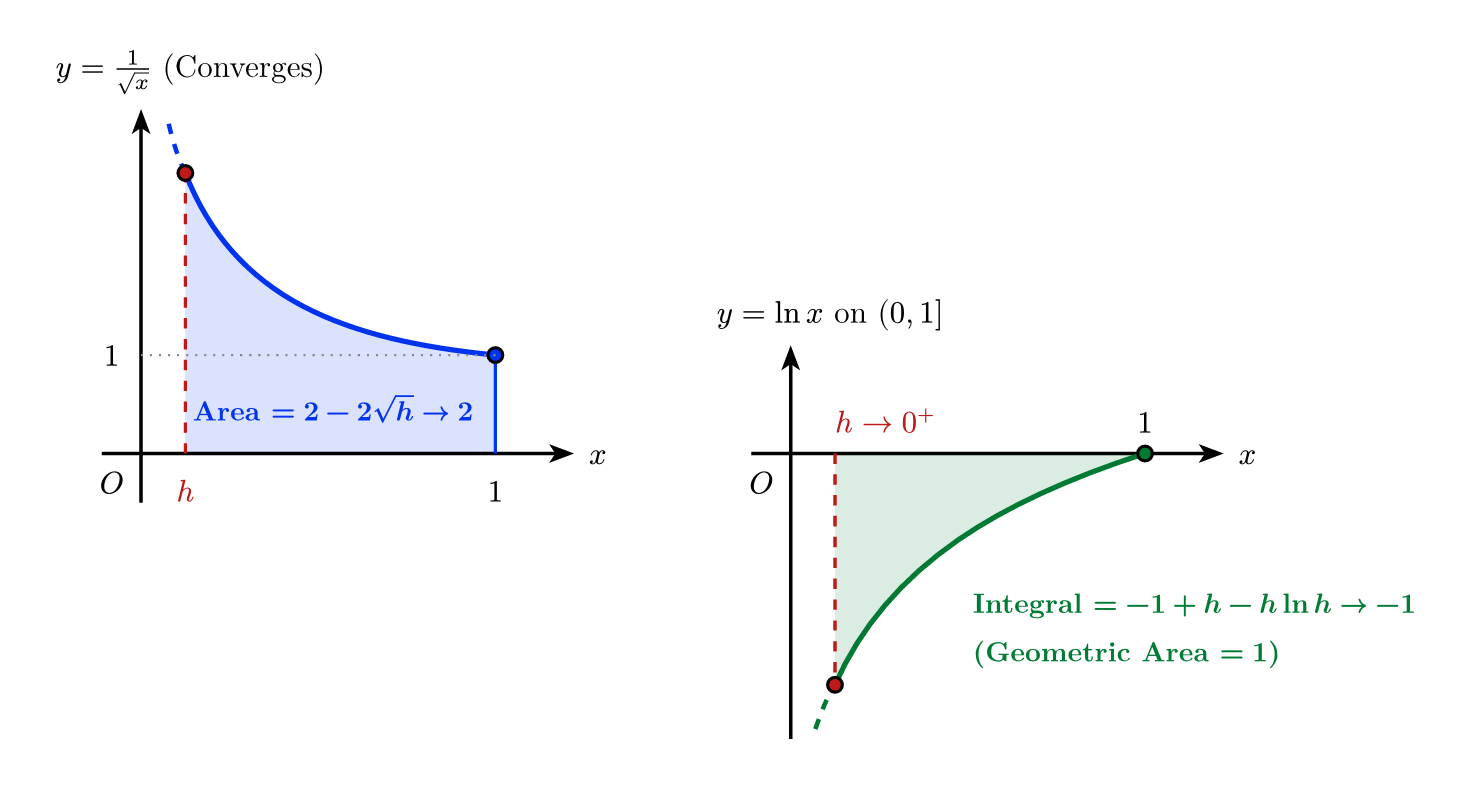
As \(x \to 0^+\), the function \(f(x) = \frac{1}{\sqrt{x}}\) blows up to \(+\infty\), so the \(y\)-axis is a vertical asymptote.
Replacing the lower limit \(0\) with \(0 + h = h\) (where \(h > 0\)) and taking the limit as \(h \to 0^+\):
On \([h, 1]\), \(x^{-1/2}\) is continuous with antiderivative \(2\sqrt{x}\):
Even though the curve climbs infinitely high along the \(y\)-axis, the chimney-shaped region becomes narrow fast enough that its total area is the finite number \(2\)!
Example 5: Area Bounded by the Natural Logarithm Near Zero
Evaluate:
Solution:
As \(x \to 0^+\), \(\ln x \to -\infty\), so the integrand has a vertical asymptote along the negative \(y\)-axis at the left endpoint \(x = 0\) (as shown in the right panel of the figure above).
Step 1 (Step Back from \(x = 0\)): We integrate from \(x = h\) (\(h > 0\)) to \(x = 1\) and take \(\lim_{h \to 0^+}\):
Step 2 (Integrate by Parts on \([h, 1]\)): Taking \(\ln x\) as the first function and \(1\) as the second function gives the antiderivative \(\int \ln x \, dx = x \ln x - x\):
Step 3 (Take the Limit as \(h \to 0^+\)): As \(h \to 0^+\), the term \(h \to 0\), and \(h \ln h\) is an indeterminate form of type \(0 \times (-\infty)\). Recall the standard limit (which we can verify by L'Hôpital's Rule):
Substituting this into our limit gives:
Thus, \(\int_0^1 \ln x \, dx = -1\) (and since \(\ln x \le 0\) on \((0, 1]\), the geometric area enclosed between \(y = \ln x\) and the \(x\)-axis is \(|-1| = 1\)).
Example 6: Why Blind Substitution Across a Vertical Asymptote Fails
Determine whether the following integral exists:
Solution:
[!CAUTION] The Classic Trap: If someone ignores the vertical asymptote at \(x = 0\) and blindly plugs the endpoints into the antiderivative \(F(x) = -\frac{1}{x}\), they get:
\[\left[ -\frac{1}{x} \right]_{-1}^1 = \left(-\frac{1}{1}\right) - \left(-\frac{1}{-1}\right) = -1 - 1 = -2 \quad \text{(ABSURD!)}\]How could the integral of a strictly positive function \(f(x) = \frac{1}{x^2} > 0\) ever be negative?! It cannot—because \(f(x)\) blows up to \(+\infty\) at the interior point \(x = 0\), violating the continuity condition of the Fundamental Theorem!
The Correct Analysis:
Since \(x = 0\) is a vertical asymptote inside \([-1, 1]\), we must split the integral at \(x = 0\):
Let us check the right piece \(\lim_{h_2 \to 0^+} \int_{h_2}^1 \frac{1}{x^2} \, dx\):
Because the limit blows up to \(+\infty\) (and the left piece also blows up to \(+\infty\)), the improper integral diverges (does not exist).
Miscellaneous Examples
Example 1
Evaluate:
Solution:
We first integrate from \(0\) to \(b\) using integration by parts (with first function \(f(x) = x\) and second function \(g(x) = e^{-x}\)) and then take the limit as \(b \to \infty\):
Now take the limit as \(b \to \infty\). Recall that exponential growth \(e^b\) dominates any polynomial power \(b\), so by L'Hôpital's Rule:
Therefore:
Example 2
Evaluate:
Solution:
The integrand \(f(x) = \frac{1}{\sqrt{1 - x^2}}\) is continuous on \([0, 1)\), but as \(x \to 1^-\), the denominator \(\sqrt{1 - x^2} \to 0\), so \(f(x) \to +\infty\) at the right endpoint \(x = 1\).
Replacing the upper limit \(1\) with \(1 - h\) (\(h > 0\)) and taking the limit as \(h \to 0^+\):
Since \(\int \frac{1}{\sqrt{1 - x^2}} \, dx = \sin^{-1} x\):
Example 3
Evaluate:
Solution:
As \(x \to 0^+\), \(\ln x \to -\infty\), so \(x = 0\) is a point where \(\ln x\) is undefined. Stepping back from \(x = 0\) to \(x = h\) (\(h > 0\)):
Applying integration by parts on \([h, 1]\) with first function \(u = \ln x\) (\(du = \frac{1}{x}\,dx\)) and second function \(dv = x \, dx\) (\(v = \frac{x^2}{2}\)):
Taking the limit as \(h \to 0^+\), since \(\lim_{h \to 0^+} (h^2 \ln h) = 0\):
Example 4
Evaluate:
Solution:
On \([2, \infty)\), the denominator \(x^2 - 1 = (x - 1)(x + 1)\) is strictly positive, so the integrand is continuous. Integrating from \(2\) to \(b\) and taking \(\lim_{b \to \infty}\):
Using the standard formula \(\int \frac{dx}{x^2 - 1} = \frac{1}{2} \ln \left| \frac{x - 1}{x + 1} \right|\):
As \(b \to \infty\), \(\frac{b - 1}{b + 1} = \frac{1 - 1/b}{1 + 1/b} \to 1\), so \(\ln\left(\frac{b - 1}{b + 1}\right) \to \ln 1 = 0\). Therefore:
Example 5
Evaluate:
Solution:
We integrate from \(e\) to \(b\) and take the limit as \(b \to \infty\):
In the finite integral \(\int_e^b \frac{1}{x (\ln x)^2} \, dx\), let \(t = \ln x\), so \(dt = \frac{1}{x} \, dx\):
- When \(x = e\), \(t = \ln e = 1\).
- When \(x = b\), \(t = \ln b\).
Thus:
Now take the limit as \(b \to \infty\). Since \(\ln b \to \infty\), we have \(\frac{1}{\ln b} \to 0\):
Example 6
Evaluate:
Solution:
The integrand \(f(x) = x^{-1/3} = \frac{1}{\sqrt[3]{x}}\) blows up to \(-\infty\) as \(x \to 0^-\) and to \(+\infty\) as \(x \to 0^+\). Because \(x = 0\) is an interior vertical asymptote, we split \([-1, 1]\) at \(x = 0\):
An antiderivative of \(x^{-1/3}\) is \(\frac{3}{2} x^{2/3} = \frac{3}{2} (\sqrt[3]{x})^2\). Let us evaluate both limits independently:
Left Piece:
Right Piece:
Because both pieces converge to finite numbers (\(-\frac{3}{2}\) and \(+\frac{3}{2}\)), the improper integral converges, and its value is their sum:
Example 7
Evaluate:
Solution:
Multiplying both the numerator and the denominator by \(e^x\) gives:
Substituting \(t = e^x\) (\(dt = e^x \, dx\), with \(x = 0 \implies t = 1\) and \(x = b \implies t = e^b\)):
As \(b \to \infty\), \(e^b \to \infty\), so \(\tan^{-1}(e^b) \to \frac{\pi}{2}\). Therefore:
Example 8
Evaluate:
Solution:
At \(x = 0\), both \(\ln x \to -\infty\) and \(\frac{1}{\sqrt{x}} \to +\infty\), so we step back from \(x = 0\) to \(x = h\) (\(h > 0\)) and take \(\lim_{h \to 0^+}\):
Applying integration by parts on \([h, 1]\) with first function \(u = \ln x\) (\(du = \frac{1}{x}\,dx\)) and second function \(dv = x^{-1/2} \, dx\) (\(v = 2\sqrt{x}\)):
Now take the limit as \(h \to 0^+\). By L'Hôpital's Rule:
Therefore:
Summary
| Type of Improper Integral | Standard Definition | Convergence Condition |
|---|---|---|
| Type 1: Upper Limit \(\infty\) | \(\int_a^\infty f(x) \, dx = \lim_{b \to \infty} \int_a^b f(x) \, dx\) | Converges if the limit as \(b \to \infty\) is a finite real number. |
| Type 1: Both Limits \(\pm\infty\) | \(\int_{-\infty}^\infty f(x) \, dx = \lim_{a \to -\infty} \int_a^0 f(x) \, dx + \lim_{b \to \infty} \int_0^b f(x) \, dx\) | Both the \((-\infty, 0]\) piece and the \([0, \infty)\) piece must converge independently. |
| Type 2: Unbounded at \(x = a\) | \(\int_a^b f(x) \, dx = \lim_{h \to 0^+} \int_{a+h}^b f(x) \, dx\) | Converges if the one-sided limit as \(h \to 0^+\) is finite. |
| Type 2: Unbounded at \(x = b\) | \(\int_a^b f(x) \, dx = \lim_{h \to 0^+} \int_a^{b-h} f(x) \, dx\) | Converges if the one-sided limit as \(h \to 0^+\) is finite. |
| Type 2: Interior Asymptote \(c \in (a, b)\) | \(\lim_{h_1 \to 0^+} \int_a^{c-h_1} f(x) \, dx + \lim_{h_2 \to 0^+} \int_{c+h_2}^b f(x) \, dx\) | Both one-sided limits around \(x = c\) must converge independently. |