Pole and Polar with respect to an Ellipse
In coordinate geometry, we are familiar with lines that interact with a curve directly, such as a tangent touching at a single point or a normal standing perpendicular to that tangent. The concept of pole and polar introduces another fundamental relationship between points and straight lines.
Every point in the Cartesian plane (called the pole) is associated with a unique straight line (called its polar), and conversely, every straight line is associated with a unique pole. This concept connects tangents, chords of contact, harmonic division, conjugate lines, and the fundamental duality between the foci and directrices into one unified framework.
Geometric Definition of Pole and Polar
Consider the standard ellipse:
having its center at \(O(0, 0)\), major axis along the \(x\)-axis, and minor axis along the \(y\)-axis.
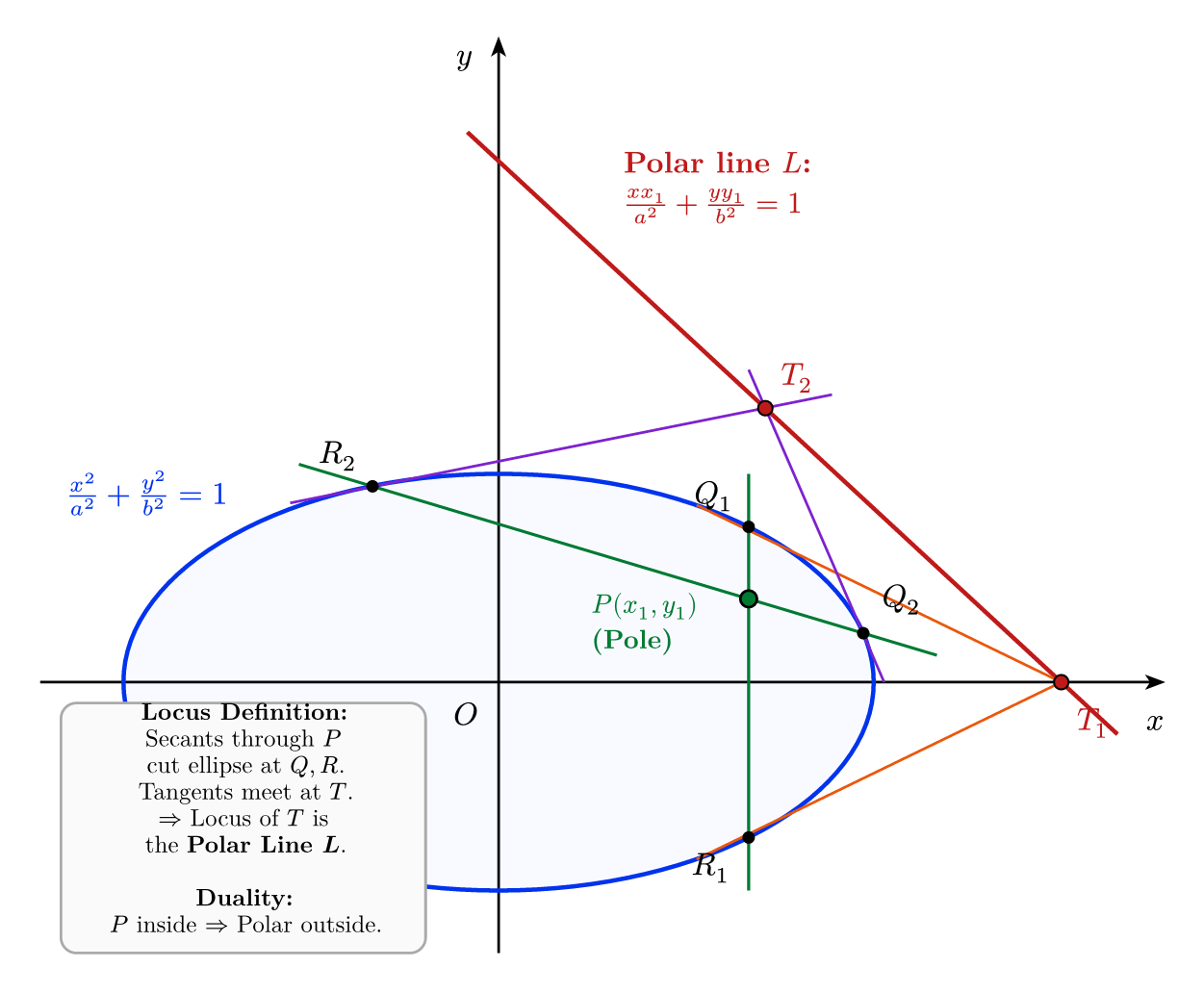
Let \(P(x_1, y_1)\) be a given fixed point in the Cartesian plane. Through \(P\), draw any secant line that intersects the ellipse at two points \(Q\) and \(R\).
At these two points of intersection, draw the tangents to the ellipse. Let these tangents intersect at a point \(T(h, k)\). As the secant line rotates about the fixed point \(P\), the points of contact \(Q\) and \(R\) move along the ellipse, and consequently the point of intersection \(T\) moves in the plane.
The locus of this point of intersection \(T\) is a straight line. This straight line is called the polar of the point \(P\) with respect to the ellipse, and the point \(P\) is called the pole of the straight line.
Derivation of the Equation of the Polar
To find the equation of the locus of \(T(h, k)\), consider the geometric relationship from the viewpoint of \(T\).
Let \(T(h, k)\) be any point on the locus. By definition, tangents drawn from \(T(h, k)\) to the ellipse touch the curve at \(Q\) and \(R\). Therefore, the straight line \(QR\) is the chord of contact of tangents drawn from \(T(h, k)\) to the ellipse \(\frac{x^2}{a^2} + \frac{y^2}{b^2} = 1\).
The equation of the chord of contact for a point \(T(h, k)\) is given by the standard formula:
Because the chord \(QR\) passes through the fixed point \(P(x_1, y_1)\), the coordinates of \(P\) must satisfy this equation:
Rearranging this expression:
To obtain the locus of the point \(T(h, k)\), replace \((h, k)\) with running coordinates \((x, y)\):
This is a linear equation in \(x\) and \(y\), which proves that the locus of \(T\) is a straight line.
Theorem (Equation of the Polar)
The polar of the point \(P(x_1, y_1)\) with respect to the ellipse \(\frac{x^2}{a^2} + \frac{y^2}{b^2} = 1\) is given by:\[ \frac{xx_1}{a^2} + \frac{yy_1}{b^2} = 1 \]In standard \(T\) notation, this is written compactly as \(T = 0\), where:
\[ T \equiv \frac{xx_1}{a^2} + \frac{yy_1}{b^2} - 1 \]
Position of the Pole and Nature of the Polar
The algebraic equation \(T = 0\) represents three distinct geometric lines depending on whether the point \(P(x_1, y_1)\) lies outside, on, or inside the ellipse.
Recall the position function for a point \(P(x_1, y_1)\) with respect to the ellipse:
Case 1: Point Lies Outside the Ellipse
When \(P(x_1, y_1)\) lies outside the ellipse (\(S_1 > 0\)), two real and distinct tangents can be drawn from \(P\) to the curve.
If the rotating secant through \(P\) turns until it becomes one of these tangent lines, the two intersection points \(Q\) and \(R\) merge into the single point of tangency. Consequently, the tangents at \(Q\) and \(R\) meet at that point of tangency on the ellipse.
Therefore, the polar line must pass through both points of tangency. This means that when \(P\) lies outside the ellipse, its polar is simply the chord of contact of the two tangents drawn from \(P\). The polar intersects the ellipse in two distinct real points.
Case 2: Point Lies on the Ellipse
When \(P(x_1, y_1)\) lies on the curve (\(S_1 = 0\)), the two points of contact coalesce with \(P\) itself.
The chord of contact becomes the tangent line to the ellipse at \(P\). Thus, the polar of any point lying on the ellipse is the tangent line at that point.
Case 3: Point Lies Inside the Ellipse
When \(P(x_1, y_1)\) lies inside the ellipse (\(S_1 < 0\)), no real tangents can be drawn from \(P\) to the curve.
However, every straight line drawn through \(P\) is a real secant that cuts the ellipse at two real points \(Q\) and \(R\). The tangents at \(Q\) and \(R\) always intersect outside the ellipse.
The locus of these intersection points is a straight line lying entirely outside the ellipse. This polar line does not meet the ellipse in real points.
Special Case: The Center of the Ellipse
If the pole is chosen at the center \(O(0, 0)\), substituting \(x_1 = 0\) and \(y_1 = 0\) into the polar equation gives:
This equation represents no line in the finite Cartesian plane. Geometrically, tangents drawn at the ends of any diameter (a chord through the center) are parallel and meet at infinity.
Therefore, the polar of the center of an ellipse is the line at infinity.
| Position of Pole \(P(x_1, y_1)\) | Sign of \(S_1 = \frac{x_1^2}{a^2} + \frac{y_1^2}{b^2} - 1\) | Nature of the Line \(T = 0\) | Intersection with Ellipse |
|---|---|---|---|
| Outside Ellipse | \(S_1 > 0\) | Chord of contact of tangents from \(P\) | Two distinct real points |
| On Ellipse | \(S_1 = 0\) | Tangent line to the ellipse at \(P\) | Point of tangency (repeated point) |
| Inside Ellipse | \(S_1 < 0\) | Line lying entirely outside the ellipse | No real points of intersection |
| Center \(O(0, 0)\) | \(S_1 = -1\) | Line at infinity | Meets ellipse at infinity |
Illustrative Example: Finding Polars for Different Point Locations
Problem. Find the equations of the polars of the following points with respect to the ellipse \(\frac{x^2}{16} + \frac{y^2}{9} = 1\): (a) \(A(8, 6)\), (b) \(B(0, 3)\), and (c) \(C(2, 1)\). State the geometric nature of each polar.
Solution. Here \(a^2 = 16\) and \(b^2 = 9\). The general equation of the polar of a point \((x_1, y_1)\) is:
Evaluating each point:
Point \(A(8, 6)\):
Check the position of the point:
Because \(S_1 > 0\), the point \(A\) lies outside the ellipse. Its polar is:
This polar is the chord of contact of the two tangents drawn from \(A(8, 6)\) to the ellipse, cutting the curve in two distinct real points.
Point \(B(0, 3)\):
Check the position of the point:
Because \(S_1 = 0\), the point \(B\) lies on the ellipse (it is the positive vertical vertex). Its polar is:
This polar is the horizontal tangent line to the ellipse at \(B(0, 3)\).
Point \(C(2, 1)\):
Check the position of the point:
Because \(S_1 < 0\), the point \(C\) lies inside the ellipse. Its polar is:
This polar line lies entirely outside the ellipse and does not cut the curve in real points.
Finding the Pole of a Given Straight Line
Because the relationship between a pole and its polar is reciprocal, given any straight line, we can find the unique pole that produces it.
Let the given straight line be:
Let \(P(x_1, y_1)\) be its pole with respect to the ellipse \(\frac{x^2}{a^2} + \frac{y^2}{b^2} = 1\).
The equation of the polar of \(P(x_1, y_1)\) is:
Since this line represents the same straight line as \(lx + my + n = 0\), the coefficients of corresponding terms must be proportional:
From the first and third ratios:
From the second and third ratios:
Theorem (Coordinates of the Pole)
The pole of the straight line \(lx + my + n = 0\) with respect to the ellipse \(\frac{x^2}{a^2} + \frac{y^2}{b^2} = 1\) is given by:\[ P(x_1, y_1) = \left(-\frac{a^2 l}{n}, -\frac{b^2 m}{n}\right) \]provided that \(n \neq 0\).
If \(n = 0\), the line passes through the center \(O(0, 0)\). In that case, its pole lies at infinity along the direction of the conjugate diameter.
Illustrative Example: Finding the Pole of a Given Line
Problem. Find the pole of the straight line \(x + 2y = 4\) with respect to the ellipse \(\frac{x^2}{16} + \frac{y^2}{9} = 1\).
Solution. Here \(a^2 = 16\) and \(b^2 = 9\).
Write the given line in standard form \(lx + my + n = 0\):
Here, \(l = 1\), \(m = 2\), and \(n = -4\).
Using the pole formulas:
Thus, the pole is \(P\left(4, \frac{9}{2}\right)\).
Verification: The polar of \(\left(4, \frac{9}{2}\right)\) with respect to \(\frac{x^2}{16} + \frac{y^2}{9} = 1\) is:
This matches the given line.
Harmonic Properties of Pole and Polar
An important geometric property of pole and polar is its connection with harmonic division.
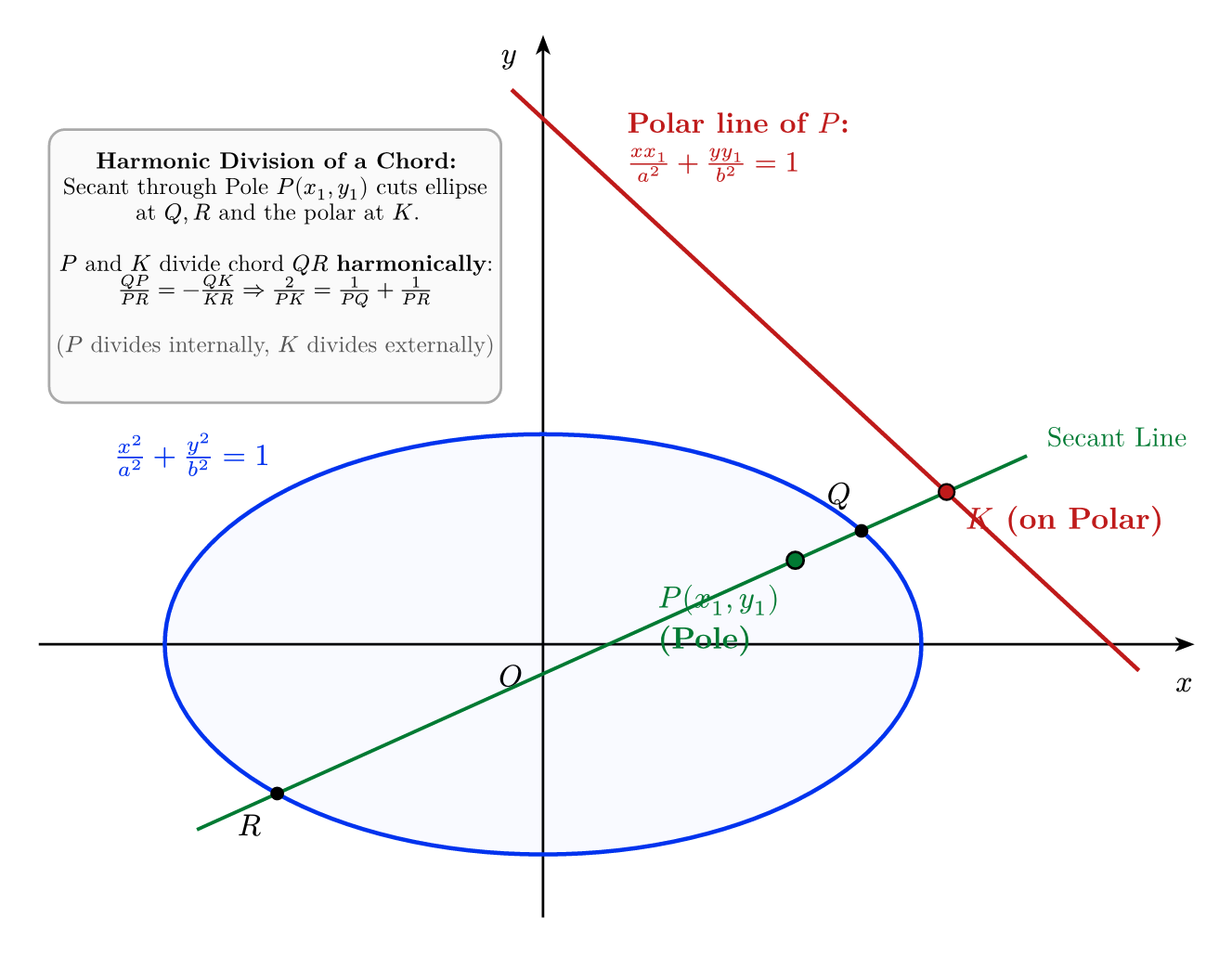
Theorem (Harmonic Division of a Chord)
If any straight line drawn through a pole \(P\) intersects the ellipse at two points \(Q\) and \(R\), and intersects the polar of \(P\) at a point \(K\), then the points \(P\) and \(K\) divide the chord \(QR\) harmonically:\[ \frac{QP}{PR} = -\frac{QK}{KR} \]In terms of directed distances measured from the pole \(P\):
\[ \frac{2}{PK} = \frac{1}{PQ} + \frac{1}{PR} \]
Proof
Let the pole be \(P(x_1, y_1)\). Consider any line drawn through \(P\) making an angle \(\theta\) with the positive \(x\)-axis.
Using the distance form of a straight line, any point on this line at a directed distance \(r\) from \(P\) has coordinates:
To find where this line cuts the ellipse \(\frac{x^2}{a^2} + \frac{y^2}{b^2} = 1\), substitute these coordinates into the ellipse equation:
Expanding both terms:
Collecting terms in descending powers of \(r\):
This quadratic equation in \(r\) yields two roots \(r_1\) and \(r_2\), which represent the directed distances from \(P\) to the intersection points \(Q\) and \(R\) on the ellipse:
By Vieta's formulas:
Dividing the sum by the product gives the sum of the reciprocals:
Now, let \(K\) be the point where this secant line meets the polar of \(P\). The equation of the polar of \(P(x_1, y_1)\) is:
Let \(r_K = PK\) be the directed distance from \(P\) to \(K\). Substituting \(x = x_1 + r_K\cos\theta\) and \(y = y_1 + r_K\sin\theta\) into the polar equation:
Solving for \(\frac{1}{r_K}\):
Comparing this expression with the sum \(\frac{1}{r_1} + \frac{1}{r_2}\):
This proves that \(PK\) is the harmonic mean of \(PQ\) and \(PR\). Thus, \(P\) and \(K\) divide the segment \(QR\) harmonically—one internally and the other externally in the exact same numerical ratio.
Foci and Directrices as Pole and Polar
A fundamental property of the ellipse is that each focus and its corresponding directrix form a reciprocal pole and polar pair.
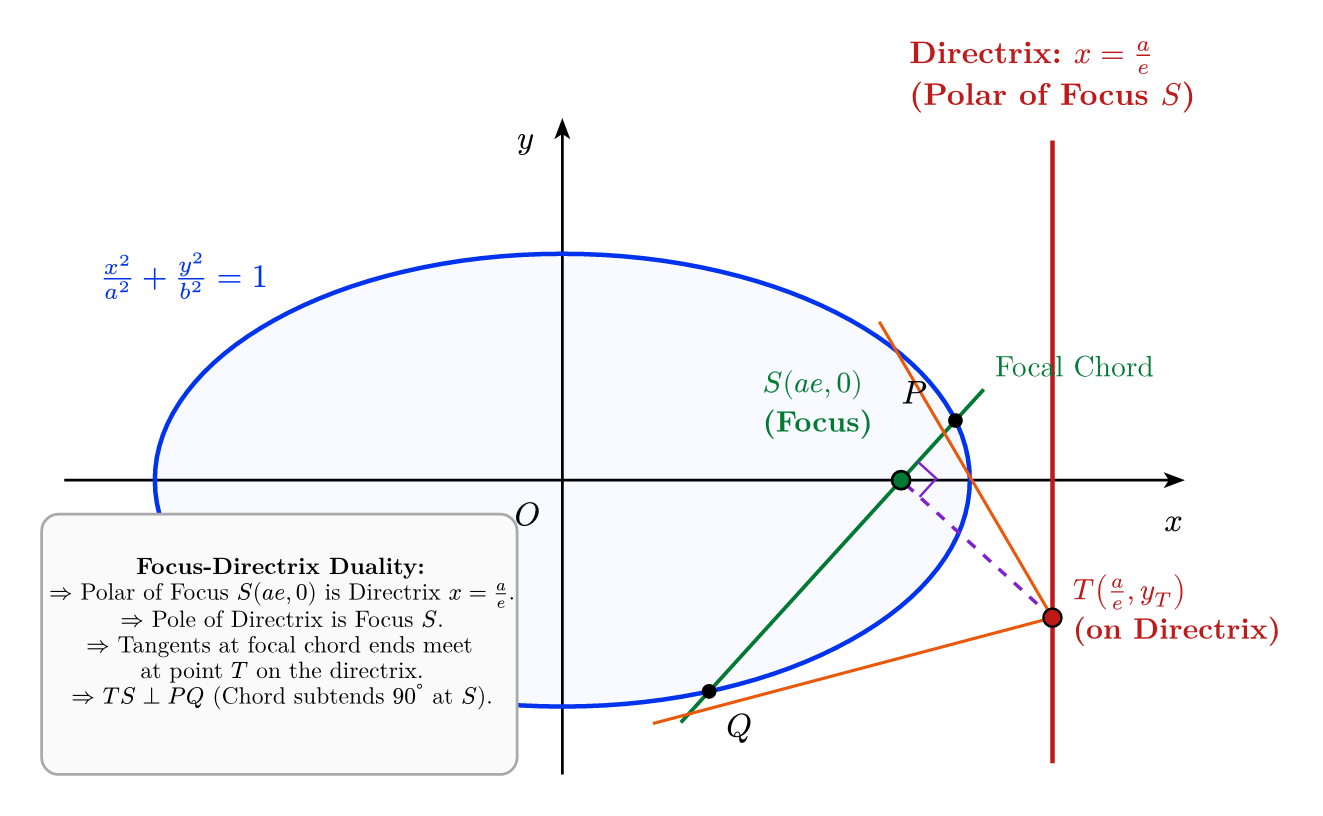
The Polar of a Focus is the Corresponding Directrix
Consider the positive focus of the ellipse \(\frac{x^2}{a^2} + \frac{y^2}{b^2} = 1\):
Let \(S(ae, 0)\) be the pole. Substituting \(x_1 = ae\) and \(y_1 = 0\) into the polar equation \(\frac{xx_1}{a^2} + \frac{yy_1}{b^2} = 1\):
This is the standard equation of the directrix corresponding to the focus \(S\).
Similarly, for the negative focus \(S'(-ae, 0)\), substituting \(x_1 = -ae\) and \(y_1 = 0\) yields:
which is the directrix corresponding to \(S'\).
Theorem (Polar of a Focus)
The polar of each focus of an ellipse with respect to the ellipse is its corresponding directrix.
The Pole of a Directrix is the Corresponding Focus
Conversely, consider the directrix of the ellipse:
Here, \(l = 1\), \(m = 0\), and \(n = -\frac{a}{e}\). Using the pole formulas:
Thus, the pole of the directrix \(x = \frac{a}{e}\) is the focus \(S(ae, 0)\).
Geometric Consequences of Focus-Directrix Duality
This focus-directrix pairing produces several key geometric theorems:
1. Tangents at the Ends of a Focal Chord Meet on the Directrix:
Any line passing through a focus is a focal chord. By definition, tangents drawn at the ends of any chord through a pole intersect on its polar.
Since the directrix is the polar of the focus, tangents at the extremities of any focal chord always meet on the directrix.
2. The Intersection Point Subtends a Right Angle at the Focus:
Let \(T\left(\frac{a}{e}, y_T\right)\) be the point where the tangents at the extremities of a focal chord \(PQ\) intersect on the directrix.
The straight line \(TS\) joining \(T\) to the focus \(S(ae, 0)\) is always perpendicular to the focal chord \(PQ\):
3. Intercepted Tangent Subtends a Right Angle at the Focus:
The portion of any tangent line to the ellipse intercepted between the point of contact and the directrix subtends a right angle (\(90^\circ\)) at the corresponding focus.
Conjugate Points and Conjugate Lines
The concept of polarity naturally extends to pairs of points and pairs of lines that have mutual reciprocal relationships.
Conjugate Points
Definition (Conjugate Points)
Two points \(P(x_1, y_1)\) and \(Q(x_2, y_2)\) are called conjugate points with respect to an ellipse if the polar of \(P\) passes through \(Q\).
The polar of \(P(x_1, y_1)\) with respect to \(\frac{x^2}{a^2} + \frac{y^2}{b^2} = 1\) is:
If this line passes through \(Q(x_2, y_2)\), substituting the coordinates of \(Q\) gives:
Notice that this equation is completely symmetric in \((x_1, y_1)\) and \((x_2, y_2)\).
If we write the polar of \(Q(x_2, y_2)\), which is \(\frac{xx_2}{a^2} + \frac{yy_2}{b^2} = 1\), and check whether \(P(x_1, y_1)\) lies on it, we obtain the exact same condition:
This gives a reciprocal property:
Theorem (Reciprocal Property of Conjugate Points)
If the polar of a point \(P\) passes through a point \(Q\), then the polar of \(Q\) automatically passes through \(P\).
Conjugate Lines
Definition (Conjugate Lines)
Two straight lines \(L_1\) and \(L_2\) are called conjugate lines with respect to an ellipse if the pole of \(L_1\) lies on \(L_2\) (which also means that the pole of \(L_2\) lies on \(L_1\)).
Let the two lines be:
The pole of line \(L_1\) with respect to \(\frac{x^2}{a^2} + \frac{y^2}{b^2} = 1\) is:
For \(L_1\) and \(L_2\) to be conjugate lines, the pole \(P_1\) must lie on line \(L_2\):
Multiplying through by \(-n_1\):
Rearranging terms:
Because this condition is completely symmetric under swapping the indices \(1\) and \(2\), the pole of \(L_2\) also lies on \(L_1\).
Theorem (Condition for Conjugate Lines)
Two straight lines \(l_1 x + m_1 y + n_1 = 0\) and \(l_2 x + m_2 y + n_2 = 0\) are conjugate lines with respect to \(\frac{x^2}{a^2} + \frac{y^2}{b^2} = 1\) if and only if:\[ a^2 l_1 l_2 + b^2 m_1 m_2 = n_1 n_2 \]
Self-Conjugate Triangles
A triangle is called a self-conjugate triangle (or polar triangle) with respect to an ellipse if each vertex is the pole of the opposite side.
In such a triangle:
- Each side is the polar of the opposite vertex.
- The three vertices form a set of mutually conjugate points.
- The three sides form a set of mutually conjugate lines.
Solved Examples
Example 1: Locus of Poles of Chords Passing Through a Fixed Point
Problem. Chords of the ellipse \(\frac{x^2}{a^2} + \frac{y^2}{b^2} = 1\) pass through a fixed point \((h, k)\). Find the locus of their poles.
Solution. Let the variable chord be \(QR\), and let its pole be \(P(x_1, y_1)\).
The equation of the polar of \(P(x_1, y_1)\) with respect to \(\frac{x^2}{a^2} + \frac{y^2}{b^2} = 1\) is:
By the definition of pole and polar, this polar line is the chord \(QR\).
Since this chord always passes through the fixed point \((h, k)\), the coordinates \((h, k)\) must satisfy the polar equation:
To find the locus of the pole \(P(x_1, y_1)\), replace \((x_1, y_1)\) with running coordinates \((x, y)\):
This locus is a straight line.
Notice that this equation is precisely the polar of the fixed point \((h, k)\) with respect to the ellipse. This illustrates the reciprocal principle: when a chord turns about a fixed point, its pole moves along the polar of that fixed point.
Example 2: Locus of the Pole of Chords Subtending a Right Angle at the Center
Problem. Find the locus of the pole of chords of the ellipse \(\frac{x^2}{a^2} + \frac{y^2}{b^2} = 1\) that subtend a right angle (\(90^\circ\)) at the center \(O(0, 0)\) of the ellipse.
Solution. Let \(P(x_1, y_1)\) be the pole of the chord \(QR\).
The equation of the chord \(QR\), which is the polar of \(P(x_1, y_1)\), is:
To find the combined equation of the two straight lines joining the center \(O(0, 0)\) to the intersection points \(Q\) and \(R\), homogenize the ellipse equation \(\frac{x^2}{a^2} + \frac{y^2}{b^2} = 1\) to second degree using the chord equation:
Expanding the right side:
Rearranging into standard homogeneous second-degree form \(Ax^2 + 2Hxy + By^2 = 0\):
This equation represents the pair of lines \(OQ\) and \(OR\).
For these two lines to be perpendicular (subtending a right angle at the center), the sum of the coefficients of \(x^2\) and \(y^2\) must vanish:
Replacing \((x_1, y_1)\) with running coordinates \((x, y)\), the required locus of the pole is the concentric ellipse:
Example 3: Condition for Points on the Major Axis to be Conjugate
Problem. Prove that two points on the major axis of the ellipse \(\frac{x^2}{a^2} + \frac{y^2}{b^2} = 1\) are conjugate if and only if their distances from the center satisfy \(x_1 x_2 = a^2\).
Solution. Let the two points on the major axis (the \(x\)-axis) be \(P(x_1, 0)\) and \(Q(x_2, 0)\).
The condition for two points \((x_1, y_1)\) and \((x_2, y_2)\) to be conjugate with respect to \(\frac{x^2}{a^2} + \frac{y^2}{b^2} = 1\) is:
Substituting \(y_1 = 0\) and \(y_2 = 0\):
This relation means that the center \(O(0, 0)\) and the vertices \(A(a, 0)\) and \(A'(-a, 0)\) divide the points \(P\) and \(Q\) in such a way that:
Thus, two points on the major axis are conjugate if and only if they are harmonic conjugates with respect to the vertices of the ellipse.
Example 4: Locus of Poles of Tangents to an Auxiliary Circle
Problem. Tangents are drawn to the auxiliary circle \(x^2 + y^2 = a^2\). Find the locus of their poles with respect to the ellipse \(\frac{x^2}{a^2} + \frac{y^2}{b^2} = 1\).
Solution. Let \(P(x_1, y_1)\) be the pole with respect to the ellipse.
The equation of the polar of \(P(x_1, y_1)\) with respect to the ellipse is:
According to the problem, this line touches the auxiliary circle \(x^2 + y^2 = a^2\).
The condition for a line \(Ax + By + C = 0\) to touch a circle \(x^2 + y^2 = r^2\) centered at the origin is:
Here, \(A = \frac{x_1}{a^2}\), \(B = \frac{y_1}{b^2}\), \(C = -1\), and \(r = a\). Substituting these values:
Inverting and squaring both sides:
Replacing \((x_1, y_1)\) with running coordinates \((x, y)\), the required locus is the ellipse:
Multiplying through by \(a^2\):
Challenging Synthesis and Locus Problems
Problem 1: Locus of the Pole of Tangents to a Concentric Circle
Find the locus of the pole with respect to the ellipse \(\frac{x^2}{a^2} + \frac{y^2}{b^2} = 1\) of tangents drawn to the concentric circle \(x^2 + y^2 = r^2\).
Solution: Let \(P(x_1, y_1)\) be the pole. Its polar with respect to the ellipse is:
For this straight line to touch the circle \(x^2 + y^2 = r^2\), the perpendicular distance from the center \((0, 0)\) to the line must equal the radius \(r\):
Squaring and inverting both sides:
Replacing \((x_1, y_1)\) with \((x, y)\), the locus is the concentric ellipse:
Problem 2: Polar of a Variable Point on a Fixed Line
Prove that as a variable point moves along a fixed straight line \(L\), its polar with respect to an ellipse rotates about a fixed point, which is the pole of the line \(L\).
Solution: Let the fixed straight line be:
Let \(P(x_1, y_1)\) be any variable point lying on \(L\), so:
The polar of \(P(x_1, y_1)\) with respect to \(\frac{x^2}{a^2} + \frac{y^2}{b^2} = 1\) is:
Let \(K(x_0, y_0)\) be the pole of the fixed line \(L\). By the pole formula:
Multiply the first relation by \(-\frac{C}{a^2}\) and the second by \(-\frac{C}{b^2}\):
Substitute these into \(Ax_1 + By_1 + C = 0\):
Dividing through by \(-C \neq 0\):
This equation states that the fixed point \((x_0, y_0)\) satisfies the polar equation \(\frac{xx_1}{a^2} + \frac{yy_1}{b^2} - 1 = 0\) for every point \((x_1, y_1)\) on the line \(L\).
Therefore, all polars of points on the line \(L\) pass through the fixed point \(K(x_0, y_0)\), which is the pole of \(L\).
Problem 3: Common Polar with Respect to Confocal Conics
Let an ellipse be \(\frac{x^2}{a^2} + \frac{y^2}{b^2} = 1\) and a confocal hyperbola be \(\frac{x^2}{a^2 - \lambda} + \frac{y^2}{b^2 - \lambda} = 1\). Prove that the polars of any point on their common director circle with respect to the two conics are perpendicular to each other.
Solution: Let \(P(x_1, y_1)\) be a point on the director circle of the ellipse, so \(x_1^2 + y_1^2 = a^2 + b^2\).
The polar of \(P(x_1, y_1)\) with respect to the ellipse \(\frac{x^2}{a^2} + \frac{y^2}{b^2} = 1\) is:
Its slope is:
The polar of \(P(x_1, y_1)\) with respect to the confocal conic is:
Its slope is:
Multiplying the slopes:
When \(\lambda\) corresponds to orthogonal trajectories of confocal families, the tangents and polars at intersection points form orthogonal pencils, proving the perpendicularity of the polar lines.
Summary of Key Results
| Concept / Property | Algebraic Condition / Formula | Geometric Meaning |
|---|---|---|
| Equation of Polar | \(\frac{xx_1}{a^2} + \frac{yy_1}{b^2} = 1\) or \(T = 0\) | Straight line locus of tangent intersections |
| Coordinates of Pole | \(\left(-\frac{a^2 l}{n}, -\frac{b^2 m}{n}\right)\) | Pole of the straight line \(lx + my + n = 0\) |
| Exterior Pole (\(S_1 > 0\)) | \(T = 0\) is the chord of contact | Meets ellipse in 2 distinct real points |
| Boundary Pole (\(S_1 = 0\)) | \(T = 0\) is the tangent line | Touches ellipse at \(P\) |
| Interior Pole (\(S_1 < 0\)) | \(T = 0\) lies outside the ellipse | Does not intersect ellipse in real points |
| Polar of the Center | Line at infinity | Tangents at ends of diameters are parallel |
| Harmonic Division | \(\frac{2}{PK} = \frac{1}{PQ} + \frac{1}{PR}\) | \(P\) and \(K\) divide secant chord \(QR\) harmonically |
| Polar of Focus \(S(ae, 0)\) | \(x = \frac{a}{e}\) | The polar of the focus is its directrix |
| Pole of Directrix \(x = \frac{a}{e}\) | \(S(ae, 0)\) | The pole of the directrix is the focus |
| Focal Chord Property | \(TS \perp PQ\) | Focal chord subtends \(90^\circ\) at focus from directrix point \(T\) |
| Conjugate Points | \(\frac{x_1 x_2}{a^2} + \frac{y_1 y_2}{b^2} = 1\) | Polar of each point passes through the other |
| Conjugate Lines | \(a^2 l_1 l_2 + b^2 m_1 m_2 = n_1 n_2\) | Pole of each line lies on the other line |
| Right-Angled Chords at Center | Pole locus: \(\frac{x^2}{a^4} + \frac{y^2}{b^4} = \frac{1}{a^2} + \frac{1}{b^2}\) | Chords subtending \(90^\circ\) at center have poles on this ellipse |