Vertical Hyperbola and Conjugate Hyperbola
Earlier, when we studied the parabola (\(y^2 = 4ax\) vs. \(x^2 = 4ay\)) and the ellipse (\(\frac{x^2}{a^2} + \frac{y^2}{b^2} = 1\) vs. \(\frac{x^2}{b^2} + \frac{y^2}{a^2} = 1\)), we saw that placing the focus on the \(y\)-axis simply rotated the standard orientation by \(90^\circ\).
The exact same idea applies to a hyperbola. What happens when the foci and vertices lie along the \(y\)-axis instead of the \(x\)-axis? Exploring this orientation naturally leads to the vertical hyperbola and its remarkable partner, the conjugate hyperbola.
The Vertical Hyperbola
Derivation from Focus and Directrix on the y-Axis
Suppose the center of symmetry is at the origin \(C(0, 0)\), while the transverse axis lies along the \(y\)-axis instead of the \(x\)-axis.
Keep our standard naming convention simple: let \(b\) denote the semi-axis along the \(y\)-axis (now the semi-transverse axis), and let \(e > 1\) be the eccentricity. Following the exact same focus-directrix setup along the vertical axis:
- Focus: \(S(0, be)\)
- Directrix: \(y = \frac{b}{e}\) (a horizontal line perpendicular to the \(y\)-axis)
Let \(P(x, y)\) be any point on this hyperbola, and let \(PM\) be the perpendicular from \(P\) onto the directrix \(y = \frac{b}{e}\).
- Distance from the focus \(S(0, be)\): \(SP = \sqrt{x^2 + (y - be)^2}\)
- Perpendicular distance to \(y = \frac{b}{e}\): \(PM = \left|y - \frac{b}{e}\right|\)
By the defining condition \(SP = e \cdot PM\):
Expand both sides:
Cancel \(-2bey\) from both sides and group \(y^2\) and constant terms:
Divide through by \(b^2(e^2 - 1)\):
Since \(e > 1\), the quantity \(b^2(e^2 - 1)\) is strictly positive. Defining \(a^2 = b^2(e^2 - 1) > 0\) gives the standard equation of a vertical hyperbola:
(Notice that you can also get this immediately by interchanging \(x \leftrightarrow y\) and \(a \leftrightarrow b\) in the horizontal hyperbola \(\frac{x^2}{a^2} - \frac{y^2}{b^2} = 1\).)
Shape, Extent, and Anatomy
Solving \(\frac{y^2}{b^2} - \frac{x^2}{a^2} = 1\) for \(x\) gives:
- For real values of \(x\), we must have \(y^2 - b^2 \ge 0\), which means \(y \ge b\) or \(y \le -b\).
- No part of the curve lies inside the horizontal strip \(-b < y < b\). In particular, the curve does not intersect the \(x\)-axis (\(y = 0\) gives \(x^2 = -a^2\), no real solution).
- As \(|y|\) increases beyond \(b\), \(|x|\) grows without bound, producing two symmetric branches opening upward and downward along the \(y\)-axis.
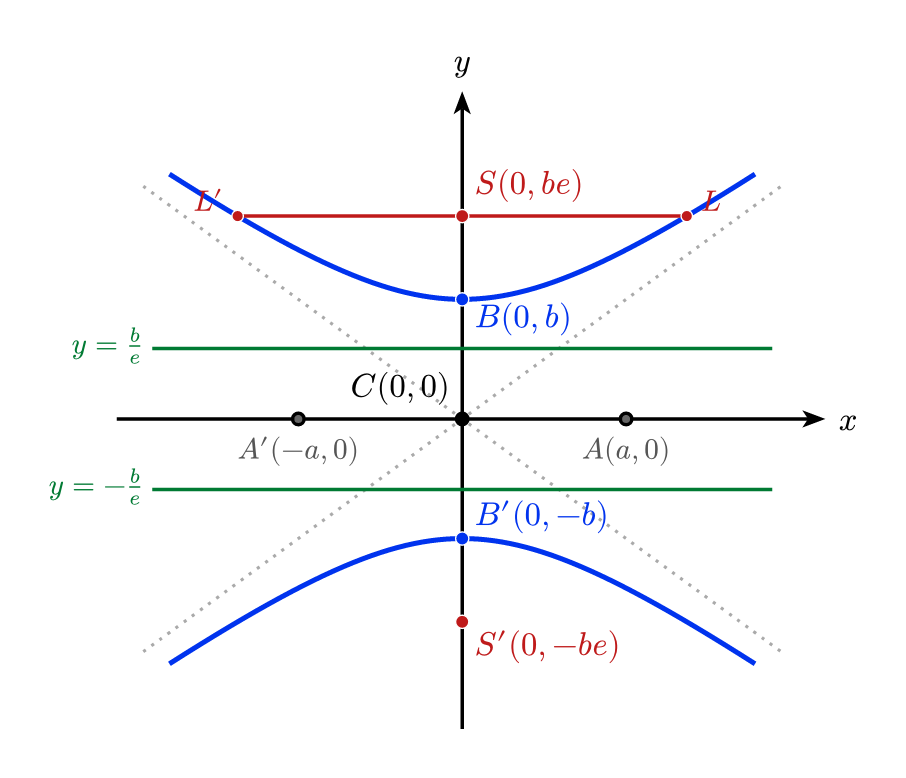
For the vertical hyperbola \(\frac{y^2}{b^2} - \frac{x^2}{a^2} = 1\):
Center: \(C(0, 0)\).
Vertices: \(B(0, b)\) and \(B'(0, -b)\).
Transverse Axis: Along the \(y\)-axis, joining \((0, -b)\) and \((0, b)\), of length \(2b\).
Conjugate Axis: Along the \(x\)-axis, joining \(A'(-a, 0)\) and \(A(a, 0)\), of length \(2a\).
Eccentricity: From \(a^2 = b^2(e^2 - 1)\):
Foci and Directrices: By symmetry about the \(x\)-axis, there is a second focus and second directrix on the negative \(y\)-side:
Latus Rectum: A focal chord perpendicular to the \(y\)-axis has equation \(y = \pm be\). Substituting into \(\frac{y^2}{b^2} - \frac{x^2}{a^2} = 1\):
So the endpoints are \(\left(\pm \frac{a^2}{b}, \pm be\right)\), and:
Focal Distances and Constant Difference: For any point \(P(x_1, y_1)\) on the vertical hyperbola, the perpendicular distances to the horizontal directrices \(y = \pm \frac{b}{e}\) give:
- On the upper branch (\(y_1 \ge b\)): \(SP = ey_1 - b\) and \(S'P = ey_1 + b\), so \(S'P - SP = 2b\).
- On the lower branch (\(y_1 \le -b\)): \(SP = b - ey_1\) and \(S'P = -b - ey_1\), so \(SP - S'P = 2b\).
Hence, for every point on \(\frac{y^2}{b^2} - \frac{x^2}{a^2} = 1\):
Crucial Difference from an Ellipse (Signs vs. Sizes):
In an ellipse \(\frac{x^2}{p^2} + \frac{y^2}{q^2} = 1\), both signs are positive, so you compare which denominator is larger to decide whether the major axis is horizontal or vertical.
In a hyperbola, you look strictly at the signs of the terms, never at which of \(a\) or \(b\) is bigger:
- \(\frac{x^2}{a^2} - \frac{y^2}{b^2} = 1\) (positive \(x^2\)-term) always opens left and right along the \(x\)-axis, even if \(a < b\).
- \(\frac{y^2}{b^2} - \frac{x^2}{a^2} = 1\) (positive \(y^2\)-term) always opens up and down along the \(y\)-axis, even if \(b < a\).
Asymptotes of the Vertical Hyperbola
Let us find the asymptotes of \(\frac{y^2}{b^2} - \frac{x^2}{a^2} = 1\) directly using the limit method from the previous section. Solving for \(y\) gives the upper and lower branches for all \(x \in \mathbb{R}\):
Take the upper branch \(f(x) = \frac{b}{a}\sqrt{x^2 + a^2}\) as \(x \to +\infty\):
Step 1: Find the slope \(m\)
Step 2: Find the \(y\)-intercept \(c\)
Rationalize using \(\sqrt{x^2 + a^2} + x\):
So \(y = \frac{b}{a}x\) is the asymptote as \(x \to +\infty\). Using \(|x| = -x\) as \(x \to -\infty\) and symmetry \(y \to -y\) for the lower branch gives the complete pair of asymptotes:
Notice one neat difference in position: since \(\sqrt{x^2 + a^2} > |x|\) for all \(x\), we always have:
That means the upper branch of \(\frac{y^2}{b^2} - \frac{x^2}{a^2} = 1\) always lies strictly above both asymptotes, and the lower branch always lies strictly below both asymptotes.
Conjugate Hyperbola
Two hyperbolas are said to be conjugate to each other when the transverse and conjugate axes of one are respectively the conjugate and transverse axes of the other.
Starting with the standard horizontal hyperbola \(H\):
Its transverse axis has length \(2a\) (along the \(x\)-axis) and its conjugate axis has length \(2b\) (along the \(y\)-axis). Swapping their roles—making the \(y\)-axis segment of length \(2b\) the transverse axis and the \(x\)-axis segment of length \(2a\) the conjugate axis—gives the conjugate hyperbola \(C\):
Notice the symmetry of this relationship: taking the conjugate of \(C\) gives back \(H\). Therefore, \(H\) and \(C\) are a conjugate pair—each is the conjugate of the other.
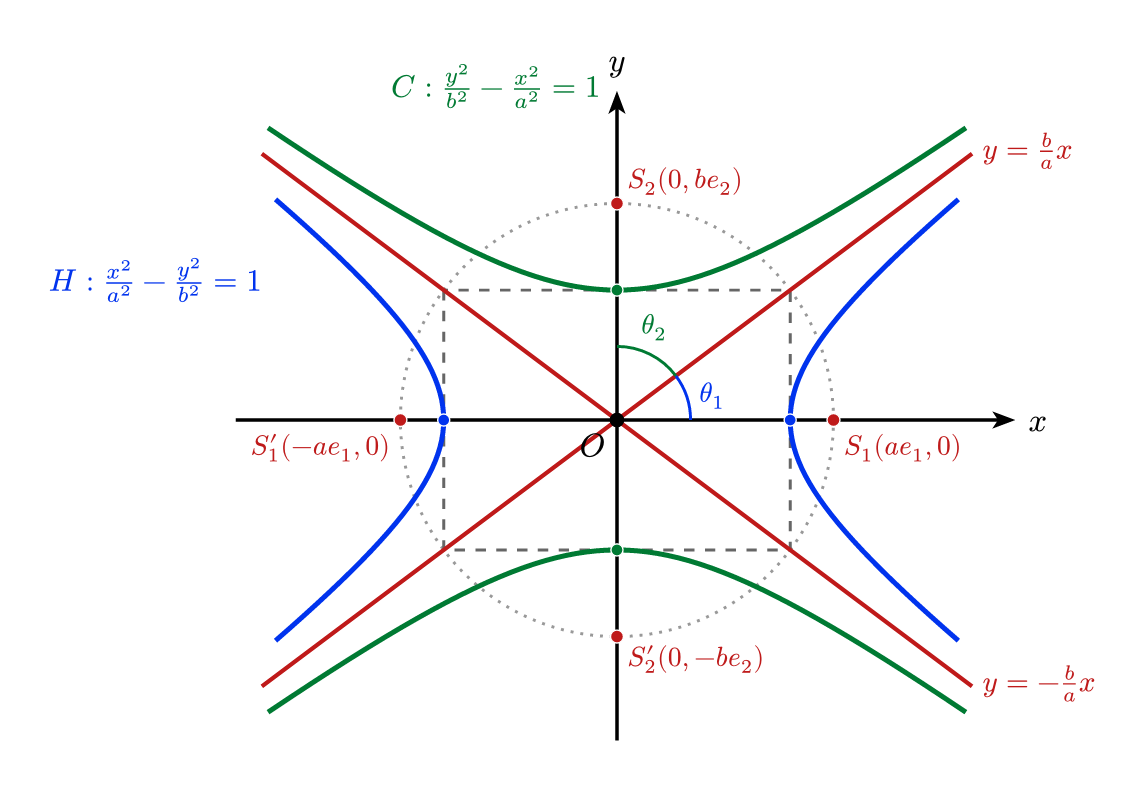
Side-by-Side Comparison of a Conjugate Pair
| Quantity | Hyperbola \(H\): \(\frac{x^2}{a^2} - \frac{y^2}{b^2} = 1\) | Conjugate Hyperbola \(C\): \(\frac{y^2}{b^2} - \frac{x^2}{a^2} = 1\) |
|---|---|---|
| Center | \((0, 0)\) | \((0, 0)\) |
| Transverse Axis | Along \(x\)-axis, length \(2a\) | Along \(y\)-axis, length \(2b\) |
| Conjugate Axis | Along \(y\)-axis, length \(2b\) | Along \(x\)-axis, length \(2a\) |
| Vertices | \((\pm a, 0)\) | \((0, \pm b)\) |
| Eccentricity | \(e_1 = \sqrt{1 + \frac{b^2}{a^2}}\) | \(e_2 = \sqrt{1 + \frac{a^2}{b^2}}\) |
| Foci | \(S_1(ae_1, 0),\ S'_1(-ae_1, 0)\) | \(S_2(0, be_2),\ S'_2(0, -be_2)\) |
| Directrices | \(x = \pm \frac{a}{e_1}\) | \(y = \pm \frac{b}{e_2}\) |
| Latus Rectum | \(\frac{2b^2}{a}\) | \(\frac{2a^2}{b}\) |
| Focal Difference | \(\|S'_1 P - S_1 P\| = 2a\) | \(\|S'_2 P - S_2 P\| = 2b\) |
| Asymptotes | \(y = \pm \frac{b}{a}x\) | \(y = \pm \frac{b}{a}x\) |
Why Conjugate Hyperbolas Share the Same Asymptotes
Look closely at the diagram of the conjugate pair above. The two hyperbolas \(H\) and \(C\) never meet, yet they nestle cleanly into opposite regions guided by the exact same pair of straight lines. We can understand this in three complementary ways:
1. Identical Combined Equations:
For \(H\), the combined equation of its asymptotes is \(\frac{x^2}{a^2} - \frac{y^2}{b^2} = 0\).
For \(C\), the combined equation of its asymptotes is \(\frac{y^2}{b^2} - \frac{x^2}{a^2} = 0\).
Multiplying the second equation by \(-1\) produces the exact same equation \(\frac{x^2}{a^2} - \frac{y^2}{b^2} = 0\), so both hyperbolas share the exact same asymptotes \(y = \pm \frac{b}{a}x\).
2. The Central Rectangle and Four Sectors:
Draw the dashed rectangle bounded by \(x = \pm a\) and \(y = \pm b\) passing through the vertices \((\pm a, 0)\) of \(H\) and \((0, \pm b)\) of \(C\). The lines joining opposite corners of this rectangle have equations \(y = \pm \frac{b}{a}x\)—the asymptotes!
These two diagonals split the coordinate plane into four open wedge-shaped sectors around the origin:
- \(H\) fills the left and right sectors (where \(|y| < \frac{b}{a}|x|\)).
- \(C\) fills the top and bottom sectors (where \(|y| > \frac{b}{a}|x|\)).
3. Constant-Term Symmetry (\(H + C = 2A\)):
Write all three equations in standard form:
- \(H(x, y) \equiv \frac{x^2}{a^2} - \frac{y^2}{b^2} - 1 = 0\)
- \(A(x, y) \equiv \frac{x^2}{a^2} - \frac{y^2}{b^2} = 0\)
- \(C(x, y) \equiv \frac{x^2}{a^2} - \frac{y^2}{b^2} + 1 = 0\)
Notice that \(H\), \(A\), and \(C\) differ only in their constant terms (\(-1\), \(0\), and \(+1\)). Adding the expressions for \(H\) and \(C\) cancels the \(+1\) and \(-1\):
Key Relations Between a Hyperbola and Its Conjugate
Let \(e_1\) and \(e_2\) be the eccentricities of \(H: \frac{x^2}{a^2} - \frac{y^2}{b^2} = 1\) and \(C: \frac{y^2}{b^2} - \frac{x^2}{a^2} = 1\), respectively.
1. Relation Between the Two Eccentricities
From the eccentricity formulas:
Adding these two equations gives the fundamental eccentricity identity:
In addition, dividing \(e_1^2\) by \(e_2^2\) gives the ratio of the two eccentricities directly in terms of \(a\) and \(b\):
(Observe the geometric meaning: if \(H\) has narrow branches so \(e_1\) is close to \(1\), then \(C\) must have wide-opening branches with a large eccentricity \(e_2\) to keep \(\frac{1}{e_1^2} + \frac{1}{e_2^2} = 1\). When \(a = b\), both curves have equal eccentricities \(e_1 = e_2 = \sqrt{2}\).)
2. All Four Foci Lie on a Single Circle
Compute the distance from the center \(O(0, 0)\) to a focus of \(H\) and to a focus of \(C\):
Since \(OS_1 = OS_2 = \sqrt{a^2 + b^2}\) (which equals half the diagonal of the central rectangle), all four foci—\((\pm \sqrt{a^2 + b^2}, 0)\) and \((0, \pm \sqrt{a^2 + b^2})\)—are at the exact same distance from the center!
Therefore, all four foci lie on the circle:
3. Complementary Angles with the Asymptotes
Let \(\theta_1\) be the acute angle between the asymptote \(y = \frac{b}{a}x\) and the transverse axis of \(H\) (\(x\)-axis), and \(\theta_2\) be the angle between the same asymptote and the transverse axis of \(C\) (\(y\)-axis):
Because the \(x\)-axis and \(y\)-axis are perpendicular, \(\theta_1 + \theta_2 = 90^\circ\). Hence, the angles between the asymptotes containing \(H\) (\(2\theta_1\)) and containing \(C\) (\(2\theta_2\)) are supplementary:
Notice also that \(e_1 = \sec\theta_1\) and \(e_2 = \sec\theta_2 = \csc\theta_1\), which provides an immediate trigonometric proof of the eccentricity identity:
4. Focus-to-Asymptote Distance and Latera Recta
- From any focus of \(H\) to either asymptote, the perpendicular distance is \(b\) (the semi-conjugate axis of \(H\)).
- From any focus \(S_2(0, be_2)\) of \(C\) to either asymptote \(bx \mp ay = 0\), the perpendicular distance is:
which equals \(a\) (the semi-conjugate axis of \(C\)).
- Multiplying the lengths of their latera recta \(L_1 = \frac{2b^2}{a}\) and \(L_2 = \frac{2a^2}{b}\) gives:
5. Common Midpoint of Any Secant Line
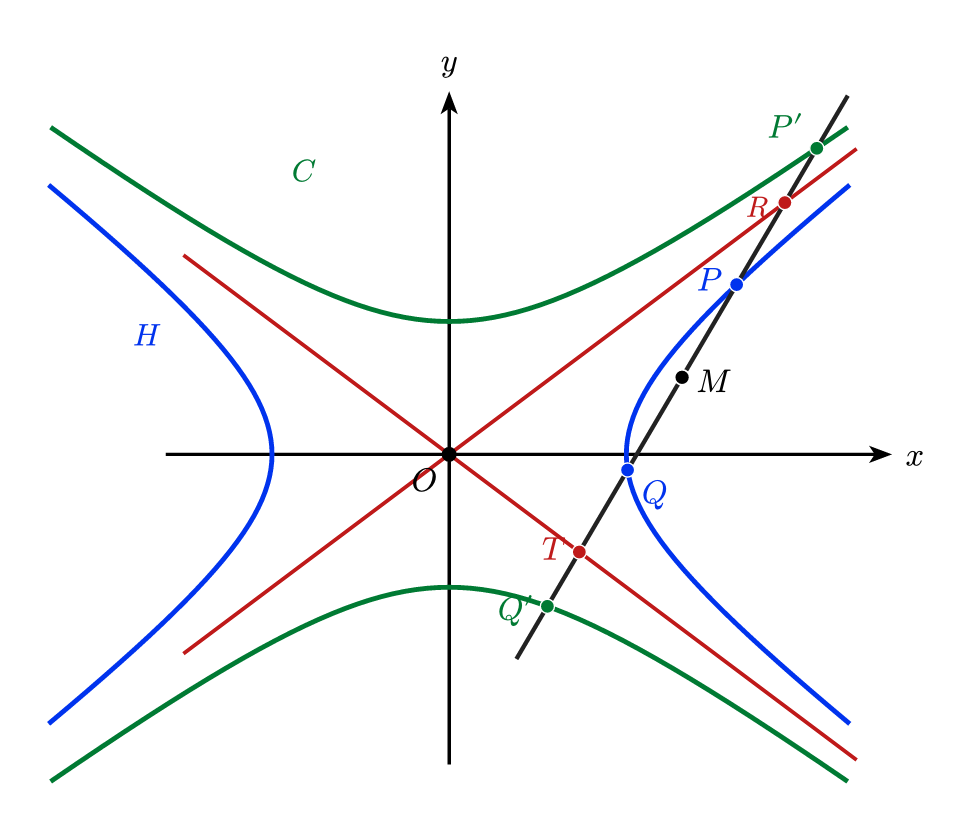
Suppose any non-asymptotic straight line \(y = mx + c\) (\(m \neq \pm \frac{b}{a}\)) meets \(H\) at \(P, Q\), meets the asymptotes \(A\) at \(R, T\), and meets \(C\) at \(P', Q'\) (whenever those intersections are real).
Because \(H\), \(A\), and \(C\) differ only in their constant terms, substituting \(y = mx + c\) into all three equations produces quadratic equations in \(x\) whose \(x^2\) and \(x\) coefficients are identical. Therefore, all three pairs of roots have the exact same sum—so the chord \(PQ\) of \(H\), the segment \(RT\) between the asymptotes, and the chord \(P'Q'\) of \(C\) all share the same midpoint \(M\).
Consequently, subtracting equal half-lengths from \(M\) shows that the outer intercepts on both sides are equal:
Illustrative Examples
Example 1: Finding Standard Attributes of a Vertical Hyperbola
Find the vertices, eccentricity, foci, directrices, latus rectum, and asymptotes of the hyperbola:
Solution:
Divide through by \(144\):
Because the \(y^2\)-term is positive (even though \(9 < 16\)), this is a vertical hyperbola opening along the \(y\)-axis. Comparing with \(\frac{y^2}{b^2} - \frac{x^2}{a^2} = 1\):
- Vertices: \((0, \pm b) = (0, \pm 3)\).
- Eccentricity: \(e = \sqrt{1 + \frac{a^2}{b^2}} = \sqrt{1 + \frac{16}{9}} = \frac{5}{3}\).
- Foci: \((0, \pm be) = \left(0, \pm 3 \cdot \frac{5}{3}\right) = (0, \pm 5)\).
- Directrices: \(y = \pm \frac{b}{e} = \pm \frac{9}{5}\).
- Length of Latus Rectum: \(\frac{2a^2}{b} = \frac{2(16)}{3} = \frac{32}{3}\).
- Asymptotes: \(y = \pm \frac{b}{a}x = \pm \frac{3}{4}x\).
Example 2: Finding a Vertical Hyperbola from Its Asymptotes and Foci
Find the equation and eccentricity of a vertical hyperbola centered at the origin whose foci are at \((0, \pm 10)\) and whose asymptotes are \(y = \pm \frac{4}{3}x\).
Solution:
Let the vertical hyperbola be \(\frac{y^2}{b^2} - \frac{x^2}{a^2} = 1\).
Step 1: Use the asymptote slopes to relate \(a\) and \(b\)
Comparing \(y = \pm \frac{b}{a}x\) with \(y = \pm \frac{4}{3}x\):
Step 2: Find the eccentricity \(e\)
Step 3: Use the foci to find \(b\) and \(a\)
Since the foci are \((0, \pm be) = (0, \pm 10)\):
Then \(a = \frac{3}{4}(8) = 6\).
Hence, the equation of the vertical hyperbola is:
with eccentricity \(e = \frac{5}{4}\).
Example 3: Eccentricity Identity and Circle of Foci
A standard hyperbola \(H: \frac{x^2}{a^2} - \frac{y^2}{b^2} = 1\) has eccentricity \(e_1 = \frac{5}{4}\) and latus rectum \(\frac{9}{2}\). Find:
- The eccentricity \(e_2\) of its conjugate hyperbola \(C\).
- The equations of both \(H\) and \(C\).
- The equation of the circle passing through all four foci of \(H\) and \(C\).
Solution:
1. Eccentricity of the conjugate hyperbola:
Using \(\frac{1}{e_1^2} + \frac{1}{e_2^2} = 1\):
2. Equations of \(H\) and \(C\):
The length of the latus rectum of \(H\) is \(2a(e_1^2 - 1) = \frac{9}{2}\):
Then \(b^2 = a^2(e_1^2 - 1) = 16\left(\frac{9}{16}\right) = 9\).
Therefore:
3. Circle through all four foci:
All four foci lie at distance \(r = \sqrt{a^2 + b^2} = \sqrt{16 + 9} = 5\) from the center \((0, 0)\) (namely \((\pm 5, 0)\) for \(H\) and \((0, \pm 5)\) for \(C\)).
Thus, the circle through all four foci is:
Example 4: Common Secant Midpoint of a Conjugate Pair
A straight line \(y = 2x - 3\) cuts the hyperbola \(H: \frac{x^2}{4} - \frac{y^2}{9} = 1\) at \(P\) and \(Q\), and cuts its conjugate hyperbola \(C\) at \(P'\) and \(Q'\). Without solving for the endpoints individually, verify that \(PQ\) and \(P'Q'\) share the same midpoint, and find its coordinates.
Solution:
Write both hyperbolas after clearing denominators (\(36\)):
Substitute \(y = 2x - 3\) into \(H\):
Since \(\Delta_H = 48^2 - 4(7)(72) = 2304 - 2016 = 288 > 0\), the line cuts \(H\) at two distinct real points \(P(x_1, y_1)\) and \(Q(x_2, y_2)\), with midpoint \(x\)-coordinate:
Next, substitute \(y = 2x - 3\) into \(C: 9x^2 - 4y^2 = -36\):
Again \(\Delta_C = 48^2 > 0\), so the line cuts \(C\) at two distinct real points \(P'(x_3, y_3)\) and \(Q'(x_4, y_4)\). Because the \(x^2\) and \(x\) coefficients are identical, the midpoint \(x\)-coordinate of \(P'Q'\) is also:
Since both midpoints lie on \(y = 2x - 3\), their common \(y\)-coordinate is:
Hence, both chords \(PQ\) and \(P'Q'\) share the exact same midpoint \(\left(\frac{24}{7}, \frac{27}{7}\right)\).
Summary of Key Results
| Property / Relation | Vertical Hyperbola / Conjugate Pair Formula |
|---|---|
| Vertical Hyperbola Equation | \(\frac{y^2}{b^2} - \frac{x^2}{a^2} = 1\), where \(a^2 = b^2(e_2^2 - 1)\) |
| Vertical Orientation Criterion | Positive \(y^2\)-term and negative \(x^2\)-term (independent of whether \(a < b\) or \(a > b\)) |
| Vertical Vertices, Foci, Directrices | Vertices \((0, \pm b)\), foci \((0, \pm be_2)\), directrices \(y = \pm \frac{b}{e_2}\), latus rectum \(\frac{2a^2}{b}\) |
| Shared Asymptotes | \(H: \frac{x^2}{a^2} - \frac{y^2}{b^2} = 1\) and \(C: \frac{y^2}{b^2} - \frac{x^2}{a^2} = 1\) share \(y = \pm \frac{b}{a}x\), with \(H + C = 2A\) |
| Eccentricity Relation | \(\frac{1}{e_1^2} + \frac{1}{e_2^2} = 1\) and \(\frac{e_1}{e_2} = \frac{b}{a}\) |
| Circle of Four Foci | All four foci lie on \(x^2 + y^2 = a^2 + b^2\) (distance \(\sqrt{a^2 + b^2}\) from center) |
| Asymptote Angles | \(2\theta_1 + 2\theta_2 = 180^\circ\) (supplementary angles containing \(H\) and \(C\)) |