Equation of Tangent and Normal to a Hyperbola
In this section, we study the straight lines that touch a hyperbola (tangents) and the straight lines perpendicular to those tangents at the point of contact (normals).
While the algebraic equations of tangents and normals to a hyperbola closely resemble those of an ellipse (obtained by the algebraic substitution \(b^2 \to -b^2\)), their geometric properties exhibit profound differences. For example, while tangents to an ellipse can take any slope in \(\mathbb{R}\), tangents to a hyperbola are strictly constrained by the slopes of its asymptotes. Similarly, the normal to a hyperbola intersects the transverse axis further away from the center than the foot of the ordinate, reversing the behavior seen in the ellipse.
Tangent to a Hyperbola
A straight line that touches the hyperbola at exactly one point (having two coincident points of intersection) is called a tangent to the hyperbola at that point.
Tangent in Point Form (Cartesian Form)
Let \(P(x_1, y_1)\) be a point lying on the horizontal hyperbola:
To find the slope of the tangent at \(P\), we differentiate implicitly with respect to \(x\):
Evaluating at the point \(P(x_1, y_1)\) (where \(y_1 \neq 0\)):
Using the point-slope form of a straight line:
Dividing both sides by \(b^2\) and multiplying by \(y_1\):
Rearranging the terms:
Since \(P(x_1, y_1)\) lies on the hyperbola, the right-hand side equals \(1\). Therefore, the equation of the tangent at \(P(x_1, y_1)\) is:
In notation, we write this as \(T = 0\), where \(T\) is obtained by the standard replacement rules:
For the Vertical Hyperbola:
For the vertical hyperbola \(\frac{y^2}{b^2} - \frac{x^2}{a^2} = 1\), the tangent at \(P(x_1, y_1)\) is:
For a Shifted Hyperbola:
For a horizontal hyperbola shifted to center \((h, k)\), \(\frac{(x - h)^2}{a^2} - \frac{(y - k)^2}{b^2} = 1\), the tangent at \(P(x_1, y_1)\) is:
Tangent in Parametric Form
Recall from the parametric equations that any point on the horizontal hyperbola \(\frac{x^2}{a^2} - \frac{y^2}{b^2} = 1\) can be expressed as:
Substituting these coordinates into the point form \(\frac{x x_1}{a^2} - \frac{y y_1}{b^2} = 1\):
Simplifying:
For the Vertical Hyperbola:
Using \(x_1 = a\tan\theta, y_1 = b\sec\theta\) on \(\frac{y^2}{b^2} - \frac{x^2}{a^2} = 1\):
Tangent in Slope Form and Points of Contact
As established when studying the intersection of a line and a hyperbola, a line \(y = mx + c\) is tangent to \(\frac{x^2}{a^2} - \frac{y^2}{b^2} = 1\) if and only if:
For real tangents to exist, the term under the radical must be strictly positive:
Thus, tangents can only have slopes steeper than the asymptotes. The equation of a tangent of slope \(m\) is:
The coordinates of the point of contact for the tangent \(y = mx + c\) are:
Substituting \(c = \pm\sqrt{a^2 m^2 - b^2}\), the two points of contact corresponding to the two parallel tangents are:
Notice that when \(m > 0\):
- The tangent \(y = mx + \sqrt{a^2 m^2 - b^2}\) touches the left branch (\(x_1 < 0\)).
- The tangent \(y = mx - \sqrt{a^2 m^2 - b^2}\) touches the right branch (\(x_1 > 0\)).
For the Vertical Hyperbola:
For \(\frac{y^2}{b^2} - \frac{x^2}{a^2} = 1\), the condition of tangency is \(c^2 = b^2 - a^2 m^2\), requiring \(|m| < \frac{b}{a}\) (flatter than the asymptotes). The slope form is:
The corresponding point of contact is:
Normal to a Hyperbola
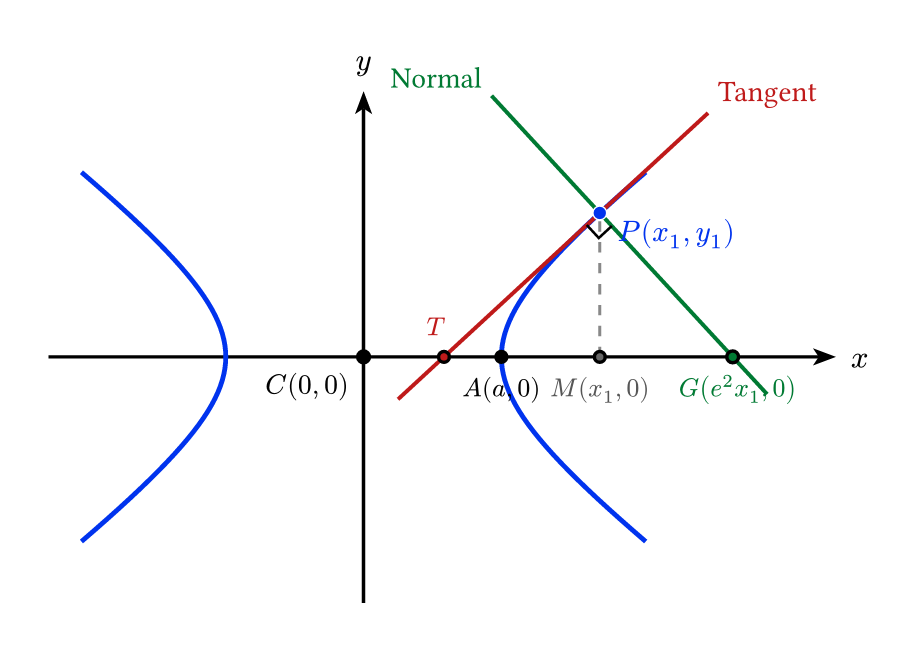
The straight line passing through the point of contact \(P(x_1, y_1)\) and perpendicular to the tangent at \(P\) is called the normal to the hyperbola at \(P\).
Equation of Normal in Point Form (Cartesian Form)
Let \(P(x_1, y_1)\) be a point on the hyperbola \(\frac{x^2}{a^2} - \frac{y^2}{b^2} = 1\).
As derived earlier, the slope of the tangent at \(P(x_1, y_1)\) is:
Since the normal is perpendicular to the tangent (\(m_N \cdot m_T = -1\)), the slope of the normal is:
Using the point-slope form:
Divide both sides by \(y_1\) and multiply both sides by \(b^2\):
Expanding both sides:
Rearranging terms to place all variable terms on the left:
Recall that for a hyperbola, \(b^2 = a^2(e^2 - 1)\), which means \(a^2 + b^2 = a^2 e^2\). Thus, we can also write the point form as:
Comparison with Ellipse:
For the ellipse \(\frac{x^2}{a^2} + \frac{y^2}{b^2} = 1\), the normal is \(\frac{a^2 x}{x_1} - \frac{b^2 y}{y_1} = a^2 - b^2\). In a hyperbola, replacing \(b^2\) with \(-b^2\) transforms the minus sign into a plus sign on both sides, yielding \(\frac{a^2 x}{x_1} + \frac{b^2 y}{y_1} = a^2 + b^2\).
For the Vertical Hyperbola:
For \(\frac{y^2}{b^2} - \frac{x^2}{a^2} = 1\), the slope of the tangent is \(m_T = \frac{b^2 x_1}{a^2 y_1}\), so the normal at \(P(x_1, y_1)\) has slope \(m_N = -\frac{a^2 y_1}{b^2 x_1}\). Carrying out the same steps gives:
Equation of Normal in Parametric Form
At any point \(P(a\sec\theta, b\tan\theta)\) on the hyperbola \(\frac{x^2}{a^2} - \frac{y^2}{b^2} = 1\), we substitute \(x_1 = a\sec\theta\) and \(y_1 = b\tan\theta\) into the point form:
Simplifying the coefficients:
Using the reciprocal identities \(\frac{1}{\sec\theta} = \cos\theta\) and \(\frac{1}{\tan\theta} = \cot\theta\):
This parametric equation is exceptionally practical because it avoids fractions in the variables \(x\) and \(y\).
For the Vertical Hyperbola:
Substituting \(x_1 = a\tan\theta, y_1 = b\sec\theta\) into \(\frac{b^2 y}{y_1} + \frac{a^2 x}{x_1} = a^2 + b^2\):
Equation of Normal in Slope Form
From the parametric form \(ax\cos\theta + by\cot\theta = a^2 + b^2\), we express \(y\) in terms of \(x\):
Notice that \(\frac{\cos\theta}{\cot\theta} = \sin\theta\). Therefore, the slope \(m\) of the normal is:
Because \(-1 < \sin\theta < 1\) for all real points on the hyperbola (excluding the vertices where \(\sin\theta = 0\) giving horizontal normals, and \(\theta \to \pm \pi/2\) where the points recede to infinity):
Key Geometric Insight on Slopes:
- Tangents must have slopes steeper than asymptotes: \(|m_{\text{tangent}}| > \frac{b}{a}\).
- Normals must have slopes flatter than the perpendiculars to asymptotes: \(|m_{\text{normal}}| < \frac{a}{b}\).
To write the normal entirely in terms of \(m\), we solve for \(\sin\theta\) and \(\cos\theta\):
Substituting these into the constant term:
Thus, the equation of a normal of slope \(m\) (where \(|m| < \frac{a}{b}\)) is:
Intercepts and Geometric Anatomy of the Normal
Let the normal at \(P(x_1, y_1)\) meet the transverse axis (\(x\)-axis) at \(G\) and the conjugate axis (\(y\)-axis) at \(g\).
1. Intercept on the Transverse Axis (x-axis)
Setting \(y = 0\) in \(\frac{a^2 x}{x_1} + \frac{b^2 y}{y_1} = a^2 + b^2\):
Since \(e^2 = 1 + \frac{b^2}{a^2}\):
Let \(M(x_1, 0)\) be the foot of the perpendicular from \(P(x_1, y_1)\) onto the transverse axis.
- In an ellipse, \(e < 1\), so \(|x_G| = e^2 |x_1| < |x_1|\). Point \(G\) lies between the center and the foot of the ordinate \(M\).
- In a hyperbola, \(e > 1\), so \(|x_G| = e^2 |x_1| > |x_1|\). Point \(G\) lies outside \(M\), further away from the center than the foot of the ordinate!
The distance \(MG\), known as the subnormal, is:
2. Intercept on the Conjugate Axis (y-axis)
Setting \(x = 0\) in the normal equation:
Thus, \(g = \left(0, \frac{a^2 + b^2}{b^2} y_1\right)\).
3. Relation Involving Tangent and Normal Intercepts
Let the tangent at \(P(x_1, y_1)\) meet the \(x\)-axis at \(T\). Setting \(y = 0\) in \(\frac{x x_1}{a^2} - \frac{y y_1}{b^2} = 1\):
Since \(x_1 > a\) for the right branch, \(x_T = \frac{a^2}{x_1} < a\). Thus, \(T\) lies inside the vertex \(A(a, 0)\)!
Multiplying the distances from the center \(C(0, 0)\) to \(T\) and \(M\):
The product of the abscissa of the tangent intercept and the abscissa of the point of contact always equals the square of the semi-transverse axis \(a^2\). Along the positive \(x\)-axis, the points are ordered as:
Condition for a General Line to be Normal to a Hyperbola
We want to find the condition under which the general line \(lx + my + n = 0\) is a normal to the hyperbola \(\frac{x^2}{a^2} - \frac{y^2}{b^2} = 1\).
Derivation:
The equation of a normal in parametric form at eccentric angle \(\theta\) is:
If \(lx + my + n = 0\) represents the same straight line, the coefficients must be proportional:
From the first and third ratios:
From the second and third ratios:
Dividing \(\cos\theta\) by \(\cot\theta\) gives \(\sin\theta\):
Now recall the fundamental identity \(\csc^2\theta - \cot^2\theta = 1 \implies \frac{1}{\sin^2\theta} - \cot^2\theta = 1\):
Dividing the entire equation by \(m^2\):
Multiplying throughout by \(b^2\):
Rearranging terms yields the condition of normality:
Finding the Foot of the Normal Using the Parametric Form
In many competitive examination problems, you are asked to find the foot of the normal (the point of contact \(P\) on the hyperbola where the normal is drawn) when given the slope of the normal, or when given a point through which the normal passes.
While you could try using the condition of normality derived above, that formula involves reciprocal squares and high-degree algebra, making it easy to commit calculation errors.
The Recommended Method: Always use the parametric coordinates \(P(a\sec\theta, b\tan\theta)\)!
Step-by-Step Method for a Given Normal Slope
- Write the parametric normal equation:
$$ ax\cos\theta + by\cot\theta = a^2 + b^2 $$
- Equate the slope:
From the equation, \(by\cot\theta = -ax\cos\theta + (a^2 + b^2)\), so the slope of the normal is:
$$ m_N = -\frac{a\cos\theta}{b\cot\theta} = -\frac{a}{b}\sin\theta $$
- Solve for the trigonometric values:
$$ \sin\theta = -\frac{b m_N}{a} $$
From \(\sin\theta\), determine:
$$ \cos\theta = \pm\sqrt{1 - \sin^2\theta} $$
$$ \sec\theta = \frac{1}{\cos\theta}, \quad \tan\theta = \frac{\sin\theta}{\cos\theta} $$
- Write the foot of the normal:
The foot of the normal is immediately obtained as:
$$ P(a\sec\theta, b\tan\theta) $$
This method requires minimal algebra, never requires memorizing the condition of normality, and directly yields the exact coordinates of the feet of the normals!
Shortest Distance Problems
Problems asking for the minimum distance between a hyperbola and an external line or point frequently appear in competitive examinations.
Shortest Distance Between a Straight Line and a Hyperbola
Consider a straight line \(L: Ax + By + C = 0\) that does not intersect the hyperbola \(\frac{x^2}{a^2} - \frac{y^2}{b^2} = 1\).
Geometric Principle:
The shortest distance between a smooth curve and a straight line occurs along their common normal. Since the line is straight, the normal to the line is simply perpendicular to it. Therefore, at the point \(P\) on the hyperbola closest to the line:
The tangent to the hyperbola at the closest point \(P\) must be parallel to the given straight line \(L\).
Standard 4-Step Solution Procedure:
- Find the slope of the given line:
$$ m = -\frac{A}{B} $$
- Verify that tangents of slope \(m\) exist:
Check that \(|m| > \frac{b}{a}\). If \(|m| \le \frac{b}{a}\), no tangent of slope \(m\) exists (the line is parallel to or flatter than the asymptotes).
- Write the equation of the parallel tangent on the closer branch:
$$ y = mx \pm \sqrt{a^2 m^2 - b^2} $$
Select the sign of the constant term that places the tangent on the side closer to the given line \(L\).
- Calculate the distance:
Find the distance between the two parallel lines:
$$ d_{\min} = \frac{|c_1 - c_2|}{\sqrt{1 + m^2}} $$
Alternatively, find the point of contact \(P\left(-\frac{a^2 m}{c}, -\frac{b^2}{c}\right)\) and compute its perpendicular distance to \(Ax + By + C = 0\) using:
$$ d_{\min} = \frac{|A x_1 + B y_1 + C|}{\sqrt{A^2 + B^2}} $$
Shortest Distance from an External Point to a Hyperbola
If \(Q(x_0, y_0)\) is a given point, the shortest distance from \(Q\) to the hyperbola occurs along the normal passing through \(Q\).
- Write the parametric normal:
$$ ax\cos\theta + by\cot\theta = a^2 + b^2 $$
- Substitute the coordinates of \(Q(x_0, y_0)\) into the normal equation:
$$ a x_0 \cos\theta + b y_0 \cot\theta = a^2 + b^2 $$
- Solve for \(\theta\) to find the foot of the normal \(P(a\sec\theta, b\tan\theta)\).
- The minimum distance is the Euclidean distance \(d_{\min} = PQ = \sqrt{(x_0 - a\sec\theta)^2 + (y_0 - b\tan\theta)^2}\).
Summary Comparison of Tangents and Normals
| Feature | Horizontal Hyperbola \(\frac{x^2}{a^2} - \frac{y^2}{b^2} = 1\) | Vertical Hyperbola \(\frac{y^2}{b^2} - \frac{x^2}{a^2} = 1\) |
|---|---|---|
| Point Form of Tangent | \(\frac{x x_1}{a^2} - \frac{y y_1}{b^2} = 1\) | \(\frac{y y_1}{b^2} - \frac{x x_1}{a^2} = 1\) |
| Parametric Tangent | \(\frac{x\sec\theta}{a} - \frac{y\tan\theta}{b} = 1\) | \(\frac{y\sec\theta}{b} - \frac{x\tan\theta}{a} = 1\) |
| Slope Form of Tangent | $y = mx \pm \sqrt{a^2 m^2 - b^2} \quad ( | m |
| Point Form of Normal | \(\frac{a^2 x}{x_1} + \frac{b^2 y}{y_1} = a^2 + b^2 = a^2 e^2\) | \(\frac{b^2 y}{y_1} + \frac{a^2 x}{x_1} = b^2 + a^2 = b^2 e^2\) |
| Parametric Normal | \(ax\cos\theta + by\cot\theta = a^2 + b^2\) | \(by\cos\theta + ax\cot\theta = a^2 + b^2\) |
| Normal Slope Condition | $ | m |
| Slope Form of Normal | \(y = mx \pm \frac{m(a^2 + b^2)}{\sqrt{a^2 - b^2 m^2}}\) | \(x = my \pm \frac{m(a^2 + b^2)}{\sqrt{b^2 - a^2 m^2}}\) |
| Condition of Normality | \(\frac{a^2}{l^2} - \frac{b^2}{m^2} = \frac{(a^2 + b^2)^2}{n^2}\) | \(\frac{b^2}{m^2} - \frac{a^2}{l^2} = \frac{(a^2 + b^2)^2}{n^2}\) |
| Transverse Intercept of Normal | \(G = (e^2 x_1, 0)\) with $ | x_G |
Illustrative Examples
Example 1: Tangent and Normal in Cartesian Form
For the hyperbola \(\frac{x^2}{16} - \frac{y^2}{9} = 1\), find the equations of the tangent and normal at the point \(P\left(5, \frac{9}{4}\right)\). Verify the position of the normal intercept \(G\) relative to the foot of the ordinate \(M\).
Solution:
First, verify that \(P\) lies on the hyperbola:
Here \(a^2 = 16, b^2 = 9\), and \(x_1 = 5, y_1 = \frac{9}{4}\).
Equation of Tangent:
Using the point form \(\frac{x x_1}{a^2} - \frac{y y_1}{b^2} = 1\):
Multiplying throughout by \(16\):
Equation of Normal:
Using the point form \(\frac{a^2 x}{x_1} + \frac{b^2 y}{y_1} = a^2 + b^2\):
Multiplying throughout by \(5\):
Verifying the Intercepts:
- The foot of the ordinate from \(P\) is \(M(5, 0)\).
- The \(x\)-intercept \(G\) of the normal is found by setting \(y = 0\) in \(16x + 20y = 125\):
$$ 16x_G = 125 \implies x_G = \frac{125}{16} = 7.8125 $$
Recall that \(e^2 = 1 + \frac{b^2}{a^2} = 1 + \frac{9}{16} = \frac{25}{16}\).
Notice that \(x_G = 7.8125 > x_1 = 5\). As predicted, \(G\) lies strictly outside \(M(5, 0)\) on the transverse axis.
- The \(x\)-intercept \(T\) of the tangent is found by setting \(y = 0\) in \(5x - 4y = 16\):
$$ 5x_T = 16 \implies x_T = \frac{16}{5} = 3.2 $$
Notice that:
All theoretical properties hold exactly.
Example 2: Finding the Foot of the Normal Using the Parametric Form
Find the equations of the normals to the hyperbola \(\frac{x^2}{9} - \frac{y^2}{4} = 1\) that have a slope equal to \(-\frac{1}{3}\), and determine the coordinates of their feet on the hyperbola.
Solution:
Here \(a^2 = 9 \implies a = 3\), and \(b^2 = 4 \implies b = 2\).
The normal slope is given as \(m = -\frac{1}{3}\).
Check Feasibility:
For a normal to exist with slope \(m\), we must have:
Since \(\left|-\frac{1}{3}\right| = \frac{1}{3} < \frac{3}{2}\), real normals with this slope exist.
Step 1: Relate slope to eccentric angle \(\theta\):
The equation of the normal in parametric form is:
The slope of this normal is:
Equating this to \(-\frac{1}{3}\):
Step 2: Compute \(\cos\theta, \sec\theta\), and \(\tan\theta\):
Since \(\sin\theta = \frac{2}{9} > 0\), \(\theta\) can lie in Quadrant I or Quadrant II:
Therefore:
Step 3: Coordinates of the Feet of the Normals:
Using \(P(a\sec\theta, b\tan\theta) = (3\sec\theta, 2\tan\theta)\):
- Case 1 (\(\cos\theta > 0\), Quadrant I):
$$ P_1 = \left(3 \cdot \frac{9}{\sqrt{77}}, \; 2 \cdot \frac{2}{\sqrt{77}}\right) = \left(\frac{27}{\sqrt{77}}, \; \frac{4}{\sqrt{77}}\right) $$
- Case 2 (\(\cos\theta < 0\), Quadrant II):
$$ P_2 = \left(3 \cdot \left(-\frac{9}{\sqrt{77}}\right), \; 2 \cdot \left(-\frac{2}{\sqrt{77}}\right)\right) = \left(-\frac{27}{\sqrt{77}}, \; -\frac{4}{\sqrt{77}}\right) $$
Step 4: Equations of the Normals:
Using \(y - y_1 = m(x - x_1)\) with \(m = -\frac{1}{3}\):
For \(P_1\):
For \(P_2\):
Thus, the two normals are \(x + 3y = \pm\frac{39}{\sqrt{77}}\).
Example 3: Shortest Distance Between a Straight Line and a Hyperbola
Find the shortest distance between the straight line \(3x - 2y + 12 = 0\) and the hyperbola \(\frac{x^2}{4} - \frac{y^2}{5} = 1\). Also find the coordinates of the point on the hyperbola closest to the line.
Solution:
Here \(a^2 = 4 \implies a = 2\), and \(b^2 = 5 \implies b = \sqrt{5}\).
The asymptote slope is \(\frac{b}{a} = \frac{\sqrt{5}}{2} \approx 1.118\).
The given line is:
The slope of the line is \(m = \frac{3}{2} = 1.5\).
Step 1: Check if parallel tangents exist:
Since \(m^2 = \frac{9}{4} > \frac{5}{4} = \frac{b^2}{a^2}\), tangents of slope \(\frac{3}{2}\) exist.
Step 2: Equations of parallel tangents:
The two parallel tangents are:
Step 3: Select the closer tangent:
The given line is \(L: 3x - 2y + 12 = 0\).
Comparing constant terms:
- For \(T_1\), \(C_1 = 4\). Distance to \(L\) involves \(|12 - 4| = 8\).
- For \(T_2\), \(C_2 = -4\). Distance to \(L\) involves \(|12 - (-4)| = 16\).
Clearly, \(T_1\) is closer to \(L\).
Step 4: Calculate the shortest distance:
Using the distance between parallel lines \(3x - 2y + 12 = 0\) and \(3x - 2y + 4 = 0\):
Step 5: Coordinates of the closest point:
The closest point is the point of contact of \(T_1\):
Thus, the point on the hyperbola closest to the line is \(\left(-3, -\frac{5}{2}\right)\), which lies on the left branch.
Example 4: Tangent and Normal to a Vertical Hyperbola
Find the equations of the tangent and normal to the vertical hyperbola \(\frac{y^2}{16} - \frac{x^2}{9} = 1\) at the point \(P(3, 4\sqrt{2})\).
Solution:
First verify that \(P(3, 4\sqrt{2})\) lies on the curve:
Here \(a^2 = 9, b^2 = 16\), and \(x_1 = 3, y_1 = 4\sqrt{2}\).
Equation of Tangent:
Using the point form for a vertical hyperbola \(\frac{y y_1}{b^2} - \frac{x x_1}{a^2} = 1\):
Multiplying throughout by \(12\):
Equation of Normal:
For a vertical hyperbola, the point form of the normal is:
Substituting \(a^2 = 9, b^2 = 16, x_1 = 3, y_1 = 4\sqrt{2}\):
Rearranging:
Example 5: Condition of Normality Applied to a Line in Normal Form
If the straight line \(x\cos\alpha + y\sin\alpha = p\) is a normal to the hyperbola \(\frac{x^2}{a^2} - \frac{y^2}{b^2} = 1\), prove that:
Solution:
The given straight line is:
Comparing this with the general linear equation \(lx + my + n = 0\):
Recall the condition for \(lx + my + n = 0\) to be a normal to the hyperbola \(\frac{x^2}{a^2} - \frac{y^2}{b^2} = 1\):
Substituting \(l = \cos\alpha, m = \sin\alpha, n = -p\):
Since \(\frac{1}{\cos^2\alpha} = \sec^2\alpha\), \(\frac{1}{\sin^2\alpha} = \csc^2\alpha\), and \((-p)^2 = p^2\):
This completes the proof. Notice how directly this mirrors the corresponding ellipse identity (\(a^2\sec^2\alpha + b^2\csc^2\alpha = \frac{(a^2 - b^2)^2}{p^2}\)), with the signs adapting to the hyperbolic geometry.