Curves Forming Closed Loops
Up to now, almost every enclosed region you calculated was trapped between two different curves—like a parabola and a line, or a circle and a parabola.
Yet many equations trace out a single curve that closes back on itself to form a loop, enclosing an area all by itself! Examples look like:
How can one equation trap a closed area? And how do you find its upper branch, lower branch, and loop boundaries without getting lost in complicated sketching?
1. Splitting a Loop Equation Into Upper and Lower Branches
An ordinary function \(y = f(x)\) has at most one \(y\)-value for every \(x\), so it can never loop back on itself. A curve can form a closed loop only when the equation gives two \(y\)-values for each \(x\) inside an interval \([a, b]\)—which happens whenever \(y\) appears to the second degree (\(y^2\) or a quadratic in \(y\)).
Case A: Symmetric Around a Spine Curve
Look at an equation of the form:
Taking square roots on both sides immediately splits the single equation into two branches:
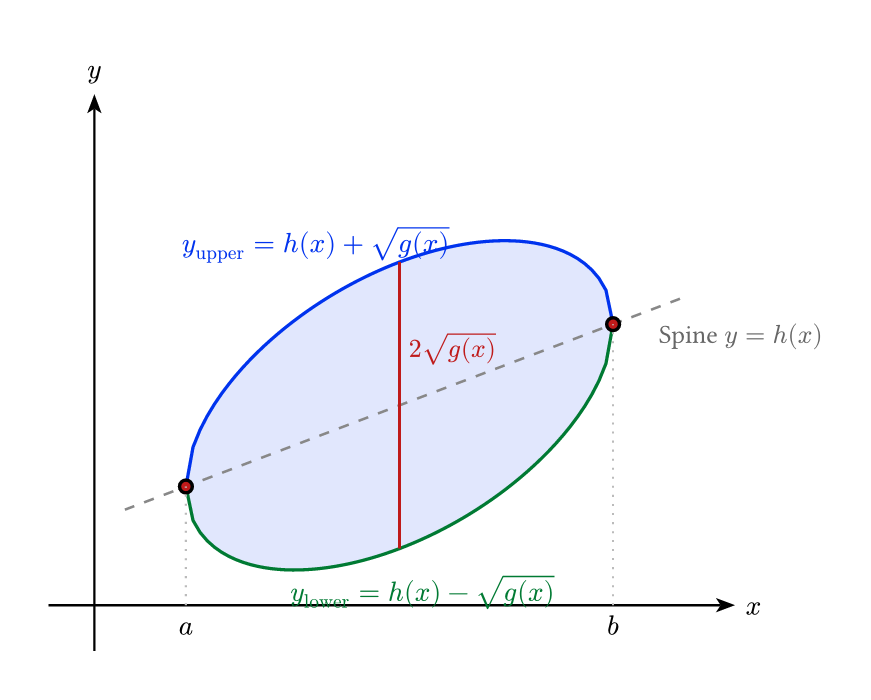
- Upper branch: \(y_{\text{upper}} = h(x) + \sqrt{g(x)}\)
- Lower branch: \(y_{\text{lower}} = h(x) - \sqrt{g(x)}\)
Watch closely what happens:
- Domain condition: Real \(y\)-values exist only where \(g(x) \ge 0\).
- Where the loop seals shut: Wherever \(g(x) = 0\) (say at \(x = a\) and \(x = b\)), the square root vanishes (\(\sqrt{g(x)} = 0\)), so both branches collide at the exact same point—\((a, h(a))\) and \((b, h(b))\)! That seals the region into a closed loop over \([a, b]\).
- The Spine Cancellation Magic: What is the height of a vertical strip stretching from \(y_{\text{lower}}\) to \(y_{\text{upper}}\)?
Look at that result: the central spine \(h(x)\) cancels out completely! Whether the loop sits on the \(x\)-axis (\(h(x) = 0\)), tilts diagonally along \(y = x\), or bends along a parabola \(y = x^2\), the vertical slice at \(x\) always has exact length \(2\sqrt{g(x)}\), so the area is simply:
(Note: Sometimes \(g(x) \ge 0\) holds on an unbounded ray like \(x \ge 0\)—for example, \((y - x)^2 = x\). Then the two branches \(y = x \pm \sqrt{x}\) start together at \((0, 0)\) and never meet again, so a boundary line like \(x = 4\) is needed to close the region!)
Case B: General Quadratic Equations in y
What if the equation is written completely expanded as a general quadratic in \(y\)?
You do not even need to guess a sketch first! Treat \(x\) as a constant and apply the quadratic formula to solve for \(y\):
- Upper branch: takes the \(+\) sign (when \(A(x) > 0\)).
- Lower branch: takes the \(-\) sign (when \(A(x) > 0\)).
- Domain & Loop Endpoints: The curve exists only where the discriminant \(D(x) \ge 0\). Any bounded interval \([a, b]\) where \(D(x) \ge 0\) and \(D(a) = D(b) = 0\) forms a closed loop!
- Direct Area Formula (Spine Cancels Automatically!): Subtracting the two roots removes \(-\frac{B(x)}{2A(x)}\) immediately:
Worked Examples
Example 1: Classic Loop Symmetric About the x-Axis
Sketch the curve \(y^2 = x^2(1 - x)\) and find the area of its closed loop.
Solution: Here \(h(x) = 0\) and \(g(x) = x^2(1 - x)\).
1. Domain: Since \(y^2 \ge 0\) and \(x^2 \ge 0\), we need \(1 - x \ge 0 \implies x \le 1\).
2. Where the branches meet: Setting \(y = 0\) gives \(x^2(1 - x) = 0 \implies x = 0\) and \(x = 1\). On \([0, 1]\), we have \(g(x) \ge 0\) with \(g(0) = g(1) = 0\), forming a single closed loop between \((0, 0)\) and \((1, 0)\).
3. Upper and lower branches on \([0, 1]\): Since \(x \ge 0\) on \([0, 1]\), \(\sqrt{x^2(1 - x)} = x\sqrt{1 - x}\), giving:
(For \(x < 0\), \(|x| = -x\), so the two branches \(y = \pm x\sqrt{1 - x}\) open outward indefinitely to the left.)
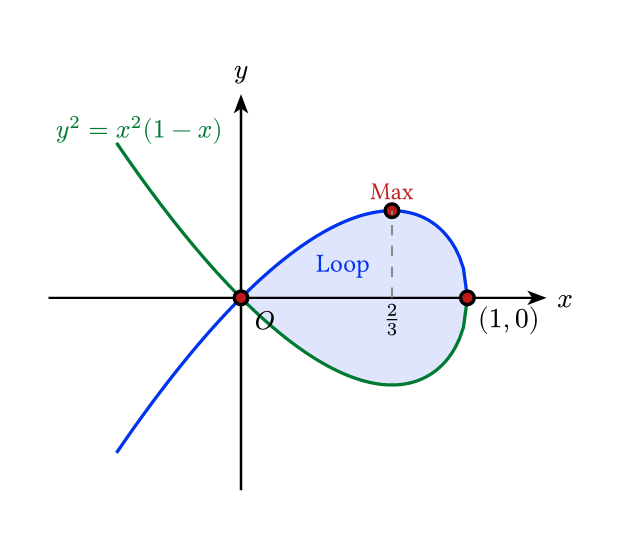
4. Area of the loop: Using \(y_{\text{upper}} - y_{\text{lower}} = 2x\sqrt{1 - x}\) on \([0, 1]\):
Substitute \(t = 1 - x \implies x = 1 - t\) and \(dx = -dt\):
Example 2: A Figure-Eight With Two Closed Loops
Find the total area enclosed by the curve \(y^2 = x^2(4 - x^2)\).
Solution: Look at the domain condition \(4 - x^2 \ge 0 \implies -2 \le x \le 2\). Setting \(y = 0\) gives three points where upper and lower branches meet: \(x = -2\), \(x = 0\), and \(x = 2\). That splits \([-2, 2]\) into two symmetric loops forming a figure-eight!
- Upper branch: \(y_{\text{upper}} = |x|\sqrt{4 - x^2}\).
- Lower branch: \(y_{\text{lower}} = -|x|\sqrt{4 - x^2}\).
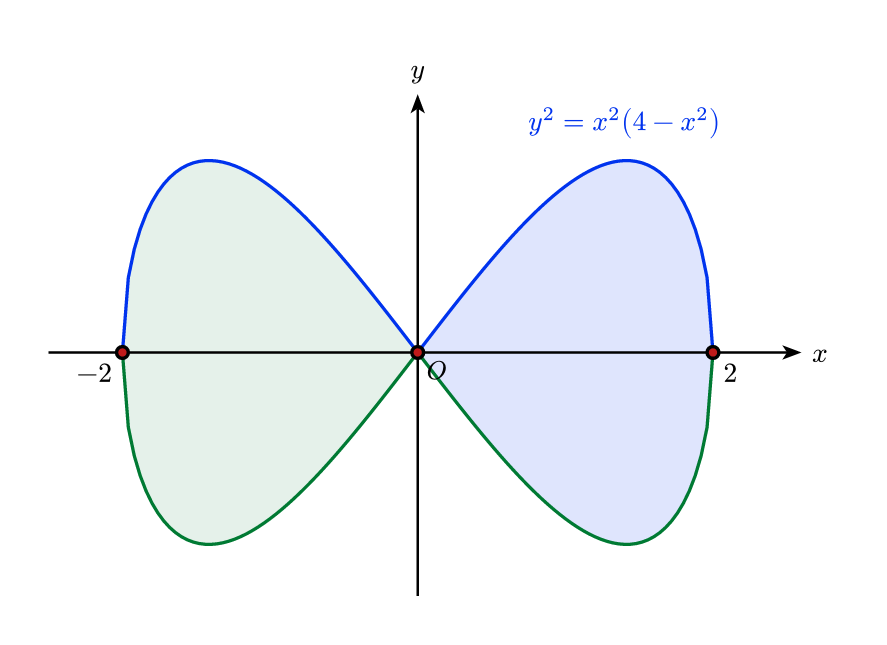
Because both \(x \to -x\) and \(y \to -y\) leave the equation unchanged, the total area of both loops equals \(4 \times\) the first-quadrant piece (\(0 \le x \le 2\)):
Substitute \(t = 4 - x^2 \implies dt = -2x\,dx \implies x\,dx = -\frac{1}{2}\,dt\) (as \(x: 0 \to 2\), \(t: 4 \to 0\)):
Example 3: Closed Loop Around a Tilted Line Spine
Find the area enclosed by the curve \((y - x)^2 = x(1 - x)\).
Solution: Taking square roots splits the curve around the diagonal spine \(y = x\):
- Upper branch: \(y_{\text{upper}} = x + \sqrt{x(1 - x)}\)
- Lower branch: \(y_{\text{lower}} = x - \sqrt{x(1 - x)}\)
Real values exist only when \(x(1 - x) \ge 0 \implies 0 \le x \le 1\). At \(x = 0\) and \(x = 1\), the branches meet at \((0, 0)\) and \((1, 1)\), sealing a tilted loop (a sheared ellipse)!
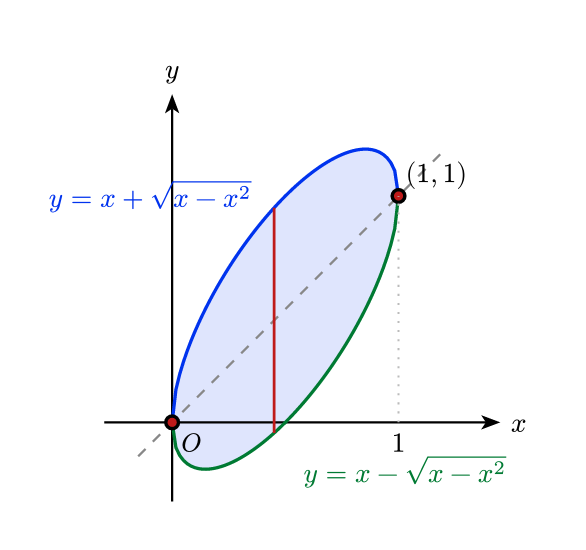
Notice how the spine \(x\) vanishes when taking the vertical strip height \(y_{\text{upper}} - y_{\text{lower}} = 2\sqrt{x(1 - x)}\):
The integral \(\int_0^1 \sqrt{\left(\frac{1}{2}\right)^2 - \left(x - \frac{1}{2}\right)^2}\,dx\) is simply the area of a semicircle of radius \(r = \frac{1}{2}\) (centered at \(x = \frac{1}{2}\)), which equals \(\frac{1}{2}\pi\left(\frac{1}{2}\right)^2 = \frac{\pi}{8}\). Multiplying by \(2\):
Example 4: Two Branches Along y = x Closed by a Vertical Line
Find the area bounded by the curve \((y - x)^2 = x\) and the vertical line \(x = 4\).
Solution: Here \(g(x) = x \ge 0\) holds for all \(x \ge 0\). Taking square roots gives:
- Upper branch: \(y_{\text{upper}} = x + \sqrt{x}\)
- Lower branch: \(y_{\text{lower}} = x - \sqrt{x}\)
Notice that these two branches meet at \((0, 0)\) and diverge to infinity as \(x \to \infty\)—so \((y - x)^2 = x\) cannot close on its own, which is why the boundary line \(x = 4\) is given (cutting the two branches at \((4, 2)\) and \((4, 6)\)).
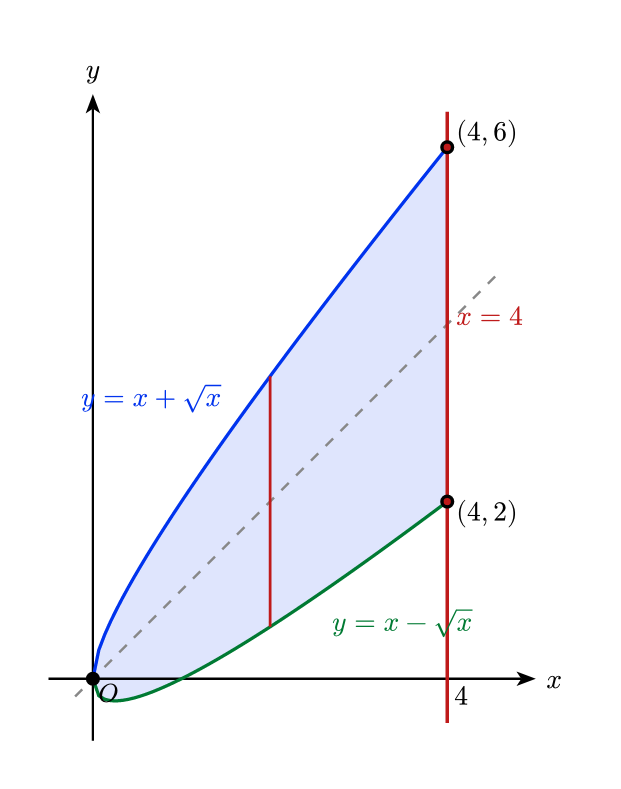
Subtracting upper minus lower branch cancels the spine \(x\):
(Notice: This is the exact same area as the upright parabola \(y^2 = x\) bounded by \(x = 4\)!)
Example 5: Closed Loop With a Curved Parabolic Spine
Find the area enclosed by \((y - x^2)^2 = 1 - x^2\).
Solution: The domain requires \(1 - x^2 \ge 0 \implies -1 \le x \le 1\). Around the curved spine \(y = x^2\):
- Upper branch: \(y_{\text{upper}} = x^2 + \sqrt{1 - x^2}\)
- Lower branch: \(y_{\text{lower}} = x^2 - \sqrt{1 - x^2}\)
At \(x = -1\) and \(x = 1\), \(\sqrt{1 - x^2} = 0\), so both branches merge at \((-1, 1)\) and \((1, 1)\) to form a heart-shaped closed loop!
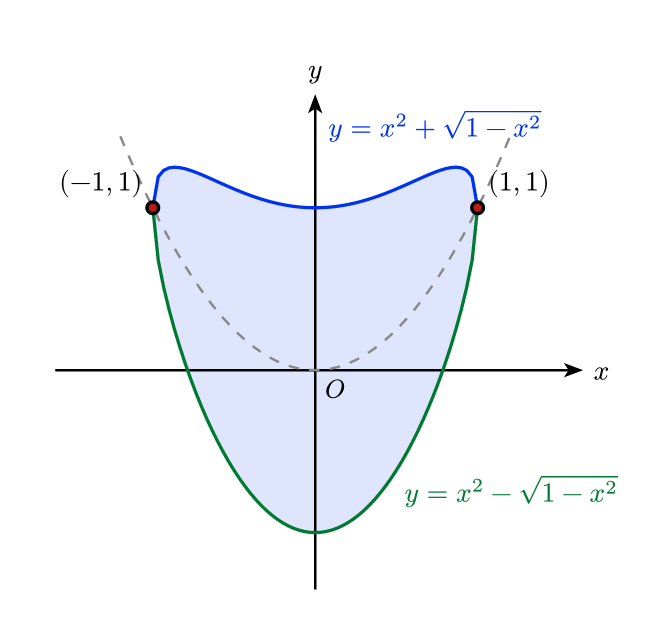
Again, subtracting upper minus lower branch completely eliminates \(x^2\):
Example 6: Finding a Loop From an Expanded Quadratic in y
Find the area of the closed curve \(2y^2 - 4xy + 3x^2 - 2x = 0\).
Solution: Do not try to guess the shape! Group the equation as a quadratic in \(y\):
Here \(A(x) = 2\), \(B(x) = -4x\), and \(C(x) = 3x^2 - 2x\). Compute the discriminant \(D(x)\):
Real points exist only where \(D(x) \ge 0 \implies 8x(2 - x) \ge 0 \implies 0 \le x \le 2\). At \(x = 0\) and \(x = 2\), \(D(x) = 0\), closing the loop! Using the vertical distance between the upper and lower roots:
Integrating from \(x = 0\) to \(x = 2\) (where \(\int_0^2 \sqrt{1 - (x - 1)^2}\,dx\) is a semicircle of radius \(1\)):
Example 7: Cubic Curve Forming a Single Tear-Drop Loop
Find the area of the closed loop of the curve \(9y^2 = x(3 - x)^2\).
Solution: Since \(9y^2 \ge 0\) and \((3 - x)^2 \ge 0\), the domain is \(x \ge 0\). Setting \(y = 0\) shows that the upper and lower branches cross each other at \(x = 0\) and \(x = 3\), sealing a loop on \([0, 3]\).
On \([0, 3]\), we have \(3 - x \ge 0\), so taking square roots gives:
(Checking the turning point of the upper branch: \(\frac{dy}{dx} = \frac{3 - 3x}{6\sqrt{x}} = 0 \implies x = 1\), height \(\frac{2}{3}\).)
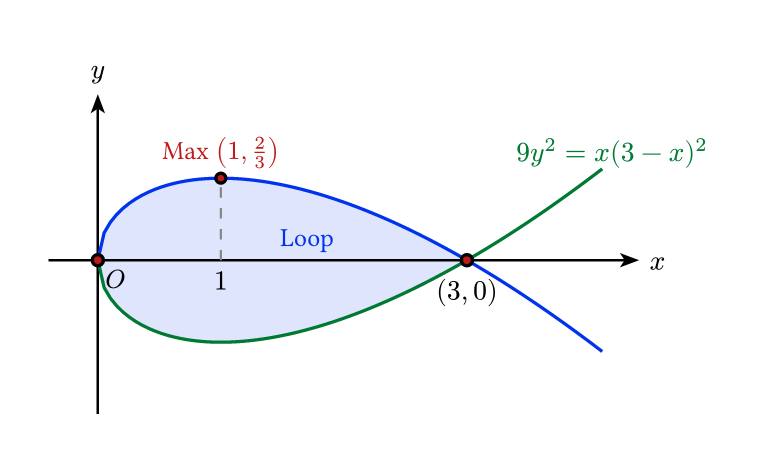
By \(x\)-axis symmetry, the loop area is:
Evaluating at \(x = 3\) (noting \(3^{3/2} = 3\sqrt{3}\) and \(3^{5/2} = 9\sqrt{3}\)):
2. Area of an Oblique Ellipse (General Second-Degree Equation)
Suppose you are given a general second-degree equation containing an \(xy\) term alongside linear and constant terms, such as:
Because of the \(2hxy\) cross-term and the \(2gx + 2fy\) terms, this conic is both rotated (oblique) and shifted away from the origin. How do we recognize when it is a genuine ellipse—and how do we find its area cleanly without computing complicated rotation angles?
Step 1: Confirm It Is a Real Ellipse
Recall the standard second-degree conic test. Form the determinant \(\Delta\):
Assuming \(b > 0\) (multiply the entire equation by \(-1\) first if \(b < 0\)), the equation represents a non-degenerate real ellipse when all three conditions hold:
- \(\Delta \neq 0\) (the curve is a true conic, not a pair of lines).
- \(h^2 - ab < 0\) (equivalently \(ab - h^2 > 0\), the ellipse condition).
- \(b\,\Delta < 0\) (or \(a\,\Delta < 0\) since \(ab > h^2 \ge 0\) guarantees \(a\) and \(b\) share the same sign—this ensures the curve has real points and is not an imaginary ellipse!).
Step 2: Write It as a Quadratic in y and Split Into Branches
Exactly as in Case B above, group the equation as a quadratic in \(y\):
Its spine (diameter) is the straight line \(y = -\frac{hx + f}{b}\), and its discriminant in \(y\) is:
Look closely at the coefficient of \(x^2\) inside the bracket: \((h^2 - ab)\)! Because \(h^2 - ab < 0\), this quadratic in \(x\) opens downward! Factoring out \((ab - h^2) > 0\) and completing the square gives:
where \((x_0, y_0)\) is the center of the ellipse and \(r\) is its horizontal half-width! Real points exist only for \(x \in [x_0 - r, \, x_0 + r]\), and at the endpoints \(x_1 = x_0 - r\) and \(x_2 = x_0 + r\), \(D(x) = 0\), giving the two vertical tangents where the upper and lower branches meet and seal the ellipse!
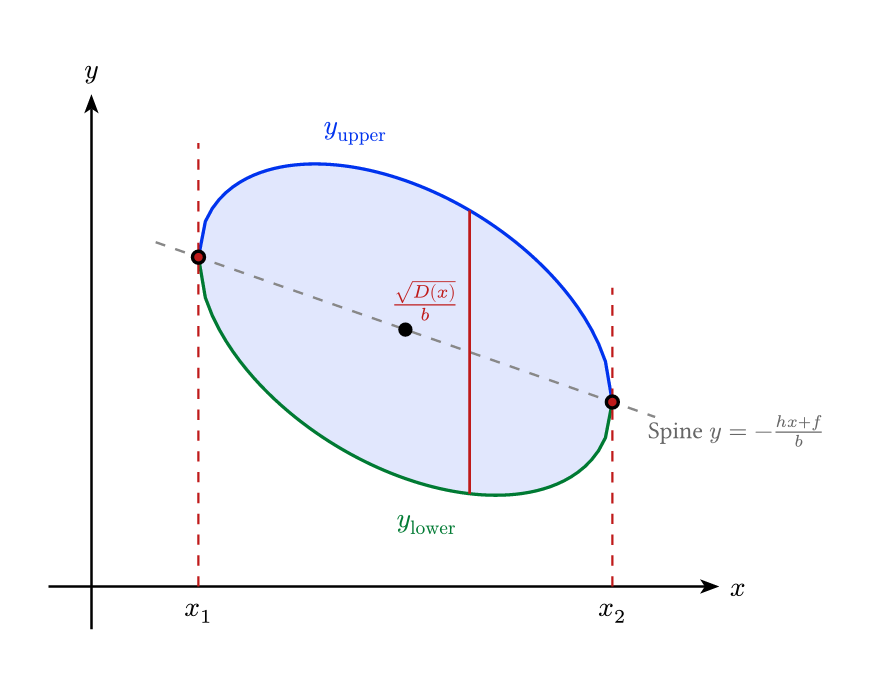
Step 3: Integrate the Difference Between Upper and Lower Branches
Subtracting the two quadratic roots kills the spine \(-\frac{hx + f}{b}\):
Integrating from \(x_0 - r\) to \(x_0 + r\) (where \(\int_{x_0 - r}^{x_0 + r} \sqrt{r^2 - (x - x_0)^2}\,dx = \frac{1}{2}\pi r^2\) is simply a semicircle of radius \(r\)):
(And if you compute \(r^2\) from the discriminant of \((h^2 - ab)x^2 + 2(hf - bg)x + (f^2 - bc)\), algebra gives \(r^2 = \frac{-b\,\Delta}{(ab - h^2)^2}\)—which both proves why \(b\,\Delta < 0\) is needed for \(r^2 > 0\) and yields the compact formula:)
(Notice: You never have to memorize this determinant formula if you just write the equation as a quadratic in \(y\), complete the square on \(D(x)\), and use the semicircle integral!)
Example 8: Oblique Shifted Ellipse With 2x^2 + 3xy
Verify that \(2x^2 + 3xy + 3y^2 - 8x - 6y + 3 = 0\) represents a real ellipse, sketch it via upper and lower branches, and find its area.
Solution:
1. Check the conic conditions: Matching with \(ax^2 + 2hxy + by^2 + 2gx + 2fy + c = 0\) gives \(a = 2\), \(h = \frac{3}{2}\), \(b = 3\), \(g = -4\), \(f = -3\), and \(c = 3\).
- \(h^2 - ab = \left(\frac{3}{2}\right)^2 - 2(3) = \frac{9}{4} - 6 = -\frac{15}{4} < 0\) (so \(ab - h^2 = \frac{15}{4} > 0\)).
- Compute \(\Delta\):
Since \(b = 3 > 0\), \(h^2 - ab < 0\), and \(b\Delta < 0\), it is a non-degenerate real ellipse.
2. Write as a quadratic in \(y\) and find the spine & discriminant:
Solving for \(y\) gives the spine diameter \(y = -\frac{3x - 6}{6} = 1 - \frac{x}{2}\), and discriminant:
Real values exist when \(15x(4 - x) \ge 0 \implies 0 \le x \le 4\). At \(x = 0\) and \(x = 4\), \(D(x) = 0\), giving the vertical-tangent endpoints \((0, 1)\) and \((4, -1)\) on the spine (with center at \((2, 0)\)).
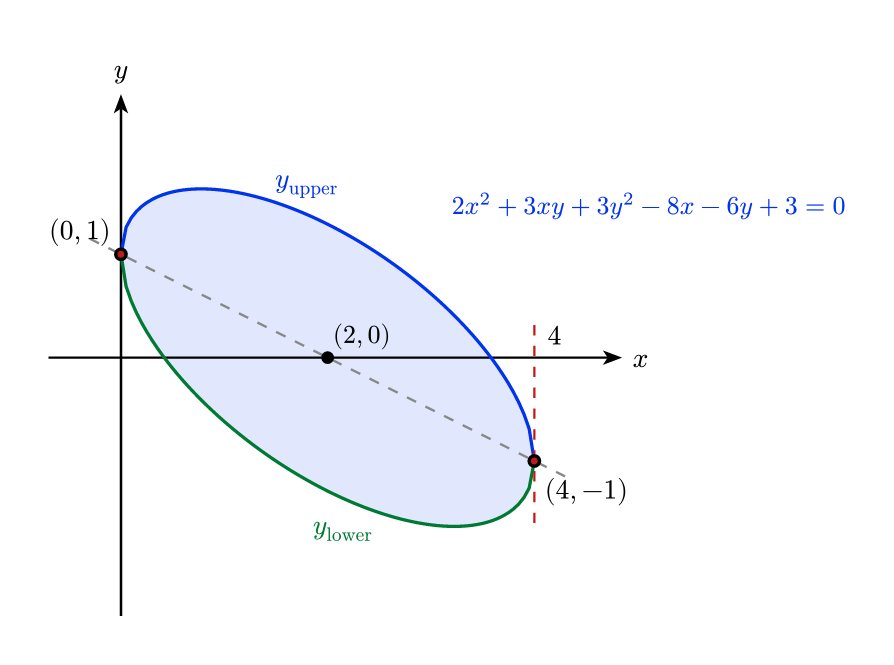
3. Compute the area from the vertical strip: Writing \(x(4 - x) = 4 - (x - 2)^2\):
Integrating from \(x = 0\) to \(x = 4\) (a semicircle of radius \(r = 2\), area \(\frac{1}{2}\pi(2)^2 = 2\pi\)):
(Check with the determinant formula: \(\frac{\pi|\Delta|}{(ab - h^2)^{3/2}} = \frac{\pi(75/4)}{(15/4)^{3/2}} = \frac{75\pi/4}{15\sqrt{15}/8} = \frac{10\pi}{\sqrt{15}} = \frac{2\pi\sqrt{15}}{3}\)—an exact match!)
Example 9: Oblique Ellipse With Irrational Vertical Tangents
Find the area enclosed by \(x^2 + 2xy + 2y^2 - 4x - 2y + 1 = 0\).
Solution: Here \(a = 1\), \(h = 1\), \(b = 2\), \(g = -2\), \(f = -1\), and \(c = 1\).
- \(h^2 - ab = 1 - 2 = -1 < 0\) (so \(ab - h^2 = 1\)).
- \(\Delta = \begin{vmatrix} 1 & 1 & -2 \\ 1 & 2 & -1 \\ -2 & -1 & 1 \end{vmatrix} = 1(2 - 1) - 1(1 - 2) - 2(-1 + 4) = 1 + 1 - 6 = -4 < 0\), confirming a real ellipse.
Group as a quadratic in \(y\):
Compute the discriminant in \(y\) and complete the square in \(x\):
Real \(y\) exist for \(3 - 2\sqrt{2} \le x \le 3 + 2\sqrt{2}\) (a half-width \(r = \sqrt{8}\)). Even though the endpoints are irrational, subtracting upper minus lower branch gives:
The integral across \([3 - \sqrt{8}, \, 3 + \sqrt{8}]\) is immediately a semicircle of radius \(\sqrt{8}\):
(Checking with \(A = \frac{\pi|\Delta|}{(ab - h^2)^{3/2}}\) gives \(\frac{\pi|-4|}{1^{3/2}} = 4\pi\) immediately!)