Location of a Point with respect to a Hyperbola
Just as we classify whether a point lies inside, on, or outside a circle, parabola, or ellipse, we can classify the position of any point \(P(x_1, y_1)\) with respect to a hyperbola. However, there is a crucial sign reversal for a hyperbola that trips up many students if they blindly apply the rule from the ellipse.
1. The Position Criterion and Why the Sign Flips
Consider the standard horizontal hyperbola:
Define the expression \(S\) by bringing \(1\) to the left-hand side:
For any point \(P(x_1, y_1)\) in the plane, let \(S_1\) be the value obtained by substituting \((x_1, y_1)\) into \(S\):
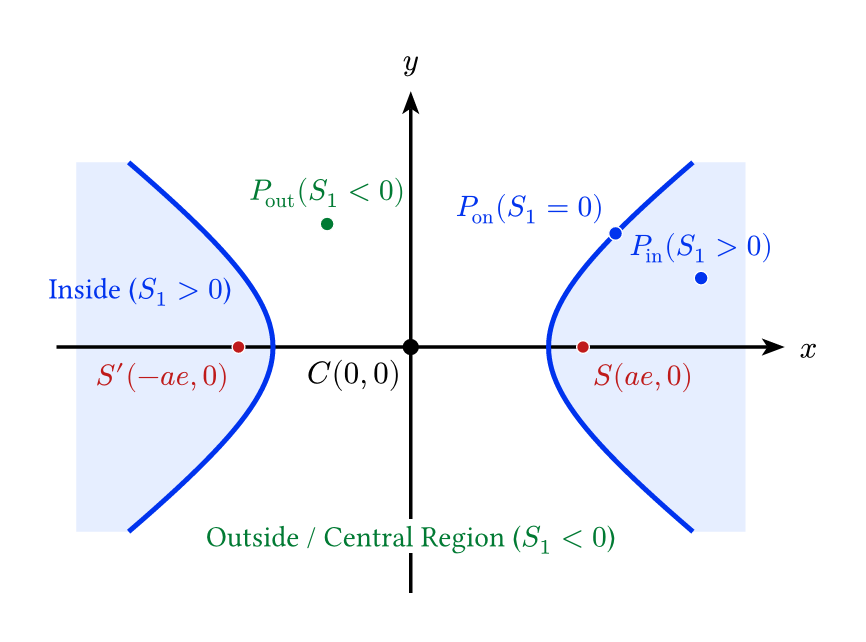
What Do "Inside" and "Outside" Mean for a Hyperbola?
A hyperbola has two branches that open away from the center \(C(0, 0)\) and cup around the two foci \(S(ae, 0)\) and \(S'(-ae, 0)\):
- The inside (or focal region) consists of the two concave regions containing the foci \(S\) and \(S'\).
- The outside (or central region) is the region between the two branches, which contains the center \(C(0, 0)\) and the conjugate axis.
Now test the center \(C(0, 0)\) and the focus \(S(ae, 0)\) in \(S_1\):
- At the center \(C(0, 0)\): \(S_1 = 0 - 0 - 1 = -1 < 0\).
- At the focus \(S(ae, 0)\): \(S_1 = \frac{a^2 e^2}{a^2} - 0 - 1 = e^2 - 1 > 0\) (since \(e > 1\)).
Therefore, unlike the ellipse (where \(S_1 < 0\) is inside and \(S_1 > 0\) is outside), for the standard hyperbola \(S \equiv \frac{x^2}{a^2} - \frac{y^2}{b^2} - 1\):
- \(S_1 > 0 \iff P(x_1, y_1)\) lies INSIDE the hyperbola (in one of the two focal regions).
- \(S_1 = 0 \iff P(x_1, y_1)\) lies ON the hyperbola.
- \(S_1 < 0 \iff P(x_1, y_1)\) lies OUTSIDE the hyperbola (in the central region between the branches).
Foolproof Memory Rule: For every conic section (circle, parabola, ellipse, hyperbola), the focus always lies inside the curve. If you ever forget the sign of \(S_1\), simply plug in the coordinates of a focus (or the center): whichever sign the focus gives is "inside"!
2. Geometric Justification
Let us prove why the sign of \(S_1\) partitions the plane this way.
Take any point \(P(x_1, y_1)\) and draw the horizontal line \(y = y_1\) passing through \(P\). Because \(1 + \frac{y_1^2}{b^2} \ge 1 > 0\), this horizontal line always intersects both branches of the hyperbola at two symmetric points \(Q(x_Q, y_1)\) and \(Q'(-x_Q, y_1)\), where \(x_Q > 0\) satisfies:
Now compare \(|x_1|\) with \(x_Q\):
Case 1: \(P\) lies inside either branch (focal region): Since \(P\) is farther from the \(y\)-axis than the curve at height \(y_1\), \(|x_1| > x_Q\):
Case 2: \(P\) lies on the hyperbola (\(|x_1| = x_Q\)):
Case 3: \(P\) lies outside (central region between both branches): Since \(P\) is closer to the \(y\)-axis than the curve at height \(y_1\), \(|x_1| < x_Q\):
Identifying Which Branch
When \(S_1 > 0\), the point \(P(x_1, y_1)\) is guaranteed to lie inside one of the two branches:
- If \(S_1 > 0\) and \(x_1 > 0\), \(P\) lies inside the right branch (the one containing \(S(ae, 0)\)).
- If \(S_1 > 0\) and \(x_1 < 0\), \(P\) lies inside the left branch (the one containing \(S'(-ae, 0)\)).
3. Vertical, Shifted, and General Hyperbolas
The exact same logic applies to vertical and shifted hyperbolas—provided you write the equation in standard normalized form first, with the transverse-axis squared term positive and \(-1\) on the left-hand side!
Standard Vertical Hyperbola
For \(\frac{y^2}{b^2} - \frac{x^2}{a^2} = 1\), define:
- \(S_1 > 0 \implies\) Inside (\(y_1 > 0\) for the upper branch; \(y_1 < 0\) for the lower branch).
- \(S_1 = 0 \implies\) On the hyperbola.
- \(S_1 < 0 \implies\) Outside (between the upper and lower branches).
Shifted Hyperbolas Centered at C(h, k)
- Shifted Horizontal: \(S \equiv \frac{(x - h)^2}{a^2} - \frac{(y - k)^2}{b^2} - 1\):
- \(S_1 > 0 \implies\) Inside (\(x_1 > h\) for right branch; \(x_1 < h\) for left branch).
- \(S_1 = 0 \implies\) On the hyperbola.
- \(S_1 < 0 \implies\) Outside.
- Shifted Vertical: \(S \equiv \frac{(y - k)^2}{b^2} - \frac{(x - h)^2}{a^2} - 1\):
- \(S_1 > 0 \implies\) Inside (\(y_1 > k\) for upper branch; \(y_1 < k\) for lower branch).
- \(S_1 = 0 \implies\) On the hyperbola.
- \(S_1 < 0 \implies\) Outside.
Trap with General Equations: If you are given a general equation \(Ax^2 + By^2 + 2gx + 2fy + c = 0\) (\(AB < 0\)), do not blindly evaluate \(S_1\) before completing the squares! As we saw in Section 04, if \(A > 0, B < 0\) and \(\Delta' < 0\), dividing by \(\Delta'\) flips the signs and turns the equation into a vertical hyperbola. Always reduce to standard form (or check the value of the expression at the center \(C(h, k)\)) first!
4. Worked Problems Based on Location of a Point
Example 1: Classifying Points Relative to Horizontal and Vertical Hyperbolas
- Determine the positions of the points \(P(5, 2)\), \(Q(3, 0)\), and \(R(1, 4)\) with respect to the hyperbola \(\frac{x^2}{9} - \frac{y^2}{16} = 1\).
- Determine the position of \(T(2, 5)\) with respect to the vertical hyperbola \(\frac{y^2}{16} - \frac{x^2}{9} = 1\).
Solution:
Part 1: For the horizontal hyperbola \(\frac{x^2}{9} - \frac{y^2}{16} = 1\):
Define the expression:
For \(P(5, 2)\):
Since \(S_1 > 0\) and \(x_1 = 5 > 0\), the point \(P(5, 2)\) lies inside the right branch.
For \(Q(3, 0)\):
Hence \(Q(3, 0)\) lies on the hyperbola (it is the right vertex).
For \(R(1, 4)\):
Hence \(R(1, 4)\) lies outside the hyperbola (in the central region between the two branches).
Part 2: For the vertical hyperbola \(\frac{y^2}{16} - \frac{x^2}{9} = 1\):
Define the expression \(S \equiv \frac{y^2}{16} - \frac{x^2}{9} - 1\). At \(T(2, 5)\):
Since \(S_1 > 0\) and \(y_1 = 5 > 0\), the point \(T(2, 5)\) lies inside the upper branch.
Example 2: Finding a Parameter Range for a Point Inside a Shifted Hyperbola
Find the set of all real values of \(\alpha\) such that the point \(P(5\alpha + 1,\; 4\alpha + 2)\) lies inside the shifted hyperbola
Solution:
Define the normalized expression:
For \(P(5\alpha + 1,\; 4\alpha + 2)\) to lie inside the hyperbola, we require \(S_1 > 0\):
Taking square roots:
Example 3: Restricting a Point to Inside a Specific Branch
Find the range of real values of \(k\) for which the point \(P(k, 2)\) lies strictly inside the right branch of the hyperbola \(\frac{x^2}{9} - \frac{y^2}{16} = 1\).
Solution:
For \(P(k, 2)\) to lie inside the hyperbola, we need \(S_1 > 0\):
This gives two intervals: \(k > \frac{3\sqrt{5}}{2}\) (inside the right branch) and \(k < -\frac{3\sqrt{5}}{2}\) (inside the left branch).
Since the problem specifically asks for the right branch, we also require \(k > 0\). Therefore:
Example 4: General Equation Sign Check
Determine whether the point \(P(3, 1)\) lies inside, on, or outside the hyperbola
Solution:
First, complete the squares to put the equation in standard form and verify its orientation:
Dividing by \(+36\) (which is positive, so no sign flip occurs):
So the normalized expression \(S \equiv \frac{(x - 1)^2}{9} - \frac{(y - 2)^2}{4} - 1\) is simply \(\frac{1}{36}(4x^2 - 9y^2 - 8x + 36y - 68)\).
Substitute \(P(3, 1)\) into the left-hand side:
Dividing by \(+36\) gives \(S_1 = -\frac{29}{36} < 0\). Therefore, \(P(3, 1)\) lies outside the hyperbola (in the central region containing the center \((1, 2)\)).
(Notice: if the right-hand side after completing the squares had been \(-36\) instead of \(+36\), dividing by \(-36\) would have flipped \(-29 < 0\) to \(+\frac{29}{36} > 0\), making the point lie inside! Always check the sign after completing the squares.)
5. Quick Reference Summary
| Hyperbola (Normalized \(S = 0\)) | Inside (Focal Region) | On Curve | Outside (Central Region) |
|---|---|---|---|
| \(\dfrac{x^2}{a^2} - \dfrac{y^2}{b^2} - 1 = 0\) | \(S_1 > 0\) | \(S_1 = 0\) | \(S_1 < 0\) |
| \(\dfrac{y^2}{b^2} - \dfrac{x^2}{a^2} - 1 = 0\) | \(S_1 > 0\) | \(S_1 = 0\) | \(S_1 < 0\) |
| \(\dfrac{(x - h)^2}{a^2} - \dfrac{(y - k)^2}{b^2} - 1 = 0\) | \(S_1 > 0\) | \(S_1 = 0\) | \(S_1 < 0\) |
| \(\dfrac{(y - k)^2}{b^2} - \dfrac{(x - h)^2}{a^2} - 1 = 0\) | \(S_1 > 0\) | \(S_1 = 0\) | \(S_1 < 0\) |