Location of a Line with respect to a Hyperbola
In the previous section, we classified whether a point lies inside, on, or outside a hyperbola. Now we consider the positional relationship between a straight line and a hyperbola: when does a line intersect the curve, when does it touch it as a tangent, and when does it pass by without meeting it?
While this question looks algebraically similar to what we did for an ellipse, the open shape and asymptotes of a hyperbola introduce fundamental differences. Most strikingly, tangents of all slopes do not exist for a hyperbola—the asymptotes divide the slope domain strictly between the hyperbola and its conjugate!
1. Intersection of a Line and a Standard Horizontal Hyperbola
Consider a straight line with slope \(m\) and \(y\)-intercept \(c\):
and the standard horizontal hyperbola:
To determine where the line meets the hyperbola, substitute \(y = mx + c\) into the hyperbola equation:
Multiply through by \(a^2 b^2\):
Group terms by powers of \(x\):
This is a quadratic equation in \(x\) of the form \(Ax^2 + Bx + C = 0\), where:
A Critical Difference from the Ellipse
For an ellipse \(\frac{x^2}{a^2} + \frac{y^2}{b^2} = 1\), the leading coefficient was \(a^2 m^2 + b^2\), which was always strictly positive for every real slope \(m\).
For a hyperbola, however, the leading coefficient is:
Depending on the slope \(m\), \(A\) can be zero, positive, or negative!
2. Complete Classification of the Line
The geometric behavior of the line falls into three distinct regimes depending on how its slope \(|m|\) compares with the asymptote slope \(\frac{b}{a}\).
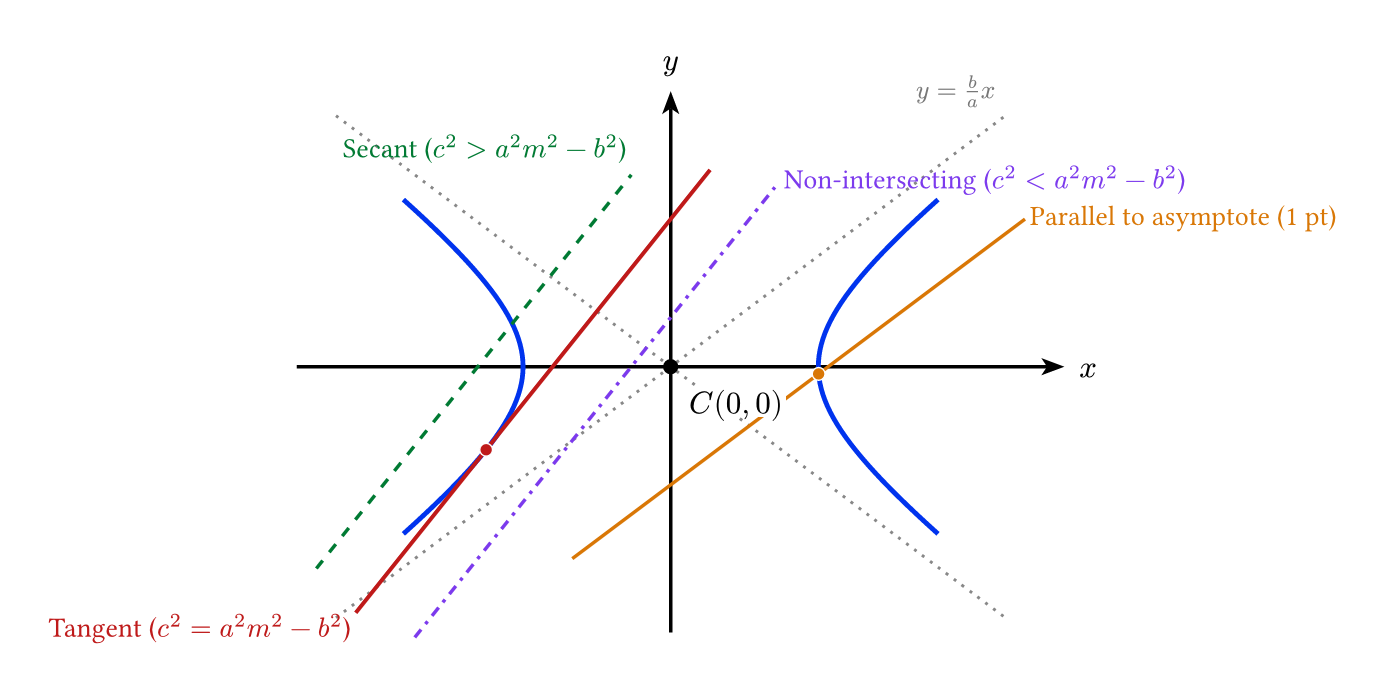
Regime 1: Line Parallel to an Asymptote
When \(m = \pm \frac{b}{a}\), the \(x^2\) coefficient vanishes (\(A = b^2 - a^2 m^2 = 0\)). The equation reduces from a quadratic to a linear equation in \(x\):
If \(c \ne 0\): The line is parallel to one of the asymptotes but does not pass through the center. Solving for \(x\):
Because there is only one real root, the line intersects the hyperbola at exactly one point! It slices through one branch and runs parallel to the asymptote along the other branch without ever touching it.
If \(c = 0\): The line passes through the origin with equation \(y = \pm \frac{b}{a}x\). The equation becomes \(-a^2 b^2 = 0\), which is impossible. The line is an asymptote itself and meets the hyperbola at no real finite points (touching it only "at infinity").
Regime 2: Line Flatter than Asymptotes
When \(|m| < \frac{b}{a}\), the line is less steep than the asymptotes. Here:
Now compute the discriminant \(D = B^2 - 4AC\):
Factoring out \(4a^2\):
Since \(b^2 - a^2 m^2 > 0\) and \(c^2 \ge 0\), the quantity inside the bracket is strictly positive for all real values of \(c\):
Furthermore, look at the product of the two roots from Vieta's formulas:
Because \(x_1 x_2 < 0\), the two roots always have opposite signs (\(x_1 > 0\) and \(x_2 < 0\)).
Conclusion for \(|m| < b/a\): Any line flatter than the asymptotes intersects the hyperbola in two distinct points lying on opposite branches (one on the right branch and one on the left branch). Such a line can never be a tangent, and can never miss the curve!
Regime 3: Line Steeper than Asymptotes
When \(|m| > \frac{b}{a}\), the line is steeper than the asymptotes. Here:
Writing the discriminant in terms of the positive quantity \((a^2 m^2 - b^2)\):
Now the sign of \(D\) depends on the vertical intercept \(c\):
Case 1: Secant Line (\(D > 0 \iff c^2 > a^2 m^2 - b^2\)) The line intersects the hyperbola at two distinct points lying on the same branch.
Case 2: Tangent Line (\(D = 0 \iff c^2 = a^2 m^2 - b^2\)) The line touches the hyperbola at exactly one point.
Case 3: Non-Intersecting Line (\(D < 0 \iff c^2 < a^2 m^2 - b^2\)) The line passes entirely between the two branches without intersecting or touching either branch.
3. Condition of Tangency and the Slope Restriction
Setting \(D = 0\) in Regime 3 gives the condition of tangency for the horizontal hyperbola \(\frac{x^2}{a^2} - \frac{y^2}{b^2} = 1\):
Why Tangents of All Slopes Are NOT Possible
Look closely at the expression under the square root: \(a^2 m^2 - b^2\). For the intercept \(c\) to be a real number, we must have:
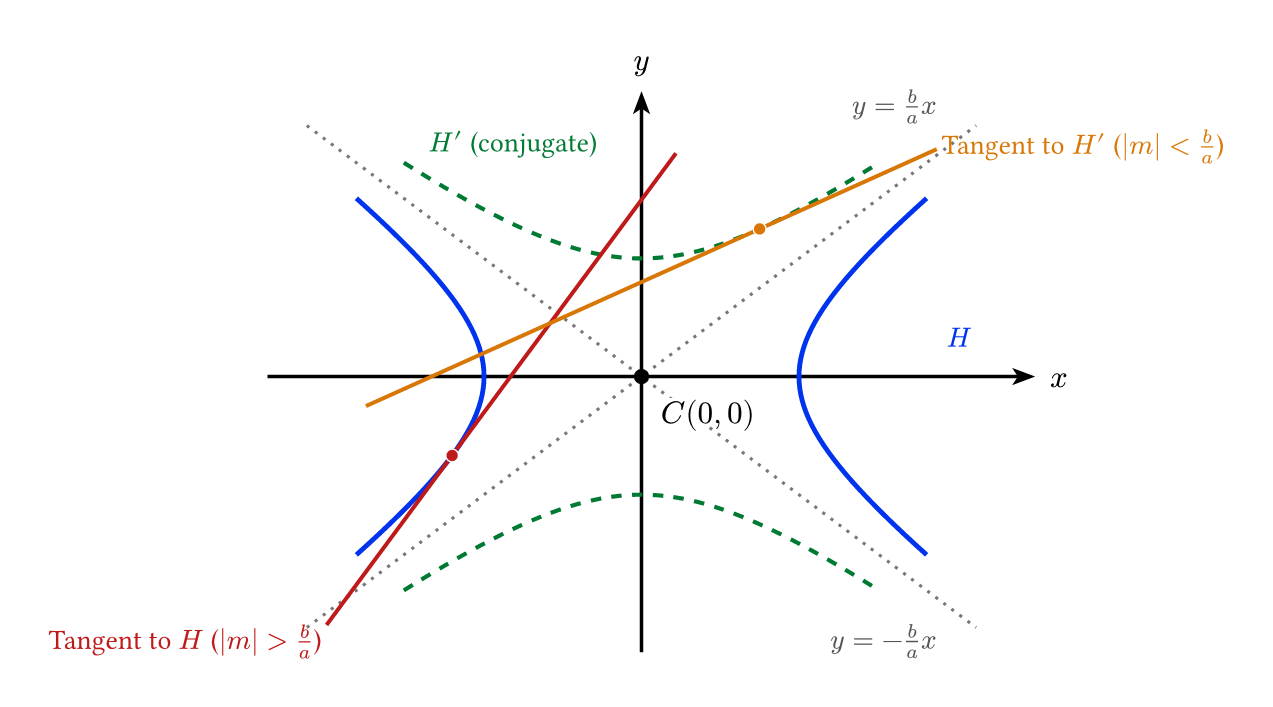
This is one of the most fundamental contrasts in coordinate geometry:
- For an Ellipse: \(c = \pm\sqrt{a^2 m^2 + b^2}\). Since \(a^2 m^2 + b^2 > 0\) for all real \(m\), tangents of every real slope exist.
- For a Parabola (\(y^2 = 4ax\)): \(c = \frac{a}{m}\). Tangents of every non-zero slope exist.
- For a Horizontal Hyperbola: Tangents exist only when \(|m| > \frac{b}{a}\) (or \(|m| \ge \frac{b}{a}\)). No tangent can ever have a slope in the open interval \(\left(-\frac{b}{a},\; \frac{b}{a}\right)\)!
4. Condition of Tangency for a Vertical Hyperbola
Now consider the standard vertical hyperbola:
Substitute \(y = mx + c\):
Setting the discriminant to zero yields the condition of tangency:
The Beautiful Complementarity of Slopes
For \(c\) to be real in the vertical hyperbola:
Notice how the two conjugate hyperbolas divide the entire range of real slopes between them:
- Horizontal Hyperbola: Real tangents exist only for \(|m| > \frac{b}{a}\) (slopes steeper than the asymptotes).
- Vertical Hyperbola: Real tangents exist only for \(|m| < \frac{b}{a}\) (slopes flatter than the asymptotes).
- Asymptotes (\(|m| = \frac{b}{a}\)): Form the exact boundary separating the two slope domains!
5. Equation of Tangents in Slope Form and Points of Contact
Standard Horizontal Hyperbola
Substituting \(c = \pm\sqrt{a^2 m^2 - b^2}\) into \(y = mx + c\):
For any permissible slope \(m\), there are two parallel tangents, one touching each branch.
Point of Contact: When \(D = 0\), the repeated root of \((b^2 - a^2 m^2)x^2 - 2a^2 mc\,x - a^2(b^2 + c^2) = 0\) is:
Substituting \(x\) into \(y = mx + c\):
Therefore, for a tangent with intercept \(c\), the point of contact is:
Substituting \(c = \pm\sqrt{a^2 m^2 - b^2}\):
Standard Vertical Hyperbola
Substituting \(c = \pm\sqrt{b^2 - a^2 m^2}\) into \(y = mx + c\):
Point of Contact:
6. Tangents to Shifted Hyperbolas
When a hyperbola has center \(C(h, k)\), translate the axes using \(X = x - h\) and \(Y = y - k\).
Shifted Horizontal Hyperbola
For \(\frac{(x - h)^2}{a^2} - \frac{(y - k)^2}{b^2} = 1\):
In the translated frame, \(Y = mX \pm \sqrt{a^2 m^2 - b^2}\). In original coordinates:
The points of contact are obtained by adding \((h, k)\) to the standard points of contact:
Shifted Vertical Hyperbola
For \(\frac{(y - k)^2}{b^2} - \frac{(x - h)^2}{a^2} = 1\):
The points of contact are:
7. Tangency Condition for a General Line
Let the line be given in general form \(lx + my + n = 0\) (\(m \ne 0\)).
Expressing in slope-intercept form gives slope \(M = -\frac{l}{m}\) and intercept \(C = -\frac{n}{m}\).
- For the horizontal hyperbola \(\frac{x^2}{a^2} - \frac{y^2}{b^2} = 1\): Applying \(C^2 = a^2 M^2 - b^2\):
- For the vertical hyperbola \(\frac{y^2}{b^2} - \frac{x^2}{a^2} = 1\): Applying \(C^2 = b^2 - a^2 M^2\):
8. Length of an Intercepted Chord
When a line cuts a hyperbola in two distinct points \(P(x_1, y_1)\) and \(Q(x_2, y_2)\), the length of the chord \(PQ\) can be calculated directly using Vieta's formulas.
Eliminating \(y\) yields the quadratic \((b^2 - a^2 m^2)x^2 - 2a^2 mc\,x - a^2(b^2 + c^2) = 0\). Using:
we find the difference between the abscissae:
The length of the chord is then:
9. Illustrative Examples
Example 1: Complete Classification of Lines Relative to a Hyperbola
Classify the relationship between each of the following lines and the hyperbola \(\frac{x^2}{16} - \frac{y^2}{9} = 1\):
- \(y = \frac{5}{4}x + 4\)
- \(y = \frac{5}{4}x + 5\)
- \(y = \frac{5}{4}x + 2\)
- \(y = \frac{3}{4}x - 2\)
- \(y = \frac{1}{2}x + 1\)
Solution:
Here \(a^2 = 16 \implies a = 4\), \(b^2 = 9 \implies b = 3\), and the asymptote slope is \(\frac{b}{a} = \frac{3}{4} = 0.75\).
For Line 1 (\(y = \frac{5}{4}x + 4\)):
- Slope \(m = \frac{5}{4} > \frac{3}{4}\).
- Evaluate \(a^2 m^2 - b^2 = 16\left(\frac{25}{16}\right) - 9 = 25 - 9 = 16\).
- Here \(c = 4\), so \(c^2 = 16 = a^2 m^2 - b^2\).
- Since \(c^2 = a^2 m^2 - b^2\), this is a tangent line.
- Point of contact: \(\left(-\frac{a^2 m}{c}, -\frac{b^2}{c}\right) = \left(-\frac{16(5/4)}{4}, -\frac{9}{4}\right) = \left(-5, -\frac{9}{4}\right)\) on the left branch.
For Line 2 (\(y = \frac{5}{4}x + 5\)):
- Slope \(m = \frac{5}{4} > \frac{3}{4}\) and \(a^2 m^2 - b^2 = 16\).
- Here \(c = 5\), so \(c^2 = 25 > 16\).
- Since \(c^2 > a^2 m^2 - b^2\), this is a secant line intersecting the left branch in two distinct points.
For Line 3 (\(y = \frac{5}{4}x + 2\)):
- Slope \(m = \frac{5}{4} > \frac{3}{4}\) and \(a^2 m^2 - b^2 = 16\).
- Here \(c = 2\), so \(c^2 = 4 < 16\).
- Since \(c^2 < a^2 m^2 - b^2\), this is a non-intersecting line passing between the two branches.
For Line 4 (\(y = \frac{3}{4}x - 2\)):
- Slope \(m = \frac{3}{4} = \frac{b}{a}\) (parallel to an asymptote) and \(c = -2 \ne 0\).
- The line intersects the hyperbola in exactly one point.
- Setting up the linear equation: \(-2(16)\left(\frac{3}{4}\right)(-2)x - 16(9 + 4) = 0 \implies 48x - 208 = 0 \implies x = \frac{13}{3}\).
For Line 5 (\(y = \frac{1}{2}x + 1\)):
- Slope \(m = \frac{1}{2} < \frac{3}{4} = \frac{b}{a}\) (flatter than the asymptotes).
- The line intersects the hyperbola in two distinct points on opposite branches (one on the left branch, one on the right branch).
Example 2: Tangents of Given Slope to Horizontal and Vertical Hyperbolas
- Find the equations of tangents of slope \(m = 2\) to the horizontal hyperbola \(\frac{x^2}{9} - \frac{y^2}{16} = 1\), and find their points of contact.
- Explain why no real tangent of slope \(m = 1\) can be drawn to \(\frac{x^2}{9} - \frac{y^2}{16} = 1\).
- Find the tangents of slope \(m = 1\) to the vertical hyperbola \(\frac{y^2}{16} - \frac{x^2}{9} = 1\).
Solution:
Part 1: For \(\frac{x^2}{9} - \frac{y^2}{16} = 1\), we have \(a^2 = 9\) and \(b^2 = 16\). The asymptote slope is \(\frac{b}{a} = \frac{4}{3}\). Since the given slope is \(m = 2 > \frac{4}{3}\), real tangents exist:
The equations of the tangents are:
Points of contact \(\left(\mp \frac{a^2 m}{c},\; \mp \frac{b^2}{c}\right)\):
- For \(y = 2x + 2\sqrt{5}\): \(\left(-\frac{9(2)}{2\sqrt{5}},\; -\frac{16}{2\sqrt{5}}\right) = \left(-\frac{9}{\sqrt{5}},\; -\frac{8}{\sqrt{5}}\right)\).
- For \(y = 2x - 2\sqrt{5}\): \(\left(\frac{9}{\sqrt{5}},\; \frac{8}{\sqrt{5}}\right)\).
Part 2: If \(m = 1\), we evaluate:
Since \(c^2 = -7\) has no real solutions, no real tangent of slope \(1\) exists for this horizontal hyperbola (the slope \(1\) is flatter than the asymptote slope \(\frac{4}{3}\)).
Part 3: For the vertical hyperbola \(\frac{y^2}{16} - \frac{x^2}{9} = 1\), we have \(b^2 = 16, a^2 = 9\). The condition of tangency is \(c^2 = b^2 - a^2 m^2\). For \(m = 1\):
Because \(m = 1 < \frac{4}{3}\), real tangents do exist for the vertical hyperbola:
Example 3: Tangents to a Shifted Hyperbola
Find the equations of the tangents to the shifted hyperbola
that are parallel to the straight line \(3x - y + 7 = 0\). Also find their points of contact.
Solution:
The line \(3x - y + 7 = 0\) has slope \(m = 3\).
For the hyperbola:
- Center \((h, k) = (2, -1)\)
- \(a^2 = 4 \implies a = 2\)
- \(b^2 = 5 \implies b = \sqrt{5}\)
- Asymptote slope \(\frac{b}{a} = \frac{\sqrt{5}}{2} \approx 1.118\)
Since \(m = 3 > \frac{\sqrt{5}}{2}\), real tangents exist:
Using the slope form for a shifted hyperbola \(y - k = m(x - h) \pm \sqrt{a^2 m^2 - b^2}\):
Points of contact:
Example 4: Tangents Drawn from an External Point
Find the equations of the tangents drawn from the point \((1, 0)\) to the hyperbola \(2x^2 - 3y^2 = 6\).
Solution:
Divide by \(6\) to obtain standard form:
Any tangent of slope \(m\) has the equation:
Since the tangent passes through \((1, 0)\), substitute \(x = 1, y = 0\):
Square both sides:
Check the slope condition: \(m^2 = 1 \ge \frac{2}{3}\), so both slopes are valid.
Now determine the correct sign of the radical for each slope:
For \(m = 1\): Since \(-1 = \pm\sqrt{3(1) - 2} = \pm 1\), this requires the minus sign. The tangent is:
For \(m = -1\): Since \(-(-1) = 1 = \pm\sqrt{3(1) - 2} = \pm 1\), this requires the plus sign. The tangent is:
Thus, the two tangents are \(x - y - 1 = 0\) and \(x + y - 1 = 0\).
Example 5: Length of an Intercepted Chord
Find the length of the chord intercepted by the hyperbola \(x^2 - 2y^2 = 2\) on the line \(2x - y = 4\).
Solution:
In standard form, the hyperbola is \(\frac{x^2}{2} - \frac{y^2}{1} = 1\) (\(a^2 = 2, b^2 = 1\)). From the line equation, express \(y\) in terms of \(x\):
Substitute into \(x^2 - 2y^2 = 2\):
Check the discriminant to confirm intersection:
Using Vieta's formulas for the roots \(x_1\) and \(x_2\):
Compute the square of the difference between the abscissae:
Taking the positive square root:
The slope of the line \(y = 2x - 4\) is \(m = 2\). Therefore, the length of the intercepted chord is:
10. Quick Reference Summary
| Hyperbola | Condition of Tangency | Tangent in Slope Form | Permissible Slopes |
|---|---|---|---|
| \(\dfrac{x^2}{a^2} - \dfrac{y^2}{b^2} = 1\) | \(c^2 = a^2 m^2 - b^2\) | \(y = mx \pm \sqrt{a^2 m^2 - b^2}\) | \(\|m\| > \dfrac{b}{a}\) |
| \(\dfrac{y^2}{b^2} - \dfrac{x^2}{a^2} = 1\) | \(c^2 = b^2 - a^2 m^2\) | \(y = mx \pm \sqrt{b^2 - a^2 m^2}\) | \(\|m\| < \dfrac{b}{a}\) |
| \(\dfrac{(x - h)^2}{a^2} - \dfrac{(y - k)^2}{b^2} = 1\) | \(c^2 = a^2 m^2 - b^2\) | \(y - k = m(x - h) \pm \sqrt{a^2 m^2 - b^2}\) | \(\|m\| > \dfrac{b}{a}\) |
| \(\dfrac{(y - k)^2}{b^2} - \dfrac{(x - h)^2}{a^2} = 1\) | \(c^2 = b^2 - a^2 m^2\) | \(y - k = m(x - h) \pm \sqrt{b^2 - a^2 m^2}\) | \(\|m\| < \dfrac{b}{a}\) |