Parametric Curves, Tangents and Normals, Optimization, and Parameter Problems
In Sections 01 through 06, we found areas of curves given directly in \(x\) and \(y\). In many calculus and geometry problems, however, curves are traced by a moving point whose coordinates depend on a third variable \(t\) (or \(\theta\)), or bounded regions involve tangents and normals, minimizing or maximizing area, and finding unknown parameters.
(Note: Inverse-function area relations and symmetry rules were already covered earlier in Chapter 24 and Section 04, so here we focus on parametric curves and multi-concept area problems—with full proofs of why each formula works and examples woven right into every case.)
1. Area of Parametric Curves
Suppose a curve is described by two equations using a parameter \(t\):
Instead of struggling to eliminate \(t\) to write \(y\) in terms of \(x\) (which is often ugly or impossible for curves like cycloids!), can we integrate directly in terms of \(t\)? Yes! Every parametric formula comes straight from the basic vertical and horizontal rectangular strips you already know.
Case 1: Parametric Arc Between the Curve and the x-Axis
Suppose a curve \(x = f(t)\), \(y = g(t)\) moves monotonically across \(x \in [a, b]\) as \(t\) runs from \(\alpha\) to \(\beta\), and stays on one side of the \(x\)-axis (\(y = g(t) \ge 0\)). Then the area between the arc and the \(x\)-axis is:
where \(t_{\text{left}}\) and \(t_{\text{right}}\) are the parameter values at the left edge \(x = a\) and right edge \(x = b\).
(Safety check: If \(y = g(t)\) crosses the \(x\)-axis inside the interval, split \(t\) wherever \(g(t) = 0\) so positive area above the axis and negative area below the axis never cancel out!)
Why and How the Formula Works (Proof)
Start from the ordinary vertical-strip formula on \([a, b]\):
Now change the variable from \(x\) to \(t\):
- At any parameter value \(t\), a thin vertical strip has height \(y = g(t)\).
- When \(t\) increases by a tiny amount \(dt\), the horizontal position \(x = f(t)\) changes by \(dx = f'(t)\,dt\), which is the strip's width.
- Match the \(x\)-endpoints to the parameter limits: \(f(t_{\text{left}}) = a\) and \(f(t_{\text{right}}) = b\).
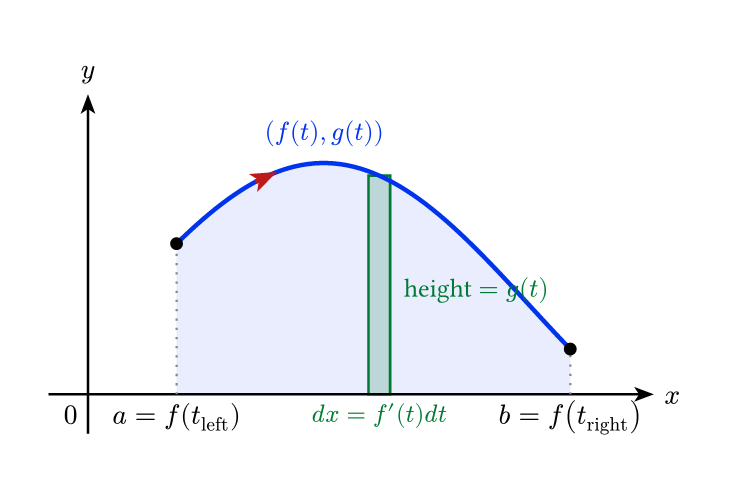
Substituting \(y = g(t)\) and \(dx = f'(t)\,dt\) gives \(A = \int_{t_{\text{left}}}^{t_{\text{right}}} g(t) \, f'(t)\,dt\).
Why do we take the absolute value if we integrate from \(\alpha\) to \(\beta\)? Suppose as \(t\) increases from \(\alpha\) to \(\beta\), \(x = f(t)\) actually moves from right to left (for example, \(x = a\cos^3 t\) goes from \(a\) down to \(0\) as \(t\) increases from \(0\) to \(\frac{\pi}{2}\)). Then \(t_{\text{left}} = \beta\) and \(t_{\text{right}} = \alpha\), so:
Because \(f'(t) \le 0\) whenever \(x\) decreases, \(\int_{\alpha}^{\beta} g(t)f'(t)\,dt\) is negative, and the minus sign flips it back to a positive area! That is why \(\big|\int_{\alpha}^{\beta} g(t) f'(t)\,dt\big|\) works cleanly in both directions.
Example 1: Area Under One Arch of a Cycloid
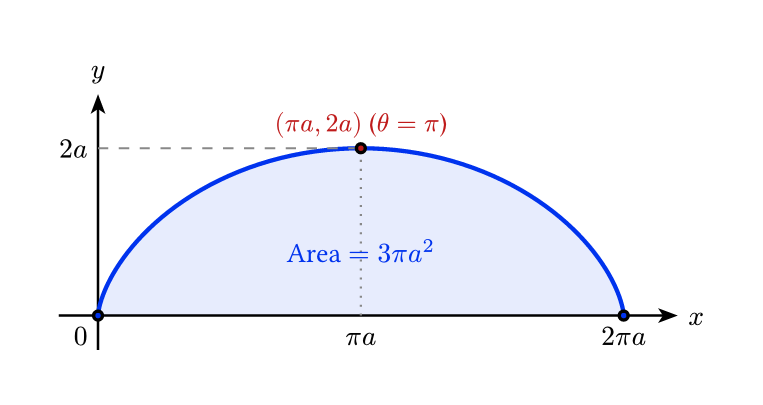
Find the area bounded by one full arch of the cycloid \(x = a(\theta - \sin\theta)\), \(y = a(1 - \cos\theta)\) (\(a > 0\), \(0 \le \theta \le 2\pi\)) and the \(x\)-axis.
Solution: First check the parameter direction and the sign of \(y\):
- At \(\theta = 0\): \((x, y) = (0, 0)\). At \(\theta = \pi\): \((x, y) = (\pi a, 2a)\). At \(\theta = 2\pi\): \((x, y) = (2\pi a, 0)\).
- Since \(\cos\theta \le 1\), we have \(y = a(1 - \cos\theta) \ge 0\) everywhere, and \(\frac{dx}{d\theta} = a(1 - \cos\theta) \ge 0\), so \(x\) moves steadily left-to-right from \(0\) to \(2\pi a\) as \(\theta\) goes from \(0\) to \(2\pi\).
Substituting \(y = a(1 - \cos\theta)\) and \(dx = a(1 - \cos\theta)\,d\theta\):
Expand \((1 - \cos\theta)^2 = 1 - 2\cos\theta + \cos^2\theta = 1 - 2\cos\theta + \frac{1 + \cos 2\theta}{2} = \frac{3}{2} - 2\cos\theta + \frac{1}{2}\cos 2\theta\):
(Notice a neat geometric fact: the area under one arch of a cycloid is always exactly \(3\) times the area \(\pi a^2\) of the rolling circle!)
Example 2: Area Enclosed by the Astroid (When Parameter Runs Backward)
Find the total area enclosed by the astroid \(x = a\cos^3 t\), \(y = a\sin^3 t\) (\(a > 0\), \(0 \le t \le 2\pi\)).
Solution: Raising \(x/a\) and \(y/a\) to the \(2/3\) power gives \(x^{2/3} + y^{2/3} = a^{2/3}\), which is symmetric about both axes and the origin. Therefore, the total enclosed area is \(4\) times the first-quadrant area:
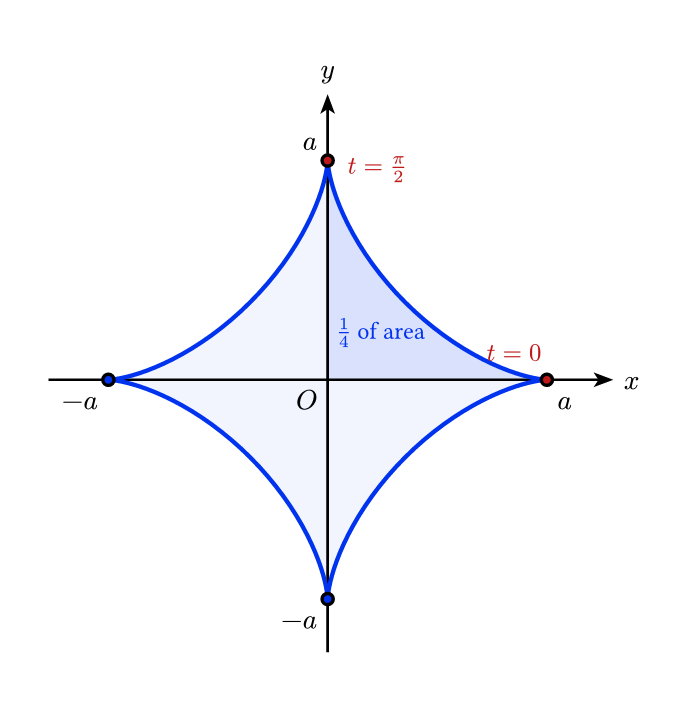
Now watch the parameter limits carefully in the first quadrant (\(0 \le x \le a\)):
- At the left boundary \(x = 0\), \(\cos^3 t = 0 \implies t = \frac{\pi}{2}\).
- At the right boundary \(x = a\), \(\cos^3 t = 1 \implies t = 0\).
As \(x\) moves left-to-right from \(0\) to \(a\), the parameter \(t\) runs backward from \(\frac{\pi}{2}\) down to \(0\)! With \(dx = -3a\cos^2 t \sin t\,dt\):
Applying Wallis' reduction formula from Chapter 24 (Definite Integration):
Multiplying by \(12a^2\):
Case 2: Parametric Arc Relative to the y-Axis (Horizontal Strips)
When horizontal strips are cleaner—\(y = g(t)\) moves monotonically between \(y = c\) and \(y = d\) while \(x = f(t)\) stays on one side of the \(y\)-axis—the area between the arc and the \(y\)-axis is:
where \(t_{\text{bottom}}\) and \(t_{\text{top}}\) are the parameter values at \(y = c\) and \(y = d\).
Why and How It Works
Replacing \(x = f(t)\) and \(dy = g'(t)\,dt\) in the horizontal-strip integral \(A = \int_{y = c}^{y = d} x\,dy\) gives the same substitution formula with \(x\) and \(y\) swapped. Taking the absolute value again handles both upward (\(g'(t) \ge 0\)) and downward (\(g'(t) \le 0\)) parameter movement.
Example 3: Horizontal Parametric Strip on a Hyperbola Branch
Find the area bounded by the parametric curve \(x = \sec t\), \(y = \tan t\) (\(0 \le t \le \frac{\pi}{4}\)), the \(y\)-axis, and the horizontal lines \(y = 0\) and \(y = 1\).
Solution: As \(t\) increases from \(0\) to \(\frac{\pi}{4}\), \(y = \tan t\) rises monotonically from \(0\) to \(1\), and \(x = \sec t \ge 1 > 0\). Using horizontal strips avoids square roots completely (\(dy = \sec^2 t\,dt\)):
Using the standard reduction integral \(\int \sec^3 t\,dt = \frac{1}{2}\big(\sec t \tan t + \ln|\sec t + \tan t|\big)\):
Case 3: Area Enclosed by a Closed Parametric Loop
Suppose \((f(t), g(t))\) starts at some point when \(t = \alpha\), travels once around a simple closed loop, and finishes back at the exact same point \(\big(f(\beta), g(\beta)\big) = \big(f(\alpha), g(\alpha)\big)\). Then the total area enclosed inside the loop is given by any of three equivalent formulas:
The third form—often written compactly as \(\frac{1}{2}\big|\int_{\alpha}^{\beta} (x\,y' - y\,x')\,dt\big|\)—is especially useful in trigonometric and polynomial loops because subtracting \(y\,x'\) from \(x\,y'\) often simplifies \(\cos^2 t + \sin^2 t = 1\) or factors into a clean square!
Why and How the Loop Formulas Work (Proofs)
Proof 1 (Why one integral around the whole loop equals the enclosed area): Look at any closed loop lying between its leftmost point \(x_{\min}\) (at parameter \(t_1\)) and rightmost point \(x_{\max}\) (at parameter \(t_2\)):
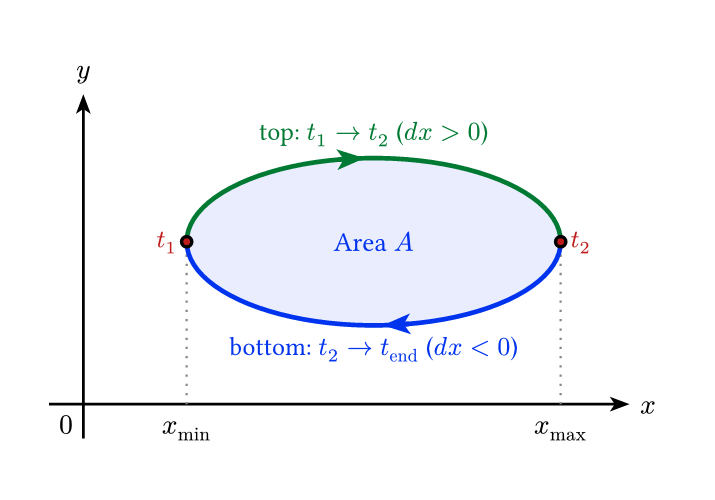
From Section 05, the area inside the loop is:
Now imagine walking clockwise around the loop once, starting from \(t_1\):
Step 1 — Top branch (\(t_1 \to t_2\)): \(x\) moves forward from \(x_{\min}\) to \(x_{\max}\), so:
Step 2 — Bottom return branch (\(t_2 \to t_{\text{end}}\)): Closing back at \(t_1\), \(x\) moves backward from \(x_{\max}\) down to \(x_{\min}\)! Reversing the limits swaps the minus sign in front of \(\int y_{\text{bottom}}\,dx\) into a plus sign:
Step 3 — Add both pieces together: The top integral and the bottom return integral glue together into one single lap around the whole parameter interval \([\alpha, \beta]\):
And what if the parameter walks counter-clockwise instead? Then the top goes right-to-left and the bottom goes left-to-right, flipping every sign so the integral equals \(-A\). Taking the absolute value works for both orientations:
(Note: Even if part of the loop dips below the \(x\)-axis, adding a constant \(C\) to \(y\) shifts the loop upward by \(C\) without changing its area—and \(\int_\alpha^\beta C\,f'(t)\,dt = C\big(f(\beta) - f(\alpha)\big) = 0\) because the loop closes! So the formula works anywhere in the plane, above or below the axes.)
Proof 2 (Why the symmetric formula works, via integration by parts): Start with \(\int_{\alpha}^{\beta} f(t)g'(t)\,dt\) and integrate by parts using \(u = f(t)\) and \(dv = g'(t)\,dt\):
Because the loop is closed, the end point equals the start point: \(\big(f(\beta), g(\beta)\big) = \big(f(\alpha), g(\alpha)\big)\). Therefore, the boundary term vanishes completely:
Look what happens when we subtract \(\int g(t)f'(t)\,dt\) from \(\int f(t)g'(t)\,dt\):
Dividing by \(2\) and taking the magnitude yields the third formula:
Example 4: Quick Check on the Ellipse Using the Symmetric Formula
Find the area enclosed by the ellipse \(x = a\cos t\), \(y = b\sin t\) (\(0 \le t \le 2\pi\)).
Solution: Compute \(x' = -a\sin t\) and \(y' = b\cos t\). Then:
Plugging into the symmetric closed-loop formula immediately gives:
Example 5: Closed Self-Intersecting Loop (Solved Both Ways)
Find the area of the closed loop formed by \(x = t^2 - 1\), \(y = t^3 - t\).
Solution: First find where the curve crosses itself: setting \(y = t(t^2 - 1) = 0\) gives \(t = 0\) and \(t = \pm 1\).
- At \(t = 0\): \((x, y) = (-1, 0)\) (the leftmost tip).
- At both \(t = -1\) and \(t = +1\): \((x, y) = (0, 0)\). So the loop closes back on itself at the origin as \(t\) runs from \(-1\) to \(1\).
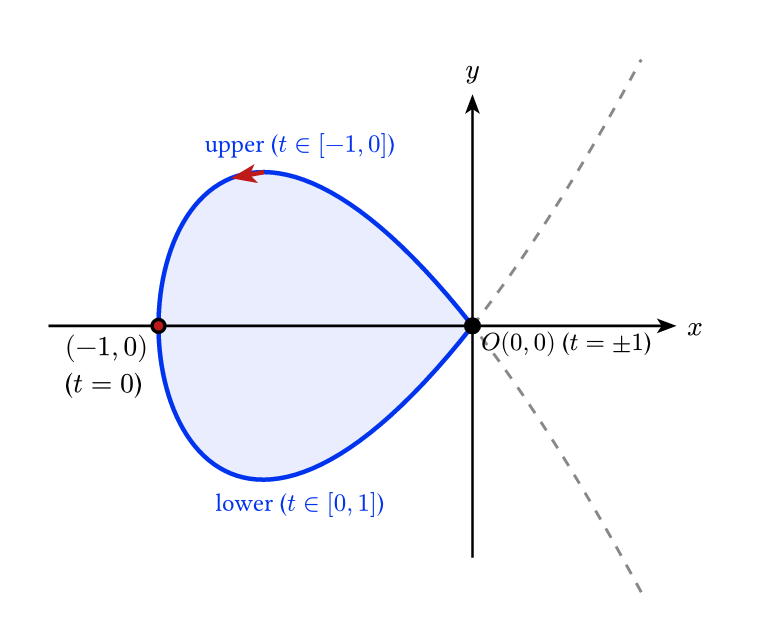
Method 1 (Upper/lower branch symmetry): As \(t\) goes from \(0\) to \(-1\), \(x\) moves from \(-1\) to \(0\) along the upper half (\(y \ge 0\)), with \(dx = 2t\,dt\):
Method 2 (Symmetric closed-loop formula): Here \(x' = 2t\) and \(y' = 3t^2 - 1\), so:
Integrating over \(t \in [-1, 1]\):
Example 6: Cubic Parametric Loop Without Eliminating t
Find the area enclosed by the loop of the curve \(x = t^2\), \(y = t - \frac{t^3}{3}\).
Solution: Check where the loop meets the \(x\)-axis (\(y = 0\)):
At \(t = 0\), the point is \((0, 0)\); at both \(t = -\sqrt{3}\) and \(t = +\sqrt{3}\), the curve passes through \((3, 0)\), closing the loop over \(t \in [-\sqrt{3}, \sqrt{3}]\). Using \(x' = 2t\) and \(y' = 1 - t^2\):
Applying the symmetric closed-loop formula:
2. Areas Bounded by Tangents and Normals
Problems combining curves with their tangents or normals connect Chapter 16, Section 07 (Tangents and Normals) with bounded areas. Why do these problems have such clean shortcuts?
- Find the tangent or normal line first: At the contact point \((x_0, y_0)\), compute \(m_T = \left.\frac{dy}{dx}\right|_{(x_0, y_0)}\) (for parametric curves, \(m_T = \frac{dy/dt}{dx/dt}\)). Write the tangent \(y - y_0 = m_T(x - x_0)\) or normal \(y - y_0 = -\frac{1}{m_T}(x - x_0)\).
- Sketch and find every corner:
- A tangent touches the curve smoothly with a repeated root at \((x_0, y_0)\), trapping a wedge-shaped region between the curve, the tangent, and an axis or another tangent.
- A normal is perpendicular to the tangent, so it usually slices cleanly across the curve and intersects it a second time.
- Choose geometry or horizontal strips when cleaner: For a circle, tangent + radius (normal) + axis forms a right triangle minus a circular sector (zero integration needed!). For curves like \(y = \ln x\) or \(y^2 = 4x\), horizontal strips (\(\int x\,dy\)) avoid splitting the region altogether.
Example 7: Circle, Its Tangent, and the x-Axis
Find the area bounded by the circle \(x^2 + y^2 = 16\), the tangent to the circle at \(P(2, 2\sqrt{3})\), and the positive \(x\)-axis.
Solution: The radius from \(O(0, 0)\) to \(P(2, 2\sqrt{3})\) is the normal to the circle at \(P\), making angle \(\theta = \tan^{-1}\!\left(\frac{2\sqrt{3}}{2}\right) = \tan^{-1}(\sqrt{3}) = \frac{\pi}{3}\) with the positive \(x\)-axis.
The tangent to \(x^2 + y^2 = 16\) at \((2, 2\sqrt{3})\) is:
Setting \(y = 0\), the tangent hits the \(x\)-axis at \(Q(8, 0)\), while the circle cuts the positive \(x\)-axis at \(R(4, 0)\).
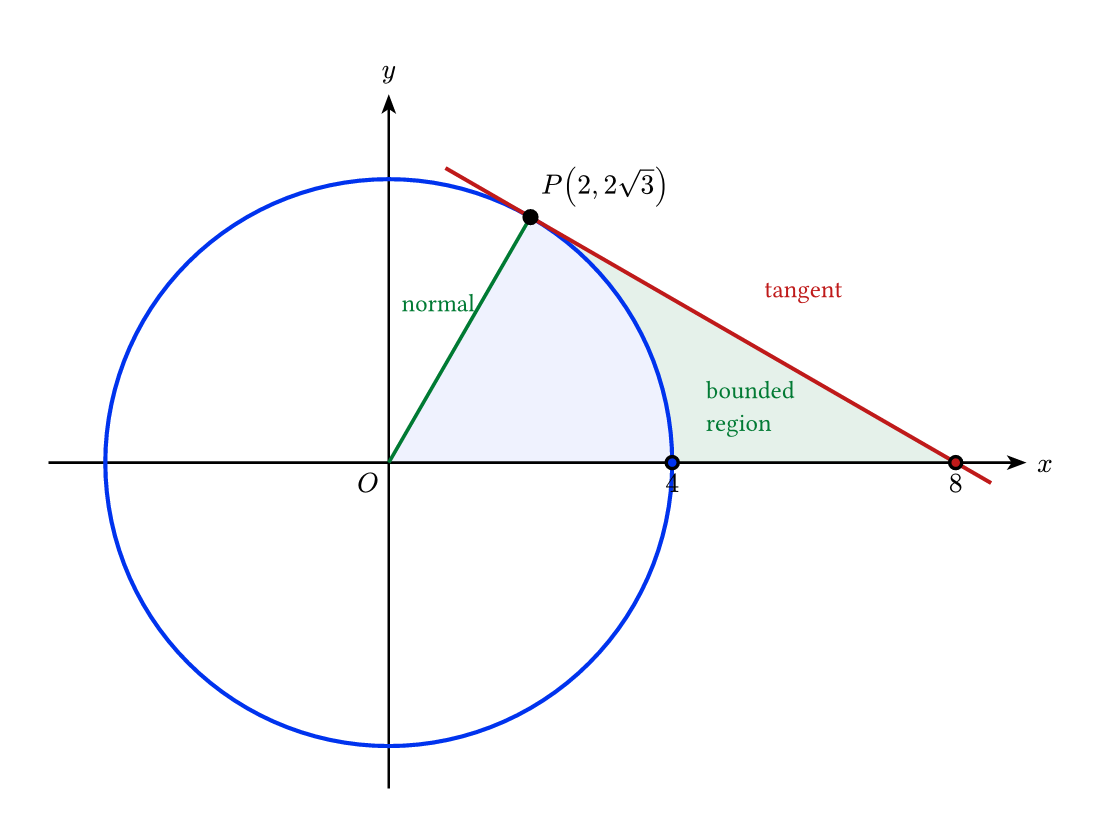
Look at the diagram: the green bounded region is simply Right Triangle \(\triangle OPQ\) minus Circular Sector \(OPR\) (no integration needed!):
- Area of \(\triangle OPQ = \frac{1}{2} \times OQ \times y_P = \frac{1}{2}(8)(2\sqrt{3}) = 8\sqrt{3}\).
- Area of circular sector \(OPR\) (radius \(r = 4\), angle \(\theta = \frac{\pi}{3}\)) \(= \frac{1}{2} r^2 \theta = \frac{1}{2}(16)\left(\frac{\pi}{3}\right) = \frac{8\pi}{3}\).
Example 8: Logarithmic Curve, Tangent, and Horizontal Strips
Find the area bounded by \(y = \ln x\), the tangent to this curve at \((e, 1)\), and the \(x\)-axis.
Solution: Differentiating \(y = \ln x\) gives \(y' = \frac{1}{x}\), so at \((e, 1)\) the slope is \(\frac{1}{e}\). The tangent line is:
Notice that the tangent passes through \((0, 0)\), while \(y = \ln x\) hits the \(x\)-axis at \((1, 0)\).
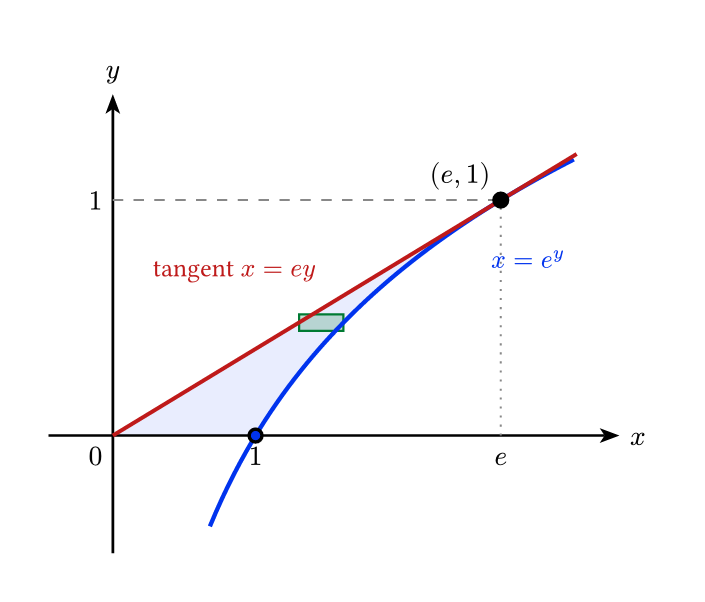
Vertical strips would force us to split at \(x = 1\), so use horizontal strips from \(y = 0\) to \(y = 1\) (right boundary \(x = e^y\), left boundary \(x = ey\)):
Example 9: Area Enclosed Between a Parabola and Its Normal
Find the area bounded by the parabola \(y^2 = 4x\) and its normal at the point \((1, 2)\).
Solution: Differentiate \(y^2 = 4x\): \(2y \frac{dy}{dx} = 4 \implies \frac{dy}{dx} = \frac{2}{y}\). At \((1, 2)\), the tangent slope is \(m_T = \frac{2}{2} = 1\), so the normal slope is \(m_N = -1\).
Equation of the normal at \((1, 2)\):
Find where the normal cuts the parabola again by substituting \(x = 3 - y\) into \(y^2 = 4x\):
So the second intersection is \((9, -6)\).
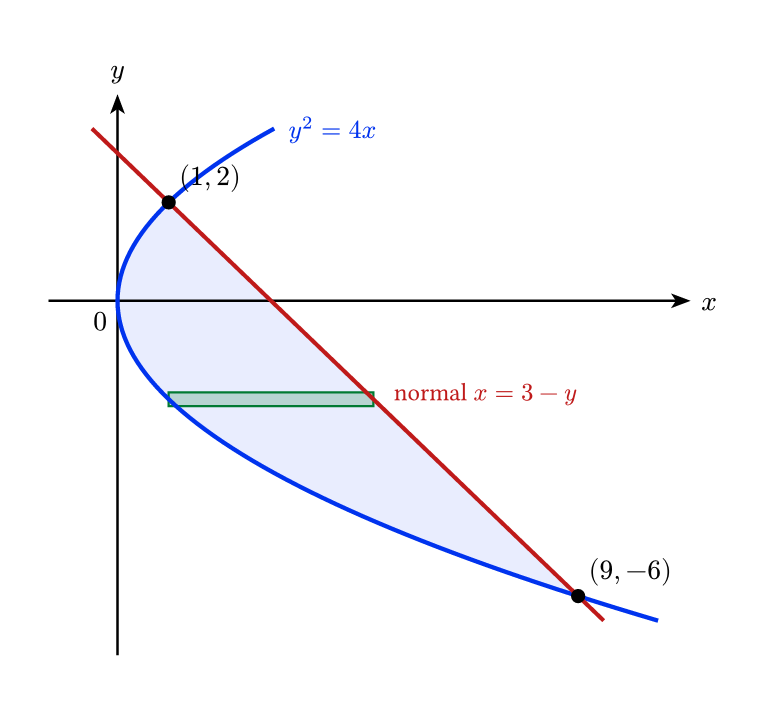
Using horizontal strips from \(y = -6\) to \(y = 2\) (right curve \(x = 3 - y\), left curve \(x = \frac{y^2}{4}\)):
(Shortcut check from Section 04: \(\frac{1}{4}y^2 + y - 3 = 0\) has \(a = \frac{1}{4}\) and \(\Delta = 1^2 - 4(\frac{1}{4})(-3) = 4\), giving \(A = \frac{\Delta^{3/2}}{6a^2} = \frac{4^{3/2}}{6(1/16)} = \frac{8 \times 16}{6} = \frac{64}{3}\)!)
Example 10: Pair of Tangents From an External Point
Find the area bounded by the parabola \(y = x^2 + 1\) and the pair of tangents drawn to it from the origin \((0, 0)\).
Solution: Let a tangent touch \(y = x^2 + 1\) at \((t, t^2 + 1)\). Since \(y' = 2x\), the tangent slope is \(2t\). Because the line also passes through \((0, 0)\), the slope of the segment from \((0, 0)\) to \((t, t^2 + 1)\) must equal \(2t\):
Thus the points of contact are \((1, 2)\) and \((-1, 2)\), and the two tangents are \(y = 2x\) and \(y = -2x\).
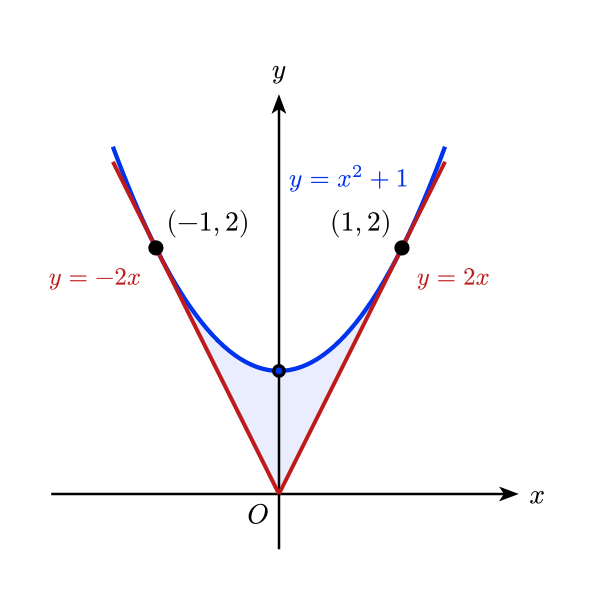
By \(y\)-axis symmetry, double the right-half pocket from \(x = 0\) to \(x = 1\):
3. Area Optimization Problems (Maxima and Minima)
Optimization problems combine bounded areas with Chapter 16, Section 05 (Maxima and Minima): a geometric boundary depends on a variable (such as a moving horizontal line \(y = k\) or a sliding point of tangency \(P\big(t, f(t)\big)\)), and we want the value that makes the bounded area as small as possible or as large as possible.
How to Solve Any Area Optimization Problem
- Sketch the figure and write the total bounded area \(A(t)\) in terms of one variable \(t\).
- Find \(A'(t)\): Either evaluate the integral into a clean formula in \(t\) and differentiate, OR differentiate directly inside the integral using the Leibniz Rule from Chapter 24 (Definite Integration).
- Solve \(A'(t) = 0\) for critical points inside the allowed interval.
- Verify max vs. min using the First Derivative Sign Test or Second Derivative Test (\(A''(t) < 0\) for maximum, \(A''(t) > 0\) for minimum).
The Horizontal-Split Midpoint Shortcut (and Why It Works)
Whenever a strictly increasing continuous curve \(y = f(x)\) on \([a, b]\) is cut by a horizontal line \(y = k\) at \(x = c(k)\), the total bounded area between \(y = f(x)\) and \(y = k\) over \([a, b]\) is always minimized when the line crosses at the exact horizontal midpoint:
Why and How It Works (Proof Using the Leibniz Rule): Write the total area as two pockets—\(A_1\) on \([a, c(k)]\) where \(k \ge f(x)\), and \(A_2\) on \([c(k), b]\) where \(f(x) \ge k\):
Apply the Leibniz Rule to differentiate with respect to \(k\)! Remember \(f\big(c(k)\big) = k\), so both boundary terms vanish immediately:
Setting \(A'(k) = 0\) gives \(c(k) = \frac{a + b}{2}\)! And since \(f\) is increasing, \(c(k)\) grows with \(k\), so \(A'(k)\) switches from negative to positive—proving that for any strictly increasing curve on \([a, b]\), the optimal horizontal splitting line always crosses at the exact horizontal midpoint \(\frac{a + b}{2}\)!
Example 11: Minimizing a Split Area on a Parabola
Find the value of \(k \in [0, 1]\) that minimizes the total area bounded by the curve \(y = x^2\), the horizontal line \(y = k\), and the vertical lines \(x = 0\) and \(x = 1\).
Solution: Here \(y = k\) crosses \(y = x^2\) at \(c = \sqrt{k} \in [0, 1]\). Looking at the sketch:
- On \([0, \sqrt{k}]\), \(y = k\) sits on top (\(A_1\)).
- On \([\sqrt{k}, 1]\), \(y = x^2\) sits on top (\(A_2\)).
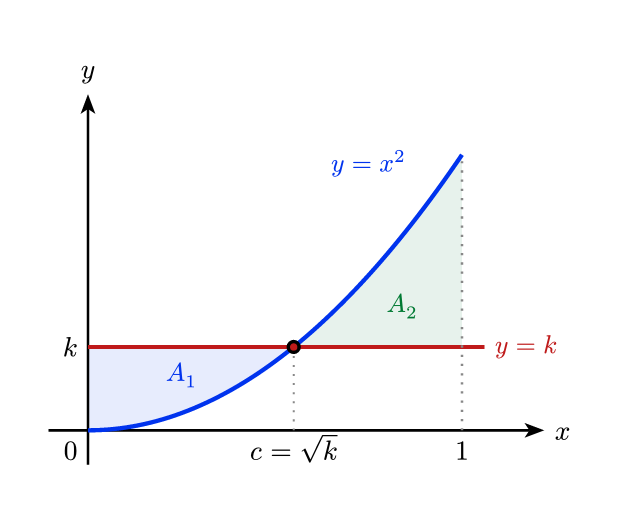
By the Leibniz Rule derivation above (with \(a = 0\), \(b = 1\), and \(c(k) = \sqrt{k}\)):
Setting \(A'(k) = 0\):
Check the second derivative: \(A''(k) = \frac{1}{\sqrt{k}} > 0\) at \(k = \frac{1}{4}\), confirming a minimum! Evaluating at \(k = \frac{1}{4}\) (\(\sqrt{k} = \frac{1}{2}\)):
Example 12: Minimum Area Triangle Formed by a Tangent and the Axes
Find the point \(P(t, 1 - t^2)\) (\(0 < t < 1\)) on the parabola \(y = 1 - x^2\) where the tangent forms a triangle of minimum area with the positive coordinate axes, and find that minimum area.
Solution: Since \(y' = -2x\), the tangent at \(P(t, 1 - t^2)\) has slope \(-2t\):
Find its intercepts with the axes:
- \(x\)-intercept (set \(y = 0\)): \(x_0 = \frac{1 + t^2}{2t}\).
- \(y\)-intercept (set \(x = 0\)): \(y_0 = 1 + t^2\).
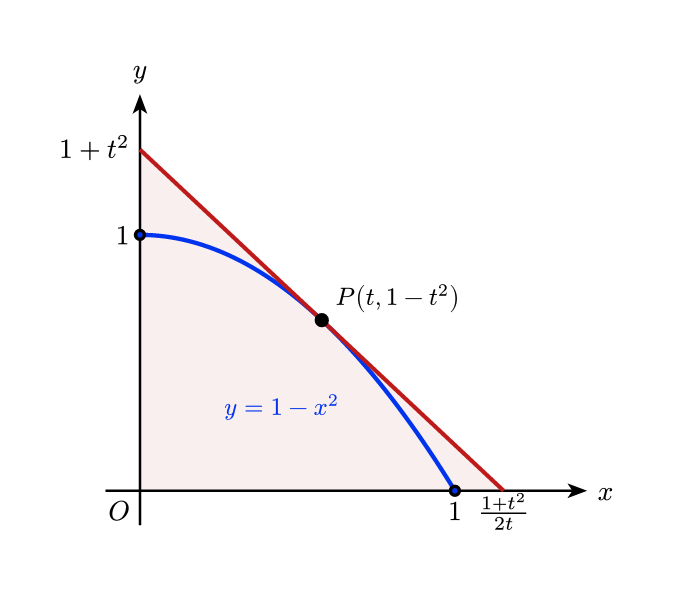
The area of the right triangle is:
Differentiate with respect to \(t\):
Setting \(A'(t) = 0\) for \(0 < t < 1\) gives \(3t^2 = 1 \implies t = \frac{1}{\sqrt{3}}\). Because \(3t^2 - 1\) changes sign from negative to positive across \(t = \frac{1}{\sqrt{3}}\), \(A(t)\) achieves a minimum at:
Substituting \(t = \frac{1}{\sqrt{3}}\) (\(t^2 = \frac{1}{3}\)) into \(A(t)\):
Example 13: Maximum Area Triangle on an Exponential Curve
Find the point on \(y = e^{-x}\) (\(x > 0\)) at which the tangent forms a triangle of maximum area with the positive coordinate axes, and find that maximum area.
Solution: Let the point of tangency be \(P(t, e^{-t})\) with \(t > 0\). Since \(y' = -e^{-x}\), the tangent equation is:
Find the axis intercepts:
- \(x\)-intercept (set \(y = 0\)): \(x_0 = 1 + t\).
- \(y\)-intercept (set \(x = 0\)): \(y_0 = (1 + t)e^{-t}\).
The triangle area is:
Differentiate with respect to \(t\):
Setting \(A'(t) = 0\) for \(t > 0\) gives \(t = 1\). Since \(1 - t\) changes sign from \(+\) (for \(0 < t < 1\)) to \(-\) (for \(t > 1\)), the area reaches its maximum at \(P(1, e^{-1})\):
4. Parameter Problems on Bounded Areas
Instead of giving you all equations and asking for the area, parameter problems give you the area (or a ratio or property of the area) and ask you to work backward to find an unknown constant \(a\), \(k\), or even an unknown curve \(f(x)\)! Four distinct varieties appear most frequently:
- Area Bisectors and Ratios (Plus Scaling Insight): A line \(y = a\) or \(x = a\) splits a region in a ratio \(m : n\). Notice that for power curves like \(y = x^2\), shrinking height \(H \to h\) scales width like \(h^{1/2}\) and therefore scales area like \(h \cdot h^{1/2} = h^{3/2}\)!
- Finding Unknown Constants From a Given Area (Check Every Side!): When solving \(A(a) = A_0\) for an unknown boundary \(x = a\), never assume \(a\) lies on only one side of the other boundary—always test both \(a > x_0\) and \(a < x_0\)!
- Crossover Splitting Plus Optimization: A parameter changes the intersection point inside \([0, 1]\), creating two split regions whose sum must be differentiated with respect to the parameter.
- Recovering an Unknown Curve or Proving Parameter Independence: If an area up to a variable line \(x\) equals a formula involving \(f(x)\), differentiating both sides with respect to \(x\) eliminates the integral! Conversely, if parameter terms cancel out when taking
top - bottom, the area is constant for all values of the parameter.
Example 14: Finding a Parameter That Bisects a Bounded Area
Find the positive number \(a\) such that the horizontal line \(y = a\) divides the area bounded by the parabola \(y = x^2\) and the line \(y = 4\) into two equal halves.
Solution: By \(y\)-axis symmetry, using horizontal strips between \(x = -\sqrt{y}\) and \(x = \sqrt{y}\) gives width \(2\sqrt{y}\). Setting the lower area (from \(y = 0\) to \(y = a\)) equal to half the total area (from \(y = 0\) to \(y = 4\)):
Evaluate both sides:
(Why the scaling shortcut works: for \(y = x^2\), any horizontal cap of height \(h\) has width proportional to \(h^{1/2}\), so its area is \(\frac{2}{3} \times \text{width} \times \text{height} \propto h^{3/2}\). To split the area in ratio \(m : n\), simply set \(\left(\frac{a}{4}\right)^{3/2} = \frac{m}{m + n}\)!)
Example 15: Finding Unknown Parameters From Given Area (Check All Cases!)
(a) Find all real values of \(k\) for which the area bounded by \(y = x^2\) and the line \(y = kx + 2\) equals \(\frac{9}{2}\) sq. units.
(b) Find all real values of \(a\) for which the area bounded by \(y = x^2\), the \(x\)-axis, and the vertical lines \(x = 1\) and \(x = a\) equals \(\frac{7}{3}\) sq. units.
Solution:
(a) Equate the line and parabola: \(x^2 - kx - 2 = 0\). Its discriminant is \(\Delta = k^2 + 8 > 0\) for every real \(k\), so by the quadratic discriminant area formula from Section 04 (\(a_{\text{quad}} = 1\)):
(b) Careful! Do not assume \(a > 1\) without checking! Because \(y = x^2 \ge 0\) everywhere (even when \(x\) is negative), \(x = a\) can sit either to the right of \(x = 1\) or to the left of \(x = 1\):
- Case 1 (\(a > 1\)):
- Case 2 (\(a < 1\)): Here \(x = a\) is the left limit and \(x = 1\) is the right limit:
So both \(a = 2\) and \(a = -\sqrt[3]{6}\) give the exact same bounded area \(\frac{7}{3}\) sq. units!
Example 16: Parameter Crossover and Optimization Combined
Find the value of \(a \in (0, 1)\) that minimizes the total area bounded by the curves \(y = x^2\), \(y = ax\), and the vertical lines \(x = 0\) and \(x = 1\). Also find this minimum area.
Solution: Solve \(x^2 = ax\) inside \([0, 1]\): since \(0 < a < 1\), the curves cross at \(x = 0\) and at \(x = a\) strictly inside \((0, 1)\).
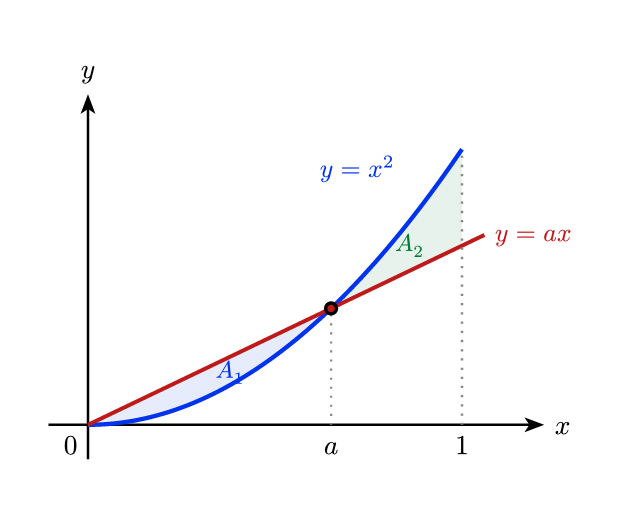
Looking at the graph:
- On \([0, a]\), the line \(y = ax\) sits above \(y = x^2\) (\(A_1\)).
- On \([a, 1]\), the parabola \(y = x^2\) rises above \(y = ax\) (\(A_2\)).
Compute the total area \(A(a) = A_1 + A_2\):
Simplifying each bracket:
Differentiate with respect to \(a\):
Check \(A''(a) = 2a > 0\) at \(a = \frac{1}{\sqrt{2}}\), confirming a minimum! Plugging \(a = \frac{1}{\sqrt{2}}\) back into \(A(a)\):
Example 17: Recovering an Unknown Curve and Parameter-Independence
(a) A positive differentiable curve \(y = f(x)\) passes through \((0, 1)\). For every \(x > 0\), the area bounded by \(y = f(x)\), the coordinate axes, and the ordinate at \(x\) equals \(\frac{1}{2}\big(f(x)^2 - 1\big)\). Find \(f(x)\).
(b) Show that for every real value of the parameter \(a\), the area bounded by the parabola \(y = x^2 + ax + 1\), its tangent at \((0, 1)\), and the vertical line \(x = 3\) is independent of \(a\).
Solution:
(a) Since \(f(x) > 0\), the given area condition says:
Differentiate both sides with respect to \(x\) using the Fundamental Theorem of Calculus:
Since \(f(x) > 0\), divide both sides by \(f(x)\):
Using \(f(0) = 1\) gives \(C = 1\), so \(f(x) = x + 1\).
(b) For \(y = x^2 + ax + 1\), the derivative is \(y' = 2x + a\). At \((0, 1)\), the slope is \(y'(0) = a\), so the tangent at \((0, 1)\) is:
Comparing the parabola and its tangent on \([0, 3]\):
The parameter \(a\) cancels out completely before we even integrate! So the bounded area is:
which is completely independent of \(a\).