Pole and Polar with respect to a Hyperbola
In Section 09, we saw that when a point \(P(x_1, y_1)\) lies in the central region outside a hyperbola (\(S_1 < 0\)), two real tangents can be drawn from \(P\), and the line joining their points of contact—the chord of contact—has the equation \(T = 0\).
What if \(P(x_1, y_1)\) lies inside one of the branches (\(S_1 > 0\)), where no real tangents can be drawn from \(P\)? The linear equation \(T = 0\) still defines a perfectly real straight line in the plane! The concept of pole and polar gives this line a unified geometric meaning for every point in the plane (except the center).
Definition of Pole and Polar
Let \(P(x_1, y_1)\) be any fixed point in the plane (other than the center \(O\)) with respect to the hyperbola:
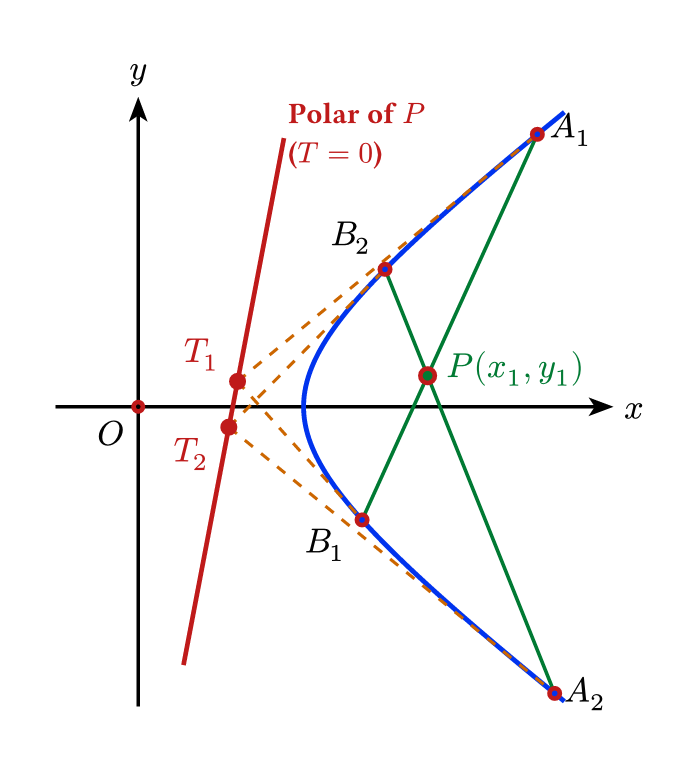
Draw any variable secant chord \(AB\) passing through \(P\), and draw the tangents to the hyperbola at \(A\) and \(B\). Let these two tangents intersect at a point \(T\).
As the chord \(AB\) rotates around \(P\), the intersection point \(T\) traces a straight line.
- This straight line is called the polar of the point \(P\) with respect to the hyperbola.
- The fixed point \(P\) is called the pole of that line with respect to the hyperbola.
Derivation of the Equation of the Polar
Let \(T(h, k)\) be the point of intersection of the tangents drawn at the endpoints \(A\) and \(B\) of a chord passing through \(P(x_1, y_1)\).
From Section 09, the chord \(AB\) is the chord of contact of \(T(h, k)\) with respect to \(\frac{x^2}{a^2} - \frac{y^2}{b^2} = 1\), so its equation is:
Because this chord passes through the fixed point \(P(x_1, y_1)\), substituting \((x, y) = (x_1, y_1)\) yields:
Replacing the moving coordinates \((h, k)\) by \((x, y)\), the locus of \(T\)—the polar of \(P(x_1, y_1)\)—is:
In standard conic notation, the equation of the polar of \(P(x_1, y_1)\) is simply:
Rectangular Hyperbola (\(xy = c^2\)):
Applying \(T = 0\) to \(xy - c^2 = 0\) gives the polar of \(P(x_1, y_1)\) with respect to \(xy = c^2\): \(x y_1 + x_1 y = 2c^2\).
Geometric Meaning of T = 0 in All Three Regions
- Outside the hyperbola (\(S_1 < 0\), \(P \neq O\)): Two real tangents exist from \(P\), and the polar \(T = 0\) is precisely the chord of contact.
- On the hyperbola (\(S_1 = 0\)): The polar \(T = 0\) becomes the tangent to the hyperbola at \(P\).
- Inside either branch (\(S_1 > 0\)): No real tangents can be drawn from \(P\), and the polar \(T = 0\) is a real line lying outside that branch (as shown in the figure above).
Two Special Poles:
- Focus and Directrix: For the focus \(S(ae, 0)\), the polar is \(\frac{x(ae)}{a^2} - 0 = 1 \implies x = \frac{a}{e}\), which is the corresponding directrix! Thus, each focus is the pole of its corresponding directrix.
- Center \(O(0, 0)\): Substituting \((x_1, y_1) = (0, 0)\) gives \(0 = 1\), which has no finite solution—the center has no finite polar (it is said to be the pole of the line at infinity).
Finding the Pole of a Given Line
Suppose a straight line is given in general form:
Let its pole with respect to \(\frac{x^2}{a^2} - \frac{y^2}{b^2} = 1\) be \(P(x_1, y_1)\). Its polar is:
Since both equations represent the exact same line, their coefficients are proportional:
Solving directly for \(x_1\) and \(y_1\):
Thus, the pole of \(lx + my + n = 0\) with respect to \(\frac{x^2}{a^2} - \frac{y^2}{b^2} = 1\) is:
(Note the sign difference from the ellipse, whose pole is \(\left(-\frac{a^2 l}{n}, -\frac{b^2 m}{n}\right)\): replacing \(b^2\) by \(-b^2\) flips the sign of \(y_1\)! If \(n = 0\), the line passes through the center \((0, 0)\) and has no finite pole.)
Pole with respect to \(xy = c^2\):
Comparing \(y_1 x + x_1 y - 2c^2 = 0\) with \(lx + my + n = 0\) gives \(\frac{y_1}{l} = \frac{x_1}{m} = \frac{-2c^2}{n}\), so the pole is \(P\left(-\frac{2c^2 m}{n},\; -\frac{2c^2 l}{n}\right)\).
Fundamental Properties of Pole and Polar
Property 1: Reciprocity Theorem (La Hire's Theorem)
Statement:
If the polar of a point \(P\) with respect to a hyperbola passes through a point \(Q\), then the polar of \(Q\) passes through \(P\).
Proof:
Let \(P(x_1, y_1)\) and \(Q(x_2, y_2)\). The polar of \(P\) is \(\frac{x x_1}{a^2} - \frac{y y_1}{b^2} = 1\). Since it passes through \(Q(x_2, y_2)\):
Because this equation is completely symmetric in \((x_1, y_1)\) and \((x_2, y_2)\), it simultaneously states that \(P(x_1, y_1)\) satisfies \(\frac{x x_2}{a^2} - \frac{y y_2}{b^2} = 1\), which is the polar of \(Q\). \(\blacksquare\)
Property 2: Conjugate Points and Conjugate Lines
Conjugate Points: Two points \(P(x_1, y_1)\) and \(Q(x_2, y_2)\) are called conjugate points with respect to the hyperbola if each lies on the polar of the other. Their algebraic condition is:
Conjugate Lines: Two lines \(L_1 \equiv l_1 x + m_1 y + n_1 = 0\) and \(L_2 \equiv l_2 x + m_2 y + n_2 = 0\) are called conjugate lines if each passes through the pole of the other.
Substituting the pole of \(L_1\), namely \(\left(-\frac{a^2 l_1}{n_1},\; \frac{b^2 m_1}{n_1}\right)\), into \(L_2 = 0\):
Multiplying through by \(-n_1\) gives the symmetric conjugacy condition for lines:
Property 3: Harmonic Division Property
Statement:
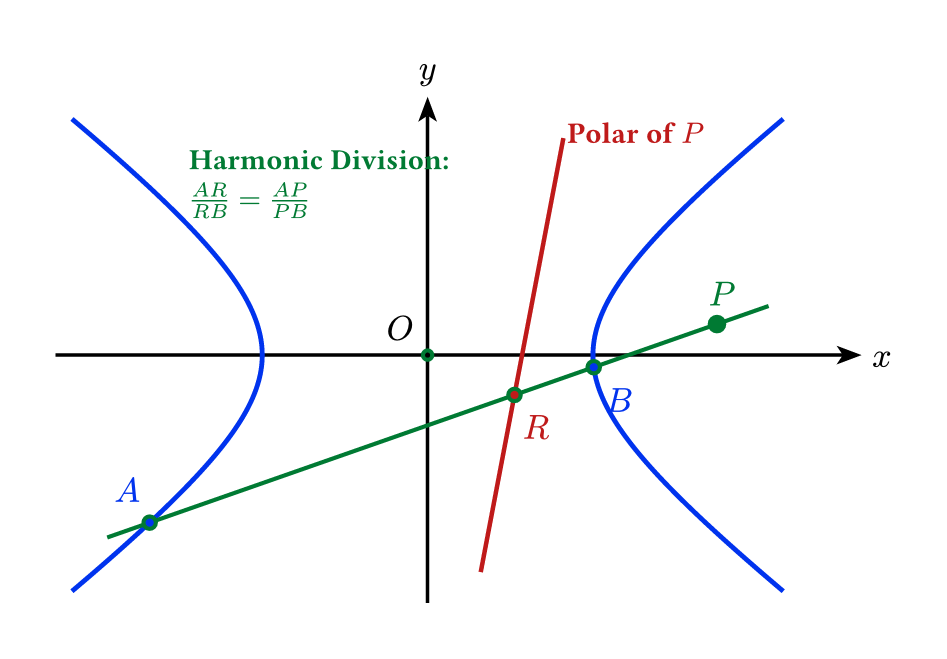
Any secant drawn through a pole \(P\) that intersects the hyperbola at \(A\) and \(B\) and intersects the polar of \(P\) at \(R\) is divided harmonically by \(P\) and \(R\): \(\frac{AR}{RB} = \frac{AP}{PB}\) (internally and externally in the same ratio).
Proof:
Let \(P(x_1, y_1)\) and \(R(x_2, y_2)\) be the two points on the secant, where \(R\) lies on the polar of \(P\), so:
Any point dividing the segment \(PR\) in the ratio \(\lambda : 1\) has coordinates \(\left(\frac{\lambda x_2 + x_1}{\lambda + 1},\; \frac{\lambda y_2 + y_1}{\lambda + 1}\right)\). Substituting into \(\frac{x^2}{a^2} - \frac{y^2}{b^2} = 1\) and multiplying by \((\lambda + 1)^2\):
Collecting powers of \(\lambda\):
By equation (1), the coefficient of \(\lambda\) is identically zero! Hence the two roots \(\lambda_1, \lambda_2\) corresponding to \(A\) and \(B\) satisfy:
Thus \(A\) and \(B\) divide \(PR\) internally and externally in the exact same numerical ratio—equivalently, \(P\) and \(R\) divide \(AB\) harmonically! \(\blacksquare\)
Property 4: Duality of Joins and Intersections
- The pole of the line joining two points \(P\) and \(Q\) is the point of intersection of the polars of \(P\) and \(Q\).
- The polar of the point of intersection of two lines \(L_1\) and \(L_2\) is the line joining the poles of \(L_1\) and \(L_2\).
(Both follow immediately from La Hire's Reciprocity Theorem: if \(R\) is the intersection of the polars of \(P\) and \(Q\), then \(R\) lies on both polars, so by reciprocity the polar of \(R\) passes through both \(P\) and \(Q\), making it the line \(PQ\).)
Illustrative Examples
Example 1: Finding the Polar of a Point and the Pole of a Line
With respect to the hyperbola \(\frac{x^2}{16} - \frac{y^2}{9} = 1\):
- Find the polar of \(P(4, 3)\).
- Find the pole of the line \(3x - 4y - 12 = 0\).
Solution:
Here \(a^2 = 16\) and \(b^2 = 9\).
1. Polar of \(P(4, 3)\):
Using \(\frac{x x_1}{a^2} - \frac{y y_1}{b^2} = 1\):
2. Pole of \(3x - 4y - 12 = 0\):
Here \(l = 3\), \(m = -4\), and \(n = -12\). Using \(P\left(-\frac{a^2 l}{n},\; \frac{b^2 m}{n}\right)\):
The pole is \((4, 3)\)—confirming exact consistency with Part 1!
Example 2: Pole with respect to a Rectangular Hyperbola
Find the pole of the line \(2x + 3y = 6\) with respect to the rectangular hyperbola \(xy = 12\).
Solution:
Write the line in standard form \(2x + 3y - 6 = 0\), so \(l = 2\), \(m = 3\), \(n = -6\), and \(c^2 = 12\).
Using the formula \(P\left(-\frac{2c^2 m}{n},\; -\frac{2c^2 l}{n}\right)\):
The pole is \((12, 8)\). (Check: the polar of \((12, 8)\) is \(8x + 12y = 2(12) = 24 \implies 2x + 3y = 6\). Exact!)
Example 3: Testing Conjugate Points and Conjugate Lines
With respect to the hyperbola \(\frac{x^2}{25} - \frac{y^2}{16} = 1\):
- Find \(k\) so that \(P(5, 4)\) and \(Q(10, k)\) are conjugate points.
- Check whether the lines \(2x + y - 5 = 0\) and \(x - 2y + 4 = 0\) are conjugate lines.
Solution:
1. Conjugate points condition (\(\frac{x_1 x_2}{a^2} - \frac{y_1 y_2}{b^2} = 1\)):
2. Conjugate lines condition (\(a^2 l_1 l_2 - b^2 m_1 m_2 = n_1 n_2\)):
Here \((l_1, m_1, n_1) = (2, 1, -5)\) and \((l_2, m_2, n_2) = (1, -2, 4)\):
Since \(82 \neq -20\), the two lines are not conjugate.
Example 4: Polar Passing Through a Focus
Prove that the polar of any point lying on a directrix of a hyperbola always passes through the corresponding focus.
Solution:
Let \(P\left(\frac{a}{e}, y_1\right)\) be any point on the right directrix \(x = \frac{a}{e}\). Its polar with respect to \(\frac{x^2}{a^2} - \frac{y^2}{b^2} = 1\) is:
Substituting the focus \(S(ae, 0)\) gives \(\frac{ae}{ae} - 0 = 1\), which holds identically for every \(y_1\)!
(Alternatively, by La Hire's Reciprocity Theorem: since the polar of \(S\) is the directrix and \(P\) lies on this directrix, the polar of \(P\) must pass through \(S\)!)
General Synthesis and Locus Problems
Problem 1: Locus of Poles of Tangents to the Auxiliary Circle
Find the locus of the poles of all tangents to the auxiliary circle \(x^2 + y^2 = a^2\) with respect to the hyperbola \(\frac{x^2}{a^2} - \frac{y^2}{b^2} = 1\).
Solution:
Let \(P(h, k)\) be the pole of a line that touches \(x^2 + y^2 = a^2\). The line itself is the polar of \(P(h, k)\) with respect to the hyperbola:
Since this line is tangent to \(x^2 + y^2 = a^2\), its perpendicular distance from \((0, 0)\) equals the radius \(a\):
Squaring both sides and replacing \((h, k)\) by \((x, y)\):
The locus is an ellipse centered at the origin with semi-axes \(a\) and \(\frac{b^2}{a}\) (the semi-latus rectum of the hyperbola!).
Problem 2: Locus of Poles of Tangents to the Conjugate Hyperbola
Find the locus of the poles of all tangents to the conjugate hyperbola \(\frac{x^2}{a^2} - \frac{y^2}{b^2} = -1\) with respect to the hyperbola \(\frac{x^2}{a^2} - \frac{y^2}{b^2} = 1\).
Solution:
Let \(P(h, k)\) be the pole. Its polar with respect to \(\frac{x^2}{a^2} - \frac{y^2}{b^2} = 1\) is:
Here \(m = \frac{b^2 h}{a^2 k}\) and \(c = -\frac{b^2}{k}\). For this line to be tangent to the conjugate hyperbola \(\frac{y^2}{b^2} - \frac{x^2}{a^2} = 1\), we apply the vertical hyperbola tangency condition \(c^2 = b^2 - a^2 m^2\):
Multiplying through by \(\frac{k^2}{b^2}\):
Replacing \((h, k)\) by \((x, y)\) gives \(\frac{x^2}{a^2} - \frac{y^2}{b^2} = -1\) — the conjugate hyperbola itself!
Problem 3: Locus of Poles of Chords Subtending a Right Angle at the Center
Find the locus of the poles of all chords of the hyperbola \(\frac{x^2}{a^2} - \frac{y^2}{b^2} = 1\) that subtend a right angle (\(90^\circ\)) at the center \(O(0, 0)\).
Solution:
Let \(P(h, k)\) be the pole of such a chord. The equation of the chord is the polar of \(P\):
Homogenize the hyperbola \(\frac{x^2}{a^2} - \frac{y^2}{b^2} = 1\) with this chord to obtain the joint equation of the lines joining \(O(0, 0)\) to the chord's endpoints:
For these two lines to be perpendicular, the sum of the coefficients of \(x^2\) and \(y^2\) must vanish:
Rearranging and replacing \((h, k)\) by \((x, y)\):
(Notice: this is a real ellipse if and only if \(a < b\), i.e., \(\frac{1}{a^2} > \frac{1}{b^2}\). If \(a \ge b\), no real chord of \(\frac{x^2}{a^2} - \frac{y^2}{b^2} = 1\) can subtend a right angle at the center!)
Summary Comparison: Hyperbola vs. Ellipse
| Concept / Formula | Horizontal Hyperbola \(\frac{x^2}{a^2} - \frac{y^2}{b^2} = 1\) | Horizontal Ellipse \(\frac{x^2}{a^2} + \frac{y^2}{b^2} = 1\) |
|---|---|---|
| Polar of \(P(x_1, y_1)\) | \(\frac{x x_1}{a^2} - \frac{y y_1}{b^2} = 1\) | \(\frac{x x_1}{a^2} + \frac{y y_1}{b^2} = 1\) |
| Pole of \(lx + my + n = 0\) | \(\left(-\frac{a^2 l}{n},\; \frac{b^2 m}{n}\right)\) | \(\left(-\frac{a^2 l}{n},\; -\frac{b^2 m}{n}\right)\) |
| Conjugate Points Condition | \(\frac{x_1 x_2}{a^2} - \frac{y_1 y_2}{b^2} = 1\) | \(\frac{x_1 x_2}{a^2} + \frac{y_1 y_2}{b^2} = 1\) |
| Conjugate Lines Condition | \(a^2 l_1 l_2 - b^2 m_1 m_2 = n_1 n_2\) | \(a^2 l_1 l_2 + b^2 m_1 m_2 = n_1 n_2\) |
| Polar of Focus \(S(\pm ae, 0)\) | Corresponding directrix \(x = \pm a/e\) | Corresponding directrix \(x = \pm a/e\) |
| Harmonic Division | \(\frac{AR}{RB} = \frac{AP}{PB}\) | \(\frac{AR}{RB} = \frac{AP}{PB}\) |