Integration via Substitution
In indefinite integration, substitution is our primary tool for simplifying composite functions by reversing the Chain Rule. When we move to definite integration, substitution becomes even cleaner: instead of converting the antiderivative back into the original variable \(x\), we transform the limits of integration directly into the new variable \(t\) and evaluate the new integral in a single pass!
At the same time, changing the variable of a definite integral changes the domain over which we are integrating. To avoid subtle algebraic and geometric traps, we must understand why changing limits works, what conditions the substitution must satisfy (continuity and differentiability), and when we must split an interval before substituting.
1. The Substitution Theorem for Definite Integrals
Type 1: Direct Substitution
Suppose we want to evaluate an integral of the form:
Here, we see an inner function \(t = g(x)\) together with its differential \(dt = g'(x) \, dx\). As \(x\) moves from the lower limit \(x = a\) to the upper limit \(x = b\), the new variable \(t = g(x)\) moves from \(t = g(a)\) to \(t = g(b)\).
[!IMPORTANT] Theorem (Integration by Substitution — Direct Form): Let \(g(x)\) have a continuous derivative \(g'(x)\) on the closed interval \([a, b]\), and let \(f(t)\) be continuous on the range of values taken by \(t = g(x)\) for \(x \in [a, b]\). Then:
\[\int_a^b f\big(g(x)\big) \, g'(x) \, dx = \int_{g(a)}^{g(b)} f(t) \, dt\]
Proof (Via the Chain Rule and Fundamental Theorem of Calculus)
Why does replacing \(g(x)\) by \(t\), \(g'(x)\,dx\) by \(dt\), and the limits \(a, b\) by \(g(a), g(b)\) give the exact same number?
Let \(F(t)\) be an antiderivative of the continuous function \(f(t)\), so that:
Right-Hand Side: Applying the First Fundamental Theorem of Calculus to the \(t\)-integral from \(t = g(a)\) to \(t = g(b)\) gives:
Left-Hand Side: Now consider the composite function \(H(x) = F\big(g(x)\big)\) on \([a, b]\). Because \(g(x)\) is differentiable on \([a, b]\) and \(F(t)\) is differentiable on the range of \(g\), the Chain Rule tells us the derivative of \(H(x)\) with respect to \(x\):
Thus, \(H(x) = F\big(g(x)\big)\) is a continuous antiderivative of \(f\big(g(x)\big) \, g'(x)\) on \([a, b]\)! Applying the First Fundamental Theorem of Calculus from \(x = a\) to \(x = b\) gives:
Since both sides equal \(F\big(g(b)\big) - F\big(g(a)\big)\), we conclude that:
Type 2: Inverse Substitution
Sometimes, instead of setting \(t = g(x)\), we substitute \(x\) as a function of \(t\):
For example, to eliminate \(\sqrt{a^2 - x^2}\), we set \(x = a\sin\theta\) and \(dx = a\cos\theta \, d\theta\).
Here, we must find a lower limit \(t = \alpha\) and an upper limit \(t = \beta\) such that \(\phi(\alpha) = a\) and \(\phi(\beta) = b\):
Does It Matter Which Interval of the New Variable We Choose?
Notice that for a periodic function like \(x = \sin\theta\), there are infinitely many angles \(\theta\) that satisfy \(\sin\alpha = a\) and \(\sin\beta = b\). For example, if \(x\) goes from \(0\) to \(1\):
- On the principal branch \(\left[0, \frac{\pi}{2}\right]\), \(\sin 0 = 0\) and \(\sin\left(\frac{\pi}{2}\right) = 1\).
- On the second-quadrant branch \(\left[\pi, \frac{\pi}{2}\right]\), \(\sin\pi = 0\) and \(\sin\left(\frac{\pi}{2}\right) = 1\).
- What if someone chooses \(\alpha = 0\) and \(\beta = \frac{5\pi}{2}\) (which spans multiple branches), or \(\alpha = 0\) and \(\beta = \pi\)?
Let us examine what happens:
When Choosing Any Single Continuous Branch (Provided You Respect Signs!): As long as \(x = \phi(t)\) is continuous and differentiable on \([\alpha, \beta]\) and maps \(\phi(\alpha) = a\), \(\phi(\beta) = b\) without leaving the domain of \(f(x)\), the Chain Rule guarantees:
However, if you choose a branch where \(\cos\theta < 0\) (such as the second quadrant), you must write \(\sqrt{1 - \sin^2\theta} = |\cos\theta| = -\cos\theta\)! The principal one-to-one branch \(\theta \in \left[-\frac{\pi}{2}, \frac{\pi}{2}\right]\) for \(x = a\sin\theta\) (or \(\theta \in \left(-\frac{\pi}{2}, \frac{\pi}{2}\right)\) for \(x = a\tan\theta\)) is universally recommended because \(\cos\theta \ge 0\) and \(\sec\theta > 0\) there, so \(|\cos\theta| = \cos\theta\) automatically!
Why Spanning Multiple Branches (Like \(\left[0, \frac{5\pi}{2}\right]\)) Fails in Practice: If you pick \(\alpha = 0\) and \(\beta = \frac{5\pi}{2}\), then as \(\theta\) moves from \(0\) to \(\frac{5\pi}{2}\), \(\cos\theta\) changes sign twice! If you carelessly write \(\sqrt{1 - \sin^2\theta} = \cos\theta\) across \(\left[0, \frac{5\pi}{2}\right]\) without absolute value bars, you will get the wrong answer. Furthermore, for \(x = \tan\theta\), spanning across \(\theta = \frac{\pi}{2}\) crosses an infinite discontinuity where \(\tan\theta\) is undefined!
Let us see both of these points clearly through two worked examples.
Inverse Substitution Example A: Choosing Another Branch vs. Spanning Multiple Branches
Evaluate:
using \(x = \sin\theta\), and compare what happens for three different choices of \([\alpha, \beta]\) where \(\sin\alpha = 0\) and \(\sin\beta = 1\):
Choice 1: The Principal One-to-One Branch \(\theta \in \left[0, \frac{\pi}{2}\right]\) (Recommended)
Here \(\sin 0 = 0\) and \(\sin\left(\frac{\pi}{2}\right) = 1\). On \(\left[0, \frac{\pi}{2}\right]\), \(\cos\theta \ge 0\), so:
Since \(dx = \cos\theta \, d\theta\), the integral is:
Choice 2: A Second-Quadrant Branch \(\theta \in \left[\pi, \frac{\pi}{2}\right]\) (Different Branch, Same Answer!)
What if we choose \(\alpha = \pi\) (since \(\sin\pi = 0\)) and \(\beta = \frac{\pi}{2}\) (since \(\sin\frac{\pi}{2} = 1\))? On the second quadrant \(\left[\frac{\pi}{2}, \pi\right]\), \(\cos\theta \le 0\), so we must be careful with the square root:
Meanwhile, differentiating \(x = \sin\theta\) still gives \(dx = \cos\theta \, d\theta\). Substituting into the integral:
We get the exact same answer \(\frac{\pi}{4}\)! Notice, however, that if we had forgotten \(|\cos\theta| = -\cos\theta\) in the second quadrant, we would have gotten \(-\frac{\pi}{4}\) (wrong sign).
Choice 3: Spanning Multiple Branches \(\theta \in \left[0, \frac{5\pi}{2}\right]\) (The Trap!)
Since \(\sin 0 = 0\) and \(\sin\left(\frac{5\pi}{2}\right) = 1\), what happens if someone blindly writes:
Why did this give \(\frac{5\pi}{4}\) instead of \(\frac{\pi}{4}\)? Because on \(\left[\frac{\pi}{2}, \frac{3\pi}{2}\right]\), \(\cos\theta\) is negative, so \(\sqrt{1 - \sin^2\theta} = |\cos\theta| = -\cos\theta\). Therefore, the true integrand is \(|\cos\theta|\cos\theta\), which is negative on \(\left[\frac{\pi}{2}, \frac{3\pi}{2}\right]\):
By staying inside the single one-to-one branch \(\left[-\frac{\pi}{2}, \frac{\pi}{2}\right]\), \(x = \sin\theta\) never folds back and \(\cos\theta\) never changes sign!
Inverse Substitution Example B: Why Tangent Substitutions Must Stay Within a Single Branch
Evaluate:
using \(x = \tan\theta\) and \(dx = \sec^2\theta \, d\theta\).
- Correct Choice (Single One-to-One Branch \(\theta \in \left(-\frac{\pi}{2}, \frac{\pi}{2}\right)\)): For \(x = -1\), we choose \(\alpha = -\frac{\pi}{4}\), and for \(x = 1\), we choose \(\beta = \frac{\pi}{4}\). Both lie inside the continuous one-to-one branch \(\left(-\frac{\pi}{2}, \frac{\pi}{2}\right)\):
- Wrong Choice (Picking \(\alpha\) and \(\beta\) from Different Branches, e.g., \(\alpha = \frac{3\pi}{4}\) and \(\beta = \frac{\pi}{4}\)): Notice that \(\tan\left(\frac{3\pi}{4}\right) = -1\) as well! What if a student picks \(\alpha = \frac{3\pi}{4}\) for the lower limit and \(\beta = \frac{\pi}{4}\) for the upper limit?
Why did this fail completely? Because between \(\theta = \frac{\pi}{4}\) and \(\theta = \frac{3\pi}{4}\) lies \(\theta = \frac{\pi}{2}\), where \(x = \tan\theta\) has an infinite discontinuity! As \(\theta\) moves from \(\frac{3\pi}{4}\) to \(\frac{\pi}{4}\), \(x = \tan\theta\) does not move through \([-1, 1]\) at all—instead, it blows up to \(\pm\infty\) at \(\theta = \frac{\pi}{2}\)!
[!IMPORTANT] Golden Rule for Inverse Substitution (\(x = \phi(t)\)): Always choose your new limits \(\alpha\) and \(\beta\) from the standard principal one-to-one branch of the inverse function:
- For \(x = a\sin\theta\): choose \(\alpha, \beta \in \left[-\frac{\pi}{2}, \frac{\pi}{2}\right]\) (where \(\cos\theta \ge 0\)).
- For \(x = a\tan\theta\): choose \(\alpha, \beta \in \left(-\frac{\pi}{2}, \frac{\pi}{2}\right)\) (where \(\tan\theta\) is continuous and \(\sec\theta > 0\)).
- For \(x = a\cos\theta\): choose \(\alpha, \beta \in [0, \pi]\) (where \(\sin\theta \ge 0\)).
2. How to Substitute Step by Step (Without Switching Back to the Original Variable)
When evaluating a definite integral by substitution, follow these four steps:
- Choose the Substitution: Identify \(t = g(x)\) (or \(x = \phi(t)\)) and differentiate to relate the differentials: \(dt = g'(x) \, dx\) (or \(dx = \phi'(t) \, dt\)).
- Check Continuity & Differentiability on \([a, b]\): Verify that \(g(x)\) and \(g'(x)\) have no discontinuities or undefined points inside \([a, b]\). (If there is a discontinuity at \(x = c\), split the integral at \(x = c\) first!)
- Change the Limits Immediately:
- When \(x = a\) (lower limit), compute \(t_{\text{lower}} = g(a)\).
- When \(x = b\) (upper limit), compute \(t_{\text{upper}} = g(b)\).
- Rewrite Completely in \(t\) and Evaluate: Replace the entire integrand, differential, and limits with their \(t\)-equivalents. Never mix \(x\)-limits with a \(t\)-integrand, and once you are in \(t\), evaluate \(\big[F(t)\big]_{g(a)}^{g(b)}\) directly—there is no need to substitute \(x\) back!
Example 1
Evaluate:
Solution:
Notice that the numerator \(2x \, dx\) is the exact differential of the denominator \(1 + x^2\).
- Substitution: Let \(t = 1 + x^2\). Then \(dt = 2x \, dx\). Both \(g(x) = 1 + x^2\) and \(g'(x) = 2x\) are smooth everywhere on \([0, 2]\).
- Change the Limits:
- When \(x = 0\), \(t = 1 + 0^2 = 1\).
- When \(x = 2\), \(t = 1 + 2^2 = 5\).
Substituting into the definite integral:
Evaluating directly in terms of \(t\):
Example 2: When the New Limits Reverse Order
What happens if our substitution \(t = g(x)\) is a decreasing function of \(x\), so that the new lower limit \(g(a)\) is larger than the new upper limit \(g(b)\)?
Do not panic—and do not swap the limits without changing the sign! Just keep \(g(a)\) at the bottom and \(g(b)\) at the top, or use the property \(\int_p^q f(t) \, dt = -\int_q^p f(t) \, dt\). The minus sign from \(dt = g'(x) \, dx\) and the reversed order of limits work together automatically!
Evaluate:
Solution:
- Substitution: Let \(t = \cos x\). Differentiating gives:
- Change the Limits:
- When \(x = 0\), \(t = \cos 0 = 1\).
- When \(x = \frac{\pi}{2}\), \(t = \cos \frac{\pi}{2} = 0\).
Notice that as \(x\) goes from \(0\) to \(\frac{\pi}{2}\), \(t\) decreases from \(1\) down to \(0\):
Using \(-\int_1^0 t^3 \, dt = +\int_0^1 t^3 \, dt\):
Example 3: Inverse Trigonometric Substitution
Evaluate:
Solution:
To simplify \(\sqrt{a^2 - x^2}\), we use the trigonometric substitution:
- Change the Limits:
- When \(x = 0\), \(a\sin\theta = 0 \implies \theta = 0\).
- When \(x = a\), \(a\sin\theta = a \implies \sin\theta = 1 \implies \theta = \frac{\pi}{2}\).
For \(\theta \in \left[0, \frac{\pi}{2}\right]\), \(\cos\theta \ge 0\), so \(\sqrt{a^2 - x^2} = \sqrt{a^2(1 - \sin^2\theta)} = a\cos\theta\). Substituting everything into the integral:
Using \(\sin\theta\cos\theta = \frac{1}{2}\sin 2\theta\), we rewrite the integrand as:
Integrating with respect to \(\theta\) from \(0\) to \(\frac{\pi}{2}\):
3. Crucial Traps: Differentiability and Non-Monotonic Substitutions
Because substitution relies on the Chain Rule and domain mapping, there are two major traps you must watch out for.
Trap 1: Non-Monotonic Substitutions That Fold Back
Suppose we use a substitution like \(t = g(x) = x^2\) on the symmetric interval \([-1, 1]\), or \(t = \sin x\) on \([0, \pi]\). Look at what happens to the limits:
- At \(x = -1\), \(t = (-1)^2 = 1\).
- At \(x = 1\), \(t = (1)^2 = 1\).
The lower limit and upper limit in \(t\) become equal (\(t = 1\) to \(t = 1\))! Does this mean the integral is zero, or did something go wrong?
The answer depends entirely on whether the integrand is already in the exact Chain Rule form \(f\big(g(x)\big) \, g'(x) \, dx\), or whether you tried to solve for \(x\) in terms of \(t\)!
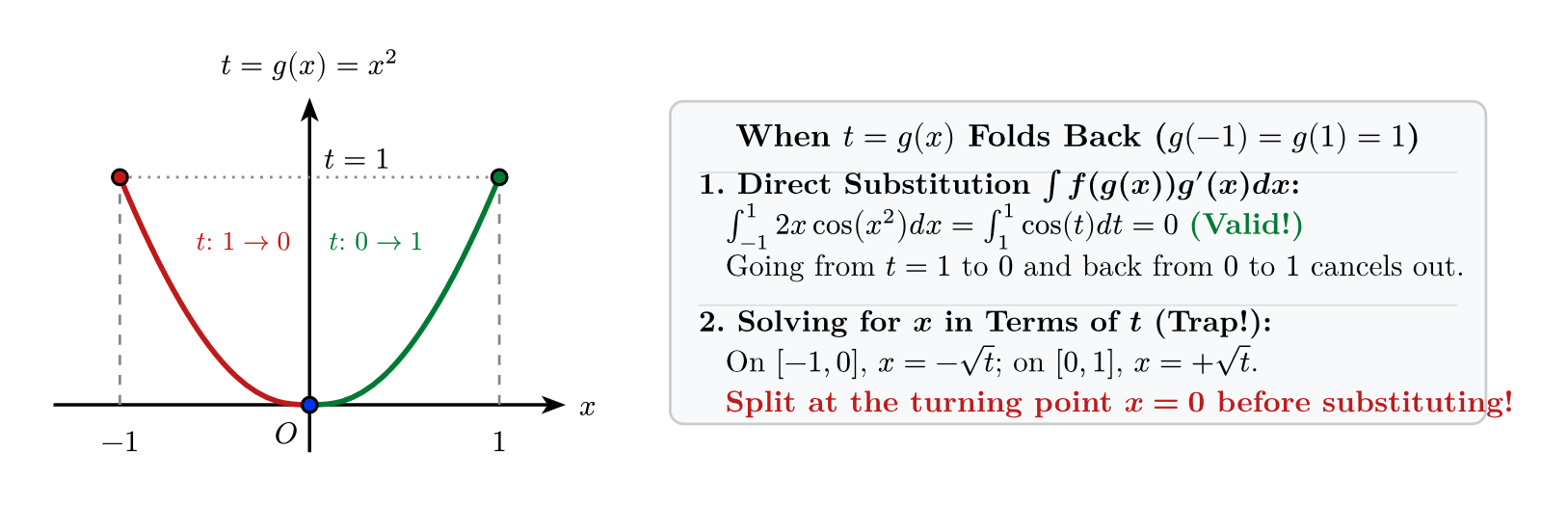
Let us compare the two cases side by side:
Case A: When the Derivative Factor Is Already Present (Direct Theorem Applies!)
Consider:
Here \(g(x) = x^2\) and \(g'(x) \, dx = 2x \, dx\) is already present in the integrand, and \(f(t) = \cos t\) is continuous everywhere. By our Substitution Theorem, it is 100% valid to write:
Why is this valid? Because as \(x\) goes from \(-1\) to \(0\), \(t = x^2\) goes from \(1\) to \(0\) (giving \(\int_1^0 \cos t \, dt\)), and as \(x\) goes from \(0\) to \(1\), \(t = x^2\) goes from \(0\) back to \(1\) (giving \(\int_0^1 \cos t \, dt\)). The two halves cancel each other out!
Case B: When You Must Solve for the Original Variable in Terms of the New Variable (You MUST Split First!)
Now consider the strictly positive integral:
Suppose a student tries to evaluate \(\int_{-1}^1 x^2 \, dx\) by setting \(t = x^2\). Since \(x = -1 \implies t = 1\) and \(x = 1 \implies t = 1\), if they blindly write \(\int_1^1 \dots dt = 0\), they get \(0\) for a strictly positive area!
Why did it fail? Because \(2x \, dx\) was not in the integrand! To express \(dx\) in terms of \(dt\), you have to solve \(t = x^2\) for \(x\):
- On the left half \([-1, 0]\), \(x\) is negative, so \(x = -\sqrt{t}\) and \(dx = -\frac{1}{2\sqrt{t}} \, dt\).
- On the right half \([0, 1]\), \(x\) is positive, so \(x = +\sqrt{t}\) and \(dx = +\frac{1}{2\sqrt{t}} \, dt\).
Because the inverse formula for \(x\) in terms of \(t\) changes sign at the turning point \(x = 0\), you cannot use a single formula across \([-1, 1]\)!
[!CAUTION] Rule for Non-Monotonic Substitutions: If your substitution \(t = g(x)\) has a turning point \(x = c\) inside \((a, b)\) (where \(g'(c) = 0\)) and you need to solve for \(x\) or \(g'(x)\) in terms of \(t\) (using a square root like \(\sqrt{t}\) or \(\cos x = \pm\sqrt{1 - \sin^2 x}\)), you MUST split the integral at the turning point \(x = c\) before substituting!
Example 4: Splitting at a Turning Point Before Substituting
Evaluate:
Solution:
First Integral: In \(\int_0^\pi \frac{\sin x}{1 + \cos^2 x} \, dx\), let \(t = \cos x\). Then \(dt = -\sin x \, dx\) is already present! As \(x\) goes from \(0\) to \(\pi\), \(t = \cos x\) decreases monotonically from \(\cos 0 = 1\) to \(\cos \pi = -1\):
Second Integral: In \(\int_0^\pi \frac{\cos x}{1 + \sin^2 x} \, dx\), let \(t = \sin x\). Again, \(dt = \cos x \, dx\) is already present in the numerator! Even though \(t = \sin x\) rises from \(0\) to \(1\) (on \([0, \pi/2]\)) and falls back from \(1\) to \(0\) (on \([\pi/2, \pi]\)), the Direct Substitution Theorem applies immediately:
(Indeed, if you split at \(x = \frac{\pi}{2}\), the left half \(\int_0^{\pi/2}\) gives \(\int_0^1 \frac{dt}{1+t^2} = \frac{\pi}{4}\) and the right half \(\int_{\pi/2}^\pi\) gives \(\int_1^0 \frac{dt}{1+t^2} = -\frac{\pi}{4}\), summing to \(0\)!)
Trap 2: Discontinuous Substitutions Inside the Interval
Recall that the Substitution Theorem requires \(t = g(x)\) to be continuous and differentiable on the entire interval \([a, b]\).
What if you choose a substitution like \(t = \tan x\), \(t = \tan\left(\frac{x}{2}\right)\), or \(t = x - \frac{1}{x}\) across an interval where \(g(x)\) blows up or jumps?
If \(g(x)\) is discontinuous at an interior point \(x = c \in (a, b)\), you cannot substitute across \(x = c\) in one piece! Just as we learned in Section 04, you must first split the integral at \(x = c\) into \([a, c-h]\) and \([c+h, b]\) as \(h \to 0^+\), and then apply the substitution on each continuous piece separately.
Example 5: Substituting Across an Interior Point of Discontinuity
Evaluate:
Solution:
To integrate \(\frac{1}{3 + 2\cos^2 x}\), we divide the numerator and denominator by \(\cos^2 x\):
We want to substitute \(t = \tan x\) and \(dt = \sec^2 x \, dx\).
Check Continuity of \(t = \tan x\): On \([0, \pi]\), the function \(t = \tan x\) is discontinuous at \(x = \frac{\pi}{2}\)! (If we ignored this and plugged \(x = 0 \implies t = 0\) and \(x = \pi \implies t = 0\), we would get \(\int_0^0 \frac{dt}{5 + 3t^2} = 0\), which is false!)
Instead, we split \([0, \pi]\) at \(x = \frac{\pi}{2}\) before changing variables:
Now \(t = \tan x\) is continuous and differentiable on each piece:
- On \(\left[0, \frac{\pi}{2}-h\right]\) as \(h \to 0^+\): As \(x\) goes from \(0\) to \(\frac{\pi}{2}^-\), \(t = \tan x\) goes from \(0\) to \(+\infty\).
- On \(\left[\frac{\pi}{2}+h, \pi\right]\) as \(h \to 0^+\): As \(x\) goes from \(\frac{\pi}{2}^+\) to \(\pi\), \(t = \tan x\) goes from \(-\infty\) to \(0\).
Thus, our integral transforms into:
Since \(\int \frac{dt}{5 + 3t^2} = \frac{1}{3} \int \frac{dt}{\left(\sqrt{\frac{5}{3}}\right)^2 + t^2} = \frac{1}{\sqrt{15}} \tan^{-1}\left(t\sqrt{\frac{3}{5}}\right)\), evaluating both pieces gives:
Miscellaneous Examples
Example 1
Evaluate:
Solution:
On the interval \(\left[0, \frac{\pi}{4}\right]\), the function \(t = \tan x\) is continuous and strictly increasing, with \(dt = \sec^2 x \, dx\).
- Change the Limits:
- When \(x = 0\), \(t = \tan 0 = 0\).
- When \(x = \frac{\pi}{4}\), \(t = \tan \frac{\pi}{4} = 1\).
Substituting \(t = \tan x\) and \(dt = \sec^2 x \, dx\) transforms the trigonometric integral into a rational integral in \(t\):
Decomposing into partial fractions using \(\frac{1}{(1 + t)(2 + t)} = \frac{1}{1 + t} - \frac{1}{2 + t}\):
Evaluating at \(t = 1\) and \(t = 0\):
Example 2
Evaluate:
Solution:
On \(\left[0, \frac{\pi}{2}\right]\), the half-angle substitution \(t = \tan\left(\frac{x}{2}\right)\) is completely continuous and differentiable:
- Change the Limits:
- When \(x = 0\), \(t = \tan 0 = 0\).
- When \(x = \frac{\pi}{2}\), \(t = \tan\left(\frac{\pi}{4}\right) = 1\).
Substituting into the integrand:
Notice how \((1 + t^2) + 2t + (1 - t^2)\) in the denominator simplifies to \(2 + 2t = 2(1 + t)\):
Therefore, our definite integral becomes:
Integrating term by term:
Example 3
Evaluate:
Solution:
For integrals containing \(x^k \sqrt{1 + x^2}\) in the denominator on an interval where \(x > 0\), the reciprocal substitution \(x = \frac{1}{t}\) works remarkably well!
- Substitution: Let \(x = \frac{1}{t}\), so \(dx = -\frac{1}{t^2} \, dt\).
- Change the Limits:
- When \(x = 1\), \(t = 1\).
- When \(x = \sqrt{3}\), \(t = \frac{1}{\sqrt{3}}\).
Since \(t > 0\) on \(\left[\frac{1}{\sqrt{3}}, 1\right]\), we have \(\sqrt{1 + x^2} = \sqrt{1 + \frac{1}{t^2}} = \frac{\sqrt{t^2 + 1}}{t}\). Substituting into the integral:
Notice that \(\frac{1}{t^2}\) cancels completely, and flipping the limits absorbs the minus sign:
Now let \(u = t^2 + 1\), so \(du = 2t \, dt \implies t \, dt = \frac{1}{2} \, du\):
- When \(t = \frac{1}{\sqrt{3}}\), \(u = \frac{1}{3} + 1 = \frac{4}{3}\).
- When \(t = 1\), \(u = 1 + 1 = 2\).
Evaluating the \(u\)-integral:
Example 4
Evaluate:
Solution:
When a linear factor \((x + 1)\) multiplies a quadratic radical \(\sqrt{x^2 - 1}\), the standard substitution is to set the linear factor equal to \(\frac{1}{t}\):
- Change the Limits:
- When \(x = 1\), \(t = \frac{1}{1 + 1} = \frac{1}{2}\).
- When \(x = 2\), \(t = \frac{1}{2 + 1} = \frac{1}{3}\).
Let us express \(\sqrt{x^2 - 1}\) in terms of \(t\) (noting that \(t \in \left[\frac{1}{3}, \frac{1}{2}\right]\) is positive):
Substituting everything into the definite integral:
The \(\frac{1}{t^2}\) factors cancel out, and reversing the limits from \(\left[\frac{1}{2}, \frac{1}{3}\right]\) to \(\left[\frac{1}{3}, \frac{1}{2}\right]\) absorbs the minus sign:
Since \(\int (1 - 2t)^{-1/2} \, dt = -\sqrt{1 - 2t}\), we obtain:
Example 5
Evaluate:
Solution:
Look at the outer factor \(x \, dx\) and the argument \(x^2\) inside the trigonometric functions. This immediately suggests substituting \(t = x^2\):
- Substitution: Let \(t = x^2\). Then \(dt = 2x \, dx \implies x \, dx = \frac{1}{2} \, dt\).
- Change the Limits:
- When \(x = \sqrt{\ln 2}\), \(t = \ln 2\).
- When \(x = \sqrt{\ln 3}\), \(t = \ln 3\).
The integral transforms into:
To integrate \(\frac{\sin t}{\sin t + \cos t}\), we write the numerator \(\sin t\) as a linear combination of the denominator \((\sin t + \cos t)\) and its derivative \((\cos t - \sin t)\):
Dividing both sides by \(\sin t + \cos t\) gives:
Since \(\cos t - \sin t\) is the exact derivative of \(\sin t + \cos t\), our integral in \(t\) becomes:
Example 6
Evaluate:
Solution:
The integrand contains a rational function of \(\cos x\) multiplied by \(\sin x \, dx\).
- Substitution: Let \(t = \cos x\). Then \(dt = -\sin x \, dx \implies \sin x \, dx = -dt\).
- Change the Limits:
- When \(x = 0\), \(t = \cos 0 = 1\).
- When \(x = \frac{\pi}{2}\), \(t = \cos \frac{\pi}{2} = 0\).
Substituting into the definite integral and flipping the limits to absorb the minus sign:
Decomposing \(\frac{t}{(t + 1)(t + 2)}\) into partial fractions:
Integrating from \(t = 0\) to \(t = 1\):
Evaluating at \(t = 1\) and \(t = 0\):
Example 7
Evaluate:
Solution:
Observe that \(x\) appears only as \(x^2\) inside the square root, and we have \(x \, dx\) outside!
- Substitution: Let \(t = x^2\). Then \(dt = 2x \, dx \implies x \, dx = \frac{1}{2} \, dt\).
- Change the Limits:
- When \(x = 0\), \(t = 0^2 = 0\).
- When \(x = 1\), \(t = 1^2 = 1\).
Substituting into the integral gives:
To integrate \(\sqrt{\frac{1 - t}{1 + t}}\), we rationalize the numerator by multiplying inside the radical by \(\frac{1 - t}{1 - t}\) (since \(1 - t \ge 0\) on \([0, 1]\)):
Splitting into two standard integrals on \([0, 1]\):
Since \(\int \frac{1}{\sqrt{1 - t^2}} \, dt = \sin^{-1} t\) and \(\int \frac{-t}{\sqrt{1 - t^2}} \, dt = \sqrt{1 - t^2}\), we obtain:
Example 8
Evaluate:
Solution:
Notice the expression \(x^4 - 1 = (x^2)^2 - 1\) inside the radical. If we multiply both the numerator and the denominator by \(x\), we create \(x \, dx\) in the numerator and \(x^2\) in the denominator:
- Substitution: Let \(t = x^2\). Then \(dt = 2x \, dx \implies x \, dx = \frac{1}{2} \, dt\).
- Change the Limits:
- When \(x = 1\), \(t = 1^2 = 1\).
- When \(x = 2\), \(t = 2^2 = 4\).
The integral transforms into:
Recall that \(\frac{d}{dt}(\sec^{-1} t) = \frac{1}{t\sqrt{t^2 - 1}}\) for \(t \ge 1\) (or you may set \(t = \sec\theta\), \(dt = \sec\theta\tan\theta \, d\theta\)). Evaluating directly:
Example 9
Evaluate:
Solution:
Recall that \(\sin 2x = 2\sin x \cos x\). Also, we can express \(\sin^4 x + \cos^4 x\) purely in terms of \(\sin^2 x\) (or \(\cos 2x\)):
- Substitution: Let \(t = \sin^2 x\). Differentiating gives:
- Change the Limits:
- When \(x = 0\), \(t = \sin^2 0 = 0\).
- When \(x = \frac{\pi}{2}\), \(t = \sin^2 \frac{\pi}{2} = 1\).
Substituting \(t = \sin^2 x\) and \(dt = \sin 2x \, dx\) into the integral gives:
Completing the square in the denominator:
Thus:
Example 10
Evaluate:
Solution:
For an integrand of the form \(\frac{1}{a + b\cos x}\), the universal trigonometric substitution is \(t = \tan\left(\frac{x}{2}\right)\).
Let us check the continuity of \(t = \tan\left(\frac{x}{2}\right)\) on \([0, \pi]\):
- As \(x\) varies from \(0\) to \(\pi\), the half-angle \(\frac{x}{2}\) varies from \(0\) to \(\frac{\pi}{2}\).
- On \(\left[0, \frac{\pi}{2}\right)\), \(t = \tan\left(\frac{x}{2}\right)\) is continuous and strictly increasing, and as \(x \to \pi^-\) (i.e., \(\frac{x}{2} \to \frac{\pi}{2}^-\)), \(t \to +\infty\)!
- Note that \(\frac{x}{2} = \frac{\pi}{2}\) occurs right at the upper endpoint \(x = \pi\) (not inside \((0, \pi)\)), so there is no interior jump discontinuity.
Using \(t = \tan\left(\frac{x}{2}\right)\), we have:
- Change the Limits:
- When \(x = 0\), \(t = \tan 0 = 0\).
- As \(x \to \pi^-\), \(t = \tan\left(\frac{\pi}{2}^-\right) \to +\infty\).
Substituting into the definite integral:
Simplifying the denominator \(5 + 5t^2 + 4 - 4t^2 = 9 + t^2 = 3^2 + t^2\):
Summary
| Concept | Rule / Formula | Key Takeaway |
|---|---|---|
| Direct Substitution | \(\int_a^b f(g(x)) \, g'(x) \, dx = \int_{g(a)}^{g(b)} f(t) \, dt\) | Transform the limits immediately (\(x = a \to t = g(a)\), \(x = b \to t = g(b)\)) and never switch back to \(x\). |
| Inverse Substitution | \(\int_a^b f(x) \, dx = \int_\alpha^\beta f(\phi(t)) \, \phi'(t) \, dt\) | Choose \([\alpha, \beta]\) on a single one-to-one branch where \(\phi(\alpha) = a\) and \(\phi(\beta) = b\). |
| Reversed Limits (\(g(a) > g(b)\)) | \(-\int_{g(a)}^{g(b)} f(t) \, dt = +\int_{g(b)}^{g(a)} f(t) \, dt\) | Decreasing substitutions reverse the order of limits; flipping them cancels the minus sign from \(dt\). |
| Non-Monotonic Substitution | If \(t = g(x)\) has a turning point \(c \in (a, b)\) and you must solve for \(x\) in terms of \(t\), split at \(x = c\) first. | Prevents sign errors when taking square roots like \(x = \pm\sqrt{t}\) or \(\cos x = \pm\sqrt{1 - \sin^2 x}\). |
| Discontinuous Substitution | If \(t = g(x)\) (such as \(\tan x\)) is undefined at \(c \in (a, b)\), split into \([a, c-h]\) and \([c+h, b]\) before substituting. | Substituting across an interior asymptote of \(g(x)\) misses the jump and produces false results. |