Graph Transformations, Symmetry, and Geometric Shortcuts
Suppose you are asked to find the area bounded by \(y = |\ln |x||\), or \((y - 2)^2 = 4(x - 1)\), or \(5x^2 - 6xy + 5y^2 = 8\), or between \(y = x^2\) and \(y = x + \frac{1}{2}\).
If you try to run a general curve-sketching analysis from scratch or solve messy quadratic roots and expand radicals on every single problem, you will spend ten minutes per integral and make arithmetic slips. Yet all of these shapes are built from curves you already know—circles, parabolas, lines, exponentials, logarithms, and \(|x|\)—using simple geometric moves: shifting, reflecting, stretching, rotating, or folding with absolute values.
In this section, we study why each transformation works, how translation and rotation invariance simplify awkward equations, and how symmetry and quadratic-discriminant shortcuts solve entire families of area problems in seconds.
1. Basic Graph Transformations (From One Parent Curve to Many)
Start with any familiar graph \(y = f(x)\), made up of points \((x, y)\) satisfying that equation. To understand any transformation, simply track where each original point \((x, y)\) moves!
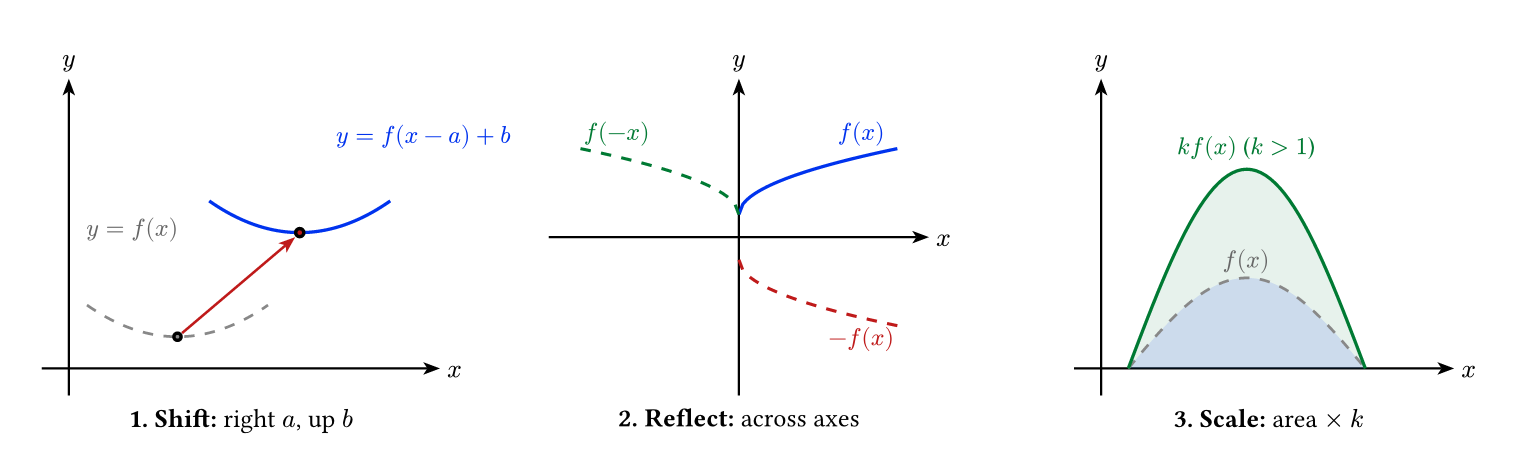
Shifting (Translation): Moving Without Changing Shape
-
Vertical Shift (\(y = f(x) + b\) or \(y - b = f(x)\)): For the same input \(x\), every \(y\)-value increases by \(b\). Every point \((x, y)\) moves rigidly to \((x, y + b)\)—shifting the entire graph up by \(b\) units (or down by \(|b|\) if \(b < 0\)). For example: \(y = x^2 + 3\) is simply \(y = x^2\) lifted \(3\) units upward (new vertex \((0, 3)\)).
-
Horizontal Shift (\(y = f(x - a)\)): This often surprises students: replacing \(x\) by \(x - a\) (for \(a > 0\)) moves the graph to the right by \(a\) units, whereas replacing \(x\) by \(x + a\) moves it to the left by \(a\) units. Why does \(x - a\) move right? Think about what input \(f\) needs! Originally, \(f\) hits its special feature (like the vertex of \(y = x^2\)) when its input inside \(f(\text{input})\) equals \(0\), i.e., at \(x = 0\). In \(y = f(x - a)\), that same input \(x - a\) reaches \(0\) when \(x - a = 0 \implies x = a\). So every feature happens \(a\) units later (to the right)! For example: \(y = |x - 2|\) shifts the sharp corner of \(y = |x|\) from \((0, 0)\) right to \((2, 0)\).
Reflections: Mirroring Across Axes and y = x
-
\(y = -f(x)\) (or replacing \(y\) by \(-y\)): Every height \(y\) becomes \(-y\), keeping \(x\) unchanged. This reflects the graph across the \(x\)-axis. Whatever lay above the \(x\)-axis flips below, and vice versa. For example: \(y = 4 - x^2\) takes \(y = x^2\), reflects it across the \(x\)-axis to \(y = -x^2\) (upside-down parabola), and shifts it up by \(4\) units to vertex \((0, 4)\).
-
\(y = f(-x)\) (replacing \(x\) by \(-x\)): Every point \((x, y)\) moves to \((-x, y)\), reflecting the graph across the \(y\)-axis. For example: \(y = e^{-x}\) is the mirror reflection of \(y = e^x\) across the \(y\)-axis.
-
Swapping \(x\) and \(y\) (\(y = f^{-1}(x)\)): Interchanging \((x, y) \leftrightarrow (y, x)\) reflects the graph across the line \(y = x\).
Stretching and Scaling: How Area Changes
Vertical Scaling (\(y = k f(x)\), where \(k > 0\)): Every height above the \(x\)-axis is multiplied by \(k\). If \(k > 1\), the graph stretches vertically away from the \(x\)-axis; if \(0 < k < 1\), it shrinks vertically toward the \(x\)-axis. Notice what happens to any area trapped between \(y = k f(x)\) and the \(x\)-axis over \([a, b]\):
The area scales by \(k\)!
Horizontal Scaling (\(y = f(kx)\), where \(k > 0\)): To produce the same output \(f(u)\), the new \(x\) only needs to reach \(\frac{u}{k}\) (since \(k \cdot \frac{u}{k} = u\)). Thus if \(k > 1\), the graph squeezes horizontally inward by factor \(\frac{1}{k}\) (just like \(y = \sin 2x\) completes its wave in \(\pi\) instead of \(2\pi\)); if \(0 < k < 1\), it stretches horizontally outward by \(\frac{1}{k}\). Under \(u = kx \implies dx = \frac{du}{k}\):
The area scales horizontally by \(\frac{1}{k}\)!
2. The Three Absolute-Value Transformations
Absolute-value curves appear everywhere in area problems. Rather than breaking every modulus expression into messy algebraic cases right away, picture how a modulus changes an existing graph \(y = f(x)\):
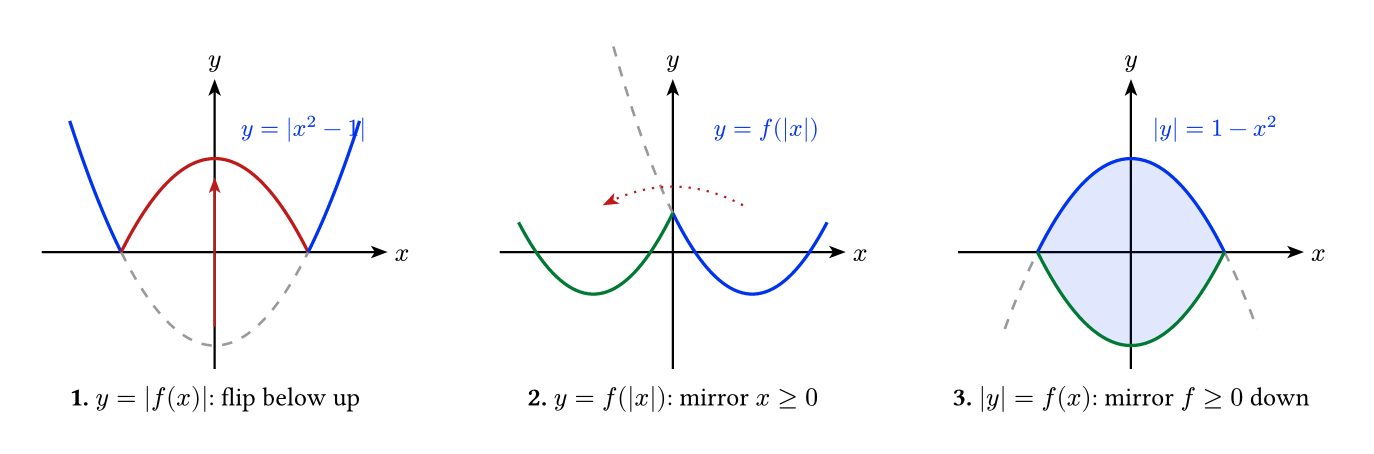
Move 1: y = |f(x)| (Modulus Outside Everything)
Since \(|f(x)| = f(x)\) when \(f(x) \ge 0\), and \(|f(x)| = -f(x)\) when \(f(x) < 0\):
- Keep every portion of \(y = f(x)\) above or on the \(x\)-axis unchanged.
- Reflect every portion below the \(x\)-axis upward across the \(x\)-axis (remember \(-f(x)\) is just an \(x\)-axis reflection!).
Illustration: To draw \(y = |x^2 - 1|\), first picture \(y = x^2 - 1\) (which dips below the \(x\)-axis between \(x = -1\) and \(x = 1\), reaching \((0, -1)\)). Now flip that bottom U-bowl upward across the \(x\)-axis so it arches to \((0, 1)\), while keeping both outer arms untouched!
Move 2: y = f(|x|) (Modulus Around x Alone)
Because \(|x| = x\) when \(x \ge 0\), and \(|x| = -x\) when \(x < 0\):
- For \(x \ge 0\), \(y = f(|x|)\) is identical to \(y = f(x)\)—so keep the right-half graph completely.
- For \(x < 0\), the negative part of the original graph \(f(x)\) does not even get used! Instead, \(f(|x|) = f(-x)\) mirrors the right half (\(x \ge 0\)) across the \(y\)-axis.
So the rule is simple: erase everything to the left of the \(y\)-axis, keep the right half (\(x \ge 0\)), and reflect it across the \(y\)-axis.
Illustration: Look at \(y = \ln |x|\) or \(y = e^{-|x|}\). Take the positive side (\(x > 0\) for \(\ln x\), or \(x \ge 0\) for \(e^{-x}\)) and mirror it across the \(y\)-axis onto \(x < 0\).
Move 3: |y| = f(x) (Modulus Around y)
Since \(|y|\) is never negative, the equation \(|y| = f(x)\) has no real points wherever \(f(x) < 0\). Wherever \(f(x) \ge 0\), \(|y| = f(x)\) splits into two symmetric \(y\)-values: \(y = +f(x)\) and \(y = -f(x)\).
So the rule is: erase everything below the \(x\)-axis (\(f(x) < 0\)), keep the non-negative part (\(f(x) \ge 0\)), and reflect it downward across the \(x\)-axis (keeping both top and bottom copies!).
Illustration: Look at \(|y| = 1 - x^2\). The parabola \(y = 1 - x^2\) is \(\ge 0\) only on \([-1, 1]\). Erasing the legs below the \(x\)-axis and mirroring the upper arch downward across the \(x\)-axis creates a closed symmetric lens!
(Bonus tip: Combine Moves 2 and 3 to draw \(|y| = f(|x|)\)—first draw \(y = f(x)\) in the first quadrant where both \(x \ge 0\) and \(f(x) \ge 0\), then mirror across both axes into all four quadrants! For \(|x| + |y| = a\), i.e. \(|y| = a - |x|\), drawing \(x + y = a\) in the first quadrant and mirroring into all four quadrants gives a diamond instantly.)
3. Symmetry Checks That Shrink Integrals
Before integrating any curve \(F(x, y) = 0\), run a 2-second sign test:
- Replace \(x\) by \(-x\): If \(F(-x, y) = F(x, y)\) (such as \(x^2\), \(\cos x\), \(|x|\)), the graph is mirror-symmetric about the \(y\)-axis. You only need the area on \(x \ge 0\), then double it!
- Replace \(y\) by \(-y\): If \(F(x, -y) = F(x, y)\) (such as \(y^2 = 4ax\), \(|y| = f(x)\)), the graph is mirror-symmetric about the \(x\)-axis. You only need the upper half (\(y \ge 0\)), then double it!
- Replace \((x, y)\) by \((-x, -y)\): If \(F(-x, -y) = F(x, y)\) (such as \(y = x^3\), \(y = \sin x\)), the curve is symmetric about the origin (\(180^\circ\) rotation), so opposite-quadrant loops have equal areas.
- Symmetric under both \(x \to -x\) and \(y \to -y\) separately: The region looks identical in all four quadrants (for example, circle, ellipse, \(|x| + |y| = a\), \(|y| = 1 - x^2\)). Integrate only in the first quadrant (\(x \ge 0, y \ge 0\)) and multiply by \(4\)!
4. Translation and Rotation Invariance in Area Calculation
Suppose you pick up a flat metal cutout on your desk, slide it across the table, and rotate it by \(45^\circ\). Does its surface area change? Of course not!
Mathematically, area is invariant under rigid motions—both translations (shifting the origin) and rotations (tilting the coordinate axes). Knowing this lets you transform ugly, off-center, or tilted equations into clean textbook curves at the origin before integrating (or avoid integrating altogether!).
Translation Invariance (Shifting Axes)
If your curves involve repeated shifted expressions like \((x - h)\) and \((y - k)\)—for instance, \((x - 3)^2 + (y + 2)^2 = 9\) alongside \((y + 2)^2 = 4(x - 3)\)—define shifted coordinates:
Because \(dX = dx\) and \(dY = dy\), every integral transforms with zero scale factor (\(dX\,dY = dx\,dy\)). You compute the area around the origin \((0, 0)\) in \((X, Y)\)-coordinates, where all algebra is minimal.
Rotation Invariance (Tilting Axes by Angle theta)
Sometimes an equation contains a nasty \(xy\) cross-term, or combinations like \(x + y\) and \(x - y\), which tilt the curve diagonally across the axes. Recall how a true (rigid) rotation of the coordinate axes by angle \(\theta\) works:
Wait—notice carefully that the vectors \((\cos\theta, \sin\theta)\) and \((-\sin\theta, \cos\theta)\) have unit length (\(\cos^2\theta + \sin^2\theta = 1\))! That guarantees distances and areas stay 100% unchanged (\(du\,dv = dx\,dy\)).
In particular, for a \(45^\circ\) tilt (\(\cos 45^\circ = \sin 45^\circ = \frac{1}{\sqrt{2}}\)), the true rigid rotation coordinates are:
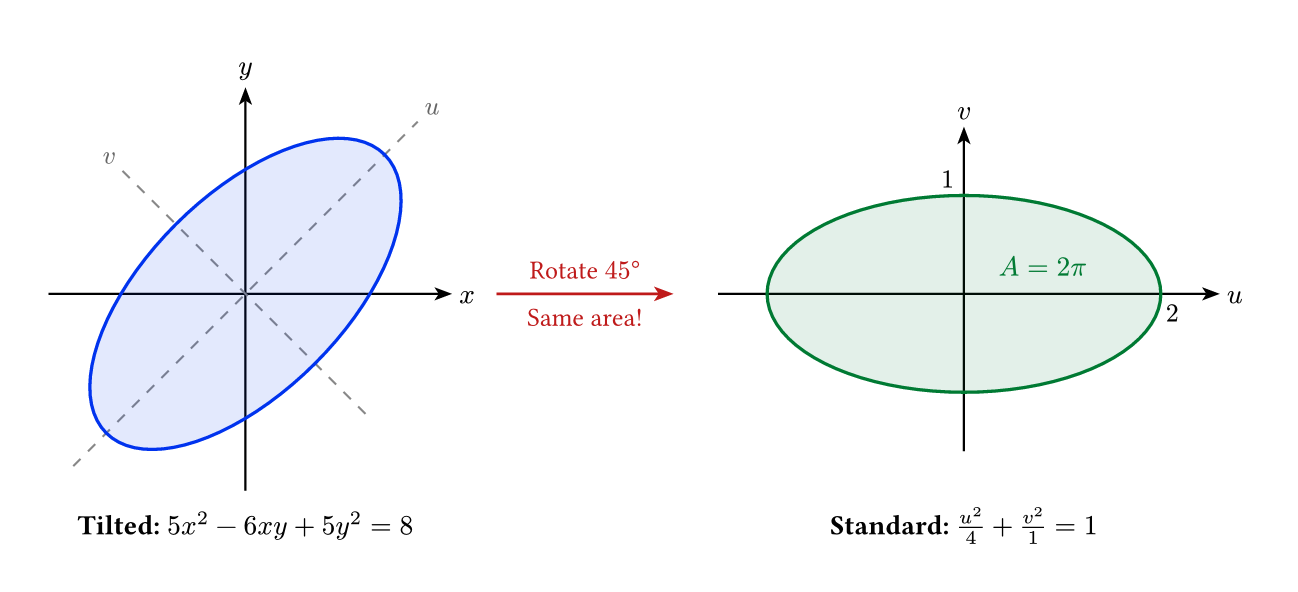
Crucial Warning on Rotation Coordinates: Never define \(u = x + y\) and \(v = x - y\) without dividing by \(\sqrt{2}\) if you want area to stay unchanged! Leaving out the \(\frac{1}{\sqrt{2}}\) stretches both axes by \(\sqrt{2}\), which doubles the true area (\(\sqrt{2} \times \sqrt{2} = 2\)). Always normalize by \(\sqrt{2}\) so that \(x + y = \sqrt{2}\,u\) and \(x - y = \sqrt{2}\,v\) represent a pure rigid rotation!
(We will see how \(5x^2 - 6xy + 5y^2 = 8\) and \((x + y)^2 = 4\sqrt{2}(x - y)\) collapse effortlessly under this exact \(45^\circ\) rotation in Examples 7 and 8 below!)
5. Area Bounded by a General Parabola and a Line: The Discriminant Formula
One of the most common problems in all of area calculus is finding the area bounded by a general vertical parabola
and a straight line
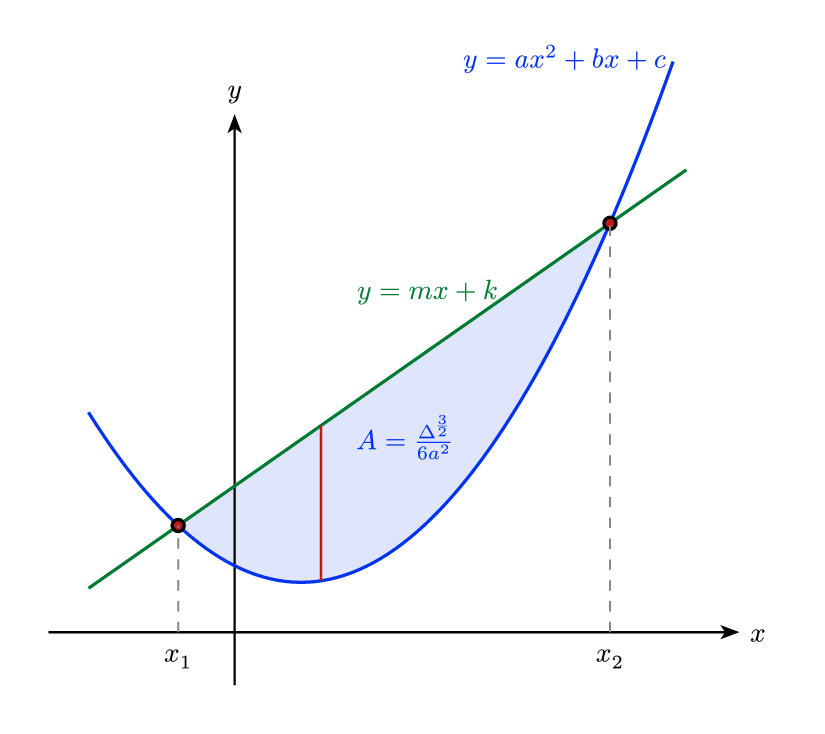
How do we usually find this area? First we find the \(x\)-coordinates \(x_1\) and \(x_2\) (\(x_1 < x_2\)) where the line and parabola intersect by solving:
Then we integrate the difference between the two curves from \(x_1\) to \(x_2\):
Wait: what happens when \(x_1\) and \(x_2\) turn out to be ugly irrational numbers (such as \(\frac{1 \pm \sqrt{3}}{2}\) or \(\frac{-3 \pm \sqrt{17}}{4}\))? Expanding \(\int_{x_1}^{x_2} (ax^2 + \dots)\,dx\) and cubing irrational roots becomes painfully slow!
Instead, we can evaluate the area directly using only the discriminant \(\Delta\)—without ever solving for \(x_1\) and \(x_2\)!
Step-by-Step Derivation Using Sum and Difference of Roots
First, compute \(\int_{x_1}^{x_2} (x - x_1)(x - x_2)\,dx\) by shifting \(t = x - x_1\). As \(x\) runs from \(x_1\) to \(x_2\), \(t\) runs from \(0\) to \(x_2 - x_1\), and \(x - x_2 = t - (x_2 - x_1)\):
Taking the absolute value gives the chord-width formula:
Now bring in the quadratic equation \(ax^2 + Bx + C = 0\) (where \(B = b - m\) and \(C = c - k\)), whose roots are \(x_1\) and \(x_2\), and whose discriminant is \(\Delta = B^2 - 4aC > 0\). Recall from quadratic theory how \((x_2 - x_1)^2\) connects to the sum and product of roots:
Taking the positive square root (\(x_2 > x_1\)):
Substitute \(x_2 - x_1 = \frac{\sqrt{\Delta}}{|a|}\) directly into \(A = \frac{|a|}{6}(x_2 - x_1)^3\):
What About a Horizontal Parabola and a Line?
Suppose instead you have a horizontal parabola
and a line. Simply rewrite the line in the form \(x = \lambda y + k\) (solving for \(x\) in terms of \(y\)), eliminate \(x\) to form a quadratic equation in \(y\):
Because swapping \(x \leftrightarrow y\) is a reflection across \(y = x\) that preserves area, if \(\Delta\) is the discriminant of this quadratic equation in \(y\), the exact same formula holds:
CRITICAL WARNING — Do NOT Cross-Multiply Fractions!
Suppose the parabola is \(y = x^2\) and the line is \(y = x + \frac{1}{2}\). Equating \(y\) gives \(x^2 - x - \frac{1}{2} = 0\) (\(a = 1, \, B = -1, \, C = -\tfrac{1}{2}\)). Do NOT clear the denominator by multiplying by \(2\) to write \(2x^2 - 2x - 1 = 0\) before plugging into \(\frac{\Delta^{3/2}}{6a^2}\)! Always keep \(a\) equal to the actual leading coefficient of \(y = ax^2 + bx + c\) (or \(x = ay^2 + by + c\)).
Look at why multiplying \(ax^2 + Bx + C = 0\) by a constant \(p \neq 1\) breaks the formula:
- The new leading coefficient is \(p a\), so \(a^2\) multiplies by \(p^2\).
- The new discriminant is \(p^2 \Delta\), so \(\Delta^{3/2}\) multiplies by \((p^2)^{3/2} = \mathbf{p^3}\).
- Therefore \(\frac{\Delta^{3/2}}{6a^2}\) multiplies by \(\frac{p^3}{p^2} = p\)—giving \(p\) times the wrong area!
Let us verify this directly with \(y = x^2\) and \(y = x + \frac{1}{2}\):
- Correct equation (\(x^2 - x - \frac{1}{2} = 0\)): \(a = 1\), \(\Delta = (-1)^2 - 4(1)\left(-\frac{1}{2}\right) = 3\), so \(A = \frac{3^{3/2}}{6(1)^2} = \frac{3\sqrt{3}}{6} = \frac{\sqrt{3}}{2}\).
- If mistakenly multiplied by \(2\) (\(2x^2 - 2x - 1 = 0\)): \(a' = 2\), \(\Delta' = (-2)^2 - 4(2)(-1) = 12\), giving \(\frac{12^{3/2}}{6(2)^2} = \frac{24\sqrt{3}}{24} = \sqrt{3}\) (wrong—double the true area!).
6. Other Calculus-Free Geometric Shortcuts
1. Circle Sectors and Segments (radius \(r\), central angle \(\theta\) radians):
- Sector area \(= \frac{1}{2}r^2\theta\).
- Segment area \(= \frac{1}{2}r^2(\theta - \sin\theta)\).
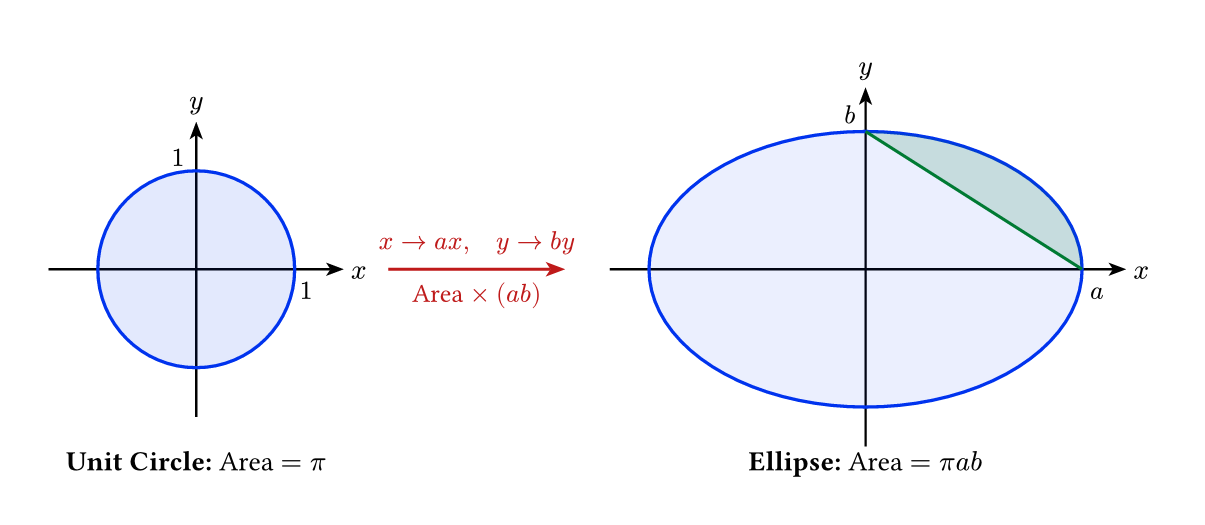
2. Area of an Ellipse (\(\frac{x^2}{a^2} + \frac{y^2}{b^2} = 1\)): Scaling the unit circle \(X^2 + Y^2 = 1\) (area \(\pi\)) by \(x = aX\) and \(y = bY\) scales every region by \(ab\). Thus the full ellipse has area \(\pi a b\)!
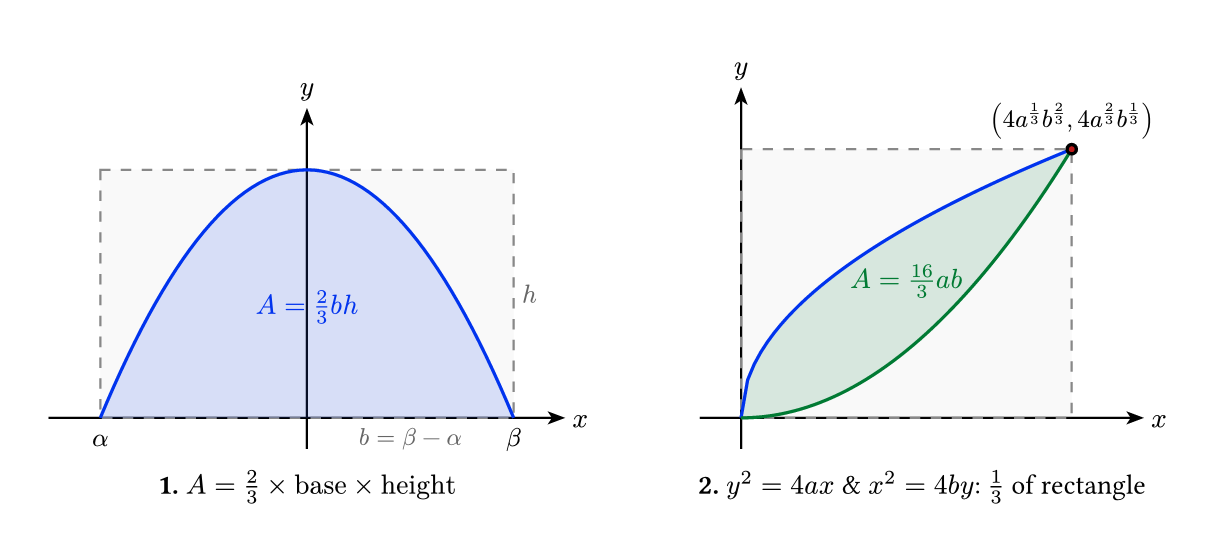
3. Parabola \(\frac{2}{3} \times \text{base} \times \text{height}\) Rule and Latus Rectum: Any parabolic segment bounded by a chord perpendicular to its axis fits inside a bounding rectangle of base \(b\) and vertex height \(h\), and always fills \(\frac{2}{3}bh\). In particular, the area cut off by the latus rectum of \(y^2 = 4ax\) (rectangle of width \(a\) and height \(4a\)) is \(\frac{2}{3}(a)(4a) = \frac{8}{3}a^2\).
4. Two Perpendicular Parabolas (\(y^2 = 4ax\) and \(x^2 = 4by\), with \(a, b > 0\)): They intersect at \((0, 0)\) and \(\big(4a^{1/3}b^{2/3}, \, 4a^{2/3}b^{1/3}\big)\), enclosing an area equal to one-third of their bounding rectangle:
Worked Examples
Example 1: Discriminant Formula With Irrational Roots (No Cross-Multiplication!)
Find the area bounded by the parabola \(y = x^2\) and the line \(y = x + \frac{1}{2}\).
Solution: Equate \(y\) from the parabola and the line directly—leaving fractions intact so \(a\) stays \(1\):
Here \(a = 1\), \(B = -1\), and \(C = -\frac{1}{2}\). Its roots are \(x = \frac{1 \pm \sqrt{3}}{2}\) (irrational!). Instead of cubing irrational roots in an integral, compute the discriminant directly:
Applying \(A = \frac{\Delta^{3/2}}{6a^2}\):
Example 2: Horizontal Parabola and Tilted Line Using Discriminant Formula
Find the area bounded by the horizontal parabola \(x = y^2 - 4y + 5\) and the line \(2y - x + 1 = 0\).
Solution: Because the parabola is given in the horizontal form \(x = ay^2 + by + c\) (with \(a = 1\)), rewrite the line as \(x = \lambda y + k\):
Eliminate \(x\) without clearing or changing the \(y^2\)-coefficient \(a = 1\):
Its roots \(3 \pm \sqrt{5}\) are irrational again! Compute \(\Delta\) in \(y\):
Therefore:
Example 3: What If Both Parabola and Line Have Fractions?
Find the area bounded by \(y = \frac{1}{3}x^2 + 1\) and \(y = \frac{1}{2}x + 2\).
Solution: Equate the \(y\)-expressions without multiplying through by \(6\):
Here \(a = \frac{1}{3}\), \(B = -\frac{1}{2}\), and \(C = -1\). Compute \(\Delta\):
Apply \(A = \frac{\Delta^{3/2}}{6a^2}\) with \(a = \frac{1}{3}\) (so \(6a^2 = 6 \cdot \frac{1}{9} = \frac{2}{3}\)):
(Compare how short that is compared to solving \(\frac{1}{3}x^2 - \frac{1}{2}x - 1 = 0\) and integrating between \(\frac{3 \pm \sqrt{57}}{4}\)!)
Example 4: Translation Invariance — Two Shifted Parabolas
Find the area enclosed by \((y - 3)^2 = 8(x - 2)\) and \((x - 2)^2 = 4(y - 3)\).
Solution: Notice both curves share the exact same vertex \((2, 3)\)! Do not expand the squares—translate the origin directly to \((2, 3)\) via \(X = x - 2\) and \(Y = y - 3\). Because translation preserves area, the problem instantly simplifies to finding the area between:
Using the perpendicular-parabolas shortcut \(A = \frac{16}{3}ab\):
Example 5: Translation Invariance — Shifted Parabola and Its Latus Rectum
Find the area bounded by \((y - 2)^2 = 4(x - 1)\) and the line \(x = 2\).
Solution: Shift the origin to \((1, 2)\) using \(X = x - 1\) and \(Y = y - 2\). Then the parabola becomes \(Y^2 = 4X\) (\(a = 1\)), and \(x = 2\) becomes \(X = 1\).
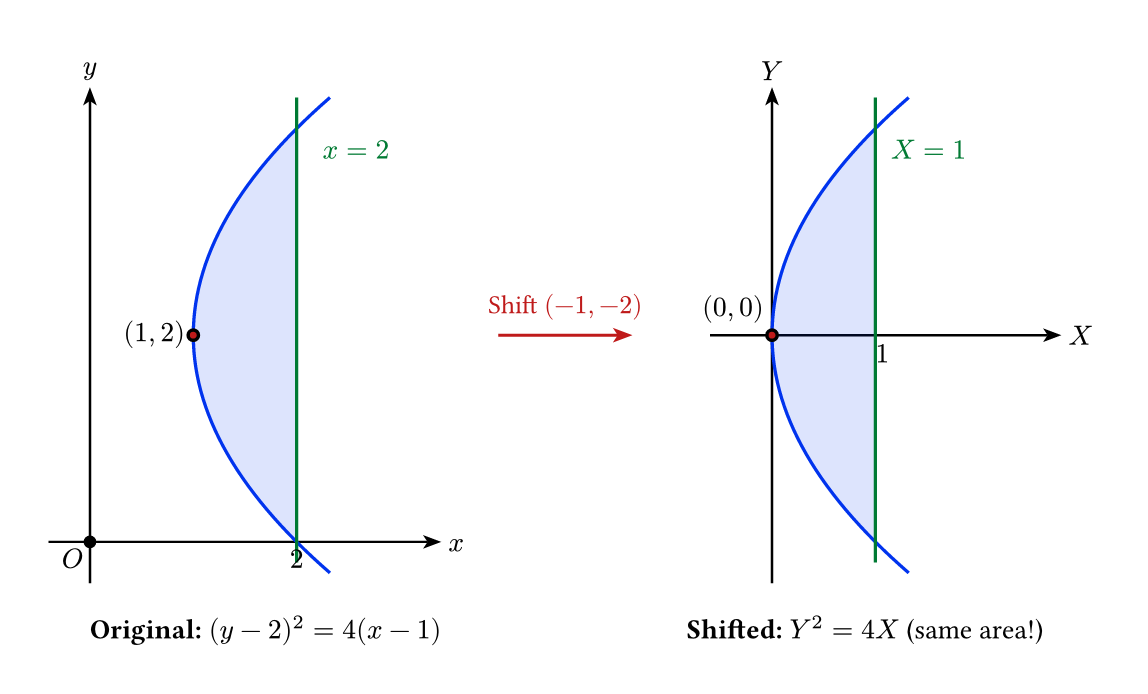
By translation invariance, the area equals the latus-rectum area of \(Y^2 = 4X\):
Example 6: Translation Invariance — Shifted Circle and Tilted Line
Find the smaller area bounded by the circle \(x^2 + y^2 - 6x + 4y + 4 = 0\) and the line \(x + y = 4\).
Solution: First complete the squares on the circle:
Shift the origin to the circle's center \((3, -2)\) by setting \(X = x - 3\) and \(Y = y + 2\) (so \(x = X + 3\) and \(y = Y - 2\)):
- The circle becomes \(X^2 + Y^2 = 9\).
- The line \(x + y = 4\) becomes \((X + 3) + (Y - 2) = 4 \implies X + Y = 3\).
Look at \(X^2 + Y^2 = 9\) and \(X + Y = 3\)! The line hits \((3, 0)\) and \((0, 3)\), cutting off exactly one quarter-circle minus a right triangle:
Example 7: Rotation Invariance — Tilted Ellipse With an xy Term
Find the area enclosed by the curve \(5x^2 - 6xy + 5y^2 = 8\).
Solution: Because of the \(-6xy\) term, solving for \(y\) directly produces nasty square roots with tilted limits. Instead, rewrite the left-hand side by grouping \((x + y)^2\) and \((x - y)^2\):
So the equation is \((x + y)^2 + 4(x - y)^2 = 8\), or:
Now apply a rigid \(45^\circ\) rotation using \(u = \frac{x + y}{\sqrt{2}}\) and \(v = \frac{x - y}{\sqrt{2}}\) (remembering the \(\sqrt{2}\) factor so that area is preserved!). Then \(x + y = \sqrt{2}\,u\) and \(x - y = \sqrt{2}\,v\), turning the equation into:
This is a standard axis-aligned ellipse with semi-axes \(a = 2\) and \(b = 1\). By rotation invariance, the tilted ellipse has the exact same area:
Example 8: Rotation Invariance — Tilted Parabola and Diagonal Chord
Find the area bounded by the tilted parabola \((x + y)^2 = 4\sqrt{2}(x - y)\) and the line \(x - y = \sqrt{2}\).
Solution: Without rotation, expressing \(y\) as a function of \(x\) or \(x\) as a function of \(y\) would require solving a quadratic with cross-terms. Notice the exact combinations \(x + y\) and \(x - y\)! Perform the rigid \(45^\circ\) rotation \(u = \frac{x + y}{\sqrt{2}}\) and \(v = \frac{x - y}{\sqrt{2}}\), so \(x + y = \sqrt{2}\,u\) and \(x - y = \sqrt{2}\,v\):
- The parabola becomes \((\sqrt{2}\,u)^2 = 4\sqrt{2}(\sqrt{2}\,v) \implies 2u^2 = 8v \implies u^2 = 4v\).
- The line becomes \(\sqrt{2}\,v = \sqrt{2} \implies v = 1\).
Now we simply want the area bounded by the upright parabola \(u^2 = 4v\) and its horizontal latus rectum \(v = 1\) (\(a = 1\))! By rotation invariance:
Example 9: Using y = |f(x)| Transformation
Find the area bounded by \(y = |x^2 - 1|\) and the horizontal line \(y = 3\).
Solution: By the \(y = |f(x)|\) rule, keep the outer arms of \(y = x^2 - 1\) and flip the lower portion on \([-1, 1]\) upward across the \(x\)-axis to \(y = 1 - x^2\). Both curves are even (\(x \to -x\) unchanged), so double the \(x \ge 0\) area. For \(x > 1\), \(x^2 - 1 = 3 \implies x = 2\):
Example 10: Using y = f(|x|) Transformation
Find the area bounded by \(y = e^{-|x|}\), the \(x\)-axis, and the lines \(x = -1\) and \(x = 1\).
Solution: Take \(y = e^{-x}\) for \(x \ge 0\) and mirror it across the \(y\)-axis onto \(x < 0\).
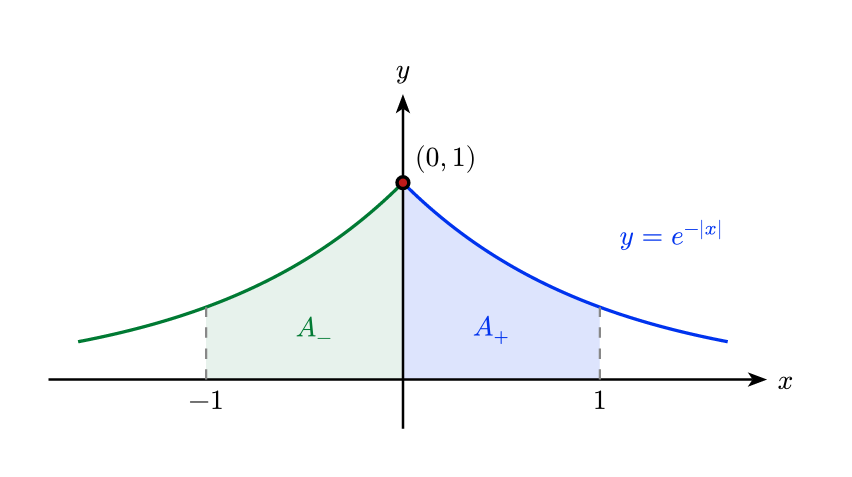
By \(y\)-axis symmetry:
Example 11: Using |y| = f(x) and Four-Quadrant Symmetry
Find the area enclosed by \(|y| = 1 - x^2\).
Solution: Keep the non-negative arch of \(y = 1 - x^2\) on \([-1, 1]\) and mirror it downward across the \(x\)-axis. By four-quadrant symmetry:
Example 12: Combining Ellipse Scaling With Triangle Geometry
Find the smaller area bounded by the ellipse \(\frac{x^2}{9} + \frac{y^2}{4} = 1\) and the line \(\frac{x}{3} + \frac{y}{2} = 1\).
Solution: The line joins the exact intercepts \((3, 0)\) and \((0, 2)\) of the ellipse (\(a = 3, b = 2\)). The smaller region is simply the first-quadrant quarter-ellipse minus the right triangle: