Combinations and Combinatorial Proofs
In Section 03 we counted permutations, where the arrangement (order) of the chosen objects matters. In many problems, however, order plays no role at all—we only wish to select a group of objects, such as picking \(5\) students for a committee or choosing \(3\) books to carry in a bag. Unordered selections of this kind are called combinations.
From Sequences to Unordered Subsets
Consider five distinct objects in a set \(A = \{a, b, c, d, e\}\). Suppose we ask: how many ordered sequences of \(3\) objects (called triplets) can be formed from \(A\)?
Examples of triplets are \((a, b, c)\), \((b, a, c)\), and \((a, b, d)\). Notice that we write sequences inside parentheses because position matters: \((a, b, c)\) and \((b, a, c)\) are different sequences even though they contain the exact same three letters. Just like seating \(5\) students on \(3\) distinct chairs, we already know the total number of triplets is \({}^5 P_3 = 5 \times 4 \times 3 = 60\).
Now look at this exact same counting problem from a second perspective.
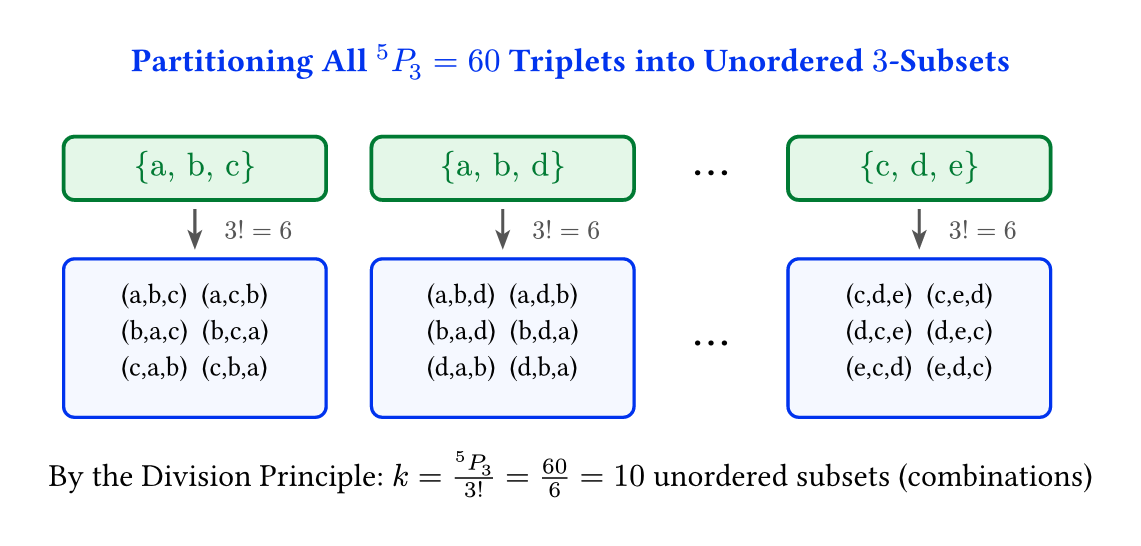
To form a triplet, first simply pick any \(3\) objects from \(A\) without arranging them—say \(\{a, b, c\}\). Why do we use curly brackets here? Because a set is unordered; we have only chosen which \(3\) objects will participate, and we have not yet placed them in sequence. Clearly \(\{a, b, c\}\) is a \(3\)-element subset of \(\{a, b, c, d, e\}\).
Once \(\{a, b, c\}\) is chosen, we can arrange its \(3\) letters into \(3! = 6\) distinct triplets:
If we instead pick a different \(3\)-element subset, such as \(\{a, b, d\}\), it again generates exactly \(6\) distinct triplets—and none of them overlap with the \(6\) triplets from \(\{a, b, c\}\).
Now ask the natural question: how many \(3\)-element subsets can be formed from these \(5\) distinct objects? Let this unknown number be \(k\) (called the \(3\)-combination of \(5\) objects). Since every one of the \(k\) subsets generates \(6\) unique triplets and together they produce all \({}^5 P_3\) triplets:
Therefore, there are exactly \(10\) ways to select (without arranging) \(3\) objects from \(5\) distinct objects.
The General Combination Formula
Definition (\(r\)-Combination): An \(r\)-combination of \(n\) distinct objects (\(0 \le r \le n\)) is the number of ways to select \(r\) objects from \(n\) distinct objects when order does not matter—equivalently, the number of \(r\)-element subsets of an \(n\)-element set. It is denoted by \({}^n C_r\) or \(\binom{n}{r}\).
Theorem (Combination Formula): For all integers \(0 \le r \le n\):
Proof (Via the Division Principle): Let \(S\) be the set of all \(r\)-permutations of \(n\) distinct objects, so \(|S| = {}^n P_r\). Partition \(S\) into pairwise disjoint, exhaustive subsets \(S_1, S_2, \dots, S_k\), where each part \(S_i\) contains all permutations made from the exact same \(r\)-element subset of objects.
Since any \(r\) distinct objects can be arranged in \(r!\) ways, every part \(S_i\) has equal size \(|S_1| = |S_2| = \dots = |S_k| = r!\). By the Division Principle, the number of distinct \(r\)-element subsets is:
Permutations vs. Combinations at a Glance:
Rewriting the formula as \({}^n P_r = \binom{n}{r} \times r!\) makes the relationship unmistakable: \({}^n C_r\) means "select only", whereas \({}^n P_r\) means "select \(r\) objects first (\(\binom{n}{r}\)), then arrange those \(r\) selected objects (\(r!\))".
Example 1: In how many ways can a team of \(5\) students be formed from a class of \(56\) students?
Solution: Since all \(5\) team positions are equivalent (order does not matter), the number of teams is:
Combinations Under Restrictions
Suppose we wish to select \(r\) objects from a pool of \(n\) distinct objects under three common types of restrictions. Notice carefully the difference between Restriction 2 and Restriction 3:
1. \(k\) particular objects are always selected (\(k \le r\)): Place those \(k\) objects into our selection right away (\(1\) way). We must then choose the remaining \(r - k\) objects from the remaining \(n - k\) objects:
2. \(k\) particular objects are never selected all together: Here some (or even \(k - 1\)) of the \(k\) objects may still be chosen—we only forbid all \(k\) of them appearing together in the same selection. Using the Subtraction Principle, subtract Restriction 1 from the unrestricted total:
3. \(k\) particular objects are never selected (none of them allowed, \(r \le n - k\)): Here not even a single one of the \(k\) objects may enter our selection. Discard those \(k\) objects completely and select all \(r\) objects from the remaining \(n - k\) objects:
Example 2 (Committee with Minimum Quota): From \(7\) men and \(6\) women, a committee of \(5\) members must be formed containing at least \(3\) men. In how many ways can this be done?
Solution: Partition the valid committees by the exact number of men selected:
- Case 1 (\(3\) men and \(2\) women): \(\binom{7}{3}\binom{6}{2} = 35 \times 15 = 525\).
- Case 2 (\(4\) men and \(1\) woman): \(\binom{7}{4}\binom{6}{1} = 35 \times 6 = 210\).
- Case 3 (\(5\) men and \(0\) women): \(\binom{7}{5}\binom{6}{0} = 21 \times 1 = 21\).
By the Addition Principle, there are \(525 + 210 + 21 = 756\) valid committees.
Example 3 (Why "Select Minimum First, Then Fill Rest" Overcounts!): In Example 2, a common mistake is to argue: "First choose \(3\) men from \(7\) in \(\binom{7}{3}\) ways to satisfy the minimum, then choose the remaining \(2\) members from the remaining \(10\) people in \(\binom{10}{2}\) ways, giving \(\binom{7}{3}\binom{10}{2} = 1575\)." Why is \(1575\) wrong?
Solution: Suppose a valid committee has \(4\) men \(\{M_1, M_2, M_3, M_4\}\) and \(1\) woman \(\{W_1\}\). Under that faulty method, this single committee is counted four separate times:
- \(\{M_1, M_2, M_3\}\) chosen first, then \(\{M_4, W_1\}\);
- \(\{M_1, M_2, M_4\}\) chosen first, then \(\{M_3, W_1\}\);
- \(\{M_1, M_3, M_4\}\) chosen first, then \(\{M_2, W_1\}\);
- \(\{M_2, M_3, M_4\}\) chosen first, then \(\{M_1, W_1\}\).
Similarly, a committee of \(5\) men is counted \(\binom{5}{3} = 10\) times! The cases overlap heavily, violating pairwise disjointness. Always partition by exact counts of each type (as in Example 2) when solving "at least" selection problems.
Select-and-Arrange: Combining Selection with Arrangement
Now that we have the combination formula \(\binom{n}{r}\) in hand, we can add a fourth powerful strategy to the three restricted-permutation techniques from Section 03: Select-and-Arrange.
Whenever a problem asks us to arrange \(r\) objects drawn from two or more separate pools—say \(k\) objects from a pool \(A\) of \(n\) distinct objects and \(r - k\) objects from a pool \(B\) of \(m\) distinct objects—trying to fill positions directly fails because we do not know which positions will hold objects from \(A\) and which from \(B\). Instead, decouple the task into two completely independent stages:
- Select: Choose \(k\) objects from \(A\) in \(\binom{n}{k}\) ways and \(r - k\) objects from \(B\) in \(\binom{m}{r - k}\) ways.
- Arrange: Arrange all \(k + (r - k) = r\) chosen objects in a row in \(r!\) ways.
By the Multiplication Principle:
Example 4 (Words from Vowels and Consonants): How many \(5\)-letter words (with or without meaning, no letter repeated) can be formed using \(3\) consonants chosen from \(7\) distinct consonants and \(2\) vowels chosen from \(5\) distinct vowels?
Solution: First select the letters (\(\binom{7}{3} = 35\) choices of consonants and \(\binom{5}{2} = 10\) choices of vowels), then arrange all \(5\) chosen letters in \(5! = 120\) ways:
Properties of Binomial Coefficients and Combinatorial Proofs
A combinatorial proof (also called a double-counting proof) proves a mathematical identity by counting the exact same finite set in two different ways and equating the two resulting expressions. Unlike purely algebraic manipulation, a combinatorial proof reveals why an identity must be true.
Property 1: Symmetry
Combinatorial Proof: Selecting \(r\) objects to include from a group of \(n\) distinct objects is equivalent to selecting the remaining \(n - r\) objects to leave out. Every \(r\)-selection corresponds bijectively to an \((n - r)\)-exclusion (exactly the basketball team-vs.-bench bijection from Section 01!). \(\blacksquare\)
Algebraic Proof:
(Useful consequence: If \(\binom{n}{x} = \binom{n}{y}\), then either \(x = y\) or \(x + y = n\).)
Property 2: Pascal's Formula
Combinatorial Proof: Suppose a class has \(n\) students and we wish to form a team of \(r\) students for a science expedition. Let \(S\) be the set of all possible teams; directly, \(|S| = \binom{n}{r}\).
Now single out one particular student in the class named \(X\). Any valid team either includes \(X\) or excludes \(X\)—there is no third possibility. Partition \(S\) into two disjoint, exhaustive sets:
- \(S_X\) (Teams including \(X\)): With \(X\) already on the team, we need \(r - 1\) more members from the remaining \(n - 1\) students, giving \(|S_X| = \binom{n - 1}{r - 1}\).
- \(S_{X'}\) (Teams excluding \(X\)): Leaving \(X\) out, we must select all \(r\) members from the remaining \(n - 1\) students, giving \(|S_{X'}| = \binom{n - 1}{r}\).
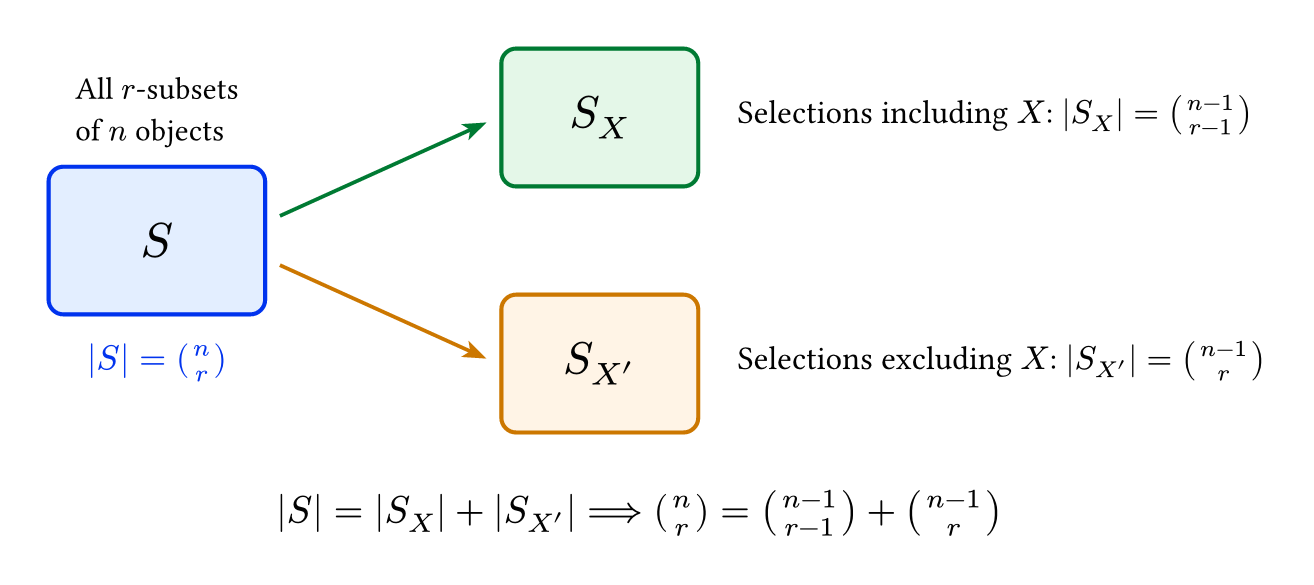
Since \(|S| = |S_X| + |S_{X'}|\), equating both counts yields \(\binom{n}{r} = \binom{n - 1}{r - 1} + \binom{n - 1}{r}\). \(\blacksquare\)
Algebraic Proof:
Property 3: Sum of All Binomial Coefficients
Combinatorial Proof: Let \(A = \{a_1, a_2, \dots, a_n\}\). Count the total number of subsets of \(A\) in two ways:
Way 1 (Partition by subset size): There is \(\binom{n}{0} = 1\) subset of size \(0\) (the empty set \(\emptyset\)), \(\binom{n}{1}\) subsets of size \(1\), \(\binom{n}{2}\) subsets of size \(2\), ..., and \(\binom{n}{n}\) subsets of size \(n\). Adding across all disjoint sizes gives \(\binom{n}{0} + \binom{n}{1} + \dots + \binom{n}{n}\).
Way 2 (Element-by-element choice): To form any subset \(B \subseteq A\), each element \(a_i\) independently faces \(2\) choices: either \(a_i \in B\) or \(a_i \notin B\). By the Multiplication Principle, there are \(\underbrace{2 \times 2 \times \dots \times 2}_{n \text{ times}} = 2^n\) subsets in total.
Equating both counts proves \(\sum_{r=0}^n \binom{n}{r} = 2^n\). \(\blacksquare\)
Property 4: Vandermonde's Identity
(where we adopt the standard convention \(\binom{a}{b} = 0\) whenever \(b < 0\) or \(b > a\)).
Combinatorial Proof: Consider a combined pool of \(n + m\) distinct objects split into Group \(A\) (\(n\) objects) and Group \(B\) (\(m\) objects). Directly, there are \(\binom{n + m}{r}\) ways to select \(r\) objects from the combined pool.
Alternatively, partition these selections by the exact number \(k\) of objects drawn from Group \(A\) (\(k = 0, 1, 2, \dots, r\)). When \(k\) objects are chosen from Group \(A\), the remaining \(r - k\) objects must come from Group \(B\), which can be done in \(\binom{n}{k}\binom{m}{r - k}\) ways. Summing over all \(k\) produces the left-hand side. \(\blacksquare\)
Important Special Case (Sum of Squares): Setting \(m = n\) and \(r = n\) in Vandermonde's Identity gives:
Applying Symmetry (\(\binom{n}{n - k} = \binom{n}{k}\)) yields the celebrated identity:
Property 5: Generalized Pascal Decomposition
Replacing \(n + m\) by \(n\) (i.e., splitting \(n\) objects into subgroups of sizes \(m\) and \(n - m\)) turns Vandermonde's Identity into:
- Setting \(m = 1\) immediately recovers Pascal's Formula: \(\binom{n - 1}{r} + \binom{n - 1}{r - 1} = \binom{n}{r}\).
- Setting \(m = 2\) proves the second-order identity:
Property 6: The Hockey-Stick Identity
Proof 1 (Telescoping via Pascal's Formula): Since \(\binom{n}{n} = 1 = \binom{n + 1}{n + 1}\), rewrite the first term and collapse pairs repeatedly using Pascal's Formula:
Continuing this chain reaction all the way to the final term yields:
Proof 2 (Combinatorial Proof): Consider a row of \(n + m\) numbered positions (\(1, 2, \dots, n + m\)) filled with \(n + 1\) identical black balls and \(m - 1\) identical white balls. Directly, choosing which \(n + 1\) positions hold the black balls can be done in \(\binom{n + m}{n + 1}\) ways.
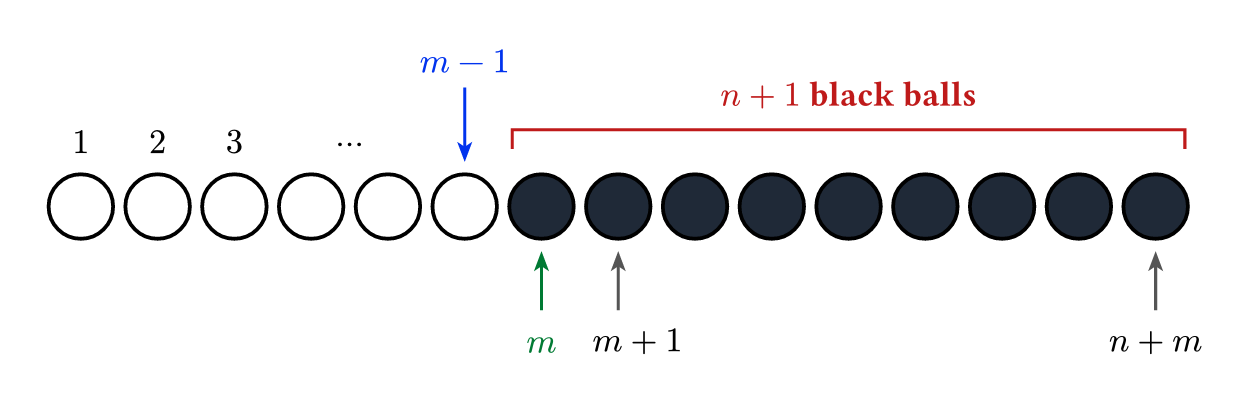
Now count the exact same arrangements by scanning from left to right and recording the position \(k\) of the first (leftmost) black ball. Since \(n\) more black balls must fit strictly to its right, the farthest right the first black ball can sit is position \(m\) (when all \(n + 1\) black balls are pushed flush against the right end, occupying positions \(m, m + 1, \dots, n + m\)). Thus \(k \in \{1, 2, \dots, m\}\):
- If the first black ball is at position \(m\), the remaining \(n\) black balls occupy the \(n\) positions to its right in \(\binom{n}{n} = 1\) way.
- If the first black ball is at position \(m - 1\), the remaining \(n\) black balls choose from \(n + 1\) positions to its right in \(\binom{n + 1}{n}\) ways.
- In general, when the first black ball sits at position \(k\) (\(1 \le k \le m\)), the remaining \(n\) black balls choose from the \(n + m - k\) positions to its right in \(\binom{n + m - k}{n}\) ways.
Summing over \(k = m, m - 1, \dots, 1\) gives \(\binom{n}{n} + \binom{n + 1}{n} + \dots + \binom{n + m - 1}{n} = \binom{n + m}{n + 1}\). \(\blacksquare\)
Property 7: The Subset-of-a-Subset (Committee–Subcommittee) Identity
Combinatorial Proof: Suppose we have \(n\) distinct balls and two distinct boxes, Box \(Y\) and Box \(Z\). We want to end up with \(m - k\) balls in Box \(Y\) and \(k\) balls in Box \(Z\) (leaving \(n - m\) balls outside).
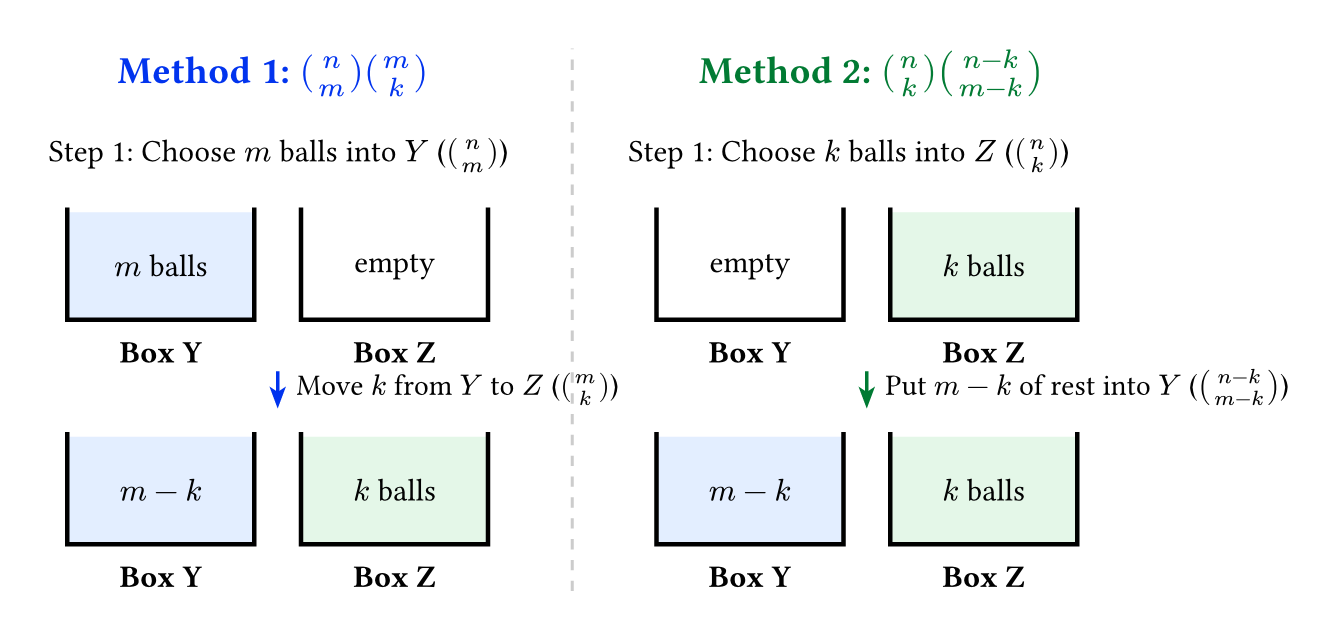
Method 1: First select \(m\) balls and place all of them into Box \(Y\) (\(\binom{n}{m}\) ways). Next select \(k\) of those \(m\) balls from Box \(Y\) and move them into Box \(Z\) (\(\binom{m}{k}\) ways). Total ways: \(\binom{n}{m}\binom{m}{k}\).
Method 2: First select \(k\) balls directly into Box \(Z\) (\(\binom{n}{k}\) ways), leaving \(n - k\) balls. Next select \(m - k\) balls from those remaining \(n - k\) balls and place them into Box \(Y\) (\(\binom{n - k}{m - k}\) ways). Total ways: \(\binom{n}{k}\binom{n - k}{m - k}\).
Since both methods produce the exact same set of final distributions, \(\binom{n}{m}\binom{m}{k} = \binom{n}{k}\binom{n - k}{m - k}\). \(\blacksquare\)
The Absorption Identity (Special Case \(m = r, k = 1\)): Substituting \(m = r\) and \(k = 1\) gives one of the handiest simplification identities in algebra and combinatorics:
(Combinatorial meaning: choosing a team of \(r\) players and appointing \(1\) captain is identical to appointing \(1\) captain from all \(n\) players first, then choosing the remaining \(r - 1\) teammates!)
Example 5 (Evaluating Sums Using Identities): Evaluate: (a) \(\binom{3}{3} + \binom{4}{3} + \binom{5}{3} + \dots + \binom{12}{3}\), and (b) \(\sum_{r=1}^{n} r\binom{n}{r}\).
Solution:
(a) By the Hockey-Stick Identity with \(n = 3\) and \(n + m - 1 = 12\) (so \(n + m = 13\)):
(b) Apply the Absorption Identity \(r\binom{n}{r} = n\binom{n - 1}{r - 1}\) and then Property 3:
Summary Table
| Identity / Formula | Expression | Combinatorial Interpretation |
|---|---|---|
| \(r\)-Combination | \(\binom{n}{r} = \frac{n!}{r!(n - r)!}\) | Unordered selection of \(r\) objects from \(n\) distinct objects |
| Symmetry | \(\binom{n}{r} = \binom{n}{n - r}\) | Choosing \(r\) to include \(\equiv\) choosing \(n - r\) to leave out |
| Pascal's Formula | \(\binom{n}{r} = \binom{n - 1}{r - 1} + \binom{n - 1}{r}\) | Split \(r\)-teams by whether a fixed person \(X\) is included or excluded |
| Subset Sum | \(\sum_{r=0}^n \binom{n}{r} = 2^n\) | Total subsets of an \(n\)-element set |
| Vandermonde's Identity | \(\sum_{k=0}^r \binom{n}{k}\binom{m}{r - k} = \binom{n + m}{r}\) | Selecting \(r\) objects from two pools of sizes \(n\) and \(m\) |
| Hockey-Stick Identity | \(\sum_{i=n}^{n+m-1} \binom{i}{n} = \binom{n + m}{n + 1}\) | Partitioning \(n + 1\) black balls by position of the leftmost black ball |
| Subset-of-a-Subset | \(\binom{n}{m}\binom{m}{k} = \binom{n}{k}\binom{n - k}{m - k}\) | Putting \(m - k\) balls in Box \(Y\) and \(k\) balls in Box \(Z\) |
| Absorption Identity | \(r\binom{n}{r} = n\binom{n - 1}{r - 1}\) | Forming an \(r\)-member team with \(1\) designated captain |