Definite Integrals as the Limit of a Sum
Revisiting the Right Sum and Left Sum
In the opening sections of this chapter, we learned how to find the area under a continuous curve \(y = f(x)\) on \([a, b]\) from first principles. Dividing \([a, b]\) into \(n\) equal strips of width \(h = \frac{b - a}{n}\) (so that \(nh = b - a\)) gave the Left Sum and the Right Sum, both of which converge to the definite integral as \(n \to \infty\):
Now focus on the Right Sum and consider the simplest special case: \(a = 0\) and \(b = 1\).
When we divide the interval \([0, 1]\) into \(n\) equal parts, each step has length \(h = \frac{1 - 0}{n} = \frac{1}{n}\), and the division points along the \(x\)-axis are:
As shown in the figure below, the \(r\)-th rectangular strip sits on the base \(\left[\frac{r-1}{n}, \frac{r}{n}\right]\) of width \(\frac{1}{n}\), and its height at the right endpoint \(x_r = \frac{r}{n}\) is \(f\!\left(\frac{r}{n}\right)\), giving it an area of \(\frac{1}{n}f\!\left(\frac{r}{n}\right)\):
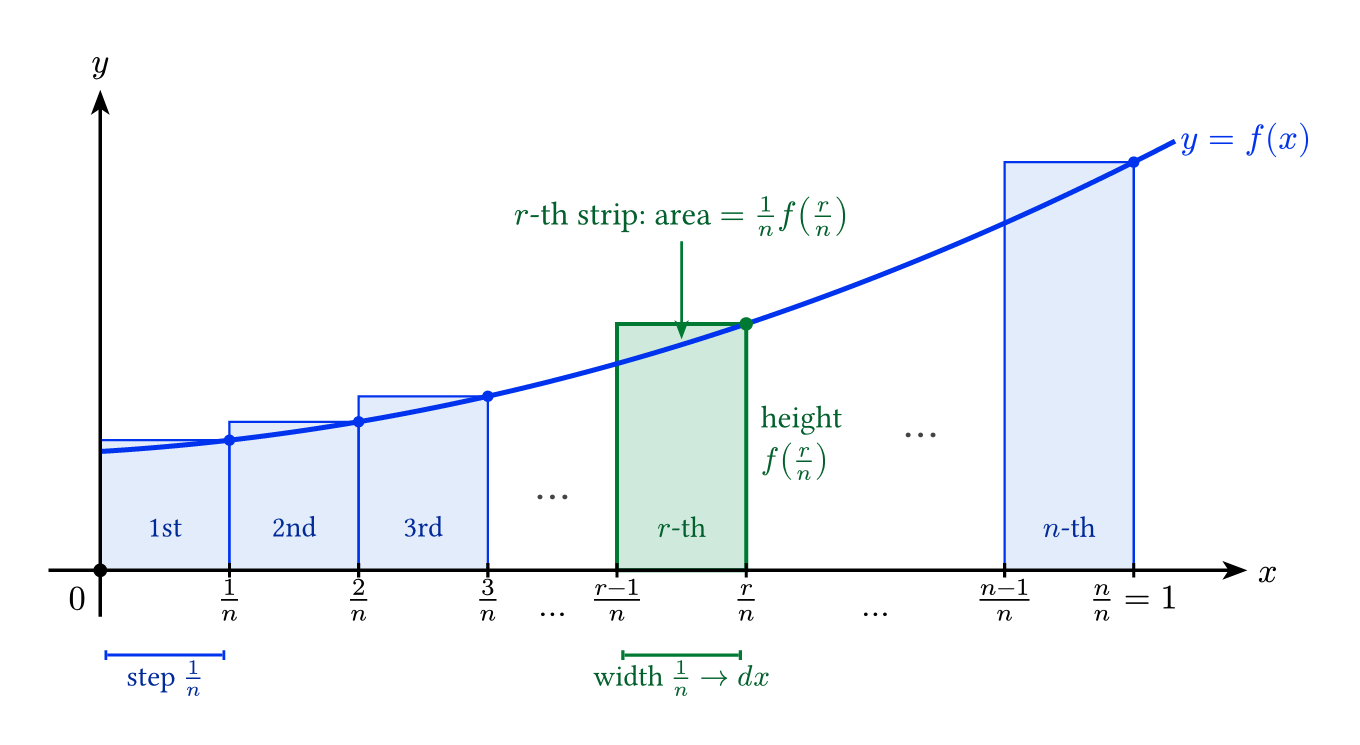
Adding the areas of all \(n\) strips from \(r = 1\) to \(r = n\) and taking the limit as \(n \to \infty\) gives our fundamental formula on \([0, 1]\):
(Similarly, using the Left Sum on \([0, 1]\) evaluates heights at the left endpoints, giving \(\int_0^1 f(x)\,dx = \lim_{n \to \infty} \frac{1}{n} \sum_{r=0}^{n-1} f\!\left(\frac{r}{n}\right)\).)
A Motivating Example and a Surprising Paradox
Let us test this \([0, 1]\) formula on the function \(f(x) = \frac{1}{1 + x^2}\). Substituting \(f\!\left(\frac{r}{n}\right) = \frac{1}{1 + (r/n)^2}\) into the Right Sum gives:
Expanding the summation term by term for \(r = 1, 2, 3, \dots, n\), we obtain the series:
Pause and examine this series carefully. What happens to each individual term as \(n \to \infty\)?
Every single term of the series approaches \(0\)! At first glance, you might wonder: if every term approaches \(0\), shouldn't the entire sum be \(0 + 0 + \dots + 0 = 0\)?
No—that is impossible! By the First Fundamental Theorem of Calculus, we already know the exact value of the left-hand side:
Why doesn't the sum equal \(0\)? Because as each individual term shrinks toward \(0\) (at the rate of \(\frac{1}{n}\)), the number of terms \(n\) simultaneously grows to \(\infty\)! You can only add the limits of individual terms when the number of terms is fixed and finite. When \(n \to \infty\) terms each of size roughly \(\frac{1}{n}\) are added together, the competing effects (\(n \times \frac{1}{n}\)) balance out to produce the finite, non-zero value \(\frac{\pi}{4}\).
Reversing the Process: From a Series Back to a Definite Integral
In the example above, we started with a known integral \(\int_0^1 \frac{1}{1+x^2}\,dx\) and expanded its Right Sum into a series. In this section, we do the exact opposite process: we are given the limit of a series and asked to find its value by recognizing the definite integral hidden inside it.
Let us see how this works on a concrete example before stating any general rule. Suppose we want to evaluate:
First, notice the telltale signature: as \(n \to \infty\), each individual term (\(\frac{1}{n+1}, \frac{1}{n+2}, \dots, \frac{1}{2n}\)) approaches \(0\), while the number of terms \(n\) grows to \(\infty\). So we cannot take the limit term by term. Instead, let us run our Right Sum steps in reverse to match the standard definition on \([0, 1]\):
Step 1 (Condense the series into \(\sum\) notation): Look at how the denominators change from term to term: \(n + 1,\; n + 2,\; n + 3,\; \dots,\; n + n\). Using a running index \(r\) from \(1\) to \(n\), the \(r\)-th term is \(\frac{1}{n + r}\):
Step 2 (Reshape to expose \(\frac{1}{n}\) and \(\frac{r}{n}\)): In the Right Sum formula \(\frac{1}{n} \sum_{r=1}^{n} f\!\left(\frac{r}{n}\right)\), a strip width \(\frac{1}{n}\) sits outside the sum and the index \(r\) appears only in the ratio \(\frac{r}{n}\). To create \(\frac{r}{n}\), factor \(n\) out of the denominator \(n + r = n\left(1 + \frac{r}{n}\right)\):
Step 3 (Compare directly with the Right Sum definition): Place our limit right next to the Right Sum definition on \([0, 1]\):
By direct comparison, our sum is literally the Right Sum of the function \(f(x) = \frac{1}{1 + x}\) on \([0, 1]\), where \(\frac{1}{n}\) is the strip width \(h\) and \(\frac{r}{n}\) is the sample point \(x_r\)! Therefore, by the definition of the definite integral:
Summary of the Working Procedure
In practice, once you have arranged a limit into the standard form \(\lim_{n \to \infty} \frac{1}{n} \sum_{r=1}^{n} f\!\left(\frac{r}{n}\right)\), you do not need to write out the full side-by-side comparison every single time. You can convert the sum directly into \(\int_0^1 f(x)\,dx\) using this short working procedure:
- Write the series in summation (\(\sum\)) form using a running index \(r\).
- Factor out \(\frac{1}{n}\) and rewrite the remaining expression strictly in terms of \(\frac{r}{n}\) so that it takes the form \(\lim_{n \to \infty} \frac{1}{n} \sum_{r=1}^{n} f\!\left(\frac{r}{n}\right)\).
- Convert to the definite integral by matching each part of the Right Sum:
- Replace \(\frac{r}{n}\) by \(x\) (the sample point \(x_r = \frac{r}{n}\)).
- Replace \(\frac{1}{n}\) by \(dx\) (the strip width \(h = \frac{1}{n}\)).
- Replace \(\lim_{n \to \infty} \sum_{r=1}^{n}\) by \(\int_0^1\) (since \(\frac{r}{n}\) runs from \(\lim_{n \to \infty} \frac{1}{n} = 0\) at \(r = 1\) to \(\lim_{n \to \infty} \frac{n}{n} = 1\) at \(r = n\)).
Extending to the General Case: Deciding the Lower and Upper Limits
What if the summation index \(r\) does not simply run from \(1\) to \(n\)? Let us trace what happens when the starting index or ending index changes.
1. Shifted Starting Index (Why r = 6 to n Still Starts at a = 0)
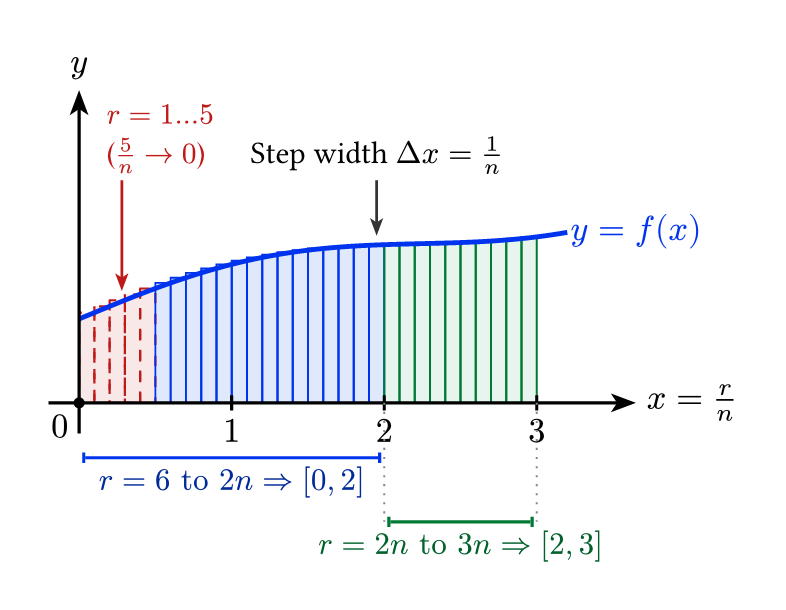
Suppose a sum starts at \(r = 6\) instead of \(r = 1\). Compared to the full sum from \(r = 1\) to \(n\), only the first \(5\) terms (\(r = 1, 2, 3, 4, 5\)) are missing.
As we just saw in our motivating example, each individual term approaches \(0\) as \(n \to \infty\). Because \(5\) is a fixed finite number of terms, the sum of those \(5\) missing terms genuinely approaches \(0 + 0 + 0 + 0 + 0 = 0\)! Removing or adding any fixed finite number of terms at either end changes nothing in the limit—the lower limit of integration is still \(a = \lim_{n \to \infty} \frac{6}{n} = 0\).
2. Extended Upper Index (0 to 2, 0 to 4, and r = 6 to 2n)
When \(r\) runs from \(1\) to \(n\), the point \(x_r = \frac{r}{n}\) steps by \(\frac{1}{n}\) from \(\frac{1}{n} \to 0\) up to \(\frac{n}{n} = 1\), covering the interval \([0, 1]\).
- Up to \(2n\) (e.g., \(r = 1\) to \(2n\), or \(r = 6\) to \(2n\)): As \(r\) continues past \(n\) up to \(2n\), the fraction \(\frac{r}{n}\) keeps marching past \(1\) all the way to \(\frac{2n}{n} = 2\). Even if the sum starts at \(r = 6\) and ends at \(r = 2n\), the first point is \(\frac{6}{n} \to 0\) and the last point is \(\frac{2n}{n} = 2\), so the integral runs from \(0\) to \(2\): \(\int_0^2 f(x)\,dx\).
- Up to \(4n\) (e.g., \(r = 0\) to \(4n - 1\)): The fraction \(\frac{r}{n}\) sweeps from \(\frac{0}{n} = 0\) to \(\frac{4n - 1}{n} \to 4\), giving an integral from \(0\) to \(4\): \(\int_0^4 f(x)\,dx\).
- Starting at a multiple of \(n\) (e.g., \(r = n + 1\) to \(4n\)): Here the first term sits at \(\frac{n + 1}{n} \to 1\) and the last term sits at \(\frac{4n}{n} = 4\), so the strips cover \(1\) to \(4\): \(\int_1^4 f(x)\,dx\).
3. The General Conversion Rule
Putting these observations together gives the universal rule for any starting index \(r = \phi(n)\) and ending index \(r = \psi(n)\). Simply compute the limiting values of \(\frac{r}{n}\) at the two extremes:
Then the limit of the sum converts directly into the definite integral from \(a\) to \(b\):
Reference Table of General Index Ranges
Here is a quick summary of how common index ranges translate into \([a, b]\) when \(x = \frac{r}{n}\) and \(\Delta x = \frac{1}{n}\):
| Index Range for \(r\) | Lower Limit \(a = \lim_{n\to\infty} \frac{r_{\text{start}}}{n}\) | Upper Limit \(b = \lim_{n\to\infty} \frac{r_{\text{end}}}{n}\) | Resulting Integral |
|---|---|---|---|
| \(r = 1\) to \(n\) | \(\lim \frac{1}{n} = 0\) | \(\lim \frac{n}{n} = 1\) | \(\int_0^1 f(x)\,dx\) |
| \(r = 6\) to \(2n\) | \(\lim \frac{6}{n} = 0\) | \(\lim \frac{2n}{n} = 2\) | \(\int_0^2 f(x)\,dx\) |
| \(r = 0\) to \(4n - 1\) | \(\lim \frac{0}{n} = 0\) | \(\lim \frac{4n - 1}{n} = 4\) | \(\int_0^4 f(x)\,dx\) |
| \(r = n + 1\) to \(4n\) | \(\lim \frac{n + 1}{n} = 1\) | \(\lim \frac{4n}{n} = 4\) | \(\int_1^4 f(x)\,dx\) |
| \(r = -n + 2\) to \(2n - 5\) | \(\lim \frac{-n + 2}{n} = -1\) | \(\lim \frac{2n - 5}{n} = 2\) | \(\int_{-1}^2 f(x)\,dx\) |
| \(r = \alpha n + c_1\) to \(\beta n + c_2\) | \(\lim \frac{\alpha n + c_1}{n} = \alpha\) | \(\lim \frac{\beta n + c_2}{n} = \beta\) | \(\int_\alpha^\beta f(x)\,dx\) |
Crucial Warning: Match Your Variable Choice to the Step Width
Compare these two very similar-looking limits:
- In \(I_A\): Setting \(x = \frac{r}{n}\), the endpoints run from \(0\) to \(2\), and the step size is \(\Delta x = \frac{1}{n}\), so \(I_A = \int_0^2 f(x)\,dx\).
- In \(I_B\): Look closely! If you set \(x = \frac{r}{n}\), then \(r = 1\) to \(n\) gives limits \(0\) to \(1\), and the integrand is \(f(2x)\), so \(I_B = \int_0^1 f(2x)\,dx\). By the scaling property (\(t = 2x\)), this equals \(\frac{1}{2}\int_0^2 f(t)\,dt\)—half of \(I_A\)!
(If you ever choose a scaled variable \(t = \frac{kr}{n}\) directly inside \(I_B\), remember that consecutive values \(t_{r+1} - t_r = \frac{k}{n}\), so you must pair \(dt\) with \(\frac{k}{n}\), writing \(\frac{1}{n} = \frac{1}{k}\left(\frac{k}{n}\right) \longrightarrow \frac{1}{k}\,dt\). Keeping \(x = \frac{r}{n}\) and using the scaling property afterward avoids this mistake every time!)
Core Worked Examples: Sums and Disguised Series
Example 1: Handling Shifted and Extended Index Limits
Evaluate both limits:
- \(L_1 = \lim_{n \to \infty} \sum_{r=6}^{2n} \frac{n}{n^2 + r^2}\)
- \(L_2 = \lim_{n \to \infty} \frac{1}{n} \sum_{r=n+1}^{4n} \sqrt{\frac{n}{r}}\)
Solution:
Part 1: Divide numerator and denominator inside the sum by \(n^2\) to isolate \(\frac{1}{n}\) and \(\frac{r}{n}\):
Set \(x = \frac{r}{n}\) and \(\frac{1}{n} \to dx\). The index limits give \(a = \lim_{n \to \infty} \frac{6}{n} = 0\) and \(b = \lim_{n \to \infty} \frac{2n}{n} = 2\):
Part 2: Write \(\sqrt{\frac{n}{r}} = \frac{1}{\sqrt{r/n}}\). As \(r\) runs from \(n + 1\) to \(4n\), the limits are \(a = \lim_{n\to\infty}\frac{n+1}{n} = 1\) and \(b = \lim_{n\to\infty}\frac{4n}{n} = 4\):
Example 2: Comparing Two Variable Choices (r/n vs. pi*r / 2n)
Evaluate:
Solution:
Evaluating \(A\): Divide top and bottom by \(n^2\) to separate \(\frac{1}{n}\) and \(\frac{r}{n}\):
Here \(a = 0\) and \(b = \lim_{n\to\infty}\frac{3n}{n} = 3\):
Evaluating \(B\): Using the safe standard choice \(x = \frac{r}{n}\) with \(a = 0\) and \(b = 1\):
(Check with scaled variable \(t = \frac{\pi r}{2n}\): consecutive points jump by \(\Delta t = \frac{\pi}{2n}\), so \(\frac{1}{n} = \frac{2}{\pi} \cdot \Delta t \longrightarrow \frac{2}{\pi}\,dt\), and \(t\) runs from \(0\) to \(\frac{\pi}{2}\), giving \(\frac{2}{\pi}\int_0^{\pi/2}\sin t\,dt = \frac{2}{\pi}\). Both paths agree completely.)
Example 3: Extracting Higher Powers and Radical Denominators
Evaluate:
- \(I_1 = \lim_{n \to \infty} \frac{1}{n^2} \sum_{r=1}^{n} r \sec^2\!\left(\frac{r^2}{n^2}\right)\)
- \(I_2 = \lim_{n \to \infty} \sum_{r=1}^{n} \frac{1}{\sqrt{4n^2 - r^2}}\)
Solution:
Part 1: Keep one \(\frac{1}{n}\) outside for \(dx\), and absorb the remaining \(\frac{1}{n}\) into \(r\) to form \(\frac{r}{n}\):
Converting \(\frac{r}{n} \to x\) over \([0, 1]\) and substituting \(u = x^2\) (\(du = 2x\,dx\)):
Part 2: Factor \(n\) out of \(\sqrt{4n^2 - r^2} = n\sqrt{4 - (r/n)^2}\):
Integrating directly gives:
Example 4: Odd-Indexed Denominators and Vanishing Small Offsets
Evaluate:
Solution: Observe that the denominators form an arithmetic progression with common difference \(2\): \(n + (2r - 1)\) as \(r\) runs from \(r = 1\) (\(n + 1\)) to \(r = n\) (\(n + 2n - 1 = 3n - 1\)). Factor out \(\frac{1}{n}\):
Notice the tiny \(-\frac{1}{n}\) offset inside the denominator. Since \(\frac{2(r-1)}{n} < \frac{2r - 1}{n} < \frac{2r}{n}\), we can trap the sum neatly between two exact Right and Left Sums:
As \(n \to \infty\), both the left-hand sum and the right-hand sum converge to the exact same integral \(\int_0^1 \frac{dx}{1 + 2x}\). By the Squeeze Theorem:
(Takeaway: any small \(O(1/n)\) shift inside a continuous function's argument—such as replacing \(\frac{2r - 1}{n}\) with \(\frac{2r}{n}\)—vanishes completely as \(n \to \infty\).)
Infinite Products as Definite Integrals
Whenever you face a growing product raised to the power \(\frac{1}{n}\) (or \(\frac{1}{n^2}\)), logarithms convert multiplication into addition, turning the product straight into a limit of a sum:
- Let \(L = \lim_{n \to \infty} \big(P_n\big)^{1/n}\) (assuming \(P_n > 0\)).
- Take the natural logarithm: \(\ln L = \lim_{n \to \infty} \frac{1}{n}\ln P_n = \lim_{n \to \infty} \frac{1}{n} \sum \ln(\dots)\).
- Evaluate the resulting definite integral \(\int_a^b \ln f(x)\,dx\), then exponentiate back:
Example 5: Classic Factorial Limit
Evaluate:
Solution: Cancel \(n!\) from \((2n)!\) and pair the remaining \(n\) factors with the \(n\) copies of \(n\) in \(n^n\):
Take the natural logarithm of \(L\):
Integrate by parts (\(u = \ln(1 + x)\), \(dv = dx\), or choose \(v = x + 1\) directly!):
Exponentiating both sides gives:
Example 6: Product Leading to Integration by Parts
Evaluate:
Solution: Write the product as \(\left[\prod_{r=1}^{n}\left(1 + \left(\frac{r}{n}\right)^2\right)\right]^{1/n}\) and take \(\ln\):
Integrate by parts with \(u = \ln(1 + x^2)\) and \(dv = dx\):
Rewrite \(\frac{x^2}{1 + x^2} = 1 - \frac{1}{1 + x^2}\):
Therefore:
Example 7: Weighted Exponent Product on an Extended Interval 0 to 2
Evaluate:
Solution: Notice the outer exponent is \(\frac{1}{n^2}\) while each factor carries an exponent \(r\). Taking the natural logarithm pulls down \(\frac{r}{n^2} = \frac{1}{n}\left(\frac{r}{n}\right)\):
Because \(r\) runs from \(1\) to \(2n\), the integral runs from \(0\) to \(2\):
Integrate by parts choosing \(u = \ln(1 + x)\) and \(dv = x\,dx\) with the clever antiderivative \(v = \frac{x^2 - 1}{2}\) (so \(1 + x\) cancels cleanly!):
Simplify \(\frac{x^2 - 1}{x + 1} = x - 1\):
Exponentiating gives:
Non-Trivial Twists: Squeeze Theorem, Trap Sums, and Symmetry
Not every limit of a sum or product drops neatly into \(\frac{1}{n} f(\frac{r}{n})\) on the first try. The final three examples cover the subtler tools you need when expressions are slightly off-form, disguised by \(n^2\) terms, or non-elementary after conversion.
Example 8: A Product Without a 1/n Power (Logarithm Bounds + Squeeze Theorem)
Evaluate:
Solution: At first glance there is no \(\frac{1}{n}\) power outside the product! Take \(\ln\) anyway and notice \(\frac{r^2}{n^3} = \frac{1}{n}\left(\frac{r}{n}\right)^2\):
Recall the standard inequality for all \(t \ge 0\):
(This follows because \((1 + t)e^{-t} \le 1\) and \(\frac{d}{dt}\big[\ln(1+t) - (t - \frac{t^2}{2})\big] = \frac{t^2}{1+t} \ge 0\).) Setting \(t = \frac{r^2}{n^3}\) and summing from \(r = 1\) to \(n\):
Look at the error term on the left: since \(r \le n\) for every term,
Meanwhile, the main sum converges directly to a definite integral:
By the Squeeze Theorem, \(\ln L = \frac{1}{3}\), and therefore:
Example 9: Trap Alert — Comparing n Terms vs. n² Terms
Evaluate and contrast these two look-alike sums:
Solution:
Evaluating \(S_1\) (Sandwich Trap — Do Not Force a Definite Integral Here!): In \(S_1\), there are \(n\) terms, and each term has size around \(\frac{1}{n^2}\)—not \(\frac{1}{n}\)! Bounding every term between the smallest (\(r = n\)) and largest (\(r = 1\)) gives:
Both outer bounds behave like \(\frac{n}{n^2} = \frac{1}{n} \to 0\), so by the Squeeze Theorem:
Evaluating \(S_2\) (True Right Sum After Substituting \(m = n^2\)): In \(S_2\), the upper index is \(n^2\) and each term has size around \(\frac{1}{n^2}\). Set \(m = n^2\) (so \(m \to \infty\) as \(n \to \infty\)), and factor out \(m\):
Now this is a standard Right Sum over \([0, 1]\):
(Always check the ratio between the number of terms and the size of each term: when \(N\) terms each have magnitude \(\sim \frac{1}{N}\), a non-zero definite integral appears!)
Example 10: Limit of a Sum Requiring King's Rule After Conversion
Evaluate:
Solution: Divide numerator and denominator of the general term by \(\sqrt{n}\):
Convert \(\frac{r}{n} \to x\) and \(\frac{1}{n} \to dx\). Because \(r\) runs from \(1\) to \(2n\), the integral goes from \(0\) to \(2\):
Finding an antiderivative here is completely unnecessary! Apply King's Rule (\(x \mapsto 2 - x\)) on \([0, 2]\):
Adding the two expressions for \(L\):
Summary: Sum-to-Integral Checklist
| Step | Action | Common Trap to Watch |
|---|---|---|
| 1. Check magnitude | Verify ~\(\alpha n\) terms each of size ~\(\frac{1}{n}\) (or use \(m = n^k\)) | If \(n\) terms have size \(\frac{1}{n^2}\), the limit is \(0\) (Example 9) |
| 2. Factor out \(\frac{1}{n}\) | Write the sum as \(\frac{1}{n}\sum f(\frac{r}{n})\) (take \(\ln\) first if it is a product) | Never leave \(\frac{1}{n}\) trapped inside \(f\); check step size matches \(dx\) |
| 3. Set \([a, b]\) | Compute \(a = \lim_{n\to\infty}\frac{r_{\text{start}}}{n}\) and \(b = \lim_{n\to\infty}\frac{r_{\text{end}}}{n}\) | Fixed shifts like \(r = 6\) to \(2n\) still start at \(a = 0\) (Example 1) |
| 4. Integrate cleanly | Evaluate \(\int_a^b f(x)\,dx\) (don't forget King's Rule or IBP!) | Exponentiate back (\(e^I\)) at the end if you took \(\ln L\) (Examples 5–8) |