Co-normal Points and Normals to a Hyperbola
In Section 08, we found the equations of tangents and normals at a given point on a hyperbola. We now reverse the question: if we start from an arbitrary point \(Q(h, k)\) in the plane, how many normals can be drawn from \(Q\) to a hyperbola, and what geometric relationships do their feet satisfy?
The feet of the normals drawn from a single point \(Q(h, k)\) to a conic are called co-normal points. Just as with the ellipse, up to four normals can be drawn from a general point to a hyperbola—yet the hyperbola's open branches and its rectangular form \(xy = c^2\) give rise to remarkably clean algebraic and geometric theorems.
Normals Drawn from a Given Point
Consider the standard horizontal hyperbola:
From Section 08, the equation of the normal at the parametric point \(P(a\sec\theta, b\tan\theta)\) is:
If this normal passes through a given point \(Q(h, k)\), then \(\theta\) must satisfy:
To convert this trigonometric equation into a polynomial, let \(t = \tan\frac{\theta}{2}\). Using the half-angle identities \(\cos\theta = \frac{1 - t^2}{1 + t^2}\) and \(\cot\theta = \frac{1 - t^2}{2t}\):
Multiply through by \(2t(1 + t^2)\):
Collecting powers of \(t\) in descending order gives a quartic (degree-4) equation in \(t\):
Since a polynomial of degree 4 has at most four real roots \(t_1, t_2, t_3, t_4\), each yielding a unique eccentric angle \(\theta_i = 2\arctan(t_i)\), we conclude:
Fundamental Result:
At most four normals can be drawn from any given point \(Q(h, k)\) to a hyperbola.
Apollonius's Rectangular Hyperbola
There is a second, purely Cartesian way to see why there are four co-normal points—and it reveals a remarkable curve passing through all four feet.
The normal at a Cartesian point \((x_1, y_1)\) on \(\frac{x^2}{a^2} - \frac{y^2}{b^2} = 1\) is:
If this normal passes through \(Q(h, k)\), then the foot \((x_1, y_1)\) must satisfy:
Clearing denominators and replacing \((x_1, y_1)\) by \((x, y)\):
Factoring this general equation (by the method of Section 10):
This is a rectangular hyperbola with asymptotes parallel to the coordinate axes, known as Apollonius's rectangular hyperbola. Notice two immediate properties:
- Setting \((x, y) = (0, 0)\) satisfies the equation, so it passes through the center \(O(0, 0)\).
- Setting \((x, y) = (h, k)\) gives \((a^2 + b^2)hk - b^2 hk - a^2 hk = 0\), so it passes through \(Q(h, k)\).
The four co-normal feet \(P_1, P_2, P_3, P_4\) are precisely the four points of intersection of the given hyperbola with Apollonius's rectangular hyperbola!
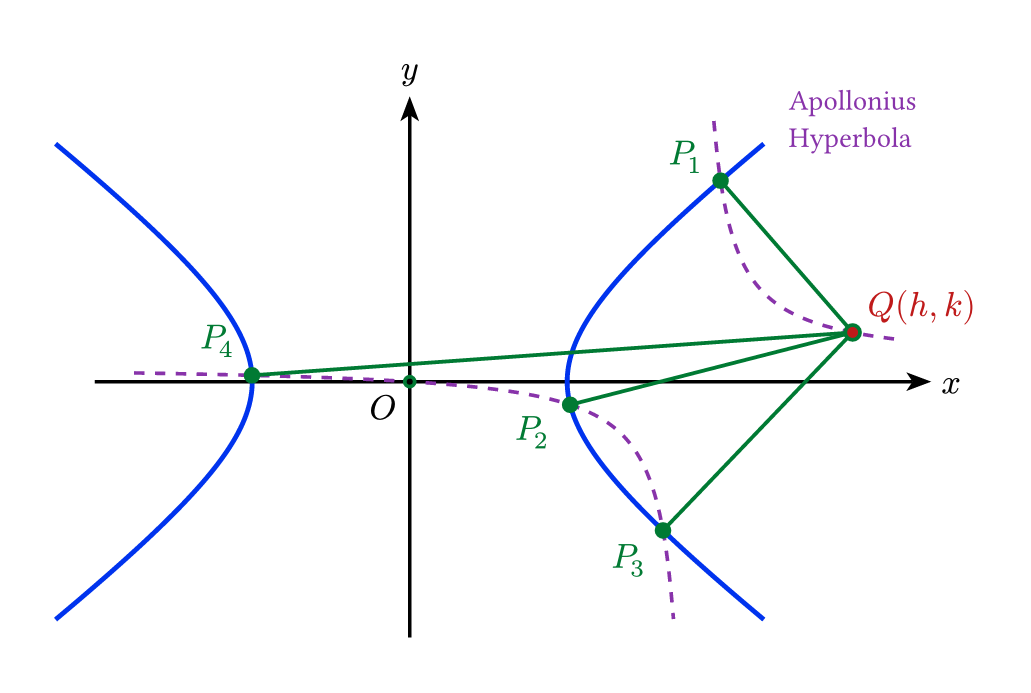
Properties of Co-normal Points on the Standard Hyperbola
Sum of the Eccentric Angles
Let \(t_1, t_2, t_3, t_4\) be the roots of the normal quartic:
By Vieta's formulas:
Recall the tangent-of-sum identity for four angles \(\alpha_i = \frac{\theta_i}{2}\) (where \(t_i = \tan\alpha_i\)):
Substituting \(S_2 = 0\) and \(S_4 = -1\):
Since the denominator vanishes (while \(S_1 - S_3 = -\frac{4ah}{bk} \neq 0\) for \(h \neq 0\)), the tangent tends to infinity, which means:
Multiplying by \(2\) yields the central eccentric-angle theorem:
Theorem:
The sum of the eccentric angles of four co-normal points on a hyperbola is always an odd multiple of \(\pi\)—the exact same condition as for an ellipse.
Co-normal Points on the Rectangular Hyperbola
The co-normal theory becomes extraordinarily clean for the rectangular hyperbola:
From Section 10, the normal at \(P\left(ct, \frac{c}{t}\right)\) is \(xt^3 - yt = c(t^4 - 1)\). If this normal passes through \(Q(h, k)\), then:
Let \(t_1, t_2, t_3, t_4\) be the parameters of the four co-normal points \(P_i\left(ct_i, \frac{c}{t_i}\right)\). Applying Vieta's formulas directly to this quartic gives four powerful identities:
1. Product of parameters:
2. Sum of parameters and sum of abscissae:
3. Sum of pairwise products:
4. Sum of reciprocal parameters and sum of ordinates:
From Vieta's third relation, \(\sum t_i t_j t_k = -\frac{k}{c}\). Dividing by \(t_1 t_2 t_3 t_4 = -1\):
Three Immediate Geometric Corollaries for xy = c^2
Corollary 1: Centroid of the Four Co-normal Points
From \(\sum x_i = h\) and \(\sum y_i = k\), the centroid \(G(\bar{x}, \bar{y})\) of the four co-normal feet is simply one-quarter of \(Q(h, k)\):
Corollary 2: Sum of Squares of Coordinates
Using \(\sum t_i^2 = \left(\sum t_i\right)^2 - 2\sum t_i t_j\) with \(\sum t_i t_j = 0\):
Similarly, since \(\sum \frac{1}{t_i t_j} = \frac{\sum t_i t_j}{t_1 t_2 t_3 t_4} = \frac{0}{-1} = 0\):
Adding the two gives a remarkable distance identity: the sum of the squares of the distances of the four co-normal feet from the center \(O\) equals \(OQ^2\):
Corollary 3: Co-normal vs. Concyclic Points (Antipodal Circle Theorem)
Recall from Section 10 that four points on \(xy = c^2\) are concyclic if and only if \(t_1 t_2 t_3 t_4 = +1\), whereas four co-normal points satisfy \(t_1 t_2 t_3 t_4 = -1\).
Suppose \(P_1, P_2, P_3, P_4\) are co-normal on \(xy = c^2\), and draw the circle passing through any three of them, say \(P_2, P_3, P_4\). Let this circle meet \(xy = c^2\) again at a fourth point \(P'(t')\).
- Since \(P_2, P_3, P_4, P'\) are concyclic: \(t_2 t_3 t_4 t' = +1\).
- Since \(P_1, P_2, P_3, P_4\) are co-normal: \(t_1 t_2 t_3 t_4 = -1 \implies t_2 t_3 t_4 = -\frac{1}{t_1}\).
Substituting into the concyclic condition:
Thus \(P' = \left(-ct_1, -\frac{c}{t_1}\right) = -P_1\): the circle through any three co-normal points on \(xy = c^2\) meets the hyperbola again at the point diametrically opposite to the fourth co-normal point!
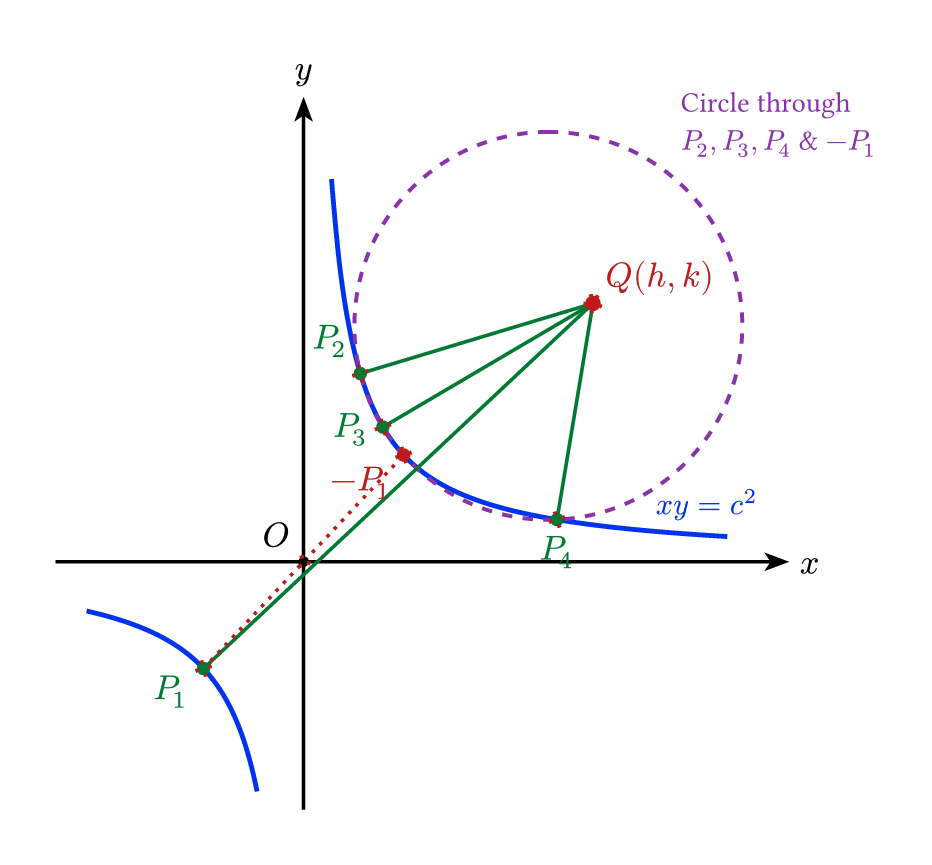
Number of Real Normals and the Evolute
Although the normal equation has degree 4, not all four roots are always real. Because complex roots of a real polynomial come in conjugate pairs, the number of real normals from \(Q(h, k)\) to \(\frac{x^2}{a^2} - \frac{y^2}{b^2} = 1\) must be either 4, 2, or 3 (on the boundary where two roots coincide).
(Unlike a parabola or ellipse, you can always draw at least 2 real normals to a hyperbola from any point in the plane, because every continuous branch has a point of minimum distance from \(Q\)—one on the left branch and one on the right branch!)
Derivation of the Boundary Curve (The Evolute)
Two normals coincide when the function:
has a repeated root, meaning both \(f(\theta) = 0\) and \(f'(\theta) = 0\) hold simultaneously. Differentiating with respect to \(\theta\):
Substitute \(bk = -ah\sin^3\theta\) back into \(f(\theta) = 0\):
Thus we have both trigonometric powers cleanly isolated:
Eliminating \(\theta\) using the identity \(\cos^2\theta + \sin^2\theta = 1\):
Multiplying through by \((ah)^{2/3}\) and replacing \((h, k)\) by \((x, y)\) gives the equation of the evolute (boundary curve) of the hyperbola:
(Compare this with the ellipse's closed 4-cusped astroid \((ax)^{2/3} + (by)^{2/3} = (a^2 - b^2)^{2/3}\): replacing \(b^2\) by \(-b^2\) opens the astroid into two symmetric 1-cusped branches with sharp cusps on the \(x\)-axis at \(x = \pm \frac{a^2 + b^2}{a}\)!)
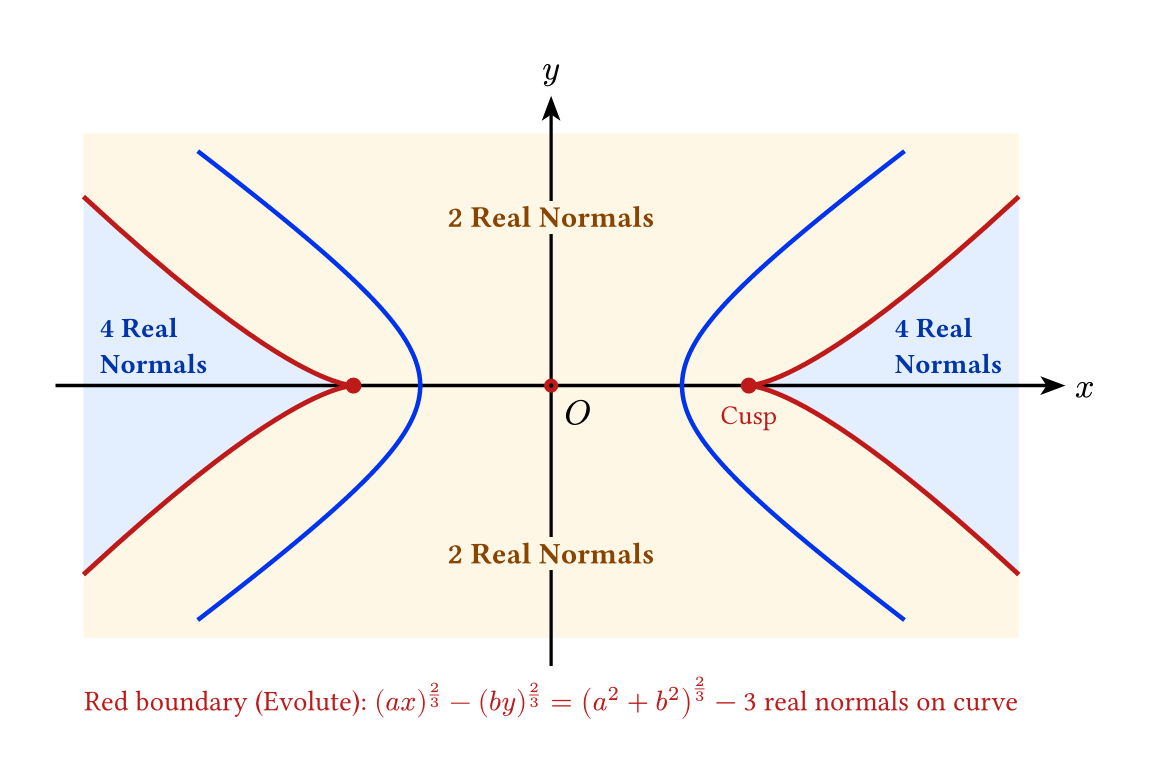
The Normal Regions of the Plane
The evolute divides the entire coordinate plane into regions determined by the sign of \((a|h|)^{2/3} - (b|k|)^{2/3} - (a^2 + b^2)^{2/3}\):
- Inside either evolute cusp — \((a|h|)^{2/3} - (b|k|)^{2/3} > (a^2 + b^2)^{2/3}\): 4 distinct real normals (3 to the nearer branch and 1 to the farther branch).
- On the evolute curve (excluding the two cusps) — \((a|h|)^{2/3} - (b|k|)^{2/3} = (a^2 + b^2)^{2/3}\): 3 distinct real normals (two of the four coincide).
- Between the two evolute branches — \((a|h|)^{2/3} - (b|k|)^{2/3} < (a^2 + b^2)^{2/3}\) (or at the two cusps themselves): 2 distinct real normals (one to each branch).
Slope Form of the Normal and the Slope Quartic
Recall from Section 08 that a normal of slope \(m\) (\(|m| < \frac{a}{b}\)) to \(\frac{x^2}{a^2} - \frac{y^2}{b^2} = 1\) has the equation:
If this normal passes through \(Q(h, k)\), then:
Squaring both sides and expanding gives the slope quartic for the four concurrent normals from \((h, k)\):
If \(m_1, m_2, m_3, m_4\) are the slopes of the four normals drawn from \(Q(h, k)\), Vieta's formulas immediately yield:
Illustrative Examples
Example 1: Finding the Fourth Co-normal Eccentric Angle
The normals at three points on a hyperbola with eccentric angles \(\theta_1 = \frac{\pi}{6}\), \(\theta_2 = \frac{\pi}{4}\), and \(\theta_3 = \frac{\pi}{3}\) are concurrent. Find the eccentric angle \(\theta_4 \in [0, 2\pi)\) of the fourth co-normal point.
Solution:
For four co-normal points on a hyperbola, the sum of their eccentric angles is an odd multiple of \(\pi\):
First compute the sum of the three given angles:
Now solve for \(\theta_4 \in [0, 2\pi)\):
- Taking \(n = 0\) (sum \(= \pi\)): \(\theta_4 = \pi - \frac{3\pi}{4} = \frac{\pi}{4}\) (which coincides with \(\theta_2\), so it does not give a distinct fourth point unless \(\theta_2\) is a repeated foot).
- Taking \(n = 1\) (sum \(= 3\pi\)): \(\theta_4 = 3\pi - \frac{3\pi}{4} = \frac{9\pi}{4} \equiv \frac{\pi}{4} \pmod{2\pi}\).
Hence \(\theta_4 = \frac{\pi}{4}\) (which tells us that for these three concurrent normals, the normal at \(\theta = \frac{\pi}{4}\) is a double normal, meaning the point of concurrency lies on the evolute!).
Example 2: Centroid and Sum of Squares for Co-normal Points on xy = c^2
Four normals are drawn from the point \(Q(8, 12)\) to the rectangular hyperbola \(xy = 9\). Find:
- The centroid of the four co-normal feet.
- The sum of the squares of the distances of the four feet from the origin.
Solution:
Here \(c^2 = 9\) and \((h, k) = (8, 12)\). The four co-normal parameters satisfy \(3t^4 - 8t^3 + 12t - 3 = 0\).
1. Centroid \(G\):
By Corollary 1, \(\sum x_i = h = 8\) and \(\sum y_i = k = 12\), so:
2. Sum of squares of distances from the origin:
By Corollary 2, \(\sum x_i^2 = h^2\) and \(\sum y_i^2 = k^2\):
Example 3: Counting Real Normals from Given Points
Determine the number of distinct real normals that can be drawn to the hyperbola \(\frac{x^2}{9} - \frac{y^2}{16} = 1\) from each of the following points:
- \(A(10, 0)\)
- \(B(8, 0)\)
- \(C(0, 5)\)
Solution:
Here \(a = 3\), \(b = 4\), and \(a^2 + b^2 = 9 + 16 = 25\).
The evolute boundary is \((3|x|)^{2/3} - (4|y|)^{2/3} = 25^{2/3}\), and its two cusps on the \(x\)-axis lie at:
1. For \(A(10, 0)\):
Evaluate \((3|x|)^{2/3} - (4|y|)^{2/3} = 30^{2/3} - 0 = 30^{2/3} > 25^{2/3}\).
Since \(A(10, 0)\) lies strictly inside the right evolute cusp (\(10 > \frac{25}{3}\)), 4 distinct real normals can be drawn from \(A(10, 0)\).
2. For \(B(8, 0)\):
Here \(3|x| = 24 < 25\), so \(24^{2/3} < 25^{2/3}\).
Since \(B(8, 0)\) lies between the two evolute cusps (\(|8| < \frac{25}{3}\)), only 2 distinct real normals can be drawn from \(B(8, 0)\) (in fact, both lie along the \(x\)-axis itself, hitting the two vertices \((3, 0)\) and \((-3, 0)\)!).
3. For \(C(0, 5)\):
Here \((3|0|)^{2/3} - (4|5|)^{2/3} = -20^{2/3} < 25^{2/3}\).
Hence 2 distinct real normals can be drawn from \(C(0, 5)\) (one to the right branch and one symmetrically to the left branch).
Example 4: Using the Antipodal Circle Property
The normals at three points \(P_1, P_2, P_3\) on the rectangular hyperbola \(xy = 4\) are concurrent at a point \(Q\), and the fourth co-normal foot is \(P_4(4, 1)\). Find the fourth point of intersection of the circle passing through \(P_1, P_2, P_3\) with the hyperbola \(xy = 4\).
Solution:
By Corollary 3 (the Antipodal Circle Theorem), the circle passing through any three co-normal points \(P_1, P_2, P_3\) on \(xy = c^2\) intersects the hyperbola again at the point diametrically opposite to the fourth co-normal point \(P_4\):
(Quick check: \(P_4(4, 1)\) has \(c = 2\) and \(t_4 = 2\), so \(P'\) has \(t' = -t_4 = -2\), giving \((-4, -1)\) on \(xy = 4\).)
General Synthesis and Locus Problems
Problem 1: Normals Drawn from a Point on the Transverse Axis
Prove directly (without using the evolute formula) that from a point \(Q(h, 0)\) on the transverse axis of \(\frac{x^2}{a^2} - \frac{y^2}{b^2} = 1\), four distinct real normals can be drawn if and only if \(|h| > \frac{a^2 + b^2}{a}\).
Solution:
The normal at a point \((x_1, y_1)\) on the hyperbola in Cartesian form is \(\frac{a^2 x}{x_1} + \frac{b^2 y}{y_1} = a^2 + b^2\). Clearing denominators gives \(a^2 x y_1 + b^2 y x_1 = (a^2 + b^2)x_1 y_1\). Substituting \(Q(h, 0)\) yields:
This splits cleanly into two cases:
- Case A (\(y_1 = 0\)): This gives the two vertices \(x_1 = \pm a\) (two real normals along the \(x\)-axis, which always exist for every \(h\)).
- Case B (\(y_1 \neq 0\)): Here \(x_1 = \frac{a^2 h}{a^2 + b^2}\). For \((x_1, y_1)\) to be a real point on the hyperbola \(\frac{x_1^2}{a^2} - \frac{y_1^2}{b^2} = 1\) with \(y_1 \neq 0\), we require \(|x_1| > a\):
When \(|h| > \frac{a^2 + b^2}{a}\), Case B yields two additional symmetric real feet \(\left(x_1, \pm y_1\right)\), making 4 distinct real normals in total. When \(|h| \le \frac{a^2 + b^2}{a}\), Case B gives no new real feet, leaving only the 2 vertex normals! \(\blacksquare\)
Problem 2: Locus of Intersection of Two Perpendicular Normals to xy = c^2
Find the locus of the point of intersection \(Q(h, k)\) of two mutually perpendicular normals to the rectangular hyperbola \(xy = c^2\).
Solution:
Recall from Section 10 that the normal to \(xy = c^2\) at \(P(ct, c/t)\) has slope \(m_N = t^2\).
Since \(t^2 > 0\) for every real \(t \neq 0\), every normal to \(xy = c^2\) has a strictly positive slope!
Can two lines with positive slopes ever be perpendicular? For perpendicular lines, we need \(m_1 m_2 = -1\):
Because \(t_1^2 t_2^2 = (t_1 t_2)^2 > 0\) for all real \(t_1, t_2 \neq 0\), the equation \(t_1^2 t_2^2 = -1\) has no real solutions!
Therefore, no two normals to a rectangular hyperbola \(xy = c^2\) can ever be perpendicular—the locus is the empty set! (Contrast this with a general hyperbola \(\frac{x^2}{a^2} - \frac{y^2}{b^2} = 1\), where normal slopes lie in \(\left(-\frac{a}{b}, \frac{a}{b}\right)\); perpendicular normals \(m_1 m_2 = -1\) require \(|m_1|, |m_2|\) to be able to straddle \(1\), which is possible if and only if \(\frac{a}{b} > 1\), i.e. \(a > b\)!)
Problem 3: Locus of Point of Concurrency When Two Co-normal Feet on xy = c^2 Are Related
If the normals at \(P_1(t_1), P_2(t_2), P_3(t_3), P_4(t_4)\) on \(xy = c^2\) are concurrent at \(Q(h, k)\), and the chord \(P_1 P_2\) has a constant slope \(m = -\lambda\) (\(\lambda > 0\)), find the locus of \(Q(h, k)\).
Solution:
From Section 10, the slope of the chord joining \(P_1(t_1)\) and \(P_2(t_2)\) on \(xy = c^2\) is \(-\frac{1}{t_1 t_2}\). Given that this slope equals \(-\lambda\):
Since \(P_1, P_2, P_3, P_4\) are co-normal at \(Q(h, k)\), they satisfy \(t_1 t_2 t_3 t_4 = -1\), so:
Now let \(u = t_1 + t_2\) and \(v = t_3 + t_4\). From the co-normal Vieta relations for \(ct^4 - ht^3 + kt - c = 0\):
1. Sum of roots:
2. Pairwise product sum (\(\sum t_i t_j = 0\)):
3. Sum of triple products (\(\sum t_i t_j t_k = -\frac{k}{c}\)):
Solve the linear system (1) and (3) for \(u\) and \(v\):
From (1), \(v = \frac{h}{c} - u\). Substituting into (3):
Then from (1):
Finally, substitute \(u\) and \(v\) into equation (2), \(uv = \lambda - \frac{1}{\lambda} = \frac{\lambda^2 - 1}{\lambda}\):
Replacing \((h, k)\) by \((x, y)\), the required locus of \(Q\) is the rectangular hyperbola:
Summary of Key Formulae and Results
| Concept / Result | Standard Hyperbola \(\frac{x^2}{a^2} - \frac{y^2}{b^2} = 1\) | Rectangular Hyperbola \(xy = c^2\) |
|---|---|---|
| Maximum Real Normals from \(Q(h, k)\) | \(4\) (minimum \(2\)) | \(4\) (minimum \(2\)) |
| Co-normal Parameter Condition | \(\theta_1 + \theta_2 + \theta_3 + \theta_4 = (2n + 1)\pi\) | \(t_1 t_2 t_3 t_4 = -1\) |
| Apollonius Curve Passing Through Feet | \((a^2 + b^2)xy - b^2 k x - a^2 h y = 0\) | \(ct^4 - ht^3 + kt - c = 0\) |
| Centroid of Four Co-normal Feet | Depends on \(a, b, h, k\) | \(\left(\frac{h}{4}, \frac{k}{4}\right)\) |
| Distance-Squared Identity | — | \(\sum x_i^2 = h^2,\; \sum y_i^2 = k^2,\; \sum OP_i^2 = OQ^2\) |
| Co-normal vs. Concyclic Product | Co-normal: \(\sum\theta_i = (2n+1)\pi\) | Co-normal: \(\prod t_i = -1\); Concyclic: \(\prod t_i = +1\) |
| Circle Through 3 Co-normal Feet | — | Meets \(xy = c^2\) again at \(-P_4\) (antipodal point) |
| Evolute (Boundary Curve) | \((ax)^{2/3} - (by)^{2/3} = (a^2 + b^2)^{2/3}\) | \((x + y)^{2/3} - (x - y)^{2/3} = (4c)^{2/3}\) |
| Slope Quartic Vieta Relations | \(\sum m_i = \frac{2k}{h},\; \prod m_i = -\frac{a^2 k^2}{b^2 h^2}\) | Every normal has slope \(m_N = t^2 > 0\) |