Transformation of Hyperbola
So far, we have studied hyperbolas whose center lies at the origin \((0, 0)\) and whose transverse and conjugate axes lie along the coordinate axes. In this section, we see what happens when a hyperbola is shifted to a new center \((h, k)\) or tilted at an angle in the plane.
1. Translation of Axes: Shifted Hyperbola with Center (h, k)
Suppose we take a standard hyperbola and shift its center from \((0, 0)\) to \((h, k)\) without rotating it, so its axes remain parallel to the coordinate axes.
By translating the origin to \((h, k)\) via the substitution
every standard formula in \((X, Y)\) carries over directly to \((x, y)\).
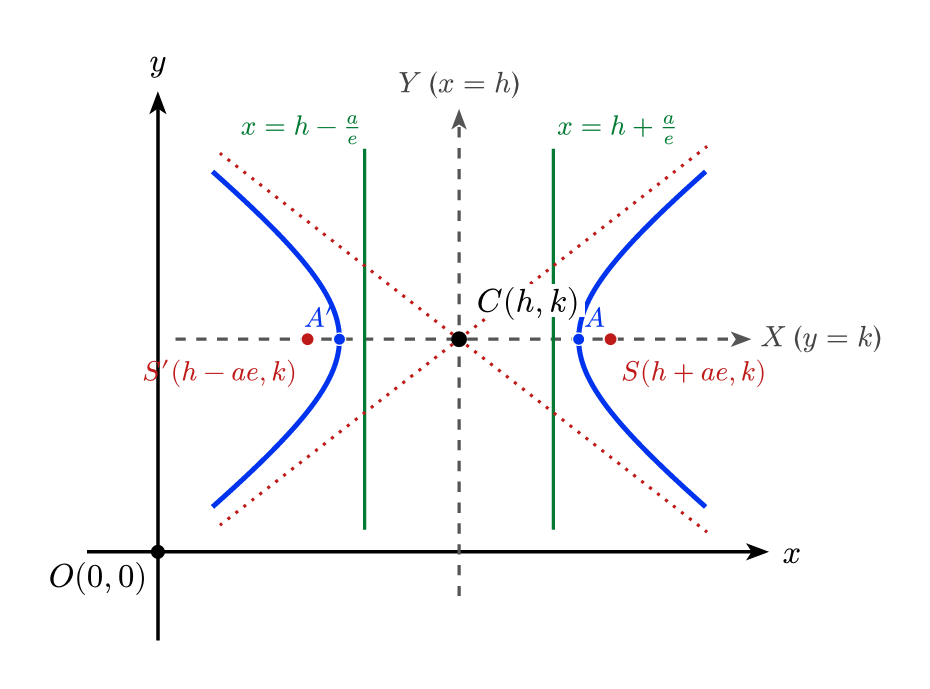
Case I: Shifted Horizontal Hyperbola
When the transverse axis is parallel to the \(x\)-axis, the equation is
Comparing with the standard horizontal hyperbola \(\frac{X^2}{a^2} - \frac{Y^2}{b^2} = 1\):
- Center: \((X, Y) = (0, 0) \implies C(h, k)\)
- Transverse Axis: \(Y = 0 \implies y = k\), of length \(2a\)
- Conjugate Axis: \(X = 0 \implies x = h\), of length \(2b\)
- Vertices: \((X, Y) = (\pm a, 0) \implies A(h + a, k)\) and \(A'(h - a, k)\)
- Eccentricity:
- Foci: \((X, Y) = (\pm ae, 0) \implies S(h + ae, k)\) and \(S'(h - ae, k)\)
- Directrices: \(X = \pm \frac{a}{e} \implies x = h \pm \frac{a}{e}\)
- Length of Latus Rectum: \(\frac{2b^2}{a}\)
- Ends of Latera Recta: \(\left(h \pm ae,\; k \pm \frac{b^2}{a}\right)\)
- Asymptotes: \(\frac{X}{a} \pm \frac{Y}{b} = 0 \implies y - k = \pm \frac{b}{a}(x - h)\)
Case II: Shifted Vertical Hyperbola
When the transverse axis is parallel to the \(y\)-axis, the \((y - k)^2\) term is positive and the \((x - h)^2\) term is negative:
Comparing with the standard vertical hyperbola \(\frac{Y^2}{b^2} - \frac{X^2}{a^2} = 1\):
- Center: \(C(h, k)\)
- Transverse Axis: \(X = 0 \implies x = h\), of length \(2b\)
- Conjugate Axis: \(Y = 0 \implies y = k\), of length \(2a\)
- Vertices: \((X, Y) = (0, \pm b) \implies B(h, k + b)\) and \(B'(h, k - b)\)
- Eccentricity:
- Foci: \((X, Y) = (0, \pm be) \implies S(h, k + be)\) and \(S'(h, k - be)\)
- Directrices: \(Y = \pm \frac{b}{e} \implies y = k \pm \frac{b}{e}\)
- Length of Latus Rectum: \(\frac{2a^2}{b}\)
- Ends of Latera Recta: \(\left(h \pm \frac{a^2}{b},\; k \pm be\right)\)
- Asymptotes: \(\frac{Y}{b} \pm \frac{X}{a} = 0 \implies y - k = \pm \frac{b}{a}(x - h)\)
Conjugate of a Shifted Hyperbola: Just as at the origin, replacing \(1\) on the right-hand side by \(-1\) turns a shifted horizontal hyperbola into its shifted conjugate vertical hyperbola (and vice versa), sharing the exact same center \((h, k)\) and asymptotes \(y - k = \pm \frac{b}{a}(x - h)\).
2. Reduction of General Axis-Parallel Equations (Completing Squares)
Any hyperbola whose axes are parallel to the coordinate axes has a second-degree equation with no \(xy\)-term:
Notice the condition \(AB < 0\): the coefficients of \(x^2\) and \(y^2\) must have opposite signs (whereas for an ellipse they have the same sign).
To identify the hyperbola, complete the squares in \(x\) and \(y\):
where \(\Delta' = \frac{g^2}{A} + \frac{f^2}{B} - c\).
Suppose \(A > 0\) and \(B < 0\). Depending on the sign of \(\Delta'\), three distinct outcomes occur:
- If \(\Delta' > 0\): Dividing both sides by \(\Delta'\) keeps the \(x\)-term positive and the \(y\)-term negative, giving a shifted horizontal hyperbola.
- If \(\Delta' < 0\): Dividing both sides by the negative number \(\Delta'\) flips the signs of both terms—making the \((y - k)^2\) term positive and the \((x - h)^2\) term negative! This gives a shifted vertical hyperbola. (Be careful: for an ellipse, \(\Delta' < 0\) meant an imaginary curve, but for a hyperbola, \(\Delta' < 0\) is a perfectly real vertical hyperbola!)
- If \(\Delta' = 0\): The equation factors into two linear equations, representing a pair of intersecting straight lines (a degenerate hyperbola consisting only of its asymptotes).
3. Examples on Shifted Horizontal and Vertical Hyperbolas
Example 1: Shifted Horizontal Hyperbola via Completing Squares
Reduce the equation \(9x^2 - 16y^2 - 36x - 32y - 124 = 0\) to standard form and find its center, vertices, eccentricity, foci, directrices, length of latus rectum, and asymptotes.
Solution:
Group the \(x\)-terms and \(y\)-terms together and move the constant to the right-hand side:
Complete the squares inside each bracket:
Divide both sides by \(144\):
Since the \((x - 2)^2\) term is positive, this is a shifted horizontal hyperbola with:
- \(h = 2,\; k = -1\)
- \(a^2 = 16 \implies a = 4\)
- \(b^2 = 9 \implies b = 3\)
Now compute the remaining parameters:
- Center: \(C(2, -1)\)
- Transverse Axis: \(y = -1\) (length \(2a = 8\)); Conjugate Axis: \(x = 2\) (length \(2b = 6\))
- Vertices: \((h \pm a, k) = (2 \pm 4, -1)\), i.e., \(A(6, -1)\) and \(A'(-2, -1)\)
- Eccentricity:
- Foci: Since \(ae = 4 \cdot \frac{5}{4} = 5\), the foci are \((h \pm ae, k) = (2 \pm 5, -1)\), i.e., \(S(7, -1)\) and \(S'(-3, -1)\)
- Directrices: \(x = h \pm \frac{a}{e} = 2 \pm \frac{16}{5}\), i.e., \(x = \frac{26}{5}\) and \(x = -\frac{6}{5}\)
- Length of Latus Rectum: \(\frac{2b^2}{a} = \frac{2(9)}{4} = \frac{9}{2}\)
- Asymptotes:
Example 2: Shifted Vertical Hyperbola via Completing Squares (Sign-Flip Case)
Find the center, eccentricity, vertices, foci, directrices, latus rectum, and asymptotes of the hyperbola
Solution:
Notice that \(x^2\) has a positive coefficient (\(+4\)) and \(y^2\) has a negative coefficient (\(-9\)), so do not jump to conclusions about orientation before completing the square!
Group the \(x\)-terms and \(y\)-terms:
Complete the squares:
Because the right-hand side is negative (\(-36\)), dividing by \(-36\) flips the signs of both terms:
Now the \((y + 3)^2\) term is positive, so this is a shifted vertical hyperbola with:
- \(h = 2,\; k = -3\)
- \(b^2 = 4 \implies b = 2\) (semi-transverse axis)
- \(a^2 = 9 \implies a = 3\) (semi-conjugate axis)
Computing all features:
- Center: \(C(2, -3)\)
- Transverse Axis: \(x = 2\) (length \(2b = 4\)); Conjugate Axis: \(y = -3\) (length \(2a = 6\))
- Vertices: \((h, k \pm b) = (2, -3 \pm 2)\), i.e., \(B(2, -1)\) and \(B'(2, -5)\)
- Eccentricity:
- Foci: Since \(be = 2 \cdot \frac{\sqrt{13}}{2} = \sqrt{13}\), the foci are \((2, -3 \pm \sqrt{13})\)
- Directrices: \(y = k \pm \frac{b}{e} = -3 \pm \frac{4}{\sqrt{13}}\)
- Length of Latus Rectum: \(\frac{2a^2}{b} = \frac{2(9)}{2} = 9\)
- Asymptotes:
Example 3: Constructing a Shifted Hyperbola from Geometric Data
Find the equation of the hyperbola whose foci are \((2, 7)\) and \((2, -3)\), and whose transverse axis has length \(6\). Also find its asymptotes.
Solution:
- Orientation and Center: Both foci \((2, 7)\) and \((2, -3)\) share the same \(x\)-coordinate (\(x = 2\)), so the transverse axis is vertical along \(x = 2\). The center \(C(h, k)\) is the midpoint of the foci:
- Parameters \(b\), \(e\), and \(a\):
- The transverse axis has length \(2b = 6 \implies b = 3\).
- The distance between the foci is \(SS' = 2be = 7 - (-3) = 10 \implies be = 5\).
- Therefore, \(e = \frac{5}{3}\), and using \(a^2 = b^2(e^2 - 1)\) (or \(b^2 e^2 = b^2 + a^2\)):
- Equation of the Hyperbola:
- Asymptotes: Setting the right-hand side to \(0\):
4. Oblique (Tilted) Hyperbolas and Geometric Invariants
When a hyperbola's transverse axis is neither horizontal nor vertical, its general second-degree equation
contains an \(xy\)-term (\(h \neq 0\)), and satisfies the hyperbola condition \(h^2 - ab > 0\) (with \(\Delta \neq 0\)). One way to handle such equations is to rotate the coordinate axes through an angle \(\theta\) satisfying \(\tan 2\theta = \frac{2h}{a - b}\) to eliminate the \(xy\)-term.
However, when you are given geometric information (such as a focus, vertex, center, directrix, or eccentricity) for an oblique hyperbola, rotating axes is rarely necessary. Instead, we use coordinate-free geometric invariants along the transverse axis!
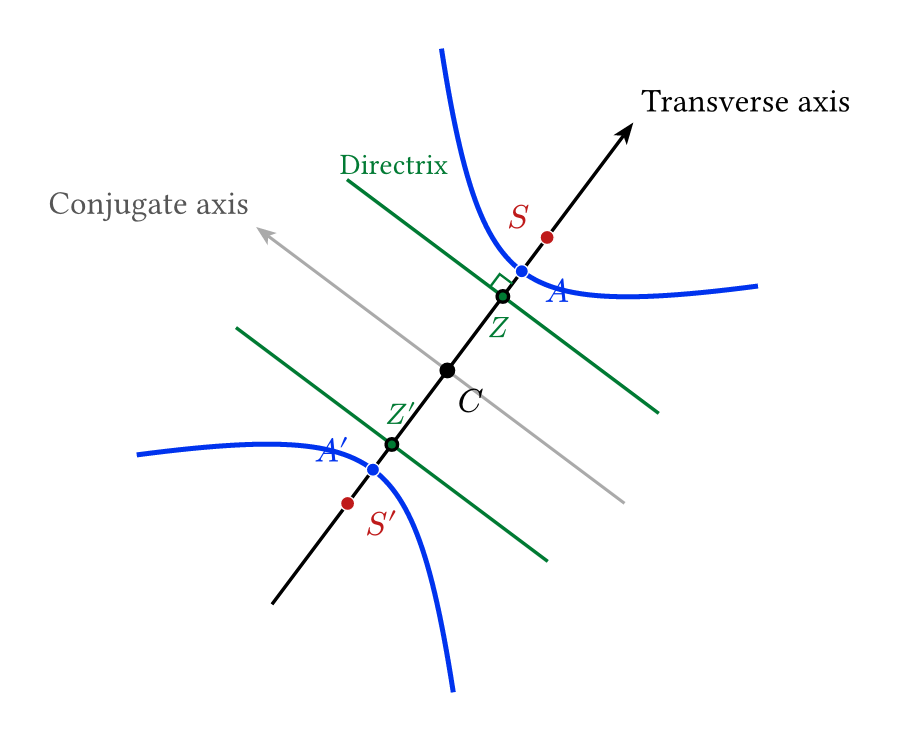
Key Geometric Invariants Along the Transverse Axis
Because \(e > 1\) for a hyperbola, we always have \(\frac{a}{e} < a < ae\). As a result, the seven key points on the transverse axis appear in the fixed symmetric order:
(Notice how this differs from an ellipse, where \(e < 1\) puts the foci inside the vertices!)
From this geometry, the following coordinate-free relations hold regardless of tilt:
- Distances from the Center \(C\):
- Distance to either foot of the directrix: \(CZ = CZ' = \frac{a}{e}\)
- Distance to either vertex: \(CA = CA' = a\)
- Distance to either focus: \(CS = CS' = ae\)
-
Crucial product: \(CS \cdot CZ = (ae)\left(\frac{a}{e}\right) = a^2\)
-
Distances Between Focus and Vertices:
- Distance from a focus to the nearer vertex: \(SA = ae - a = a(e - 1)\)
- Distance from a focus to the farther vertex: \(S'A = ae + a = a(e + 1)\)
-
Semi-conjugate axis relation: \(b^2 = a^2(e^2 - 1) = a(e - 1)\cdot a(e + 1) = SA \cdot S'A\)
-
Vector Stepping Along the Axis: If \(\hat{u} = (\cos\alpha, \sin\alpha)\) is the unit vector pointing along the transverse axis from \(C\) toward \(S\), then any point at signed distance \(d\) from \(C\) is simply
-
Directrices: Each directrix is perpendicular to the transverse axis \(\hat{u}\) and passes through \(Z\) or \(Z'\). If \(\hat{u} = (u_x, u_y)\), any line perpendicular to \(\hat{u}\) has the form \(u_x x + u_y y = \text{constant}\).
-
Cartesian Equation Directly from Definition: Once a focus \(S(x_0, y_0)\), its corresponding directrix \(lx + my + n = 0\), and the eccentricity \(e\) are known, the equation of the hyperbola is immediately obtained from \(SP = e \cdot PM\):
Let us apply these invariants in two complete oblique hyperbola problems.
Example 4: Oblique Hyperbola from Focus, Nearer Vertex, and Eccentricity
A hyperbola has focus \(S(10, 13)\), nearer vertex \(A(4, 5)\), and eccentricity \(e = 2\). Geometrically determine its center, the other vertex, the other focus, the equations of its transverse and conjugate axes, the equations of both directrices, and the length of its latus rectum.
Solution:
- Find the unit direction vector \(\hat{u}\) and semi-transverse axis \(a\): The vector from the nearer vertex \(A(4, 5)\) to the focus \(S(10, 13)\) points along the transverse axis:
Its length is
Since \(A\) is the vertex nearer to \(S\), the distance \(AS\) equals \(a(e - 1)\):
The unit vector along the transverse axis (pointing from \(C\) toward \(A\) and \(S\)) is
Also, \(ae = 10(2) = 20\) and \(b^2 = a^2(e^2 - 1) = 100(4 - 1) = 300 \implies b = 10\sqrt{3}\).
- Find the Center \(C\), Other Vertex \(A'\), and Other Focus \(S'\): Stepping backwards from \(A\) by distance \(CA = a = 10\) along \(-\hat{u}\) gives the center \(C\):
By symmetry about \(C\):
- Other vertex \(A'\): \(A' = C - 10\hat{u} = (-2, -3) - (6, 8) = (-8, -11)\)
-
Other focus \(S'\): \(S' = C - 20\hat{u} = (-2, -3) - (12, 16) = (-14, -19)\)
-
Find the Transverse and Conjugate Axes:
- Transverse axis: Passes through \(C(-2, -3)\) and \(A(4, 5)\), with slope \(\frac{5 - (-3)}{4 - (-2)} = \frac{8}{6} = \frac{4}{3}\):
- Conjugate axis: Passes through \(C(-2, -3)\) and is perpendicular to the transverse axis, so its slope is \(-\frac{3}{4}\):
- Find Both Directrices: The distance from \(C\) to the foot of each directrix is \(CZ = \frac{a}{e} = \frac{10}{2} = 5\). Stepping \(\pm 5\hat{u} = \pm (3, 4)\) from \(C(-2, -3)\) gives the two feet:
Each directrix is perpendicular to \(\hat{u} = \left(\frac{3}{5}, \frac{4}{5}\right)\), so both have the form \(3x + 4y = k\):
- Directrix corresponding to \(S\) (passing through \(Z(1, 1)\)): \(3(1) + 4(1) = 7 \implies 3x + 4y = 7\).
-
Directrix corresponding to \(S'\) (passing through \(Z'(-5, -7)\)): \(3(-5) + 4(-7) = -43 \implies 3x + 4y = -43\).
-
Length of the Latus Rectum:
Example 5: Oblique Hyperbola from Center, One Focus, and Corresponding Directrix
An oblique hyperbola has center \(C(1, 2)\), one focus at \(S(11, 26)\), and the corresponding directrix \(5x + 12y - 79 = 0\). Find its eccentricity, the lengths of its transverse and conjugate axes, the other focus, the other directrix, both vertices, the length of the latus rectum, and the Cartesian equation of the hyperbola.
Solution:
- Compute \(CS = ae\) and \(CZ = \frac{a}{e}\):
- Distance from center \(C(1, 2)\) to focus \(S(11, 26)\):
- Perpendicular distance from center \(C(1, 2)\) to the directrix \(5x + 12y - 79 = 0\):
- Find \(a\), \(e\), and \(b\): Multiply the two invariants to eliminate \(e\):
Now divide to find \(e\):
And find \(b\) using \(b^2 = (ae)^2 - a^2\):
Therefore, the transverse axis has length \(2a = 20\) and the conjugate axis has length \(2b = 48\).
- Find the Other Focus \(S'\) and Other Directrix:
- Since \(C(1, 2)\) is the midpoint of \(SS'\):
- The other directrix is parallel to \(5x + 12y - 79 = 0\), so it has the form \(5x + 12y + \lambda = 0\). Because \(C(1, 2)\) lies midway between the two parallel directrices, the signed value of \(5x + 12y + \lambda\) at \(C(1, 2)\) must be the negative of \(5(1) + 12(2) - 79 = -50\):
So the other directrix is \(5x + 12y + 21 = 0\).
- Find Both Vertices \(A\) and \(A'\): The unit vector from \(C(1, 2)\) toward \(S(11, 26)\) is
Stepping \(\pm a\hat{u} = \pm 10\left(\frac{5}{13}, \frac{12}{13}\right) = \pm \left(\frac{50}{13}, \frac{120}{13}\right)\) from \(C(1, 2)\):
- Length of the Latus Rectum:
- Cartesian Equation of the Hyperbola: Using \(SP^2 = e^2 \cdot PM^2\) with \(S(11, 26)\), directrix \(5x + 12y - 79 = 0\), and \(e = \frac{13}{5}\):
Notice how \(13^2 = 169\) cancels with \(5^2 + 12^2 = 169\):
(Notice that expanding this produces an \(xy\)-term, confirming the hyperbola is genuinely tilted!)
5. Quick Reference Summary
| Feature | Shifted Horizontal Hyperbola | Shifted Vertical Hyperbola |
|---|---|---|
| Equation | \(\dfrac{(x - h)^2}{a^2} - \dfrac{(y - k)^2}{b^2} = 1\) | \(\dfrac{(y - k)^2}{b^2} - \dfrac{(x - h)^2}{a^2} = 1\) |
| Center | \((h, k)\) | \((h, k)\) |
| Transverse Axis | \(y = k\) (length \(2a\)) | \(x = h\) (length \(2b\)) |
| Conjugate Axis | \(x = h\) (length \(2b\)) | \(y = k\) (length \(2a\)) |
| Vertices | \((h \pm a,\; k)\) | \((h,\; k \pm b)\) |
| Eccentricity (\(e\)) | \(\sqrt{1 + \dfrac{b^2}{a^2}}\) | \(\sqrt{1 + \dfrac{a^2}{b^2}}\) |
| Foci | \((h \pm ae,\; k)\) | \((h,\; k \pm be)\) |
| Directrices | \(x = h \pm \dfrac{a}{e}\) | \(y = k \pm \dfrac{b}{e}\) |
| Latus Rectum | \(\dfrac{2b^2}{a}\) | \(\dfrac{2a^2}{b}\) |
| Asymptotes | \(y - k = \pm \dfrac{b}{a}(x - h)\) | \(y - k = \pm \dfrac{b}{a}(x - h)\) |