Area Under a Curve and Between Two Curves
In Chapter 24, we discovered a remarkable geometric meaning of the definite integral: when a function \(f(x)\) is continuous and non-negative on \([a, b]\), the definite integral \(\int_a^b f(x)\,dx\) measures the exact area trapped under the curve \(y = f(x)\) and above the \(x\)-axis.
In this chapter, we turn that idea into a complete toolkit for calculating areas of plane regions bounded by curves and lines. Before jumping into formulas or slicing diagrams, let us build the intuition step by step so every formula makes complete geometric sense.
1. Area Under a Non-Negative Curve and the x-Axis
Suppose \(f(x) \ge 0\) for all \(x \in [a, b]\). Then the area \(A\) bounded by the curve \(y = f(x)\), the \(x\)-axis (\(y = 0\)), and the vertical lines \(x = a\) and \(x = b\) is:
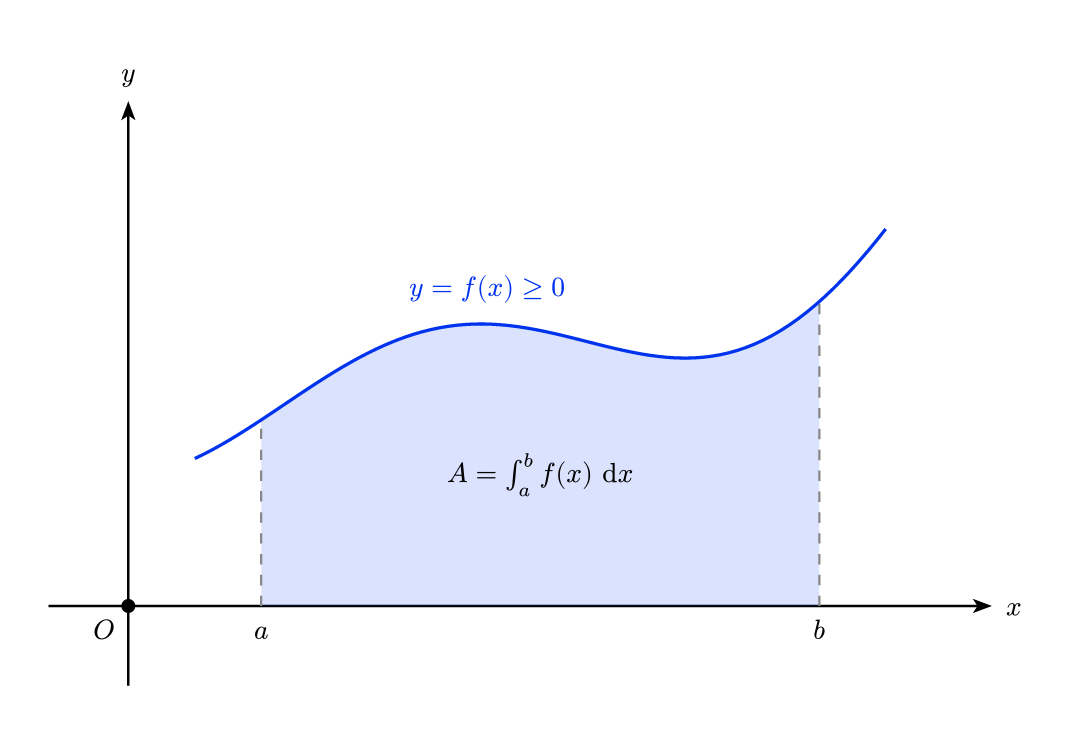
Why You Do Not Need to Draw the Graph When f(x) >= 0
Students often think that every area problem must begin with an accurate graph of the function. Let us pause and ask: why do we draw a graph in area problems in the first place?
Remember from Chapter 24 that the definite integral \(\int_a^b f(x)\,dx\) is a signed area: any portion of the curve above the \(x\)-axis contributes positively, while any portion below the \(x\)-axis contributes negatively. Normally, we sketch the graph only to find out where the curve crosses the \(x\)-axis so that we can put a minus sign on the negative pieces.
Now suppose you can verify purely from algebra that \(f(x) \ge 0\) for every \(x \in [a, b]\). For example:
- \(f(x) = x^2 + 3x + 2\) on \([0, 2]\) (all terms are positive),
- \(f(x) = \sin^2 x\) on \([0, \pi]\) (a square is always \(\ge 0\)),
- \(f(x) = e^{-x}\) on \([0, 1]\) (an exponential is always \(> 0\)),
- \(f(x) = |x - 1| + 2\) on \([-1, 3]\) (an absolute value plus a positive number is always \(> 0\)).
Because \(f(x) \ge 0\) everywhere on \([a, b]\), the curve never dips below the \(x\)-axis anywhere in that interval. Whether it rises, falls, bends, or has sharp corners, the entire region sits safely above the \(x\)-axis. Therefore, there is no need to draw the graph at all—the definite integral \(\int_a^b f(x)\,dx\) automatically gives the exact geometric area!
Example 1: Polynomial Non-Negative on the Given Interval
Find the area bounded by the curve \(y = x^2 + 3x + 2\), the \(x\)-axis, and the vertical lines \(x = 0\) and \(x = 2\).
Solution: For every \(x \in [0, 2]\), each term \(x^2\), \(3x\), and \(2\) is non-negative, so \(y = x^2 + 3x + 2 > 0\). We do not need to sketch the parabola. The area is directly:
Example 2: Trigonometric Square Without Sketching
Find the area bounded by \(y = \sin^2 x\), the \(x\)-axis, \(x = 0\), and \(x = \pi\).
Solution: Even without picturing the exact shape of \(y = \sin^2 x\), we know that \(\sin^2 x \ge 0\) for all \(x \in [0, \pi]\). Hence:
Example 3: Modulus Function Strictly Above the x-Axis
Find the area bounded by \(y = |x - 1| + 2\), the \(x\)-axis, \(x = -1\), and \(x = 3\).
Solution: Since \(|x - 1| \ge 0\), we have \(y = |x - 1| + 2 \ge 2 > 0\) for all \(x \in [-1, 3]\). No graph is required to check the sign of \(y\). We simply split the integral at \(x = 1\) to remove the absolute value sign:
Evaluating each piece:
2. Area Between a Non-Negative Curve and the y-Axis
What if a region is bounded by a curve, the \(y\)-axis (\(x = 0\)), and two horizontal lines \(y = c\) and \(y = d\)?
Suppose the curve can be written in the form \(x = g(y)\) (or equivalently \(y = f(x)\) has inverse \(x = f^{-1}(y)\)), where \(g(y) \ge 0\) for all \(y \in [c, d]\).
How do we find this area? Recall what we proved in Chapter 24 (Transformation and Equivalence of Definite Integrals) when studying inverse functions: reflect the entire picture across the line \(y = x\)!
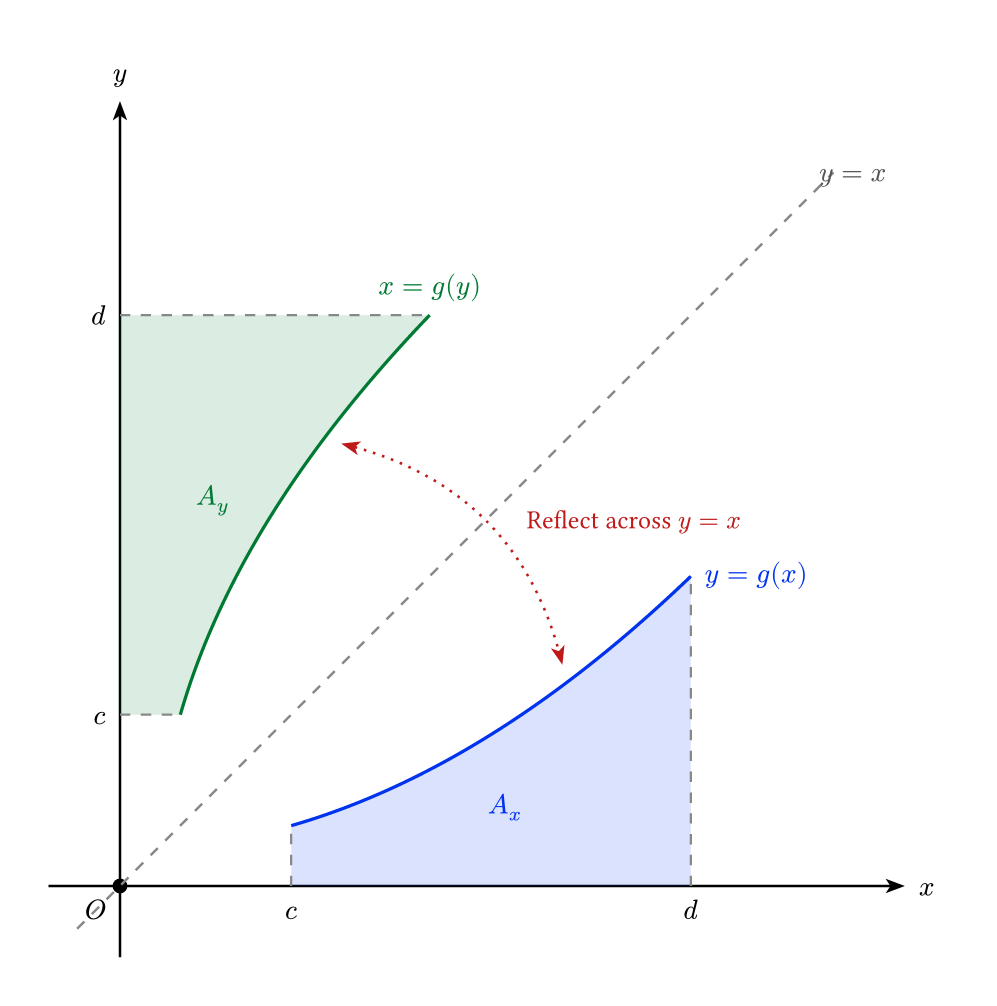
Under reflection across the line \(y = x\) (which swaps the coordinates \((x, y) \leftrightarrow (y, x)\)):
- The \(y\)-axis (\(x = 0\)) maps onto the \(x\)-axis (\(y = 0\)).
- The horizontal lines \(y = c\) and \(y = d\) map onto the vertical lines \(x = c\) and \(x = d\).
- The curve \(x = g(y) \ge 0\) maps onto the curve \(y = g(x) \ge 0\).
Since a mirror reflection preserves area, the area \(A_y\) between \(x = g(y)\) and the \(y\)-axis from \(y = c\) to \(y = d\) is identical to the area \(A_x\) under \(y = g(x)\) and the \(x\)-axis from \(x = c\) to \(x = d\):
And just as before, whenever you know algebraically that \(g(y) \ge 0\) on \([c, d]\), you do not need to sketch the graph to compute this area!
Example 4: Area Between a Logarithmic Curve and the y-Axis
Find the area bounded by the curve \(y = \ln x\), the \(y\)-axis, and the horizontal lines \(y = 0\) and \(y = 2\).
Solution: Since the boundary is the \(y\)-axis and the limits are horizontal lines \(y = 0\) and \(y = 2\), we express \(x\) in terms of \(y\):
Because \(e^y > 0\) for all \(y \in [0, 2]\), the curve lies completely to the right of the \(y\)-axis. Reflecting across \(y = x\) shows that the area is:
Example 5: Area Between a Cubic Curve and the y-Axis
Find the area bounded by the curve \(y = x^3\), the \(y\)-axis, \(y = 1\), and \(y = 8\).
Solution: Solving for \(x\) in terms of \(y\) gives \(x = y^{1/3}\). Since \(y^{1/3} \ge 0\) on \([1, 8]\), the area is:
3. The Two General Situations: Area Between Two Curves
In almost every area problem, the region is not bounded by an axis at all—it is trapped between two curves. Overall, there are two fundamental situations in area calculation.
Situation 1: Area Between Two Curves From x = a to x = b
Suppose two curves \(y = f(x)\) and \(y = g(x)\) satisfy \(f(x) \ge g(x)\) on \([a, b]\). Very often, they intersect at \((a, f(a))\) and \((b, f(b))\) and enclose a closed region between \(x = a\) and \(x = b\). Then the area between them is:
Why Does Top Minus Bottom Always Work, Even Below the x-Axis?
Students sometimes worry: "What if one or both curves go below the \(x\)-axis? Do I have to split the integral at the \(x\)-axis?"
No! Let us check all three possible positions of the \(x\)-axis to see why \(\int_a^b \big(f(x) - g(x)\big)\,dx\) works in every single case:
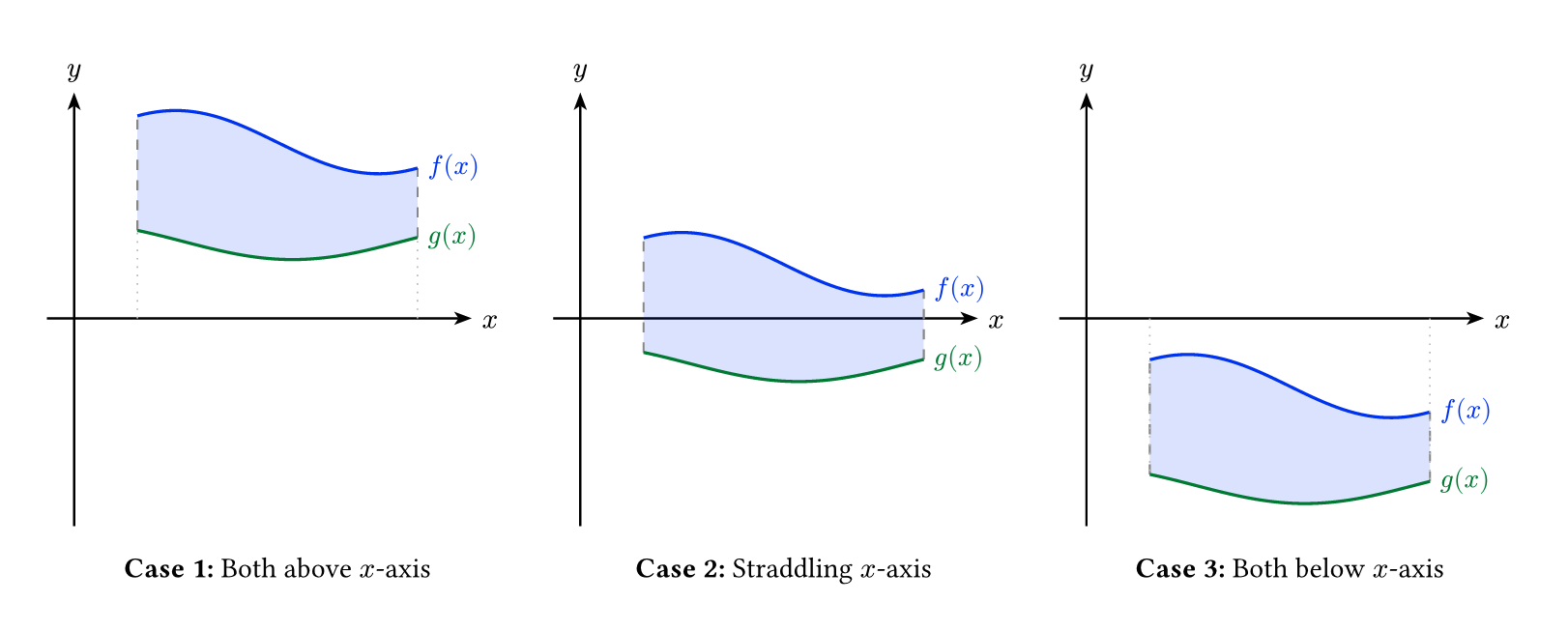
Case 1 (Both curves above the \(x\)-axis, \(f(x) \ge g(x) \ge 0\)): The area between the curves is the area under \(f(x)\) minus the area under \(g(x)\):
Case 2 (Straddling the \(x\)-axis, \(f(x) \ge 0 \ge g(x)\)): The region has two parts: the part above the \(x\)-axis has area \(\int_a^b f(x)\,dx\), and the part below the \(x\)-axis has area \(-\int_a^b g(x)\,dx\) (because \(\int_a^b g(x)\,dx\) is negative when \(g(x) \le 0\)). Adding the two positive areas gives:
Case 3 (Both curves below the \(x\)-axis, \(0 \ge f(x) \ge g(x)\)): Imagine shifting the entire region upward by a large constant \(K\) so that both \(f(x) + K \ge g(x) + K \ge 0\) lie above the \(x\)-axis. Shifting a shape upward does not change its area! By Case 1, the area is:
In all three cases, the \(x\)-axis drops out completely. All that matters is which curve is on top (\(f(x)\)) and which curve is on the bottom (\(g(x)\)).
Situation 2: Area Between Two Curves From y = c to y = d
Now suppose a region is bounded on the left and right by two curves written as functions of \(y\):
where \(\phi(y) \ge \psi(y)\) for all \(y \in [c, d]\) (for instance, intersecting at \((\phi(c), c)\) and \((\phi(d), d)\)).
By reflecting across the line \(y = x\), "Right minus Left" becomes "Top minus Bottom", so the enclosed area is:
This works regardless of whether the region lies to the right of the \(y\)-axis, straddles the \(y\)-axis, or lies completely to the left of the \(y\)-axis.
4. The Strip Interpretation: Vertical vs. Horizontal Strips
Now that we know why both formulas work, there is a clean visual way to remember and set up any area integral: the strip method.
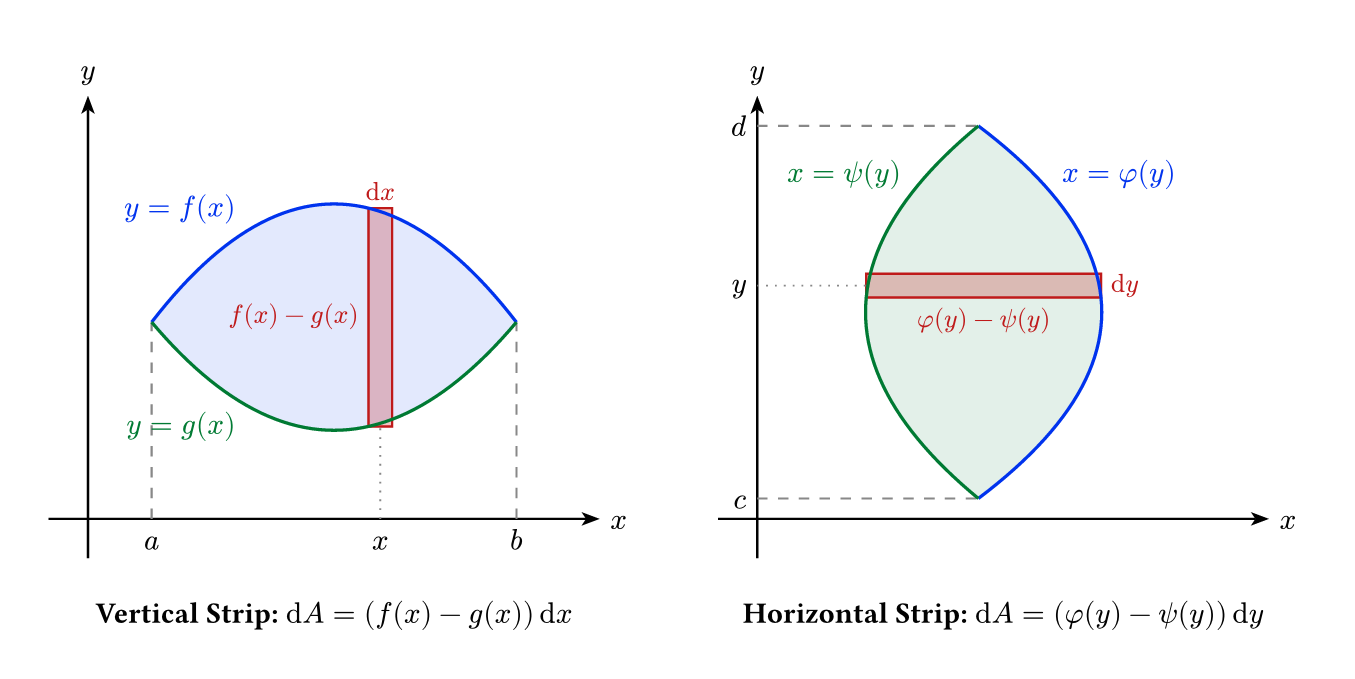
Vertical Strip (\(dx\)-method): At any position \(x \in [a, b]\), imagine a thin vertical rectangular strip of infinitesimal width \(dx\). Its bottom end rests on \(y = g(x)\) and its top end rests on \(y = f(x)\), so its height is \(f(x) - g(x)\). Its tiny area is:
As this vertical strip sweeps from \(x = a\) to \(x = b\), the integral accumulates the total area \(A = \int_a^b (f(x) - g(x))\,dx\).
Horizontal Strip (\(dy\)-method): At any height \(y \in [c, d]\), imagine a thin horizontal rectangular strip of infinitesimal thickness \(dy\). Its left end rests on \(x = \psi(y)\) and its right end rests on \(x = \phi(y)\), so its length is \(\phi(y) - \psi(y)\). Its tiny area is:
As this horizontal strip sweeps from \(y = c\) to \(y = d\), the integral accumulates the total area \(A = \int_c^d (\phi(y) - \psi(y))\,dy\).
How Do You Choose Between Vertical and Horizontal Strips?
Both methods give the exact same answer, but one is often dramatically easier than the other:
- Choose Vertical Strips (\(dx\)) when the top and bottom boundaries are single, clean functions of \(x\) across the entire interval \([a, b]\).
- Choose Horizontal Strips (\(dy\)) when expressing \(x\) in terms of \(y\) (the inverse form) is simpler, or when a vertical strip would have to jump from one bottom curve to another mid-way through the region.
Let us see this difference in action with worked examples!
5. Worked Examples on Bounded Areas
Example 6: Two Parabolas (Clean Vertical Strips)
Find the area bounded by the curves \(y = x^2\) and \(y = 4x - x^2\).
Solution: First, find the points of intersection by setting the two \(y\)-expressions equal:
On \([0, 2]\), test \(x = 1\): \(4(1) - 1^2 = 3 > 1^2 = 1\), so \(y = 4x - x^2\) is the top curve and \(y = x^2\) is the bottom curve throughout \([0, 2]\). Using vertical strips:
Example 7: Why Horizontal Strips Beat Vertical Strips
Find the area bounded by the parabola \(y^2 = x\) and the line \(y = x - 2\).
Solution: Find the points of intersection by substituting \(x = y^2\) into \(y = x - 2\):
The intersection points are \((1, -1)\) and \((4, 2)\).
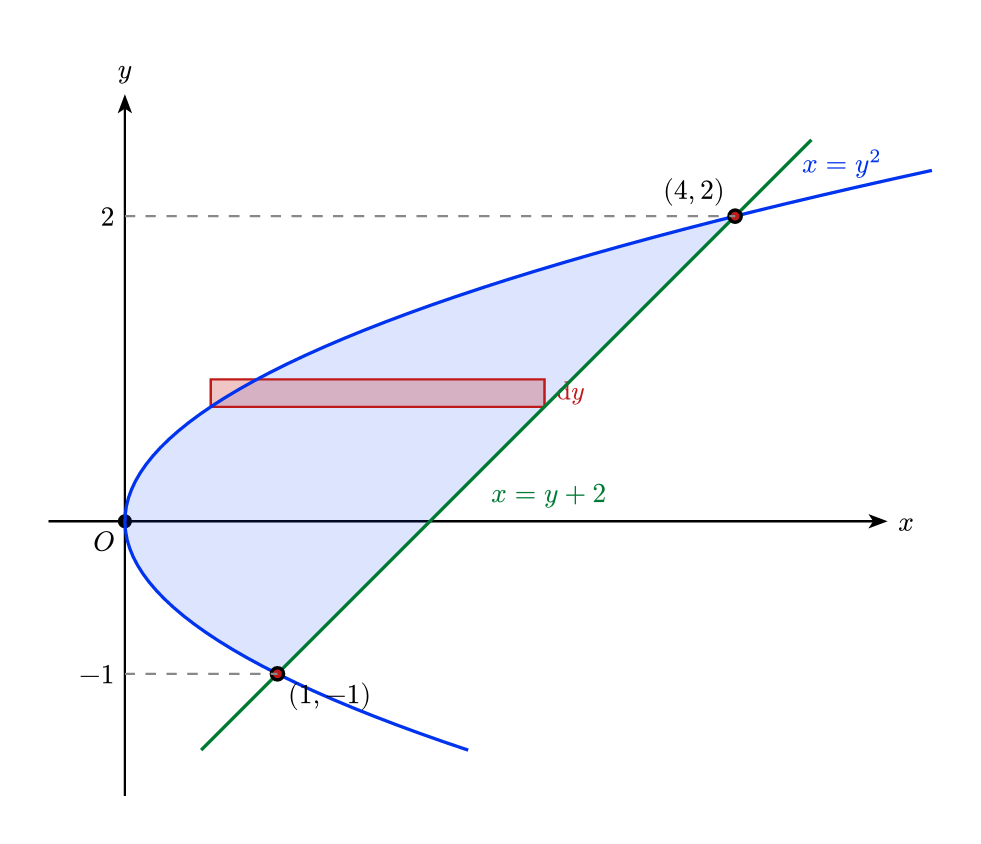
Look at what happens if you try vertical strips: from \(x = 0\) to \(x = 1\), the strip runs between the upper branch \(y = \sqrt{x}\) and the lower branch \(y = -\sqrt{x}\); then from \(x = 1\) to \(x = 4\), the bottom boundary switches to the line \(y = x - 2\). You would have to split the region into two integrals and integrate square roots!
Instead, use horizontal strips from \(y = -1\) to \(y = 2\). Throughout this entire \(y\)-interval, the right boundary is always the line \(x = y + 2\) and the left boundary is always the parabola \(x = y^2\):
Evaluating at the endpoints:
Example 8: Two Symmetric Parabolas
Find the area enclosed by the parabolas \(y^2 = 4x\) and \(x^2 = 4y\).
Solution: Substituting \(y = \frac{x^2}{4}\) into \(y^2 = 4x\) gives:
The intersection points are \((0, 0)\) and \((4, 4)\). On \([0, 4]\), the upper curve is \(y = 2\sqrt{x}\) and the lower curve is \(y = \frac{x^2}{4}\). Using vertical strips:
Example 9: Area Between Sine and Cosine Between Two Consecutive Intersections
Find the area bounded by \(y = \sin x\) and \(y = \cos x\) between \(x = \frac{\pi}{4}\) and \(x = \frac{5\pi}{4}\).
Solution: At \(x = \frac{\pi}{4}\) and \(x = \frac{5\pi}{4}\), \(\sin x = \cos x\). On the interval \(\left(\frac{\pi}{4}, \frac{5\pi}{4}\right)\), testing \(x = \frac{\pi}{2}\) gives \(\sin\frac{\pi}{2} = 1 > 0 = \cos\frac{\pi}{2}\), so \(\sin x \ge \cos x\) throughout. Notice that both curves go negative in the third quadrant, yet Top minus Bottom works without splitting at the \(x\)-axis:
Evaluating at the limits:
Example 10: Three Curves — Splitting the Region Into Two Parts
Find the area in the first quadrant bounded by the parabola \(y = x^2\), the line \(y = 2 - x\), and the \(x\)-axis (\(y = 0\)).
Solution: First, find where \(y = x^2\) meets \(y = 2 - x\):
In the first quadrant, they intersect at \((1, 1)\). Also, \(y = x^2\) meets the \(x\)-axis at \((0, 0)\) and \(y = 2 - x\) meets the \(x\)-axis at \((2, 0)\).
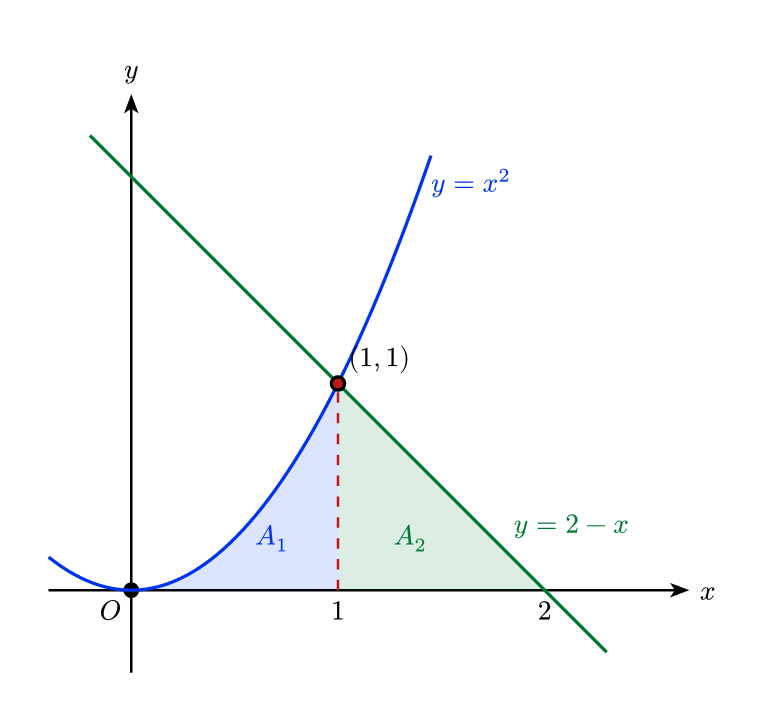
If we use vertical strips, the top boundary changes at \(x = 1\): from \(x = 0\) to \(x = 1\) the top curve is \(y = x^2\), whereas from \(x = 1\) to \(x = 2\) the top curve is \(y = 2 - x\). So we split the area at \(x = 1\) into \(A_1 + A_2\):
(Notice: You could also solve this with a single horizontal strip from \(y = 0\) to \(y = 1\), where the right boundary is \(x = 2 - y\) and the left boundary is \(x = \sqrt{y}\): \(\int_0^1 (2 - y - \sqrt{y})\,dy = 2 - \frac{1}{2} - \frac{2}{3} = \frac{5}{6}\)!)
Example 11: Three Curves Where Splitting Is Essential
Find the area in the first quadrant bounded by the curves \(y = x\), \(y = \frac{1}{x}\), the \(x\)-axis, and the vertical line \(x = 2\).
Solution: In the first quadrant, \(y = x\) and \(y = \frac{1}{x}\) intersect when \(x = \frac{1}{x} \implies x = 1\).
- For \(x \in [0, 1]\), we have \(x \le \frac{1}{x}\), so the lower of the two curves forming the boundary with the \(x\)-axis is \(y = x\).
- For \(x \in [1, 2]\), we have \(\frac{1}{x} \le x\), so the upper boundary of the region is \(y = \frac{1}{x}\).
Splitting at \(x = 1\):
Example 12: Parabola and Line With Negative Coefficients (Horizontal Strips)
Find the area bounded by the parabola \(x = y^2 - 2y\) and the line \(x = y\).
Solution: Equate the two \(x\)-expressions to find the \(y\)-coordinates of intersection:
For \(y \in [0, 3]\), testing \(y = 1\) gives \(x_{\text{line}} = 1\) and \(x_{\text{parabola}} = 1 - 2 = -1\), so the line \(x = y\) lies to the right of the parabola \(x = y^2 - 2y\). Using horizontal strips: