Common Tangents, Confocal Conics, and Locus Problems
In this section, we bring together the algebraic and geometric tools developed across the chapter to solve three classical families of problems: finding common tangents between a hyperbola and other conics, analyzing confocal ellipses and hyperbolas, and deriving loci generated by moving tangents and chords.
Common Tangents Involving Hyperbolas
To find all straight lines that are simultaneously tangent to two given conics, we follow a uniform three-step strategy:
- Write the slope-form tangent \(y = mx + c\) to the first conic.
- Impose the tangency condition of the second conic to obtain an equation for the slope \(m\).
- Retain only real slopes \(m\) that satisfy the domain constraints of both conics (for instance, \(|m| > \frac{b}{a}\) for \(\frac{x^2}{a^2} - \frac{y^2}{b^2} = 1\), or \(m < 0\) for \(xy = c^2\)), and always check separately for vertical common tangents (\(x = \pm a\)).
Hyperbola and Circle
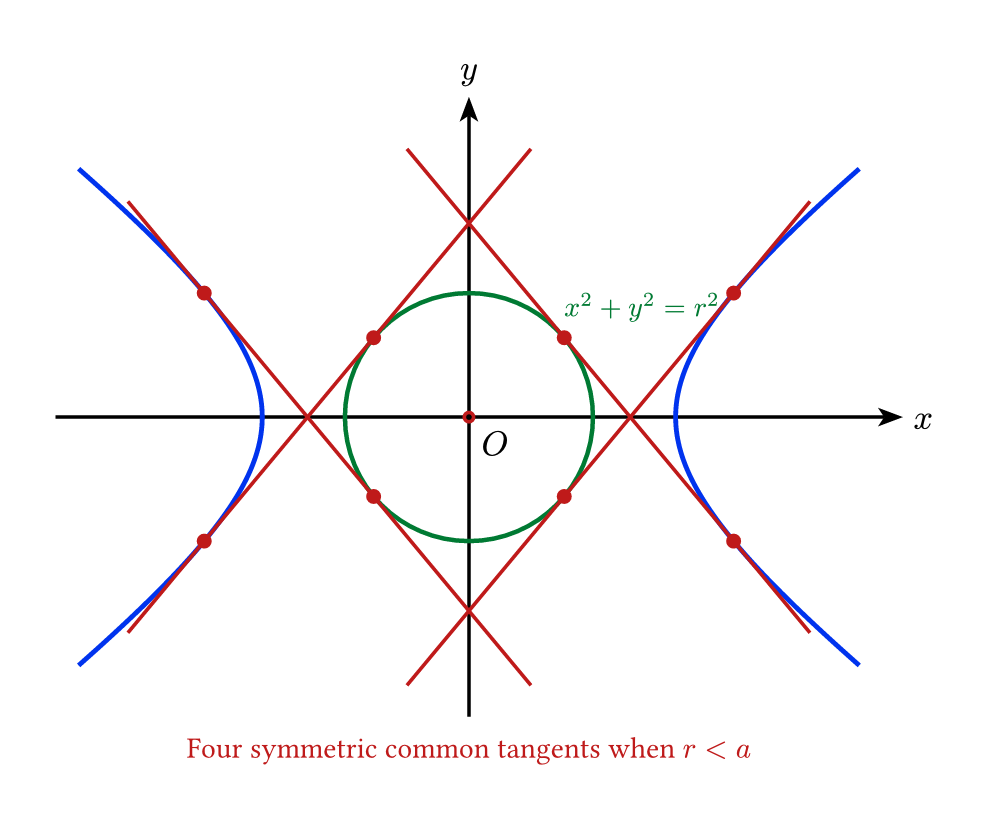
Consider the horizontal hyperbola \(\frac{x^2}{a^2} - \frac{y^2}{b^2} = 1\) and the concentric circle \(x^2 + y^2 = r^2\).
A non-vertical line \(y = mx + c\) is tangent to both curves if and only if:
Equating the two expressions for \(c^2\):
Since \(b^2 + r^2 > 0\) always, the existence of real common tangents depends solely on how \(r\) compares with \(a\):
- \(r < a\): \(a^2 - r^2 > 0\), giving two equal and opposite slopes \(m = \pm\sqrt{\frac{b^2 + r^2}{a^2 - r^2}}\) (notice \(m^2 = \frac{b^2 + r^2}{a^2 - r^2} > \frac{b^2}{a^2}\), so \(|m| > \frac{b}{a}\) is automatically satisfied!). With \(c = \pm r\sqrt{1 + m^2}\), there are 4 symmetric common tangents.
- \(r = a\) (the auxiliary circle): The circle touches both branches internally at the vertices \((\pm a, 0)\), giving exactly 2 vertical common tangents \(x = a\) and \(x = -a\).
- \(r > a\): \(a^2 - r^2 < 0\), so \(m^2 < 0\) has no real solutions, and the circle intersects both branches—there are 0 real common tangents.
Hyperbola and Ellipse
For a concentric hyperbola \(\frac{x^2}{a_1^2} - \frac{y^2}{b_1^2} = 1\) and ellipse \(\frac{x^2}{a_2^2} + \frac{y^2}{b_2^2} = 1\), equating the tangency conditions \(c^2 = a_1^2 m^2 - b_1^2\) and \(c^2 = a_2^2 m^2 + b_2^2\) gives:
Exactly as with the circle:
- If \(a_1 > a_2\): 4 symmetric common tangents with \(m = \pm\sqrt{\frac{b_1^2 + b_2^2}{a_1^2 - a_2^2}}\).
- If \(a_1 = a_2\): 2 vertical common tangents \(x = \pm a_1\).
- If \(a_1 < a_2\): 0 real common tangents.
Hyperbola and Parabola
For the standard hyperbola \(\frac{x^2}{a^2} - \frac{y^2}{b^2} = 1\) and the parabola \(y^2 = 4px\), equating \(c^2 = a^2 m^2 - b^2\) with \(c = \frac{p}{m}\) yields the biquadratic in \(m\):
Since the discriminant \(b^4 + 4a^2 p^2 > 0\) and the product of the two roots in \(m^2\) is \(-\frac{p^2}{a^2} < 0\), there is always one positive root for \(m^2\):
Thus there are always 2 symmetric common tangents to \(\frac{x^2}{a^2} - \frac{y^2}{b^2} = 1\) and \(y^2 = 4px\), corresponding to \(m = \pm\sqrt{\frac{b^2 + \sqrt{b^4 + 4a^2 p^2}}{2a^2}}\) and \(c = \frac{p}{m}\).
(For the rectangular hyperbola \(xy = c^2\) and the parabola \(y^2 = 4px\), equating \(c_{\text{line}} = \frac{p}{m}\) with \(c_{\text{line}}^2 = -4mc^2\) gives \(\frac{p^2}{m^2} = -4mc^2 \implies m^3 = -\frac{p^2}{4c^2}\), yielding a unique real common tangent with negative slope \(m = -\left(\frac{p^2}{4c^2}\right)^{1/3}\)!)
Confocal Conics
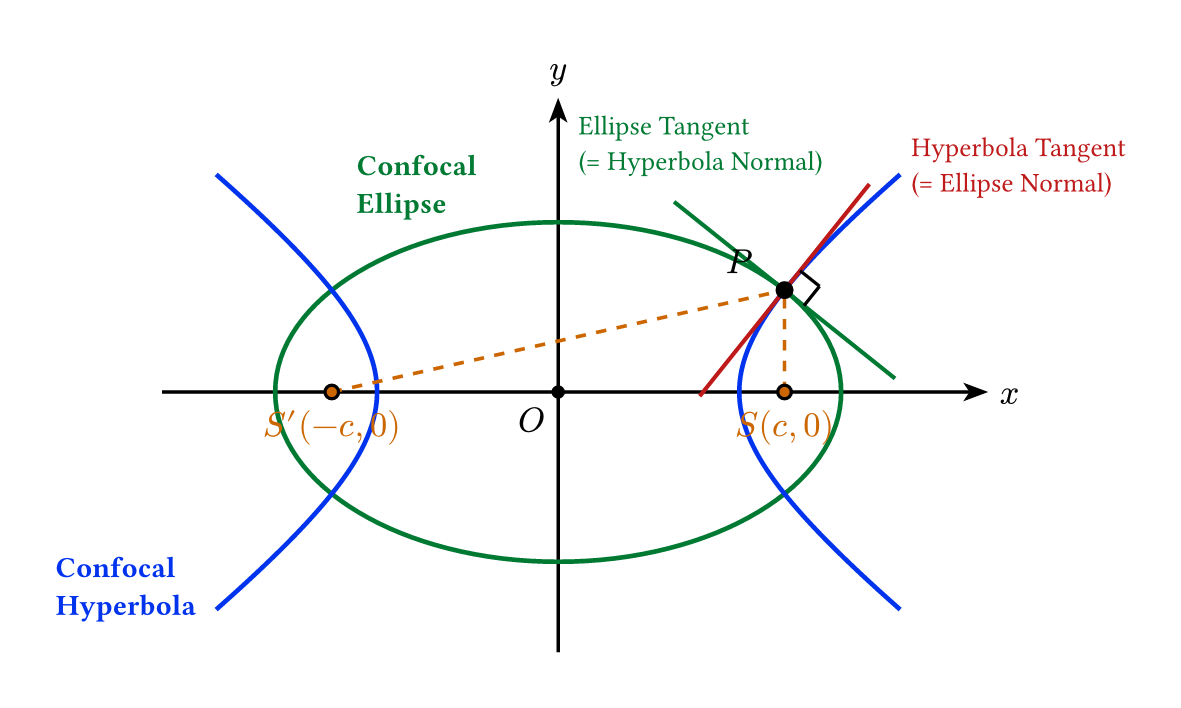
Two conics that share the exact same pair of foci \(S(c, 0)\) and \(S'(-c, 0)\) are called confocal conics.
Starting from a base ellipse \(\frac{x^2}{a^2} + \frac{y^2}{b^2} = 1\) (\(a > b\), focal distance \(c = \sqrt{a^2 - b^2}\)), the entire confocal family sharing foci \((\pm c, 0)\) is given by a single parameter \(\lambda\):
- When \(\lambda < b^2\): both denominators are positive, giving a confocal ellipse with \(c^2 = (a^2 - \lambda) - (b^2 - \lambda) = a^2 - b^2\).
- When \(b^2 < \lambda < a^2\): the first denominator is positive and the second is negative, giving a confocal hyperbola \(\frac{x^2}{a^2 - \lambda} - \frac{y^2}{\lambda - b^2} = 1\) with \(c^2 = (a^2 - \lambda) + (\lambda - b^2) = a^2 - b^2\).
Theorem 1: Orthogonal Intersection of Confocal Ellipse and Hyperbola
Statement:
Any confocal ellipse and hyperbola intersect each other orthogonally (at \(90^\circ\)) at all four points of intersection.
Proof 1 (Using Reflection Properties):
Let \(P\) be any point of intersection of a confocal ellipse and hyperbola sharing the foci \(S\) and \(S'\), and draw the two focal radii \(S'P\) and \(SP\).
- By the reflection property of the ellipse (Chapter 20, Section 09), the normal to the ellipse at \(P\) bisects the interior angle \(\angle S'PS\), while the tangent to the ellipse bisects the exterior angle.
- By the reflection property of the hyperbola (Section 11), the tangent to the hyperbola at \(P\) bisects the interior angle \(\angle S'PS\), while the normal to the hyperbola bisects the exterior angle.
Because any angle \(\angle S'PS\) has a unique interior angle bisector, the tangent to the hyperbola at \(P\) coincides identically with the normal to the ellipse at \(P\)!
Since the tangent and normal to the ellipse are perpendicular, the tangent to the hyperbola and the tangent to the ellipse at \(P\) meet at \(90^\circ\). \(\blacksquare\)
Proof 2 (Algebraic Proof):
Let the confocal ellipse and hyperbola be:
with common focal relation \(a_E^2 - b_E^2 = a_H^2 + b_H^2 = c^2\). At any intersection point \(P(x_1, y_1)\), subtracting the two equations gives:
From confocality, \(a_E^2 - b_E^2 = a_H^2 + b_H^2 \implies a_E^2 - a_H^2 = b_E^2 + b_H^2 \neq 0\). Canceling this common factor:
The slopes of the tangents at \(P(x_1, y_1)\) are \(m_E = -\frac{b_E^2 x_1}{a_E^2 y_1}\) and \(m_H = \frac{b_H^2 x_1}{a_H^2 y_1}\). Multiplying them:
Hence the two curves cut each other orthogonally. \(\blacksquare\)
Related Properties of Confocal Conics
Property 2: Exact Intersection Coordinates and Distance from the Center
From Proof 2 above, \(\frac{x_1^2}{a_E^2 a_H^2} = \frac{y_1^2}{b_E^2 b_H^2} = k\). Substituting \(x_1^2 = k a_E^2 a_H^2\) and \(y_1^2 = k b_E^2 b_H^2\) into the ellipse \(\frac{x_1^2}{a_E^2} + \frac{y_1^2}{b_E^2} = 1\):
Hence the four intersection points satisfy:
Adding \(x_1^2 + y_1^2\) gives the squared distance from the center \(O(0, 0)\) to every intersection point \(P\):
(Equivalently, \(OP^2 = a_H^2 + b_E^2\)!)
Property 3: Uniqueness Through Any Point in the Plane
Through any point \(P(x_1, y_1)\) not lying on either coordinate axis (\(x_1 \neq 0, y_1 \neq 0\)), exactly one confocal ellipse and one confocal hyperbola pass.
Proof: Substituting \((x_1, y_1)\) into \(\frac{x^2}{a^2 - \lambda} + \frac{y^2}{b^2 - \lambda} = 1\) gives a quadratic in \(\lambda\):
Evaluate \(f(\lambda)\) at three key values:
- As \(\lambda \to -\infty\): \(f(\lambda) \to +\infty\).
- At \(\lambda = b^2\): \(f(b^2) = -y_1^2(a^2 - b^2) < 0\).
- At \(\lambda = a^2\): \(f(a^2) = -x_1^2(b^2 - a^2) = +x_1^2(a^2 - b^2) > 0\).
By the Intermediate Value Theorem, \(f(\lambda) = 0\) has one root \(\lambda_1 \in (-\infty, b^2)\) (a confocal ellipse) and one root \(\lambda_2 \in (b^2, a^2)\) (a confocal hyperbola). \(\blacksquare\)
Property 4: Locus of Intersection of Perpendicular Tangents (One to Each Confocal Conic)
If a tangent to the confocal ellipse \(\frac{x^2}{a_E^2} + \frac{y^2}{b_E^2} = 1\) is perpendicular to a tangent to the confocal hyperbola \(\frac{x^2}{a_H^2} - \frac{y^2}{b_H^2} = 1\), their point of intersection \(Q(h, k)\) lies on a concentric circle:
Proof: A tangent of slope \(m\) to the ellipse satisfies \(k - mh = \pm\sqrt{a_E^2 m^2 + b_E^2}\). A perpendicular tangent (slope \(-\frac{1}{m}\)) to the hyperbola satisfies \(k + \frac{1}{m}h = \pm\sqrt{\frac{a_H^2}{m^2} - b_H^2} \implies mk + h = \pm\sqrt{a_H^2 - b_H^2 m^2}\). Squaring and adding eliminates \(m\):
By confocality, \(a_E^2 - b_H^2 = a_H^2 + b_E^2\). Factoring \((1 + m^2)\) and dividing gives \(h^2 + k^2 = a_E^2 - b_H^2\). Notice from Property 2 that this circle passes directly through all four points of intersection of the confocal ellipse and hyperbola! \(\blacksquare\)
Illustrative Examples on Common Tangents and Confocal Conics
Example 1: Common Tangents to a Hyperbola and a Circle
Find the equations of all common tangents to the hyperbola \(\frac{x^2}{9} - \frac{y^2}{7} = 1\) and the circle \(x^2 + y^2 = 5\).
Solution:
Here \(a^2 = 9\), \(b^2 = 7\), and \(r^2 = 5\). Since \(r^2 < a^2\) (\(5 < 9\)), four symmetric common tangents exist.
Equating the tangency conditions \(a^2 m^2 - b^2 = r^2(1 + m^2)\):
Then \(c^2 = r^2(1 + m^2) = 5(1 + 3) = 20 \implies c = \pm 2\sqrt{5}\).
The four common tangents are:
Example 2: Common Tangents to a Hyperbola and a Parabola
Find the equations of the common tangents to the hyperbola \(\frac{x^2}{4} - \frac{y^2}{3} = 1\) and the parabola \(y^2 = 8x\).
Solution:
For \(y^2 = 8x\), \(4p = 8 \implies p = 2\), so any tangent of slope \(m \neq 0\) is \(y = mx + \frac{2}{m}\).
For this line to also touch \(\frac{x^2}{4} - \frac{y^2}{3} = 1\), we apply \(c^2 = a^2 m^2 - b^2\):
Solving the quadratic in \(m^2\):
Since \(m^2 > 0\), we take the positive root \(m^2 = \frac{3 + \sqrt{73}}{8}\), giving \(m = \pm\sqrt{\frac{3 + \sqrt{73}}{8}}\), and the two common tangents are \(y = mx + \frac{2}{m}\).
Example 3: Common Tangent to a Rectangular Hyperbola and a Parabola
Find the equation of the common tangent to the rectangular hyperbola \(xy = 4\) and the parabola \(y^2 = 16x\).
Solution:
Any tangent of slope \(m \neq 0\) to the parabola \(y^2 = 16x\) (\(p = 4\)) is:
For this line to be tangent to \(xy = 4\) (\(c^2 = 4\)), the tangency condition from Section 10 is \(d^2 = -4mc^2\) (\(m < 0\)):
Substituting \(m = -1\) into \(y = mx + \frac{4}{m}\) gives the unique real common tangent:
Example 4: Common Tangents to a Hyperbola and an Ellipse
Find the common tangents to the hyperbola \(\frac{x^2}{25} - \frac{y^2}{9} = 1\) and the ellipse \(\frac{x^2}{16} + \frac{y^2}{7} = 1\).
Solution:
Here \(a_1^2 = 25, b_1^2 = 9\) and \(a_2^2 = 16, b_2^2 = 7\). Since \(a_1^2 > a_2^2\) (\(25 > 16\)), four symmetric common tangents exist:
Then \(c^2 = a_2^2 m^2 + b_2^2 = 16\left(\frac{16}{9}\right) + 7 = \frac{256 + 63}{9} = \frac{319}{9} \implies c = \pm\frac{\sqrt{319}}{3}\).
The four common tangents are:
Example 5: Finding Confocal Conics Passing Through a Given Point
Find the equations of the confocal ellipse and confocal hyperbola sharing the foci \((\pm 4, 0)\) that pass through the point \(P(4, 3)\).
Solution:
Since the foci are \((\pm 4, 0)\), \(c^2 = 16\). Represent the confocal family as:
where \(k > 16\) gives a confocal ellipse and \(0 < k < 16\) gives a confocal hyperbola. Substituting \(P(4, 3)\):
Multiplying through by \(k(k - 16)\):
Applying the quadratic formula:
Since \(\sqrt{657} \approx 25.63\):
- \(k_1 = \frac{41 + \sqrt{657}}{2} \approx 33.32 > 16\) gives the confocal ellipse \(\frac{x^2}{k_1} + \frac{y^2}{k_1 - 16} = 1\).
- \(k_2 = \frac{41 - \sqrt{657}}{2} \approx 7.68 \in (0, 16)\) gives the confocal hyperbola \(\frac{x^2}{k_2} - \frac{y^2}{16 - k_2} = 1\).
By Theorem 1, these two conics intersect at \(P(4, 3)\) at an exact angle of \(90^\circ\).
Classic Locus Problems
Locus Problem 1: Foot of Perpendicular from the Center onto Any Tangent (Pedal Curve)
Find the locus of the foot of the perpendicular drawn from the center \(O(0, 0)\) onto any tangent to the hyperbola \(\frac{x^2}{a^2} - \frac{y^2}{b^2} = 1\).
Solution:
Let \(N(h, k)\) be the foot of the perpendicular from \(O(0, 0)\) onto a tangent.
The slope of \(ON\) is \(\frac{k}{h}\), so the tangent (perpendicular to \(ON\)) has slope \(m = -\frac{h}{k}\) and passes through \((h, k)\):
Applying the tangency condition \(c^2 = a^2 m^2 - b^2\) with \(m = -\frac{h}{k}\) and \(c = \frac{h^2 + k^2}{k}\):
Multiplying through by \(k^2\) and replacing \((h, k)\) by \((x, y)\):
(Special case: for the rectangular hyperbola \(x^2 - y^2 = a^2\), this gives \((x^2 + y^2)^2 = a^2(x^2 - y^2)\) — the famous figure-eight curve known as the lemniscate of Bernoulli!)
Locus Problem 2: Midpoint of Tangent Segment Intercepted Between the Coordinate Axes
A variable tangent to the hyperbola \(\frac{x^2}{a^2} - \frac{y^2}{b^2} = 1\) meets the \(x\)-axis at \(A\) and the \(y\)-axis at \(B\). Find the locus of the midpoint of segment \(AB\).
Solution:
The tangent at \(P(a\sec\theta, b\tan\theta)\) is:
Its intercepts on the coordinate axes are \(A(a\cos\theta, 0)\) and \(B(0, -b\cot\theta)\).
Let \(M(h, k)\) be the midpoint of \(AB\):
Eliminate \(\theta\) using the identity \(\sec^2\theta - \tan^2\theta = 1\):
Replacing \((h, k)\) by \((x, y)\), the required locus is:
Locus Problem 3: Reflection of a Focus Across Any Tangent
Find the locus of the reflection (mirror image) of the focus \(S(ae, 0)\) across any variable tangent to the hyperbola \(\frac{x^2}{a^2} - \frac{y^2}{b^2} = 1\).
Solution:
Let \(R(h, k)\) be the reflection of \(S(ae, 0)\) across a tangent, and let \(Y\) be the foot of the perpendicular from \(S\) onto that tangent.
By definition of reflection, \(Y\) is the midpoint of segment \(SR\), so:
From Section 11 (Property 1), the foot \(Y\) of the perpendicular from the focus \(S\) onto any tangent always lies on the auxiliary circle \(x^2 + y^2 = a^2\)! Substituting \(Y\):
Multiplying through by \(4\) and replacing \((h, k)\) by \((x, y)\):
The locus is a circle centered at the other focus \(S'(-ae, 0)\) with radius \(2a\)! (Notice this also follows from the reflection property: \(S', P, R\) are collinear with \(SP = PR\), so \(S'R = S'P - PR = S'P - SP = 2a\)!)
Locus Problem 4: Intersection of Tangents When Sum of Eccentric Angles Is Constant
Tangents are drawn to the hyperbola \(\frac{x^2}{a^2} - \frac{y^2}{b^2} = 1\) at two points \(P(\theta_1)\) and \(Q(\theta_2)\) such that \(\theta_1 + \theta_2 = 2\alpha\) (a constant). Find the locus of their point of intersection \(T(h, k)\).
Solution:
From Section 09, the tangents at \(P(\theta_1)\) and \(Q(\theta_2)\) are:
Subtracting the second equation from the first at their intersection \(T(h, k)\):
Applying the sum-to-product identities:
Since \(\theta_1 \neq \theta_2\), canceling \(-2\sin\left(\frac{\theta_1 - \theta_2}{2}\right)\) and substituting \(\frac{\theta_1 + \theta_2}{2} = \alpha\):
Replacing \(k\) by \(y\) gives the horizontal straight line \(y = b\tan\alpha\).
(Remark: Contrast this with the ellipse \(\frac{x^2}{a^2} + \frac{y^2}{b^2} = 1\), where \(\theta_1 + \theta_2 = 2\alpha\) gives a diameter through the origin \(y = \frac{b}{a}\tan\alpha\cdot x\). On the hyperbola, because \(y = b\tan\theta\) has \(\sin\theta\) in the numerator and \(\cos\theta\) on the right-hand side, \(\theta_1 + \theta_2 = 2\alpha\) produces the horizontal line \(y = b\tan\alpha\)!)
Locus Problem 5: Intersection of Tangents at Ends of a Chord Touching a Circle
Chords of the hyperbola \(\frac{x^2}{a^2} - \frac{y^2}{b^2} = 1\) are drawn tangent to the concentric circle \(x^2 + y^2 = r^2\). Find the locus of the point of intersection of the tangents to the hyperbola at the endpoints of these chords.
Solution:
Let \(T(h, k)\) be the point of intersection of the tangents at the endpoints \(P\) and \(Q\) of such a chord.
Then \(PQ\) is the chord of contact of \(T(h, k)\) with respect to \(\frac{x^2}{a^2} - \frac{y^2}{b^2} = 1\):
Since this chord is tangent to \(x^2 + y^2 = r^2\), its perpendicular distance from \((0, 0)\) equals \(r\):
Squaring both sides and replacing \((h, k)\) by \((x, y)\):
The required locus is a concentric ellipse with semi-axes \(\frac{a^2}{r}\) and \(\frac{b^2}{r}\).
Summary of Key Results
| Topic | Key Equation / Condition |
|---|---|
| Common Tangents: Hyperbola & Circle (\(r < a\)) | \((a^2 - r^2)m^2 = b^2 + r^2\) (4 symmetric tangents) |
| Common Tangents: Hyperbola & Ellipse (\(a_1 > a_2\)) | \((a_1^2 - a_2^2)m^2 = b_1^2 + b_2^2\) (4 symmetric tangents) |
| Common Tangents: Hyperbola & Parabola (\(y^2 = 4px\)) | \(a^2 m^4 - b^2 m^2 - p^2 = 0\) (2 symmetric tangents) |
| Common Tangent: \(xy = c^2\) & Parabola (\(y^2 = 4px\)) | \(m^3 = -\frac{p^2}{4c^2}\) (1 unique real tangent) |
| Confocal Family | \(\frac{x^2}{a^2 - \lambda} + \frac{y^2}{b^2 - \lambda} = 1\) (\(\lambda < b^2\): ellipse; \(b^2 < \lambda < a^2\): hyperbola) |
| Confocal Intersection Angle | Always \(90^\circ\) (orthogonal; shared interior bisector of \(\angle S'PS\)) |
| Confocal Intersection Coordinates | \(x^2 = \frac{a_E^2 a_H^2}{c^2},\; y^2 = \frac{b_E^2 b_H^2}{c^2},\; OP^2 = a_E^2 - b_H^2\) |
| Perpendicular Tangents to Confocal Pair | Intersect on the circle \(x^2 + y^2 = a_E^2 - b_H^2\) |
| Pedal Curve from Center \(O\) | \((x^2 + y^2)^2 = a^2 x^2 - b^2 y^2\) (lemniscate when \(a = b\)) |
| Reflection of Focus \(S(ae, 0)\) Across Tangents | Circle \((x + ae)^2 + y^2 = 4a^2\) centered at \(S'(-ae, 0)\) |