MatheramaMatherama
← Hyperbola
Hyperbola·Section 15·16 min read

Common Tangents, Confocal Conics, and Locus Problems

In this section, we bring together the algebraic and geometric tools developed across the chapter to solve three classical families of problems: finding common tangents between a hyperbola and other conics, analyzing confocal ellipses and hyperbolas, and deriving loci generated by moving tangents and chords.


Common Tangents Involving Hyperbolas§

To find all straight lines that are simultaneously tangent to two given conics, we follow a uniform three-step strategy:

  1. Write the slope-form tangent y=mx+cy = mx + c to the first conic.
  2. Impose the tangency condition of the second conic to obtain an equation for the slope mm.
  3. Retain only real slopes mm that satisfy the domain constraints of both conics (for instance, ∣m∣>ba|m| > \frac{b}{a} for x2a2−y2b2=1\frac{x^2}{a^2} - \frac{y^2}{b^2} = 1, or m<0m < 0 for xy=c2xy = c^2), and always check separately for vertical common tangents (x=±ax = \pm a).

Hyperbola and Circle§

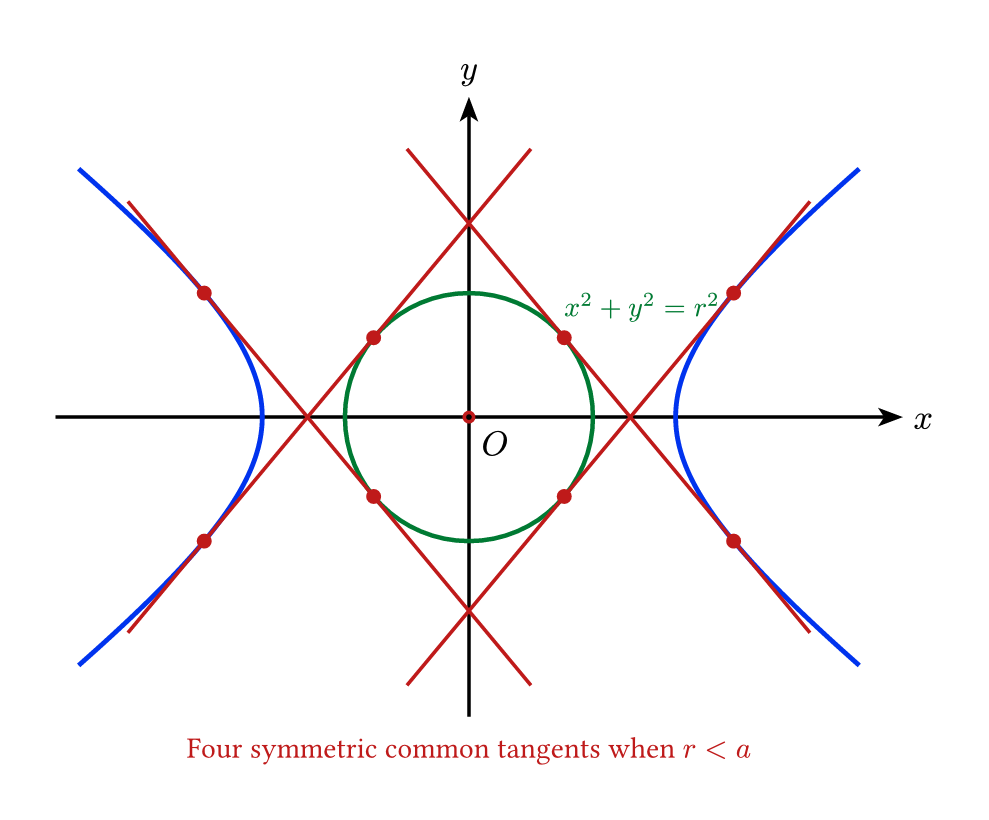
Consider the horizontal hyperbola x2a2−y2b2=1\frac{x^2}{a^2} - \frac{y^2}{b^2} = 1 and the concentric circle x2+y2=r2x^2 + y^2 = r^2.

A non-vertical line y=mx+cy = mx + c is tangent to both curves if and only if:

c2=a2m2−b2andc2=r2(1+m2)c^2 = a^2 m^2 - b^2 \qquad \text{and} \qquad c^2 = r^2(1 + m^2)

Equating the two expressions for c2c^2:

a2m2−b2=r2+r2m2  ⟹  (a2−r2)m2=b2+r2a^2 m^2 - b^2 = r^2 + r^2 m^2 \implies (a^2 - r^2)m^2 = b^2 + r^2

Since b2+r2>0b^2 + r^2 > 0 always, the existence of real common tangents depends solely on how rr compares with aa:

  • r<ar < a: a2−r2>0a^2 - r^2 > 0, giving two equal and opposite slopes m=±b2+r2a2−r2m = \pm\sqrt{\frac{b^2 + r^2}{a^2 - r^2}} (notice m2=b2+r2a2−r2>b2a2m^2 = \frac{b^2 + r^2}{a^2 - r^2} > \frac{b^2}{a^2}, so ∣m∣>ba|m| > \frac{b}{a} is automatically satisfied!). With c=±r1+m2c = \pm r\sqrt{1 + m^2}, there are 4 symmetric common tangents.
  • r=ar = a (the auxiliary circle): The circle touches both branches internally at the vertices (±a,0)(\pm a, 0), giving exactly 2 vertical common tangents x=ax = a and x=−ax = -a.
  • r>ar > a: a2−r2<0a^2 - r^2 < 0, so m2<0m^2 < 0 has no real solutions, and the circle intersects both branches—there are 0 real common tangents.

Four Symmetric Common Tangents to a Hyperbola and Concentric Circle


Hyperbola and Ellipse§

For a concentric hyperbola x2a12−y2b12=1\frac{x^2}{a_1^2} - \frac{y^2}{b_1^2} = 1 and ellipse x2a22+y2b22=1\frac{x^2}{a_2^2} + \frac{y^2}{b_2^2} = 1, equating the tangency conditions c2=a12m2−b12c^2 = a_1^2 m^2 - b_1^2 and c2=a22m2+b22c^2 = a_2^2 m^2 + b_2^2 gives:

(a12−a22)m2=b12+b22(a_1^2 - a_2^2)m^2 = b_1^2 + b_2^2

Exactly as with the circle:

  • If a1>a2a_1 > a_2: 4 symmetric common tangents with m=±b12+b22a12−a22m = \pm\sqrt{\frac{b_1^2 + b_2^2}{a_1^2 - a_2^2}}.
  • If a1=a2a_1 = a_2: 2 vertical common tangents x=±a1x = \pm a_1.
  • If a1<a2a_1 < a_2: 0 real common tangents.

Hyperbola and Parabola§

For the standard hyperbola x2a2−y2b2=1\frac{x^2}{a^2} - \frac{y^2}{b^2} = 1 and the parabola y2=4pxy^2 = 4px, equating c2=a2m2−b2c^2 = a^2 m^2 - b^2 with c=pmc = \frac{p}{m} yields the biquadratic in mm:

a2m2−b2=p2m2  ⟹  a2m4−b2m2−p2=0a^2 m^2 - b^2 = \frac{p^2}{m^2} \implies a^2 m^4 - b^2 m^2 - p^2 = 0

Since the discriminant b4+4a2p2>0b^4 + 4a^2 p^2 > 0 and the product of the two roots in m2m^2 is −p2a2<0-\frac{p^2}{a^2} < 0, there is always one positive root for m2m^2:

m2=b2+b4+4a2p22a2>b2a2m^2 = \frac{b^2 + \sqrt{b^4 + 4a^2 p^2}}{2a^2} > \frac{b^2}{a^2}

Thus there are always 2 symmetric common tangents to x2a2−y2b2=1\frac{x^2}{a^2} - \frac{y^2}{b^2} = 1 and y2=4pxy^2 = 4px, corresponding to m=±b2+b4+4a2p22a2m = \pm\sqrt{\frac{b^2 + \sqrt{b^4 + 4a^2 p^2}}{2a^2}} and c=pmc = \frac{p}{m}.

(For the rectangular hyperbola xy=c2xy = c^2 and the parabola y2=4pxy^2 = 4px, equating cline=pmc_{\text{line}} = \frac{p}{m} with cline2=−4mc2c_{\text{line}}^2 = -4mc^2 gives p2m2=−4mc2  ⟹  m3=−p24c2\frac{p^2}{m^2} = -4mc^2 \implies m^3 = -\frac{p^2}{4c^2}, yielding a unique real common tangent with negative slope m=−(p24c2)1/3m = -\left(\frac{p^2}{4c^2}\right)^{1/3}!)


Confocal Conics§

Two conics that share the exact same pair of foci S(c,0)S(c, 0) and S′(−c,0)S'(-c, 0) are called confocal conics.

Starting from a base ellipse x2a2+y2b2=1\frac{x^2}{a^2} + \frac{y^2}{b^2} = 1 (a>ba > b, focal distance c=a2−b2c = \sqrt{a^2 - b^2}), the entire confocal family sharing foci (±c,0)(\pm c, 0) is given by a single parameter λ\lambda:

x2a2−λ+y2b2−λ=1\frac{x^2}{a^2 - \lambda} + \frac{y^2}{b^2 - \lambda} = 1
  • When λ<b2\lambda < b^2: both denominators are positive, giving a confocal ellipse with c2=(a2−λ)−(b2−λ)=a2−b2c^2 = (a^2 - \lambda) - (b^2 - \lambda) = a^2 - b^2.
  • When b2<λ<a2b^2 < \lambda < a^2: the first denominator is positive and the second is negative, giving a confocal hyperbola x2a2−λ−y2λ−b2=1\frac{x^2}{a^2 - \lambda} - \frac{y^2}{\lambda - b^2} = 1 with c2=(a2−λ)+(λ−b2)=a2−b2c^2 = (a^2 - \lambda) + (\lambda - b^2) = a^2 - b^2.

Theorem 1: Orthogonal Intersection of Confocal Ellipse and Hyperbola§

Statement:
Any confocal ellipse and hyperbola intersect each other orthogonally (at 90∘90^\circ) at all four points of intersection.

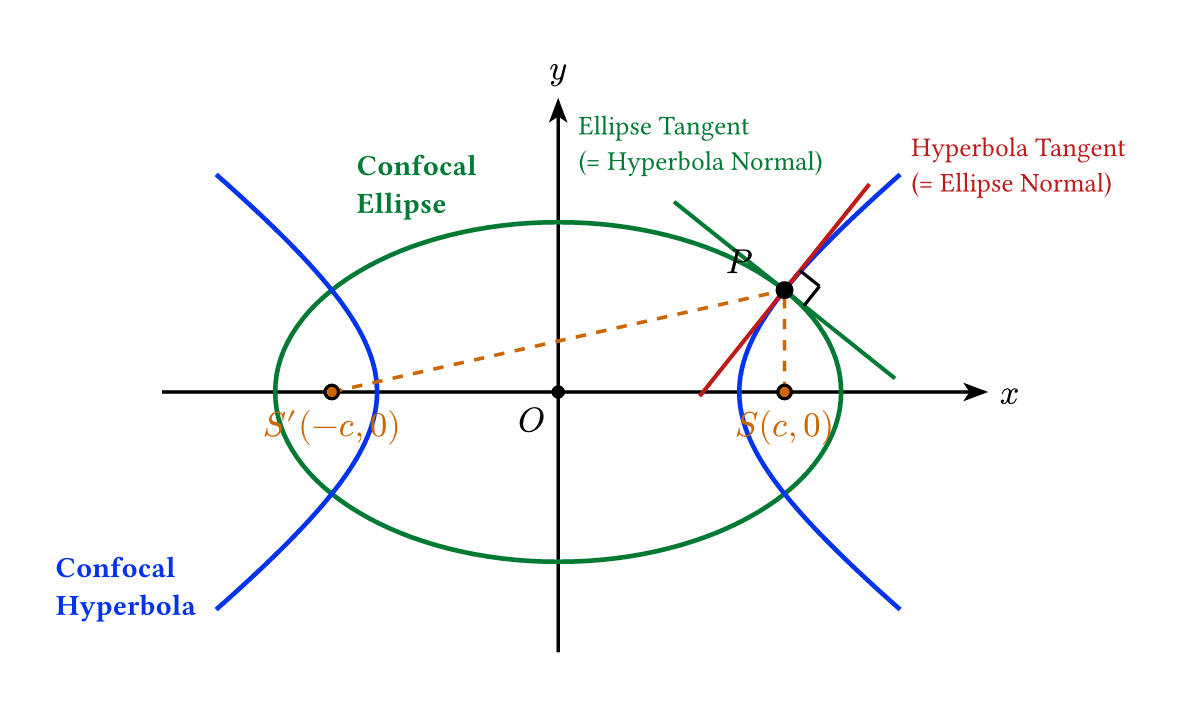
Orthogonal Intersection of a Confocal Ellipse and Hyperbola

Proof 1 (Using Reflection Properties):

Let PP be any point of intersection of a confocal ellipse and hyperbola sharing the foci SS and S′S', and draw the two focal radii S′PS'P and SPSP.

  1. By the reflection property of the ellipse (Chapter 20, Section 09), the normal to the ellipse at PP bisects the interior angle ∠S′PS\angle S'PS, while the tangent to the ellipse bisects the exterior angle.
  2. By the reflection property of the hyperbola (Section 11), the tangent to the hyperbola at PP bisects the interior angle ∠S′PS\angle S'PS, while the normal to the hyperbola bisects the exterior angle.

Because any angle ∠S′PS\angle S'PS has a unique interior angle bisector, the tangent to the hyperbola at PP coincides identically with the normal to the ellipse at PP!

Since the tangent and normal to the ellipse are perpendicular, the tangent to the hyperbola and the tangent to the ellipse at PP meet at 90∘90^\circ. ■\blacksquare

Proof 2 (Algebraic Proof):

Let the confocal ellipse and hyperbola be:

x2aE2+y2bE2=1andx2aH2−y2bH2=1\frac{x^2}{a_E^2} + \frac{y^2}{b_E^2} = 1 \qquad \text{and} \qquad \frac{x^2}{a_H^2} - \frac{y^2}{b_H^2} = 1

with common focal relation aE2−bE2=aH2+bH2=c2a_E^2 - b_E^2 = a_H^2 + b_H^2 = c^2. At any intersection point P(x1,y1)P(x_1, y_1), subtracting the two equations gives:

(1aH2−1aE2)x12=(1bH2+1bE2)y12\left(\frac{1}{a_H^2} - \frac{1}{a_E^2}\right)x_1^2 = \left(\frac{1}{b_H^2} + \frac{1}{b_E^2}\right)y_1^2 aE2−aH2aE2aH2x12=bE2+bH2bE2bH2y12\frac{a_E^2 - a_H^2}{a_E^2 a_H^2}x_1^2 = \frac{b_E^2 + b_H^2}{b_E^2 b_H^2}y_1^2

From confocality, aE2−bE2=aH2+bH2  ⟹  aE2−aH2=bE2+bH2≠0a_E^2 - b_E^2 = a_H^2 + b_H^2 \implies a_E^2 - a_H^2 = b_E^2 + b_H^2 \neq 0. Canceling this common factor:

x12aE2aH2=y12bE2bH2  ⟹  x12y12=aE2aH2bE2bH2\frac{x_1^2}{a_E^2 a_H^2} = \frac{y_1^2}{b_E^2 b_H^2} \implies \frac{x_1^2}{y_1^2} = \frac{a_E^2 a_H^2}{b_E^2 b_H^2}

The slopes of the tangents at P(x1,y1)P(x_1, y_1) are mE=−bE2x1aE2y1m_E = -\frac{b_E^2 x_1}{a_E^2 y_1} and mH=bH2x1aH2y1m_H = \frac{b_H^2 x_1}{a_H^2 y_1}. Multiplying them:

mE⋅mH=−bE2bH2aE2aH2⋅x12y12=−bE2bH2aE2aH2⋅aE2aH2bE2bH2=−1m_E \cdot m_H = -\frac{b_E^2 b_H^2}{a_E^2 a_H^2}\cdot\frac{x_1^2}{y_1^2} = -\frac{b_E^2 b_H^2}{a_E^2 a_H^2}\cdot\frac{a_E^2 a_H^2}{b_E^2 b_H^2} = -1

Hence the two curves cut each other orthogonally. ■\blacksquare


Property 2: Exact Intersection Coordinates and Distance from the Center

From Proof 2 above, x12aE2aH2=y12bE2bH2=k\frac{x_1^2}{a_E^2 a_H^2} = \frac{y_1^2}{b_E^2 b_H^2} = k. Substituting x12=kaE2aH2x_1^2 = k a_E^2 a_H^2 and y12=kbE2bH2y_1^2 = k b_E^2 b_H^2 into the ellipse x12aE2+y12bE2=1\frac{x_1^2}{a_E^2} + \frac{y_1^2}{b_E^2} = 1:

k(aH2+bH2)=1  ⟹  k=1c2k(a_H^2 + b_H^2) = 1 \implies k = \frac{1}{c^2}

Hence the four intersection points satisfy:

x12=aE2aH2c2,y12=bE2bH2c2x_1^2 = \frac{a_E^2 a_H^2}{c^2}, \qquad y_1^2 = \frac{b_E^2 b_H^2}{c^2}

Adding x12+y12x_1^2 + y_1^2 gives the squared distance from the center O(0,0)O(0, 0) to every intersection point PP:

OP2=aE2aH2+bE2bH2c2=aE2(c2−bH2)+(aE2−c2)bH2c2=c2(aE2−bH2)c2=aE2−bH2OP^2 = \frac{a_E^2 a_H^2 + b_E^2 b_H^2}{c^2} = \frac{a_E^2(c^2 - b_H^2) + (a_E^2 - c^2)b_H^2}{c^2} = \frac{c^2(a_E^2 - b_H^2)}{c^2} = a_E^2 - b_H^2

(Equivalently, OP2=aH2+bE2OP^2 = a_H^2 + b_E^2!)

Property 3: Uniqueness Through Any Point in the Plane

Through any point P(x1,y1)P(x_1, y_1) not lying on either coordinate axis (x1≠0,y1≠0x_1 \neq 0, y_1 \neq 0), exactly one confocal ellipse and one confocal hyperbola pass.

Proof: Substituting (x1,y1)(x_1, y_1) into x2a2−λ+y2b2−λ=1\frac{x^2}{a^2 - \lambda} + \frac{y^2}{b^2 - \lambda} = 1 gives a quadratic in λ\lambda:

f(λ)=(a2−λ)(b2−λ)−x12(b2−λ)−y12(a2−λ)=0f(\lambda) = (a^2 - \lambda)(b^2 - \lambda) - x_1^2(b^2 - \lambda) - y_1^2(a^2 - \lambda) = 0

Evaluate f(λ)f(\lambda) at three key values:

  • As λ→−∞\lambda \to -\infty: f(λ)→+∞f(\lambda) \to +\infty.
  • At λ=b2\lambda = b^2: f(b2)=−y12(a2−b2)<0f(b^2) = -y_1^2(a^2 - b^2) < 0.
  • At λ=a2\lambda = a^2: f(a2)=−x12(b2−a2)=+x12(a2−b2)>0f(a^2) = -x_1^2(b^2 - a^2) = +x_1^2(a^2 - b^2) > 0.

By the Intermediate Value Theorem, f(λ)=0f(\lambda) = 0 has one root λ1∈(−∞,b2)\lambda_1 \in (-\infty, b^2) (a confocal ellipse) and one root λ2∈(b2,a2)\lambda_2 \in (b^2, a^2) (a confocal hyperbola). ■\blacksquare

Property 4: Locus of Intersection of Perpendicular Tangents (One to Each Confocal Conic)

If a tangent to the confocal ellipse x2aE2+y2bE2=1\frac{x^2}{a_E^2} + \frac{y^2}{b_E^2} = 1 is perpendicular to a tangent to the confocal hyperbola x2aH2−y2bH2=1\frac{x^2}{a_H^2} - \frac{y^2}{b_H^2} = 1, their point of intersection Q(h,k)Q(h, k) lies on a concentric circle:

x2+y2=aE2−bH2=aH2+bE2x^2 + y^2 = a_E^2 - b_H^2 = a_H^2 + b_E^2

Proof: A tangent of slope mm to the ellipse satisfies k−mh=±aE2m2+bE2k - mh = \pm\sqrt{a_E^2 m^2 + b_E^2}. A perpendicular tangent (slope −1m-\frac{1}{m}) to the hyperbola satisfies k+1mh=±aH2m2−bH2  ⟹  mk+h=±aH2−bH2m2k + \frac{1}{m}h = \pm\sqrt{\frac{a_H^2}{m^2} - b_H^2} \implies mk + h = \pm\sqrt{a_H^2 - b_H^2 m^2}. Squaring and adding eliminates mm:

(1+m2)(h2+k2)=(aE2−bH2)m2+(bE2+aH2)(1 + m^2)(h^2 + k^2) = (a_E^2 - b_H^2)m^2 + (b_E^2 + a_H^2)

By confocality, aE2−bH2=aH2+bE2a_E^2 - b_H^2 = a_H^2 + b_E^2. Factoring (1+m2)(1 + m^2) and dividing gives h2+k2=aE2−bH2h^2 + k^2 = a_E^2 - b_H^2. Notice from Property 2 that this circle passes directly through all four points of intersection of the confocal ellipse and hyperbola! ■\blacksquare


Illustrative Examples on Common Tangents and Confocal Conics§


Example 1: Common Tangents to a Hyperbola and a Circle§

Find the equations of all common tangents to the hyperbola x29−y27=1\frac{x^2}{9} - \frac{y^2}{7} = 1 and the circle x2+y2=5x^2 + y^2 = 5.

Solution:

Here a2=9a^2 = 9, b2=7b^2 = 7, and r2=5r^2 = 5. Since r2<a2r^2 < a^2 (5<95 < 9), four symmetric common tangents exist.

Equating the tangency conditions a2m2−b2=r2(1+m2)a^2 m^2 - b^2 = r^2(1 + m^2):

9m2−7=5+5m2  ⟹  4m2=12  ⟹  m2=3  ⟹  m=±39m^2 - 7 = 5 + 5m^2 \implies 4m^2 = 12 \implies m^2 = 3 \implies m = \pm\sqrt{3}

Then c2=r2(1+m2)=5(1+3)=20  ⟹  c=±25c^2 = r^2(1 + m^2) = 5(1 + 3) = 20 \implies c = \pm 2\sqrt{5}.

The four common tangents are:

y=±3x±25y = \pm\sqrt{3}x \pm 2\sqrt{5}

Example 2: Common Tangents to a Hyperbola and a Parabola§

Find the equations of the common tangents to the hyperbola x24−y23=1\frac{x^2}{4} - \frac{y^2}{3} = 1 and the parabola y2=8xy^2 = 8x.

Solution:

For y2=8xy^2 = 8x, 4p=8  ⟹  p=24p = 8 \implies p = 2, so any tangent of slope m≠0m \neq 0 is y=mx+2my = mx + \frac{2}{m}.

For this line to also touch x24−y23=1\frac{x^2}{4} - \frac{y^2}{3} = 1, we apply c2=a2m2−b2c^2 = a^2 m^2 - b^2:

(2m)2=4m2−3  ⟹  4m4−3m2−4=0\left(\frac{2}{m}\right)^2 = 4m^2 - 3 \implies 4m^4 - 3m^2 - 4 = 0

Solving the quadratic in m2m^2:

m2=3±9+648=3±738m^2 = \frac{3 \pm \sqrt{9 + 64}}{8} = \frac{3 \pm \sqrt{73}}{8}

Since m2>0m^2 > 0, we take the positive root m2=3+738m^2 = \frac{3 + \sqrt{73}}{8}, giving m=±3+738m = \pm\sqrt{\frac{3 + \sqrt{73}}{8}}, and the two common tangents are y=mx+2my = mx + \frac{2}{m}.


Example 3: Common Tangent to a Rectangular Hyperbola and a Parabola§

Find the equation of the common tangent to the rectangular hyperbola xy=4xy = 4 and the parabola y2=16xy^2 = 16x.

Solution:

Any tangent of slope m≠0m \neq 0 to the parabola y2=16xy^2 = 16x (p=4p = 4) is:

y=mx+4my = mx + \frac{4}{m}

For this line to be tangent to xy=4xy = 4 (c2=4c^2 = 4), the tangency condition from Section 10 is d2=−4mc2d^2 = -4mc^2 (m<0m < 0):

(4m)2=−4m(4)  ⟹  16m2=−16m  ⟹  m3=−1  ⟹  m=−1\left(\frac{4}{m}\right)^2 = -4m(4) \implies \frac{16}{m^2} = -16m \implies m^3 = -1 \implies m = -1

Substituting m=−1m = -1 into y=mx+4my = mx + \frac{4}{m} gives the unique real common tangent:

y=−x−4  ⟹  x+y+4=0y = -x - 4 \implies x + y + 4 = 0

Example 4: Common Tangents to a Hyperbola and an Ellipse§

Find the common tangents to the hyperbola x225−y29=1\frac{x^2}{25} - \frac{y^2}{9} = 1 and the ellipse x216+y27=1\frac{x^2}{16} + \frac{y^2}{7} = 1.

Solution:

Here a12=25,b12=9a_1^2 = 25, b_1^2 = 9 and a22=16,b22=7a_2^2 = 16, b_2^2 = 7. Since a12>a22a_1^2 > a_2^2 (25>1625 > 16), four symmetric common tangents exist:

(a12−a22)m2=b12+b22  ⟹  (25−16)m2=9+7  ⟹  9m2=16  ⟹  m=±43(a_1^2 - a_2^2)m^2 = b_1^2 + b_2^2 \implies (25 - 16)m^2 = 9 + 7 \implies 9m^2 = 16 \implies m = \pm\frac{4}{3}

Then c2=a22m2+b22=16(169)+7=256+639=3199  ⟹  c=±3193c^2 = a_2^2 m^2 + b_2^2 = 16\left(\frac{16}{9}\right) + 7 = \frac{256 + 63}{9} = \frac{319}{9} \implies c = \pm\frac{\sqrt{319}}{3}.

The four common tangents are:

y=±43x±3193y = \pm\frac{4}{3}x \pm \frac{\sqrt{319}}{3}

Example 5: Finding Confocal Conics Passing Through a Given Point§

Find the equations of the confocal ellipse and confocal hyperbola sharing the foci (±4,0)(\pm 4, 0) that pass through the point P(4,3)P(4, 3).

Solution:

Since the foci are (±4,0)(\pm 4, 0), c2=16c^2 = 16. Represent the confocal family as:

x2k+y2k−16=1\frac{x^2}{k} + \frac{y^2}{k - 16} = 1

where k>16k > 16 gives a confocal ellipse and 0<k<160 < k < 16 gives a confocal hyperbola. Substituting P(4,3)P(4, 3):

16k+9k−16=1\frac{16}{k} + \frac{9}{k - 16} = 1

Multiplying through by k(k−16)k(k - 16):

16(k−16)+9k=k2−16k  ⟹  k2−41k+256=016(k - 16) + 9k = k^2 - 16k \implies k^2 - 41k + 256 = 0

Applying the quadratic formula:

k=41±412−4(256)2=41±1681−10242=41±6572k = \frac{41 \pm \sqrt{41^2 - 4(256)}}{2} = \frac{41 \pm \sqrt{1681 - 1024}}{2} = \frac{41 \pm \sqrt{657}}{2}

Since 657≈25.63\sqrt{657} \approx 25.63:

  • k1=41+6572≈33.32>16k_1 = \frac{41 + \sqrt{657}}{2} \approx 33.32 > 16 gives the confocal ellipse x2k1+y2k1−16=1\frac{x^2}{k_1} + \frac{y^2}{k_1 - 16} = 1.
  • k2=41−6572≈7.68∈(0,16)k_2 = \frac{41 - \sqrt{657}}{2} \approx 7.68 \in (0, 16) gives the confocal hyperbola x2k2−y216−k2=1\frac{x^2}{k_2} - \frac{y^2}{16 - k_2} = 1.

By Theorem 1, these two conics intersect at P(4,3)P(4, 3) at an exact angle of 90∘90^\circ.


Classic Locus Problems§


Locus Problem 1: Foot of Perpendicular from the Center onto Any Tangent (Pedal Curve)§

Find the locus of the foot of the perpendicular drawn from the center O(0,0)O(0, 0) onto any tangent to the hyperbola x2a2−y2b2=1\frac{x^2}{a^2} - \frac{y^2}{b^2} = 1.

Solution:

Let N(h,k)N(h, k) be the foot of the perpendicular from O(0,0)O(0, 0) onto a tangent.

The slope of ONON is kh\frac{k}{h}, so the tangent (perpendicular to ONON) has slope m=−hkm = -\frac{h}{k} and passes through (h,k)(h, k):

y−k=−hk(x−h)  ⟹  hx+ky=h2+k2  ⟹  y=−hkx+h2+k2ky - k = -\frac{h}{k}(x - h) \implies hx + ky = h^2 + k^2 \implies y = -\frac{h}{k}x + \frac{h^2 + k^2}{k}

Applying the tangency condition c2=a2m2−b2c^2 = a^2 m^2 - b^2 with m=−hkm = -\frac{h}{k} and c=h2+k2kc = \frac{h^2 + k^2}{k}:

(h2+k2k)2=a2(−hk)2−b2\left(\frac{h^2 + k^2}{k}\right)^2 = a^2\left(-\frac{h}{k}\right)^2 - b^2

Multiplying through by k2k^2 and replacing (h,k)(h, k) by (x,y)(x, y):

(x2+y2)2=a2x2−b2y2(x^2 + y^2)^2 = a^2 x^2 - b^2 y^2

(Special case: for the rectangular hyperbola x2−y2=a2x^2 - y^2 = a^2, this gives (x2+y2)2=a2(x2−y2)(x^2 + y^2)^2 = a^2(x^2 - y^2) — the famous figure-eight curve known as the lemniscate of Bernoulli!)


Locus Problem 2: Midpoint of Tangent Segment Intercepted Between the Coordinate Axes§

A variable tangent to the hyperbola x2a2−y2b2=1\frac{x^2}{a^2} - \frac{y^2}{b^2} = 1 meets the xx-axis at AA and the yy-axis at BB. Find the locus of the midpoint of segment ABAB.

Solution:

The tangent at P(asec⁡θ,btan⁡θ)P(a\sec\theta, b\tan\theta) is:

xsec⁡θa−ytan⁡θb=1\frac{x\sec\theta}{a} - \frac{y\tan\theta}{b} = 1

Its intercepts on the coordinate axes are A(acos⁡θ,0)A(a\cos\theta, 0) and B(0,−bcot⁡θ)B(0, -b\cot\theta).

Let M(h,k)M(h, k) be the midpoint of ABAB:

h=acos⁡θ2  ⟹  sec⁡θ=a2hh = \frac{a\cos\theta}{2} \implies \sec\theta = \frac{a}{2h} k=−bcot⁡θ2  ⟹  tan⁡θ=−b2kk = -\frac{b\cot\theta}{2} \implies \tan\theta = -\frac{b}{2k}

Eliminate θ\theta using the identity sec⁡2θ−tan⁡2θ=1\sec^2\theta - \tan^2\theta = 1:

(a2h)2−(−b2k)2=1  ⟹  a24h2−b24k2=1\left(\frac{a}{2h}\right)^2 - \left(-\frac{b}{2k}\right)^2 = 1 \implies \frac{a^2}{4h^2} - \frac{b^2}{4k^2} = 1

Replacing (h,k)(h, k) by (x,y)(x, y), the required locus is:

a2x2−b2y2=4\frac{a^2}{x^2} - \frac{b^2}{y^2} = 4

Locus Problem 3: Reflection of a Focus Across Any Tangent§

Find the locus of the reflection (mirror image) of the focus S(ae,0)S(ae, 0) across any variable tangent to the hyperbola x2a2−y2b2=1\frac{x^2}{a^2} - \frac{y^2}{b^2} = 1.

Solution:

Let R(h,k)R(h, k) be the reflection of S(ae,0)S(ae, 0) across a tangent, and let YY be the foot of the perpendicular from SS onto that tangent.

By definition of reflection, YY is the midpoint of segment SRSR, so:

Y=(h+ae2,  k2)Y = \left(\frac{h + ae}{2},\; \frac{k}{2}\right)

From Section 11 (Property 1), the foot YY of the perpendicular from the focus SS onto any tangent always lies on the auxiliary circle x2+y2=a2x^2 + y^2 = a^2! Substituting YY:

(h+ae2)2+(k2)2=a2\left(\frac{h + ae}{2}\right)^2 + \left(\frac{k}{2}\right)^2 = a^2

Multiplying through by 44 and replacing (h,k)(h, k) by (x,y)(x, y):

(x+ae)2+y2=4a2(x + ae)^2 + y^2 = 4a^2

The locus is a circle centered at the other focus S′(−ae,0)S'(-ae, 0) with radius 2a2a! (Notice this also follows from the reflection property: S′,P,RS', P, R are collinear with SP=PRSP = PR, so S′R=S′P−PR=S′P−SP=2aS'R = S'P - PR = S'P - SP = 2a!)


Locus Problem 4: Intersection of Tangents When Sum of Eccentric Angles Is Constant§

Tangents are drawn to the hyperbola x2a2−y2b2=1\frac{x^2}{a^2} - \frac{y^2}{b^2} = 1 at two points P(θ1)P(\theta_1) and Q(θ2)Q(\theta_2) such that θ1+θ2=2α\theta_1 + \theta_2 = 2\alpha (a constant). Find the locus of their point of intersection T(h,k)T(h, k).

Solution:

From Section 09, the tangents at P(θ1)P(\theta_1) and Q(θ2)Q(\theta_2) are:

xsec⁡θ1a−ytan⁡θ1b=1  ⟹  xa−ybsin⁡θ1=cos⁡θ1\frac{x\sec\theta_1}{a} - \frac{y\tan\theta_1}{b} = 1 \implies \frac{x}{a} - \frac{y}{b}\sin\theta_1 = \cos\theta_1 xsec⁡θ2a−ytan⁡θ2b=1  ⟹  xa−ybsin⁡θ2=cos⁡θ2\frac{x\sec\theta_2}{a} - \frac{y\tan\theta_2}{b} = 1 \implies \frac{x}{a} - \frac{y}{b}\sin\theta_2 = \cos\theta_2

Subtracting the second equation from the first at their intersection T(h,k)T(h, k):

−kb(sin⁡θ1−sin⁡θ2)=cos⁡θ1−cos⁡θ2-\frac{k}{b}(\sin\theta_1 - \sin\theta_2) = \cos\theta_1 - \cos\theta_2

Applying the sum-to-product identities:

−kb⋅2cos⁡(θ1+θ22)sin⁡(θ1−θ22)=−2sin⁡(θ1+θ22)sin⁡(θ1−θ22)-\frac{k}{b}\cdot 2\cos\left(\frac{\theta_1 + \theta_2}{2}\right)\sin\left(\frac{\theta_1 - \theta_2}{2}\right) = -2\sin\left(\frac{\theta_1 + \theta_2}{2}\right)\sin\left(\frac{\theta_1 - \theta_2}{2}\right)

Since θ1≠θ2\theta_1 \neq \theta_2, canceling −2sin⁡(θ1−θ22)-2\sin\left(\frac{\theta_1 - \theta_2}{2}\right) and substituting θ1+θ22=α\frac{\theta_1 + \theta_2}{2} = \alpha:

kbcos⁡α=sin⁡α  ⟹  k=btan⁡α\frac{k}{b}\cos\alpha = \sin\alpha \implies k = b\tan\alpha

Replacing kk by yy gives the horizontal straight line y=btan⁡αy = b\tan\alpha.

(Remark: Contrast this with the ellipse x2a2+y2b2=1\frac{x^2}{a^2} + \frac{y^2}{b^2} = 1, where θ1+θ2=2α\theta_1 + \theta_2 = 2\alpha gives a diameter through the origin y=batan⁡α⋅xy = \frac{b}{a}\tan\alpha\cdot x. On the hyperbola, because y=btan⁡θy = b\tan\theta has sin⁡θ\sin\theta in the numerator and cos⁡θ\cos\theta on the right-hand side, θ1+θ2=2α\theta_1 + \theta_2 = 2\alpha produces the horizontal line y=btan⁡αy = b\tan\alpha!)


Locus Problem 5: Intersection of Tangents at Ends of a Chord Touching a Circle§

Chords of the hyperbola x2a2−y2b2=1\frac{x^2}{a^2} - \frac{y^2}{b^2} = 1 are drawn tangent to the concentric circle x2+y2=r2x^2 + y^2 = r^2. Find the locus of the point of intersection of the tangents to the hyperbola at the endpoints of these chords.

Solution:

Let T(h,k)T(h, k) be the point of intersection of the tangents at the endpoints PP and QQ of such a chord.

Then PQPQ is the chord of contact of T(h,k)T(h, k) with respect to x2a2−y2b2=1\frac{x^2}{a^2} - \frac{y^2}{b^2} = 1:

hxa2−kyb2−1=0\frac{hx}{a^2} - \frac{ky}{b^2} - 1 = 0

Since this chord is tangent to x2+y2=r2x^2 + y^2 = r^2, its perpendicular distance from (0,0)(0, 0) equals rr:

∣−1∣h2a4+k2b4=r\frac{|-1|}{\sqrt{\frac{h^2}{a^4} + \frac{k^2}{b^4}}} = r

Squaring both sides and replacing (h,k)(h, k) by (x,y)(x, y):

x2a4+y2b4=1r2\frac{x^2}{a^4} + \frac{y^2}{b^4} = \frac{1}{r^2}

The required locus is a concentric ellipse with semi-axes a2r\frac{a^2}{r} and b2r\frac{b^2}{r}.


Summary of Key Results§

Topic Key Equation / Condition
Common Tangents: Hyperbola & Circle (r<ar < a) (a2−r2)m2=b2+r2(a^2 - r^2)m^2 = b^2 + r^2 (4 symmetric tangents)
Common Tangents: Hyperbola & Ellipse (a1>a2a_1 > a_2) (a12−a22)m2=b12+b22(a_1^2 - a_2^2)m^2 = b_1^2 + b_2^2 (4 symmetric tangents)
Common Tangents: Hyperbola & Parabola (y2=4pxy^2 = 4px) a2m4−b2m2−p2=0a^2 m^4 - b^2 m^2 - p^2 = 0 (2 symmetric tangents)
Common Tangent: xy=c2xy = c^2 & Parabola (y2=4pxy^2 = 4px) m3=−p24c2m^3 = -\frac{p^2}{4c^2} (1 unique real tangent)
Confocal Family x2a2−λ+y2b2−λ=1\frac{x^2}{a^2 - \lambda} + \frac{y^2}{b^2 - \lambda} = 1 (λ<b2\lambda < b^2: ellipse; b2<λ<a2b^2 < \lambda < a^2: hyperbola)
Confocal Intersection Angle Always 90∘90^\circ (orthogonal; shared interior bisector of ∠S′PS\angle S'PS)
Confocal Intersection Coordinates x2=aE2aH2c2,  y2=bE2bH2c2,  OP2=aE2−bH2x^2 = \frac{a_E^2 a_H^2}{c^2},\; y^2 = \frac{b_E^2 b_H^2}{c^2},\; OP^2 = a_E^2 - b_H^2
Perpendicular Tangents to Confocal Pair Intersect on the circle x2+y2=aE2−bH2x^2 + y^2 = a_E^2 - b_H^2
Pedal Curve from Center OO (x2+y2)2=a2x2−b2y2(x^2 + y^2)^2 = a^2 x^2 - b^2 y^2 (lemniscate when a=ba = b)
Reflection of Focus S(ae,0)S(ae, 0) Across Tangents Circle (x+ae)2+y2=4a2(x + ae)^2 + y^2 = 4a^2 centered at S′(−ae,0)S'(-ae, 0)
Section 15 of 15 · Hyperbola

Mark this section complete when you have worked through its proofs.