MatheramaMatherama
← Hyperbola
Hyperbola·Section 9·14 min read

Pair of Tangents and Chord of Contact

In this section, we study the pair of tangents that can be drawn from an external point to a hyperbola, along with the straight line joining their points of contact, known as the chord of contact.

While the algebraic formulas for a hyperbola (SS1=T2S S_1 = T^2 and T=0T = 0) look identical to those for an ellipse, the geometry of a hyperbola introduces fascinating peculiarities:

  • The region "outside" the hyperbola is the central region between the two open branches (S1<0S_1 < 0).
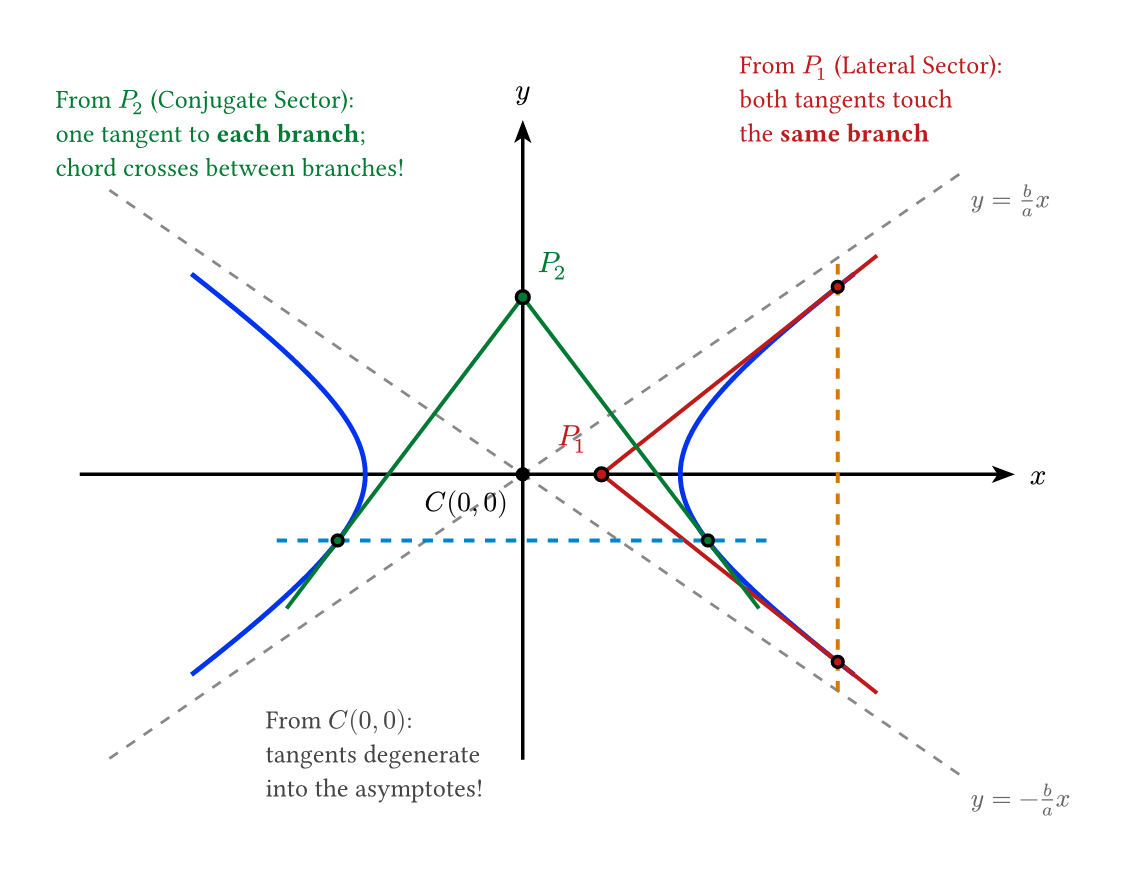
  • Tangents drawn from the center (0,0)(0, 0) degenerate into the asymptotes.
  • Tangents drawn from an external point can touch the same branch or touch opposite branches, depending on whether the point lies in the lateral or conjugate asymptote sectors.
  • A chord of contact can connect two points on the same branch or bridge across from the left branch to the right branch.

Pair of Tangents from an External Point§

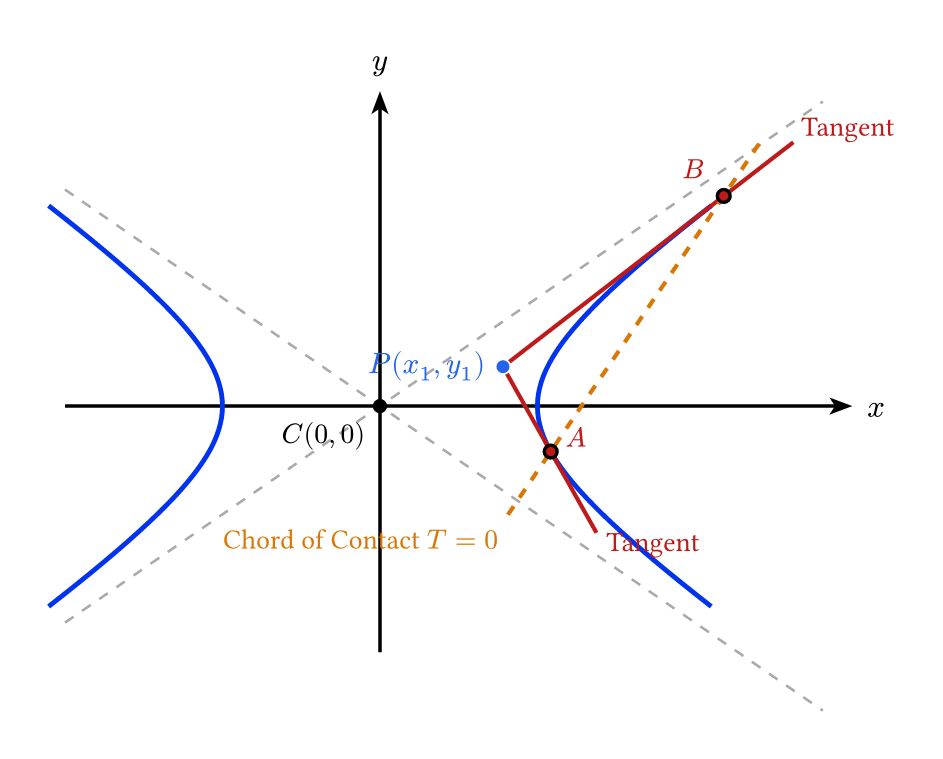
Let P(x1,y1)P(x_1, y_1) be a point lying outside the horizontal hyperbola:

S≡x2a2−y2b2−1=0S \equiv \frac{x^2}{a^2} - \frac{y^2}{b^2} - 1 = 0

Recall that the exterior of the hyperbola corresponds to:

S1≡x12a2−y12b2−1<0S_1 \equiv \frac{x_1^2}{a^2} - \frac{y_1^2}{b^2} - 1 < 0

From any such external point, exactly two straight lines can be drawn that touch the hyperbola.

Pair of Tangents and Chord of Contact to a Hyperbola


Combined Equation of the Pair of Tangents (S S1 = T^2)§

The combined (joint) equation representing both tangents drawn from P(x1,y1)P(x_1, y_1) to the hyperbola is given by:

SS1=T2S S_1 = T^2

where:

S≡x2a2−y2b2−1S \equiv \frac{x^2}{a^2} - \frac{y^2}{b^2} - 1 S1≡x12a2−y12b2−1S_1 \equiv \frac{x_1^2}{a^2} - \frac{y_1^2}{b^2} - 1 T≡xx1a2−yy1b2−1T \equiv \frac{x x_1}{a^2} - \frac{y y_1}{b^2} - 1

Proof of S S1 = T^2§

Let Q(x,y)Q(x, y) be any point lying on either of the two tangent lines passing through P(x1,y1)P(x_1, y_1).

Any point RR dividing the directed line segment PQPQ in the ratio k:1k : 1 has coordinates given by the section formula:

R(kx+x1k+1,  ky+y1k+1)R\left(\frac{k x + x_1}{k + 1}, \; \frac{k y + y_1}{k + 1}\right)

If the point RR lies on the hyperbola x2a2−y2b2−1=0\frac{x^2}{a^2} - \frac{y^2}{b^2} - 1 = 0, its coordinates must satisfy the hyperbola's equation:

1a2(kx+x1k+1)2−1b2(ky+y1k+1)2−1=0\frac{1}{a^2}\left(\frac{k x + x_1}{k + 1}\right)^2 - \frac{1}{b^2}\left(\frac{k y + y_1}{k + 1}\right)^2 - 1 = 0

Multiplying the entire equation by (k+1)2(k + 1)^2:

(kx+x1)2a2−(ky+y1)2b2−(k+1)2=0\frac{(k x + x_1)^2}{a^2} - \frac{(k y + y_1)^2}{b^2} - (k + 1)^2 = 0

Expanding each term:

k2x2+2kxx1+x12a2−k2y2+2kyy1+y12b2−(k2+2k+1)=0\frac{k^2 x^2 + 2k x x_1 + x_1^2}{a^2} - \frac{k^2 y^2 + 2k y y_1 + y_1^2}{b^2} - (k^2 + 2k + 1) = 0

Collecting powers of kk:

k2(x2a2−y2b2−1)+2k(xx1a2−yy1b2−1)+(x12a2−y12b2−1)=0k^2\left(\frac{x^2}{a^2} - \frac{y^2}{b^2} - 1\right) + 2k\left(\frac{x x_1}{a^2} - \frac{y y_1}{b^2} - 1\right) + \left(\frac{x_1^2}{a^2} - \frac{y_1^2}{b^2} - 1\right) = 0

Using our standard notations SS, TT, and S1S_1, this is a quadratic equation in kk:

k2S+2kT+S1=0k^2 S + 2k T + S_1 = 0

Condition for Tangency:

The straight line PQPQ will be a tangent to the hyperbola if and only if it touches the hyperbola at exactly one point (having two coincident points of intersection).

For the line PQPQ to touch the curve, the two values of the division ratio kk given by the quadratic equation must be equal. Therefore, the discriminant of this quadratic in kk must be zero:

Δ=(2T)2−4(S)(S1)=0\Delta = (2T)^2 - 4(S)(S_1) = 0 4T2−4SS1=0  ⟹  SS1=T24T^2 - 4S S_1 = 0 \implies S S_1 = T^2

Since Q(x,y)Q(x, y) is any arbitrary point on either tangent, the equation SS1=T2S S_1 = T^2 is the combined equation of the pair of tangents drawn from P(x1,y1)P(x_1, y_1).


Condition for Tangents to be Real (The Slope Quadratic)§

To understand when real tangents can be drawn, let a line passing through P(x1,y1)P(x_1, y_1) have slope mm:

y−y1=m(x−x1)  ⟹  y=mx+(y1−mx1)y - y_1 = m(x - x_1) \implies y = mx + (y_1 - m x_1)

Comparing this with the slope-form condition of tangency c2=a2m2−b2c^2 = a^2 m^2 - b^2, where c=y1−mx1c = y_1 - m x_1:

(y1−mx1)2=a2m2−b2(y_1 - m x_1)^2 = a^2 m^2 - b^2 y12−2mx1y1+m2x12=a2m2−b2y_1^2 - 2m x_1 y_1 + m^2 x_1^2 = a^2 m^2 - b^2

Rearranging into a quadratic equation in mm:

(x12−a2)m2−2x1y1m+(y12+b2)=0(x_1^2 - a^2)m^2 - 2x_1 y_1 m + (y_1^2 + b^2) = 0

The discriminant DD of this quadratic equation determines the reality of the slopes mm:

D=(−2x1y1)2−4(x12−a2)(y12+b2)D = (-2x_1 y_1)^2 - 4(x_1^2 - a^2)(y_1^2 + b^2) D=4x12y12−4(x12y12+b2x12−a2y12−a2b2)D = 4x_1^2 y_1^2 - 4\left(x_1^2 y_1^2 + b^2 x_1^2 - a^2 y_1^2 - a^2 b^2\right) D=−4(b2x12−a2y12−a2b2)D = -4\left(b^2 x_1^2 - a^2 y_1^2 - a^2 b^2\right)

Dividing and multiplying by a2b2a^2 b^2:

D=4a2b2(1−x12a2+y12b2)=−4a2b2S1D = 4a^2 b^2\left(1 - \frac{x_1^2}{a^2} + \frac{y_1^2}{b^2}\right) = -4a^2 b^2 S_1

This equation reveals the geometry of tangents to a hyperbola:

  • When S1<0S_1 < 0 (Point outside the hyperbola): D=−4a2b2S1>0D = -4a^2 b^2 S_1 > 0. The quadratic has two distinct real roots, meaning two real and distinct tangents can be drawn from PP.
  • When S1=0S_1 = 0 (Point on the hyperbola): D=0D = 0. Exactly one tangent exists (touching at PP).
  • When S1>0S_1 > 0 (Point inside either branch): D<0D < 0. No real tangents can be drawn from PP to the hyperbola.

Peculiarities of Tangents to a Hyperbola§

The geometry of tangents to a hyperbola has unique characteristics that do not occur in parabolas or ellipses.

Peculiarities of tangents: same branch vs opposite branches and asymptotes


1. Tangents from the Center Degenerate into the Asymptotes§

What happens if we attempt to draw tangents from the center C(0,0)C(0, 0) of the hyperbola?

At (x1,y1)=(0,0)(x_1, y_1) = (0, 0):

S1=02a2−02b2−1=−1S_1 = \frac{0^2}{a^2} - \frac{0^2}{b^2} - 1 = -1 T=x(0)a2−y(0)b2−1=−1T = \frac{x(0)}{a^2} - \frac{y(0)}{b^2} - 1 = -1

Substituting these into SS1=T2S S_1 = T^2:

(x2a2−y2b2−1)(−1)=(−1)2\left(\frac{x^2}{a^2} - \frac{y^2}{b^2} - 1\right)(-1) = (-1)^2 −(x2a2−y2b2)+1=1-\left(\frac{x^2}{a^2} - \frac{y^2}{b^2}\right) + 1 = 1 x2a2−y2b2=0\frac{x^2}{a^2} - \frac{y^2}{b^2} = 0

Factoring this difference of squares:

(xa−yb)(xa+yb)=0\left(\frac{x}{a} - \frac{y}{b}\right)\left(\frac{x}{a} + \frac{y}{b}\right) = 0

This is the combined equation of the two asymptotes of the hyperbola!

Geometric Meaning:
The asymptotes are the limiting tangents to the hyperbola whose points of contact have receded to infinity. Therefore, from the center (0,0)(0, 0), no finite tangent can be drawn; the "pair of tangents" from the center are the asymptotes themselves!


2. Tangents Touching the Same Branch vs. Opposite Branches§

The two asymptotes xa±yb=0\frac{x}{a} \pm \frac{y}{b} = 0 divide the exterior region (S1<0S_1 < 0) into distinct geometric sectors:

Case A: The Lateral Sectors

In these sectors (surrounding the transverse axis between the center and each vertex, where ∣x1∣/a>∣y1∣/b|x_1|/a > |y_1|/b and S1<0S_1 < 0), the point P(x1,y1)P(x_1, y_1) lies between the asymptotes and one of the branches.

From any point P1P_1 in a lateral sector:

  • Both tangents touch the same branch (the branch adjacent to that sector).
  • The chord of contact joins two points lying on the same branch.

Case B: The Conjugate / Vertical Sectors

In these sectors (surrounding the conjugate axis, where ∣y1∣/b>∣x1∣/a|y_1|/b > |x_1|/a), the point P2(x1,y1)P_2(x_1, y_1) lies above or below the asymptotes.

From any point P2P_2 in the conjugate sector:

  • One tangent touches the right branch, and the other tangent touches the left branch!
  • The chord of contact connects a point on the right branch to a point on the left branch, crossing directly between the two branches!

Chord of Contact§

Let P(x1,y1)P(x_1, y_1) be a point outside the hyperbola x2a2−y2b2=1\frac{x^2}{a^2} - \frac{y^2}{b^2} = 1. The two tangents drawn from PP touch the hyperbola at two points A(xA,yA)A(x_A, y_A) and B(xB,yB)B(x_B, y_B).

The straight line segment ABAB connecting these two points of contact is called the chord of contact of PP with respect to the hyperbola.


Equation of the Chord of Contact (T = 0)§

The equation of the chord of contact of tangents drawn from P(x1,y1)P(x_1, y_1) to the hyperbola x2a2−y2b2=1\frac{x^2}{a^2} - \frac{y^2}{b^2} = 1 is:

T=0  ⟺  xx1a2−yy1b2=1T = 0 \iff \frac{x x_1}{a^2} - \frac{y y_1}{b^2} = 1

Proof:

Since A(xA,yA)A(x_A, y_A) lies on the hyperbola, the equation of the tangent at AA is:

xxAa2−yyAb2=1\frac{x x_A}{a^2} - \frac{y y_A}{b^2} = 1

Because this tangent passes through the external point P(x1,y1)P(x_1, y_1), the coordinates (x1,y1)(x_1, y_1) satisfy this equation:

x1xAa2−y1yAb2=1(1)\frac{x_1 x_A}{a^2} - \frac{y_1 y_A}{b^2} = 1 \tag{1}

Similarly, since B(xB,yB)B(x_B, y_B) lies on the hyperbola, the equation of the tangent at BB is:

xxBa2−yyBb2=1\frac{x x_B}{a^2} - \frac{y y_B}{b^2} = 1

Because this tangent also passes through P(x1,y1)P(x_1, y_1):

x1xBa2−y1yBb2=1(2)\frac{x_1 x_B}{a^2} - \frac{y_1 y_B}{b^2} = 1 \tag{2}

Now examine the linear equation in variables (x,y)(x, y):

xx1a2−yy1b2=1\frac{x x_1}{a^2} - \frac{y y_1}{b^2} = 1

Equations (1)(1) and (2)(2) prove that both points A(xA,yA)A(x_A, y_A) and B(xB,yB)B(x_B, y_B) satisfy this linear equation.

Since two distinct points uniquely determine a straight line, this linear equation must be the equation of the straight line passing through AA and BB. Therefore, the chord of contact is:

T≡xx1a2−yy1b2−1=0T \equiv \frac{x x_1}{a^2} - \frac{y y_1}{b^2} - 1 = 0

For the Vertical Hyperbola:

For y2b2−x2a2=1\frac{y^2}{b^2} - \frac{x^2}{a^2} = 1, the chord of contact of P(x1,y1)P(x_1, y_1) is:

yy1b2−xx1a2=1\frac{y y_1}{b^2} - \frac{x x_1}{a^2} = 1

Finding the Point of Intersection of Tangents at the Ends of a Chord§

A frequent problem asks: Given the equation of a chord of a hyperbola, find the point where the tangents drawn at the ends of this chord intersect.

Method:

Let the given chord have equation:

Ax+By+C=0(1)Ax + By + C = 0 \tag{1}

Let the tangents at the endpoints of this chord intersect at P(x1,y1)P(x_1, y_1).

Then the given chord is the chord of contact of P(x1,y1)P(x_1, y_1) with respect to the hyperbola x2a2−y2b2=1\frac{x^2}{a^2} - \frac{y^2}{b^2} = 1. Its equation must therefore be:

x1a2x−y1b2y−1=0(2)\frac{x_1}{a^2}x - \frac{y_1}{b^2}y - 1 = 0 \tag{2}

Since equation (1)(1) and equation (2)(2) represent the same straight line, the coefficients of xx, yy, and the constant terms must be proportional:

x1/a2A=−y1/b2B=−1C\frac{x_1/a^2}{A} = \frac{-y_1/b^2}{B} = \frac{-1}{C}

Equating the first and third ratios:

x1a2A=−1C  ⟹  x1=−a2AC\frac{x_1}{a^2 A} = -\frac{1}{C} \implies x_1 = -\frac{a^2 A}{C}

Equating the second and third ratios:

−y1b2B=−1C  ⟹  y1=b2BC-\frac{y_1}{b^2 B} = -\frac{1}{C} \implies y_1 = \frac{b^2 B}{C}

Thus, the point of intersection of the tangents at the ends of the chord is:

P(−a2AC,  b2BC)P\left(-\frac{a^2 A}{C}, \; \frac{b^2 B}{C}\right)

Angle Between the Pair of Tangents§

Let the pair of tangents from P(x1,y1)P(x_1, y_1) have slopes m1m_1 and m2m_2.

Recall the quadratic equation in mm satisfied by the tangent slopes:

(x12−a2)m2−2x1y1m+(y12+b2)=0(x_1^2 - a^2)m^2 - 2x_1 y_1 m + (y_1^2 + b^2) = 0

By Vieta's formulas:

m1+m2=2x1y1x12−a2m_1 + m_2 = \frac{2x_1 y_1}{x_1^2 - a^2} m1m2=y12+b2x12−a2m_1 m_2 = \frac{y_1^2 + b^2}{x_1^2 - a^2}

The acute angle θ\theta between the tangents is given by:

tan⁡θ=∣m1−m21+m1m2∣=(m1+m2)2−4m1m2∣1+m1m2∣\tan\theta = \left|\frac{m_1 - m_2}{1 + m_1 m_2}\right| = \frac{\sqrt{(m_1 + m_2)^2 - 4m_1 m_2}}{|1 + m_1 m_2|}

Substituting the sum and product of slopes:

(m1+m2)2−4m1m2=4x12y12−4(x12−a2)(y12+b2)(x12−a2)2=−4a2b2S1(x12−a2)2(m_1 + m_2)^2 - 4m_1 m_2 = \frac{4x_1^2 y_1^2 - 4(x_1^2 - a^2)(y_1^2 + b^2)}{(x_1^2 - a^2)^2} = \frac{-4a^2 b^2 S_1}{(x_1^2 - a^2)^2} 1+m1m2=1+y12+b2x12−a2=x12+y12−(a2−b2)x12−a21 + m_1 m_2 = 1 + \frac{y_1^2 + b^2}{x_1^2 - a^2} = \frac{x_1^2 + y_1^2 - (a^2 - b^2)}{x_1^2 - a^2}

Therefore:

tan⁡θ=2ab−S1∣x12+y12−(a2−b2)∣\tan\theta = \frac{2ab\sqrt{-S_1}}{\left|x_1^2 + y_1^2 - (a^2 - b^2)\right|}

The Director Circle§

When the pair of tangents are mutually perpendicular, θ=90∘\theta = 90^\circ, which requires tan⁡θ→∞\tan\theta \to \infty, or equivalently:

1+m1m2=0  ⟹  x12+y12−(a2−b2)=01 + m_1 m_2 = 0 \implies x_1^2 + y_1^2 - (a^2 - b^2) = 0

Replacing (x1,y1)(x_1, y_1) with general coordinates (x,y)(x, y), the locus of points from which perpendicular tangents can be drawn to the hyperbola is:

x2+y2=a2−b2x^2 + y^2 = a^2 - b^2

This circle is called the director circle of the hyperbola.

  • If a>ba > b: The director circle is a real circle centered at (0,0)(0, 0) with radius a2−b2\sqrt{a^2 - b^2}.
  • If a=ba = b (Rectangular Hyperbola): The director circle degenerates to the single point (0,0)(0, 0).
  • If a<ba < b: a2−b2<0a^2 - b^2 < 0, so no real point exists from which perpendicular tangents can be drawn (the director circle is imaginary).

Summary Comparison§

Concept Horizontal Hyperbola x2a2−y2b2=1\frac{x^2}{a^2} - \frac{y^2}{b^2} = 1 Ellipse x2a2+y2b2=1\frac{x^2}{a^2} + \frac{y^2}{b^2} = 1
Combined Tangents Equation SS1=T2S S_1 = T^2 SS1=T2S S_1 = T^2
Exterior Condition for Real Tangents S1<0S_1 < 0 (central region between branches) S1>0S_1 > 0 (unbounded outer plane)
Discriminant of Slope Quadratic Δ=−4a2b2S1>0\Delta = -4a^2 b^2 S_1 > 0 Δ=4a2b2S1>0\Delta = 4a^2 b^2 S_1 > 0
Tangents from Center (0,0)(0, 0) Degenerate into asymptotes x2a2−y2b2=0\frac{x^2}{a^2} - \frac{y^2}{b^2} = 0 No tangents (center is inside)
Branch Distribution Same branch in lateral sector; opposite branches in vertical sector N/A (single closed curve)
Chord of Contact T=0  ⟹  xx1a2−yy1b2=1T = 0 \implies \frac{x x_1}{a^2} - \frac{y y_1}{b^2} = 1 T=0  ⟹  xx1a2+yy1b2=1T = 0 \implies \frac{x x_1}{a^2} + \frac{y y_1}{b^2} = 1
Chord Spanning Can connect points on same branch or bridge opposite branches Always inside the single oval
Director Circle x2+y2=a2−b2x^2 + y^2 = a^2 - b^2 (real only if a>ba > b) x2+y2=a2+b2x^2 + y^2 = a^2 + b^2 (always real)

Illustrative Examples§

Example 1: Combined Equation of Pair of Tangents§

Find the combined equation of the pair of tangents drawn from the point P(1,2)P(1, 2) to the hyperbola x24−y29=1\frac{x^2}{4} - \frac{y^2}{9} = 1. Also find the angle between them.

Solution:

Here a2=4,b2=9a^2 = 4, b^2 = 9, and (x1,y1)=(1,2)(x_1, y_1) = (1, 2).

Step 1: Compute S, S1, and T:

S≡x24−y29−1S \equiv \frac{x^2}{4} - \frac{y^2}{9} - 1 S1≡124−229−1=14−49−1=9−16−3636=−4336S_1 \equiv \frac{1^2}{4} - \frac{2^2}{9} - 1 = \frac{1}{4} - \frac{4}{9} - 1 = \frac{9 - 16 - 36}{36} = -\frac{43}{36}

Since S1=−4336<0S_1 = -\frac{43}{36} < 0, the point P(1,2)P(1, 2) lies outside the hyperbola, so two real tangents exist.

T≡x(1)4−y(2)9−1=x4−2y9−1T \equiv \frac{x(1)}{4} - \frac{y(2)}{9} - 1 = \frac{x}{4} - \frac{2y}{9} - 1

Step 2: Form S S1 = T^2:

(x24−y29−1)(−4336)=(x4−2y9−1)2\left(\frac{x^2}{4} - \frac{y^2}{9} - 1\right)\left(-\frac{43}{36}\right) = \left(\frac{x}{4} - \frac{2y}{9} - 1\right)^2

Multiply through by 362=129636^2 = 1296:

The left-hand side becomes:

−43⋅36(x24−y29−1)=−1548(x24−y29−1)=−387x2+172y2+1548-43 \cdot 36 \left(\frac{x^2}{4} - \frac{y^2}{9} - 1\right) = -1548\left(\frac{x^2}{4} - \frac{y^2}{9} - 1\right) = -387 x^2 + 172 y^2 + 1548

The right-hand side is:

(36(x4−2y9−1))2=(9x−8y−36)2\left(36\left(\frac{x}{4} - \frac{2y}{9} - 1\right)\right)^2 = (9x - 8y - 36)^2

Expanding (9x−8y−36)2(9x - 8y - 36)^2:

81x2+64y2+1296−144xy−648x+576y81 x^2 + 64 y^2 + 1296 - 144 x y - 648 x + 576 y

Equating the two sides:

−387x2+172y2+1548=81x2+64y2−144xy−648x+576y+1296-387 x^2 + 172 y^2 + 1548 = 81 x^2 + 64 y^2 - 144 x y - 648 x + 576 y + 1296

Moving all terms to one side:

468x2−144xy−108y2−648x+576y−252=0468 x^2 - 144 x y - 108 y^2 - 648 x + 576 y - 252 = 0

Dividing the entire equation by 3636:

13x2−4xy−3y2−18x+16y−7=013 x^2 - 4 x y - 3 y^2 - 18 x + 16 y - 7 = 0

This is the combined equation of the pair of tangents.

Step 3: Angle Between the Tangents:

In the second-degree equation Ax2+2Hxy+By2+2Gx+2Fy+C=0A x^2 + 2H x y + B y^2 + 2G x + 2F y + C = 0:

A=13,2H=−4  ⟹  H=−2,B=−3A = 13, \quad 2H = -4 \implies H = -2, \quad B = -3

The angle θ\theta between the lines is given by:

tan⁡θ=2H2−AB∣A+B∣=2(−2)2−(13)(−3)∣13+(−3)∣=24+3910=24310=435\tan\theta = \frac{2\sqrt{H^2 - AB}}{|A + B|} = \frac{2\sqrt{(-2)^2 - (13)(-3)}}{|13 + (-3)|} = \frac{2\sqrt{4 + 39}}{10} = \frac{2\sqrt{43}}{10} = \frac{\sqrt{43}}{5} θ=tan⁡−1(435)\theta = \tan^{-1}\left(\frac{\sqrt{43}}{5}\right)

Example 2: Determining Branch Contact§

Determine whether the tangents drawn from the following points touch the same branch or opposite branches of the hyperbola x29−y216=1\frac{x^2}{9} - \frac{y^2}{16} = 1:

  1. P(2,1)P(2, 1)
  2. Q(1,3)Q(1, 3)
  3. R(0,0)R(0, 0)

Solution:

Here a2=9  ⟹  a=3a^2 = 9 \implies a = 3, and b2=16  ⟹  b=4b^2 = 16 \implies b = 4.

The asymptotes are y=±43xy = \pm \frac{4}{3}x, or ∣x∣3=∣y∣4\frac{|x|}{3} = \frac{|y|}{4}.

For P(2, 1):

Evaluate S1S_1:

S1=229−1216−1=49−116−1=64−9−144144=−89144<0S_1 = \frac{2^2}{9} - \frac{1^2}{16} - 1 = \frac{4}{9} - \frac{1}{16} - 1 = \frac{64 - 9 - 144}{144} = -\frac{89}{144} < 0

Since S1<0S_1 < 0, real tangents exist. Now compare coordinates to the asymptote ratios:

∣x1∣a=23≈0.667,∣y1∣b=14=0.250\frac{|x_1|}{a} = \frac{2}{3} \approx 0.667, \quad \frac{|y_1|}{b} = \frac{1}{4} = 0.250

Since ∣x1∣a>∣y1∣b\frac{|x_1|}{a} > \frac{|y_1|}{b}, the point P(2,1)P(2, 1) lies in the lateral sector (surrounding the positive xx-axis). Therefore, both tangents touch the same branch (the right branch).

For Q(1, 3):

Evaluate S1S_1:

S1=129−3216−1=19−916−1=16−81−144144=−209144<0S_1 = \frac{1^2}{9} - \frac{3^2}{16} - 1 = \frac{1}{9} - \frac{9}{16} - 1 = \frac{16 - 81 - 144}{144} = -\frac{209}{144} < 0

Since S1<0S_1 < 0, real tangents exist. Comparing coordinates to the asymptote ratios:

∣x1∣a=13≈0.333,∣y1∣b=34=0.750\frac{|x_1|}{a} = \frac{1}{3} \approx 0.333, \quad \frac{|y_1|}{b} = \frac{3}{4} = 0.750

Since ∣y1∣b>∣x1∣a\frac{|y_1|}{b} > \frac{|x_1|}{a}, the point Q(1,3)Q(1, 3) lies in the conjugate / vertical sector (surrounding the positive yy-axis). Therefore, one tangent touches the right branch and the other tangent touches the left branch! The chord of contact crosses directly between the two branches.

For R(0, 0):

The point RR is the center of the hyperbola. Substituting (0,0)(0, 0) into SS1=T2S S_1 = T^2 yields the pair of asymptotes:

x29−y216=0\frac{x^2}{9} - \frac{y^2}{16} = 0

No finite tangents exist; the tangents degenerate into the two asymptotes with points of contact at infinity.


Example 3: Finding the Intersection Point of Tangents from a Given Chord§

Find the point of intersection of the tangents drawn at the ends of the chord 3x−2y+6=03x - 2y + 6 = 0 with respect to the hyperbola x29−y24=1\frac{x^2}{9} - \frac{y^2}{4} = 1.

Solution:

Let the tangents at the ends of the chord intersect at P(x1,y1)P(x_1, y_1).

The equation of the chord of contact of P(x1,y1)P(x_1, y_1) with respect to x29−y24=1\frac{x^2}{9} - \frac{y^2}{4} = 1 is:

xx19−yy14=1  ⟹  x19x−y14y−1=0\frac{x x_1}{9} - \frac{y y_1}{4} = 1 \implies \frac{x_1}{9}x - \frac{y_1}{4}y - 1 = 0

The given chord is:

3x−2y+6=03x - 2y + 6 = 0

Divide by −6-6 to make the constant term −1-1:

−36x+26y−1=0  ⟹  −12x+13y−1=0-\frac{3}{6}x + \frac{2}{6}y - 1 = 0 \implies -\frac{1}{2}x + \frac{1}{3}y - 1 = 0

Comparing coefficients:

x19=−12  ⟹  x1=−92=−4.5\frac{x_1}{9} = -\frac{1}{2} \implies x_1 = -\frac{9}{2} = -4.5 −y14=13  ⟹  y1=−43-\frac{y_1}{4} = \frac{1}{3} \implies y_1 = -\frac{4}{3}

Thus, the tangents at the ends of the chord intersect at:

P(−92,  −43)P\left(-\frac{9}{2}, \; -\frac{4}{3}\right)

Example 4: Locus of the Point of Intersection of Perpendicular Tangents§

Prove that the locus of the point of intersection of mutually perpendicular tangents to the hyperbola x2a2−y2b2=1\frac{x^2}{a^2} - \frac{y^2}{b^2} = 1 is the circle x2+y2=a2−b2x^2 + y^2 = a^2 - b^2. Discuss the case when a=ba = b.

Solution:

Let the point of intersection be P(h,k)P(h, k).

Any tangent of slope mm to the hyperbola x2a2−y2b2=1\frac{x^2}{a^2} - \frac{y^2}{b^2} = 1 is:

y=mx±a2m2−b2y = mx \pm \sqrt{a^2 m^2 - b^2}

Since this tangent passes through P(h,k)P(h, k):

k=mh±a2m2−b2  ⟹  k−mh=±a2m2−b2k = mh \pm \sqrt{a^2 m^2 - b^2} \implies k - mh = \pm\sqrt{a^2 m^2 - b^2}

Squaring both sides:

(k−mh)2=a2m2−b2(k - mh)^2 = a^2 m^2 - b^2 k2−2mhk+m2h2=a2m2−b2k^2 - 2mhk + m^2 h^2 = a^2 m^2 - b^2

Rearranging as a quadratic in mm:

(h2−a2)m2−2hkm+(k2+b2)=0(h^2 - a^2)m^2 - 2hkm + (k^2 + b^2) = 0

Let the two roots of this equation be m1m_1 and m2m_2, representing the slopes of the two tangents passing through P(h,k)P(h, k).

By Vieta's relations, the product of the slopes is:

m1m2=k2+b2h2−a2m_1 m_2 = \frac{k^2 + b^2}{h^2 - a^2}

Since the tangents are mutually perpendicular:

m1m2=−1  ⟹  k2+b2h2−a2=−1m_1 m_2 = -1 \implies \frac{k^2 + b^2}{h^2 - a^2} = -1 k2+b2=−(h2−a2)=−h2+a2k^2 + b^2 = -(h^2 - a^2) = -h^2 + a^2 h2+k2=a2−b2h^2 + k^2 = a^2 - b^2

Generalizing (h,k)→(x,y)(h, k) \to (x, y), the required locus is:

x2+y2=a2−b2x^2 + y^2 = a^2 - b^2

Special Case: Rectangular Hyperbola (a=ba = b):

When a=ba = b, the hyperbola is rectangular (its asymptotes are perpendicular, y=±xy = \pm x).

The equation of the director circle becomes:

x2+y2=a2−a2=0  ⟹  x2+y2=0x^2 + y^2 = a^2 - a^2 = 0 \implies x^2 + y^2 = 0

The only real solution to x2+y2=0x^2 + y^2 = 0 is the origin (0,0)(0, 0).

Remarkable Geometric Insight:
For a rectangular hyperbola, the only point from which perpendicular tangents can be drawn is the center (0,0)(0, 0). And as shown earlier, the "tangents" drawn from the center are the asymptotes themselves, which are indeed perpendicular!

Section 9 of 15 · Hyperbola

Mark this section complete when you have worked through its proofs.