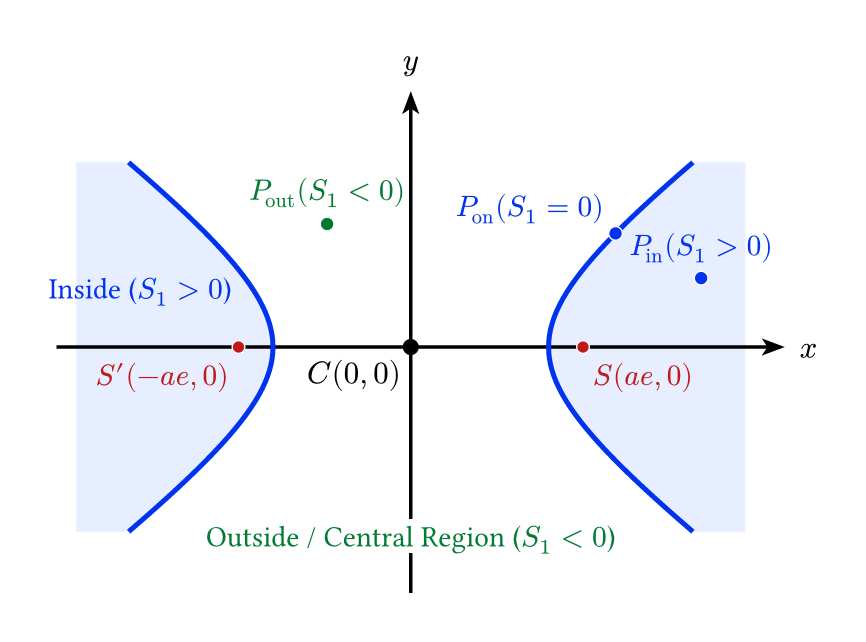
Just as we classify whether a point lies inside, on, or outside a circle, parabola, or ellipse, we can classify the position of any point P(x1,y1) with respect to a hyperbola. However, there is a crucial sign reversal for a hyperbola that trips up many students if they blindly apply the rule from the ellipse.
Define the expression S by bringing 1 to the left-hand side:
S≡a2x2−b2y2−1
For any point P(x1,y1) in the plane, let S1 be the value obtained by substituting (x1,y1) into S:
S1≡a2x12−b2y12−1
What Do "Inside" and "Outside" Mean for a Hyperbola?§
A hyperbola has two branches that open away from the center C(0,0) and cup around the two foci S(ae,0) and S′(−ae,0):
The inside (or focal region) consists of the two concave regions containing the foci S and S′.
The outside (or central region) is the region between the two branches, which contains the center C(0,0) and the conjugate axis.
Now test the center C(0,0) and the focus S(ae,0) in S1:
At the center C(0,0): S1=0−0−1=−1<0.
At the focus S(ae,0): S1=a2a2e2−0−1=e2−1>0 (since e>1).
Therefore, unlike the ellipse (where S1<0 is inside and S1>0 is outside), for the standard hyperbola S≡a2x2−b2y2−1:
S1>0⟺P(x1,y1) lies INSIDE the hyperbola (in one of the two focal regions).
S1=0⟺P(x1,y1) lies ON the hyperbola.
S1<0⟺P(x1,y1) lies OUTSIDE the hyperbola (in the central region between the branches).
Foolproof Memory Rule: For every conic section (circle, parabola, ellipse, hyperbola), the focus always lies inside the curve. If you ever forget the sign of S1, simply plug in the coordinates of a focus (or the center): whichever sign the focus gives is "inside"!
Let us prove why the sign of S1 partitions the plane this way.
Take any point P(x1,y1) and draw the horizontal liney=y1 passing through P. Because 1+b2y12≥1>0, this horizontal line always intersects both branches of the hyperbola at two symmetric points Q(xQ,y1) and Q′(−xQ,y1), where xQ>0 satisfies:
a2xQ2−b2y12=1⟹a2xQ2=1+b2y12
Now compare ∣x1∣ with xQ:
Case 1: P lies inside either branch (focal region):
Since P is farther from the y-axis than the curve at height y1, ∣x1∣>xQ:
The exact same logic applies to vertical and shifted hyperbolas—provided you write the equation in standard normalized form first, with the transverse-axis squared term positive and −1 on the left-hand side!
S1>0⟹ Inside (x1>h for right branch; x1<h for left branch).
S1=0⟹ On the hyperbola.
S1<0⟹ Outside.
Shifted Vertical:S≡b2(y−k)2−a2(x−h)2−1:
S1>0⟹ Inside (y1>k for upper branch; y1<k for lower branch).
S1=0⟹ On the hyperbola.
S1<0⟹ Outside.
Trap with General Equations: If you are given a general equation Ax2+By2+2gx+2fy+c=0 (AB<0), do not blindly evaluate S1 before completing the squares! As we saw in Section 04, if A>0,B<0 and Δ′<0, dividing by Δ′ flips the signs and turns the equation into a vertical hyperbola. Always reduce to standard form (or check the value of the expression at the center C(h,k)) first!
Dividing by +36 (which is positive, so no sign flip occurs):
9(x−1)2−4(y−2)2=1
So the normalized expression S≡9(x−1)2−4(y−2)2−1 is simply 361(4x2−9y2−8x+36y−68).
Substitute P(3,1) into the left-hand side:
4(3)2−9(1)2−8(3)+36(1)−68=36−9−24+36−68=−29<0
Dividing by +36 gives S1=−3629<0. Therefore, P(3,1) lies outside the hyperbola (in the central region containing the center (1,2)).
(Notice: if the right-hand side after completing the squares had been −36 instead of +36, dividing by −36 would have flipped −29<0 to +3629>0, making the point lie inside! Always check the sign after completing the squares.)